

Discrete Diodes Market Size and Share Analysis- 2026 To 2033
The Discrete Diodes Market size is anticipated to grow at a CAGR of 6.4%, with USD 3.46 Bn in 2026, and is expected to reach USD 5.35 Bn by 2033. The primary drivers are largely defined by the increasing semiconductor content in automobiles, rising adoption of electric vehicles, growing demand for power-efficient electronic systems, expansion of industrial automation, and increasing deployment of diodes in consumer electronics, telecommunications, power supplies, and renewable energy systems. According to World Semiconductor Trade Statistics (WSTS), the broader discrete semiconductor segment is forecast to grow by approximately 8% in 2026, following weakness in the previous cycle.
Key Takeaways
- The light emitting diode (LED) segment is anticipated to account for 42% of the market share in 2026. The segment's growth is fueled by the extensive use of LEDs in residential and commercial lighting, automotive lighting, electronic displays, industrial systems and connected devices, supported by their high efficiency, long operational life and decreasing costs. The International Energy Agency (IEA) says that average LEDs sold are close to 100 lumens per watt, while premium and professional products can exceed 200 lumens per watt.
- The consumer electronics segment is set to lead the industry segment with an estimated 40% share in 2026. The segment’s growth is owing to the extensive use of discrete diodes for rectification, voltage regulation, circuit protection, switching, power management, displays, and signal processing across smartphones, computers, televisions, wearables, and smart-home devices. According to IDC, global smartphone shipments reached 293.8 million units in the first quarter of 2026 alone, while approximately 1.09 Bn smartphones are forecast to be shipped worldwide during 2026.
- Asia Pacific is expected to acquire the prominent share of approximately 47% in 2026. The region’s growth is owing to its highly concentrated semiconductor and electronics manufacturing ecosystem, substantial fabrication capacity, large consumer electronics production base, and strong presence of semiconductor manufacturers across China, Taiwan, South Korea, Japan, and Southeast Asia. According to SEMI, China, Taiwan, and South Korea together accounted for 79% of global semiconductor manufacturing equipment spending in 2025, compared with 74% in 2024.
Market Drivers
Rapid Vehicle Electrification is Increasing Demand for Automotive Discrete Diodes
The global Discrete Diodes Market is benefiting from the rapid electrification of vehicles and the increasing electronic content incorporated into modern automobiles. Discrete diodes are used across automotive systems for rectification, reverse-polarity protection, voltage clamping, DC-DC power conversion, battery charging, LED lighting, motor control, and other power-management functions. STMicroelectronics highlights automotive Schottky diodes for DC-DC converters, LED lighting, reverse-battery protection and motor control. Automotive ultrafast diodes are used for secondary-side rectification of on-board chargers.
According to the International Energy Agency (IEA) Global EV Outlook 2026, global electric car sales exceeded 20 million units in 2025, increasing approximately 20% from 2024. Electric cars accounted for 25% of all new cars sold worldwide, compared with substantially lower penetration only a few years earlier.
Expansion of Industrial Automation and Robotics is Strengthening Demand for Power and Protection Diodes
Another key factor for the Discrete Diodes Market is the growing automation of factories, since automated production systems require motor drives, industrial power supplies, controllers, sensors, robotic systems, and power conversion equipment. Rectifier diodes find wide application in low- and medium-voltage motor drives, industrial power supplies, as well as battery chargers and other power-conversion systems.
According to the International Federation of Robotics (IFR) says some 542,000 industrial robots were set up worldwide in 2024, more than double the number set up ten years before. The operational stock of industrial robots worldwide increased by almost 9 % to about 4.66 million units over the previous year.
Current Events and Their Impact on the Discrete Diodes Market
Current Event | Description and its Impact |
U.S. Strengthens Section 301 Measures on Chinese Semiconductor Imports (2025–2026) |
|
India Expands Domestic Semiconductor Manufacturing Support Including Discrete Semiconductor Fabs (2025–2026) |
|
- Current Industry Events of 2026
- Market Size Estimation
- Regional Breakdown
- Competitive Landscape
- Customer Intelligence
- Segmental Analysis
- Pricing Analysis
- Key Market Drivers, Challenges & Future Trends
- Customized Insights Section
Segmental Insights
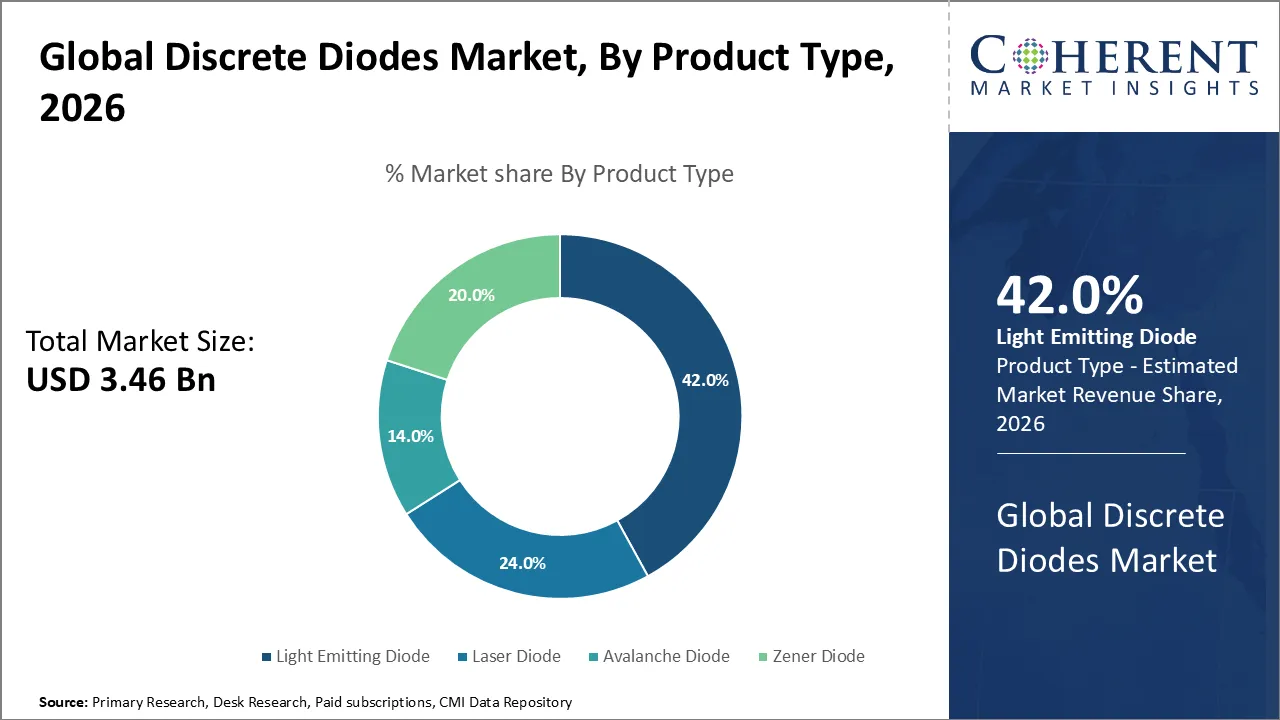
Why is Light Emitting Diode (LED) Acquiring the Largest Share?
On the basis of product type, the light emitting diode (LED) segment is projected to account for the largest Discrete Diodes Market share of an estimated 42% in 2026. The segment’s growth is owing to the extensive utilization of LEDs across general lighting, automotive lighting, displays, signaling systems, consumer electronics, industrial equipment, and smart infrastructure, supported by their high energy efficiency, long operating life, compact form factor, and declining lifecycle costs.
According to the International Energy Agency (IEA), LEDs sold today provide an average efficacy of close to 100 lumens per watt, compared with approximately 20 lumens per watt for conventional halogen lamps. The best LED products available today achieve 230 lumens per watt, demonstrating the large efficiency advantage that justifies continuing replacement of conventional lighting technologies.
In September 2026 Lumileds announced a major expansion of its LED manufacturing operations in Penang, Malaysia with new production lines for packaged LEDs and integrated lighting assemblies.
Why is Consumer Electronics Holding the Largest Market Share?
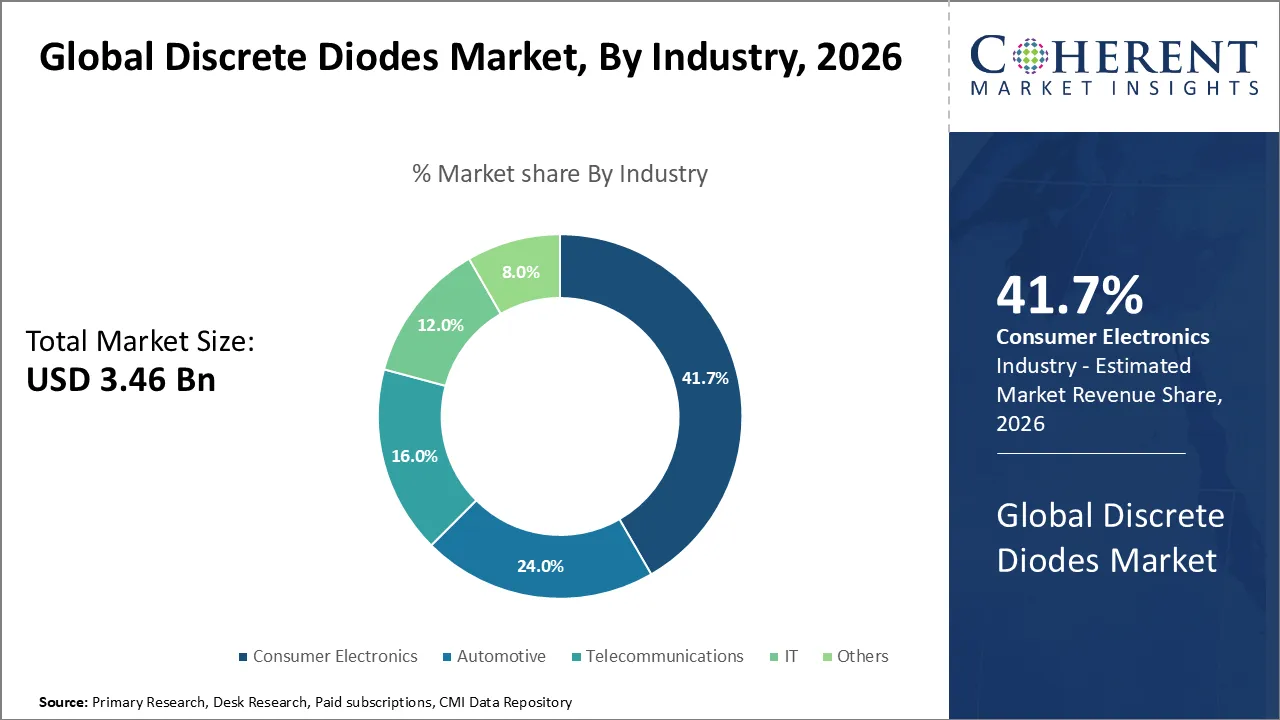
On the basis of industry, the consumer electronics sector is anticipated to dominate the Discrete Diodes Market with an estimated 41.7% share by 2026. The segment’s dominance is because of the prevalent use of switching diodes, Schottky diodes, Zener diodes, rectifier diodes and LEDs in smartphones, wearables, hearables, televisions, computers, chargers, displays, smart-home products and other portable electronic devices.
According to IDC, worldwide wearable-device shipments reached 145.7 million units in the first quarter of 2026, up 4.3% year-on-year, according to IDC. The production volumes of compact consumer electronic products that require miniature power-management and protection components are substantial, as illustrated by hearables making up about two-thirds of total wearable shipments.
In May 2026, ROHM introduced the RESDxVx series of ESD protection diodes for high-speed interfaces over 10 Gbps. The new devices target consumer electronics such as smartphones, tablets, notebook PCs, gaming consoles, USB dongles and AV equipment and support interfaces such as USB4, Thunderbolt 4, HDMI, DisplayPort and PCI Express.
Discrete Diodes Market Trends
- The miniaturization of discrete diode packages is encouraging manufacturers to migrate from traditional SMA, SMB and SMC packages to small surface mount and clip-bonded packages that provide higher power density and less PCB space. In April 2025 Nexperia announced the availability of 16 planar Schottky diodes in CFP2-HP packaging as part of the industry trend to replace larger SMA/B/C packages with smaller CFP options. The devices support reverse voltages from 20 V to 60 V and currents of 1 A to 2 A, while providing enhanced heat dissipation from a smaller footprint.
- The growing requirement for ultra-low-capacitance ESD protection diodes in high-speed automotive data networks is becoming an important technological trend. Modern vehicles are increasingly incorporating multi-gigabit Ethernet, high-resolution camera links, infotainment interfaces, USB, HDMI, and PCIe connectivity, which necessitates protection devices that maintain signal integrity. In April 2025, Nexperia unveiled automotive flip-chip ESD protection diodes featuring capacitance below 0.25 pF and a -3 dB insertion-loss point of 14.6 GHz for high-speed in-vehicle communication systems.
- The transition toward 48 V automotive electrical architectures is expanding demand for higher-voltage protection diodes. The trend in electric and hybrid vehicles is to transfer some of the electrical systems from conventional 12 V networks to 48 V architectures to increase the power efficiency and to meet higher electrical loads. In July 2025, Nexperia launched six AEC-Q101-qualified ESD diodes specifically for 48 V automotive communication networks, offering maximum reverse working voltages of 54 V, 60 V, and 72 V.
Regional Insights
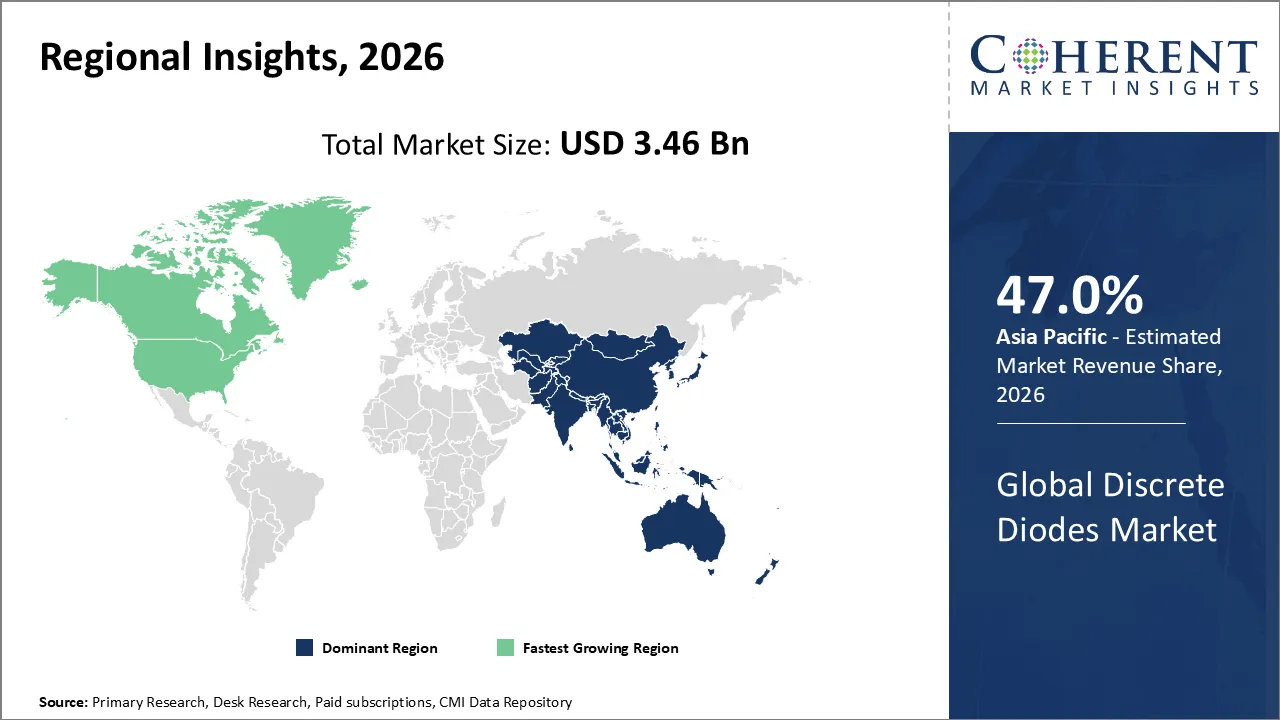
Asia Pacific Dominates Owing to the Strong Semiconductor and Electronics Manufacturing Ecosystem
The Asia Pacific region is expected to account for approximately 47% of the Discrete Diodes Market share in 2026. The region’s dominance is owing to its extensive semiconductor manufacturing infrastructure, large electronics production base, strong automotive-electronics industry, and concentration of diode and semiconductor manufacturers across China, Taiwan, South Korea, Japan, and Southeast Asia.
According to SEMI, China, Taiwan, and South Korea together accounted for 79% of worldwide semiconductor manufacturing equipment spending in 2025, increasing from 74% in 2024. China recorded USD 49.3 billion, Taiwan USD 31.5 billion, and South Korea USD 25.8 billion in semiconductor equipment spending during the year.
In May 2026, Seoul Semiconductor, based in South Korea, announced the mass production of its High Voltage (HV) opto-semiconductor technology for four major global automotive manufacturers and plans to scale the deployment to 10 vehicle models by the end of 2026.
North America Discrete Diodes Market Trends
North America is expected to witness rapid growth in the Discrete Diodes Market over the forecast period, supported by semiconductor reshoring, expansion of domestic fabrication capacity, increasing automotive and industrial electronics demand, and investment in power-semiconductor technologies. The region also has established discrete semiconductor manufacturers and growing demand for high-efficiency diodes in AI data centers, electric vehicles, communications equipment, industrial systems and energy infrastructure.
The region is witnessing increased investment specifically in power-semiconductor technology. In July 2025, U.S.-based onsemi announced a USD 20 million strategic collaboration with Stony Brook University and Empire State Development, including an USD 8 million investment in a new wide-bandgap semiconductor research center focused on silicon carbide and related materials for electrification and energy-efficient power systems.
In September 2026, U.S.-based Vishay Intertechnology introduced four new series of surface-mount standard rectifiers in its Power DFN6546A package. The devices support 200 V, 400 V, and 600 V reverse voltages, current ratings from 5 A to 12 A, and forward-surge capability of up to 320 A.
Domestic Semiconductor Reshoring and Recovering Electronics Demand are Accelerating the Discrete Diodes Market in the United States
The U.S. Discrete Diodes Market is witnessing steady growth owing to increasing domestic semiconductor investment, supply-chain localization, and rising semiconductor content across automotive, industrial, AI data-center, communications, and power-electronics applications. Discrete rectifiers, Schottky diodes, Zener diodes, protection diodes, and switching diodes remain essential components across these electronic systems.
The recovery is also evident among U.S.-based discrete semiconductor suppliers. Diodes Incorporated announced revenue of USD 445.5 million for Q2 2026, up from USD 366.2 million for Q2 2025 and over 20% year-over-year growth.
China Discrete Diodes Market Trends
China is anticipated to remain a significant growth and manufacturing center for the Discrete Diodes Market, driven by its extensive semiconductor supply chain, large-scale electronics production, ongoing investment in mature-node semiconductor capacity and increasing domestic production of discrete power and protection devices.
In March 2026, Nexperia China announced that it had started producing semiconductor devices using 12-inch wafers in China. The company stated that the products include Schottky rectifiers, bipolar discrete devices, and electrostatic-discharge protection devices, providing a direct indication of expanding local manufacturing capability for discrete semiconductors in China.
Who are the Major Companies in Discrete Diodes Industry
Some of the major key players in Discrete Diodes Market are Diodes Inc., Fairchild, International Rectifier, Micro Commercial Comp, IXYS, ON Semiconductor, ICT Power, NXP, Toshiba, ROHM Semiconductor, Panasonic, Vishay, STMicroelectronics, Central Semiconductor Corp., Diodes Incorporated, Hitachi Ltd., Infineon Technologies AG, IXYS Corporation, and M/A-Com Technology Solutions.
Key News
- In August 2026, ON Semiconductor (onsemi) expanded its discrete-diode portfolio with the BAS21AMR6T high-voltage switching diode, rated at 250 V. During the same period, the company added new ESD protection diodes, including the ESDM1132MX4, designed for USB, GPIO, and audio lines with a 3.6 V working voltage and 15 kV ESD capability.
- In June 2026, MACOM Technology Solutions introduced its Hot Via Chip Scale technology based on the company's AlGaAs diode technology. The process routes RF signal and ground connections vertically through the die, eliminating conventional wire bonds and enabling direct surface-mount assembly.
Market Report Scope
Discrete Diodes Market Report Coverage
Report Coverage | Details | ||
Base Year: | 2025 | Market Size in 2026: | USD 3.46 Bn |
Historical Data for: | 2020 to 2024 | Forecast Period: | 2026 to 2033 |
CAGR: | 6.4% | 2033 Value Projection: | USD 5.35 Bn |
Geographies covered: |
| ||
Segments covered: |
| ||
Companies covered: | Diodes Inc., Fairchild, International Rectifier, Micro Commercial Comp, IXYS, ON Semiconductor, ICT Power, NXP, Toshiba, ROHM Semiconductor, Panasonic, Vishay, STMicroelectronics, Central Semiconductor Corp., Diodes Incorporated, Hitachi Ltd., Infineon Technologies AG, IXYS Corporation, and M/A-Com Technology Solutions. | ||
Growth Drivers: |
| ||
Restraints & Challenges: |
| ||
Analyst Opinion
- The Discrete Diodes Market is benefiting from the continued expansion of mature-node semiconductor manufacturing, as a large proportion of rectifier, Schottky, Zener, switching, protection, and other discrete devices do not require leading-edge process nodes. According to SEMI, global 200 mm semiconductor fab equipment spending is expected to increase 10% year-on-year to USD 7.7 billion in 2026, while installed 200 mm capacity is projected to reach approximately 7.7 million wafers per month.
- Semiconductor localization and supply-chain resilience are becoming increasingly important structural factors for the Discrete Diodes Market. According to the Semiconductor Industry Association (SIA), semiconductor companies had announced more than USD 500 billion in private-sector investment in the U.S. by July 2025, with these projects expected to contribute to a 203% increase in U.S. semiconductor fabrication capacity between 2022 and 2032.
- The shift toward higher-efficiency power conversion and wide-bandgap semiconductor technologies is creating an important premium-growth opportunity within the diode market. STMicroelectronics plans to invest approximately USD 2.0–2.2 billion in net capital expenditure during 2026, including capacity additions for its new 200 mm silicon-carbide manufacturing facility in Catania, Italy, and its 200 mm SiC device joint venture in Chongqing, China. ST entered the ramp-up phase for both facilities during the second quarter of 2026.
Speak to the analyst
Want personalized insights?
Take the findings above to one of our principal consultants, or have the report rebuilt around the segments, geographies and competitors you actually track.
Market Segmentation
- By Product Type (Revenue, USD Bn, 2021-2033)
- Light Emitting Diode
- Laser Diode
- Avalanche Diode
- Zener Diode
- By Industry (Revenue, USD Bn, 2021-2033)
- IT
- Telecommunications
- Consumer Electronics
- Automotive
- Others
- By Region (Revenue, USD Bn, 2021-2033)
- North America
- U.S.
- Canada
- Latin America
- Brazil
- Mexico
- Argentina
- Rest of Latin America
- Europe
- Germany
- U.K.
- France
- Italy
- Spain
- Russia
- Rest of Europe
- Asia Pacific
- China
- India
- Japan
- Australia
- South Korea
- ASEAN
- Rest of Asia Pacific
- Middle East
- GCC
- Israel
- Rest of Middle East
- Africa
- South Africa
- Central Africa
- North Africa
- North America
Sources
Primary Research Interviews
- Discrete diode manufacturers
- Semiconductor component manufacturers
- Power electronics engineers
- Automotive electronics suppliers
- Consumer electronics component procurement managers
- Industrial automation and power-system engineers
- Semiconductor distributors and channel partners
- R&D heads from semiconductor and power-device companies
- Key opinion leaders (KOLs) in discrete and power semiconductors
Databases
- World Semiconductor Trade Statistics (WSTS)
- U.S. International Trade Commission (USITC)
- UN Comtrade Database
- World Bank
- Organisation for Economic Co-operation and Development (OECD)
- U.S. Bureau of Economic Analysis (BEA)
- Eurostat
- National Bureau of Statistics of China
Magazines
- EE Times
- Power Electronics News
- Electronic Design
- Semiconductor Engineering
- Electronics Weekly
- Power Electronics Europe
Journals
- IEEE Transactions on Power Electronics
- IEEE Transactions on Electron Devices
- IEEE Journal of the Electron Devices Society
- Solid-State Electronics
- Microelectronics Reliability
- Semiconductor Science and Technology
- Journal of Electronic Materials
Newspapers
- Reuters
- The Wall Street Journal
- Financial Times
- Nikkei Asia
- The Economic Times
- South China Morning Post
Associations
- Semiconductor Industry Association (SIA)
- SEMI
- World Semiconductor Trade Statistics (WSTS)
- JEDEC Solid State Technology Association
- IEEE Electron Devices Society
- Electronic Components Industry Association (ECIA)
- China Semiconductor Industry Association (CSIA)
- India Electronics and Semiconductor Association (IESA)
Public Domain Sources
- Company Annual Reports and Investor Presentations
- Company Product Datasheets and Technical Documentation
- Company Product Launches and Press Releases
- Government Semiconductor Policy and Manufacturing Publications
- Import-Export and Semiconductor Trade Statistics
- Patent Databases such as WIPO, USPTO, EPO, and Google Patents
- Semiconductor Fab Capacity and Manufacturing Investment Announcements
- Automotive, Consumer Electronics, Industrial, and Power Electronics Industry Publications
- Regulatory and Standards Publications Related to Semiconductor Components
Proprietary Elements
- CMI Data Analytics Tool
- Proprietary CMI Existing Repository of Information for the Last 10 Years
Get access to 250+ pages report
Every segment, forecast, competitor profile and data table behind the analysis above — available for instant download.
- ESOMAR Member
- ISO 9001:2015 Certified
- D-U-N-S Registered
- GDPR & CCPA Compliant
Missing comfort of reading report in your local language? Find your preferred language:
Transform your Strategy with Exclusive Trending Reports
Frequently Asked Questions
The Discrete Diodes Market is expected to reach USD 5.35 Bn by 2033, compared with USD 3.46 Bn in 2026.
Major players operating in the global Discrete Diodes Market include Diodes Inc., Fairchild, International Rectifier, Micro Commercial Comp, IXYS, ON Semiconductor, ICT Power, NXP, Toshiba, ROHM Semiconductor, Panasonic, Vishay, STMicroelectronics, Central Semiconductor Corp., Diodes Incorporated, Hitachi Ltd., Infineon Technologies AG, IXYS Corporation, and M/A-Com Technology Solutions.
High price competition and margin pressure, supply chain disruptions, and raw material volatility are the key factors hampering growth of the Discrete Diodes Market.
The increasing adoption of discrete diodes in consumer electronics, along with rising demand for automotive electronics and electric vehicles, is driving market growth. Increasing semiconductor content in automobiles, industrial automation, telecommunications, power supplies, and renewable energy systems is also supporting demand.
The Discrete Diodes Market is anticipated to grow at a CAGR of 6.4% between 2026 and 2033.
Among regions, Asia Pacific is expected to account for the largest share of the global Discrete Diodes Market, with approximately 47% market share in 2026. The region benefits from extensive semiconductor manufacturing infrastructure and a large electronics production base across China, Taiwan, South Korea, Japan, and Southeast Asia.
The Light Emitting Diode (LED) segment is projected to hold the largest share of the Discrete Diodes Market, accounting for an estimated 42% in 2026. Its dominance is supported by extensive use across lighting, automotive systems, displays, consumer electronics, industrial equipment, and smart infrastructure.