

Semiconductor Memory Market Analysis & Forecast: 2026-2033
Semiconductor Memory Market size is estimated to be valued at USD 35.05 Bn in 2026 and is expected to reach USD 51.67 Bn in 2033, exhibiting a compound annual growth rate (CAGR) of 5.7% from 2026 to 2033.
Key Takeaways
- By Type, ROM segment is expected to dominate the Semiconductor Memory Market with 55.0% shares in 2026, due to high demand in computing devices and servers, while Flash Memory within ROM is rapidly growing owing to its application in mobile and storage devices.
- By Region, North America is projected to hold the 32% share in 2026, due to innovation in data centers, automotive, and telecom sectors.
Market Overview
The market is witnessing significant growth driven by increasing demand for high-performance memory in consumer electronics, data centers, and automotive applications. Moreover, advancements in memory technology such as 3D NAND and MRAM are further propelling market expansion. However, factors like supply chain disruptions and fluctuating raw material prices are expected to challenge the growth of the global semiconductor memory market.
Current Events and Its Impact on the Semiconductor Memory Market
Event | Description and Impact |
US-China Technology Trade Tensions and Export Controls |
|
Memory Technology Transition and Innovation Race |
|
AI and Data Center Infrastructure Boom |
|
Pricing Analysis
The semiconductor memory market features a tiered pricing structure influenced by memory type, technology generation, and regional supply-demand dynamics. Standard DDR4 DRAM modules were priced between approximately US $3.5–5.0 per gigabyte (GB) in early 2025. For instance, in Q1 2024, DDR4 prices averaged around US $4.8/GB in the USA, US $4.3/GB in China, and US $4.9/GB in South Korea.
In Q2 2024, prices in China dropped to about US $3.5/GB due to increased supply, while South Korea maintained steadier pricing near US $4.7/GB. By early 2025, DDR5 memory—positioned as the next-generation standard—was priced at a premium, ranging from US $7–9/GB across major markets, reflecting adoption in data centers and high-performance computing.
In the semiconductor memory market for the automotive sector, specialty memory types like high-bandwidth memory (HBM) and MRAM command higher prices—often exceeding US $15/GB—due to limited production volumes and their critical applications in advanced automotive technologies.
- Current Industry Events of 2026
- Market Size Estimation
- Regional Breakdown
- Competitive Landscape
- Customer Intelligence
- Segmental Analysis
- Pricing Analysis
- Key Market Drivers, Challenges & Future Trends
- Customized Insights Section
Role of Emerging Technologies
AI and automation are transforming semiconductor memory manufacturing by enhancing precision, yield, and production efficiency—similar to their impact in other high-tech sectors. Advanced fabrication techniques now incorporate machine learning algorithms and real-time sensor data to optimize lithography and etching processes, reducing defects and improving chip performance.
In commercial operations, AI-driven predictive maintenance models analyze equipment data to foresee potential failures, minimizing downtime and maximizing throughput. Additionally, automation in testing and quality control uses imaging and sensor analytics to detect anomalies early, enabling manufacturers to maintain high consistency across memory chip batches.
Market Dynamics- Drivers
- Rising consumption of smartphones, especially in the Middle East and North America
The demand for smartphones has increased significantly in the recent past, especially in the Middle East, and North America. According to the GSM Association, in 2018, the number of mobile subscribers was 5.1 billion, which 67% of the global population. Rapid digitalization and automation in the aforementioned regions have led to increased use of smartphones.
The use of memory-based elements in technologically advanced products such as wearables smartphones is increasing rapidly. Thus, these factors are expected to drive growth of the global semiconductor memory market during the forecast period.
- Rapid development in automotive technologies
The automotive sector is increasing using memory solutions for its safety systems, owing to its excellent performance and low power consumption benefits. Memory solutions are playing a crucial role in autonomous driving capabilities, particularly for vehicle-to-everything (V2X) connectivity and comprehensive in-vehicle infotainment (IVI) systems. These technologies require power memory solutions with companies such as Samsung leading the race.
For instance, Samsung memory supports vehicle systems that power different functionalities such as vision computing, fusion, and HD maps. Thus, these factors are expected to propel the global semiconductor memory market growth over the forecast period.
Segmental Insights
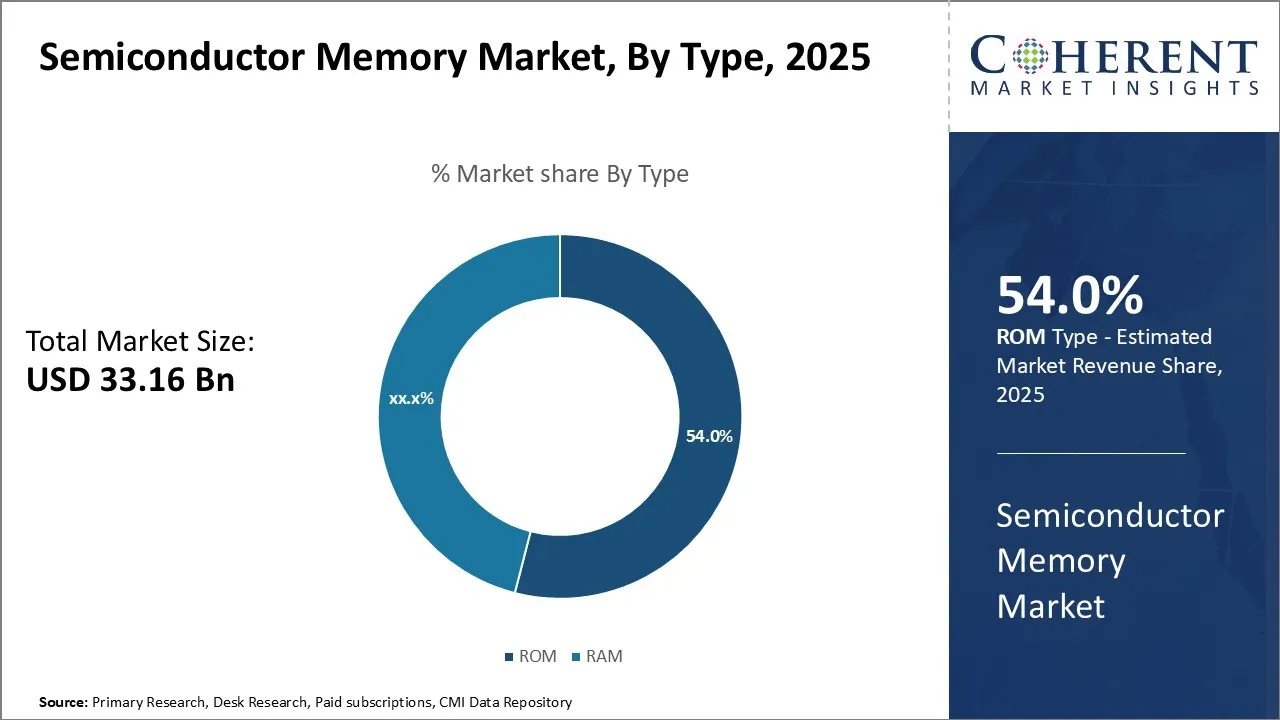
Semiconductor Memory Market Insights, By Type
ROM is expected to contribute the highest share in 2026, driven by its widespread use in computing devices, servers, and mobile applications. Variants such as DDR4 and DDR5 are seeing accelerated adoption due to higher data transfer rates and efficiency improvements. Meanwhile, NAND flash memory is gaining traction in consumer electronics and enterprise storage, fueled by growing demand for SSDs and mobile storage solutions.
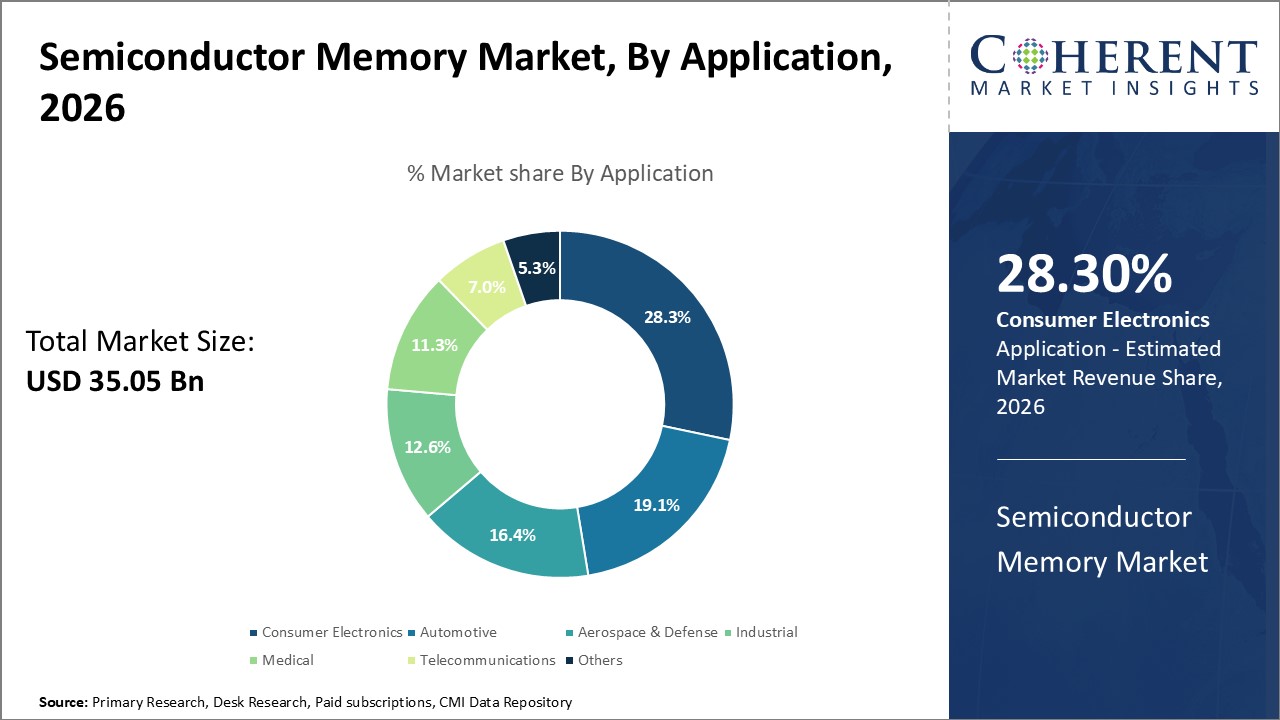
Semiconductor Memory Market Insights, By Application
Consumer electronics is anticipated to hold the largest market share in 2026, attributed to the growing proliferation of smartphones, tablets, and smart devices requiring efficient memory solutions. The data center and cloud computing sector is another key driver, with surging demand for high-performance memory to support AI workloads, big data analytics, and enterprise storage.
Automotive and industrial sectors are increasingly adopting advanced memory types to enable next-generation features such as autonomous driving and IoT connectivity.
Regional Insights
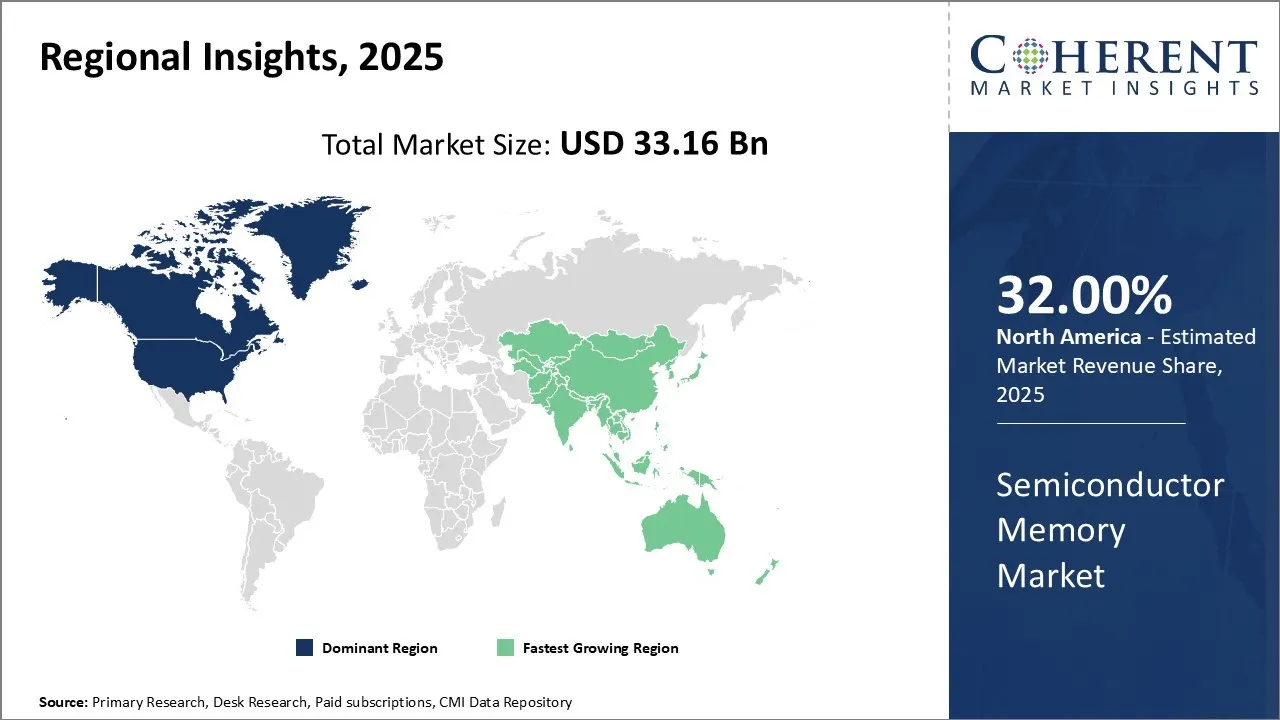
North America Semiconductor Memory Market Analysis and Trends
North America is also witnessing robust growth, supported by rapid adoption of AI, cloud computing, and IoT technologies, with the United States and Canada leading advancements in data center and enterprise memory demand.
Asia Pacific Semiconductor Memory Market Analysis and Trends
Asia Pacific dominates the global semiconductor memory market demand, accounting for a significant share driven by major players like Samsung Electronics, SK Hynix, and Toshiba, along with leading foundries such as TSMC. Growth in consumer electronics, automotive, and mobile industries, coupled with government incentives and improved IP protection, fuel the region’s market expansion, particularly in China, Japan, South Korea, India, and Taiwan.
Europe maintains a strong presence, especially in automotive and industrial applications, with countries like Germany and France enhancing semiconductor production to reduce import reliance. Meanwhile, Latin America is experiencing gradual growth driven by consumer electronics and automotive sectors, with Brazil and Mexico expanding manufacturing capabilities.
Dominating Countries in the Semiconductor Memory Market
The semiconductor memory market forecast indicates that the United States will dominate globally, holding a substantial share in 2026. This leadership is supported by heavy investments in semiconductor R&D, a strong presence of leading memory manufacturers, and significant government initiatives to boost domestic chip production and technology innovation.
Other countries significantly contributing to the semiconductor memory market include South Korea, Taiwan, China, Japan, and Germany. South Korea and Taiwan lead in memory chip manufacturing, with major players like Samsung and TSMC driving innovation and capacity expansion. China is rapidly increasing its focus on self-reliance in semiconductor technology amid global trade tensions. The Asia Pacific region, including these countries, is identified as the fastest-growing market due to expanding electronics manufacturing and growing demand in automotive, telecommunications, and consumer electronics sectors.
Market Report Scope
Semiconductor Memory Market Report Coverage
| Report Coverage | Details | ||
|---|---|---|---|
| Base Year: | 2025 | Market Size in 2026: | USD 35.05 Bn |
| Historical Data for: | 2020 To 2024 | Forecast Period: | 2026 To 2033 |
| Forecast Period 2026 to 2033 CAGR: | 5.7% | 2033 Value Projection: | USD 51.67 Bn |
| Geographies covered: |
| ||
| Segments covered: |
| ||
| Companies covered: | Microchip Technology, Inc., SK Hynix, Inc., NXP Semiconductors, Samsung Electronics Co., Ltd., Intel Corporation, Infineon Technologies AG, Cypress Semiconductor Corporation, Renesas Electronics Corporation, Semiconductor Manufacturing International Corporation (SMIC), Taiwan Semiconductor Manufacturing Company Limited (TSMC), Texas Instruments Incorporated, Toshiba Corporation, and Western Digital Corporation | ||
| Growth Drivers: |
| ||
| Restraints & Challenges: |
| ||
Global Semiconductor Memory Market: Opportunities
- Modernization vehicle architecture
Vehicle architecture modernization provides massive opportunities for market players. Different aspects of vehicle architecture such as automated driving systems, infotainment systems, and safety systems can incorporate semiconductor memory devices, in order to enhance user experience.
Flash and DRAM memory are used in lighting control & ADAS systems that offer high-speed and connectivity to the vehicle systems. Key companies in the market can capitalize on these opportunities in the market by provide novel products and gain a significant advantage in the market.
- R&D activities can provide major business opportunities in the global semiconductor memory market
Key companies are focused on research and development activities, in order to enhance the market presence. For instance, in November 2018, Micron Technology collaborated with BMW Group to improve the development of automotive memory solutions.
Global Semiconductor Memory Market Trends
Semiconductor memory solutions are increasingly being used in the healthcare sector in various medical devices to monitor diseases, share data securely, and analyze medical information remotely. Such devices promote more accessible healthcare, especially in rural and remote areas. For instance, in Rwanda, medical companies have started using drones to deliver human medical supplies such as blood and organs, which uses semiconductor memory drones.
In consumer electronics, semiconductor memory devices are used as a digital electronic semiconductor for the storage of digital data namely computer memory. Consumer electronics such as wearables, smartphones, and other smart devices. Key companies in the market can provide novel products and gain a significant advantage in the competitive market.
Analyst Viewpoint
- The global semiconductor memory market is experiencing rapid growth, driven by escalating demand for memory solutions across data centers, AI applications, consumer electronics, and automotive sectors. Technological innovations such as DDR5 adoption and 3D NAND scaling are enhancing memory performance and capacity, strengthening their role in high-speed computing and storage.
- Opportunities are expanding with advancements in high-bandwidth memory (HBM) and emerging non-volatile memory technologies, which are critical for AI training workloads and edge computing. Additionally, growing investments in cloud infrastructure and 5G deployment are fueling sustained demand for advanced memory solutions.
- However, the market faces challenges from supply chain disruptions, semiconductor material shortages, and geopolitical tensions impacting manufacturing and trade. The semiconductor memory market with fabrication process complexities is constrained by high production costs and intricate manufacturing requirements, which limit large-scale deployment—especially in emerging regions.
- North America is expected to maintain market leadership owing to strong R&D, established semiconductor ecosystems, and early technology adoption. Meanwhile, the Asia Pacific region is projected to be the fastest-growing market, supported by expanding electronics manufacturing hubs, government incentives, and rising digital transformation across developing economies.
Key Developments
- In April 2025, Micron Technology announced the expansion of its 3D NAND flash production capacity in Taiwan to meet rising demand from cloud service providers and consumer electronics manufacturers.
- In February 2025, SK Hynix introduced advanced high-bandwidth memory (HBM3) solutions targeting AI training workloads and graphics processing units, promising significant performance improvements.
- In November 2024, Western Digital launched new enterprise-grade NVMe SSDs optimized for data centers, focusing on reliability and low latency to support big data analytics.
- In August 2023, Kioxia Corporation collaborated with leading semiconductor foundries to accelerate development of next-generation 3D flash memory technologies, aiming to enhance storage density and durability.
Market Segmentation
- Global Semiconductor Memory Market, By Type (Revenue, USD Bn, 2021 - 2033)
- RAM
- SRAM
- SDRAM
- MRAM
- DRAM
- ROM
- EEPROM
- EPROM
- Flash Memory
- PROM
- RAM
- Global Semiconductor Memory Market, By Application (Revenue, USD Bn, 2021 - 2033)
- Aerospace & Defense
- Automotive
- Consumer Electronics
- Industrial
- Medical
- Telecommunications
- Others
- Global Semiconductor Memory Market, By Region (Revenue, USD Bn, 2021 - 2033)
- North America
- U.S.
- Canada
- Latin America
- Brazil
- Argentina
- Mexico
- Rest of Latin America
- Europe
- Germany
- U.K.
- Spain
- France
- Italy
- Russia
- Rest of Europe
- Asia Pacific
- China
- India
- Japan
- Australia
- South Korea
- ASEAN
- Rest of Asia Pacific
- Middle East
- GCC Countries
- Israel
- Rest of Middle East
- Africa
- South Africa
- North Africa
- Central Africa
- North America
- Company Profiles
- Microchip Technology, Inc.
- SK Hynix, Inc.
- NXP Semiconductors
- Samsung Electronics Co., Ltd.
- Intel Corporation
- Infineon Technologies AG
- Cypress Semiconductor Corporation
- Renesas Electronics Corporation
- Semiconductor Manufacturing International Corporation (SMIC)
- Taiwan Semiconductor Manufacturing Company Limited (TSMC)
- Texas Instruments Incorporated
- Toshiba Corporation
- Western Digital Corporation
Sources
Primary Research Interviews
- Semiconductor Memory Manufacturers (Samsung, SK Hynix, Micron Technology)
- Memory Controller IC Designers and Suppliers
- System Integrators and OEM Companies
- Technology Consultants and Industry Analysts
- Others
Databases
- Bloomberg Terminal
- S&P Capital IQ
- Semiconductor Industry Association (SIA) Database
- IC Insights Database
- IHS Markit Semiconductor Database
- Others
Magazines
- Electronic Design Magazine
- Semiconductor Today
- EE Times Magazine
- Electronics Weekly
- Others
Journals
- IEEE Journal of Solid State Circuits
- Nature Electronics
- Semiconductor Science and Technology
- Others
Newspapers
- The Wall Street Journal
- Financial Times
- Nikkei Asia
- Reuters Technology News
- Electronic Engineering Times
- Others
Associations
- Semiconductor Industry Association (SIA)
- JEDEC Solid State Technology Association
- Global Semiconductor Alliance (GSA)
- Electronic Components Industry Association (ECIA)
- Others
Public Domain Sources
- U.S. Securities and Exchange Commission (SEC) Filings
- Company Annual Reports and Investor Relations
- Government Statistics and Trade Data
- Patent Databases (USPTO, WIPO)
- Others
Proprietary Elements
- CMI Data Analytics Tool
- Proprietary CMI Existing Repository of information for last 8 years
*Definition: Semiconductor memory is a digital electronic semiconductor device used for digital data storage, such as computer memory. It typically refers to devices in which data is stored within metal–oxide–semiconductor (MOS) memory cells on a silicon integrated circuit memory chip.
Get access to 250+ pages report
Every segment, forecast, competitor profile and data table behind the analysis above — available for instant download.
- ESOMAR Member
- ISO 9001:2015 Certified
- D-U-N-S Registered
- GDPR & CCPA Compliant
Missing comfort of reading report in your local language? Find your preferred language:
Transform your Strategy with Exclusive Trending Reports
Frequently Asked Questions
The Semiconductor Memory Market size is estimated to be valued at USD 35.05 Bn in 2026, and is expected to reach USD 51.67 Bn by 2033.
The CAGR of the global Market is projected to be 5.7% from 2026 to 2033.
Major factor driving the growth of market during the forecast period is rising demand for home audio networking rising consumption of smartphone, especially in Middle East and North America.
Major factors hampering the growth of the market during the forecast period constitutes constant fluctuations in raw material supply.
APAC semiconductor memory industry outlook is expected to generate the highest revenue during the forecast period.
Some of the key players operating in the market are Microchip Technology, Inc., SK Hynix, Inc., NXP Semiconductors, Samsung Electronics Co., Ltd., Intel Corporation, Infineon Technologies AG, Cypress Semiconductor Corporation, Renesas Electronics Corporation, Semiconductor Manufacturing International Corporation (SMIC), Taiwan Semiconductor Manufacturing Company Limited (TSMC), Texas Instruments Incorporated, Toshiba Corporation, and Western Digital Corporation.
Key sectors investing in semiconductor memory include automotive, consumer electronics, industrial, IT & telecommunications, healthcare, and aerospace & defense.