

Flow Battery Market Analysis & Forecast: 2026-2033
Flow Battery Market size is estimated to be valued at USD 1,195.2 Mn in 2026 and is expected to reach USD 2,811.8 Mn in 2033, exhibiting a compound annual growth rate (CAGR) of 13.0% from 2026 to 2033.
Key Takeaways
- By Battery Type, Vanadium Redox Flow Battery is expected to lead the Flow Battery Market Share with 84.8% owing to its off-grid, min-grid, and utility market application as demand for the technology continues to rise as it is being developed and commercialized by multiple firms.
- By Region, Asia Pacific region to hold a significant share of the market at roughly 87.22% which is the result of increased energy storage system industrialization in the region, rapid urban expansion, and government incentives.
Market Overview
The Flow Battery Market Forecast is likely to experience rapid growth in the coming years owing to acceleration in technological innovation and new developments. For instance, Invinity Energy systems proclaimed in February 2026 that they will be deploying their VS3 next generation flow batteries in a commercial Solar Plus Storage project in the state of California, demonstrating greater efficiency and scalability.
Current Events and Its Impact on the Global Flow Battery Market
Event | Description and Impact |
Increasing adoption of renewable energy sources |
|
Growth of the electric vehicle (EV) market |
|
Pricing Analysis of Flow Battery
The flow battery price constantly changes based on technology, size, and brand. The Vanadium Redox Flow Batteries (VRFBs) are usually made for utility-scale deployments, like Rongke Power’s 200 MW/800 MWh unit, which costs between USD $300M–400M, or smaller units from Invinity and Storion intended for residential use which cost between USD $20,000–35,000. Zinc-Bromine Flow Batteries (ZBFBs), like Redflow's ZCell (10 kWh), fall in the USD $15,000–20,000 range, while ZBFB commercial units from EnSync can exceed USD $250,000. Organic flow batteries are still in the research and development phase and are not yet priced for public sale.
Some raw materials influence the cost: the size of the system, the price of the system's components (most notably the vanadium), the scale of manufacturing, and the government subsidies. As of 2025, the large-scale systems will cost on average USD $500–700 per kWh. Changes in technology, production scale, and incentive policies supporting the systems will help to lower expenses in the long run.
- Current Industry Events of 2026
- Market Size Estimation
- Regional Breakdown
- Competitive Landscape
- Customer Intelligence
- Segmental Analysis
- Pricing Analysis
- Key Market Drivers, Challenges & Future Trends
- Customized Insights Section
Segmental Insights
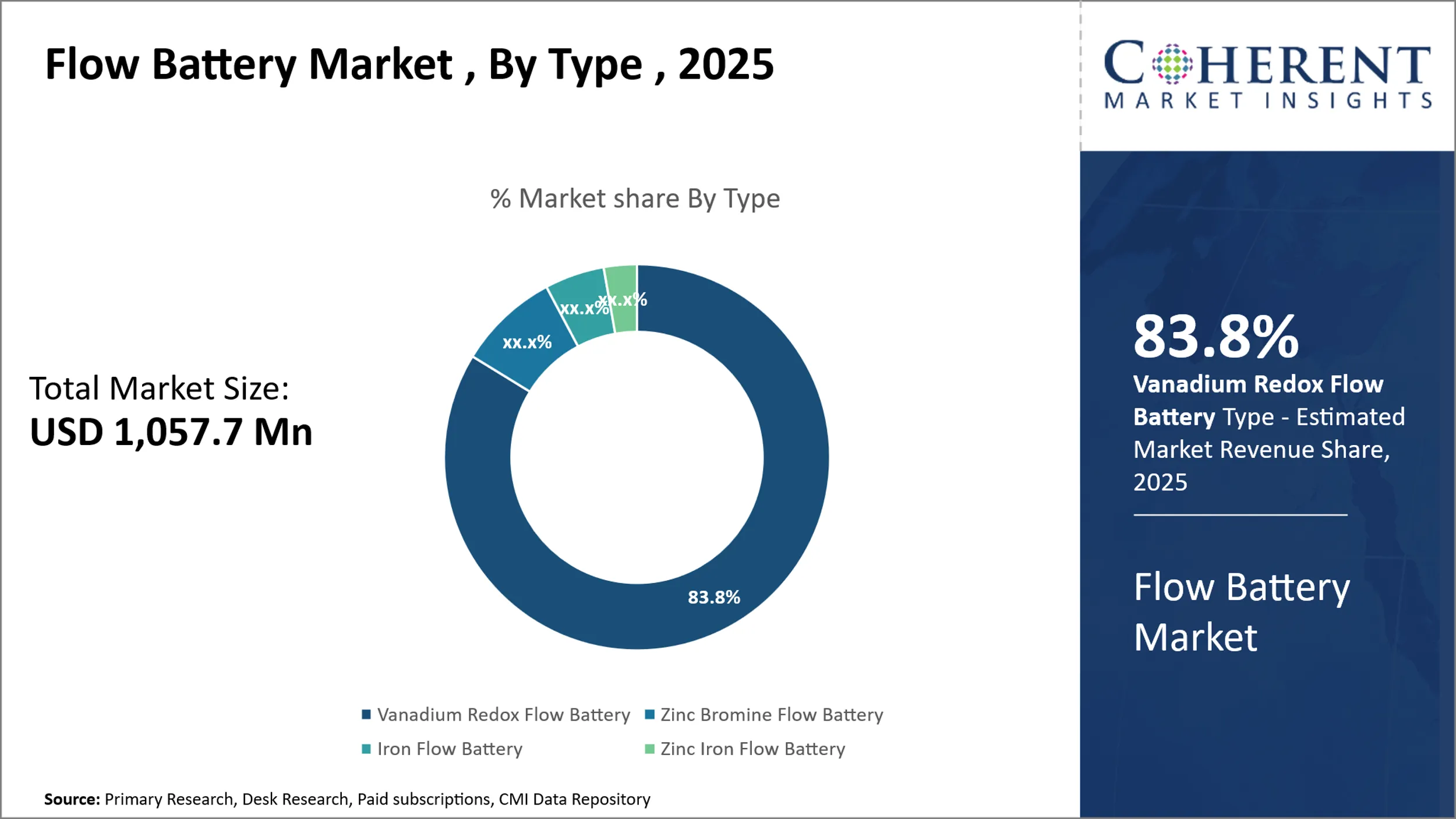
Flow Battery Market Insights, By Type
Vanadium Redox Flow Batteries Leading Grid-Scale Deployment
In terms of type, the Vanadium Redox Flow Battery (VRFB) segment is expected to dominate the global Flow Battery Market Growth, driven by its strong adoption in mini-grid, off-grid, and utility-scale energy storage projects. These batteries are gaining traction due to their long cycle life, scalability, and ability to store energy for extended durations without degradation.
Companies such as Invinity Energy Systems and Sumitomo Electric Industries are actively commercializing VRFBs to meet rising demand across commercial and industrial applications. Additionally, government-backed projects and renewable energy targets are fueling large-scale deployments, especially in Europe, North America, and Asia.
Global Flow Battery Market: Regional Insights

Asia Pacific Flow Battery Market Analysis and Trends
The Asia Pacific region is expected to have the maximum participation in the global flow battery market for the projected period. This is supported by rapid industrial development, increased urban energy consumption, and positive government policies about storing renewable energy.
China, India, Japan, and South Korea are rapidly adopting modern grid systems and decentralized energy frameworks, whereby flow batteries present flexible and long-duration storage options. There is a growing uptake of flow battery technologies by the region’s industrial, mini-grids, and utility-scale sectors to maintain reliable electricity and power system services.
Europe Flow Battery Market Analysis and Trends
The Flow Battery Market Value in Europe is expected to grow at a slower pace, driven by the European regions ambitious climate targets, policies on integrating renewables, and mandates on energy storage systems. Germany, the U.K., and Netherlands are working towards the implementation of energy storage systems to control the volatile supply of wind and solar energy. The EU Green Deal alongside robust policies supporting clean investments amplify the need for commercial and utility-level flow battery systems.
Flow Battery Market Dominating Countries
United States Flow Battery Market Analysis and Trends
The U.S. remains the most advanced country in flow battery innovation and deployment, driven by energy resilience, renewable integration, and decarbonization goals. Government programs like the Inflation Reduction Act are further funding Advanced Energy Storage investments. Flow batteries are undergoing testing and adoption in utility-scale pilot projects to enable better peak shaving and decrease reliance on fossil fuel usage. California and New York are spearheading these projects.
China Flow Battery Market Analysis and Trends
China is becoming the world’s most advanced country in the manufacturing and deployment of flow batteries due to its strong domestic supply chain and its aggressive targets for renewable energy. The momentum for self-sufficiency and carbon neutrality from the government of China is stimulating an upward trend of capital investments into flow battery systems especially the Vanadium redox technology. State-owned enterprises and private firms are working together on national demonstration projects for the commercial proof of concept for battery storage on the grid.
Market Report Scope
Flow Battery Market Report Coverage
| Report Coverage | Details | ||
|---|---|---|---|
| Base Year: | 2025 | Market Size in 2026: | USD 1,195.2 Mn |
| Historical Data for: | 2020 To 2024 | Forecast Period: | 2026 To 2033 |
| Forecast Period 2026 to 2033 CAGR: | 13.0% | 2033 Value Projection: | USD 2,811.8 Mn |
| Geographies covered: |
| ||
| Segments covered: |
| ||
| Companies covered: | VRB Energy, H2 Inc., ESS Tech Inc., Stryten Energy, Vanadis Power GmbH, CellCube Energy Storage Systems Inc., Primus Power Corporation, Dalian Rongke Power Co. Ltd., RedFlow Ltd., and Invinity Energy Systems PLC. | ||
| Growth Drivers: |
| ||
| Restraints & Challenges: |
| ||
Market Dynamics
Global Flow Battery Market Trends
- Increase in popularity of vanadium redox flow batteries is a growing trend
Vanadium redox flow batteries are redox flow batteries that can store energy using V2+/V3+ and V4+/V5+ redox pairs of vanadium in the positive and negative half-cells respectively. The power and energy ratings of these batteries are not linked with one another and each of them is optimized for a different type of use. Several countries are working on increasing their energy needs without gaps.
- Growing number of renewable energy projects is another trend in the market
In renewable technologies, natural resources are used for generating electricity. Green energy requires novel technologies and development of renewable energy sources is leading to growing need for energy storage systems in order for storing the electricity generated through these sources.
Global Flow Battery Market Drivers
- Rising adoption of renewable energy to drive the market growth
The importance of energy storage is rapidly increasing in the power industry majorly owing to rise in investments in renewable energy technology sector. The use of lithium-ion batteries is widespread; however, flow batteries have promising advantages for long-term use and in applications that need regular cycle throughout the day. With flow batteries, renewable energy such as wind and solar energy can be made accessible for longer period in order for countering major intermittency issues.
- Investments in aspiring wind and solar energy targets to fuel the market pace
As per the International Energy Agency, the renewable electricity capacity in the world is likely to grow by more than 60% by 2032. According to the same source, renewable energy are likely to contribute nearly 95% to the rise in global capacity of power by 2032, with solar PV being the major contributor.
Global Flow Battery Market Opportunity
Increasing development of advanced and novel flow battery chemistries to create ample of opportunities in the global flow battery market over the forecast period. The flow battery market is on the rise constantly, due to which several companies and researchers from around the world are focusing on development and investment in novel battery chemistries for the flow battery in terms of higher power density and low cost.
The battery energy storage system is an alternative to solar PV systems. Flow batteries offer maximum energy storing, prevent blackouts, and reduce energy cost for homes and small businesses. Thus, the use of flow batteries is growing in residential applications and it is likely to create growth opportunities in the market.
Global Flow Battery Market: Key Developments
- May 2025 – ESS Inc., Sumitomo Electric, and Invinity Energy Systems announced strategic global partnerships aimed at accelerating the development and deployment of utility-scale flow battery energy storage systems. These collaborations focus on integrating flow batteries into renewable energy grids in the U.S., Europe, and Asia, strengthening the global transition toward long-duration, sustainable energy storage.
- September 2024 – VRB Energy announced a significant technological breakthrough in vanadium redox flow battery (VRFB) architecture, achieving higher energy density and reduced system costs. This advancement positions flow batteries as a more competitive alternative to lithium-ion batteries, particularly for long-duration applications such as grid balancing and renewable energy integration.
- April 2024 – Governments in regions including the European Union, India, and Australia introduced targeted subsidies and financial incentives to support the deployment of advanced energy storage solutions. These policy measures include tax credits, capital grants, and streamlined approval processes specifically aimed at scaling up technologies such as vanadium and zinc-bromine flow batteries in both grid-connected and off-grid renewable energy projects.
Global Flow Battery Market: Key Companies Insights
The global flow battery market is highly competitive. This is attributed to continuous launch of new technologies due to ongoing R &D and efforts by value chain participants. Moreover, key players are adopting various business growth strategies in order to expand their presence on regional as well as global basis. Some of the key players in the global flow battery market are VRB Energy, H2 Inc., ESS Tech Inc., Stryten Energy, Vanadis Power GmbH, CellCube Energy Storage Systems Inc., Primus Power Corporation, Dalian Rongke Power Co. Ltd., RedFlow Ltd., and Invinity Energy Systems PLC.
Market Segmentation
- Global Flow Battery Market, By Type (Revenue, USD Mn, 2021 - 2033)
- Vanadium Redox Flow Battery
- Zinc Bromine Flow Battery
- Iron Flow Battery
- Zinc Iron Flow Battery
- Global Flow Battery Market, By Region (Revenue, USD Mn, 2021 - 2033)
- North America
- U.S.
- Canada
- Latin America
- Brazil
- Argentina
- Mexico
- Rest of Latin America
- Europe
- Germany
- U.K.
- Spain
- France
- Italy
- Russia
- Rest of Europe
- Asia Pacific
- China
- India
- Japan
- Australia
- South Korea
- ASEAN
- Rest of Asia Pacific
- Middle East
- GCC Countries
- Israel
- Rest of Middle East
- Africa
- South Africa
- North Africa
- Central Africa
- Company Profiles
- VRB Energy
- ESS Tech Inc.
- Vanadis Power GmbH
- Primus Power Corporation
- RedFlow Ltd.
- Invinity Energy Systems PLC
- Dalian Rongke Power Co. Ltd
- CellCube Energy Storage Systems Inc.
- Stryten Energy
- H2 Inc.
Sources
Primary Research Interviews
- Flow battery manufacturers
- Energy storage system integrators
- Renewable energy project developers
- Utility companies
- Others
Databases
- International Energy Agency (IEA) Energy Storage Database
- U.S. Department of Energy Global Energy Storage Database
- European Energy Storage Database
- China Energy Storage Alliance (CNESA) Database
- Others
Magazines
- Energy Storage News
- Renewable Energy World
- Energy Manager Today
- Others
Journals
- Journal of Energy Storage
- Applied Energy
- Journal of Power Sources
- Energy Policy
- Others
Newspapers
- The Wall Street Journal
- Financial Times
- The New York Times
- The Guardian
- Others
Associations
- Energy Storage Association (ESA)
- European Association for Storage of Energy (EASE)
- China Energy Storage Alliance (CNESA)
- India Energy Storage Alliance (IESA)
- Others
Public Domain Sources
- International Renewable Energy Agency (IRENA) Publications
- U.S. Energy Information Administration (EIA) Reports
- European Commission Energy Storage Reports
- National Renewable Energy Laboratory (NREL) Publications
- Others
Proprietary Elements
- CMI Data Analytics Tool
- Proprietary CMI Existing Repository of information for last 8 years
*Definition: A flow battery is an electrochemical storage system that uses differences in oxidation states of metals to store energy. Redox flow batteries are rechargeable electrochemical energy storage systems used for enhancing grid stability and to reduce power supply interruptions
Get access to 250+ pages report
Every segment, forecast, competitor profile and data table behind the analysis above — available for instant download.
- ESOMAR Member
- ISO 9001:2015 Certified
- D-U-N-S Registered
- GDPR & CCPA Compliant
Missing comfort of reading report in your local language? Find your preferred language:
Transform your Strategy with Exclusive Trending Reports
Frequently Asked Questions
The Flow Battery Industry is estimated to be valued at USD 1,195.2 Mn in 2026, and is expected to reach USD 2,811.8 Mn by 2033.
The CAGR of the global Flow Battery industry is projected to be 13.0% from 2026 to 2033.
Rising adoption of renewable energy and investments in aspiring wind and solar energy targets are fuelling the growth of market.
The Vanadium Redox Flow Battery segment is the leading segment in the market.
Decline in cost and rise in adoption of lithium-ion batteries and need for high capital investment for flow battery production are the major factors restraining growth of the market.
VRB Energy, H2 Inc., ESS Tech Inc., Stryten Energy, Vanadis Power GmbH, CellCube Energy Storage Systems Inc., Primus Power Corporation, Dalian Rongke Power Co. Ltd., RedFlow Ltd., and Invinity Energy Systems PLC.