

Silicon Photonics Market Size and Forecast: 2026 to 2033
Silicon Photonics Market is estimated to be valued at USD 3,636.4 Mn in 2026 and is expected to reach USD 15,665.5 Mn in 2033, exhibiting a compound annual growth rate (CAGR) of 23.2% from 2026 to 2033.
Key Takeaways
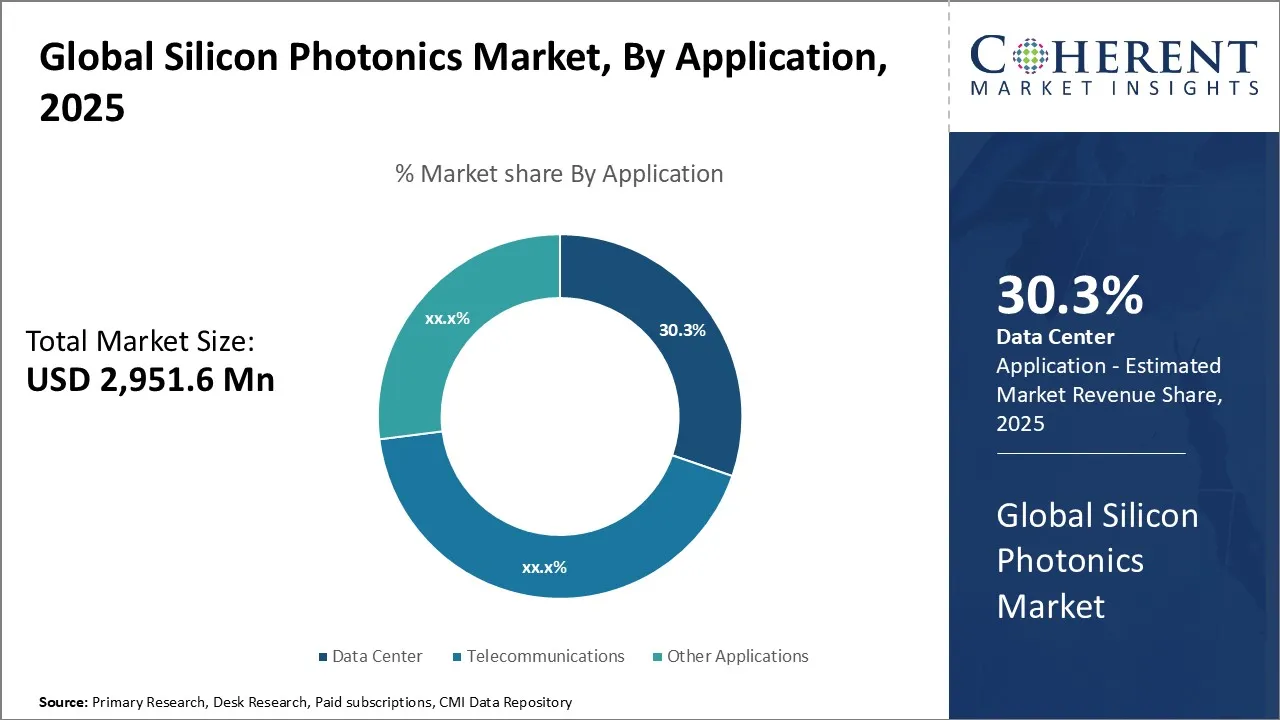
- By Application, Data Center hold the largest market share of 34.2% in 2026 owing to its explosive growth in data traffic & data‑center demand.
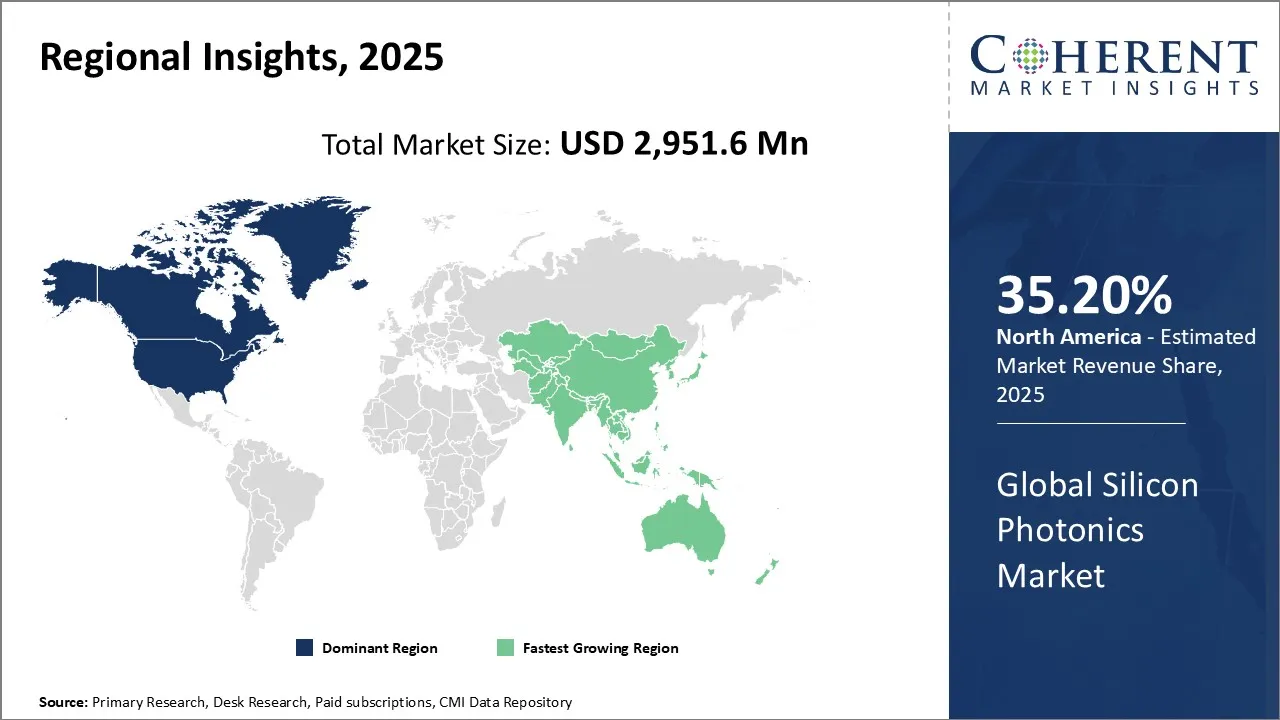
- By Region, North America dominates the overall market with an estimated share of 35.2% in 2026 owing to the large, mature and expanding data‑center.
Market Overview
The Silicon Photonics market is rapidly evolving as data centers, telecommunications, and high-performance computing increasingly demand high-speed, low-latency data transmission. By using silicon-based optical components, the technology delivers energy-efficient, scalable, and high-density interconnects that surpass traditional copper solutions. Companies are driving innovation through growing adoption in cloud computing, AI workloads, and 5G networks, while semiconductor manufacturers and research institutions actively accelerate commercialization. Silicon photonics is actively reshaping modern communication infrastructure.
Current Events and Its Impact on the Silicon Photonics Market
Current Events | Description and its impact |
Geopolitical Tensions and Trade Policies |
|
Technological Breakthroughs and R&D Advancements |
|
Supply Chain and Raw Material Constraints |
|
Segmental Insights
- Current Industry Events of 2026
- Market Size Estimation
- Regional Breakdown
- Competitive Landscape
- Customer Intelligence
- Segmental Analysis
- Pricing Analysis
- Key Market Drivers, Challenges & Future Trends
- Customized Insights Section
Silicon Photonics Market Insights, By Application - Data Center contribute the highest share of the market owing to its scalability, density & simplified cabling / infrastructure
Data Center hold the largest market share of 34.2% in 2026. Data centers are increasingly adopting Silicon Photonics to achieve faster, more reliable, and energy-efficient data transmission. Growing demands from cloud computing, AI workloads, and large-scale analytics push the need for high-bandwidth, low-latency interconnects that copper cannot provide. Silicon photonics delivers compact, scalable solutions that cut power usage and simplify cabling, supporting dense server deployments. Companies actively drive adoption through advances in photonic integration, industry investments, and technological innovations, establishing silicon photonics as a core enabler of next-generation data center performance. For instance, in February 2025, STMicroelectronics has introduced a new data-center photonics chip, created in partnership with Amazon Web Services (AWS). Named the PIC100, the chip is designed to enable next-generation 800Gbps and 1.6Tbps optical interconnects for all types of workloads, including those driven by artificial intelligence (AI).
Regional Insights
North America Silicon Photonics Market Trends
North America dominates the overall market with an estimated share of 35.2% in 2026. North America is rapidly advancing its Silicon Photonics market through developments in data centers, cloud computing, and high-performance computing infrastructures. Companies are accelerating adoption by deploying hyperscale data centers and meeting the rising demand for high-speed optical interconnects. Innovators are reshaping network architectures with photonic integration, co-packaged optics, and energy-efficient designs. Semiconductor manufacturers, research institutions, and tech firms are actively collaborating to speed commercialization. Expanding applications in 5G, AI, and telecom are further strengthening North America’s leadership in silicon photonics. For instance, in April 2026, TSMC introduced its new A14 logic process at its North America Technology Symposium, advancing beyond the N2 node to boost AI performance and energy efficiency. A14 features integrated silicon photonics using the COUPE™ engine, N12 and N3 logic base dies for HBM4, and an Integrated Voltage Regulator that delivers five times the vertical power density of a separate board-level power chip.
Asia Pacific Silicon Photonics Market Trends
Countries across Asia Pacific are actively expanding their data center, cloud, and telecom infrastructures, driving rapid growth in the Silicon Photonics market. Rising demand for high-speed, low-latency data transmission and energy-efficient interconnects is prompting widespread adoption. Governments and technology companies are investing in research, development, and manufacturing to advance photonic integration and optical networking solutions. Innovators are reshaping regional network architectures through co-packaged optics, high-density modules, and AI-driven applications, establishing Asia Pacific as a major hub for next-generation silicon photonics. For instance, in May 2026, Shri S. Krishnan, Secretary of MeitY, unveiled two indigenously developed silicon photonics products at IIT Madras’ CoE-CPPICS: a Fiber-Array Unit (FAU) attachment tool for photonic chip packaging and a silicon photonic quantum random number generator (QRNG).
United States Silicon Photonics Market Trends
The United States is actively driving the Silicon Photonics market by advancing data center, cloud, and high-performance computing infrastructures. Companies are adopting energy-efficient, high-density optical interconnects to meet growing demand for high-speed, low-latency data transmission. U.S. technology firms and research institutions are investing in photonic integration, co-packaged optics, and innovative packaging techniques to boost performance and scalability. Expanding applications in AI, 5G, and telecom networks are accelerating deployment, establishing the United States as a leading innovator in the global silicon photonics market. For instance, in April 2026, Coherent launched new optical transport solutions—including a high-efficiency pump laser and silicon photonics transceiver modules—to boost data center performance and improve the efficiency of AI workloads.
India Silicon Photonics Market Trends
India is actively expanding its data center, cloud, and telecom infrastructure, driving growth in the Silicon Photonics market to support rising digitalization. Companies are adopting silicon photonics solutions to meet increasing demand for high-speed, low-latency, and energy-efficient data transmission. Technology firms and research institutions are investing in photonic integration, optical interconnects, and advanced networking solutions to boost performance. Growing applications in AI, 5G, and IoT are accelerating deployment, establishing India as an emerging hub for next-generation silicon photonics technologies. For instance, in August 2026, izmomicro, a division of izmo Ltd., announced a major silicon photonics packaging milestone, reinforcing its pioneering role in India’s semiconductor sector and strengthening the country’s position in the global push for next-generation data and AI infrastructure.
End-user Feedback and Unmet Needs in the Silicon Photonics Market
End-user Feedback and Unmet Needs
- Performance and Reliability Demands: End-users report a need for higher data rates, lower latency, and consistent performance across long-distance interconnects. Reliability under heavy workloads, thermal stability, and reduced signal loss remain critical. Many data centers seek solutions that maintain peak efficiency without frequent maintenance or system downtimes.
- Integration and Compatibility Challenges: Users highlight difficulties in integrating silicon photonics with existing electronic systems, legacy networks, and data center infrastructure. Standardization gaps and interoperability issues slow deployment, requiring end-users to invest in specialized hardware or custom solutions to achieve seamless connectivity.
- Cost and Scalability Concerns: Although silicon photonics offers efficiency, end-users point out high initial investment costs and manufacturing expenses. Scaling solutions for hyperscale deployments remains a challenge, as organizations seek affordable, mass-producible modules without compromising performance or energy efficiency.
Silicon Photonics Market Trend
Data Center and Cloud Expansion
The market is driven by the rapid growth of data centers and cloud computing infrastructure worldwide. Organizations are seeking high-speed, low-latency, and energy-efficient optical interconnects to support massive data traffic. Silicon photonics offers compact, scalable, and high-density solutions, enabling hyperscale data centers to meet increasing bandwidth demands. Continuous adoption in cloud services, content delivery networks, and enterprise computing is reshaping network architectures and pushing industry players to innovate faster.
Integration with AI and HPC Applications
Silicon photonics is increasingly integrated into AI, machine learning, and high-performance computing workloads. These applications demand high-bandwidth, low-latency interconnects to efficiently transfer massive datasets between CPUs, GPUs, and memory modules. The market trend focuses on developing co-packaged optics, photonic integrated circuits, and advanced modulators to enhance data throughput. Adoption in AI-driven data centers is encouraging companies to innovate and optimize silicon photonic solutions for real-time processing and computationally intensive applications.
Silicon Photonics Market Opportunity
Artificial Intelligence and High-Performance Computing
The expanding adoption of AI, machine learning, and high-performance computing workloads opens opportunities for silicon photonics. These applications require ultra-high bandwidth and low-latency interconnects to transfer large datasets efficiently between CPUs, GPUs, and memory units. Companies can focus on developing co-packaged optics, multi-channel transceivers, and advanced modulators to enhance computational performance. By addressing the needs of AI-driven data centers and supercomputing infrastructure, silicon photonics firms can establish a strong foothold in high-value computing markets.
Market Report Scope
Silicon Photonics Market Report Coverage
| Report Coverage | Details | ||
|---|---|---|---|
| Base Year: | 2025 | Market Size in 2026: | USD 3,636.4 Mn |
| Historical Data for: | 2020 To 2024 | Forecast Period: | 2026 To 2033 |
| Forecast Period 2026 to 2033 CAGR: | 23.2% | 2033 Value Projection: | USD 15,665.5 Mn |
| Geographies covered: |
| ||
| Segments covered: |
| ||
| Companies covered: | Broadcom Inc., Sicoya GMBH, GlobalFoundries Inc., Intel Corporation, Juniper Networks Inc., Cisco Systems Inc., IBM Corporation, and NeoPhotonics Corporation | ||
| Growth Drivers: |
| ||
| Restraints & Challenges: |
| ||
Silicon Photonics Market News
- In August 2025, Wave Photonics, a Cambridge-based photonics chip design firm, launched its PDK Management Platform, with CORNERSTONE as its first foundry adopter. The platform integrates foundry PDKs with major EDA tools to streamline photonic integrated circuit design.
- In May 2025, Neuchâtel-based CCRAFT, a new CSEM spin-off, launched as the world’s first production-ready foundry for Thin-Film Lithium Niobate (TFLN) photonic integrated circuits. As AI, cloud computing, and real-time communications drive rapid data growth, silicon photonics and other existing platforms are beginning to hit performance limits.
Analyst Opinion (Expert Opinion)
- Silicon photonics has moved beyond the status of a niche or “future” technology. Rapid commercialization over the past 12–18 months has positioned it to fundamentally redefine the architecture of high-performance, data-centric infrastructure. The launch of DustPhotonics’ 1.6 Tb/s merchant silicon photonics engine—supporting 8 channels of 224 Gb each, with an 800 Gb/s DR4 variant—marks a critical milestone. This is a commercial product, not a prototype, targeting hyperscale data centers and AI infrastructure today.
- The implications of this product extend beyond raw bandwidth. By integrating onboard lasers with a photonic integrated circuit (PIC), DustPhotonics has streamlined module design, reduced power consumption, minimized optical loss, and improved cost efficiency for transceiver manufacturers. Once supply chain and economic conditions align, such silicon photonics engines are likely to replace many traditional copper and discrete-optics interconnects, particularly in high-density, power-sensitive AI clusters.
- This shift responds to a clear technological imperative: traditional copper and legacy optical interconnects are approaching physical, thermal, and cost limitations. As data centers—especially those supporting AI and ML workloads—scale to hundreds of thousands or millions of GPUs, high-density, low-power optical interconnects become the only viable solution. Silicon photonics, with CMOS-compatible manufacturing, high bandwidth-per-watt efficiency, and compact form factor, offers the only scalable path forward.
- The next 18–36 months will prove decisive. Organizations and cloud providers that adopt silicon photonics engines early—for high-density AI clusters, HPC deployments, long-haul links, or emerging quantum networks—will secure substantial advantages in efficiency, cost, and performance. Conversely, those continuing to rely on legacy interconnects risk being constrained by rising energy costs, cooling challenges, and bandwidth bottlenecks.
Speak to the analyst
Want personalized insights?
Take the findings above to one of our principal consultants, or have the report rebuilt around the segments, geographies and competitors you actually track.
Market Segmentation
- Global Silicon Photonics Market, By Application
- Data Center
- Telecommunications
- Other Applications
- Regional Insights (Revenue, USD Mn, 2021 - 2033)
- North America
- U.S.
- Canada
- Latin America
- Brazil
- Argentina
- Mexico
- Rest of Latin America
- Europe
- Germany
- U.K.
- Spain
- France
- Italy
- Russia
- Rest of Europe
- Asia Pacific
- China
- India
- Japan
- Australia
- South Korea
- ASEAN
- Rest of Asia Pacific
- Middle East
- GCC Countries
- Israel
- Rest of Middle East
- Africa
- South Africa
- North Africa
- Central Africa
- North America
- Key Players Insights
- Broadcom Inc.
- Sicoya GMBH
- GlobalFoundries Inc
- Intel Corporation
- Juniper Networks Inc.
- Cisco Systems Inc.
- IBM Corporation
- NeoPhotonics Corporation
Sources
Primary Research interviews
- Industry experts and engineers from leading photonics companies
- Academic researchers specializing in silicon photonics
- Supply chain and manufacturing professionals
- Technology developers and startup founders in the photonics space
Databases
- IEEE Xplore Digital Library
- SPIE Digital Library
- Scopus
- Web of Science
- Google Scholar
Magazines
- Photonics Spectra
- Laser Focus World
- Optics & Photonics News
- Compound Semiconductor Magazine
Journals
- Nature Photonics
- Journal of Lightwave Technology
- Optics Express
- Applied Physics Letters
- IEEE Photonics Journal
Newspapers
- The Wall Street Journal (Technology Section)
- Financial Times (Tech & Innovation Section)
- The New York Times (Technology Section)
Associations
- IEEE Photonics Society
- SPIE (The International Society for Optics and Photonics)
- Optical Society (OSA)
- European Photonics Industry Consortium (EPIC)
Public Domain sources
- Company annual reports and investor presentations
- Government publications and reports (e.g., U.S. Department of Energy, NIST)
- Patent filings from USPTO and WIPO
- Technical white papers released by universities and research institutions
Proprietary Elements
- CMI Data Analytics Tool
- Proprietary CMI Existing Repository of information for last 8 years
Get access to 250+ pages report
Every segment, forecast, competitor profile and data table behind the analysis above — available for instant download.
- ESOMAR Member
- ISO 9001:2015 Certified
- D-U-N-S Registered
- GDPR & CCPA Compliant
Missing comfort of reading report in your local language? Find your preferred language:
Transform your Strategy with Exclusive Trending Reports
Frequently Asked Questions
The Silicon Photonics Market is estimated to be valued at USD 3,636.4 Mn in 2026, and is expected to reach USD 15,665.5 Mn by 2033.
The CAGR of the Silicon Photonics Market is projected to be 23.2% from 2026 to 2033.
Reduced power consumption offered by silicon photonics-based transceivers and increasing need for high-speed connectivity and high data transfer capabilities in data centers are fuelling the growth of the market.
The Data Centers segment is the leading component segment in the market.
Risk of thermal heat and complexity of integrating on-chip laser are the major factors restraining growth of the market.
Broadcom Inc., Sicoya GMBH, GlobalFoundries Inc., Intel Corporation, Juniper Networks Inc., Cisco Systems Inc., IBM Corporation, and NeoPhotonics Corporation