

Hazardous Location LED Lighting Market Size and Share Analysis: 2026 - 2033
The Hazardous Location LED Lighting Market is anticipated to grow at a CAGR of 8.5% with USD 674.8 Mn in 2026 and is expected to reach USD 1,197.4 Mn in 2033. The Hazardous Location LED Lighting Market is growing due to stricter industrial safety compliance, rising use of explosion-proof lighting in oil & gas, petrochemical, chemical processing, power generation, mining, pharmaceutical, and food processing facilities, and the replacement of conventional lighting with energy-efficient LED systems. For instance, in January 2026, the IEA published that global LNG supply growth is expected to accelerate further in 2026, supporting stronger gas demand and industrial activity. Moreover, in February 2026, the U.S. EIA published that U.S. marketed natural gas production is forecast to average 120.8 Bcf/d in 2026, reinforcing demand from gas processing, LNG, and pipeline facilities. In February 2026, Larson Electronics released a Class I Division 1 explosion-proof LED control station with five LED pilot lights, rated for Class I, Class II, and Class III hazardous environments, showing continued product innovation by LED manufacturers.
Source: U.S. Energy Information Administration; International Energy Agency; Larson Electronic ; Dialight
Key Takeaways
- Class-I is expected to account the largest share of 58.4% in 2026, because oil & gas, petrochemical, fuel storage, paint booths, and chemical processing facilities require lighting where flammable gases or vapors may form ignitable mixtures. OSHA defines Class I locations this way, while Warom’s safety guide, published on February 26, 2026, notes Division 1 covers continuous or frequent hazardous concentrations, driving demand for certified explosion-proof LED fixtures.
- Zone 1 will dominate with 34.2% in 2026, because it covers areas where explosive gas or vapour atmospheres are likely during normal operation, so refineries, loading bays, pumps, valves, chemical plants, and fuel-handling zones need certified lighting more consistently than Zone 2 areas. The U.K. HSE published this Zone 1 definition on 17 April 2025, and Warom highlighted Zone 1 LED fittings on 11 April 2026.
- Oil and gas hold the dominant share of 31.4% in 2026 because refineries, LPG/LNG terminals, gas-processing plants, offshore rigs, and fuel storage areas continuously handle flammable gases, vapors, and high-risk electrical zones. A 2026 Numaligarh Refinery GeM tender, published on April 2, 2026, required 3,000 65W FLP LED luminaires with IS/IEC 60079 compliance, PESO approval, Gas Group IIC, and Zone 1/2 suitability, showing heavy oil-sector demand.
Source: PESO – Petroleum and Explosives Safety Organisation; U.S. Department of Labor
- North America is expected to acquire the dominant share of 36.2% in 2026, because its large oil & gas, petrochemical, LNG, and industrial base create continuous demand for certified explosion-proof LED fixtures. OSHA’s hazardous-location rule requires electrical equipment to match flammable gas, vapor, dust, or fiber risks. On February 13, 2026, the U.S. EIA published on its website that marketed natural gas production would average 120.8 Bcf/d in 2026, supporting lighting demand across gas facilities.
Segmental Insights
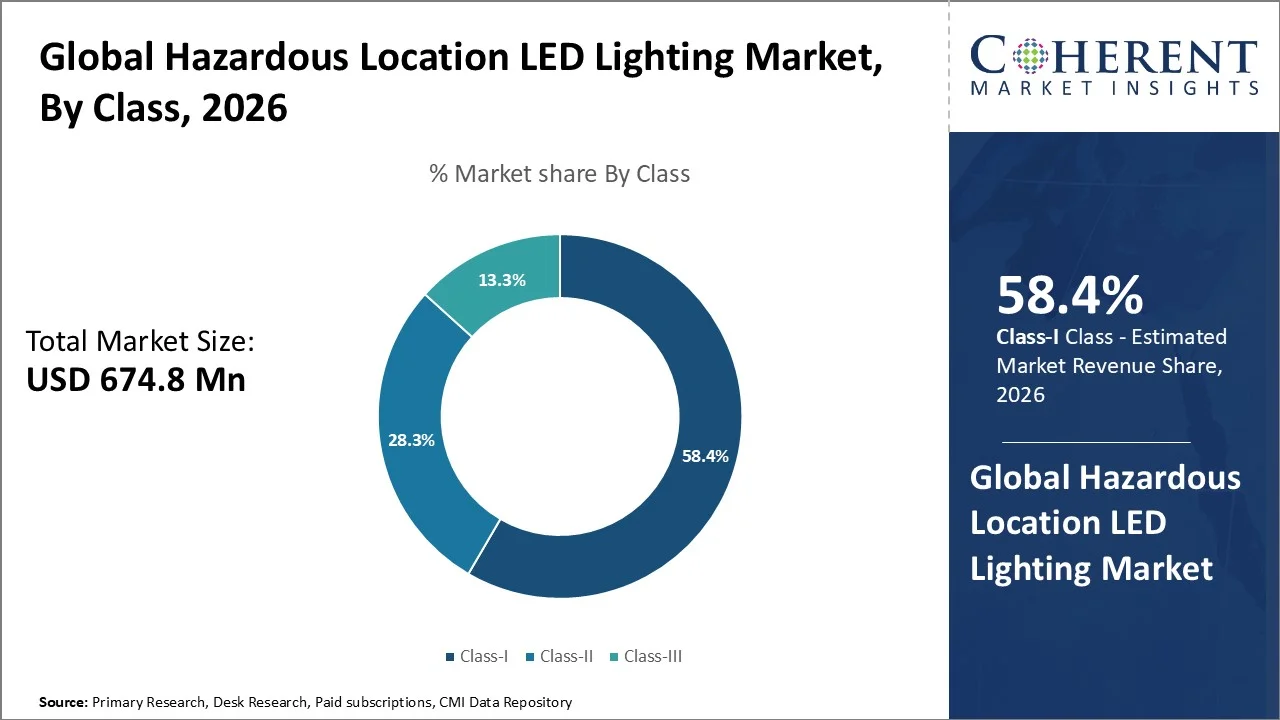
Why is Class-I Acquiring the Largest Market Share?
Class-I is projected to account for the largest share of cognitive systems spending in 2026, representing approximately 58.4% of the total volume. Class-I is the dominant segment because it covers facilities where flammable gases or vapors can form explosive mixtures, making lighting certification a safety requirement rather than an optional upgrade. Occupational Safety and Health Administration (OSHA) defines Class-I locations as areas where flammable gases or vapors are, or may be, present in sufficient quantities to ignite, including Division 1 areas where such concentrations may exist during normal operations. Demand is strongest in oil and gas, refining, petrochemical, LNG, chemical processing, wastewater, and fuel-storage assets, where vapor release risk is frequent. For instance, U.S. Energy Information Administration’s Weekly Petroleum Status Report, published on May 6, 2026, reported U.S. refinery inputs of 16.0 million barrels per day and 90.1% refinery utilization for the week ending May 1, 2026. Moreover, on February 13, 2026, Energy Information Administration stated that U.S. marketed natural gas production would average 120.8 Bcf/d in 2026. These high-throughput hydrocarbon operations favor Class-I explosion-proof LED fixtures with lower heat, longer life, and reduced maintenance.
- Current Industry Events of 2026
- Market Size Estimation
- Regional Breakdown
- Competitive Landscape
- Customer Intelligence
- Segmental Analysis
- Pricing Analysis
- Key Market Drivers, Challenges & Future Trends
- Customized Insights Section
Zone 1 holds the Largest Market Share
Zone 1 segment dominate the market, accounting for a significant 34.2% share in 2026, because it covers areas where explosive gas or vapour atmospheres are likely during normal operations, making it more safety-critical than Zone 2 and more commercially widespread than the highly restricted Zone 0. HSE guidance defines Zone 1 as an area where an explosive gas atmosphere is likely in normal operation, while Zone 2 is only unlikely or short-duration exposure. For instance, in its April 7, 2026 Short-Term Energy Outlook, the U.S. EIA projected U.S. dry natural gas production at 109.59 billion cubic feet per day in 2026 and LNG exports at 17.0 billion cubic feet per day, supporting continued activity in gas processing, LNG, terminals, and refinery environments. Eaton’s Zone 1 LED fixtures are designed for refineries, drilling rigs, petrochemical, pharmaceutical, loading dock, and tunnel applications, showing strong product relevance. Hence, strict compliance, high-risk exposure, and frequent retrofit demand support Zone 1 dominance.
Source: Health and Safety Executive (HSE); U.S. Energy Information Administration; Eaton
Which End User Industry segment dominates the market?
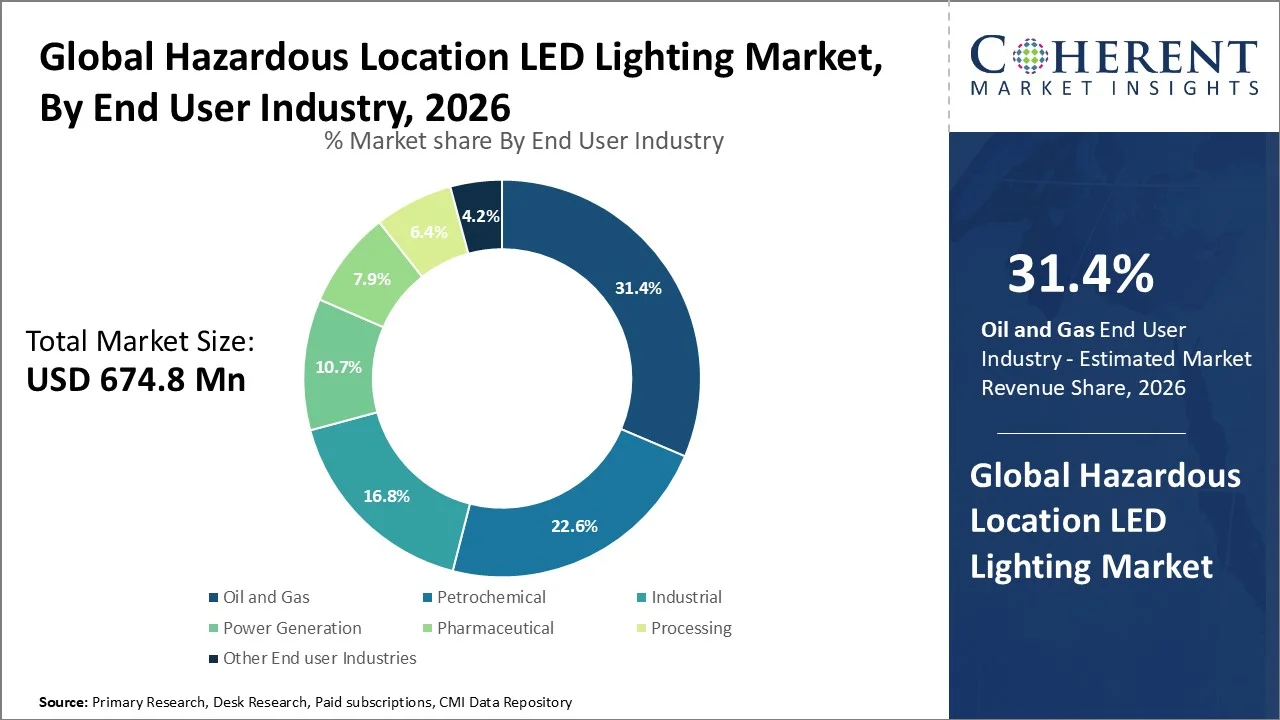
Oil and Gas account for the largest share of 31.4% in 2026 because upstream rigs, refineries, LNG terminals, gas processing plants, offshore platforms, tank farms, and petrochemical units have continuous exposure to flammable gases, vapours, dust, salt spray, vibration, and high ambient temperatures. This creates strong demand for certified explosion-proof LED lighting with long operating life and reduced shutdown-related maintenance. For instance, in April 2026, the U.S. EIA’s Short-Term Energy Outlook, projected U.S. crude oil production at 13.5 million barrels per day in 2026 and LNG exports at 17.0 billion cubic feet per day, indicating high activity across production, processing, storage, and export infrastructure. Furthermore, Occupational Safety and Health Administration (OSHA) hazardous-location regulation requires electrical equipment and wiring to match the presence and likelihood of flammable vapours, liquids, gases, or combustible dust. Eaton’s Crouse-Hinds HFL LED floodlights are listed for oil and gas refineries, drilling rigs, petrochemical facilities, and platforms, supporting segment-specific adoption.
Market Driver
Expansion of Oil & Gas and Petrochemical Facilities
Growing petrochemical and oil & gas facilities has driven the global hazardous location LED lighting market growth over the forecast period. Expansion of oil & gas and petrochemical facilities directly drives demand for hazardous-location LED lighting because every new LNG train, refinery unit, tank farm, compressor station, and petrochemical processing area requires certified lighting for flammable gases, vapors, and dust-prone zones. For instance, in April 2026, the U.S. Energy Information Administration, stated that U.S. LNG exports are forecast to rise by 1.9 Bcf/d in 2026 to 17.0 Bcf/d, supported by ramp-up of projects such as Corpus Christi Stage 3 and Golden Pass LNG. This indicates more hazardous operating areas needing reliable, explosion-proof illumination. Furthermore, on April 22, 2026, India’s PIB, reported that refinery companies and petrochemical complexes were permitted to supply C3 and C4 streams, and over 5,600 MT of propylene had been sold by refineries to chemical and pharma industries since April 9, 2026. Eaton’s Crouse-Hinds hazardous LED fixtures are specified for chemical, petrochemical, platforms, and heavy industrial facilities, supporting such expansion-driven demand.
Rising industrial automation and 24/7 plant operations
Rising industrial automation and 24/7 plant operations are increasing demand for hazardous-location LED lighting because automated plants need uninterrupted, clearly visible, low-maintenance illumination in areas with gas, vapour, dust, heat, vibration, and remote equipment. For instance, in May 2026, the International Federation of Robotics reported that China’s manufacturing sector operated around 2 million robots and accounted for 54% of annual global industrial robot installations, showing how continuous automated production is expanding globally. Moreover, in the U.S., the Federal Reserve’s April 16, 2026 release showed mining capacity utilization at 84.5%, indicating high operating intensity in sectors such as oil, gas, and minerals. OSHA requires hazardous-location electrical equipment to be intrinsically safe or approved for the specific classified location. Therefore, plants shift to certified explosion-proof LEDs with longer service life, instant-on operation, monitoring, and lower relamping downtime. Dialight’s SafeSite High Bay, for example, is rated over 150,000 hours.
Advancement in smart monitoring, predictive maintenance, and explosion-proof LED technology is transforming the Hazardous Location LED Lighting Market
Innovation in hazardous location LED lighting can drive the hazardous location LED lighting market growth by making lighting systems safer, smarter, more energy-efficient, and easier to maintain in high-risk industrial environments.
Advanced LED fixtures with explosion-proof designs, better thermal management, corrosion-resistant housings, and higher ingress protection ratings improve reliability in oil & gas, petrochemical, mining, pharmaceutical, and power generation facilities. Smart hazardous-location LEDs with IoT sensors, remote monitoring, dimming controls, motion detection, and predictive maintenance features help operators reduce downtime and improve plant safety.
Advancement in smart monitoring, predictive maintenance, and explosion-proof LED technology is transforming the Hazardous Location LED Lighting Market by shifting demand from basic illumination to connected asset management. For instance, on January 13, 2026, according to the data published by the U.S. Department of Labor, hazard Communication redline document, published specifies the use of explosion-proof electrical, ventilating, and lighting equipment where volatile liquids may generate explosive atmospheres, strengthening compliance-driven replacement demand. Moreover, Eaton’s official 2026 product page for Champ VMV Connected hazardous-area LED fixtures states that sensors detect occupancy, lighting levels, and ambient temperature, while controllers send fixture/sensor alarms and provide energy metering, supporting predictive maintenance and lower downtime. Additionally, in April, 2026, the U.S. Department of Energy, reported nearly USD 13 million in annual savings across 95 million square feet from high-efficiency lighting upgrades, proving the cost logic behind LED conversion. Dialight’s April 22, 2026 announcement also highlighted hazardous and industrial LED innovations for extreme iron and steel environments.
Current Events and Their Impact on the Hazardous Location LED Lighting Market
Current Event | Description and its Impact |
Increasing Favorable Regulatory Shifts |
|
2026 National Electrical Code Strengthens Focus on Hazardous Classified Installations |
|
European Commission Issues 6th Edition ATEX Guidelines in January 2026 |
|
Increasing Government Rules and Supportive Policy |
|
IEC Publishes IEC 60079:2026 Series for Explosive Atmospheres |
|
Hazardous Location LED Lighting Market Trends
- Smart monitoring and predictive maintenance are becoming core adoption trends – Hazardous location LED lighting is shifting from simple illumination to connected safety infrastructure. Eaton’s 2026 Crouse-Hinds Champ VMVL intelligent fixtures monitor ambient light, temperature, motion, energy consumption, and fixture health; irregularities generate alarms through Brightlayer Lighting software for planned action. Eaton also states intelligent controls can reduce lighting energy use by up to 50%, supporting predictive maintenance and lower downtime in hazardous plants.
Source: Eaton
- Retrofit replacement of HID and fluorescent fixtures is accelerating industrial users are replacing legacy HID and fluorescent lighting because hazardous areas need lower maintenance, stronger safety, and higher energy efficiency. In March 2026, Dialight launched its DuroSite High Output LED Floodlight for APAC and EMEA, noting that an estimated 50% of targeted industries still use traditional HID lighting. The product targets ports, rail yards, processing infrastructure, stockpiles, and security perimeters.
- ATEX, IECEx, and zone-compliant lighting is gaining priority – Regulatory compliance is a major trend as buyers increasingly specify certified products for Zone 1, Zone 2, Zone 21, and Zone 22 environments. The European Commission’s ATEX page states that the sixth edition of ATEX Directive 2014/34/EU guidelines was issued in January 2026. Eaton’s ExLin LED fixture also lists IECEx/ATEX ratings for Zone 1 and Zone 21, with IP66/IP67 protection.
- Oil & gas and offshore applications are driving demand for rugged LEDs – Offshore platforms, refineries, and petrochemical facilities need lighting that can tolerate vibration, corrosion, moisture, and hazardous gases. In April 2026, Dialight confirmed participation at Offshore Technology Conference 2026 in Houston, highlighting rugged LED solutions for harsh and hazardous offshore applications. OTC 2026 covers more than 162,000 sq. ft. of exhibit space and attracts over 30,000 attendees from 100+ countries.
- Dust-heavy industrial environments are creating new LED demand – Grain handling, bulk material processing, food processing, and powder-handling facilities are increasing demand for explosion-proof and dust-rated LED fixtures. In January 2026, Dialight announced its GEAPS Exchange 2026 participation and highlighted rugged LED solutions for dusty and hazardous grain handling environments. Products showcased included DuroSite LED Linear, Vigilant Linear, SafeSite High Bay, ProSite Floodlight, and Swivelpole integrated solutions.
- High-performance engineering is replacing basic explosion-proof design Buyers now prefer hazardous LEDs with corrosion-resistant housings, higher ingress protection, vibration resistance, emergency options, and thermal control. Eaton’s HPL LED explosion-proof fixtures cover Zone 1/2 gas and Zone 21/22 dust environments, provide 3,000–8,000 lumens, and deliver up to 66% energy savings compared with HID fixtures. The products also offer IP66 protection, anti-shock design, vibration resistance, and mercury-free construction.
Regional Insights
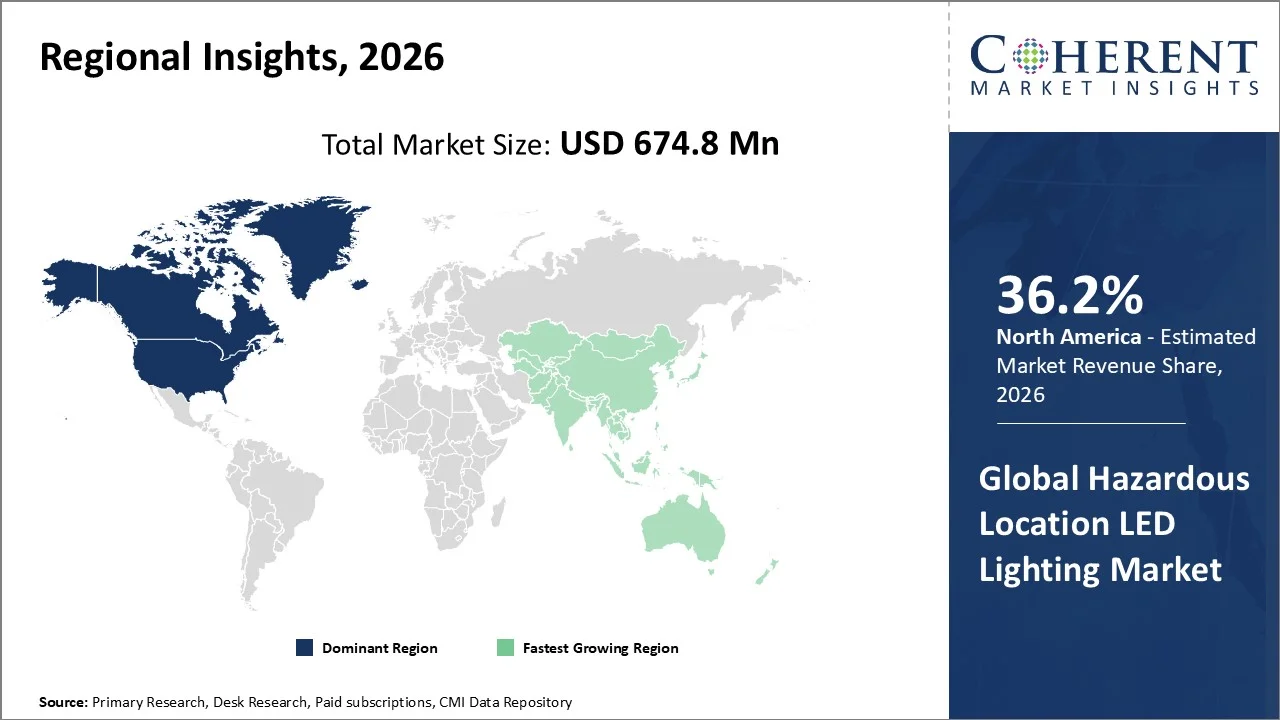
North America Dominates Owing to Large Hydrocarbon Operations
North America account 36.2% market share in 2026, supported by because the region has strict workplace-safety rules, large hydrocarbon operations, and mature replacement demand from refineries, LNG terminals, chemical plants, wastewater facilities, and industrial sites. OSHA requires electrical equipment and wiring in hazardous classified locations to be suitable for areas where flammable vapors, gases, liquids, combustible dusts, or fibers may be present. For instance, the operating base is large: U.S. Energy Information Administration’s Weekly Petroleum Status Report, reported U.S. refinery inputs of 16.0 million barrels per day and refinery utilization of 90.1% for the week ending May 1, 2026. Furthermore, on February 13, 2026, U.S. Energy Information Administration also stated that U.S. marketed natural gas production is expected to average 120.8 Bcf/d in 2026. These high-risk, continuous-process facilities require certified explosion-proof LED lighting for safety, compliance, and lower maintenance.
Asia Pacific Hazardous Location LED Lighting Market Trends
The Asia-Pacific region is poised to be as the fastest-growing region through 2026-2033, owing to rapid refinery, LNG, CNG/CBG, chemical, mining, and industrial manufacturing expansion is increasing the number of classified hazardous zones that require certified LED lighting. For instance, on April 17, 2026, China’s National Bureau of Statistics, published reported that industrial value added rose 6.1% year-on-year during January–March 2026, while petroleum and natural gas extraction grew 9.4% and raw chemical materials and chemical products grew 9.0% in March 2026. Additionally, India is also expanding gas and fuel infrastructure: PIB, published on April 22, 2026, stated that PESO disposed of 467 CNG/CBG station applications since March 25, 2026, approved 41 biogas cylinder filling/storage plants, and granted 5 MMTPA additional LNG regasification capacity at Dahej. These developments increase demand for explosion-proof LED lighting in gas stations, refineries, petrochemical units, and fuel storage sites.
Heavy Manufacturing Sites is Accelerating the Hazardous Location LED Lighting Market Demand in United States
The U.S. dominates the North America hazardous-location LED lighting market because it has the region’s largest concentration of oil and gas, LNG, refining, petrochemical, mining, utilities, and heavy manufacturing sites that require certified lighting in explosive or harsh operating areas. For instance, on April 7, 2026, the U.S. Energy Information Administration’s Short-Term Energy Outlook, projected U.S. crude oil production at 13.5 million barrels per day and LNG exports at 17.0 billion cubic feet per day in 2026, supporting strong demand from terminals, platforms, processing plants, and storage facilities. Furthermore, in April 2026, the Federal Reserve release reported U.S. mining capacity utilization at 84.5%, showing high operating intensity in hazardous industrial settings. OSHA also requires hazardous-location electrical equipment to be approved for the specific classified location. Eaton’s Crouse-Hinds NLE LEDs target heavy industrial, chemical, petrochemical, platforms, and utilities, reinforcing U.S. adoption.
India Hazardous Location LED Lighting Market Trends
India is emerging as a dominant country in the Asia Pacific Hazardous Location LED Lighting Market because its core hazardous industries oil refining, petrochemicals, chemicals, mining, and energy are expanding at scale and require certified flameproof, explosion-proof, and dust-protected lighting. For instance, in May 2026, Petroleum Planning & Analysis Cell-PPAC’s refinery capacity page, updated 2026 lists India’s installed refining capacity at 258,116 thousand MT, creating continuous demand for Zone-rated lighting across refineries, storage terminals, and process units. Furthermore, in January 2026, Press Information Bureau reported that India’s chemicals and petrochemicals sector contributed 8.1% to manufacturing GVA, while selected chemicals and petrochemicals production reached 58,617 thousand MT in FY25, supporting hazardous-area lighting demand in processing plants. Mining also strengthens demand: PIB stated on April 2, 2026 that captive and commercial coal production reached 210.46 MT in FY2025–26, with 12 new blocks operationalized, increasing lighting needs in dust-prone hazardous sites.
Who are the Major Companies in Hazardous Location LED Lighting Market
Some of the major key players in Hazardous Location LED Lighting Market are Worksite Lighting LLC, DCD Technologies ME FZCO, Azz Inc., Nemalux Inc., IKIO LED Lighting, Luceco Middle East FZCO, Glamox UK, WAROM Technology MENA FZCO, SA Equip, Shenzhen CESP Co. Ltd., Raytec Ltd., PROLUX International FZ LLC, Hilclare Lighting, Munira Lighting (AL Hatimi Trading FZE), Hubbell Limited, Emerson FZE (Emerson Electric Co.), Current Lighting Solutions LLC (GE Current), ABB Installation Products Inc., Larson Electronics LLC, R.Stahl Limited, Technology Co. Ltd., Digital Lumens Inc. (OSRAM), Dialight PLC, and Eaton Corporation
Key News
- In March 2026, Dialight, a company focused on providing hazardous and industrial LED lighting solutions launched its new DuroSite High Output LED Floodlight, designed for large-scale industrial applications across APAC and EMEA. The product targets ports, rail yards, onshore supply bases, stockpiles, processing infrastructure, and security perimeters. It is available in FA and FB series configurations, carries CE, ENEC, and RCM certifications, and includes features such as 50°C ambient temperature rating, vibration testing to ANSI C136.31, symmetric/asymmetric optics, and optional remote driver mounting up to 100 meters. The launch strengthens LED retrofit demand in heavy industrial and hazardous-adjacent environments where operators are replacing HID lighting to reduce maintenance, improve safety, and lower energy use.
Source: Dialight
- In February 2026, Inatex Global Pty Ltd., an Australian supplier of Warom Hazardous Area and other specialty asset protection equipment announced the release of the HRT97 Series IECEx Explosion-Proof LED Floodlight, developed for Zone 2 gas and Zone 21/22 dust hazardous areas. The product is IECEx and ATEX certified, supports IEC 60079 and EN 60079 standards, and is available from 200W to 1000W for large-area illumination. It is suitable for oil & gas facilities, petrochemical plants, LNG terminals, mining operations, chemical processing areas, and offshore platforms.
- In January 2026, Raytec, a UK-based manufacturer specializing in high-performance LED lighting introduced its upgraded Mid Power Range, with improvements aimed at lower operating costs, higher system efficiency, and better lighting performance across hazardous and industrial environments. The upgrade aligns with demand for more efficient LED fixtures in safety-critical zones where reliability, visibility, and maintenance reduction are key purchase criteria.
- In September 2025, LEDVANCE, a company providing general lighting for professional and consumer launched its first comprehensive Hazardous Location LED Luminaire Portfolio for North America. The portfolio includes explosion-proof high bay, linear, floodlight, and jelly jar fixtures. The products are UL844 certified and designed for Class I, Division 2; Class II, Divisions 1 & 2; and Class III environments. The fixtures also feature IP66 and IK08 ratings, with lifespans up to 100,000 hours.
Market Report Scope
Hazardous Location LED Lighting Market Report Coverage
| Report Coverage | Details | ||
|---|---|---|---|
| Base Year: | 2025 | Market Size in 2026: | USD 674.8 Mn |
| Historical Data for: | 2020 To 2024 | Forecast Period: | 2026 To 2033 |
| Forecast Period 2026 to 2033 CAGR: | 8.5% | 2033 Value Projection: | USD 1,197.4 Mn |
| Geographies covered: |
| ||
| Segments covered: |
| ||
| Companies covered: | Worksite Lighting LLC, DCD Technologies ME FZCO, Azz Inc., Nemalux Inc., IKIO LED Lighting, Luceco Middle East FZCO, Glamox UK, WAROM Technology MENA FZCO, SA Equip, Shenzhen CESP Co. Ltd., Raytec Ltd., PROLUX International FZ LLC, Hilclare Lighting, Munira Lighting (AL Hatimi Trading FZE), Hubbell Limited, Emerson FZE (Emerson Electric Co.), Current Lighting Solutions LLC (GE Current), ABB Installation Products Inc., Larson Electronics LLC, R.Stahl Limited, Technology Co. Ltd., Digital Lumens Inc. (OSRAM), Dialight PLC, and Eaton Corporation | ||
Analyst Opinion
- The Hazardous Location LED Lighting Market is moving from basic illumination replacement to safety-led capital investment, because industrial buyers now evaluate fixtures based on explosion-proof certification, thermal control, enclosure integrity, and compliance readiness. OSHA states that hazardous classified locations include areas where flammable vapors, liquids, gases, combustible dusts, or fibers may be present, including petroleum and chemical processing plants. In 2026, this compliance pressure strengthened further as IEC published IEC 60079:2026 on April 28, 2026 for equipment used in explosive atmospheres. This shows that certified LED lighting is becoming a core safety requirement, not a discretionary upgrade.
- Oil & gas and refining facilities remain the strongest demand base for hazardous location LED lighting, especially in North America, because these sites contain Class I environments with flammable gases and vapors. EIA’s Weekly Petroleum Status Report, published on May 6, 2026, reported that U.S. refinery inputs averaged 16.0 million barrels per day for the week ending May 1, 2026, while refineries operated at 90.1% of capacity. In February 2026, EIA also forecast U.S. marketed natural gas production at 120.8 Bcf/d in 2026. This operating intensity supports demand for explosion-proof LED fixtures in refineries, gas plants, compressor stations, terminals, and storage areas.
- Asia Pacific is emerging as the fastest-expanding opportunity area because industrial growth is increasing the number of hazardous zones across oil & gas, chemicals, mining, CNG/CBG stations, LNG facilities, and manufacturing sites. China’s National Bureau of Statistics, published on April 17, 2026, reported that petroleum and natural gas extraction rose 9.4% and raw chemical materials and chemical products rose 9.0% in March 2026. India’s PIB, published on April 22, 2026, stated that PESO disposed of 467 CNG/CBG station applications since March 25, 2026 and approved 41 biogas cylinder filling and storage plants. This infrastructure growth directly supports demand for certified hazardous-area LEDs.
- Europe is strengthening the quality and certification side of the market, making ATEX-compliant LED lighting essential for suppliers targeting petrochemical plants, offshore platforms, mines, flour mills, and other explosive-atmosphere applications. The European Commission states that ATEX Directive 2014/34/EU covers equipment and protective systems intended for potentially explosive atmospheres and defines essential health and safety requirements before products are placed on the EU market. In January 2026, the Commission issued the sixth edition of the ATEX Directive guidelines, reinforcing the need for correct documentation, conformity assessment, CE marking, and standard-aligned product design. These favors established manufacturers with certified hazardous location LED portfolios.
Source: European Commission
Speak to the analyst
Want personalized insights?
Take the findings above to one of our principal consultants, or have the report rebuilt around the segments, geographies and competitors you actually track.
Market Segmentation
- By Class (Revenue, USD Mn, 2021-2033)
- Class-I
- Class-II
- Class-III
- By Device Type (Revenue, USD Mn, 2021-2033)
- Zone 0
- Zone 20
- Zone 1
- Zone 21
- Zone 2
- Zone 22
- By End User Industry (Revenue, USD Mn, 2021-2033)
- Oil and Gas
- Petrochemical
- Industrial
- Power Generation
- Pharmaceutical
- Processing
- Other End user Industries
- By Region (Revenue, USD Mn, 2021-2033)
- North America
- U.S.
- Canada
- Latin America
- Brazil
- Mexico
- Argentina
- Rest of Latin America
- Europe
- Germany
- U.K.
- France
- Italy
- Spain
- Russia
- Rest of Europe
- Asia Pacific
- China
- India
- Japan
- Australia
- South Korea
- ASEAN
- Rest of Asia Pacific
- Middle East
- GCC
- Israel
- Rest of Middle East
- Africa
- South Africa
- Central Africa
- North Africa
- North America
- Competitive Landscape
- Worksite Lighting LLC
- DCD Technologies ME FZCO
- Azz Inc.
- Nemalux Inc.
- IKIO LED Lighting
- Luceco Middle East FZCO
- Glamox UK
- WAROM Technology MENA FZCO
- SA Equip
- Shenzhen CESP Co. Ltd.
- Raytec Ltd.
- PROLUX International FZ LLC
- Hilclare Lighting, Munira Lighting (AL Hatimi Trading FZE)
- Hubbell Limited
- Emerson FZE (Emerson Electric Co.)
- Current Lighting Solutions LLC (GE Current)
- ABB Installation Products Inc.
- Larson Electronics LLC
- Stahl Limited
- Technology Co. Ltd.
- Digital Lumens Inc. (OSRAM)
- Dialight PLC
- Eaton Corporation
Sources
Primary Research Interviews
- Interviews with EHS managers and plant safety officers to assess compliance needs and lighting replacement priorities.
- Insights from LED manufacturers and certification experts on ATEX, IECEx, UL, and NEC standards.
- Discussions with oil & gas, chemical, mining, and wastewater operators to understand adoption drivers.
- Conversations with distributors, EPCs, and procurement teams to evaluate pricing, supply, and supplier selection.
Databases
- U.S. Energy Information Administration (EIA)
- U.S. Bureau of Labor Statistics (BLS)
- U.S. Census Bureau – Manufacturing and Construction Data
- Eurostat Industrial Production Database
- UN Comtrade Database
Magazines
- LEDs Magazine
- Electrical Contractor Magazine
- EC&M Magazine
- Offshore Magazine
- Processing Magazine
Journals
- IEEE Transactions on Industry Applications
- Journal of Loss Prevention in the Process Industries
- Safety Science Journal
- Process Safety Progress
- Lighting Research & Technology
Newspapers
- The Wall Street Journal – Energy and Industrials Section
- Financial Times – Energy and Manufacturing Section
- Reuters – Energy and Industrial News
- The Economic Times – Energy and Infrastructure Section
- Nikkei Asia – Industrial and Energy Section
Associations
- National Fire Protection Association (NFPA)
- International Electrotechnical Commission (IEC)
- IECEx System
- National Electrical Manufacturers Association (NEMA)
- Association of Energy Engineers (AEE)
Public Domain Sources
- Occupational Safety and Health Administration (OSHA)
- U.S. Department of Energy (DOE)
- European Commission ATEX Directive Documents
- UK Health and Safety Executive (HSE)
- Press Information Bureau (PIB), India
Proprietary Elements
- CMI Data Analytics Tool
- Proprietary CMI Existing Repository of information for last 10 years
Get access to 250+ pages report
Every segment, forecast, competitor profile and data table behind the analysis above — available for instant download.
- ESOMAR Member
- ISO 9001:2015 Certified
- D-U-N-S Registered
- GDPR & CCPA Compliant
Missing comfort of reading report in your local language? Find your preferred language:
Transform your Strategy with Exclusive Trending Reports
Frequently Asked Questions
The Hazardous Location LED Lighting Market is expected to reach USD 1,197.4 Mn in 2033.
Major players operating in the global Hazardous Location LED Lighting Market include Worksite Lighting LLC, DCD Technologies ME FZCO, Azz Inc., Nemalux Inc., IKIO LED Lighting, Luceco Middle East FZCO, Glamox UK, WAROM Technology MENA FZCO, SA Equip, Shenzhen CESP Co. Ltd., Raytec Ltd., PROLUX International FZ LLC, Hilclare Lighting, Munira Lighting (AL Hatimi Trading FZE), Hubbell Limited, Emerson FZE (Emerson Electric Co.), Current Lighting Solutions LLC (GE Current), ABB Installation Products Inc., Larson Electronics LLC, R.Stahl Limited, Technology Co. Ltd., Digital Lumens Inc. (OSRAM), Dialight PLC, and Eaton Corporation among others.
High cost of replacing traditional lamps to LED lighting and Growing concerns about diode quality are the major factors hampering the growth of the hazardous location LED lighting market.
Expansion of oil & gas and petrochemical facilities and rising industrial automation and 24/7 plant operations are the key factors driving growth of the hazardous location LED lighting market.
The Hazardous Location LED Lighting Market is anticipated to grow at a CAGR of 8.5% between 2026 and 2033.
Among regions, North America is expected to account for a largest market share in the global Hazardous Location LED Lighting Market over the forecast period.