

5G Chipset Market Size and Forecast – 2026 to 2033
The Global 5G Chipset Market is estimated to be valued at USD 45.62 Bn in 2026 and is expected to reach USD 157.84 Bn by 2033, exhibiting a compound annual growth rate (CAGR) of 19.4% from 2026 to 2033.
Key Takeaways
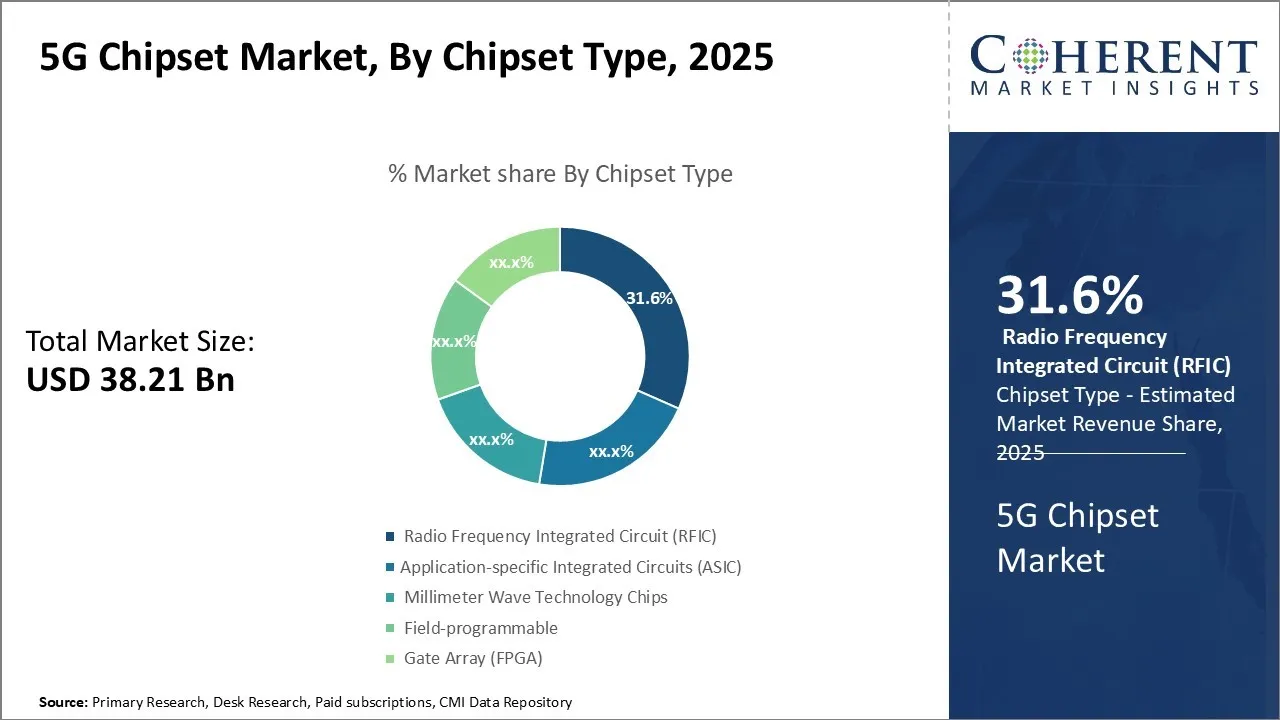
- By Chipset Type, Radio Frequency Integrated Circuit (RFIC) hold the largest market share of 32.6% in 2026 owing to the rapid deployment of 5G networks.
- By Operational Frequency, 26-39 GHz expected to hold largest market share of 47.7% in 2026 owing to the large spectrum availability.
- By Vertical, IT & Telecom acquired the prominent market share of 42.8% in 2026 owing to its massive infrastructure build‑out.
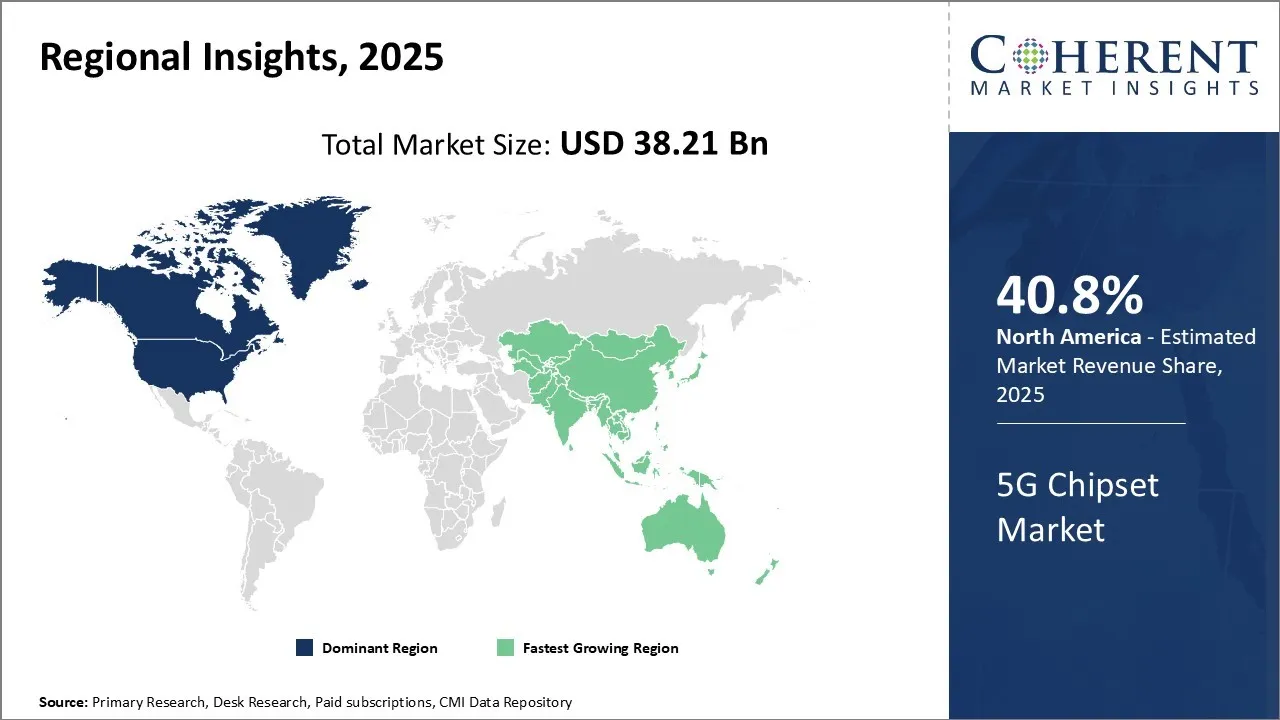
- By Region, North America dominates the overall market with an estimated share of 40.8% in 2026 owing to the strong 5G adoption & infrastructure rollout.
Market Overview
The 5G chipset market is rapidly expanding as telecom, IT, and consumer electronics sectors increasingly adopt 5G networks worldwide. Companies are investing in chipsets that support sub-6 GHz and mm Wave bands to meet the rising demand for high-speed data, low-latency applications, and advanced connectivity solutions. Innovations in RF technology, semiconductor materials, and integrated system-on-chips improve device performance and energy efficiency. The deployment of private networks, fixed wireless access, and edge computing continues to create new market opportunities, positioning 5G chipsets at the core of next-generation communication infrastructure.
Current Events and Its Impact on the 5G Chipset Market
Current Events | Description and its impact |
Geopolitical Tensions and Trade Policies |
|
Technological Advancements and Industry Innovations |
|
Macroeconomic Trends and Supply Chain Dynamics |
|
Segmental Insights
- Current Industry Events of 2026
- Market Size Estimation
- Regional Breakdown
- Competitive Landscape
- Customer Intelligence
- Segmental Analysis
- Pricing Analysis
- Key Market Drivers, Challenges & Future Trends
- Customized Insights Section
5G Chipset Market Insights, By Chipset Type: Radio Frequency Integrated Circuit (RFIC) contribute the highest share of the market owing to its technological advancements in semiconductor processes.
Radio Frequency Integrated Circuit (RFIC) hold the largest market share of 32.6% in 2026. The 5G chipset market is increasingly adopting Radio Frequency Integrated Circuits (RFICs) to achieve efficient high-frequency signal processing and compact communication components. RFICs deliver reliable connectivity across sub-6 GHz and mmWave bands, enabling faster data transmission and lower latency. Semiconductor advancements, enhanced power efficiency, and the integration of multiple functions into single chips boost network performance. The rapid rollout of 5G infrastructure, smartphones, IoT devices, and emerging solutions such as private networks and edge computing continues to propel RFIC demand.
In May 2025, Natcast, the non-profit running the National Semiconductor Technology Center (NSTC), has finalized contracts for its first R&D Jump Start program, AIDRFIC, focused on AI-driven RF integrated circuit.
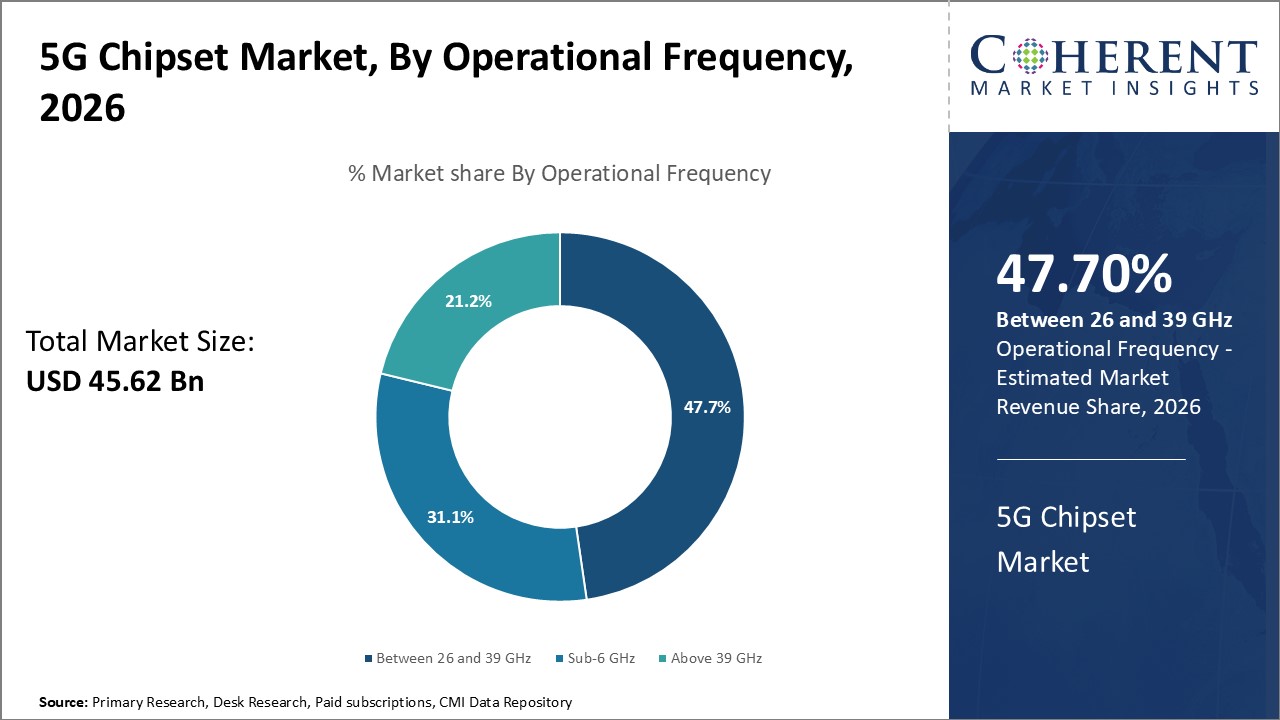
5G Chipset Market Insights, By Operational Frequency: 26-39 GHz contribute the highest share of the market owing to its fixed wireless access (FWA).
26-39 GHz expected to hold largest market share of 47.7% in 2026. Telecom operators and device manufacturers are increasingly adopting 26–39 GHz spectrum chipsets in the 5G market to deliver ultra-high-speed data and low-latency connectivity. These chipsets power advanced applications such as augmented reality, virtual reality, and high-capacity fixed wireless access. Innovations in millimeter-wave transceivers and RF front-end modules enhance signal reliability and energy efficiency. The ongoing expansion of 5G infrastructure, enterprise networks, and next-generation consumer devices continues to accelerate the adoption of chipsets capable of operating in the 26–39 GHz band.
5G Chipset Market Insights, By Vertical: IT & Telecom contribute the highest share of the market owing to its virtualization, network slicing, and private 5G.
IT & Telecom acquired the prominent market share of 42.8% in 2026. The IT and telecom sectors are actively propelling the 5G chipset market by investing in network modernization and advanced connectivity solutions. Telecom operators install 5G base stations, small cells, and Massive MIMO systems, relying on high-performance chipsets to ensure seamless data transmission. Rising demand for enterprise solutions, cloud services, and IoT applications drives the need for low-latency, high-capacity networks. Furthermore, private 5G deployments, edge computing, and virtualization technologies depend on sophisticated chipsets, positioning IT and telecom as key drivers of 5G infrastructure growth and adoption. For instance, in May 2025, MediaTek announced the launch of premium 5G phones using its new Dimensity 9400e chip. The company also introduced its T930 chip for 5G FWA and mobile Wi-Fi devices, supporting sub-6 GHz bands and speeds up to 10Gbps.
Regional Insights
North America 5G Chipset Market Trends
North America dominates the overall market with an estimated share of 40.8% in 2026. Leading semiconductor firms in North America actively shape the 5G chipset market, supported by government initiatives like the CHIPS Act that promote domestic chip production. Telecom operators rapidly deploy mmWave and mid-band 5G infrastructure, while businesses implement private networks and edge computing for industrial applications. A sophisticated consumer base, along with continuous innovation in low-latency, high-throughput chipsets, drives strong market growth and reinforces the region’s position as a technology leader in 5G development. For instance, in April 2026, Orbic and GCT announced a letter of intent to jointly develop and supply an Orbic-branded mobile hotspot and FWA gateway using a Verizon-certified 5G module powered by GCT’s new 5G chipset.
Asia Pacific 5G Chipset Market Trends
Expansive 5G rollouts in China, India, South Korea, and Japan are actively driving the Asia Pacific 5G chipset market, supported by strong local semiconductor companies. Rapid smartphone adoption, growing IoT deployments, and smart-city projects are increasing demand for advanced 5G chipsets. Governments across the region promote 5G infrastructure through favorable policies and spectrum allocation. At the same time, chipset manufacturers are developing high-performance, energy-efficient designs to meet the needs of both consumer and industrial applications.
MediaTek has introduced Dimensity, its new family of powerful 5G SoCs that combine advanced connectivity, multimedia, AI, and imaging features for premium phones. The Dimensity lineup is designed to drive next-generation 5G innovation and give consumers faster, smarter mobile experiences.
United States 5G Chipset Market Trends
Leading domestic semiconductor firms like Qualcomm, Intel, and Broadcom are actively driving the United States 5G chipset market through continuous innovation. Telecom giants such as Verizon, AT&T, and T-Mobile are rapidly expanding 5G infrastructure, focusing on mmWave and mid-band, while fixed wireless access emerges as a major application. Industries increasingly adopt edge computing and private 5G networks, and the availability of advanced spectrum allows chipset manufacturers to develop high-performance, low-latency solutions that meet growing connectivity demands. For instance, Apple has released a new version of its most affordable iPhone with a faster processor and 5G connectivity.
China 5G Chipset Market Trends
The Chinese government actively supports local semiconductor development and drives the 5G chipset market to reduce reliance on foreign chips. Domestic companies are ramping up production of 5G baseband, RF, and integrated system chips, with major players like Huawei advancing technological independence. Rapid deployment of 5G base stations and the growth of IoT initiatives boost demand, while policy incentives motivate chipset manufacturers to innovate energy-efficient, high-performance 5G chip designs. For instance, Huawei’s sub-brand Honor has expanded its lineup by launching the Honor 30S, its first mid-range phone powered by the Kirin 820 5G chipset.
End-user Feedback and Unmet Needs in the 5G Chipset Market
- Performance and Speed Expectations: End-users increasingly demand chipsets that support ultra-fast data rates, low latency, and seamless connectivity for applications like AR/VR, cloud gaming, and real-time streaming. Current solutions sometimes fall short in delivering consistent high-speed performance, especially in congested networks or challenging environments, highlighting a critical gap in chipset efficiency and reliability.
- Power Efficiency and Thermal Management: Many users report that 5G devices face rapid battery drain and overheating during intensive usage. Chipsets that balance high performance with low power consumption and efficient heat management are still in demand. This feedback emphasizes the need for energy-optimized designs that maintain device longevity without compromising network speed or stability.
- Compatibility and Multi-Band Support: End-users expect chipsets to operate smoothly across sub-6 GHz and mmWave frequencies, as well as in diverse regional networks. Limited multi-band compatibility causes connectivity issues when devices roam or switch between bands. Meeting these requirements remains an unmet need for chip designers aiming to ensure global usability and seamless network transitions.
5G Chipset Market Trend
Expansion of MMWave and Sub-6 GHz Deployment
The 5G chipset market is witnessing a strong push toward supporting both mmWave and sub-6 GHz frequencies. Chipset makers are developing solutions that deliver high-speed data, low latency, and reliable coverage across urban and rural areas. Operators’ increasing deployment of dense small-cell networks and Massive MIMO infrastructure drives demand for versatile, multi-band chipsets capable of handling complex network traffic while maintaining energy efficiency and consistent performance across varying geographic regions.
Integration of RF and System-on-Chip Solutions
Market trends show growing adoption of RFIC integration within system-on-chip (SoC) designs. By combining multiple components, manufacturers reduce device size, improve power efficiency, and enhance performance. Integrated solutions allow smartphones, IoT devices, and industrial equipment to operate at higher speeds with lower latency. This trend supports compact form factors and simplifies manufacturing while addressing end-user expectations for seamless connectivity, robust signal strength, and extended battery life in increasingly sophisticated 5G-enabled devices.
5G Chipset Market Opportunity
Fixed Wireless Access (FWA) Expansion
Fixed Wireless Access (FWA) is emerging as a compelling alternative to fiber in underserved or hard-to-wire areas. 5G chipsets optimized for CPE (customer premise equipment) can deliver broadband-like speeds over wireless connections, driving new demand. Chipset companies can seize this opportunity by developing cost-effective, power-efficient modems and RFICs that support long-range coverage and stable throughput, thereby enabling ISPs and telecom operators to expand broadband services faster and more flexibly.
Market Report Scope
5G Chipset Market Report Coverage
| Report Coverage | Details | ||
|---|---|---|---|
| Base Year: | 2025 | Market Size in 2026: | USD 45.62 Bn |
| Historical Data for: | 2020 To 2024 | Forecast Period: | 2026 To 2033 |
| Forecast Period 2026 to 2033 CAGR: | 19.4% | 2033 Value Projection: | USD 157.84 Bn |
| Geographies covered: |
| ||
| Segments covered: |
| ||
| Companies covered: | Altiostar, Analog Devices, Inc., Anokiwave, Inc., Broadcom Inc., Huawei Technologies Co., Ltd., Infineon Technologies AG, Intel Corporation, Marvell Technology Group Ltd., MediaTek Inc., Nokia, Qualcomm Technologies, Inc., Qorvo, Inc., Renesas Electronics Corporation, Samsung Electronics Co., Ltd., and Texas Instruments Incorporated | ||
| Growth Drivers: |
| ||
| Restraints & Challenges: |
| ||
5G Chipset Market News
- In November 2025, Samsung launched the Galaxy Book 5 Edge 5G in select markets as the latest addition to its Galaxy Book 5 series and the successor to the Galaxy Book 4 Edge.
- In November 2025, Motorola launched the Moto G67 Power 5G in India, featuring a large battery, a powerful processor, and a premium vegan leather finish, all for about Rs 15,999.
- In February 2025, Qualcomm has launched the Snapdragon 6 Gen 4 5G chipset for premium mid-range phones, saying it delivers faster performance and better power efficiency for smooth gaming, creation, and everyday use.
Analyst Opinion (Expert Opinion)
- Frankly, the 5G chipset arena is entering a crucible where sheer volume is no longer enough — differentiation is critical. MediaTek’s recent surge (its 5G‑smartphone shipments jumped significantly) over Qualcomm in some quarters illustrates that OEMs are favoring cost‑effective silicon even in 5G devices. Qualcomm’s dominance in modem IP is under increasing pressure, and its rising R&D spend must translate into real architectural advances, not just incremental gains.
- mmWave-enabled handsets routinely throttle under sustained load because chipsets overheat — studies show a drop in aggregated channels in real-world tests due to thermal limits. If chipset providers don’t solve for prolonged mmWave throughput, 5G’s promise in high‑density settings (stadiums, campuses) could be hollow.
- There’s also a strategic pivot: network silicon is fragmenting. Open RAN and AI-driven beamforming — as seen in products like Nokia’s ReefShark 6 and Marvell’s DPUs — demand highly specialized 5G chips. General-purpose basebands won’t cut it. Players that lean into this niche (not just pursuing handset volume) will define the next phase.
- Geopolitics remains front and center: China’s push for domestic modem integration (e.g., Huawei’s Kirin line) underscores the risk of supply chain disruption. In short, the 5G chipset market is evolving into a battleground of thermal engineering, architectural specialization, and regional resilience — and the winners will be those who architect for these complexities, not just for volume.
Speak to the analyst
Want personalized insights?
Take the findings above to one of our principal consultants, or have the report rebuilt around the segments, geographies and competitors you actually track.
Market Segmentation
- Chipset Type Insights (Revenue, USD Bn, 2021 - 2033)
- Application-specific Integrated Circuits (ASIC)
- Radio Frequency Integrated Circuit (RFIC)
- Millimeter Wave Technology Chips
- Field-programmable
- Gate Array (FPGA)
- Operational Frequency Insights (Revenue, USD Bn, 2021 - 2033)
- Sub-6 GHz
- Between 26 and 39 GHz
- Above 39 GHz
- Vertical Insights (Revenue, USD Bn, 2021 - 2033)
- Manufacturing
- Energy & Utilities
- Media & Entertainment
- IT & Telecom
- Transportation & Logistics
- Healthcare
- Others
- Regional Insights (Revenue, USD Bn, 2021 - 2033)
- North America
- U.S.
- Canada
- Latin America
- Brazil
- Argentina
- Mexico
- Rest of Latin America
- Europe
- Germany
- U.K.
- Spain
- France
- Italy
- Russia
- Rest of Europe
- Asia Pacific
- China
- India
- Japan
- Australia
- South Korea
- ASEAN
- Rest of Asia Pacific
- Middle East & Africa
- GCC Countries
- Israel
- South Africa
- Rest of Middle East & Africa
- Key Players Insights
- Altiostar
- Analog Devices, Inc.
- Anokiwave, Inc.
- Broadcom Inc.
- Huawei Technologies Co., Ltd.
- Infineon Technologies AG
- Intel Corporation
- Marvell Technology Group Ltd.
- MediaTek Inc.
- Nokia
- Qualcomm Technologies, Inc.
- Qorvo, Inc.
- Renesas Electronics Corporation
- Samsung Electronics Co., Ltd.
- Texas Instruments Incorporated
Sources
Primary Research interviews
- 5G chipset engineers and product managers at Qualcomm, MediaTek, Broadcom, Huawei, and Samsung
- Network architects and CTOs from telecom operators like Verizon, AT&T, T-Mobile, China Mobile, and NTT Docomo
- IoT device manufacturers integrating 5G connectivity
- Semiconductor fabrication and RFIC design teams
Databases
- IEEE Xplore Digital Library
- GSMA Intelligence
- 3GPP standards repository
- FCC Spectrum Allocation Database
- ITU (International Telecommunication Union) Statistics Database
Magazines
- IEEE Spectrum
- Electronics Weekly
- EDN Network
- Semiconductor Engineering
- Network World
Journals
- IEEE Transactions on Microwave Theory and Techniques
- IEEE Transactions on Communications
- Journal of Semiconductor Technology and Science
- IEEE Journal on Selected Areas in Communications
- Microelectronics Journal
Newspapers
- The Wall Street Journal – Technology Section
- Financial Times – Telecom & Semiconductor Coverage
- The New York Times – Technology Section
- South China Morning Post – Technology Section
- The Economic Times – Telecom & Semiconductor Section
Associations
- GSMA (Global System for Mobile Communications Association)
- IEEE Communications Society
- 3GPP (3rd Generation Partnership Project)
- SEMI (Semiconductor Equipment and Materials International)
- ITU (International Telecommunication Union)
Public Domain sources
- Company press releases and annual reports (Qualcomm, MediaTek, Broadcom, Huawei, Samsung)
- FCC filings and spectrum auctions
- Patent databases (USPTO, WIPO)
- Academic white papers and preprints (arXiv, ResearchGate)
- Government technology policy documents
Proprietary Elements
- CMI Data Analytics Tool
- Proprietary CMI Existing Repository of information for last 8 years
Get access to 250+ pages report
Every segment, forecast, competitor profile and data table behind the analysis above — available for instant download.
- ESOMAR Member
- ISO 9001:2015 Certified
- D-U-N-S Registered
- GDPR & CCPA Compliant
Missing comfort of reading report in your local language? Find your preferred language:
Transform your Strategy with Exclusive Trending Reports
Frequently Asked Questions
The 5G Chipset Market is estimated to be valued at USD 45.62 Bn in 2026, and is expected to reach USD 157.84 Bn by 2033.
The CAGR of the 5G Chipset Market is projected to be 19.4% from 2026 to 2033.
Increasing mobile data traffic and advancement of IoT and connected devices are the major factors driving the growth of the global 5G chipset market.
High infrastructure investment required and latency and connectivity issues are the major factors hampering the growth of the global 5G chipset market.
In terms of Chipset Type, the Radio Frequency Integrated Circuit (RFIC) segment is estimated to dominate the market in 2026.
Altiostar, Analog Devices, Inc., Anokiwave, Inc., Broadcom Inc., Huawei Technologies Co., Ltd., Infineon Technologies AG, Intel Corporation, Marvell Technology Group Ltd., MediaTek Inc., Nokia, Qualcomm Technologies, Inc., Qorvo, Inc., Renesas Electronics Corporation, Samsung Electronics Co., Ltd., and Texas Instruments Incorporated are the major players.
North America is expected to lead the global 5G chipset market.