

LED Driver Market Size and Trends- 2026 to 2033
The Global LED Driver Market is estimated to be valued at USD 25.57 Bn in 2026 and is expected to reach USD 106.47 Bn by 2033, exhibiting a compound annual growth rate (CAGR) of 22.6% from 2026 to 2033.
Key Takeaways
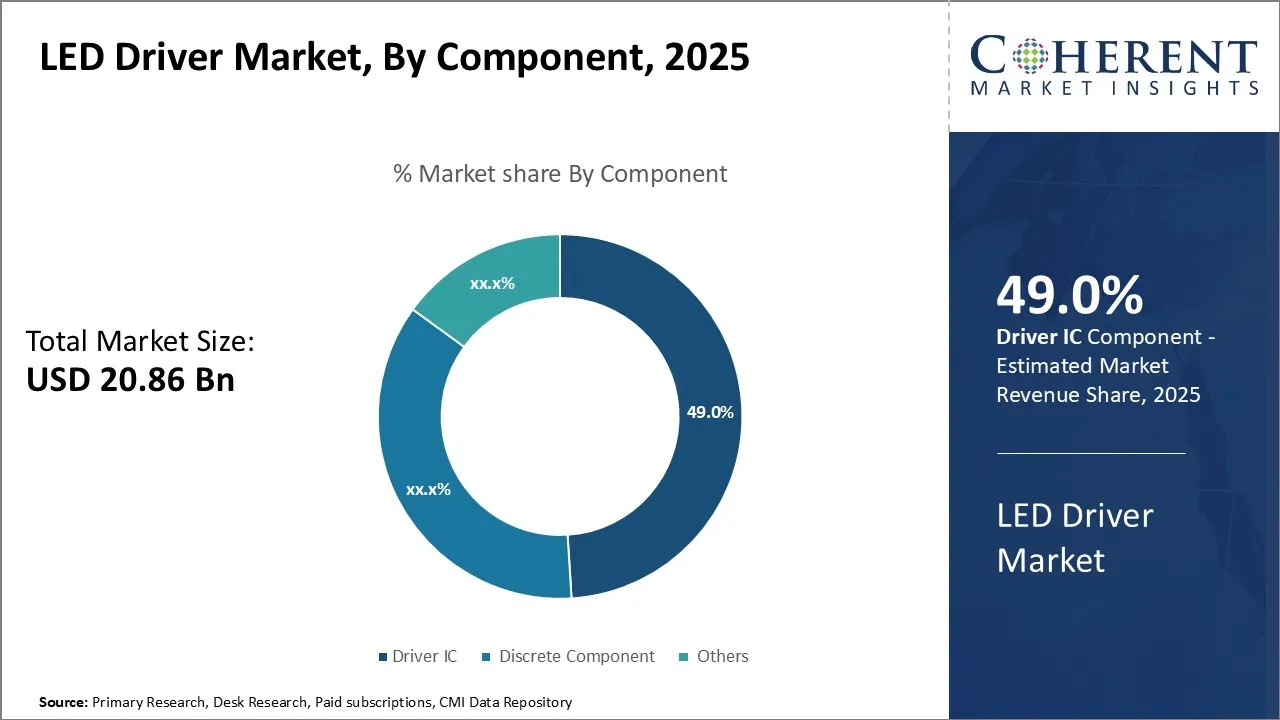
- Based on Component, the Driver IC segment is expected to lead the market with 50% share in 2026, driven by their compact, integrated, and cost-effective design.
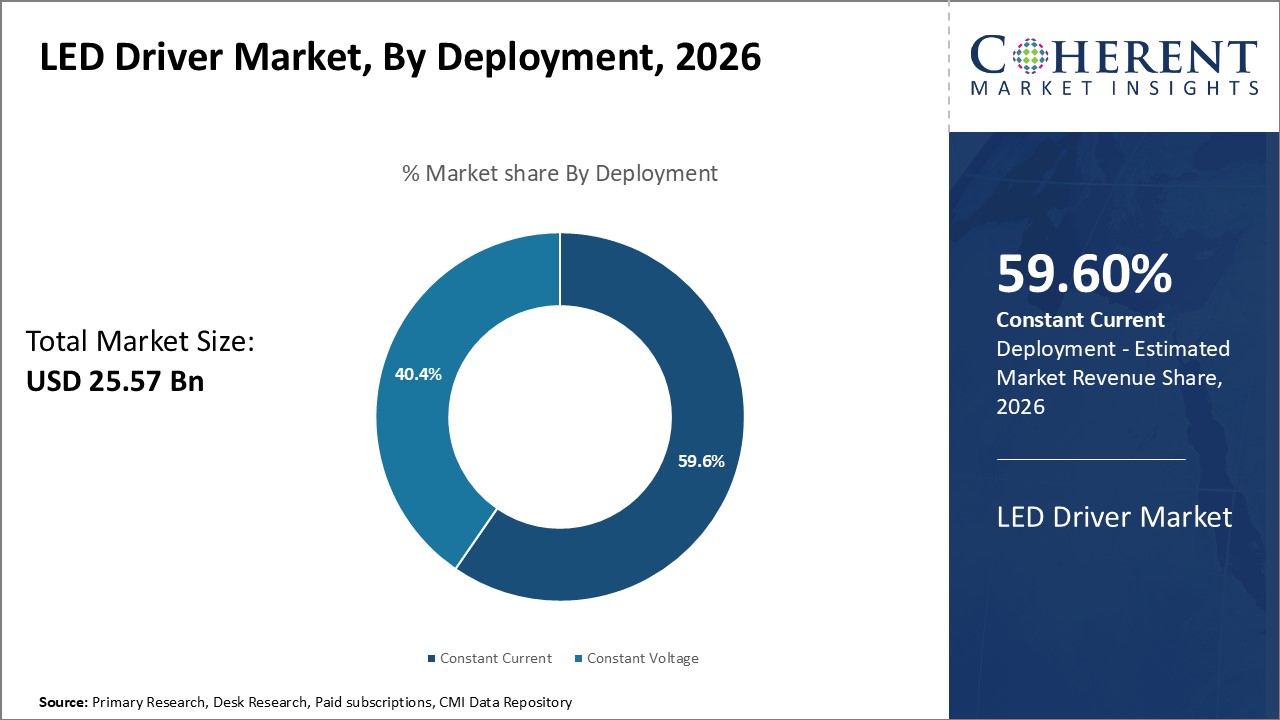
- Based on Supply Type, the Constant Current segment is projected to account for 59.6% share in 2026, ensuring stable, high-quality illumination across demanding applications.
- Based on Application, the Lighting segment is expected to hold the largest share of the market in 2026, driven by global energy mandates and widespread smart lighting adoption.
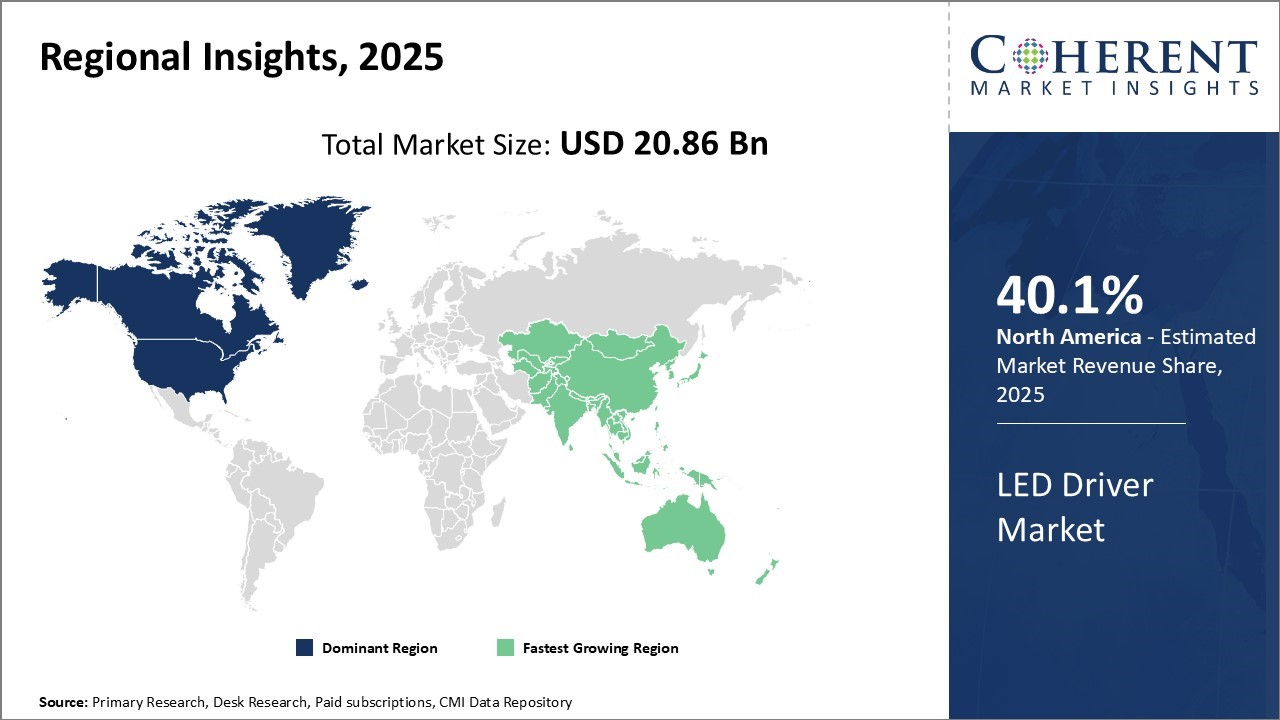
- Based on Region, North America is set to lead the market with 40.1% share in 2026. While, Asia Pacific is anticipated to be the fastest growing region.
Market Overview
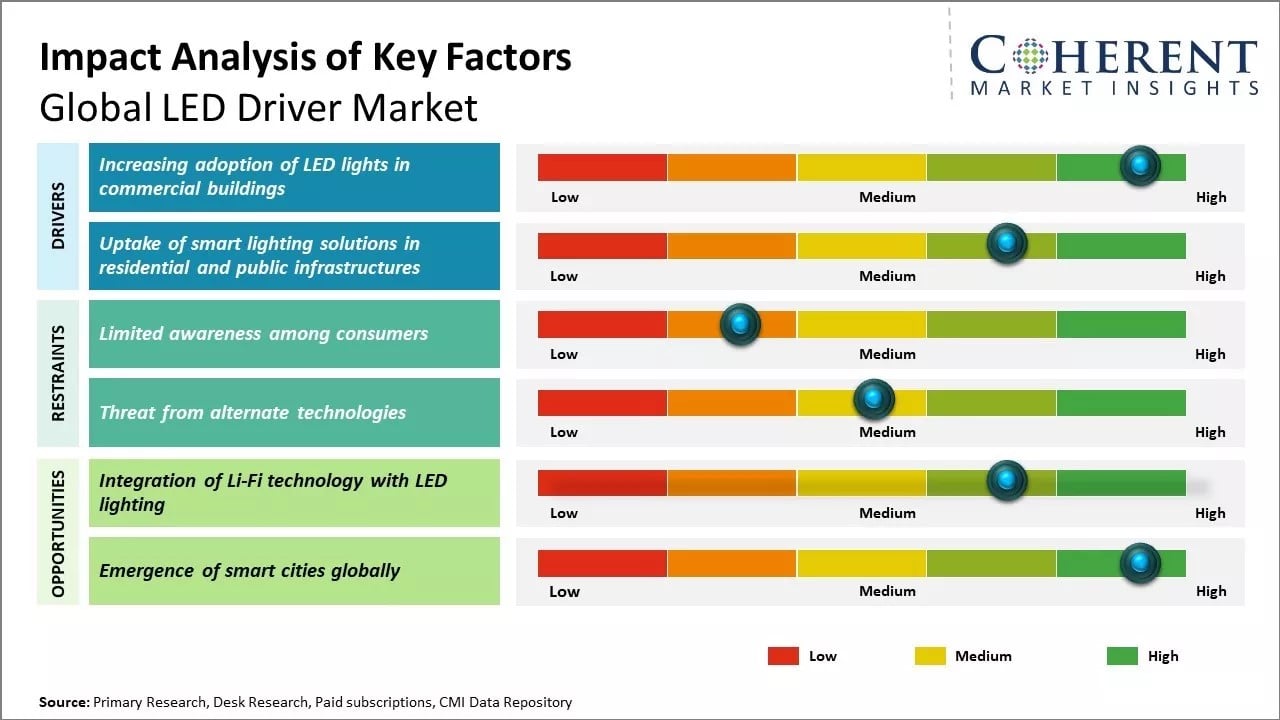
LEDs offer energy saving qualities and cost efficiency over traditional lighting. Manufacturers are focusing on developing energy efficient and sustainable lighting solutions to reduce energy consumption and carbon footprint. Also, rapid urbanization and infrastructure growth in developing nations have increased the demand for efficient lighting systems. Growing investments by governments worldwide in smart city projects utilizing LED lighting is another factor driving the LED driver market growth. However, high initial investment and availability of substitutes may hamper the market growth.
Current Events and Its Impacts on the LED Driver Market
Current Event | Description and its Impact |
Energy Efficiency Regulations and Government Policies |
|
Technological Advancement in IoT and Smart Lighting |
|
Smart LED Drivers
Smart LED drivers are transforming traditional lighting systems by integrating with Internet of Things (IoT) platforms to enable advanced functionality beyond illumination. These drivers allow remote control of lighting fixtures through mobile apps or centralized dashboards, making it easy to adjust brightness, color temperature, and scheduling from anywhere. They also support real-time diagnostics, detecting issues such as overheating or voltage irregularities and sending alerts for maintenance, which reduces downtime and operational costs.
Additionally, smart LED drivers collect and transmit energy usage data, helping facility managers optimize consumption and meet sustainability goals. When paired with sensors, they enable adaptive lighting that responds to occupancy or ambient light levels, enhancing comfort and efficiency. Their compatibility with building management systems allows seamless integration with HVAC, security, and other infrastructure, making them a cornerstone of modern smart buildings and cities.
For instance, in March 2025, Edison Opto launched its SMART RGB LED Series, integrating driver ICs with 16-bit PWM color control, temperature compensation, and low EMI architecture. Designed for automotive applications, these LEDs offer high-speed data transmission and precise color management. The series supports advanced lighting functions, enhancing performance and reliability in next-generation vehicle lighting systems.
- Current Industry Events of 2026
- Market Size Estimation
- Regional Breakdown
- Competitive Landscape
- Customer Intelligence
- Segmental Analysis
- Pricing Analysis
- Key Market Drivers, Challenges & Future Trends
- Customized Insights Section
Segmental Insights
LED Driver Market Insights, By Component - Driver IC Dominance Is Driven By Their Compact Integrated And Cost-Effective Design
In terms of component, the driver IC segment is expected to hold 50% share of the market in 2026 owing to its crucial role in powering LEDs. As the name suggests, Driver IC acts as the driving force that regulates the flow of current to LED modules. It is designed to precisely control the intensity and chromaticity of light emitted from LEDs. Unlike discrete components that require additional circuitry, Driver IC integrates all necessary functions like constant current regulation, dimming control, protection, etc., into a single package. This integrated design makes it cost efficient and compact compared to discrete solutions.
Moreover, Driver IC facilitates easy design and manufacturing of LED lighting and display products. Its programmable attributes allow LED strips, bulbs or fixtures to be manufactured on a large scale with consistent performance. The ubiquitous availability of different Driver IC variants from leading chipmakers also empowers designers and OEMs to develop customized LED solutions as per their unique requirements. The combination of cost-effectiveness, versatility and reliability secures the dominant position of Driver IC in the global LED driver market.
For instance, in March 2025, Nexperia launched a 12-channel LED driver IC tailored for automotive lighting systems, supporting ASIL-B functional safety compliance. Designed for exterior and interior applications, the driver integrates diagnostics and fault detection features, enabling precise control and enhanced reliability. This innovation addresses growing demand for safety-critical, high-performance LED solutions in next-generation vehicles.
LED Driver Market Insights, By Supply Type - Constant Current Leads Ensuring Stable High-Quality Illumination Across Demanding Applications
In terms of supply type, the constant current segment is expected to hold 59.6% share of the market in 2026 owing to its ability to address stability issues. Unlike voltage-driven LEDs that may vary in light output due to fluctuations in voltage or temperature, constant current supplies maintain consistent luminance over the lifetime of LEDs. This is achieved by regulating the current and ensuring it does not surpass the maximum rating of LED even when the supply voltage or ambient temperature changes.
Constant current architecture becomes imperative especially for applications involving dimming, as voltage fluctuations during dimming cycles can noticeably affect light quality. Driver ICs based on constant current topology feature advanced current control techniques that stabilize light output despite dimming. They also protect LEDs against transient over-current events that may occur due to input voltage spikes. Such protections are essential to prevent premature degradation or failure of expensive LED components.
Given the sensitivity of LEDs to current and temperature variations, constant current drivers have emerged as a trusted solution to deliver sustained, high-quality illumination demanded in professional lighting installations and consumer electronics. Their rock-solid current regulation under changing operational conditions cements constant current as the leader in the global LED driver supply type segment.
For instance, in April 2025, Inventronics introduced a 75W constant current outdoor LED driver engineered for extreme cold environments, operating reliably down to -55°C. Designed for high bay, tunnel, and street lighting, the driver ensures stable performance in harsh conditions. Its robust construction and precise current regulation make it ideal for demanding outdoor and industrial lighting applications.
LED Driver Market Insights, By Application - Lighting Dominance Is Driven by Global Energy Mandates and Widespread Smart Lighting Adoption
In terms of application, the lighting segment is expected to hold the largest share of the market in 2026, primarily fueled by global efforts to enhance energy efficiency and reduce carbon emissions. Across residential, commercial, and industrial sectors, the transition from traditional lighting technologies to LED-based systems has gained significant momentum. This shift is not only driven by the superior energy performance of LEDs but also by stringent government regulations and incentive programs that encourage retrofitting outdated lighting infrastructure. As a result, the demand for compatible and efficient LED drivers has surged.
Furthermore, the proliferation of smart lighting systems, integrated with building automation and urban infrastructure has elevated the role of LED drivers from basic power regulators to intelligent control units. These advanced drivers enable features such as dimming, remote monitoring, and adaptive lighting, which are essential for modern smart environments. The convergence of lighting with IoT and digital building platforms continues to reinforce the strategic importance of LED drivers in shaping the future of sustainable and connected lighting ecosystems.
For instance, in November 2025, Novosense unveiled advanced LED driver ICs tailored for automotive lighting applications, enhancing precision and reliability in vehicle illumination systems. These ICs support intelligent control, fault protection, and efficient current regulation, making them ideal for headlamps, tail lights, and ambient lighting. The launch reflects growing demand for high-performance, customizable LED solutions in next-generation automotive designs.
Regional Insights
North America LED Driver Market Analysis & Trends
North America has established itself as the dominant regional market for LED drivers with an estimated 40.1% share in 2026, driven by strong industry presence and early adoption of LED lighting solutions across various sectors. The U.S. is the single largest country market in North America owing to widespread LED retrofitting activities in commercial, residential, and industrial facilities. Moreover, the presence of leading LED driver manufacturers such as MEAN WELL, driver IC innovation and innovation in the region ensures easy availability of diverse and compliant product portfolio catering to various application areas.
The North American market is also characterized by advanced technical requirements and stringent product compliance standards set by regulatory bodies such as energy star, which has further strengthened the regional industry ecosystem over the years.
For instance, in August 2026, ETC launched the F-Drive RX, a centralized LED driver solution designed for architectural lighting systems in North America. Supporting both low-voltage and constant current outputs, the F-Drive RX offers streamlined installation, advanced dimming capabilities, and fault monitoring. This innovation enhances flexibility and reliability in professional lighting environments, meeting evolving demands for integrated control.
Asia Pacific LED Driver Market Analysis & Trends
Asia Pacific has emerged as the fastest expanding regional LED driver market globally on account of rapid infrastructure growth and government push for energy efficient solutions across developing economies. China represents the major chunk of the Asia Pacific market volume given the large manufacturing capabilities and growing export demand from other regions. Other high potential country markets include India, Japan, and South Korea.
The strong export orientation of the regional LED industry coupled with cost competitive manufacturing environments have made Asia Pacific a key exporter surplus region meeting significant portion of global demand for LED drivers. However, currency fluctuations and evolving trade policies require close monitoring given the export dependency of regional players on international markets like North America and Europe.
For instance, in January 2026, Diodes Incorporated released the AL8866Q, an 85V automotive-qualified LED driver designed for high-power vehicle lighting. Supporting buck, boost, buck-boost, and SEPIC topologies, it features analog and PWM dimming, fault reporting, and enhanced EMI performance. Ideal for headlamps, fog lights, and turn signals, the driver meets global automotive standards with robust functionality.
LED Driver Market Outlook Country-Wise
The U.S. LED Driver Market Trends
In 2026, the U.S. LED driver market is thriving due to rising adoption of smart lighting in homes, offices, and public infrastructure. Government incentives for energy-efficient retrofits, growth in electric vehicles with advanced lighting systems, and demand for connected, dimmable lighting solutions are fueling strong market expansion across residential, commercial, and automotive sectors.
For instance, in August 2026, Diodes Incorporated launched a 48-channel LED driver designed for next-generation automotive lighting systems. Supporting dynamic lighting effects, fault diagnostics, and precise current control, the driver enhances safety and design flexibility in vehicles. Targeted at global markets, including North America, the innovation meets rising demand for intelligent, high-performance LED solutions in modern automotive applications.
China LED Driver Market Trends
In 2026, China’s LED driver market is booming due to rapid urbanization, expansive smart city projects, and strong government support for energy-efficient lighting. As the world’s largest LED manufacturing hub, China benefits from robust domestic demand across commercial, industrial, and automotive sectors, driving innovation and large-scale deployment of intelligent LED driver technologies.
For instance, in April 2026, LTECH unveiled a range of intelligent LED drivers, including NFC programmable, DALI dimming, and 0-10V models, aimed at smart lighting applications. Headquartered in Zhuhai, China, the company serves global markets with advanced solutions for commercial buildings, smart homes, and architectural projects, reinforcing its leadership in energy-efficient lighting technology.
Market Report Scope
LED Driver Market Report Coverage
| Report Coverage | Details | ||
|---|---|---|---|
| Base Year: | 2025 | Market Size in 2026: | USD 25.57 Bn |
| Historical Data for: | 2020 To 2024 | Forecast Period: | 2026 To 2033 |
| Forecast Period 2026 to 2033 CAGR: | 22.6% | 2033 Value Projection: | USD 106.47 Bn |
| Geographies covered: |
| ||
| Segments covered: |
| ||
| Companies covered: | Acuity Brands Lighting Inc., Cree, Inc., Eaton Corporation Plc, Harvard Engineering, Hubbell Incorporated, Lutron Electronics Co. Inc., Macroblock, Inc., MEAN WELL Enterprises Co. Ltd, Osram GmbH, Signify Holding, Texas Instruments, Tridonic GmbH & Co. KG, U.S. LED, ERP Power LLC, and Delta Electronics, Inc. | ||
| Growth Drivers: |
| ||
| Restraints & Challenges: |
| ||
LED Driver Market Driver
Increasing adoption of LED lights in commercial buildings
The global LED driver market is expected to see significant growth in the coming years due to the rising adoption of LED lights in commercial buildings across the world. LED lights have emerged as a cost effective and energy efficient alternative to traditional lighting solutions for commercial infrastructure such as malls, shops, offices, hospitals, etc. LED lights last significantly longer than other lighting types and use much less power to operate. This translates to huge savings potential in terms of maintenance and electricity costs for commercial building owners and managers over the lifetime of installation.
Majority of new commercial construction projects as well as refurbishment of existing buildings are opting for LED light fixtures. Commercial real estate developers are promoting LED lights as a key feature for tenants looking to reduce operating expenses. International lighting standards and regulations are increasingly favoring high efficiency LED lights. All new commercial buildings in many countries will now need to meet minimum thresholds for LED lighting usage. This creates steady long-term demand for LED drivers that form a core component of any LED lighting system, and contributes to the rising LED driver market share globally.
Uptake of smart lighting solutions in residential and public infrastructures
Another major factor propelling the LED driver market demand is the rising deployment of smart and connected lighting systems across residential and public infrastructure globally. With advancements in wireless communication technologies and IoT solutions, LED lights are now being integrated with motion sensors, dimmers, voice assistant, remote monitoring capabilities, and other smart features. This allows for real-time control, automation, remote management, and collection of valuable energy usage data.
Many cities and municipalities are deploying smart street lights fitted with LED bulbs, wireless networking nodes, and advanced light management systems. This helps reduce energy bills and achieve long-term savings through centralized remote monitoring and control of the street lighting infrastructure. Similarly, smart LED solutions are gaining popularity in street signs, traffic signals, parking lots, building exteriors, and other outdoor public areas. Even residential users are embracing smart and connected home lighting products to create ambient atmospheres, improve household automation, and maximize energy savings. All these innovative smart lighting installations require high performance LED drivers with integrated control and communication capabilities.
LED Driver Market Opportunities
Integration of Li-Fi technology with LED lighting
Implementing Li-Fi within LED lighting systems allows for dual use of the infrastructure for both illumination and high-speed data communications. LED lights installed in homes, offices, streetlights, etc. can act as access points for internet connectivity indoors as well as outdoors. This brings the advantages of fiber-like internet speeds combined with the flexibility and accessibility of wireless networks. By embedding microchips and photo detectors within LED luminaires, it empowers any light source to transform into a communication node.
There is massive potential for using Li-Fi in a variety of applications such as connected streetlights for smart cities, industrial internet-of-things, location-based services in malls and airports. The healthcare sector is another major area where Li-Fi can facilitate faster and more secure data transfer between medical devices. As Li-Fi-enabled lighting gains traction, the LED driver market forecast anticipates strong growth in demand for advanced drivers capable of supporting both lighting and data transmission functions.
Analyst Opinion (Expert Opinion)
The LED driver market value is advancing rapidly, driven by global demand for energy-efficient lighting and smart infrastructure. LED drivers, which regulate power to LED systems, are evolving into intelligent modules that support dimming, wireless control, and thermal management. As of 2025, LED lighting comprises over 70% of global installations, up from 55% in 2020, directly boosting demand for advanced drivers.
Smart buildings are expanding, with over 2.5 billion square meters of floor space expected to feature intelligent lighting by 2026. This trend is accelerating the adoption of drivers with integrated communication protocols like Zigbee and Bluetooth Mesh. In the automotive sector, more than 90% of new vehicles now use LED lighting, requiring robust, temperature-resistant drivers.
Efficiency improvements are notable, modern constant current drivers achieve over 90% power conversion efficiency, compared to 80–85% five years ago. Innovations in GaN and SiC semiconductors have reduced driver size by up to 30%, while enhancing thermal performance and switching speed.
Regulatory momentum is strong, with over 45 countries enforcing LED standards that require certified driver components. As lighting systems become central to smart environments, LED drivers are transitioning from simple regulators to strategic enablers of automation, diagnostics, and energy optimization.
Speak to the analyst
Want personalized insights?
Take the findings above to one of our principal consultants, or have the report rebuilt around the segments, geographies and competitors you actually track.
LED Driver Industry News
- In November 2025, Novosense introduced an advanced automotive LED driver designed to enhance vehicle lighting systems with greater efficiency and reliability. The new driver supports intelligent dimming, thermal protection, and high integration, making it ideal for modern automotive applications.
- In October 2025, Melexis launched a groundbreaking code-free LIN LED driver, revolutionizing automotive LED design. The new solution simplifies integration by eliminating the need for software coding, enabling faster deployment and reduced development costs.
- In September 2025, ACE LEDS introduced new front-end emergency LED drivers tailored for flat panel luminaires in the U.S. market. Designed to ensure reliable illumination during power outages, these drivers enhance safety and compliance in commercial lighting systems.
- In March 2023, Cree LED, a leading manufacturer of advanced LED technology, introduced the J Series 5050C, an E-Class LED that boasts the highest efficacy in the industry for high-power LEDs, achieving 228 lumens per watt (LPW) at 70 CRI and 4000K with a power consumption of 1W. These advanced LEDs provide up to three times the light output compared to competing 5050 LEDs while maintaining the same level of efficacy.
Market Segmentation
- Component Insights (Revenue, USD Bn, 2026 - 2033)
- Driver IC
- Discrete Component
- Others
- Supply Type Insights (Revenue, USD Bn, 2026 - 2033)
- Constant Current
- Constant Voltage
- Application Insights (Revenue, USD Bn, 2026 - 2033)
- Consumer Electronics
- Lighting
- Automotive
- Outdoor Displays
- Regional Insights (Revenue, USD Bn, 2026 - 2033)
- North America
- U.S.
- Canada
- Latin America
- Brazil
- Argentina
- Mexico
- Rest of Latin America
- Europe
- Germany
- U.K.
- Spain
- France
- Italy
- Russia
- Rest of Europe
- Asia Pacific
- China
- India
- Japan
- Australia
- South Korea
- ASEAN
- Rest of Asia Pacific
- Middle East & Africa
- GCC Countries
- Israel
- South Africa
- Rest of Middle East & Africa
- Key Players Insights (Revenue, USD Bn, 2021 - 2033)
- Acuity Brands Lighting Inc.
- Cree, Inc.
- Eaton Corporation Plc
- Harvard Engineering
- Hubbell Incorporated
- Lutron Electronics Co. Inc.
- Macroblock, Inc.
- MEAN WELL Enterprises Co. Ltd
- Osram GmbH
- Signify Holding
- Texas Instruments
- Tridonic GmbH & Co. KG
- U.S. LED
- ERP Power LLC
- Delta Electronics, Inc.
Sources
Primary Research Interviews
- LED Driver Manufacturers (Texas Instruments, Infineon Technologies, ON Semiconductor, STMicroelectronics executives)
- LED Lighting OEMs and Product Designers
- Electronic Component Distributors and Channel Partners
- Smart Lighting System Integrators
- Energy Efficiency Consultants and Regulatory Experts
- Others
Databases
- Global LED Driver Market Intelligence Database
- Semiconductor Industry Analytics Platform
- LED Lighting Component Trade Statistics Database
- Energy Efficiency Product Certification Database
- Others
Magazines
- LEDs Magazine
- Electronic Design
- Semiconductor Digest
- Lighting & Sound America
- Others
Journals
- IEEE Journal of Solid-State Circuits
- Journal of Light & Visual Environment
- Optics Express
- Journal of Electronic Materials
- Others
Newspapers
- EE Times
- Semiconductor Engineering News
- TechCrunch (Hardware & IoT section)
- Business Wire (Lighting Technology Releases)
- Others
Associations
- Illuminating Engineering Society (IES)
- International Association of Lighting Designers (IALD)
- Semiconductor Industry Association (SIA)
- National Electrical Manufacturers Association (NEMA)
- Others
Public Domain Sources
- U.S. Department of Energy (DOE) Solid-State Lighting Program Reports
- Energy Star Certified Product Listings
- International Energy Agency (IEA) Efficiency Reports
- Bureau of Indian Standards (BIS) LED Driver Specifications
- Others
Proprietary Elements
- CMI Data Analytics Tool
- Proprietary CMI Existing Repository of information for last 8 years
Definition: The global LED driver market offers a variety of LED driver solutions that are used to power and regulate the flow of current to LED lighting products. LED drivers are integral electronic components that ensure the stable and consistent operation of LED lights. They are available for applications such as lighting fixtures, lighting panels, backlighting, and displays. The global LED driver market provides innovative solutions to support the rapid adoption of LED lighting across various end-use sectors including residential, commercial, industrial, and outdoor lighting.
Get access to 250+ pages report
Every segment, forecast, competitor profile and data table behind the analysis above — available for instant download.
- ESOMAR Member
- ISO 9001:2015 Certified
- D-U-N-S Registered
- GDPR & CCPA Compliant
Missing comfort of reading report in your local language? Find your preferred language:
Transform your Strategy with Exclusive Trending Reports
Frequently Asked Questions
The LED Driver Market is estimated to be valued at USD 25.57 Bn in 2026, and is expected to reach USD 106.47 Bn by 2033.
The CAGR of the LED Driver Market is projected to be 22.6% from 2026 to 2033.
Increasing adoption of LED lights in commercial buildings and uptake of smart lighting solutions in residential and public infrastructures are the major factors driving the growth of global LED driver market.
Limited awareness among consumers and threat from alternate technologies are the major factors hampering the growth of global LED driver market.
In terms of component, the driver IC segment is estimated to dominate the market in 2026.
Acuity Brands Lighting Inc., Cree, Inc., Eaton Corporation Plc, Harvard Engineering, Hubbell Incorporated, Lutron Electronics Co. Inc., Macroblock, Inc., MEAN WELL Enterprises Co. Ltd, Osram GmbH, Signify Holding, Texas Instruments, Tridonic GmbH & Co. KG, U.S. LED, ERP Power LLC, and Delta Electronics, Inc. are the major players.
North America is expected to lead the global LED driver market in 2026.