

Lead Acid Battery Market Analysis & Forecast
Lead acid battery market is estimated to be valued at USD 56.12 Bn in 2026 and is expected to reach USD 82.72 Bn by 2033, growing at a compound annual growth rate (CAGR) of 5.7% from 2026 to 2033.
Key Takeaways
- By Product Type, the SLI (Starting, Lighting, and Ignition) lead acid battery segment is expected to lead the market with a 48.8% share in 2026.
- By Construction Method, The Flooded Lead Acid Battery Segment is projected to hold the largest share of 59.32% in 2026, due to its cost-effectiveness and ease of maintenance in industrial and automotive sectors.
- By End-Use, The Industrial Segment is anticipated to dominate with a 51.12% market share in 2026, supported by rising demand for backup power solutions and energy storage in manufacturing and infrastructure.
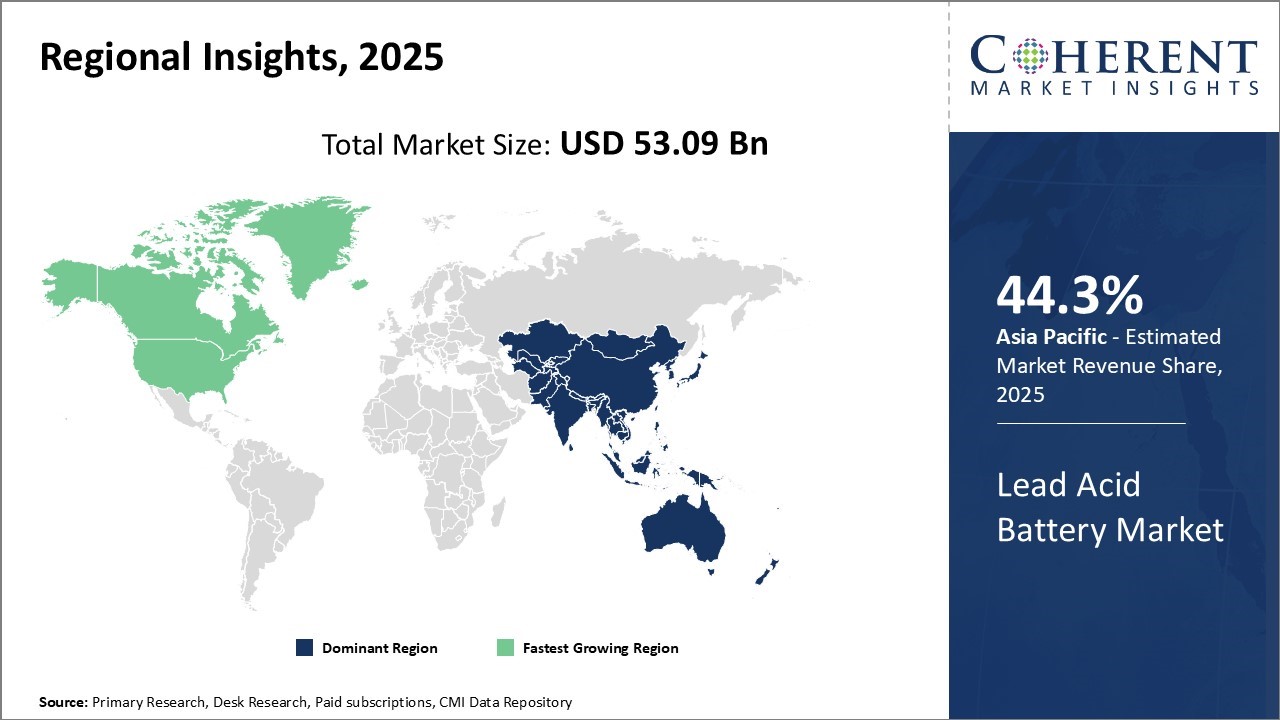
- By Region, Asia Pacific is forecasted to lead the global lead acid battery market with a 44.3% share in 2026.
Market Overview
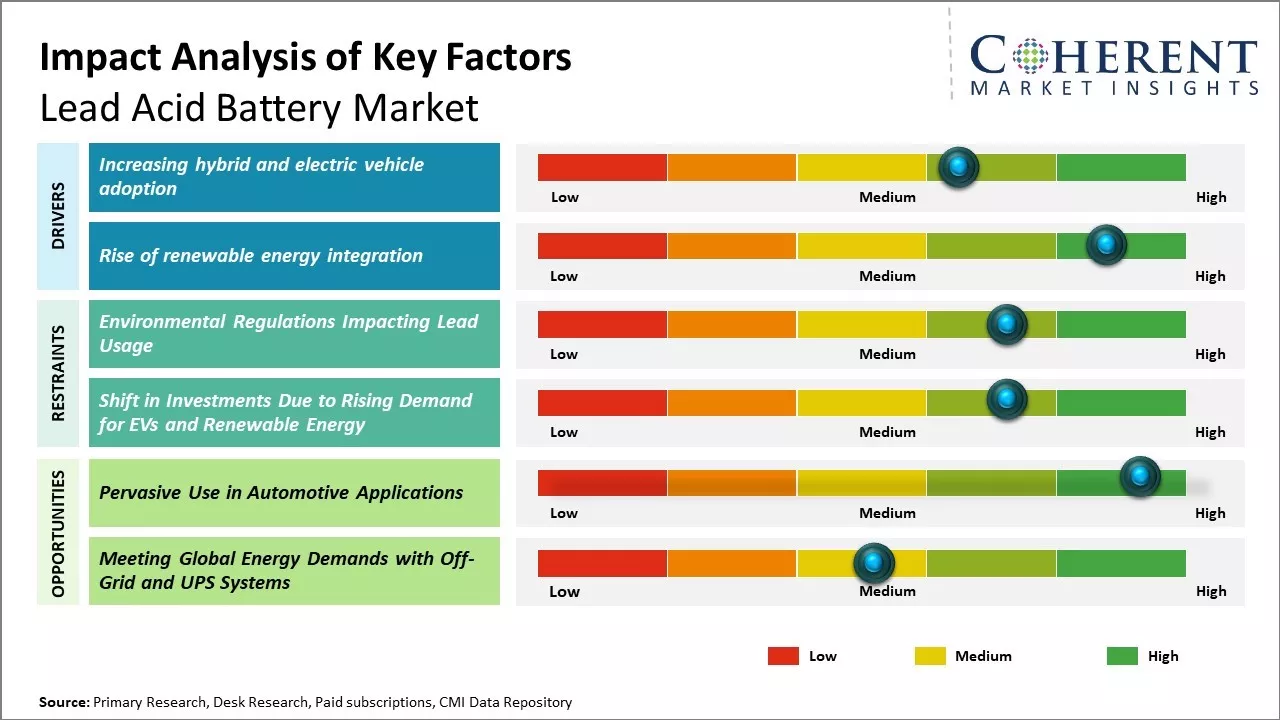
The Lead Acid Battery Market is expected to witness moderate growth over the forecast period. Though lead acid batteries have significant applications in automotive sector especially for automobiles in developing countries, increasing focus towards developing low-maintenance batteries such as lithium-ion batteries is expected to hamper the growth of this market. Replacement of existing lead acid batteries will continue to boost its demand. However, stricter environment regulations regarding usage of lead will be a major challenge.
Current Events and Its Impact on the Lead Acid Battery Market
Event | Description and Impact |
Geopolitical Supply Chain Pressures |
|
Recycling Infrastructure Investments |
|
Technological Innovation Funding |
|
Pricing Analysis: Lead Acid Battery Market
Lead acid battery pricing ranges from $0.08 to $0.25 per Wh, influenced by application, capacity, brand, and raw material costs. Prices remain stable across standard applications, while premium and industrial variants command higher rates due to performance and durability demands.
In the automotive sector, standard 12V SLI batteries cost $40–$95, while AGM and deep-cycle models range from $110 to $400, used in start-stop vehicles and recreational applications.
For UPS systems, small units (7–18Ah) cost $18–$65, mid-range batteries (26–100Ah) are priced between $80–$320, and large-scale units exceed $1,000 depending on discharge rate and lifespan requirements.
Motive power systems, including forklift batteries, range from $2,600 to $10,500, reflecting their custom-built design and operational intensity. Batteries for floor cleaning equipment are typically $240–$650.
In stationary applications such as telecom and data centers, front terminal batteries (12V, 40–100Ah) are priced at $160–$520, optimized for long life and reliability.
Overall, while advanced technologies challenge the market, lead acid batteries remain cost-effective and competitive in price-sensitive and high-reliability applications.
- Current Industry Events of 2026
- Market Size Estimation
- Regional Breakdown
- Competitive Landscape
- Customer Intelligence
- Segmental Analysis
- Pricing Analysis
- Key Market Drivers, Challenges & Future Trends
- Customized Insights Section
Role of Emerging Technologies in the Lead Acid Battery Market
Emerging technologies are reshaping the lead acid battery industry, enabling it to remain competitive across traditional and emerging applications.
- Advanced Grid and Alloy Technologies: Modern batteries feature optimized grid designs (radial and 3D structures) and alloy compositions with calcium, tin, and antimony, improving conductivity, corrosion resistance, and battery longevity.
- Enhanced AGM (Absorbed Glass Mat) Systems: Innovations in separator materials and compression techniques enhance acid retention, vibration resistance, and deep discharge recovery, making AGM batteries ideal for high-performance automotive and backup power systems.
- Gel Electrolyte Improvements: Proprietary gel formulations with thixotropic agents ensure stable operation in extreme temperatures. Micro-gel technologies further boost conductivity, expanding use in solar and telecom sectors.
- Smart Battery Management Integration: Embedded sensors and wireless-enabled Battery Management Systems (BMS) provide real-time monitoring of cell health, temperature, and charge status, enabling predictive maintenance and optimized performance.
- Carbon Additive Technologies: The use of carbon, including graphene and nanotubes, in negative plates improves charge acceptance and cycle life, especially in partial state-of-charge and renewable energy applications.
- Automated Manufacturing Enhancements: Precision-controlled production systems and advanced formation charging improve quality, consistency, and material efficiency, lowering production costs and improving product reliability.
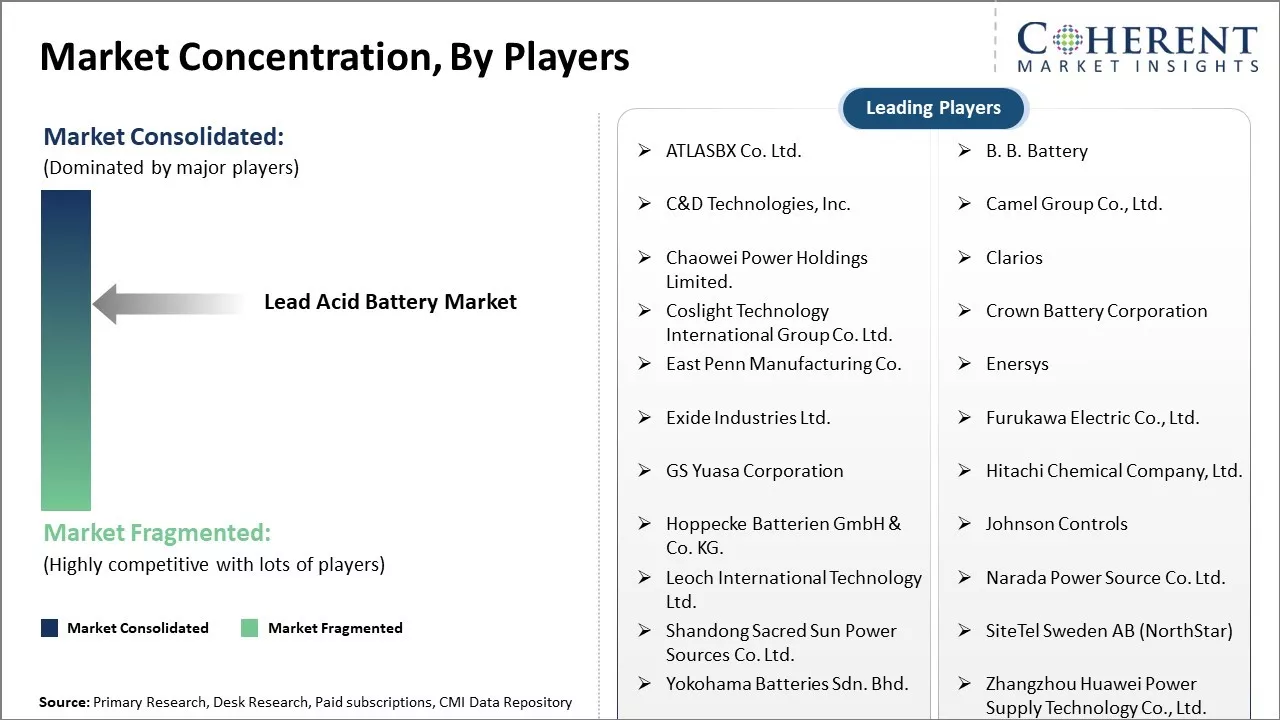
Market Concentration and Competitive Landscape
Increasing hybrid and electric vehicle adoption
Increasing demand for hybrid and electric vehicles across the globe has been one of the key drivers of growth for lead acid batteries. Unlike lithium-ion batteries used in premium EVs, lead acid batteries are more cost effective and their technology is more mature. As a result, these are increasingly being used as starting, lighting and ignition batteries in hybrid vehicles which have both an internal combustion engine as well as an electric motor. With automakers aggressively expanding their EV/hybrid lineups to comply with stricter emission regulations, the lead acid battery market is expected to witness growth.
Recent breakthroughs in material science and manufacturing technologies have also enabled lead acid batteries to last longer which widens their appeal for automotive applications.
For instance, in July 2020, EnerSys a stored energy systems and technology provider for industrial applications, partnered with Blink Charging Company, a leading electric vehicle (EV) charging equipment provider, to develop high-power wireless DC fast charging systems for integrated battery storage in transportation applications.
Rise of renewable energy integration
The prominence of renewable sources of energy such as solar and wind has been rising across both developed and developing nations. For optimum utilization of power generated from intermittent renewable sources, large-scale energy storage is becoming indispensable. While technologies such as pumped hydro and lithium-ion batteries are also being adopted, lead acid batteries still offer a viable and cost-effective option for hundreds of megawatts of energy storage applications worldwide.
Their ability to provide deep discharge cycles at an affordable upfront cost makes them suited for applications like rural electrification, microgrids and load balancing in power distribution systems. Major renewable energy product manufacturers are also integrating lead acid batteries into their portfolio to address the storage requirements of their solar panel and wind turbine offerings. This is expected to significantly contribute to the demand for lead acid batteries in the coming years.
For instance, in May 2023, C&D Technologies a technology company that produces and markets systems for the power conversion and storage of electrical power introduced the Pure Lead Max VRLA battery designed for data centres. This innovation, backed by an industry-leading eight-year warranty, features proprietary pure-lead technology, a catalyst design for extended life, and sustainability benefits through recycled materials. The battery promises up to 38% lower maintenance costs and a reduced footprint, emphasizing longevity and performance.
Market Opportunities: Pervasive Use in Automotive Applications
Lead acid batteries continue to be widely used for automotive starting, lighting and ignition due to their low cost and reliability. These are universally compatible with chargers and devices. Their use in off-grid renewable energy and UPS systems helps meet rising energy demands worldwide. Telecom tower installations and industrial equipment applications keep revenues stable. New sealed and improved gel battery technologies boost performance.
Segmental Insights
Lead Acid Battery Market Insights, By Product Type
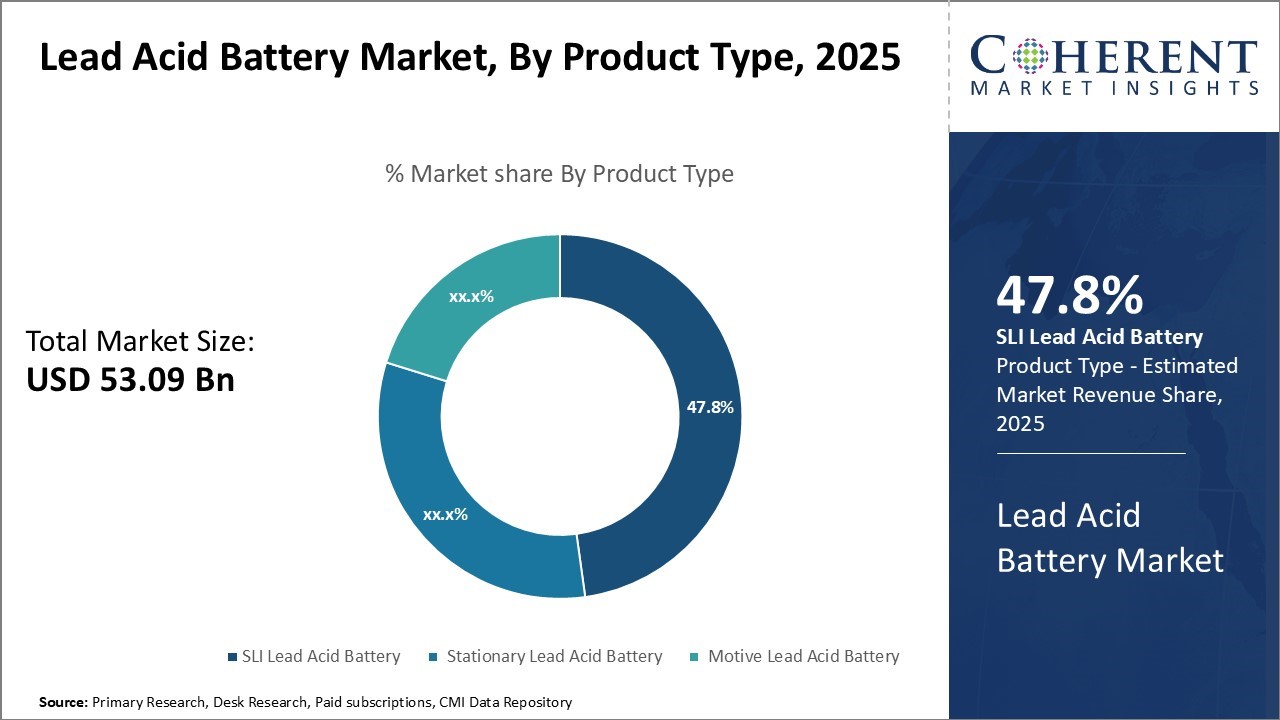
In terms of product type, SLI lead acid battery segment is estimated to contribute the highest share of 48.8% of the market in 2026, owing to its reliability and suitability for a diverse range of applications. SLI batteries are predominantly used to start combustion engines in vehicles and are chosen by automakers because of their high cranking power even in adverse conditions.
The robust construction of SLI batteries allows them to withstand rigorous daily start-stop cycles and the vibrations encountered in vehicle engines. Their simple and proven technology also contributes to their high reliability compared to other battery types.
Furthermore, SLI batteries are suited for engines of all sizes, from compact passenger cars to heavy trucks and off-road vehicles. Their wide operating temperature range also makes them ideal for both temperate and tropical driving conditions. Overall, the dependability of SLI batteries in starting engines efficiently has cemented their prominent role in the global mobility industry.
Lead Acid Battery Market Insights, By Construction Method
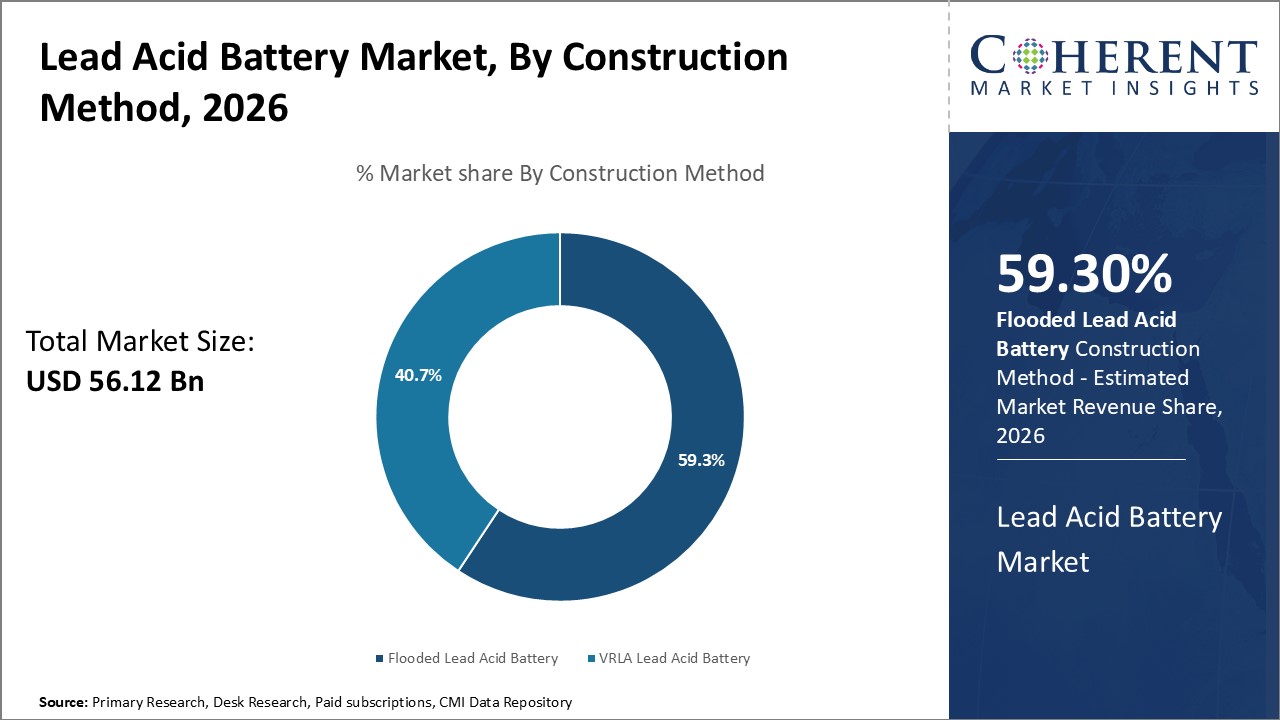
In terms of construction method, flooded lead acid battery segment is estimated to contribute the highest share of 59.32% in the market in 2026, owing to strong demand from industrial users for critical equipment backup.
Flooded batteries are the technology of choice for stationary applications like emergency lighting, telecommunications towers, security systems, and backup power for IT infrastructure. Their advantages in such uses include the ability to deliver high surge currents and deep cycle discharge capabilities.
Additionally, flooded batteries demonstrate excellent charge acceptance allowing them extend equipment uptime during power outages. Their reliability and relatively lower cost compared to other technologies also factor in their widespread industrial and commercial use. Key end-users like manufacturing plants, power utilities, and data centers continue to rely on flooded batteries for uninterrupted power supply to equipment crucial for their operations.
Lead Acid Battery Market Insights, By End-use
In terms of End-use, Industrial segment is estimated to contribute the highest share of 51.12% in the market in 2026, due to growing demand from electric forklifts and other warehouse vehicles. Motive batteries are uniquely engineered to withstand the rigorous deep discharge and frequent recharging from motive applications like electric forklifts, airport ground support vehicles, automated guided vehicles, and floor scrubbers. Their deep cycle discharge capability provides sufficient power for extended vehicle run times between charges.
Additionally, their vibration resistance and charge acceptance allow for opportunity charging during shifts. Leading logistics and e-commerce companies extensively utilize electric forklifts in their warehouses. Rising investments in automation and the growing warehousing industry is propelling motive battery adoption. Battery manufacturers are focusing on extending battery life through advanced materials to capitalize on the opportunities in the growing motive battery segment.
Lead Acid Battery Market - Regional Insights
Asia Pacific Lead Acid Battery Market Analysis and Trends
Asia Pacific is projected to lead the global lead acid battery market with an estimated 44.3% share in 2026, driven by rapid industrialization and increasing automobile ownership across emerging economies such as China and India. The region benefits from a strong manufacturing base supported by low-cost labor and readily available raw materials, positioning it as a global price leader in battery production and exports.
Domestic demand continues to expand due to growing adoption of energy storage systems across retail, commercial, and transportation sectors. Additionally, the presence of numerous small- and mid-sized enterprises engaged in battery assembly, recycling, and component supply further reinforces the regional production ecosystem. These factors collectively make Asia Pacific the most dominant and cost-competitive region in the global lead acid battery landscape.
North America Lead Acid Battery Market Analysis and Trends
North America is expected to be the fastest-growing regional market for lead acid batteries, registering a robust CAGR of 7.73% during 2026–2031. The region’s growth is supported by a strong automotive industry, advanced electrification initiatives, and a well-established vehicle fleet in the U.S. and Canada.
The presence of major manufacturing firms and original equipment manufacturers (OEMs) has driven investments in local production facilities to serve nearby markets efficiently. In parallel, a mature battery recycling infrastructure supports sustainability and helps manage raw material costs, enhancing industry competitiveness. North America's emphasis on circular economy practices and proximity to high-demand sectors positions it as a rapidly advancing market in the global battery value chain.
Dominating Countries in the Lead Acid Battery Market
China Lead Acid Battery Market Analysis and Trends
China stands at the forefront of the global lead acid battery market, underpinned by its extensive manufacturing capabilities, low-cost labor, and access to abundant raw materials. The country has emerged as a major export hub, supplying cost-effective battery solutions to both emerging and developed markets. Government-backed industrial policies and environmental recycling mandates have supported the growth of both large-scale enterprises and a vibrant ecosystem of small-scale recyclers and assemblers. China's dominance is further reinforced by strong domestic demand driven by automotive production, industrial machinery, and renewable energy storage applications.
India Lead Acid Battery Market Analysis and Trends
India is rapidly strengthening its position in the global lead acid battery landscape, driven by rising automotive ownership, expanding power backup needs, and increasing infrastructure development. The country’s thriving telecom, transportation, and industrial sectors are key demand drivers for energy storage systems.
Local manufacturers benefit from favorable government initiatives promoting domestic production and battery recycling. With a growing middle class and rapid urbanization, India presents significant growth opportunities for both domestic producers and global players looking to tap into an expanding consumer base.
United States Lead Acid Battery Market Analysis and Trends
The United States represents one of the most technologically advanced markets for lead acid batteries, supported by a mature automotive sector and large-scale electrification programs. OEMs and battery manufacturers benefit from proximity to high-value consumer and industrial markets as well as a robust recycling infrastructure that reinforces sustainability and cost efficiency.
Continued investments in power grid stabilization, renewable integration, and backup power for data centers further fuel battery demand. With established regulatory frameworks and advanced R&D capabilities, the U.S. remains a pivotal contributor to innovation and growth in the global lead acid battery sector.
Market Report Scope
Lead Acid Battery Market Report Coverage
| Report Coverage | Details | ||
|---|---|---|---|
| Base Year: | 2025 | Market Size in 2026: | USD 56.12 Bn |
| Historical Data for: | 2020 To 2024 | Forecast Period: | 2026 To 2033 |
| Forecast Period 2026 to 2033 CAGR: | 5.7% | 2033 Value Projection: | USD 82.72 Bn |
| Geographies covered: |
| ||
| Segments covered: |
| ||
| Companies covered: | ATLASBX Co. Ltd., B. B. Battery, C&D Technologies, Inc., Camel Group Co., Ltd., Chaowei Power Holdings Limited., Clarios, Coslight Technology International Group Co. Ltd., Crown Battery Corporation, East Penn Manufacturing Co., Enersys, Exide Industries Ltd., Furukawa Electric Co., Ltd., GS Yuasa Corporation, Hitachi Chemical Company, Ltd., Hoppecke Batterien GmbH & Co. KG., Johnson Controls, Leoch International Technology Ltd., Narada Power Source Co. Ltd., Shandong Sacred Sun Power Sources Co. Ltd., SiteTel Sweden AB (NorthStar), Yokohama Batteries Sdn. Bhd., Zhangzhou Huawei Power Supply Technology Co., Ltd. | ||
| Growth Drivers: |
| ||
| Restraints & Challenges: |
| ||
Analyst Viewpoint
- The lead acid battery market maintains steady momentum, fueled by strong demand from automotive and industrial sectors, particularly in emerging economies experiencing rapid vehicle penetration and electrification of infrastructure.
- Telecom expansion in developing regions continues to drive VRLA battery adoption, underscoring the technology’s reliability for backup power in off-grid and rural installations.
- Despite this growth, the market contends with significant challenges, including tightening environmental regulations, lead price volatility, and the ongoing shift toward lithium-ion batteries in high-performance sectors such as electric vehicles.
- Nonetheless, lead acid batteries retain a competitive edge in renewable energy applications, especially in off-grid and grid-tied energy storage where affordability and operational simplicity are critical.
- Industrial users, including those in material handling, warehouse logistics, and data centers, continue to favor lead acid solutions due to their cost-effectiveness and compatibility with existing infrastructure.
- Asia-Pacific leads global demand and production, driven by large-scale manufacturing in China and India, while North America and Europe represent mature replacement markets facing growing regulatory scrutiny.
- Overall, lead acid batteries are expected to sustain relevance in cost-sensitive and legacy systems, even as advanced chemistries gain traction in premium and performance-focused applications.
Lead Acid Battery Market Key Developments
- In May 2025, Exide Industries inaugurated a state-of-the-art lead battery recycling plant in Gujarat, India, to strengthen sustainable sourcing and reduce dependence on virgin lead materials.
- In April 2025, EnerSys launched an AI-powered battery health management platform targeting telecom and industrial backup applications, enhancing predictive maintenance and performance reliability.
- In March 2025, GS Yuasa Corporation signed a strategic agreement with a European utility provider to pilot advanced lead-acid battery storage systems integrated with smart grid infrastructure.
- In February 2025, Amara Raja Batteries introduced a new line of solar-compatible tubular lead-acid batteries with improved charge retention and extended lifecycle for off-grid energy systems.
- In January 2025, the U.S. Department of Energy awarded funding to a multi-partner consortium to accelerate R&D on hybrid energy storage systems combining lead-acid and lithium-ion technologies.
Market Segmentation
- Product Type Insights (Revenue, USD Bn, 2021 - 2033)
- SLI Lead Acid Battery
- Stationary Lead Acid Battery
- Motive Lead Acid Battery
- Construction Method Insights (Revenue, USD Bn, 2021 - 2033)
- Flooded Lead Acid Battery
- VRLA Lead Acid Battery
- End-use Insights (Revenue, USD Bn, 2021 - 2033)
- Industrial
- Commercial
- Residential
- Regional Insights (Revenue, USD Bn, 2021 - 2033)
- North America
- U.S.
- Canada
- Latin America
- Brazil
- Argentina
- Mexico
- Rest of Latin America
- Europe
- Germany
- U.K.
- Spain
- France
- Italy
- Russia
- Rest of Europe
- Asia Pacific
- China
- India
- Japan
- Australia
- South Korea
- ASEAN
- Rest of Asia Pacific
- Middle East & Africa
- GCC Countries
- South Africa
- Israel
- Rest of Middle East & Africa
- Key Players Insights
- ATLASBX Co. Ltd.
- B. B. Battery
- C&D Technologies, Inc.
- Camel Group Co., Ltd.
- Chaowei Power Holdings Limited.
- Clarios
- Coslight Technology International Group Co. Ltd.
- Crown Battery Corporation
- East Penn Manufacturing Co.
- Enersys
- Exide Industries Ltd.
- Furukawa Electric Co., Ltd.
- GS Yuasa Corporation
- Hitachi Chemical Company, Ltd.
- Hoppecke Batterien GmbH & Co. KG.
- Johnson Controls
- Leoch International Technology Ltd.
- Narada Power Source Co. Ltd.
- Shandong Sacred Sun Power Sources Co. Ltd.
- SiteTel Sweden AB (NorthStar)
- Yokohama Batteries Sdn. Bhd.
- Zhangzhou Huawei Power Supply Technology Co., Ltd.
Sources
Primary Research Interviews
- Battery Manufacturers and OEMs
- Raw Material Suppliers (Lead, Sulfuric Acid)
- Automotive Industry Executives
- Energy Storage Solution Providers
- Others
Databases
- IEA Energy Storage Database
- BloombergNEF Battery Database
- Wood Mackenzie Power & Renewables Database
- Others
Magazines
- Battery Industry Magazine
- Energy Storage Journal
- Automotive News
- Power Electronics Magazine
- Battery Power Magazine
- Others
Journals
- Journal of Power Sources
- Energy Storage Materials
- Journal of Energy Storage
- Others
Newspapers
- Financial Times
- The Wall Street Journal
- Reuters Business News
- Bloomberg Business
- Energy News Today
- Others
Associations
- Battery Council International (BCI)
- International Lead Association (ILA)
- Energy Storage Association (ESA)
- Society of Automotive Engineers (SAE)
- Advanced Lead Acid Battery Consortium (ALABC)
- Others
Public Domain Sources
- U.S. Department of Energy Reports
- International Energy Agency (IEA) Publications
- European Battery Alliance Reports
- EPA Battery Recycling Guidelines
- World Bank Energy Sector Reports
- Others
Proprietary Elements
- CMI Data Analytics Tool
- Proprietary CMI Existing Repository of information for last 8 years
*Definition: The lead acid battery market includes all revenues from companies manufacturing lead-acid batteries that use lead oxide and lead metal electrodes to store and release energy electrochemically. This market includes sales of starting, lighting and ignition batteries for automobiles as well as industrial lead acid batteries used in applications like forklifts, electric utility equipment, electric vehicles, and uninterrupted power supply systems. The lead acid battery market serves industries such as transportation, utilities, telecommunication, and manufacturing.
Get access to 250+ pages report
Every segment, forecast, competitor profile and data table behind the analysis above — available for instant download.
- ESOMAR Member
- ISO 9001:2015 Certified
- D-U-N-S Registered
- GDPR & CCPA Compliant
Missing comfort of reading report in your local language? Find your preferred language:
Transform your Strategy with Exclusive Trending Reports
Frequently Asked Questions
The Lead Acid Battery Market size is estimated to be valued at USD 56.12 Bn in 2026, and is expected to reach USD 82.72 Bn by 2033.
The CAGR of the global Market is projected to be 5.7% from 2026 to 2033.
Increasing hybrid and electric vehicle adoption and rise of renewable energy integration are the major factor driving the growth of lead acid battery industry.
Environmental regulations impacting lead usage and shift in investments due to rising demand for EVs and renewable energy are the major factor hampering the growth of market.
In terms of Product Type, SLI Lead Acid Battery segment estimated to dominate the market in 2026.
ATLASBX Co. Ltd., B. B. Battery, C&D Technologies, Inc., Camel Group Co., Ltd., Chaowei Power Holdings Limited., Clarios, Coslight Technology International Group Co. Ltd., Crown Battery Corporation, East Penn Manufacturing Co., Enersys, Exide Industries Ltd., Furukawa Electric Co., Ltd., GS Yuasa Corporation, Hitachi Chemical Company, Ltd., Hoppecke Batterien GmbH & Co. KG., Johnson Controls, Leoch International Technology Ltd.,Zhangzhou Huawei Power Supply Technology Co., Ltd. are the major players.
Asia Pacific is expected to lead the lead acid battery industry in 2026.