

Embedded Systems Market Size and Trends
The global embedded systems market is estimated to be valued at USD 201.40 Bn in 2026 and is expected to reach USD 336.27 Bn by 2033, exhibiting a compound annual growth rate (CAGR) of 7.6% from 2026 to 2033.
Key Takeaways
- Based on Component, Hardware segment is projected to account for 54.4% of the global market in 2026, owing to bulk standardization opportunities.
- Based on Type, Standalone system is expected to capture 38.8% share of the market in 2026, due to proliferation of individual embedded applications across end-use industries.
- Based on End User, the Automotive segment is projected to command 42.3% share of the market in 2026, due to the proliferation of connected vehicles and advanced driver assistance systems.
- Based on Region, North America is set to dominate the global personalized medicine market with a 36.3% share in 2026.
Market Overview
The Global Embedded Systems Market is witnessing significant growth owing to the increasing Internet of Things (IoT) penetration and rising demand for software-based systems from various end-use industries such as automotive, healthcare, industrial automation, and consumer electronics.
The global embedded systems market trend shows a rising demand for systems-on-chip in applications such as smart grids, wearable devices, and industrial machines. Furthermore, emerging technologies in embedded systems such as artificial intelligence (AI), machine learning, and deep learning are creating opportunities for market players to develop innovative products and solutions. Processors with higher efficiency and lower power consumption compatible with emerging technologies will drive the future growth of the embedded systems market.
Current Events and their Impact on the Embedded Systems Market
Current Event | Description and its Impact |
Global Semiconductor Supply Chain Crisis and Recovery |
|
Rapid Growth of Edge AI and IoT Infrastructure Deployment |
|
Drivers
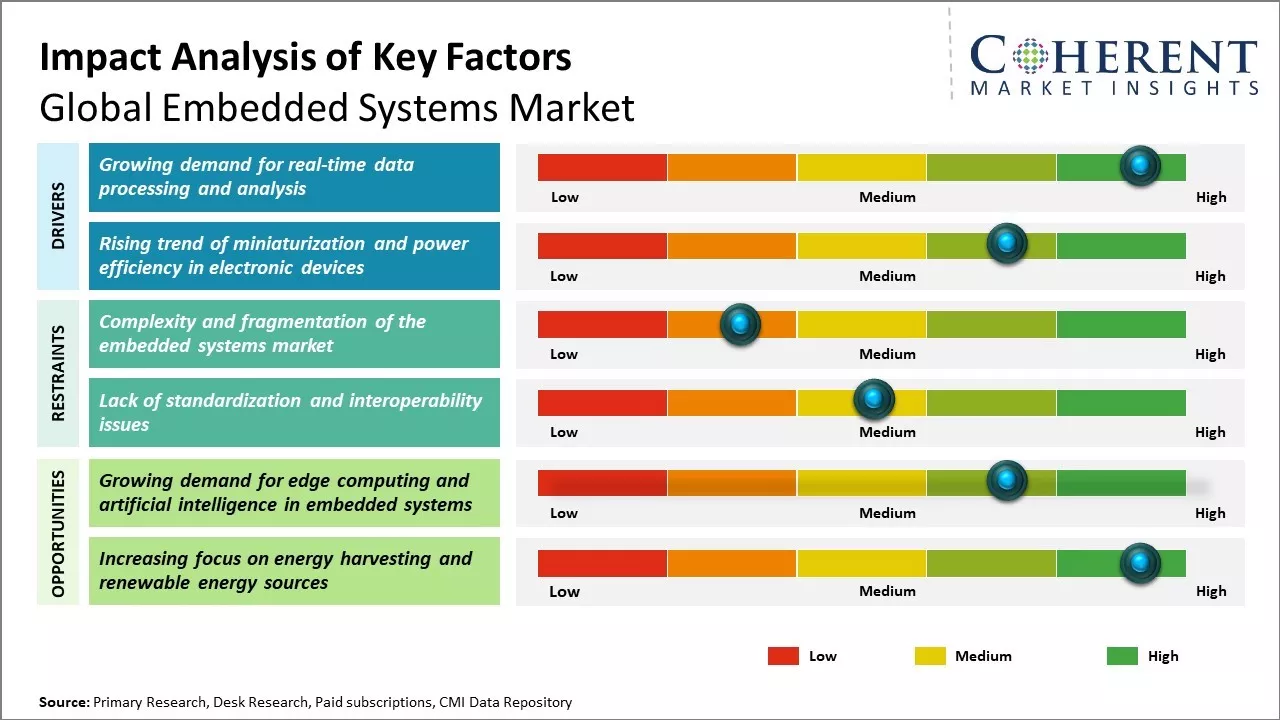
Rising trend of miniaturization and power efficiency in electronic devices
With growing affordability and accessibility, consumer electronics have become ubiquitous in today's world. Be it smartphones, wearables, smart home devices, appliances or entertainment systems - electronics are increasingly becoming integrated into daily lives. However, the continuous rise in the level of integration, functionality, and performance poses design challenges for original equipment manufacturers.
There is constant pressure to pack more features into smaller footprints while also optimizing for longer battery lives. At the same time, users also expect sleeker, more portable devices without comprising on functionality. This has accelerated the trend of reduction in form factor and power consumption across consumer electronics.
Embedded systems have played a pivotal role in enabling miniaturization through their small size, low-power processor technologies and ability to custom design for specific applications. Original design manufacturers find embedded solutions that tightly integrate various components like sensors, connectivity, memory, processing, etc. into tiny packages. This has allowed the industry to build innovative devices like hearables, smartwatches, advanced digital cameras, miniature medical devices, and others.
Ongoing advancements in semiconductor manufacturing processes are further driving the ability to develop even smaller and more powerful embedded boards, system on chips and modules. Their tight integration helps consolidate functionalities into minimum possible footprints.
- Current Industry Events of 2026
- Market Size Estimation
- Regional Breakdown
- Competitive Landscape
- Customer Intelligence
- Segmental Analysis
- Pricing Analysis
- Key Market Drivers, Challenges & Future Trends
- Customized Insights Section
Segmental Insights
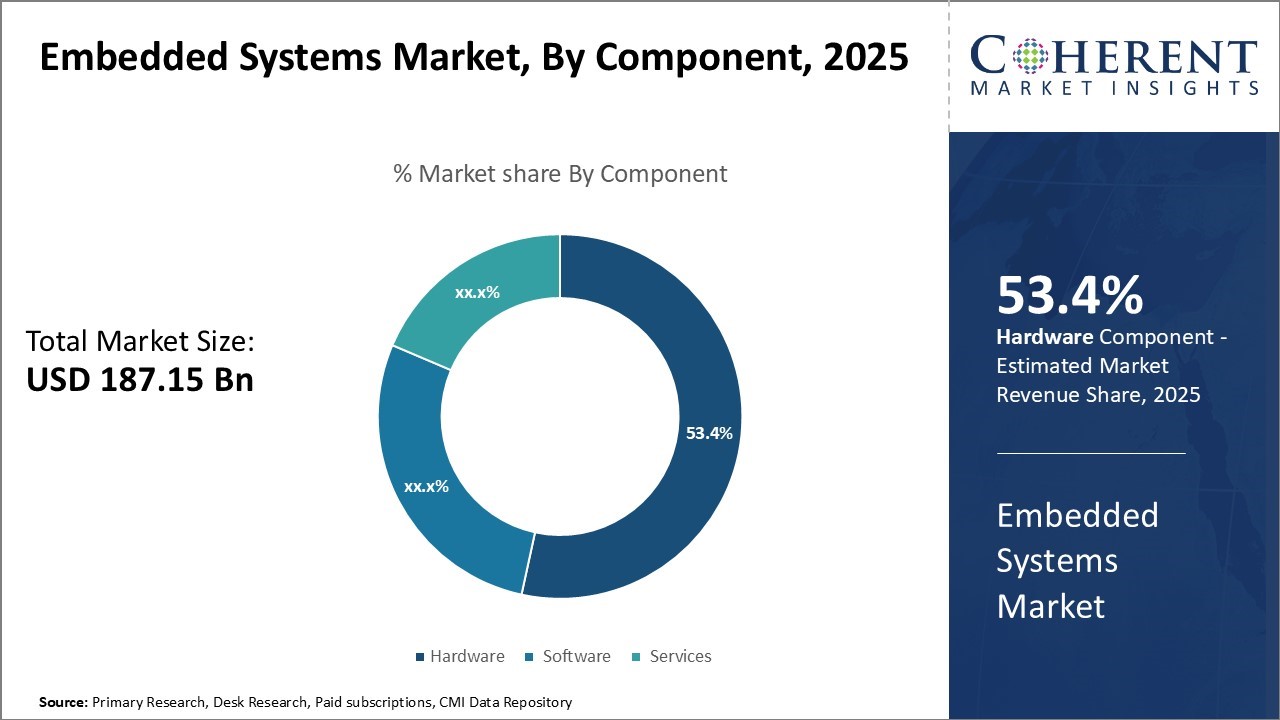
Embedded Systems Market Insights, By Component - Economies of Scale Drive Hardware Dominance
In terms of component, hardware is expected to contribute 54.4% share of the global embedded systems market in 2026 owing to bulk standardization opportunities. Embedded hardware forms the core building blocks across a wide variety of end use products and applications. Being an integral piece of electronic devices, embedded hardware sees massive volumes of production runs each year.
This allows hardware manufacturers to significantly benefit from economies of scale during the manufacturing process. Standardizing chipset and component designs enables optimizations across the supply chain from procuring raw materials to production assembly. Bulk orders directly translate to lower per-unit production costs.
Additionally, hardware benefits from a simpler product life cycle compared to software and services. Once a processor or module design is finalized, minimal ongoing innovation is required to continue mass production. This allows harnessing scale advantages over a longer duration for each hardware generation before a redesign.
In August 2025, KPIT Technologies partnered with COEP Technological University to launch the KPIT APEX Lab in Pune. This industry-academia initiative focuses on enhancing student skills in embedded systems and hardware-software integration, supporting KPIT’s CSR and academic development goals.
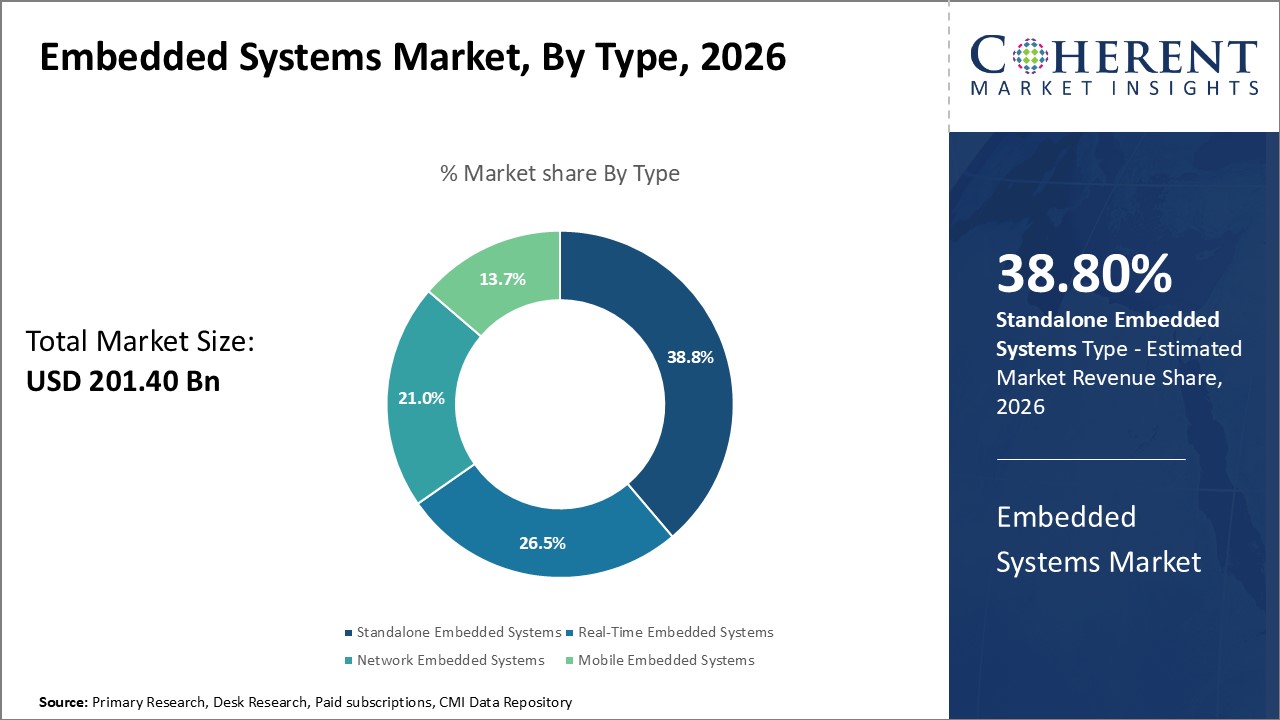
Embedded Systems Market Insights, By Type - Proliferation of Standalone Applications Boosts Individual Hardware Demand
In terms of type, standalone embedded systems are expected to contribute 38.8% of the market share in 2026 owing to the proliferation of individual embedded applications across end-use industries. Standalone systems comprise a complete microprocessor and peripheral components packaged into a single chip or module without any additional hardware. They are self-contained with dedicated functions and operate independently of any other device.
The rapid expansion of the Internet of Things (IoT) has seen unprecedented growth in standalone sensors, controllers and single-use devices embedded into various machines, infrastructure and everyday products. Use cases include smart home appliances, industrial automation equipment, building automation, infrastructure monitoring nodes, medical instrumentation, inventory tracking tags and many more. As standalone nodes can serve highly focused individual applications, IoT architecture is built upon networks of discrete embedded systems, further accelerating the embedded systems market revenue.
Embedded Systems Market Insights, By End User - Growth of Connected Products Drives Demand Across the Automotive Vertical
In terms of end user, the automotive segment is expected to contribute 42.3% share to the embedded systems market in 2026 owing to the proliferation of connected vehicles and advanced driver assistance systems. Modern cars integrate dozens of embedded systems to control engine, stability, infotainment, navigation and safety-critical functions. The automotive industry is undergoing a shift towards vehicle connectivity and autonomy.
In October 2023, Infineon Technologies AG, a global leader in semiconductor solutions, partnered with Eatron Technologies, a fast-growing technology company dedicated to unlocking the full potential of batteries with intelligent software. The collaboration aimed to integrate advanced machine learning solutions and algorithms into Infineon's AURIX TC4x microcontroller (MCU) family, with the goal of advancing automotive Battery Management Systems (BMS). By leveraging the state-of-the-art machine learning capabilities of the AURIX TC4x MCU, including its integrated parallel processing unit (PPU), Eatron is able to maximize the performance and accuracy of its AI-powered battery management software.
Regional Insights
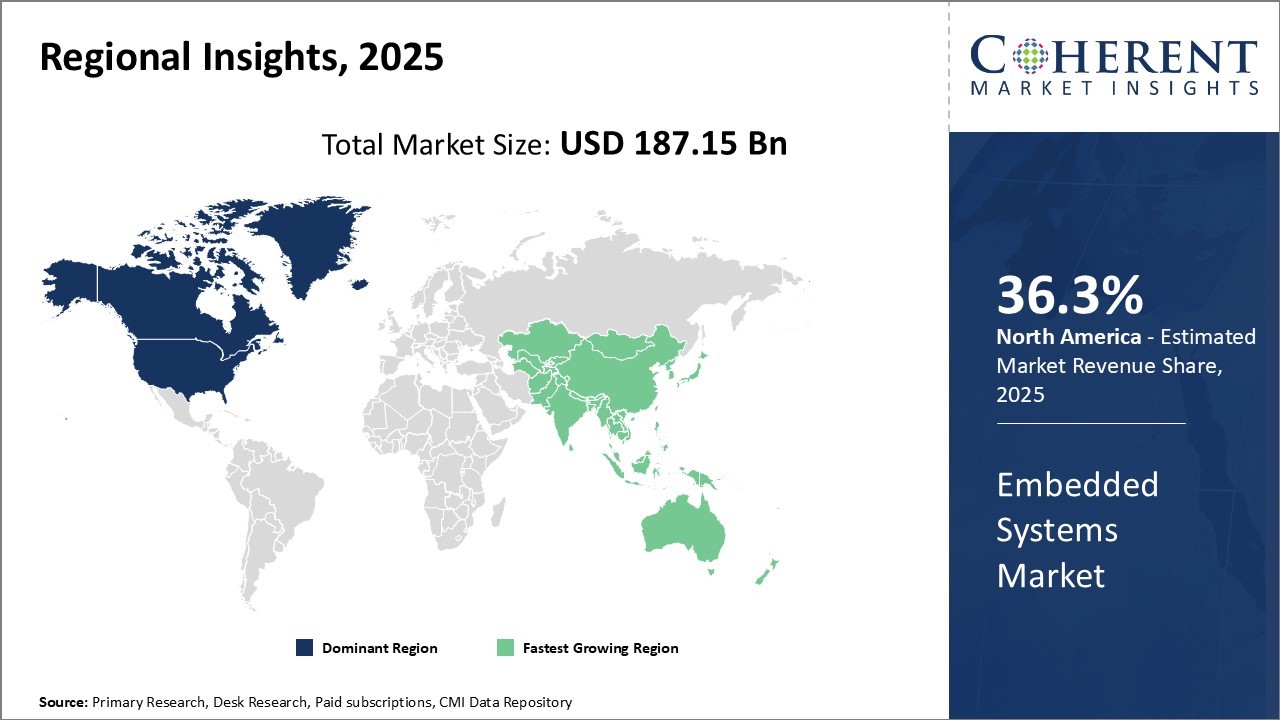
North America Embedded Systems Market Analysis & Trends
The North America region currently dominates the global embedded systems market. The region is expected to hold 36.3% of the market share in 2026. Several factors have contributed to North America's leading position. With countries like the U.S. and Canada, the region is home to many large enterprises and technology giants developing next-generation embedded solutions. It has a sizable semiconductor industry and major embedded systems product developers. North American manufacturers are also early adopters of advanced embedded technologies across sectors like automotive, industrial automation, and medical devices.
Support from government has helped North America emerge as a hub for embedded systems innovation. Several universities and research facilities are actively involved in next-gen embedded technology research and development. This strong coupling between academia and industry has led to rapid product development and commercialization of novel embedded concepts.
North American companies also have a strategic focus on sophisticated embedded hardware and software engineering capabilities. Their embedded solutions cater to mission-critical applications demanding high reliability and performance.
For instance, in September 2024, Smith, announced its participation in embedded world's first trade show in North America.
Asia Pacific Embedded Systems Market Analysis & Trends
The Asia Pacific region, led by countries such as China, Japan, South Korea, and others, is witnessing the fastest growth in the embedded systems market. Asia Pacific has emerged as a global manufacturing powerhouse with a large production-linked domestic market and competitive manufacturing and labor costs. This makes embedded systems an integral part of various goods manufactured in Asia Pacific, from consumer electronics and appliances to industrial machines. The growing middle-class population and their rising disposability incomes in Asia Pacific also boosts the smarter embedded devices market demand.
In July 2023, Microchip Technology Inc., a leading provider of smart, connected, and secure embedded control solutions, announced plans to invest approximately USD 300 million to expand its operations in the Indian embedded systems market over the next few years. The investment will focus on enhancing its facilities in Chennai and Bangalore in India, as well as establishing a new research and development center in Hyderabad, India. This initiative aims to bolster Microchip's presence in India, where it currently employs around 2,500 people across various locations.
Embedded Systems Market Outlook Country-Wise
The U.S. Embedded Systems Market Trends
The U.S. embedded systems market is experiencing robust growth, driven by advancements in AI, IoT, and automation technologies. Key sectors driving this growth include industrial automation, automotive electronics, and consumer devices. n the automotive industry, the adoption of embedded systems is accelerating with the rise of electric vehicles (EVs) and autonomous driving technologies.
China Embedded Systems Market Trends
China's embedded systems market is experiencing robust growth, driven by advancements in AI, the adoption of RISC-V architecture, and a strategic shift toward domestic chip development. The Chinese government is actively promoting technological self-sufficiency, leading to the development of domestic AI chips and embedded systems.
For instance, in November 2024, MYIR has launched a new embedded System-On-Module (SoM), the MYC-LR3576, based on the Rockchip RK3576 processor.
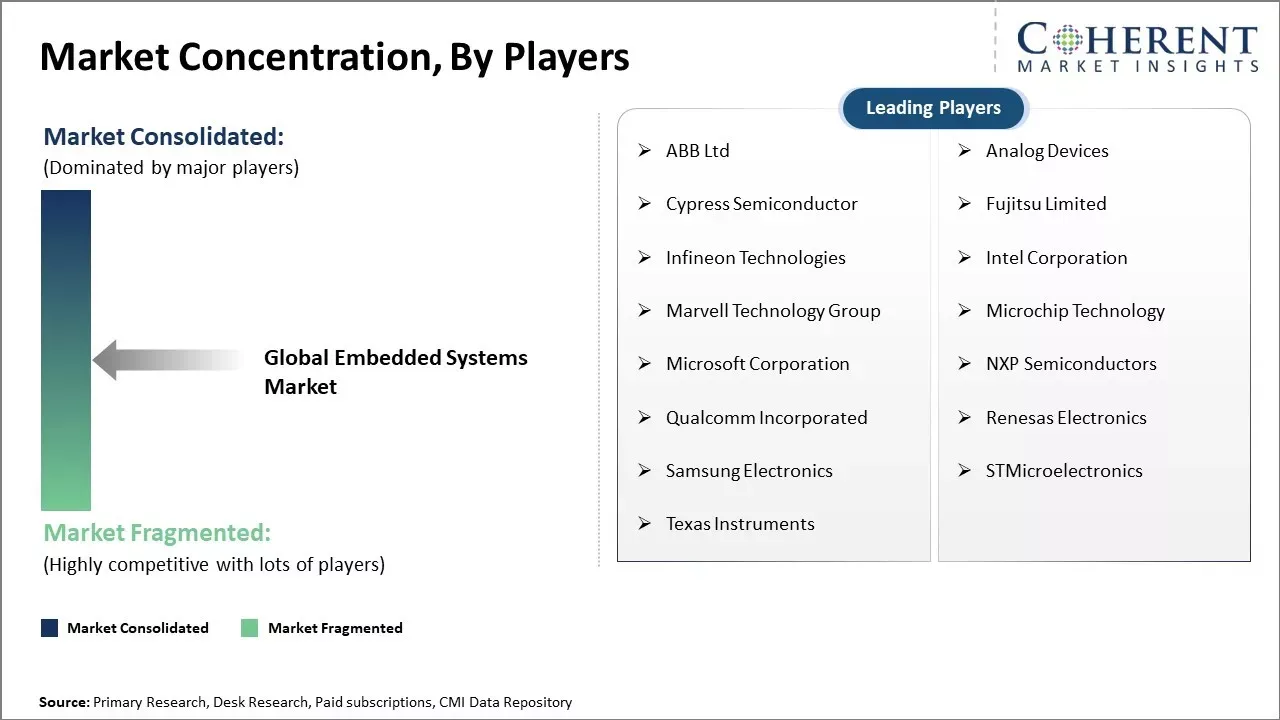
Market Concentration and Competitive Landscape
Analyst Opinion (Expert Opinion)
The global embedded systems market is poised to grow significantly over the coming years. Drivers such as the rising demand for industrial automation and government mandates on safety systems will boost market revenues. Further, the robust growth of the automotive industry and incorporation of complex digital networks in modern vehicles will drive embedded systems adoption. Growth opportunities also exist in developing applications for the IoT and connected devices space.
However, high manufacturing costs and intellectual property issues limit the widespread use of embedded systems in some regions. Design complexities associated with advanced technologies pose challenges as well. Lack of in-house expertise prevents small enterprises from implementing embedded solutions. Furthermore, security vulnerabilities impact the large-scale deployment of embedded platforms connected to the internet.
Moving forward, North America is likely to dominate the embedded systems market owing to considerable investments in R&D by major players. The Asia Pacific region, especially China, is projected to see the fastest growth on account of increasing electronics production and low-cost manufacturing centers. The flourishing automotive, industrial, and consumer electronics sectors in developing Asian economies will catalyze market revenues. European nations are also emerging as major innovation hubs for embedded technologies.
Speak to the analyst
Want personalized insights?
Take the findings above to one of our principal consultants, or have the report rebuilt around the segments, geographies and competitors you actually track.
Embedded Systems Industry News
- In October 2024, Analog Devices launched embedded software development environment, CodeFusion Studio™ and Developer Portal to simplify and speed development for the intelligent edge.
- In April 2024, Kontron, unveiled SMARC-sGET 2 Module, a powerful and secure module designed for industrial IoT applications. This new module aims to enhance the capabilities of IoT devices by providing advanced features tailored for demanding environments.
Market Report Scope
Embedded Systems Market Report Coverage
| Report Coverage | Details | ||
|---|---|---|---|
| Base Year: | 2025 | Market Size in 2026: | USD 201.40 Bn |
| Historical Data for: | 2020 To 2024 | Forecast Period: | 2026 To 2033 |
| Forecast Period 2026 to 2033 CAGR: | 7.6% | 2033 Value Projection: | USD 336.27 Bn |
| Geographies covered: |
| ||
| Segments covered: |
| ||
| Companies covered: | ABB Ltd, Analog Devices, Cypress Semiconductor, Fujitsu Limited, Infineon Technologies, Intel Corporation, Marvell Technology Group, Microchip Technology, Microsoft Corporation, NXP Semiconductors, Qualcomm Incorporated, Renesas Electronics, Samsung Electronics, STMicroelectronics, and Texas Instruments | ||
| Growth Drivers: |
| ||
| Restraints & Challenges: |
| ||
Market Opportunity - Growing demand for edge computing and artificial intelligence in embedded systems
The growing demand for edge computing and artificial intelligence capabilities in embedded systems is opening up significant opportunities for market players. With the proliferation of IoT networks and connected devices, there is an increasing need to process data locally and perform real-time analytics at the edge to reduce latency.
This factor is driving up the demand for powerful embedded systems equipped with AI processors, neural network accelerators, and advanced algorithms. OEMs across industries are opting for embedded AI edge devices to enable advanced automation, predictive maintenance, computer vision and VR/AR applications.
Additionally, the ability to deploy AI models over extended periods with minimal network connectivity is fueling the need for enhanced on-device processing. Leading embedded vendors are well positioned to leverage this opportunity by offering customized edge computing solutions embedded with best-in-class AI capabilities.
Market Segmentation
- By Component Insights (Revenue, USD Bn, 2021 - 2033)
- Hardware
- Software
- Services
- By Type Insights (Revenue, USD Bn, 2021 - 2033)
- Standalone Embedded Systems
- Real-Time Embedded Systems
- Network Embedded Systems
- Mobile Embedded Systems
- By End User Insights (Revenue, USD Bn, 2021 - 2033)
- Automotive
- Consumer Electronics
- Healthcare
- Industrial
- Telecommunications
- Others
- By Regional Insights (Revenue, USD Bn, 2021 - 2033)
- North America
- U.S.
- Canada
- Latin America
- Brazil
- Argentina
- Mexico
- Rest of Latin America
- Europe
- Germany
- U.K.
- Spain
- France
- Italy
- Russia
- Rest of Europe
- Asia Pacific
- China
- India
- Japan
- Australia
- South Korea
- ASEAN
- Rest of Asia Pacific
- Middle East
- GCC Countries
- Israel
- Rest of Middle East
- Africa
- South Africa
- North Africa
- Central Africa
- Key Players Insights
- ABB Ltd
- Analog Devices
- Cypress Semiconductor
- Fujitsu Limited
- Infineon Technologies
- Intel Corporation
- Marvell Technology Group
- Microchip Technology
- Microsoft Corporation
- NXP Semiconductors
- Qualcomm Incorporated
- Renesas Electronics
- Samsung Electronics
- STMicroelectronics
- Texas Instruments
Sources
Primary Research Interviews
- Embedded Systems Hardware Manufacturers
- Software Development Companies
- System Integrators and Solution Providers
- End-User Industries (Automotive, Healthcare, Industrial)
- Others
Databases
- IEEE Xplore Digital Library
- Frost & Sullivan Database
- Others
Magazines
- Embedded Systems Programming Magazine
- Electronic Design Magazine
- EDN (Electronic Design News) Magazine
- Circuit Cellar Magazine
- EE Times Magazine
- Others
Journals
- IEEE Embedded Systems Letters
- ACM Transactions on Embedded Computing Systems
- Journal of Systems Architecture
- Others
Newspapers
- Electronic Engineering Times
- EE Times Asia
- Electronics Weekly
- Electronic Products & Technology
- Semiconductor Today
- Others
Associations
- Embedded Systems Association (ESA)
- IEEE Computer Society
- Association for Computing Machinery (ACM)
- International Association of Embedded System Engineers
- Electronic Industries Alliance (EIA)
- Others
Public Domain Sources
- Government Technology Reports
- Patent Databases (USPTO, EPO)
- Company Annual Reports and SEC Filings
- Industry White Papers and Technical Documentation
- Open Source Hardware and Software Communities
- Others
Proprietary Elements
- CMI Data Analytics Tool
- Proprietary CMI Existing Repository of information for last 8 years
*Definition: The global embedded systems market consists of companies that design and market embedded systems to be used in various sectors globally. Embedded systems are specialized computer systems designed for specific control functions within equipment like motor vehicles, medical devices, communication devices, and industrial equipment. They typically include a microprocessor with programming stored in ROM or flash memory. This market includes hardware, software tools, and development platforms used to design and develop embedded systems.
Get access to 250+ pages report
Every segment, forecast, competitor profile and data table behind the analysis above — available for instant download.
- ESOMAR Member
- ISO 9001:2015 Certified
- D-U-N-S Registered
- GDPR & CCPA Compliant
Missing comfort of reading report in your local language? Find your preferred language:
Transform your Strategy with Exclusive Trending Reports
Frequently Asked Questions
The Embedded Systems Market is estimated to be valued at USD 201.40 Bn in 2026, and is expected to reach USD 336.27 Bn by 2033.
The CAGR of the Embedded Systems Market is projected to be 7.6% from 2026 to 2033.
Growing demand for real-time data processing and analysis and rising trend of miniaturization and power efficiency in electronic devices are the major factors driving the growth of the global embedded systems market.
Complexity and fragmentation of the embedded systems market and lack of standardization and interoperability issues are the major factors hampering the growth of the global embedded systems market.
In terms of component, hardware is estimated to dominate the market revenue share in 2026.
ABB Ltd, Analog Devices, Cypress Semiconductor, Fujitsu Limited, Infineon Technologies, Intel Corporation, Marvell Technology Group, Microchip Technology, Microsoft Corporation, NXP Semiconductors, Qualcomm Incorporated, Renesas Electronics, Samsung Electronics, STMicroelectronics, and Texas Instruments are the major players.
North America is expected to lead the global embedded systems market.