

Quantum Dots Market Size and Forecast – 2026-2033
The quantum dots market is estimated to be valued at USD 8.56 Bn in 2026 and is expected to reach USD 28.91 Bn by 2033, growing at a compound annual growth rate (CAGR) of 19.0% from 2026 to 2033.
Key Takeaways
- Based on Type, the Cadmium Selenide Quantum Dots (CdSe/ZnS) segment is expected to lead the market with 38.5 % share in 2026, driven by superior display performance.
- Based on Application, the Light Emitting Diodes (LEDs) segment is expected to hold the largest share of the market in 2026, driven by superior efficiency and color quality.
- Based on Region, Asia Pacific is set to lead the quantum dots market with 47.6 % share in 2026. While, North America is anticipated to be the fastest growing region.
Market Overview
The rising demand for quantum dots in display panels for television screens and smartphones is expected to be a major driver for the market. Quantum dots offer better color accuracy and brightness than conventional LCD technology. They are also more environment-friendly and less power-intensive compared to LED displays. Adoption of quantum dot displays in various end-use industries like consumer electronics and healthcare for imaging is projected to surge in the following years. Developments in manufacturing processes to mass-produce quantum dots economically is further expected to boost the demand of Quantum Dots.
Current Events and Its Impact
Current Event | Description and its Impact |
Rapid Advancement in Display Technology Competition |
|
European Union Green Deal and Sustainability Regulations |
|
Quantum Dots in 2025: Advancements in Display Technology
- 95% DCI-P3 color coverage achieved in QD monitors (e.g., Koorui’s 750Hz gaming monitor, CES 2025).
- 40-second adaptation speed in QD-based visual sensors, far faster than the human eye.
- 30–40% efficiency improvement in QD solar cells compared to conventional thin-film technologies.
- Over 135 research papers per month published globally on QDs in 2025, showing intense academic interest.
- Current Industry Events of 2026
- Market Size Estimation
- Regional Breakdown
- Competitive Landscape
- Customer Intelligence
- Segmental Analysis
- Pricing Analysis
- Key Market Drivers, Challenges & Future Trends
- Customized Insights Section
Segmental Insights
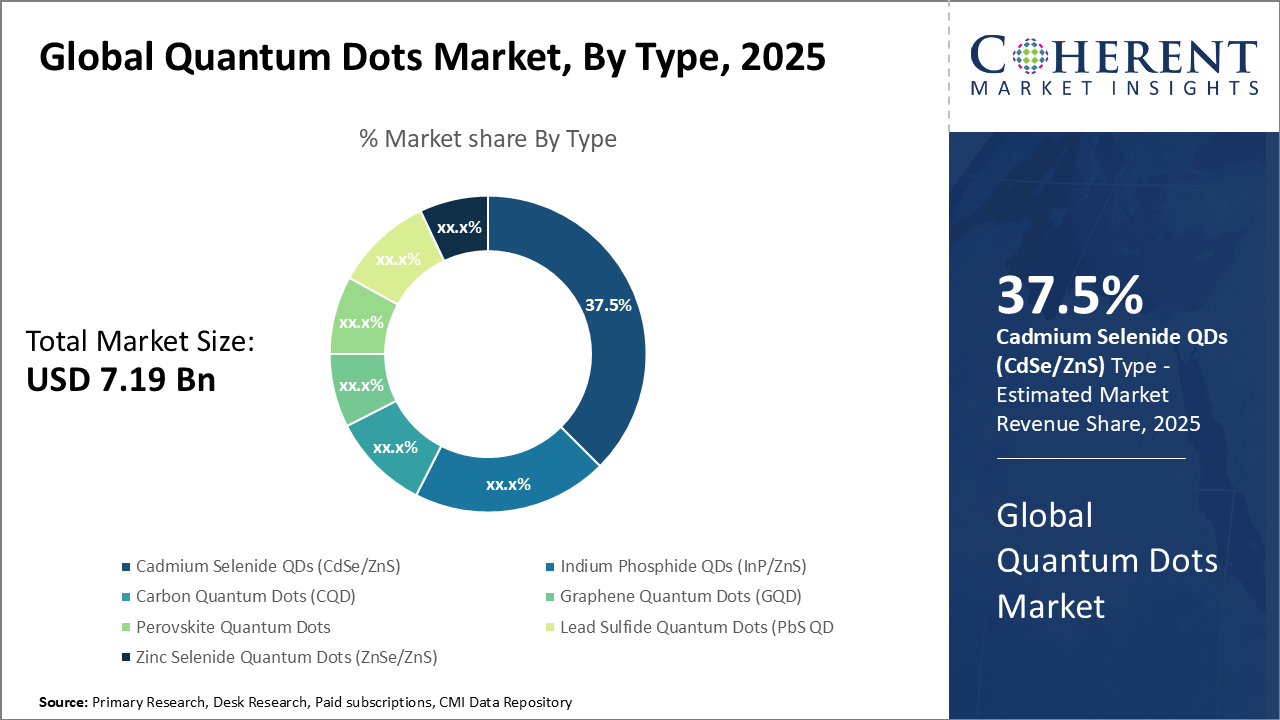
Quantum Dots Market Insights, By Type - Cadmium Selenide Quantum Dots (CdSe/ZnS) Driven by Superior Display Performance
In terms of type, cadmium Selenide Quantum Dots (CdSe/ZnS) is expected to lead the 38.5% share of the market in 2026, due to their superior optical properties such as brightness, stability, and tunable emission. Their widespread use in consumer electronics displays and imaging devices, along with a well-developed supply chain, keeps them in the lead even though there remain concerns about cadmium toxicity.
For instance, in April 2026, UbiQD raised $20 million to improve its cadmium-free quantum dot technology, which was designed to make light work better for farming and solar energy. The money helps grow greenhouse films that increase crop yields and solar innovations. This shows that there is a growing need for quantum dots that are safe and environmentally friendly, not just for display and imaging markets.
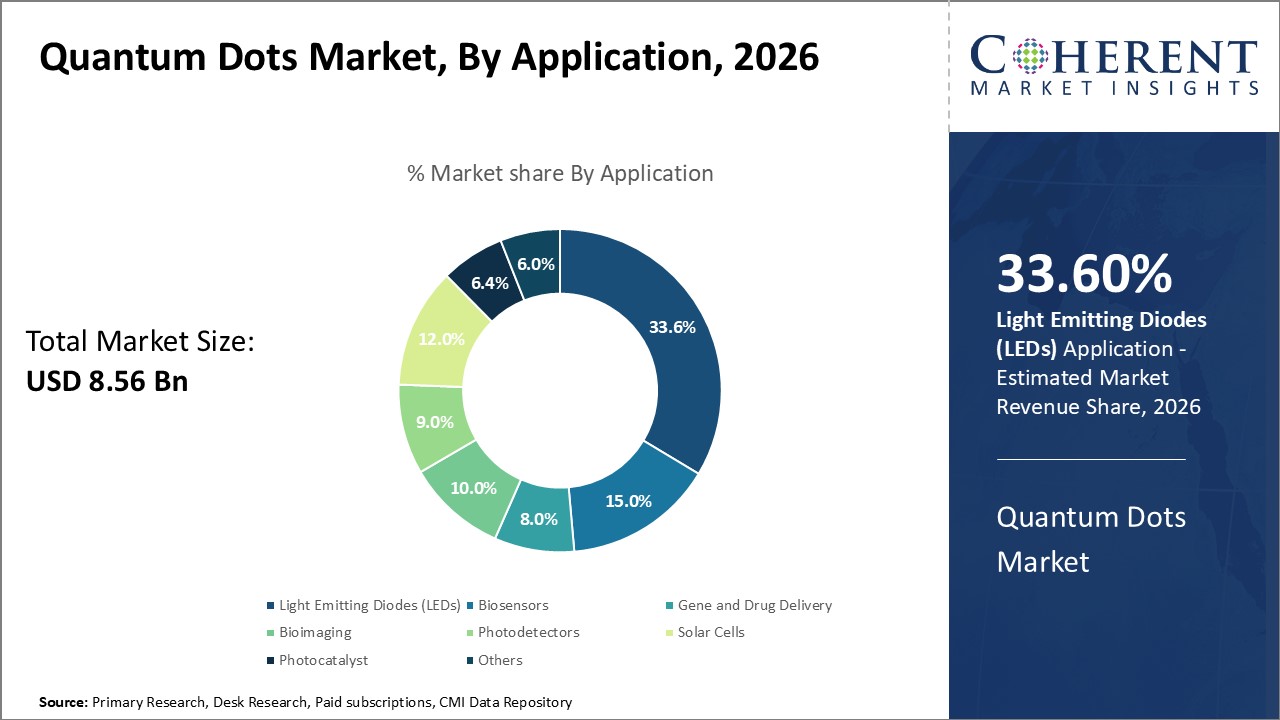
Quantum Dots Market Insights, By Application - LEDs Dominance Driven by Superior Efficiency and Color Quality
In terms of application, Light Emitting Diodes (LEDs) is expected to contribute the highest share of 33.60% in 2026, owing to ongoing technological developments. Quantum dots are revolutionizing LED lighting solutions due to narrow and tunable emission spectra. They enhance color purity, improve efficiency, and allow access to new regions of color gamut.
Quantum dot LEDs demonstrate greatly reduced power consumption compared to conventional lighting products. They are environment-friendly and can potentially reduce energy bills. The superior light quality of quantum dot LEDs makes them ideal for use in digital signage, LCD displays and other lighting applications. Their ability to produce saturated colors with a wide color space is fueling adoption. LED chip and package manufacturers are increasingly integrating quantum dots to develop next-generation lighting offerings. Declining prices of quantum dots will make the technology affordable for mass consumer markets. Strict regulations regarding energy efficiency are propelling the shift towards quantum dot LED lighting. Their long operational lifetime and design flexibility present untapped growth avenues. On account of these factors, LEDs will continue dominating the application segment.
For instance, in March 2025, researchers have made quantum dot LEDs that are good for the environment by using materials that don't contain heavy metals. These LEDs emit pure blue light with almost absolutely no degradation of energy. This breakthrough solves the problems with cadmium-based QDs that make them toxic, making lighting and display technologies safer and more environmentally friendly. The new technology supports energy-efficient uses, which is in line with the global demand for quantum dot solutions that are good for the environment by 2025.
Regional Insights
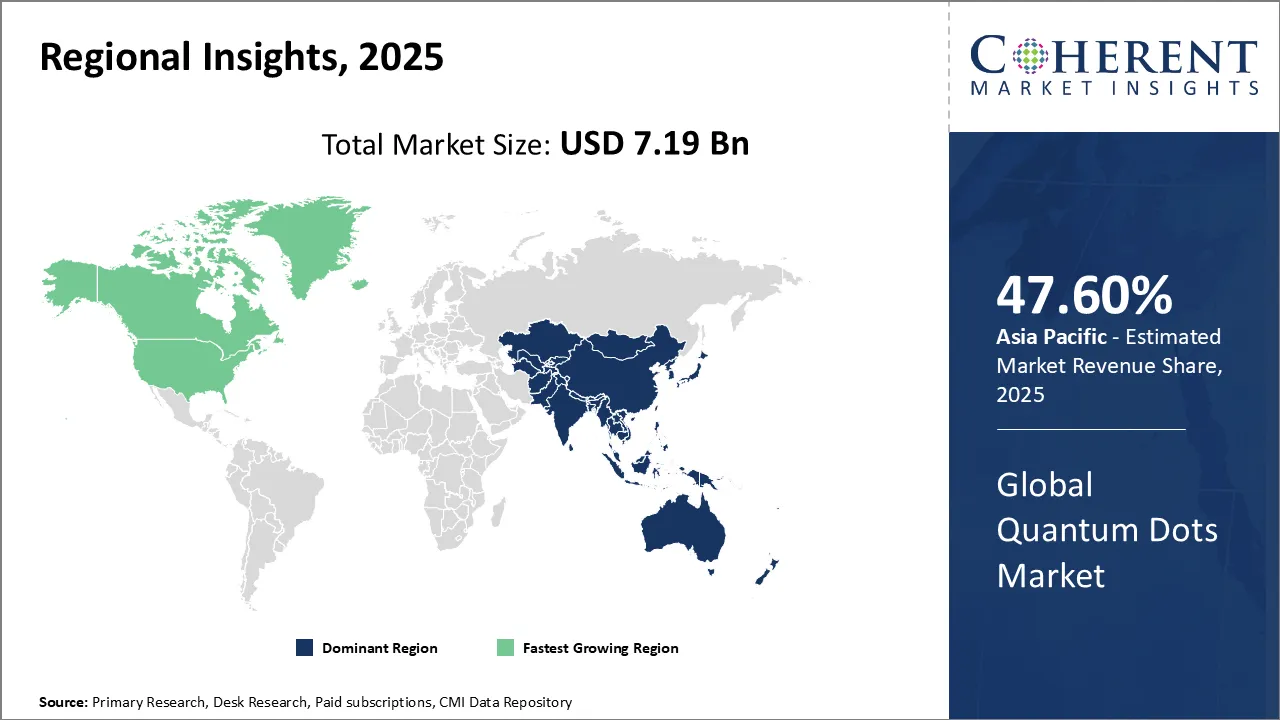
Asia Pacific Quantum Dots Market Analysis & Trends
The Asia Pacific region is poised to dominate the quantum dots market and is projected to hold the largest market share of 47.6% in 2026. Additionally, it is expected to exhibit the highest Compound Annual Growth Rate (CAGR) of 23.21% during the same year. This substantial growth trajectory can be attributed to several key factors driving the adoption and expansion of quantum dots technology across various industries within the region.
For instance, in December 2026, a group of researchers from China has launched a new quantum computing platform that could accelerate up scientific research. The goal of the system is to speed up and improve the efficiency of calculations, which allows researchers to make progress in materials science, pharmaceuticals, and complex simulations. This launch shows that China is becoming a leader in quantum technologies and is dedicated to promoting innovation around the world.
North America Quantum Dots Market Analysis & Trends
North America is projected to be the fastest growing region in response to big investments in research and development, the use of alternatives that do not contain cadmium, and their growing use in healthcare, defense, and consumer electronics. Rapid growth is happening in many industries because of the rising demand for advanced displays, bioimaging, and eco-friendly technologies, as well as strict energy efficiency rules.
For instance, in August 2026, the Rainbow Lab at NC State is a research center with multiple robots that speeds up the search for new quantum dots. The lab quickly tests new materials for displays, lighting, solar energy, and biomedical imaging using automation and AI-driven experimentation. This project in the U.S. shows how North America is becoming more important in the development and commercialization of quantum dots.
Quantum Dots Market Outlook Country-Wise
China Quantum Dots Market Trends
China's quantum dots market grows quickly in 2026 owing to strong manufacturing of consumer electronics, government-backed research into nanotechnology, and a growing need for high-definition displays. Environmental rules encourage alternatives that don't contain cadmium, and the use of these alternatives is growing in solar energy, biomedical imaging, and optoelectronics. This combination keeps China on top and keeps demand high.
For instance, in July 2026, researchers in China made a visual sensor based on quantum dots that can quickly adjust to very bright or very dark light. This sensor quickly changes its sensitivity, which makes imaging and recognition better. The human eye takes minutes to do this. The breakthrough exhibits that quantum dots have the power to change things in robotics, self-driving cars, and neuromorphic computing.
U.S. Quantum Dots Market Trends
In 2026, the U.S. demand for quantum dots market is demanding as more people are using high-definition displays, there are eco-friendly alternatives that don't contain cadmium, and quantum dots are being used more and more in healthcare, defense, and solar energy. Strong investments in research and development, rules that promote energy efficiency, and advances in nanotechnology all help the U.S. become a leader in innovation and commercialization.
For instance, in January 2026, Researchers at NREL in the US managed to better control the process of making quantum dots, which improved their stability and performance. This breakthrough makes them better for use in solar cells, optoelectronics, and advanced materials. Scientists are paving the way for more efficient and reliable energy technologies and new electronic uses around the world by fine-tuning the properties of quantum dots.
Market Report Scope
Quantum Dots Market Report Coverage
| Report Coverage | Details | ||
|---|---|---|---|
| Base Year: | 2025 | Market Size in 2026: | USD 8.56 Bn |
| Historical Data for: | 2020 To 2024 | Forecast Period: | 2026 To 2033 |
| Forecast Period 2026 to 2033 CAGR: | 19.0% | 2033 Value Projection: | USD 28.91 Bn |
| Geographies covered: |
| ||
| Segments covered: |
| ||
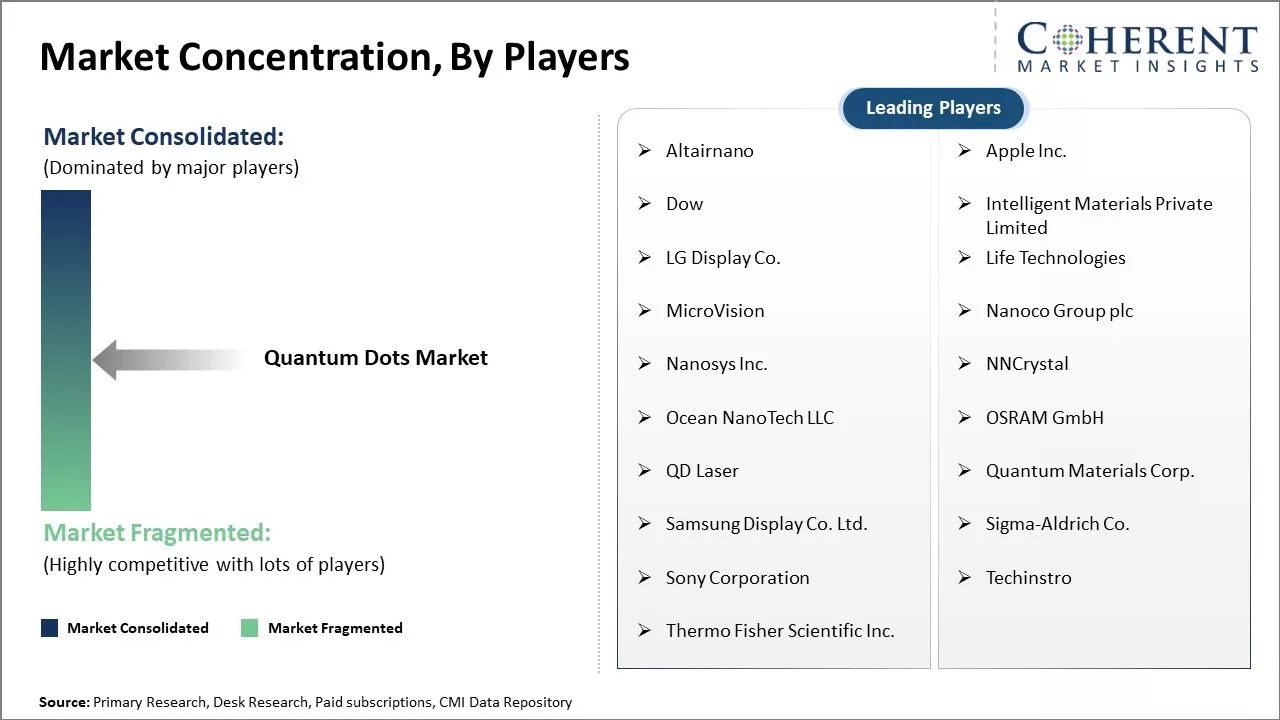
| Companies covered: | Altairnano, Apple Inc. , Dow , Intelligent Materials Private Limited , LG Display Co., Life Technologies, MicroVision , Nanoco Group plc, Nanosys Inc., NNCrystal , Ocean NanoTech LLC, OSRAM GmbH , QD Laser, Quantum Materials Corp., Samsung Display Co. Ltd. , Sigma-Aldrich Co. , Sony Corporation , Techinstro , and Thermo Fisher Scientific Inc. | ||
| Growth Drivers: |
| ||
| Restraints & Challenges: |
| ||
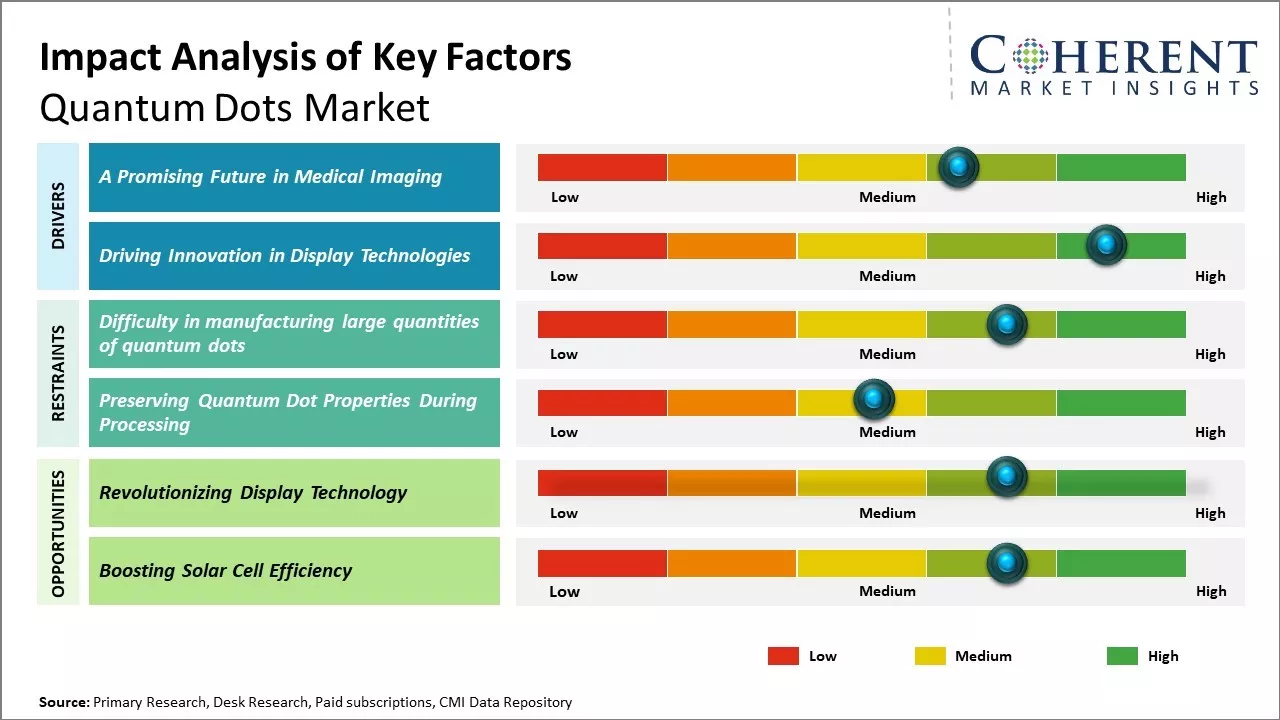
A Promising Future in Medical Imaging
Quantum dots hold immense potential for medical imaging applications. Their wavelength-tune able light emission property allows these semiconductor nanoparticles to be tailored for specific imaging techniques. Quantum dots offer brighter and more precise signal than conventional fluorophores used today. Their resistance to photobleaching enables longer image acquisition times. This makes them particularly suited for techniques like in vivo imaging where continuous monitoring is important.
Research is ongoing to develop quantum dots that can be safely used inside the human body. Some key efforts include engineering their surfaces to avoid toxicity and loading them in biodegradable carriers to ensure they pass harmlessly through the system after use. Once these aspects are satisfactorily addressed, quantum dots based contrast agents could revolutionize medical diagnostics. Their sensitivity could enable detection of cancers and other diseases at an early, more treatable stage. Multi-modal imaging using quantum dots may allow combining functional and anatomical data on one platform. This would provide richer clinical insights compared to current single-modality options.
The applications seem limitless. Targeted cancer imaging, cell tracking for regenerative therapies, mapping of neuronal connections in the brain - quantum dots could find wide use across many areas. Early clinical trials also indicate their feasibility and performance advantages. With continued progress on the bio-compatibility front, quantum dots based medical imaging is poised to take off in the coming years. It promises to enhance disease management and push the boundaries of precision medicine.
Market Concentration and Competitive Landscape
Driving Innovation in Display Technologies
Quantum dots are finding increasing adoption in display applications due to their unique optical characteristics. As emissive layers in television and monitor screens, quantum dots enable improved color gamut, higher resolution and energy efficiency compared to conventional displays. Their wide color space covers almost 100% of Rec. 2020, producing vibrant, lifelike hues. Coupled with high resolution and contrast, quantum dot displays provide an unparalleled visual experience.
Manufacturers are leveraging these qualities to gain an edge. As display technology evolves towards 8K, high dynamic range and wider color volumes, quantum dots give early adopters a competitive advantage. They help future-proof displays against increasing pixel densities and high brightness levels. Quantum dots also allow thinner screen profiles by replacing thick, power-hungry CCFL backlights with uniform LED alternatives. This has proven instrumental in creating slender, lightweight designs for laptops, tablets, and smartphones.
Market Opportunities - Revolutionizing Display Technology
The superior light emission and absorption properties of quantum dots make them well-suited for uses in LEDs, solar cells, medical imaging, and displays. As technologies in these application areas advance, the demand for quantum dots is expected to increase tremendously. Quantum dots also have potential applications in quantum computing that could emerge as a new large market in the coming decade.
Analyst Opinion (Expert Opinion)
- The quantum dots market is moving from early commercialization to wider use of the technology. The display industry is the main driver of this growth, but it is also gaining ground in lighting, photovoltaics, biosensing, and new photonics applications. Recent evaluations of the industry show a large and growing base, with strong evidence of year-on-year volume increases across materials, films, and integrated device components.
- Display and monitor apps make up a significant part of total demand. This is as quantum-dot films are very popular in high-end TVs and monitors. People like these films because they work perfectly with the LCD infrastructure that is already in place and because they can make things brighter and show more colors. On-chip quantum dots and printable formulations are still small parts of the market, but they are growing quickly as microLED technology develops.
- Asia-Pacific currently makes and uses the most products because it has so many display OEMs, panel makers, and supply-chain clusters. Cadmium-free materials, especially indium-phosphide and perovskite quantum dots, are becoming more popular as regulations get stricter and OEMs move toward solutions that are better for the environment.
- The main thing that makes long-term forecasts uncertain is how quickly people are using them in areas other than displays. Quick integration into photovoltaics, lighting, and biosensing could greatly increase the size of the market, while slower commercialization would keep near-term growth focused on display-based applications.
Speak to the analyst
Want personalized insights?
Take the findings above to one of our principal consultants, or have the report rebuilt around the segments, geographies and competitors you actually track.
Recent Development
- In December 2025, The National Quantum Mission started India's National Hub for Quantum Communication at IIT Madras. The hub works with C-DOT on quantum cryptography, QKD networks, quantum memory, and satellite communication. It is located at IIT Madras Research Park and helps India stay ahead in secure quantum technologies by bringing together researchers, businesses, and startups.
- In January 2025, At CES 2025, the Chinese company Koorui unveiled the world's first 750Hz gaming monitor with quantum dots. The 24.5-inch G7 model has a quantum dot film that makes the colors on the TN panel more accurate. It has a response time of 0.5ms and covers 95% of the DCI-P3 color space. Starting in 2025, mass production will begin, with a focus on e-sports markets around the world.
- In January 2025, LG Electronics' 2025 QNED TVs do not utilize quantum dots like older models, even though their name suggests they do. Instead, they have a Dynamic QNED Color Solution. This has raised concerns about misleading branding, which may have occurred before in the industry, and it could hurt people's trust in high-end display technologies.
Market Segmentation
- Type Insights (Revenue, USD Bn, 2026 - 2033)
- Cadmium Selenide Quantum Dots (CdSe/ZnS)
- Carbon Quantum Dots (CQD)
- Graphene Quantum Dots (GQD)
- Indium Phosphide Quantum Dots (InP/ZnS QD)
- Lead Sulfide Quantum Dots (PbS QD)
- Perovskite Quantum Dots
- Zinc Selenide Quantum Dots (ZnSe/ZnS QD)
- Application Insights (Revenue, USD Bn, 2026 - 2033)
- Biosensors
- Gene and Drug Delivery
- Bioimaging
- Light Emitting Diodes (LEDs)
- Photodetectors
- Solar Cells
- Photocatalyst
- Others
- Regional Insights (Revenue, USD Bn, 2026 - 2033)
- North America
- U.S.
- Canada
- Latin America
- Brazil
- Argentina
- Mexico
- Rest of Latin America
- Europe
- Germany
- U.K.
- Spain
- France
- Italy
- Russia
- Rest of Europe
- Asia Pacific
- China
- India
- Japan
- Australia
- South Korea
- ASEAN
- Rest of Asia Pacific
- Middle East & Africa
- GCC Countries
- Israel
- Rest of Middle East & Africa
- North America
- Key Players Insights (Revenue, USD Bn, 2021 - 2033)
- Altairnano
- Apple Inc.
- Dow
- Intelligent Materials Private Limited
- LG Display Co.
- Life Technologies
- MicroVision
- Nanoco Group plc
- Nanosys Inc.
- NNCrystal
- Ocean NanoTech LLC
- OSRAM GmbH
- QD Laser
- Quantum Materials Corp.
- Samsung Display Co. Ltd.
- Sigma-Aldrich Co.
- Sony Corporation
- Techinstro
- Thermo Fisher Scientific Inc.
Sources
Primary Research Interviews
- Quantum dot manufacturers (cadmium-free & cadmium-based producers)
- Display panel OEMs (TV, smartphone, monitor manufacturers)
- LED & lighting manufacturers integrating quantum dot color converters
- Biomedical imaging & diagnostics companies using quantum dots
- Solar cell & photodetector developers employing quantum-dot-based materials
- Nanomaterials suppliers and colloidal synthesis specialists
- Equipment & process tool vendors (nanofabrication, ligand-exchange equipment)
- R&D scientists and university research groups (materials science, optics, chemistry)
- Regulatory & toxicology experts for nanomaterials
- Others
Databases
- Bloomberg Terminal
- Thomson Reuters Eikon / Refinitiv
- IHS Markit
- Euromonitor International
- S&P Global Market Intelligence
- Clarivate (Web of Science)
- Scopus
- SciFinder / CAS
- Others
Magazines
- Photonics Spectra
- LEDs Magazine
- Materials Today (industry section)
- Nanowerk News / Nano Today (industry features)
- Display Daily / Display Week coverage
- C&EN (Chemical & Engineering News)
- Others
Journals
- ACS Nano
- Nano Letters
- Advanced Materials
- Journal of Physical Chemistry C
- Small
- Optics Express
- Nature Nanotechnology
- Others
Newspapers
- Financial Times
- The Wall Street Journal
- Reuters
- Bloomberg News
- The New York Times (technology coverage)
- Others
Associations
- Society for Information Display (SID)
- SPIE – The International Society for Optics and Photonics
- IEEE Nanotechnology Council
- American Chemical Society (ACS) – Materials/Nanoscience divisions
- European Materials Research Society (E-MRS)
- Nanotechnology Industries Association (NIA)
- Others
Public Domain Sources
- U.S. Department of Energy (DOE) – Office of Science (materials & photonics programs)
- National Institute of Standards and Technology (NIST) – nanometrology resources
- Environmental Protection Agency (EPA) – nanomaterials guidance and regulations
- European Commission – Directorate-General for Research & Innovation (nanotech reports)
- OECD – Working Party on Manufactured Nanomaterials
- World Health Organization (WHO) – nanotechnology & health briefs (where applicable)
- Others
Proprietary Elements
- CMI Data Analytics Tool
- Proprietary CMI Existing Repository of Information for the Last 8 Years
Get access to 250+ pages report
Every segment, forecast, competitor profile and data table behind the analysis above — available for instant download.
- ESOMAR Member
- ISO 9001:2015 Certified
- D-U-N-S Registered
- GDPR & CCPA Compliant
Missing comfort of reading report in your local language? Find your preferred language:
Transform your Strategy with Exclusive Trending Reports
Frequently Asked Questions
The Quantum Dots Market is estimated to be valued at USD 8.56 Bn in 2026, and is expected to reach USD 28.91 Bn by 2033.
The CAGR of the Quantum Dots Market is projected to be 19.0% from 2026 to 2033.
A promising future in medical imaging and driving innovation in display technologies are the major factors driving the growth of the quantum dots market.
Difficulty in manufacturing large quantities of quantum dots and preserving quantum dot properties during processing are the major factors hampering the growth of the quantum dots market.
In terms of type, Carbon Quantum Dots (CQD) is estimated to dominate the market revenue share in 2026.
Altairnano, Apple Inc. , Dow , Intelligent Materials Private Limited , LG Display Co., Life Technologies, MicroVision , Nanoco Group plc, Nanosys Inc., NNCrystal , Ocean NanoTech LLC, OSRAM GmbH , QD Laser, Quantum Materials Corp., Samsung Display Co. Ltd. , Sigma-Aldrich Co. , Sony Corporation , Techinstro , and Thermo Fisher Scientific Inc. are the major players.
Asia Pacific is expected to lead the quantum dots market in 2026.