

Port Infrastructure Market Size and Forecast — 2026 - 2033
The Global Port Infrastructure Market size is estimated to be valued at USD 65.4 billion in 2026 and is expected to reach USD 101.7 billion by 2033, exhibiting a compound annual growth rate (CAGR) of 7.2% from 2026 to 2033.
Overview
The port infrastructure market is driven by the steady growth of global trade and containerization, increasing demand for efficient cargo handling, and expansion of maritime logistics networks. Rising investments in modernizing ports with automation, smart technologies, and digital systems enhance operational efficiency and reduce turnaround time. Government initiatives and public-private partnerships support large-scale port development projects, especially in emerging economies. Additionally, the growth of e-commerce and energy trade, including LNG shipments, boosts port activity. Environmental regulations are also pushing ports to adopt sustainable infrastructure, while strategic geopolitical positioning and the need for resilient supply chains further accelerate infrastructure upgrades and capacity expansion worldwide.
Key Takeaways
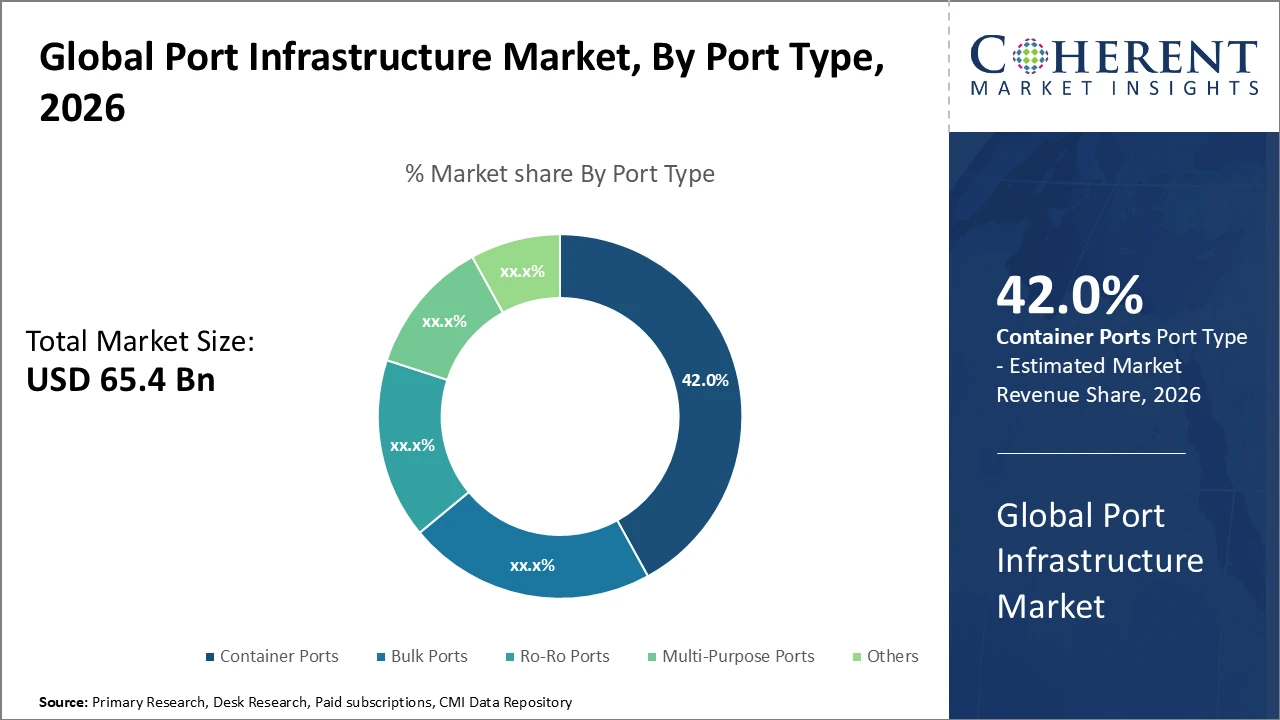
Container Ports segment holds the dominant market share with over 42%, driven by surging containerized trade and automation enhancements. Bulk Ports are emerging rapidly, supported by growing commodity trade flows in emerging regions.
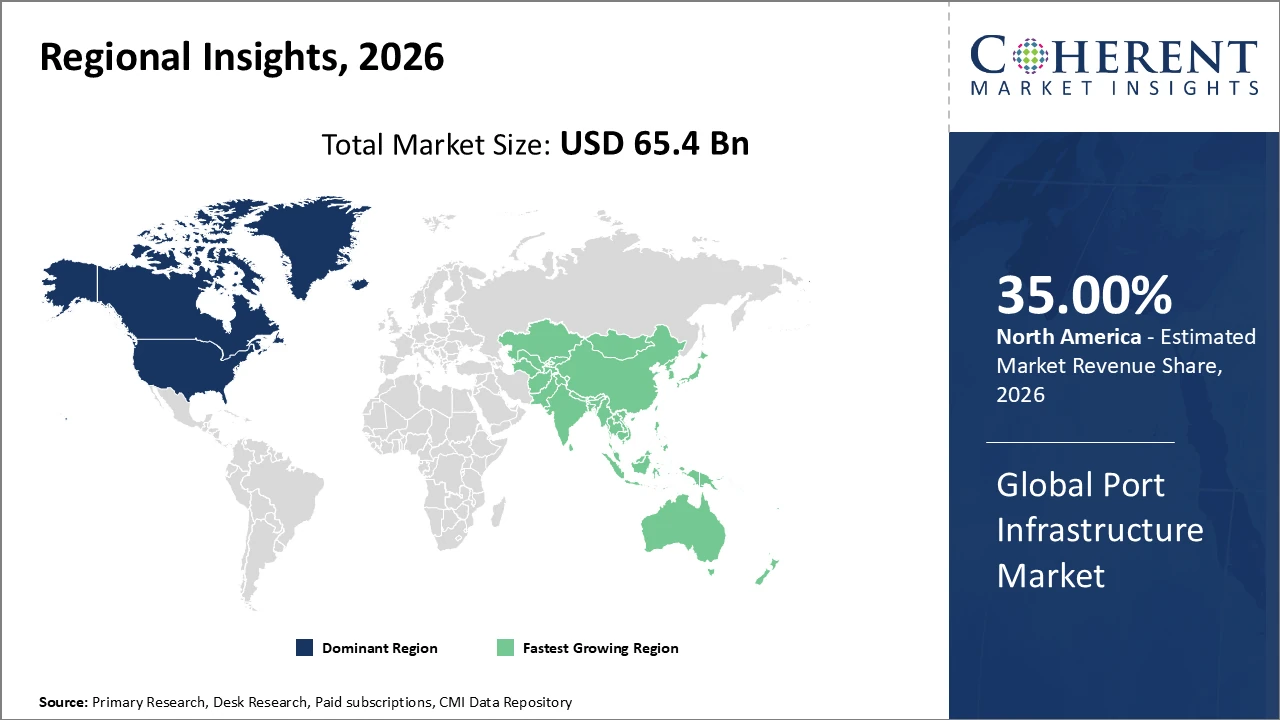
North America accounts for the largest industry share, attributed to advanced port technologies and strong regulatory frameworks. Asia Pacific is the fastest-growing region, with a CAGR of approximately 8.5% due to rising import-export activities and infrastructure investments.
Emerging markets in Latin America and the Middle East & Africa present untapped opportunities, fueled by government-led port modernization and trade ecosystem development.
Port Infrastructure Market Segmentation Analysis
Port Infrastructure Market Insights, By Port Type
Container Ports dominate the market with a share of 42% due to the surge in global containerized trade and the widespread adoption of automated handling systems, significantly increasing throughput capacity. Bulk Ports are growing rapidly, driven by expanding trade in commodities such as coal, grains, and ores, supported by infrastructure upgrades that improve unloading speed and storage capacity. Ro-Ro Ports specialize in vehicle and wheeled cargo operations, experiencing steady growth thanks to rising automotive exports. Multi-purpose Ports provide versatility across various cargo types, serving niche markets with adaptable infrastructure. Other segments include specialized ports for liquid bulk and project cargo, holding a smaller market share.
Port Infrastructure Market Insights, By Infrastructure
Quay Walls dominate the market due to their essential role in vessel docking and accommodating larger ships, driving significant investment as ports modernize and reinforce existing structures. Cranes and Cargo Handling Equipment closely follow, fueled by technological advancements such as electric, automated, and remote-controlled cranes that improve operational efficiency and reduce labor costs. Storage Facilities, including warehouses and container yards, are vital for managing cargo throughput and logistics. Access Roads and Rail Connectivity strengthen hinterland integration, enabling efficient multimodal transport. Other infrastructure components, such as utilities and port IT systems, provide critical support, ensuring smooth port operations and enhancing overall efficiency.
Port Infrastructure Market Insights, By End User
Shipping Companies dominate the market share, relying heavily on port infrastructure for efficient vessel turnaround, cargo handling, and streamlined operations, which drives substantial investments in terminal optimization. Warehousing and Logistics firms leverage enhanced storage, container yard facilities, and multimodal connectivity to improve distribution efficiency and reduce transit times. Manufacturing sectors generate significant demand by facilitating the import and export of raw materials and finished goods, particularly in industrialized regions of Asia Pacific. Energy and Mining industries utilize bulk ports to handle commodities such as oil, gas, coal, and minerals efficiently. Other end users include fisheries, government agencies, and specialized cargo operators requiring tailored port services.
Port Infrastructure Market Trends
Digital transformation and sustainability are driving port infrastructure trends.
Smart ports using AI, IoT, and blockchain have improved cargo processing efficiency by up to 20%.
The Port of Los Angeles implemented a zero-emission terminal in 2024, setting standards for eco-friendly port operations.
Integrated multimodal logistics hubs are expanding, connecting ports with inland freight networks to enhance supply chain resilience.
Automation in cargo handling, such as automated cranes and container tracking, is increasingly adopted to reduce operational costs and improve throughput.
Ports are prioritizing energy-efficient and low-emission equipment to align with global environmental regulations.
Port Infrastructure Market Insights, By Geography
North America Port Infrastructure Market Analysis and Trends
North America holds a leading position in the port infrastructure market, accounting for approximately 35% of global market share. This dominance is supported by advanced logistics ecosystems, well-established regulatory frameworks, and consistent investments in digitalization and sustainable port operations. Key initiatives, such as the expansion and modernization of the Port of Los Angeles and other major U.S. terminals, enhance cargo handling efficiency and support larger vessel capacities. Additionally, the adoption of smart port technologies, including AI, IoT, and automated cargo systems, strengthens operational performance, while ongoing infrastructure upgrades and green energy initiatives further consolidate North America’s leadership in global port infrastructure development.
Asia Pacific Port Infrastructure Market Analysis and Trends
Asia Pacific leads the fastest-growing segment in the port infrastructure market, registering a CAGR of approximately 8.5%. This growth is driven by rapid industrialization, rising import-export activities, and substantial government investments in port modernization projects in countries such as China, India, and Indonesia. Expansion of deep-water ports and adoption of automated container handling systems enhance operational efficiency and throughput, attracting both domestic and international shipping operators. Furthermore, strategic initiatives to develop integrated multimodal transport networks and logistic corridors strengthen supply chain connectivity, creating significant opportunities for private investments and technology adoption in the region’s rapidly evolving port infrastructure ecosystem.
Port Infrastructure Market Outlook for Key Countries
USA Port Infrastructure Market Analysis and Trends
The U.S. port infrastructure market benefits from significant federal and state investments focused on capacity expansion and resilience improvements. Programs such as the Infrastructure Investment and Jobs Act have facilitated modernization of major ports, including Savannah and Los Angeles, boosting cargo handling capacities by nearly 18% in 2026. Leading operators like the Port of Los Angeles and DP World are implementing advanced automated handling systems and eco-friendly initiatives, enhancing operational efficiency and sustainability. These developments not only strengthen the U.S. competitive position in global trade but also drive substantial market revenue growth, positioning the country as a critical hub for modern port infrastructure development.
Germany Port Infrastructure Market Analysis and Trends
Germany’s port infrastructure market is driven by its strategic location as Europe’s logistics hub and the high volume of maritime trade through ports like Hamburg and Bremerhaven. Investments in deep-water berths, automated container terminals, and quay wall upgrades have strengthened operational efficiency and cargo throughput. The adoption of green technologies, including electrification of cargo handling equipment and shore power for vessels, aligns with EU sustainability directives. Germany’s emphasis on multimodal connectivity integrates ports with rail and inland waterways, enhancing supply chain efficiency. Growing container traffic, government-backed modernization projects, and technological advancements continue to position Germany as a leading European port infrastructure market.
Analyst Opinion
Increasing Automation and Digitalization: Adoption of automated cargo handling systems and IoT connectivity is enhancing operational efficiency. In 2025, AI-driven crane operations at major ports reduced turnaround times by 15%, boosting market revenue and improving global supply chain reliability.
Expansion of Deep-water Ports: Deep-water port projects are growing to accommodate larger container ships. The Port of Rotterdam’s Maasvlakte 2 expansion increased capacity by 40% in 2024, highlighting the importance of large-scale infrastructure investments for global competitiveness.
Rising Demand from Emerging Economies: Ports in Asia Pacific and Latin America are expanding due to rising manufacturing and trade. India’s Jawaharlal Nehru Port cargo volumes rose 12% in 2026 from new industrial corridors.
Investment in Sustainability Initiatives: Green port strategies and environmental regulations are influencing capital allocation. In 2024, dock equipment electrification at the Port of Los Angeles cut emissions by 20%, supporting market growth and global sustainability commitments.
- Current Industry Events of 2026
- Market Size Estimation
- Regional Breakdown
- Competitive Landscape
- Customer Intelligence
- Segmental Analysis
- Pricing Analysis
- Key Market Drivers, Challenges & Future Trends
- Customized Insights Section
Market Scope
| Report Coverage | Details | ||
|---|---|---|---|
| Base Year: | 2025 | Market Size in 2026: | USD 65.4 billion |
| Historical Data for: | 2020 To 2024 | Forecast Period: | 2026 To 2033 |
| Forecast Period 2026 to 2033 CAGR: | 7.2% | 2033 Value Projection: | USD 101.7 billion |
| Geographies covered: |
| ||
| Segments covered: |
| ||
| Companies covered: | DP World, PSA International, APM Terminals, Port of Antwerp, DP World Australia, Dubai Ports Authority, CMA CGM Group, Yilport Holding, Port of Singapore Authority | ||
| Growth Drivers: |
| ||
Port Infrastructure Market Growth Factors
The surge in global trade volumes is propelling significant investments in port capacity expansion and infrastructure modernization. Ports are increasingly deploying advanced digital technologies, including blockchain and IoT, to enhance logistics security and operational efficiency. Government initiatives in emerging economies further stimulate market revenue through funding for port expansion and modernization. Environmental regulations are driving the adoption of green solutions, positioning sustainable port infrastructure as a critical growth factor. For example, Asia Pacific nations invested over USD 3 billion in port electrification projects in 2024, highlighting the strategic focus on technological and eco-friendly enhancements across the region.
Port Infrastructure Market Development
In February 2026, V.O. Chidambaranar Port Authority became the first port in India to implement a Digital Twin platform for port management, advancing smart and efficient maritime operations.
Key Players
Leading Companies of the Market
DP World
PSA International
APM Terminals
CMA CGM Group
DP World Australia
Yilport Holding
Dubai Ports Authority
Port of Singapore Authority
Port of Antwerp
Several leading companies such as DP World and PSA International have advanced investments in smart port technologies and sustainable infrastructure, enhancing operational throughput and reducing costs. For instance, Hutchison Ports’ deployment of automated yard trucks in 2025 resulted in a 10% increase in cargo handling efficiency. Additionally, strategic partnerships among major market players have improved cross-border trade facilitation, expanding market reach and reinforcing competitive positioning. These initiatives collectively demonstrate the industry’s focus on integrating technology, sustainability, and collaboration to optimize port operations and capture long-term growth opportunities in global maritime infrastructure.
Port Infrastructure Market Future Outlook
The future of the port infrastructure market is poised for robust growth, driven by increasing global trade volumes, technological modernization, and sustainability initiatives. Smart port technologies, including AI-driven cargo handling, IoT connectivity, and automated terminals, will continue to enhance operational efficiency and reduce turnaround times. Expansion of deep-water ports and multimodal logistics hubs will accommodate larger vessels and streamline inland freight networks. Government investments and public-private partnerships, particularly in emerging economies, will accelerate modernization projects. Additionally, green infrastructure adoption, such as electrification of port equipment and emission reduction strategies, will become a critical focus, aligning market growth with environmental regulations and long-term sustainability.
Port Infrastructure Market Historical Analysis
The port infrastructure market has experienced steady growth over the past decade, fueled by globalization, rising trade volumes, and investments in modernization. Historically, container ports dominated due to the rapid expansion of containerized shipping, while bulk ports grew alongside commodity trade. Technological advancements, including automated cargo handling systems and terminal operating software, improved operational efficiency and throughput. North America and Europe initially led market development due to established port networks, while Asia Pacific gradually emerged as a key growth region, driven by industrialization and trade expansion. Investments in quay walls, cranes, and logistics connectivity historically underpinned revenue growth and market resilience.
Sources
Primary Research Interviews:
Port authorities, operations managers, and logistics planners overseeing terminal capacity, cargo handling, and automation projects.
Engineers, project managers, and planners from construction and civil engineering firms involved in quay wall, crane, and storage infrastructure development.
Industry experts from port technology providers and equipment manufacturers focusing on smart port solutions, automation, and sustainable infrastructure.
Magazines:
Port Technology International – Trends in smart port solutions, cargo handling systems, and port automation.
Journal of Commerce – Global port operations, shipping, and logistics developments.
MarineLink – Innovations in port construction, dredging, and cargo terminal projects.
Journals:
Maritime Policy & Management – Research on port infrastructure, governance, and operational efficiency.
Transportation Research Part E – Studies on logistics, terminal optimization, and multimodal transport.
Journal of Shipping and Trade – Insights on port development, trade flows, and infrastructure investments.
Newspapers:
The Wall Street Journal – Port investments, mergers, and global trade news.
Financial Times – Infrastructure developments, regulatory updates, and trade trends affecting ports.
Reuters – Port modernization projects, technology adoption, and market performance.
Bloomberg – Company performance and investment trends in port operations.
Associations:
International Association of Ports and Harbors (IAPH) – Standards, best practices, and research for port development.
American Association of Port Authorities (AAPA) – Data, policies, and insights on North American ports.
European Sea Ports Organisation (ESPO) – Guidelines and industry data for European port operations and modernization.
Get access to 250+ pages report
Every segment, forecast, competitor profile and data table behind the analysis above — available for instant download.
- ESOMAR Member
- ISO 9001:2015 Certified
- D-U-N-S Registered
- GDPR & CCPA Compliant
Missing comfort of reading report in your local language? Find your preferred language:
Transform your Strategy with Exclusive Trending Reports
Frequently Asked Questions
The leading companies include DP World, PSA International, and Port of Singapore Authority, all of which hold significant market share through investments in technology and capacity expansion.
The market size is projected to reach USD 101.7 billion by 2033 from USD 65.4 billion in 2026, exhibiting a CAGR of 7.2%, driven by rising global trade volumes and port modernization efforts.
The shipping companies remains the largest user, accounting for over 42% market share, followed by manufacturing and energy industries that increasingly rely on efficient port logistics.
Digitalization, deep-water port expansion, green infrastructure adoption, and multimodal connectivity will shape market trends, fostering enhanced operational efficiency and sustainability.
The market landscape is competitive with major players focusing on automation and sustainability, while challenges include regulatory compliance, cybersecurity risks, and infrastructure financing.
Strategies such as strategic alliances, technology partnerships, capacity expansion, and sustainability initiatives are predominant among market companies aiming for business growth and increased market share.