

Sodium-Ion Battery Market Size and Trends
The Sodium-Ion Battery Market is estimated to be valued at US$ 25.20 Bn in 2026 and is expected to reach US$ 63.85 Bn by 2033, growing at a compound annual growth rate (CAGR) of 14.2% from 2026 to 2033.
Key Takeaways
- Based on Type, the Sodium-Sulphur Battery segment is expected to dominate the global sodium-ion battery market in 2026, accounting for 66.2% of the market share owing to high energy density.
- Based on Application, the Stationery Energy Storage segment is expected to be the leading segment in the market, capturing 72.7% of the share in 2026 on account of its high discharge capability.
- Based End User, the Consumer Electronic Devices segment is projected to hold the largest share with 29.8% in 2026 on account of the rising adoption of portable devices.
- Based on Region, North America is expected to lead the market, holding a share of 40. 2% in 2026. While, Asia Pacific is anticipated to be the fastest growing region during the forecast period.
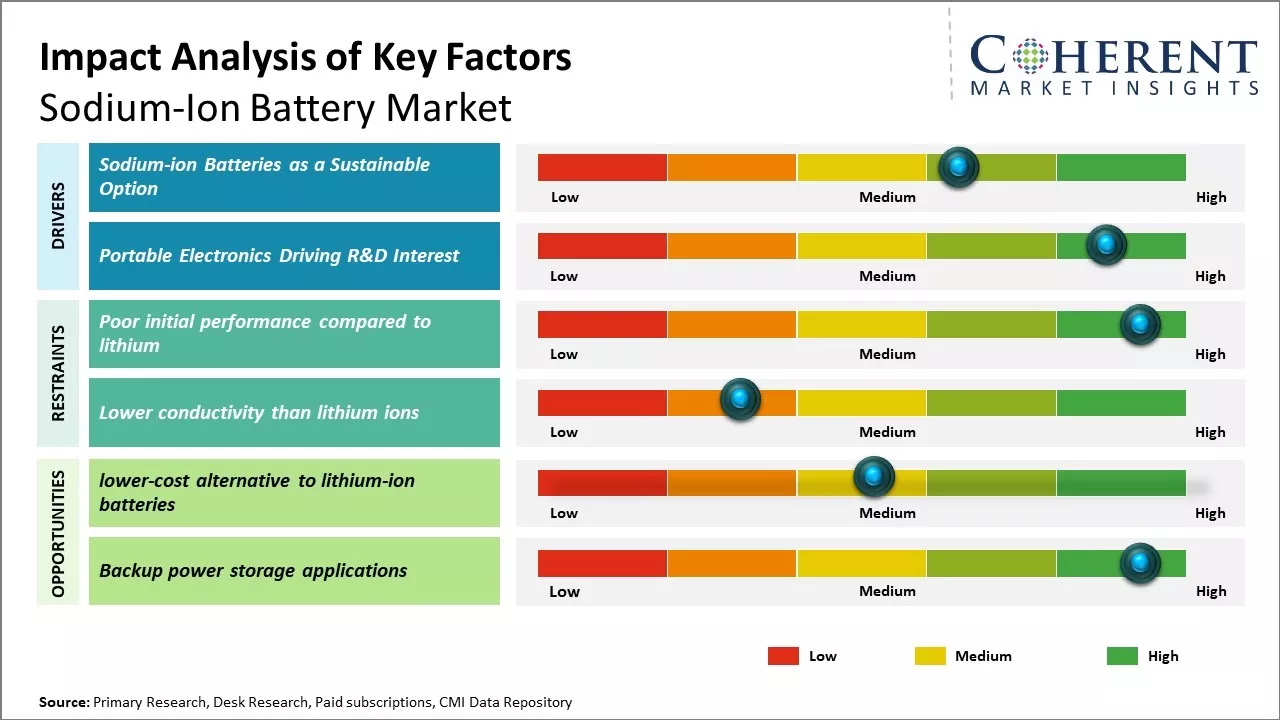
Market Overview
The global sodium-ion battery market is poised for substantial growth over the forecast period, driven by increasing interest in cost-effective and sustainable energy storage solutions. Sodium-ion batteries are gaining momentum as a promising alternative to lithium-ion batteries due to their low production cost and the abundant availability of sodium. A surge in R&D activities, aimed at improving battery performance and lifecycle, coupled with growing investments from major industry players, is further propelling the sodium-ion battery market demand. These batteries are increasingly being adopted in automotive applications and stationary energy storage systems, where cost-efficiency and material accessibility are crucial.
Current Events and their Impact on the Sodium-Ion Battery Market
Current Event | Description and its Impact |
Breakthrough Commercial Developments and Technology Maturation |
|
Government Funding and Strategic Policy Support |
|
Sodium-Ion Batteries Vs Lithium-Ion Batteries
Feature | Sodium‑Ion Battery | Lithium‑Ion Battery |
Cost per kWh | Lower — theoretically US $40–77/kWh (2019 data) | Higher — ~US $137/kWh average (2020) ( |
Energy Density | ~75–200 Wh/kg (lower by ~30%) due to sodium’s heavier mass | ~120–260 Wh/kg depending on chemistry (e.g. LFP or NMC) |
Cycle Life | Hundreds to thousands of cycles depending on design | Often exceeds 3,500 cycles (e.g. LiFePO₄) |
Safety & Stability | Generally safer and more stable, especially in aqueous formats | Higher risk of thermal runaway, requires robust safety controls |
Material Availability | Sodium is abundant and low-cost | Lithium, cobalt, nickel are scarce or geopolitically sensitive |
Operational Temperature Range | Wide: operates from −20 °C to 60 °C with consistent performance | Optimal between 15 °C–35 °C, performance affected in extremes |
- Current Industry Events of 2026
- Market Size Estimation
- Regional Breakdown
- Competitive Landscape
- Customer Intelligence
- Segmental Analysis
- Pricing Analysis
- Key Market Drivers, Challenges & Future Trends
- Customized Insights Section
Pricing Analysis of Sodium-Ion Battery
- Industry & Grid-Scale Cost Estimates
- Current cell cost: approximately $87 per kWh, slightly below comparable lithium‑ion cells (~$89/kWh).
- Pack‑level cost: around $50 per kWh, as projected by IDTechEx for mid‑ to large‑scale production.
- Future Projections & Cost Reductions
- Commodity-scale forecasts expect sodium‑ion cell cost to drop to $40 per kWh by the end of the decade (~2028), with pack cost near $50 per kWh.
- Modelers predict long-term potential as low as $10 per kWh cell level (extremely optimistic scenario).
Segmental Insights
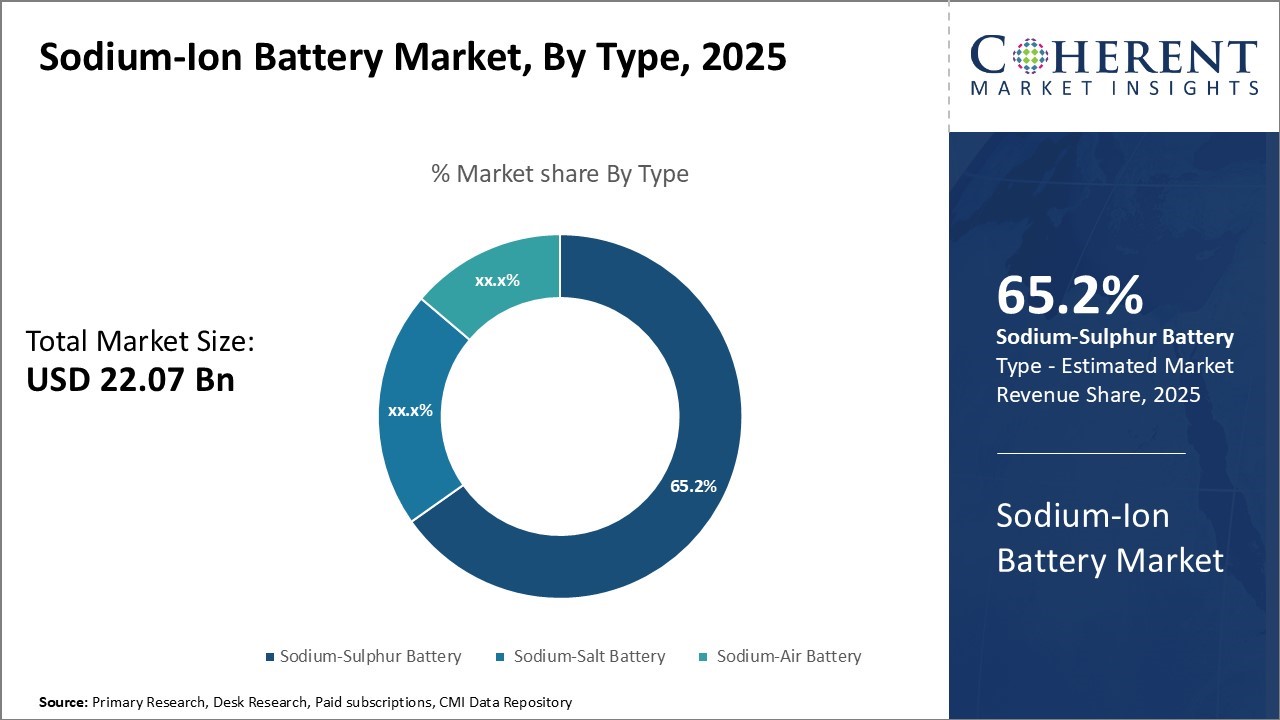
Sodium-Ion Battery Market Insights, By Type - Sodium-Sulphur Battery Acquires the largest share owing to its Superior Technical Performance
In terms of type, the sodium-sulphur battery segment contributes the highest share of the market with 66.2% in 2026, owing to its superior technical performance compared to other types. Sodium-sulphur batteries have relatively high energy densities and can operate at high temperatures up to 300°C. This allows them to deliver stable performance even in extreme weather conditions. They also have a long cycle life and high efficiencies, often above 90%.
Additionally, sodium-sulphur batteries are environmentally friendly as they do not contain toxic heavy metals like lead or cadmium. Their electrolyte is made from inexpensive and abundantly available sulfur. Due to these technical advantages, sodium-sulphur batteries remain the preferred solution for large-scale energy storage applications where high performance is critical.
In May 2025, Japanese manufacturer NGK Insulators deployed a 70 MWh sodium–sulfur (NaS) battery system in Shizuoka Prefecture, Japan, and it has now been selected by U.S. utility Duke Energy for a pilot demonstration.
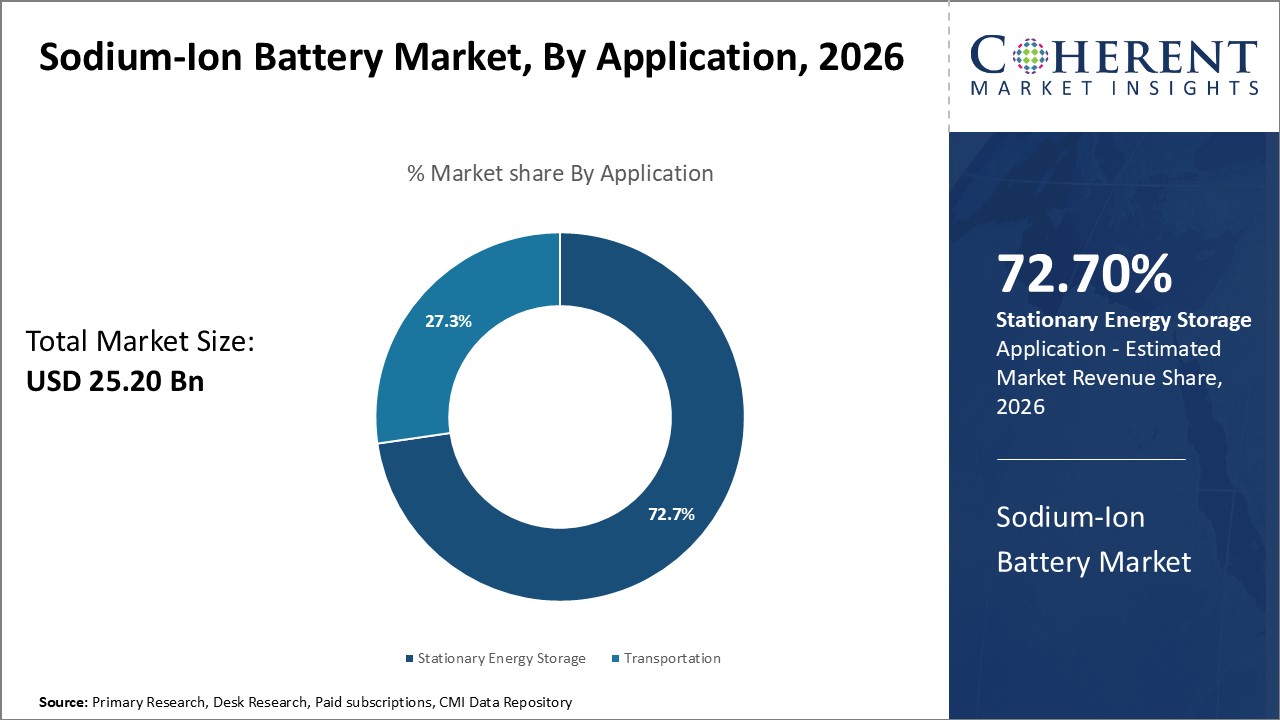
Sodium-Ion Battery Market Insights, By Application - Stationary Energy Storage Holds the dominant share owing to Wide Applicability
In terms of application, the stationary energy storage segment contributes the highest share of the market with 72.7% in 2026 due to its wide applicability across various industries. Sodium-ion batteries excel at stationary storage due to their long duration and high discharge capability. They are well-suited for stabilizing grid fluctuations from renewable energies and providing backup power during outages. Industries such as electric utilities increasingly rely on sodium-ion batteries for these functions. Additionally, commercial and industrial facilities use stationary sodium-ion storage for power management and saving on demand charges. Their resilience and long life also make them suitable for remote off-grid applications such as street lighting, telecom towers, and security systems. Owing to these diverse uses, stationary energy storage continues to be a major driver of sodium-ion battery adoption.
In July 2025, Peak Energy deployed the United States’ first grid‑scale sodium‑ion stationary storage system through a pilot with utilities and independent power producers. Featuring patent‑pending, passively cooled design, the system targets a 20% reduction in lifetime cost and a 33% decrease in degradation over 20 years. As a form of stationary storage, this infrastructure offers long‐duration reliability, enhanced safety, and lower total cost compared with lithium‑ion alternatives.
Sodium-Ion Battery Market Insights, By End User - Consumer Electronic Devices holds the largest share on account of the Growing Needs of Discerning Customers
In terms of end users, the consumer electronic devices segment contributes the highest share of the market with 29.8% in 2026, owing to the growing needs of discerning customers. Users now expect portable devices with richer features, more processing power, and enhanced connectivity - all of which drive up the energy and power requirements. Sodium-ion batteries are attractive to device makers as they offer higher energy density than traditional lithium-ion alternatives. This allows for extended runtimes and makes space for more powerful components within the same battery footprint. Additionally, sodium cells are better suited to withstand repeated fast charging cycles without significant capacity loss. Their reliability and safety aspects also address growing customer concerns. With demand for premium yet sustainable devices continuing to rise, sodium-ion batteries perfectly match the evolving requirements of end consumers in this segment.
In March 2025, Osaka-based Elecom Co., Ltd. introduced consumer-grade sodium‑ion mobile power bank. The 9,000 mAh device delivers up to 45 W via USB‑C PD and 18 W via USB‑A. Its sodium‑ion chemistry is touted to offer ten times longer lifespan of 5,000 charge cycles versus the average 500 for lithium‑ion, alongside enhanced safety and performance in temperatures as low as –35 °C. Environmentally, sodium is more abundant and less toxic than lithium.
Regional Insights
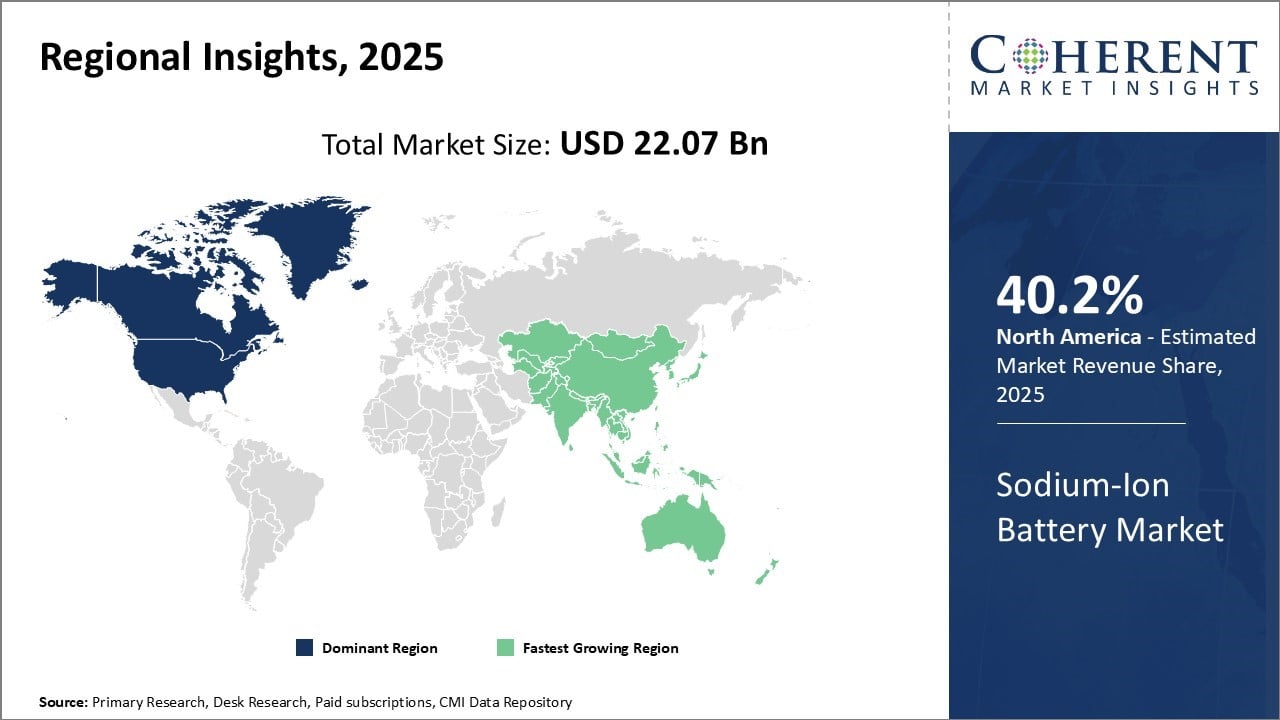
North America Sodium-Ion Battery Market Analysis & Trends
North America currently dominates the global sodium-ion battery market with 40.2% in 2026. The region is home to key players like CATL, Panasonic, and Samsung SDI, who have significant investments in sodium-ion battery R&D. Several sodium-ion battery pilot and demonstration projects are also underway in the US and Canada. Government initiatives like the Department of Energy's Energy Storage Grand Challenge are encouraging the development of next-gen energy storage technologies such as sodium-ion batteries.
The automotive industry in North America is increasingly focusing on electrification. Major automakers like GM and Ford have outlined ambitious EV production targets. This rising demand for EVs, along with the region's developed industrial ecosystem, makes it an ideal early adopter of sodium-ion batteries once they reach commercialization. Additionally, North America has a well-established consumer electronics industry, which can drive initial adoption of sodium-ion batteries in applications like consumer devices.
For instance, in August 2024, Natron Energy unveiled plans for a $1.4 billion sodium‑ion battery giga‑factory in Edgecombe County, North Carolina, near Rocky Mount. The facility, slated for the Kingsboro Megasite, is projected to reach 24 GWh annual production by 2028, multiplying Natron’s output approximately fortyfold.
Asia Pacific Sodium-Ion Battery Market Analysis & Trends
The Asia Pacific region is poised to be the fastest-growing market for sodium-ion batteries. Countries like China, South Korea, and Japan are global leaders in battery manufacturing and have a large presence across the value chain from raw material sourcing to cell production. For example, Chinese giants like CATL have emphasized building out domestic sodium-ion battery manufacturing capacities.
For instance, in April 2026, CATL launched the second generation of its “Shenxing” fast‑charging battery at an event in Shanghai, offering a major leap in EV charging performance. The company says the new LFP cell delivers roughly 520 km (323 miles) of driving range after just five minutes of charging, and can hit 80% from empty in 15 minutes even under cold‑weather conditions around –10 °C. Alongside the upgrade, CATL introduced its Naxtra sodium‑ion battery, offering up to 175 Wh/kg for a safer, low‑cost alternative to lithium‑iron‑phosphate systems. Such innovations are accelerating the sodium-ion battery market share.
Sodium-Ion Battery Market Outlook Country-Wise
The U.S. Sodium-Ion Battery Market Trends
The United States is emerging as a key player in the sodium-ion battery market due to its focus on reducing reliance on imported lithium. Federal funding for next-gen battery R&D, combined with the need for cost-effective and safer energy storage for utility-scale renewables and defense applications, is driving adoption. Sodium-ion’s thermal stability, supply chain resilience, and suitability for stationary ESS make it a strategic choice for the U.S. energy and military sectors.
China Sodium-Ion Battery Market Trends
China is a key driver in the sodium-ion battery market due to strong government support for energy security and battery innovation. Major investments in renewable energy and grid storage, along with the presence of leading players like CATL and HiNa Battery, are accelerating adoption. As demand for cost-effective EVs and energy storage systems (ESS) rises, sodium-ion batteries offer a viable alternative to lithium, supported by China’s vast industrial ecosystem and focus on scalable, low-cost solutions.
In June 2026, China inaugurated the Baochi Energy Storage Station in Wenshan, Yunnan province, a global first in deploying grid‑forming sodium‑ion battery technology at scale. Commissioned by China Southern Power Grid, the hybrid facility combines lithium‑ion and sodium‑ion batteries with a 200 MW/400 MWh capacity over 34,000 m².
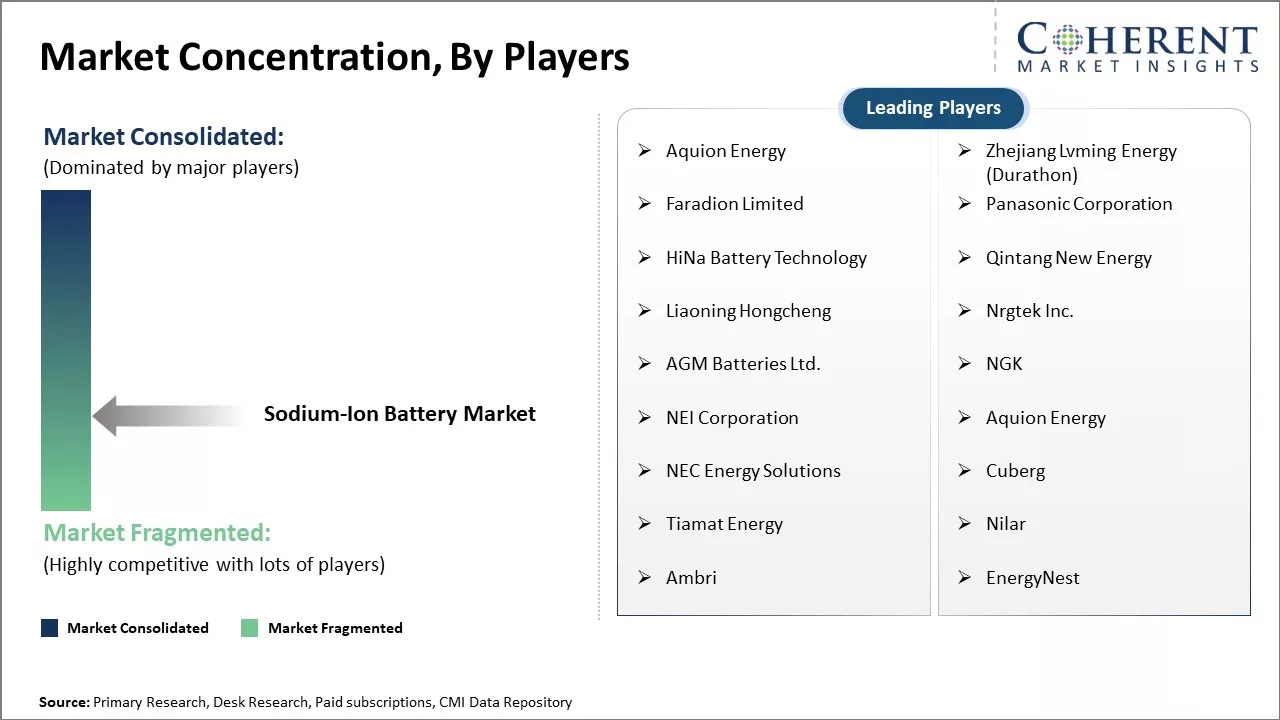
Market Concentration and Competitive Landscape
Sodium-Ion Battery Industry News
- In May 2025, Indian researchers at the Jawaharlal Nehru Centre for Advanced Scientific Research (JNCASR), under the Department of Science & Technology, unveiled a breakthrough sodium‑ion battery capable of charging to 80% capacity in just six minutes and enduring over 3,000 charge cycles.
- In December 2024, HiTHIUM unveiled the world’s first utility‑scale‑focused sodium‑ion battery, the ∞Cell N162Ah, at its second Eco‑Day event. Engineered with sodium iron ortho‑pyrophosphate cathode and hard carbon anode, the cell offers high-rate charge/discharge, exceptional round‑trip efficiency, wide‑temperature performance and long cycle life with capacity retention of 94.2 % after 4,000 cycles at 25 °C and over 20,000 cycles anticipated.
- In June 2023, FinDreams, the battery division of Chinese automaker BYD, collaborated with Huaihai Holding Group. Together, they plan to provide sodium-ion batteries for small electric vehicles.
Market Report Scope
Sodium-Ion Battery Market Report Coverage
| Report Coverage | Details | ||
|---|---|---|---|
| Base Year: | 2025 | Market Size in 2026: | USD 25.20 Bn |
| Historical Data for: | 2020 To 2024 | Forecast Period: | 2026 To 2033 |
| Forecast Period 2026 to 2033 CAGR: | 14.2%2033 Value Projection: | USD 63.85 Bn | |
| Geographies covered: |
| ||
| Segments covered: |
| ||
| Companies covered: | Aquion Energy, Zhejiang Lvming Energy (Durathon), Faradion Limited, Panasonic Corporation, HiNa Battery Technology, Qintang New Energy, Liaoning Hongcheng, Nrgtek Inc., AGM Batteries Ltd., NGK, NEI Corporation, Aquion Energy, NEC Energy Solutions, Cuberg, Tiamat Energy, Nilar, Ambri, EnergyNest | ||
| Growth Drivers: |
| ||
| Restraints & Challenges: |
| ||
Sodium-Ion Battery Market Drivers
- Sodium-ion Batteries as a Sustainable Option
As climate change concerns rise globally, focus has increased on developing renewable energy sources and environmentally friendly technologies. Researchers and businesses are actively exploring battery systems that reduce dependency on lithium and other scarce resources. Sodium-ion batteries represent a promising avenue as sodium is widely available and affordable. These batteries employ sodium ions instead of lithium ions to carry the charge between the anode and cathode during charging and discharging.
For instance, in February 2025, Trentar Energy Solutions commercialized KPIT Technologies’ breakthrough sodium‑ion battery technology under a new technology transfer agreement aimed at bolstering sustainable energy storage infrastructure. The partnership has Trentar investing in a 3 GWh manufacturing facility, while KPIT licenses its proprietary battery design and will receive upfront technology transfer fees including future royalties.
- Portable Electronics Driving R&D Interest
Apart from large-scale energy storage, the portable electronics segment is emerging as a promising area in the sodium-ion battery market, gaining traction among researchers and innovators. As sustainability becomes a priority in consumer electronics, manufacturers are actively exploring sodium-ion batteries as an alternative to lithium-ion, which relies on expensive and limited lithium resources. Sodium-ion batteries enable a more environmentally conscious, closed-loop system, offering thousands of charge-discharge cycles with the reuse of sodium ions.
According to ongoing sodium-ion battery market research, leading tech firms and startups are working on chemistries suitable for compact devices such as smartphones, tablets, and laptops. These devices demand high energy density, low cost, and compact design, criteria that early sodium-ion prototypes are increasingly meeting in terms of stability and lifespan.
In June 2025, MIT World Peace University (MIT‑WPU) has inaugurated India’s first private‑university battery research and fabrication facility, focused on next‑generation lithium‑ion and sodium‑ion technologies. Researchers aim to drive down costs and improve domestic battery manufacturing, supporting applications from electric vehicles to grid storage. This advance dovetails with national goals of energy self‑reliance and clean mobility, positioning MIT‑WPU at the forefront of India’s sustainable innovation ecosystem.
Sodium-Ion Battery Market Opportunities
- Lower-cost alternative to lithium-ion batteries
One of the most promising future opportunities in the sodium-ion battery market lies in its positioning as a lower-cost alternative to lithium-ion batteries. As the global energy landscape shifts toward sustainability and affordability, sodium-ion batteries are gaining attention for their reliance on abundant and inexpensive sodium resources, in contrast to the high cost and limited supply of lithium. This makes them a strategically viable solution, especially for markets sensitive to material costs and large-scale energy needs.
According to the sodium-ion battery market forecast, sodium-ion batteries have huge potential for energy storage, driven by the increasing need for grid stabilization and renewable integration. By 2026, it is projected that 70% of sodium-ion batteries will be deployed for energy storage applications, supporting electrical grids with efficient, scalable solutions. In contrast, only 18% are expected to be used in electric vehicles, while the remaining share will serve small transport applications such as e-scooters and light urban mobility.
This shift highlights the technology’s strength in stationary applications, where size and weight are less critical, and cost-effectiveness and cycle life are prioritized. As innovation continues and manufacturing scales up, sodium-ion batteries are well-positioned to redefine energy storage economics and expand access to clean energy infrastructure globally.
Analyst Opinion (Expert Opinion)
The Sodium-Ion Battery Market value is nearing an inflection point driven by both systemic pressure to diversify energy storage chemistries and material supply chain realities.
The most underappreciated catalyst is the structural shift in grid storage demand. It is forecast that by 2026, nearly 70% of sodium-ion batteries will be utilized for energy storage, particularly in grid-balancing and renewable integration projects. This is not a future scenario, it’s already unfolding. In India, NTPC has launched pilot deployments using sodium-ion-based solutions in solar hybrid projects in Rajasthan, citing thermal stability and low-cost sourcing as key drivers. Similarly, the EU-backed NAIMA project has entered pre-commercial stages in France and Spain, demonstrating multi-hour energy discharge at a lower cost per cycle than LFP batteries.
China controls over 70% of global lithium processing, while sodium sources are geographically more diversified, this represents an opportunity for regional energy independence. Companies like CATL and Faradion have demonstrated that sodium-ion cells can now match ~160 Wh/kg energy density, which just five years ago was viewed as technically improbable.
From a policy and ESG lens, sodium-ion batteries satisfy two urgent mandates: cost democratization and sustainability. Their recyclability is higher due to the absence of toxic, conflict-prone materials. For instance, the UK government’s Faraday Institution explicitly classified sodium-ion as a strategic low-carbon alternative in its 2024 report on next-generation chemistries.
However, challenges persist. The current commercial supply chain lacks scale and cathode material standardization, and until these bottlenecks are addressed, the technology will remain confined to non-critical mobility applications, scooters, low-speed EVs, and small logistics vehicles, which are expected to comprise about 12–15% of global sodium-ion deployment by 2026.
Speak to the analyst
Want personalized insights?
Take the findings above to one of our principal consultants, or have the report rebuilt around the segments, geographies and competitors you actually track.
Market Segmentation
- Type Insights (Revenue, USD Bn, 2026 - 2033)
- Sodium-Sulphur Battery
- Sodium-Salt Battery
- Sodium-Air Battery
- Application Insights (Revenue, USD Bn, 2026 - 2033)
- Stationary Energy Storage
- Transportation
- End User Insights (Revenue, USD Bn, 2026 - 2033)
- Consumer Electronic Devices
- Automobile & Transportation
- Power Backup
- Industrial
- Aerospace & defence
- Marine
- Regional Insights (Revenue, USD Bn, 2026 - 2033)
- North America
- U.S.
- Canada
- Latin America
- Brazil
- Argentina
- Mexico
- Rest of Latin America
- Europe
- Germany
- U.K.
- France
- Italy
- Russia
- Rest of Europe
- Asia Pacific
- China
- India
- Japan
- Australia
- South Korea
- ASEAN
- Rest of Asia Pacific
- Middle East & Africa
- GCC Countries
- South Africa
- Rest of Middle East & Africa
- North America
- Key Players
- Aquion Energy
- Zhejiang Lvming Energy (Durathon)
- Faradion Limited
- Panasonic Corporation
- HiNa Battery Technology
- Qintang New Energy
- Liaoning Hongcheng
- Nrgtek Inc.
- AGM Batteries Ltd.
- NGK
- NEI Corporation
- Aquion Energy
- NEC Energy Solutions
- Cuberg
- Tiamat Energy
- Nilar
- Ambri
- EnergyNest
Sources
Primary Research Interviews from the following stakeholders
Stakeholders
- Interviews with battery cell manufacturers, anode/cathode material suppliers, EV OEMs, energy storage system integrators, utility companies, and R&D heads across global energy markets.
Specific Stakeholders
- Heads of battery innovation at automotive OEMs
- Energy storage project leads at renewable power developers and utilities
- Procurement managers at consumer electronics firms adopting sodium-ion cells
- CTOs and lab heads at advanced chemistry battery startups and pilot-scale sodium battery ventures
- Supply chain managers at electrode and electrolyte manufacturers
- Academic researchers from battery material science labs in institutions such as IITs, Tsinghua University, and University of Cambridge
Databases
- United Nations Comtrade Database
- World Trade Organization (WTO) International Trade Statistics
- Ministry of Heavy Industries (India) – Battery Manufacturing Policy Data
- China Statistical Yearbook – Battery Materials and Export Data
- S. Geological Survey (USGS) – Sodium and Mineral Commodity Reports
- Japan Battery Association Data
- International Energy Agency (IEA) – Energy Storage & Battery Technologies Report
- Eurostat – Battery Production and Trade
- Korea Customs Data Portal – Battery Exports & Raw Material Imports
- Directorate General of Commercial Intelligence and Statistics (DGCIS), India
Magazines
- Power Electronics News
- Battery Technology Magazine
- Energy Storage News
- IEEE Spectrum – Batteries & Energy Section
- CleanTechnica – Battery & EV Tech Section
- Charged EVs Magazine
- Materials Today – Energy Materials Section
- IEEE Potentials – Battery R&D
Journals
- Journal of Power Sources (Elsevier)
- Advanced Energy Materials (Wiley)
- Energy Storage Materials
- Journal of Materials Chemistry A (RSC)
- Electrochimica Acta
- Materials for Renewable and Sustainable Energy
- ChemSusChem
- Journal of The Electrochemical Society
Newspapers
- The Economic Times – Energy Storage & EV Industry
- The Hindu Business Line – Renewable Energy & Tech Policy
- Financial Times – Energy Markets & Batteries
- South China Morning Post – Tech Supply Chains
- Nikkei Asia – Battery Manufacturing & EV Supply Chain
- The Wall Street Journal – Emerging Tech and Materials
- Business Standard – Clean Energy & Innovation
Associations
- International Battery Materials Association (IBMA)
- Global Battery Alliance (GBA)
- International Electrotechnical Commission (IEC) – Battery Standards Committee
- India Energy Storage Alliance (IESA)
- Advanced Sodium Battery Consortium (ASBC)
- IEEE Energy Storage and Conversion Systems Group
- China Industrial Association of Power Sources (CIAPS)
- Japan Battery Recyclers Association (JBRA)
Public Domain Sources
- Ministry of Science and Technology, India – Mission Innovation Reports
- NITI Aayog – Advanced Chemistry Cell (ACC) Battery Storage Roadmap
- Ministry of Economy, Trade and Industry (METI), Japan – Battery Industry Strategy
- U.S. Department of Energy (DOE) – ARPA-E Battery Initiatives
- India Investment Grid – Advanced Battery Sector Opportunities
- European Commission – Batteries Regulation and Energy Storage Plans
- National Renewable Energy Laboratory (NREL), U.S. – Battery Research Publications
- Reserve Bank of India (RBI) – Sectoral Credit Flow to Energy Storage
Proprietary Elements
- CMI Data Analytics Tool, and Proprietary CMI Existing Repository of information for last 8 years
*Definition: The sodium-ion battery market refers to the market for rechargeable battery technology that uses sodium ions as charge carriers instead of lithium ions. Sodium-ion batteries have the potential to provide low-cost energy storage solutions with performance comparable to lithium-ion batteries. They utilize sodium salts like sodium chloride as the electrolyte instead of more expensive lithium compounds. Sodium-ion batteries are expected to play a key role in grid-scale energy storage applications and enable wider adoption of renewable energy.
Get access to 250+ pages report
Every segment, forecast, competitor profile and data table behind the analysis above — available for instant download.
- ESOMAR Member
- ISO 9001:2015 Certified
- D-U-N-S Registered
- GDPR & CCPA Compliant
Missing comfort of reading report in your local language? Find your preferred language:
Transform your Strategy with Exclusive Trending Reports
Frequently Asked Questions
The Sodium-Ion Battery Market is estimated to be valued at USD 25.20 Bn in 2026, and is expected to reach USD 63.85 Bn by 2033.
The CAGR of the Sodium-Ion Battery Market is projected to be 14.2% from 2026 to 2033.
Sodium-ion Batteries as a Sustainable Option and Portable Electronics Driving R&D Interest are the major factor driving the growth of Sodium-Ion Battery Market.
Poor initial performance compared to lithium and Lower conductivity than lithium ions are the major factor hampering the growth of Sodium-Ion Battery Market.
In terms of Type, Sodium-Sulphur Battery, estimated to dominate the market revenue share in 2026.
Aquion Energy, Zhejiang Lvming Energy (Durathon), Faradion Limited, Panasonic Corporation, HiNa Battery Technology, Qintang New Energy, Liaoning Hongcheng, Nrgtek Inc., AGM Batteries Ltd., NGK, NEI Corporation, Aquion Energy, NEC Energy Solutions, Cuberg, Tiamat Energy, Nilar, Ambri, EnergyNest are the major players.
North America is expected to lead the Sodium-Ion Battery Market in 2026.