

Global Smart Grid Market Size and Forecast – 2026 To 2033
The Global Smart Grid Market is estimated to be valued at USD 78.62 Bn in 2026 and is expected to reach USD 144.65 Bn by 2033, growing at a compound annual growth rate (CAGR) of 9.10% from 2026 to 2033. This substantial growth is supported by accelerated electricity infrastructure modernization, increasing renewable energy penetration, and rising demand for intelligent energy management systems that improve grid reliability and operational efficiency.
Utilities worldwide are transitioning toward digitally connected networks integrating advanced metering, automation, real-time monitoring, and distributed energy resource management. In September 2025, the European Commission launched actions under its Electricity Grids Action Plan to accelerate investments in electricity grid modernization, digitalization, and flexibility solutions, strengthening the foundation for smart grid deployment across Europe.
Key Takeaways of the Global Smart Grid Market
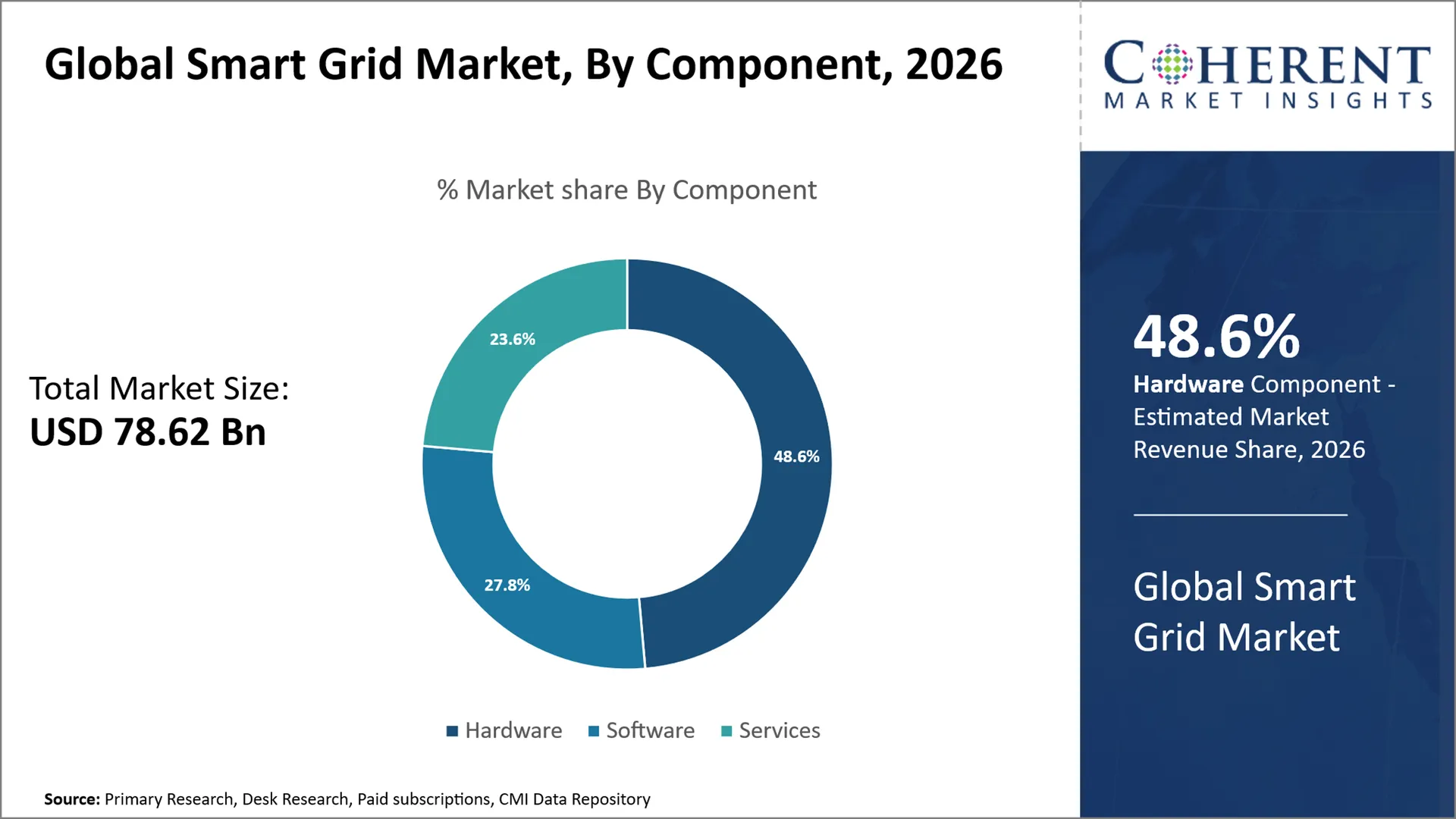
- Hardware is projected to record an estimated CAGR of 8.90% and account for 48.6% of the global smart grid market in 2026, supported by continued deployment of smart meters, sensors, transformers, and grid equipment required for physical network modernization. In February 2026, Adani Energy Solutions announced deployment of 1 crore smart meters across electricity distribution networks, highlighting large-scale hardware adoption for grid digitization.
- Advanced Metering Infrastructure is expected to achieve an estimated CAGR of 10.20% and represent 32.8% of the global smart grid market in 2026, as utilities prioritize real-time consumption monitoring, automated billing, and improved distribution visibility. In December 2025, India’s Ministry of Power reported large-scale smart meter deployment under the Revamped Distribution Sector Scheme, strengthening AMI implementation across utilities.
- Smart Distribution Grid is forecast to expand at an estimated CAGR of 9.40% and capture 46.8% of the global smart grid market in 2026, reflecting utility investments in automated distribution management, reliability improvement, and renewable energy integration. In October 2025, the U.S. Department of Energy highlighted grid modernization programs focused on improving distribution resilience through advanced technologies and digital controls.
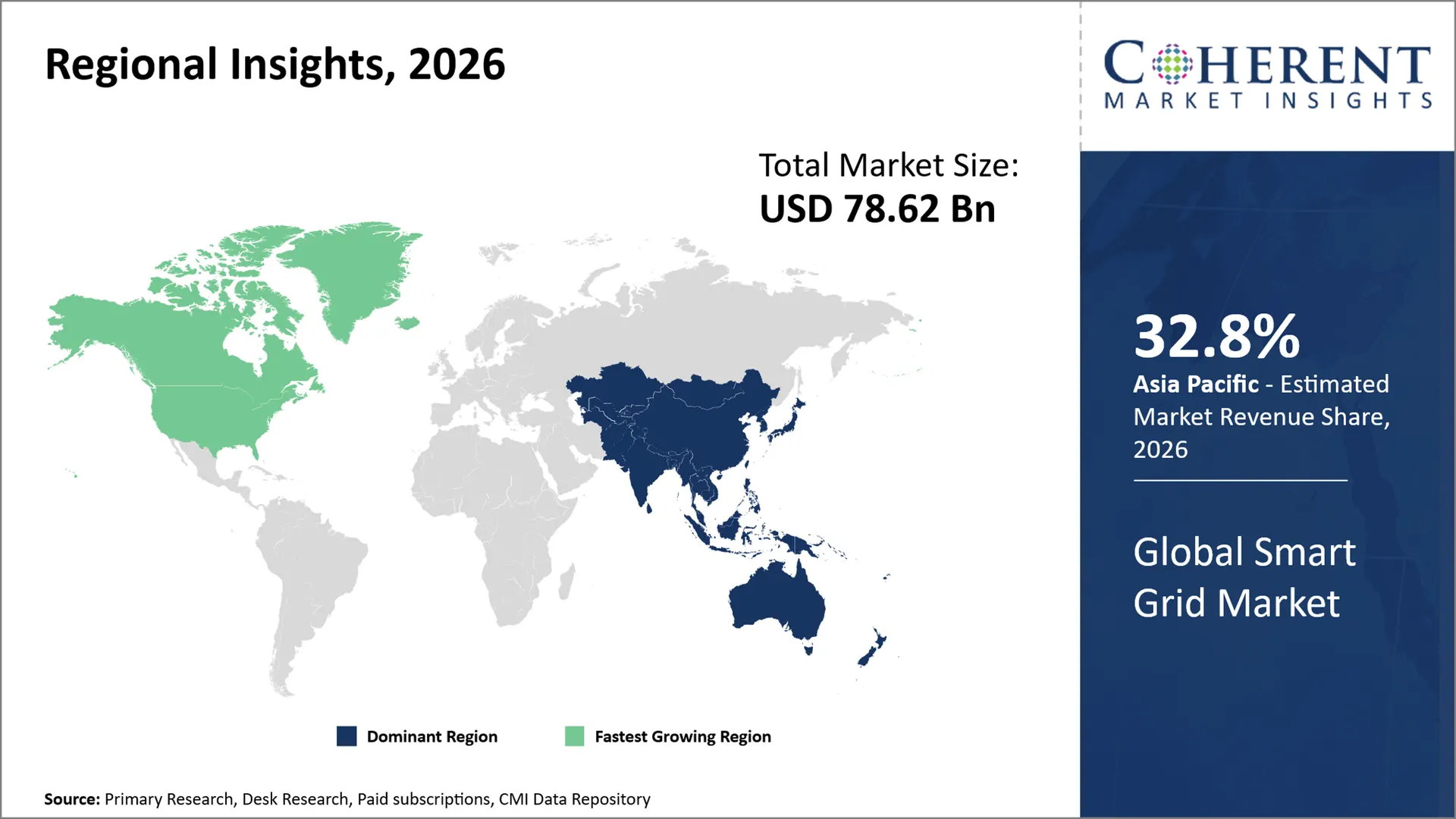
- Asia Pacific is estimated to grow at an estimated CAGR of 9.70% and hold 32.8% of the global smart grid market in 2026, driven by large-scale electricity infrastructure upgrades, smart meter programs, and integration of distributed energy resources across emerging economies. In December 2025, Japan’s Agency for Natural Resources and Energy initiated support measures for smart meter-based demand response demonstrations to improve renewable energy utilization.
- North America is expected to register an estimated CAGR of 10.10% and account for 29.8% of the global smart grid market in 2026, supported by grid resilience investments, aging infrastructure replacement, and advanced digital management systems. In April 2025, Google announced collaboration with PJM Interconnection and Tapestry to develop AI-based grid optimization capabilities for improving electricity system management.
Segmental Insights
Why Does Hardware Dominate the Global Smart Grid Market?
Hardware is expected to account for 48.6% of the global smart grid market in 2026, supported by its fundamental role in enabling grid digitization through smart meters, sensors, communication equipment, monitoring devices, and automation components. Utilities require physical infrastructure upgrades before implementing advanced analytics and intelligent control systems, making hardware the foundation of smart grid deployment. Demand is particularly strong from electricity distribution companies modernizing aging networks and improving reliability through connected equipment. Manufacturers benefit from increasing requirements for interoperable grid components, while suppliers gain opportunities through large-scale utility modernization projects. Hardware adoption is also strengthened by renewable integration needs requiring improved visibility across power networks. In March 2025, the U.S. Department of Energy announced selected projects under its Grid Resilience and Innovation Partnerships program supporting deployment of advanced grid equipment and infrastructure improvements.
- Current Industry Events of 2026
- Market Size Estimation
- Regional Breakdown
- Competitive Landscape
- Customer Intelligence
- Segmental Analysis
- Pricing Analysis
- Key Market Drivers, Challenges & Future Trends
- Customized Insights Section
Why Does Advanced Metering Infrastructure Represent the Largest Technology Category in the Global Smart Grid Market?
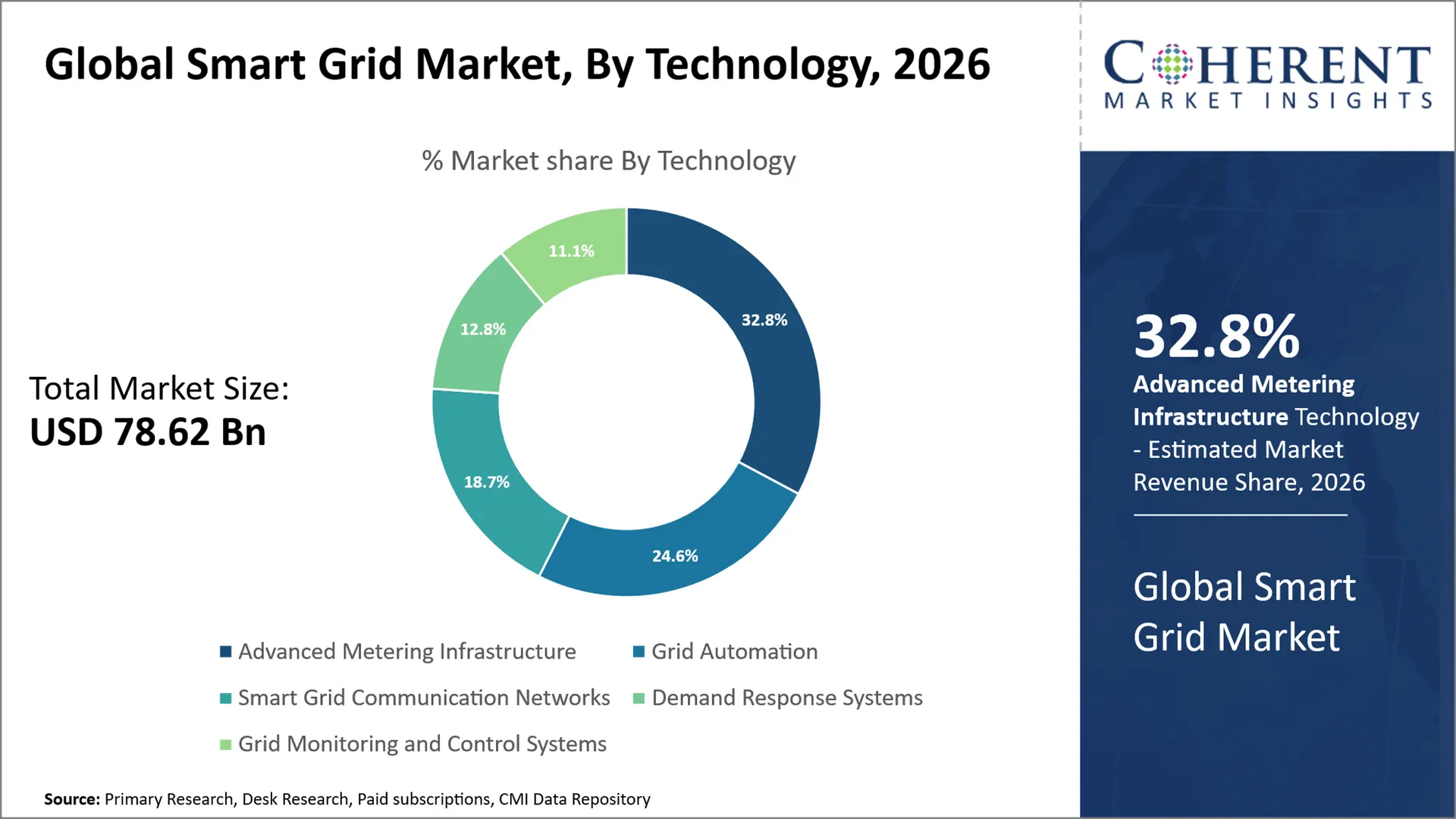
Advanced Metering Infrastructure is expected to represent 32.8% of the global smart grid market in 2026, driven by utilities’ requirement for accurate consumption measurement, automated billing, remote monitoring, and improved customer-level energy visibility. Unlike conventional meters, AMI systems provide two-way communication between consumers and utilities, enabling demand management, theft detection, and better load forecasting. Distribution companies are prioritizing AMI deployment as a practical entry point for broader grid digitalization programs. Meter manufacturers, communication technology providers, and utility service operators benefit from long-term deployment contracts and maintenance opportunities. In January 2025, India’s Ministry of Power continued monitoring smart meter implementation progress under national distribution modernization programs, supporting wider AMI adoption across electricity networks.
Why Does Distribution Grid Dominate the Application Category of the Global Smart Grid Market?
Distribution Grid is expected to hold 42.8% of the global smart grid market in 2026, reflecting utilities’ priority toward improving the final electricity delivery network where outages, losses, and operational inefficiencies directly affect consumers. Smart distribution systems enable automated fault detection, voltage optimization, outage management, and better integration of rooftop solar, storage systems, and electric vehicle charging infrastructure. Investment is concentrated among distribution utilities seeking improved service quality, reduced operational costs, and greater network flexibility. Equipment suppliers, automation providers, and grid management solution companies benefit from increasing demand for distribution-level intelligence rather than conventional network expansion alone. In April 2025, the European Commission highlighted digitalization of electricity distribution networks as a key element of modernizing Europe’s energy infrastructure through improved flexibility and renewable integration.
Current Events and their Impact
Current Event | Description and Its Impact |
Smart Grid Grants Expansion Program – United States (2026) |
|
Revamped Distribution Sector Scheme and Smart Meter Deployment – India (2026) |
|
Grid Modernization and Resilience Programs – United States (2026) |
|
Global Smart Grid Market Dynamics
Key Market Drivers
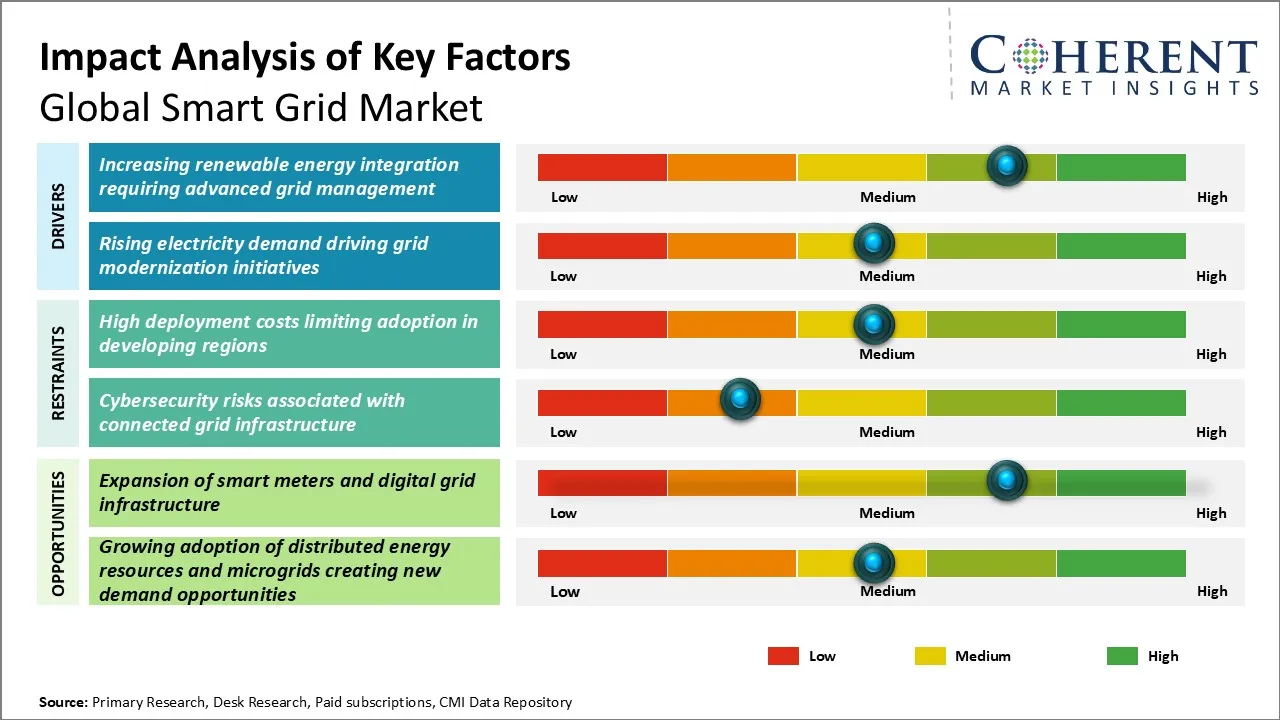
- Increasing Renewable Energy Integration Requiring Advanced Grid Management: Increasing renewable energy integration is strengthening demand for smart grid solutions by creating the need for flexible monitoring, balancing, and automated control across electricity networks. Variable generation from solar and wind sources requires utilities to deploy advanced communication systems, grid automation tools, and real-time analytics to maintain stability. Transmission operators, distribution utilities, and technology providers benefit as investments shift toward intelligent infrastructure capable of managing distributed energy resources. In December 2025, the Australian Energy Market Operator (AEMO) highlighted the need for advanced operational capabilities and system flexibility to manage increasing renewable generation penetration across Australia’s electricity network, reinforcing demand for digital grid management solutions.
- Rising Electricity Demand Driving Grid Modernization Initiatives: Rising electricity consumption from industrial expansion, electrification of transport, data centers, and residential energy usage is encouraging utilities to upgrade aging power infrastructure with smart grid capabilities. Modernization programs enable operators to improve reliability, reduce operational losses, and optimize asset utilization through digital monitoring and automated decision-making. Equipment manufacturers, software providers, and utility service companies benefit from increasing demand for integrated grid solutions. In October 2024, Natural Resources Canada announced a new funding intake under the Smart Renewables and Electrification Pathways Program to support utilities and system operators implementing grid modernization technologies, transmission upgrades, and clean electricity integration projects.
Emerging Market Trends
- Transition Toward AI-Enabled Autonomous Grid Operations: Smart grid development is increasingly moving beyond basic monitoring toward autonomous decision-making capabilities using artificial intelligence, machine learning, and predictive analytics. Utilities are adopting intelligent platforms that can identify faults, forecast demand patterns, optimize power flows, and support preventive maintenance. This transition is changing competition from hardware-focused offerings toward integrated solutions combining sensors, communication infrastructure, software analytics, and operational expertise. Technology providers with strong data management capabilities are likely to gain importance as utilities seek smarter, self-optimizing networks.
- Expansion of Distributed Energy Resource Management Platforms: The growing presence of rooftop solar systems, battery storage, electric vehicles, and community energy resources is encouraging utilities to adopt distributed energy resource management platforms. These systems help coordinate decentralized power assets while maintaining grid stability and improving flexibility. The trend is reshaping customer relationships by transforming consumers into active participants through demand response and energy management programs. Solution providers capable of integrating multiple distributed assets into utility operations are expected to gain strategic importance during the forecast period.
Regional Insights
Why Does Asia Pacific Dominate the Global Smart Grid Market?
Asia Pacific maintains a strong position in the smart grid market with 32.8% share due to rapid electricity demand growth, large-scale urbanization, renewable energy expansion, and government-led power infrastructure upgrades. Countries including China, India, and Japan are investing heavily in smart meters, automated distribution systems, and digital grid platforms to improve network efficiency and manage increasing electricity complexity. The region’s large population base, expanding industrial activities, and transition toward cleaner energy systems are creating significant opportunities for grid technology providers. Utilities are increasingly adopting intelligent solutions to reduce transmission losses, improve outage management, and integrate decentralized energy resources. In January 2025, China’s National Energy Administration released guidance emphasizing further development of intelligent power systems and digital transformation across the electricity sector.
Why North America Is Emerging as the Fastest-Growing Region in the Global Smart Grid Market?
North America is emerging as the fastest-growing region with 29.8% market share of the global smart grid market in 2026 due to extensive electricity infrastructure, accelerated grid modernization programs, and high adoption of digital energy management solutions among utilities. The region benefits from a mature power sector, strong investment capacity, and increasing integration of renewable generation, electric vehicles, and distributed energy resources. Utilities across the U.S. and Canada are prioritizing advanced metering infrastructure, grid automation, and cybersecurity solutions to improve reliability and operational efficiency. The presence of leading technology providers and strong research capabilities further supports innovation in grid intelligence. In April 2025, the Federal Energy Regulatory Commission (FERC) issued actions related to improving transmission planning and cost allocation frameworks, supporting more efficient expansion and modernization of North America’s electricity networks.
Global Smart Grid Market Outlook for Key Countries
Why Is the U.S. a Key Market for the Global Smart Grid Market?
The U.S. represents a key global smart grid market due to its aging electricity infrastructure, growing renewable energy deployment, and increasing need for grid resilience against extreme weather events. Utilities are investing in advanced distribution management systems, automated controls, smart meters, and energy management platforms to improve reliability and operational visibility. The country also benefits from strong participation from technology companies, electrical equipment manufacturers, and software providers developing next-generation grid solutions. Increasing electrification of transportation and industrial operations is further creating demand for flexible and intelligent electricity networks. In August 2025, the Federal Energy Regulatory Commission approved initiatives supporting improvements in transmission planning and grid reliability, reinforcing the need for advanced grid management capabilities.
Why Is India Important in the Global Smart Grid Market?
India is becoming increasingly important in the global smart grid market due to rising electricity consumption, distribution sector modernization needs, and government focus on improving power efficiency. The country’s large utility network requires digital solutions to reduce commercial and technical losses, improve billing accuracy, and enhance consumer-level energy management. Smart meters, communication infrastructure, and automated distribution technologies are gaining importance as electricity providers transition toward more efficient operating models. India’s renewable energy expansion is also increasing the need for flexible grid management systems capable of balancing variable power generation. In February 2025, the Ministry of Power highlighted continued progress under national electricity distribution modernization initiatives, including smart metering programs designed to improve utility performance and consumer services.
Why Does China Support Growth in the Global Smart Grid Market?
China supports global smart grid market growth through its extensive electricity infrastructure, manufacturing capabilities, and large-scale renewable energy integration requirements. The country has developed one of the world’s largest power networks, creating significant demand for advanced transmission systems, automated distribution technologies, energy storage integration, and digital grid management platforms. Domestic equipment manufacturers and technology providers benefit from strong industrial ecosystems supporting grid hardware production, communication technologies, and automation solutions. China’s continued expansion of solar and wind power capacity requires advanced balancing and control systems to maintain network stability. In March 2025, the National Energy Administration emphasized digital transformation and modernization of energy infrastructure as part of China’s broader electricity sector development strategy.
Why Is Germany a Strategic Country in the Global Smart Grid Market?
Germany holds strategic importance in the smart grid market due to its advanced industrial base, renewable energy transition, and strong focus on efficient electricity management systems. The country’s energy transition strategy requires intelligent grid infrastructure capable of managing decentralized renewable generation, energy storage, and changing consumption patterns. German utilities and technology companies are increasingly adopting digital monitoring, automation, and demand management solutions to improve grid flexibility. The country’s engineering expertise and emphasis on high-quality electrical infrastructure support innovation in grid technologies and industrial applications. In November 2025, Germany’s Federal Ministry for Economic Affairs and Climate Action continued advancing initiatives related to energy system modernization and digital energy infrastructure development, supporting broader smart grid adoption.
Why Is Japan an Important Growth Market for the Global Smart Grid Market?
Japan represents an important smart grid market due to its focus on energy security, disaster resilience, renewable integration, and advanced electricity management technologies. The country’s geographically constrained energy system and need for reliable electricity supply encourage investment in smart distribution networks, demand response systems, and digital grid solutions. Japan’s utilities are adopting intelligent infrastructure to improve efficiency while supporting increased renewable energy penetration and decentralized power generation. The country also has strong capabilities in electrical equipment, automation, and digital technologies that support domestic smart grid development. In April 2025, Japan’s Ministry of Economy Trade and Industry continued promoting next-generation electricity systems through initiatives focused on flexible energy management and grid optimization.
Technology Deployment and Infrastructure Landscape in the Global Smart Grid Market
Technology | Primary Function | Adoption Stage | Commercial Impact |
Advanced Metering Infrastructure (AMI) | Enables automated meter reading, consumption monitoring, and two-way communication between utilities and consumers | High Adoption | Supports utility digitization and improves billing accuracy, demand forecasting, and customer engagement |
Grid Automation Systems | Provides automated switching, fault detection, and network control capabilities | High Adoption | Improves reliability and reduces outage response time |
Smart Grid Communication Networks | Enables secure data transfer between grid assets, control centers, and consumers | Growing Adoption | Supports expansion of connected grid infrastructure |
Demand Response Management Systems | Coordinates electricity consumption based on grid conditions and pricing signals | Medium Adoption | Enables flexible demand management and improved load balancing |
Grid Monitoring and Control Systems | Provides real-time visibility of network performance and asset conditions | Growing Adoption | Supports predictive maintenance and operational optimization |
Digital Twin Technology | Creates virtual representations of grid assets for simulation and planning | Early Commercial Adoption | Improves investment decisions, asset management, and system planning |
How Are Digital Grid Platforms and Distributed Energy Management Creating New Growth Opportunities in the Global Smart Grid Market?
Digital grid platforms represent a significant opportunity as utilities increasingly require centralized systems capable of managing complex electricity ecosystems involving renewable generation, storage assets, electric vehicles, and consumer-side energy resources. Unlike traditional grid infrastructure focused mainly on power delivery, digital platforms enable utilities to optimize operations through data analytics, automation, and predictive decision-making. This opportunity is particularly relevant for distribution utilities, industrial energy users, and regions expanding renewable power capacity. Companies can capture this opportunity by developing interoperable software platforms, cybersecurity capabilities, and integrated hardware-software solutions. Market participants that combine grid expertise with digital capabilities can differentiate through advanced analytics, lifecycle services, and customized utility solutions. However, successful participation requires investment in software development, data infrastructure, regulatory compliance, and partnerships with utilities.
Market Players, Key Development, and Competitive Intelligence
Key Developments
- In March 2026, Schneider Electric continued strengthening its digital energy management solutions portfolio for utilities and infrastructure customers. This is important for the Global Smart Grid Market because energy management platforms are becoming essential for improving grid efficiency, monitoring assets, and integrating decentralized energy resources.
- In February 2026, Hitachi Energy advanced its grid automation and digital solutions portfolio supporting modern electricity networks. This is important for the Global Smart Grid Market because utilities require advanced control systems and grid technologies to improve reliability and manage changing electricity flows.
- In January 2026, Siemens Energy expanded its digital grid technology initiatives focused on improving power network flexibility and operational intelligence. This is important for the Global Smart Grid Market because utilities increasingly require integrated digital solutions combining grid equipment, automation, and software capabilities.
Competitive Landscape
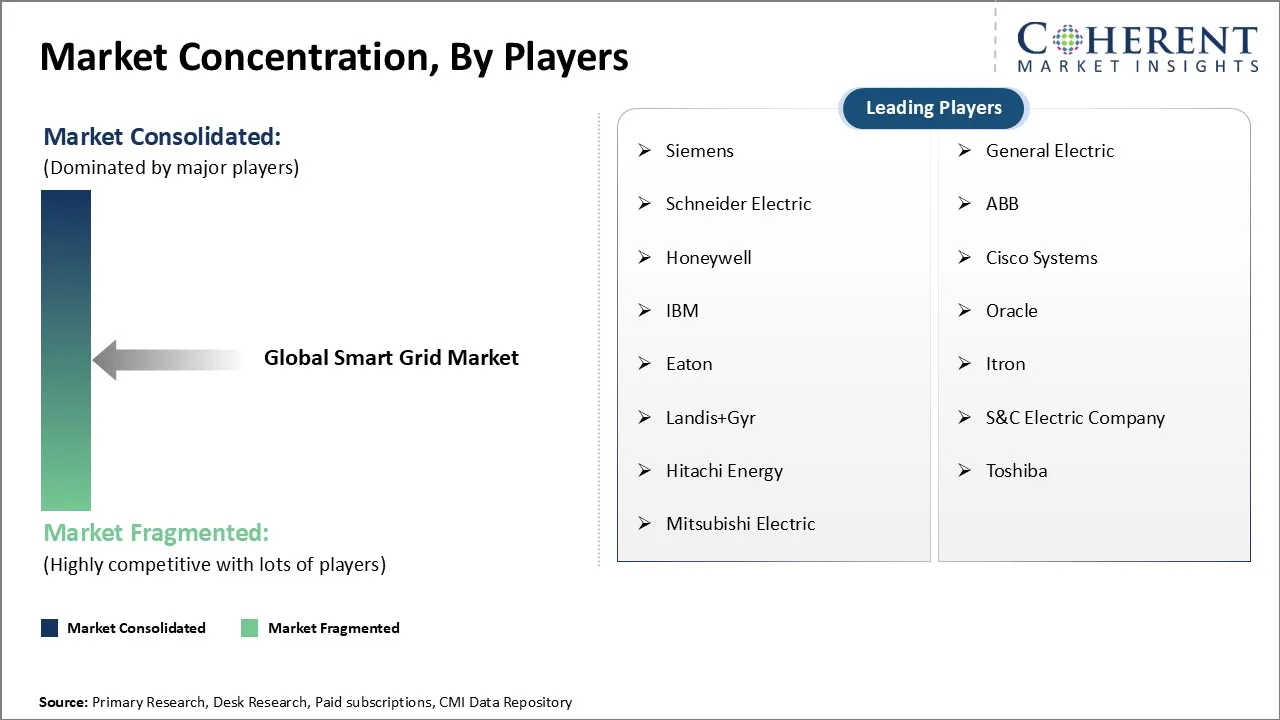
The global smart grid market is moderately consolidated, with competition involving multinational electrical equipment manufacturers, digital technology companies, grid solution providers, and specialized automation firms. Competition is shaped by technology capabilities, interoperability, cybersecurity, reliability, lifecycle support, and integration expertise. Regional companies also participate by providing localized solutions aligned with utility requirements and regulatory frameworks.
Key Focus Areas includes
- Integrated hardware, software, and service offerings
- Grid automation and digital control capabilities
- Cybersecurity and data protection solutions
- Interoperability with existing utility infrastructure
- Advanced analytics and predictive maintenance capabilities
- Utility partnerships and long-term service contracts
- Regional implementation expertise and regulatory compliance
- Reliability and total cost of ownership advantages
Market Report Scope
Global Smart Grid Market Report Coverage | |||
Report Coverage | Details | ||
Base Year | 2025 | Market Size in 2026: | USD 78.62 Bn |
Historical Data For: | 2020 To 2024 | Forecast Period: | 2026 To 2033 |
Forecast Period 2026 To 2033 CAGR: | 9.10% | 2033 Value Projection: | USD 144.65 Bn |
Geographies covered: |
| ||
Segments covered: |
| ||
Companies covered: | Siemens, General Electric, Schneider Electric, ABB, Honeywell, Cisco Systems, IBM, Oracle, Eaton, Itron, Landis+Gyr, S&C Electric Company, Hitachi Energy, Toshiba, Mitsubishi Electric | ||
Growth Drivers: |
| ||
Restraints & Challenges: |
| ||
Analyst Opinion (Expert Opinion)
- The smart grid market is expected to move toward integrated energy intelligence platforms rather than standalone infrastructure solutions. Competitive advantage will increasingly depend on the ability to combine physical grid assets with software, analytics, cybersecurity, and service capabilities. Companies that develop complete lifecycle solutions are likely to strengthen their position as utilities seek fewer technology partners with broader capabilities.
- The emergence of autonomous grid management has the potential to reshape traditional utility operations. Artificial intelligence, distributed energy coordination, and real-time decision systems could shift grid management from reactive maintenance toward predictive and self-adjusting networks. Organizations lacking digital capabilities may face increasing pressure as utilities prioritize smarter operational models.
- Market participants should prioritize cybersecurity, interoperability, and scalable software platforms while maintaining strong hardware reliability. Companies should focus on utility partnerships and regional customization rather than relying only on product sales. Key risks include complex integration requirements, regulatory differences, and delayed infrastructure investments, requiring flexible business models and strong technical support capabilities.
Speak to the analyst
Want personalized insights?
Take the findings above to one of our principal consultants, or have the report rebuilt around the segments, geographies and competitors you actually track.
Market Segmentation
- Component Insights (Revenue, USD Bn, 2021 - 2033)
- Hardware
- Software
- Services
- Technology Insights (Revenue, USD Bn, 2021 - 2033)
- Advanced Metering Infrastructure
- Grid Automation
- Smart Grid Communication Networks
- Demand Response Systems
- Grid Monitoring and Control Systems
- Application Insights (Revenue, USD Bn, 2021 - 2033)
- Transmission Grid
- Distribution Grid
- Residential Energy Management
- Industrial Energy Management
- Commercial Energy Management
- End User Insights (Revenue, USD Bn, 2021 - 2033)
- Utilities
- Industrial Users
- Commercial Buildings
- Residential Consumers
- Grid Type Insights (Revenue, USD Bn, 2021 - 2033)
- Smart Distribution Grid
- Smart Transmission Grid
- Microgrids
- Other Grid Systems
- Distribution Channel Insights (Revenue, USD Bn, 2021 - 2033)
- Direct Sales
- Indirect Sales
- Regional Insights (Revenue, USD Bn, 2021 - 2033)
- North America
- U.S.
- Canada
- Latin America
- Brazil
- Argentina
- Mexico
- Rest of Latin America
- Europe
- Germany
- U.K.
- Spain
- France
- Italy
- Russia
- Rest of Europe
- Asia Pacific
- China
- India
- Japan
- Australia
- South Korea
- ASEAN
- Rest of Asia Pacific
- Middle East
- GCC Countries
- Israel
- Rest of Middle East
- Africa
- South Africa
- North Africa
- Central Africa
- North America
Sources
Primary Research Interviews
- Smart grid technology providers, utility companies, electricity distributors, transmission operators, grid automation solution providers, and energy management companies
- Power system engineers, grid modernization specialists, utility executives, renewable energy integration experts, cybersecurity professionals, and energy consultants
Stakeholders
- Smart grid equipment manufacturers, electrical component suppliers, automation companies, software providers, communication technology providers, and grid solution integrators
- Utilities, independent power producers, transmission and distribution companies, energy service providers, infrastructure developers, and technology partners
- Industrial energy users, commercial facilities, residential energy consumers, and distributed energy resource operators
End-use Sectors
- Electricity transmission and distribution networks
- Renewable energy integration and distributed energy management
- Industrial energy management and smart infrastructure applications
- Commercial buildings, residential energy systems, and demand response programs
Regulatory and Industry Bodies
- Energy ministries and electricity regulatory authorities
- Grid operators and transmission system organizations
- Renewable energy and power sector agencies
- Cybersecurity and critical infrastructure regulatory bodies
- International energy organizations and electricity industry associations
Databases
- Company annual reports, investor presentations, and regulatory filings
- Utility infrastructure databases and electricity generation datasets
- Government energy statistics and grid modernization databases
- Renewable energy capacity databases and power sector intelligence platforms
- Trade databases, technology deployment records, and infrastructure project databases
Magazines and Journals
- Power and energy industry publications
- Smart grid technology journals and engineering publications
- Renewable energy and electricity infrastructure journals
- Energy transition and sustainability publications
- Utility technology and digital transformation magazines
Associations
- International Smart Grid Action Network (ISGAN)
- International Energy Agency (IEA)
- Edison Electric Institute (EEI)
- GridWise Alliance
- National and regional electricity industry associations
Public Domain Sources
- Grid modernization initiatives and electricity infrastructure developments
- Renewable energy integration programs and energy transition policies
- Smart meter deployment and digital utility transformation activities
- Power transmission and distribution expansion projects
- Energy efficiency, demand response, and grid resilience developments
Key Standards and Regulations
- Electricity grid reliability and operational standards
- Smart meter communication and interoperability standards
- Cybersecurity requirements for critical energy infrastructure
- Renewable energy integration and grid connection regulations
- Data protection and digital energy management compliance requirements
Proprietary Elements
- CMI Data Analytics Tool
- proprietary CMI repository containing 10+ years of energy, power infrastructure, technology, and industrial market intelligence.
Get access to 250+ pages report
Every segment, forecast, competitor profile and data table behind the analysis above — available for instant download.
- ESOMAR Member
- ISO 9001:2015 Certified
- D-U-N-S Registered
- GDPR & CCPA Compliant
Missing comfort of reading report in your local language? Find your preferred language:
Frequently Asked Questions
The CAGR of global smart grid market is projected to be 9.10% from 2026 to 2033.
The global smart grid market is estimated to be valued at USD 78.62 Bn in 2026 and is expected to reach USD 144.65 Bn by 2033.
Advanced metering infrastructure, grid automation, smart communication networks, demand response systems, and digital monitoring solutions are shaping the evolution of the global smart grid market.
Smart grid solutions are widely applied across electricity transmission, distribution management, renewable energy integration, energy monitoring, demand response, and utility operational optimization.
Companies entering the smart grid market need to address infrastructure integration complexities, cybersecurity requirements, regulatory compliance, interoperability issues, and high implementation requirements.
Utilities should evaluate technology compatibility, cybersecurity capabilities, scalability, operational efficiency improvements, lifecycle support, and integration capabilities with existing electricity infrastructure.
The growth of the global smart grid market is primarily driven by increasing renewable energy integration, which requires advanced grid management capabilities, along with rising electricity demand encouraging modernization of existing power infrastructure.