

Industrial Control Systems (ICS) Market Size and Forecast: 2026 to 2033
Industrial Control Systems (ICS) Market is estimated to be valued at USD 1,61,798.7 Mn in 2026 and is expected to reach USD 2,69,307.2 Mn in 2033, exhibiting a compound annual growth rate (CAGR) of 7.6% from 2026 to 2033.
Key Takeaways
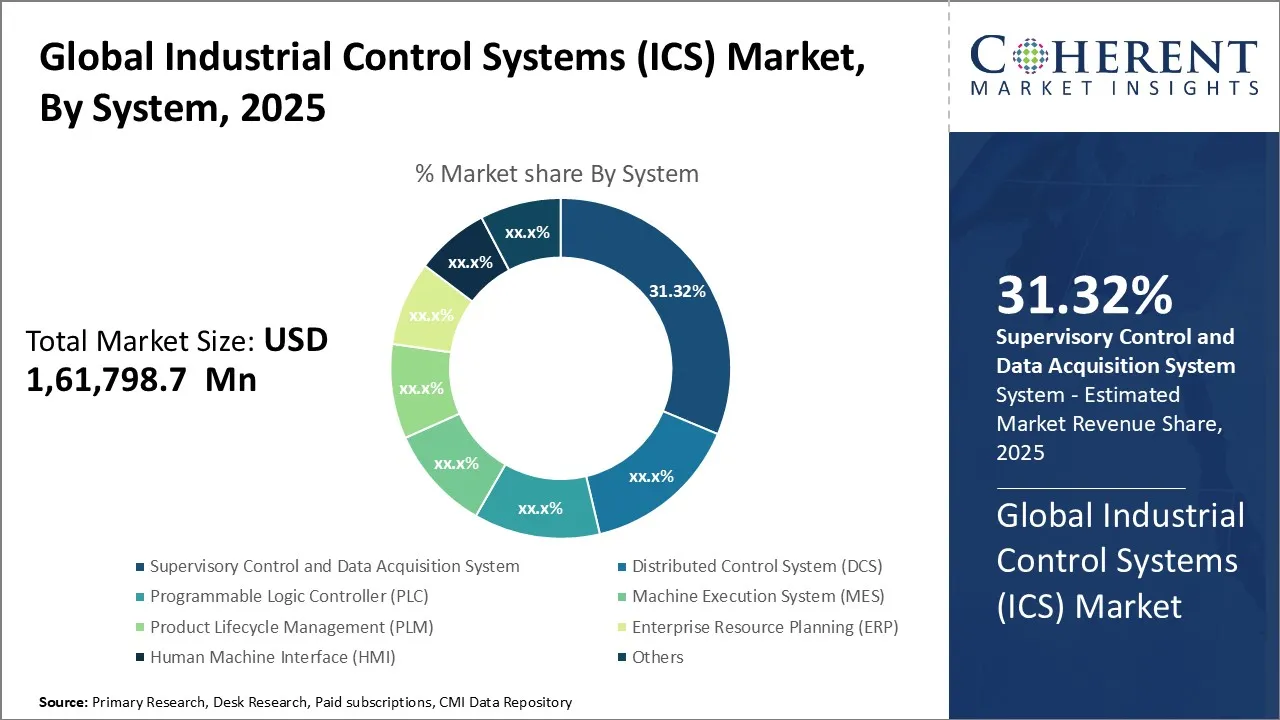
- By System, Supervisory Control and Data Acquisition System hold the largest market share of 32.3% in 2026 owing to its industry 4.0 & automation demand.
- By End-User, Automotive expected to hold largest market share in 2026 owing to its high automation & mass‑production requirements in automotive manufacturing.
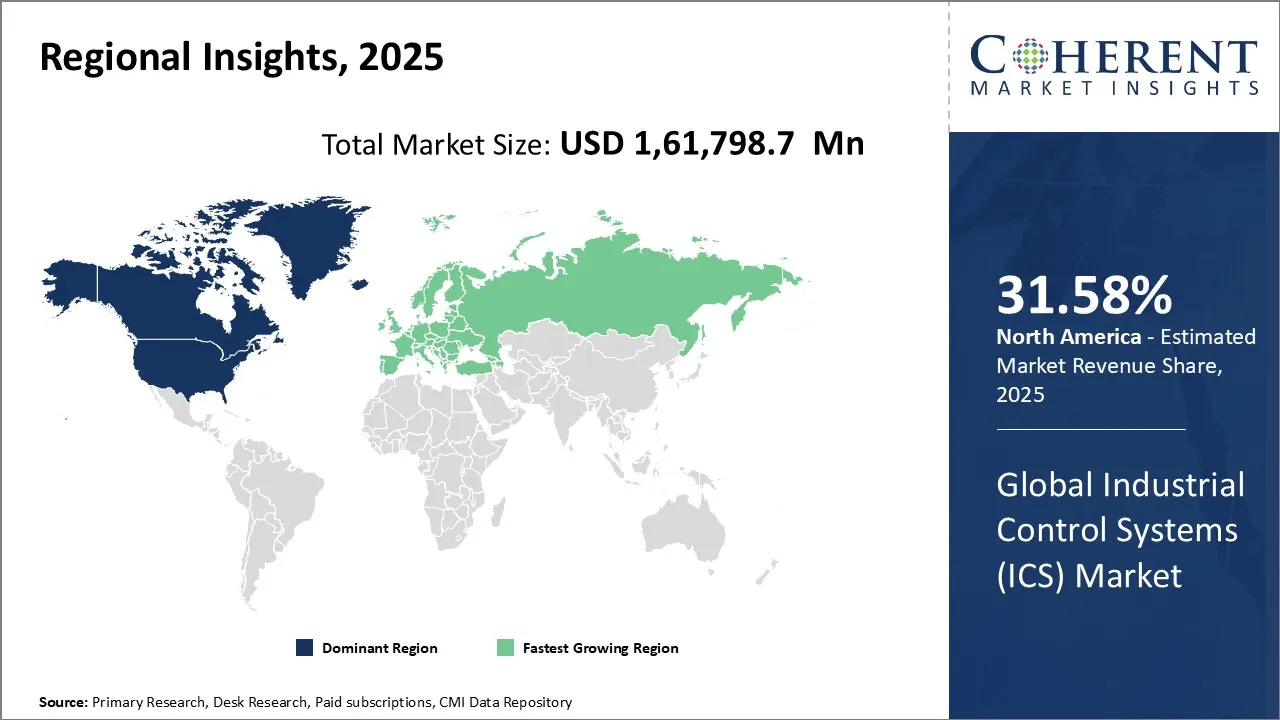
- By Region, North America dominates the overall market with an estimated share of 31.58% in 2026 owing to the advanced manufacturing & automation adoption.
Market Overview
The Industrial Control Systems (ICS) market delivers technologies that actively monitor, control, and automate industrial processes across sectors such as manufacturing, energy, oil and gas, and utilities. Companies increasingly adopt ICS solutions to boost operational efficiency, enhance safety, and enable real-time decision-making through automation, digital transformation, and IoT and AI integration. Rising demand for smart infrastructure, predictive maintenance, and dependable energy management drives adoption, while advanced systems like SCADA, PLCs, and DCS help industries optimize productivity and maintain reliable operations.
Current Events and Its Impact on the Industrial Control Systems (ICS) Market
Current Events | Description and its impact |
Geopolitical Tensions Impacting Supply Chains |
|
Technological Advancements and Cybersecurity Threats |
|
Segmental Insights
- Current Industry Events of 2026
- Market Size Estimation
- Regional Breakdown
- Competitive Landscape
- Customer Intelligence
- Segmental Analysis
- Pricing Analysis
- Key Market Drivers, Challenges & Future Trends
- Customized Insights Section
Industrial Control Systems (ICS) Market Insights, By System - Supervisory Control and Data Acquisition System contribute the highest share of the market owing to its rising industrial automation and digitalization
Supervisory Control and Data Acquisition System hold the largest market share of 32.3% in 2026. Increasing industrial automation and digitalization across manufacturing, energy, water, and utility sectors drive the growth of Supervisory Control and Data Acquisition (SCADA) systems in the Industrial Control Systems (ICS) market. Industries adopt SCADA to enable real-time monitoring, optimize processes, and implement predictive maintenance. By integrating IoT, cloud, and advanced analytics, SCADA enhances operational efficiency and allows effective remote control. Moreover, regulatory compliance, safety standards, and the demand for reliable infrastructure motivate industries to deploy SCADA systems across their operations. For instance, in January 2025, the Pipeline Open Data Standard (PODS) Association has introduced a new SCADA Link Module that enables operators to directly connect SCADA readings with geospatial data in their PODS databases.
-market-by-end-user.webp "Industrial Control Systems (ICS) Market, By End User")
Industrial Control Systems (ICS) Market Insights, By End User - Automotive contribute the highest share of the market owing to its automation‑heavy manufacturing
The automotive sector actively drives Industrial Control Systems (ICS) adoption by automating vehicle manufacturing and assembly processes. Manufacturers use ICS to boost production efficiency, maintain consistent quality, and minimize downtime across complex assembly lines. The transition to electric and hybrid vehicles, combined with the implementation of Industry 4.0 technologies, promotes ICS use for real-time monitoring, predictive maintenance, and process optimization. Furthermore, regulatory compliance, safety standards, and the need for efficient supply chains compel automotive companies to deploy advanced control systems. For instance, in November 2025, Rockwell Automation has launched SecureOT, an industrial cybersecurity suite that helps manufacturers and critical infrastructure operators protect their operational technology systems from emerging cyber threats.
Regional Insights
North America Industrial Control Systems (ICS) Market Trends
North America dominates the overall market with an estimated share of 31.58% in 2026. North America is driving the growth of the Industrial Control Systems (ICS) market as manufacturers, utilities, and infrastructure operators adopt automation, digital manufacturing, and smart-grid upgrades. Companies are deploying cloud-integrated, IoT- and AI-enabled ICS platforms while strengthening cybersecurity to protect critical infrastructure. Increased investments in energy grids, utilities, oil and gas, and semiconductor factories are fueling demand. Businesses are modernizing legacy control systems, implementing edge and wireless connectivity, and expanding ICS-driven automation across various industrial sectors.
In June 2026, ABB has expanded its Mexico Technology and Engineering Center (MXTEC), doubling its office space to support North American operations. Located in Merida, Yucatan, the center is growing to meet rising industry demand and enhance innovation through its engineering, sales, and project support capabilities.
Europe Industrial Control Systems (ICS) Market Trends
Europe is expanding its Industrial Control Systems (ICS) market as manufacturers and utilities adopt smart automation, AI, and IoT to achieve greener, more efficient operations. Companies are replacing legacy infrastructure with modular, cloud-based control platforms that enable real-time monitoring, predictive maintenance, and seamless data analytics. Regulators are driving industries to enhance energy efficiency and cybersecurity, prompting control system upgrades. At the same time, smart grid initiatives, water management projects, and sustainable manufacturing are steadily increasing ICS adoption across multiple sectors.
United States Industrial Control Systems (ICS) Market Trends
The United States is driving growth in the Industrial Control Systems (ICS) market as companies implement IoT-, AI-, and cloud-enabled control systems for real-time monitoring, predictive maintenance, and data-driven operations. Industries facing labor shortages and rising wages are increasingly automating processes with ICS to reduce human intervention and lower operational costs. As infrastructure and utilities modernize, including smart grids, water systems, and energy networks, businesses are demanding robust, secure ICS platforms. Simultaneously, rising cybersecurity threats and regulatory requirements are prompting firms to deploy secure-by-design ICS solutions to safeguard critical infrastructure.
In September 2026, CISA issued six Industrial Control Systems (ICS) advisories, offering updated details on security concerns, vulnerabilities, and exploits affecting ICS environments.
United Kingdom Industrial Control Systems (ICS) Market Trends
The United Kingdom is advancing its Industrial Control Systems (ICS) market as manufacturers and utilities implement automation and smart-manufacturing upgrades. Companies are adopting IoT- and AI-enabled control platforms to support real-time monitoring and predictive maintenance in response to growing demand for connected operations. Rising labor costs and workforce shortages are prompting factories to increase automation. At the same time, modernization of energy grids, water systems, and utilities is driving demand for robust, secure ICS solutions, while regulatory focus on safety, efficiency, and cybersecurity encourages firms to upgrade legacy systems and invest in advanced control technologies.
In October 2026, Rockwell Automation, Inc., the world’s leading industrial automation and digital transformation company, introduced the ControlLogix® 5590 controller. As the latest core component of the Logix platform, it is engineered to meet modern manufacturing needs with unified software integration and multidiscipline control, enabling more streamlined and efficient operations.
End-user Feedback and Unmet Needs in the Industrial Control Systems (ICS) Market
- Demand for Real-Time Monitoring and Analytics: End users report that traditional ICS solutions often lack real-time data visibility and advanced analytics. Manufacturers and utility operators need more integrated dashboards and predictive insights to quickly identify inefficiencies, optimize processes, and prevent downtime, highlighting a strong demand for smarter, data-driven control systems.
- Integration Challenges with Legacy Systems: Many industries face difficulties integrating modern ICS platforms with older equipment and legacy infrastructure. Users seek seamless interoperability, standardized protocols, and flexible interfaces to avoid costly system overhauls. This gap presents opportunities for vendors to deliver adaptable solutions that bridge old and new technologies efficiently.
- Cybersecurity and Data Protection Needs: End users emphasize rising concerns over cybersecurity, especially in critical infrastructure. Existing ICS often lack advanced protection against cyberattacks, prompting demand for secure-by-design systems with intrusion detection, encryption, and real-time threat mitigation capabilities to safeguard sensitive operations and maintain regulatory compliance.
Industrial Control Systems (ICS) Market Trend
Adoption of Smart Manufacturing and Industry 4.0
Industries are increasingly embracing smart manufacturing and Industry 4.0 principles, integrating sensors, IoT devices, and AI-enabled analytics into ICS platforms. Companies are using these technologies to enhance production efficiency, reduce errors, and gain real-time visibility across operations. This trend reflects a shift from traditional, manual control systems to fully automated, data-driven environments where predictive maintenance, resource optimization, and seamless communication between machines and software improve overall industrial performance.
Integration with Cloud and Edge Computing
ICS vendors are focusing on cloud and edge computing integration to provide scalable, flexible, and responsive control systems. Cloud platforms enable centralized monitoring and analytics, while edge computing supports low-latency decision-making at the operational site. This hybrid approach allows organizations to process data locally, reduce network dependency, and respond faster to operational issues. Companies adopting these solutions benefit from enhanced remote monitoring, improved data storage, and streamlined management of distributed assets across multiple industrial facilities.
Industrial Control Systems (ICS) Market Opportunity
Growth in Renewable Energy and Utilities
As energy generation shifts toward renewables, utilities and grid operators need robust ICS solutions to manage distributed energy resources, smart grids, and microgrids. ICS platforms enable real-time monitoring, energy optimization, and fault detection, supporting reliable power delivery and operational efficiency. Vendors can tap into this opportunity by offering scalable, secure, and adaptive systems that integrate renewable energy sources, enhance infrastructure resilience, and meet evolving regulatory and environmental standards.
Market Report Scope
Industrial Control Systems (ICS) Market Report Coverage
| Report Coverage | Details | ||
|---|---|---|---|
| Base Year: | 2025 | Market Size in 2026: | USD 1,61,798.7 Mn |
| Historical Data for: | 2020 To 2024 | Forecast Period: | 2026 To 2033 |
| Forecast Period 2026 to 2033 CAGR: | 7.6% | 2033 Value Projection: | USD 2,69,307.2 Mn |
| Geographies covered: |
| ||
| Segments covered: |
| ||
| Companies covered: | Mitsubishi Electric Corporation, Siemens Ag, Schneider Electric Se, Abb Limited, Yokogawa Electric Corporation, Omron Corporation, General Electric, Emerson Electric Co., Honeywell International, Inc., and Rockwell Automation, Inc. | ||
| Growth Drivers: |
| ||
| Restraints & Challenges: |
| ||
Industrial Control Systems (ICS) Market News
- In October 2025, Crowd Supply highlighted the SigCore UC, a forthcoming universal industrial I/O controller that integrates durable hardware with open-source software, offering engineers, researchers, and educators a versatile platform for control and data acquisition.
- In August 2025, Mitsubishi Electric has launched the MX Controller series, expanding its Melsec line with advanced technology designed to improve high-precision motion synchronization, cybersecurity, and integrated control for manufacturers undergoing digital transformation.
Analyst Opinion (Expert Opinion)
- The ICS market is approaching a strategic inflection point driven equally by rising security requirements and expanding automation needs. In 2023, global ICS-related cyber incidents increased significantly, with approximately 926 reported attacks worldwide, prompting over 60% of industrial organizations to adopt security-first control platforms.
- Nearly half of major industrial operators now deploy AI-based anomaly detection within their control networks. This shift reflects a practical response to escalating risk, as ICS environments become integral to critical infrastructure—such as power grids and water systems—where the consequences of breaches or downtime outweigh traditional operational practices.
- A widening gap is emerging between early adopters and lagging facilities. Organizations modernizing with cloud- or edge-enabled ICS and incorporating cybersecurity by design are achieving notable gains in efficiency and resilience. For example, IIoT-enabled ICS deployments have significantly improved remote monitoring and real-time decision-making within energy and utility sectors.
- In contrast, plants that continue relying on outdated control systems face increasing vulnerabilities, including exposure to well-known exploits in legacy protocols and the absence of built-in defensive features. Recent studies indicate that more than one-third of ICS systems experienced malicious activity in the past year.
Speak to the analyst
Want personalized insights?
Take the findings above to one of our principal consultants, or have the report rebuilt around the segments, geographies and competitors you actually track.
Market Segmentation
- Global Industrial Control Systems (ICS) Market, By System
- Supervisory Control and Data Acquisition System
- Distributed Control System
- Programmable Logic Controller
- Machine Execution System (MES)
- Product Lifecycle Management (PLM)
- Enterprise Resource Planning (ERP)
- Human Machine Interface (HMI)
- Others
- Global Industrial Control Systems (ICS) Market, By End-user
- Automotive
- Chemical and Petrochemical
- Oil and Gas
- Utilities
- Pharmaceutical
- Food and Beverage
- Others
- Regional Insights (Revenue, USD Mn, 2021 - 2033)
- North America
- U.S.
- Canada
- Latin America
- Brazil
- Argentina
- Mexico
- Rest of Latin America
- Europe
- Germany
- U.K.
- Spain
- France
- Italy
- Russia
- Rest of Europe
- Asia Pacific
- China
- India
- Japan
- Australia
- South Korea
- ASEAN
- Rest of Asia Pacific
- Middle East
- GCC Countries
- Israel
- Rest of Middle East
- Africa
- South Africa
- North Africa
- Central Africa
- North America
- Key Players Insights
- Mitsubishi Electric Corporation
- Siemens Ag
- Schneider Electric Se
- Abb Limited
- Yokogawa Electric Corporation
- Omron Corporation
- General Electric
- Emerson Electric Co.
- Honeywell International, Inc.
- Rockwell Automation, Inc.
Sources
Primary Research interviews
- Interviews with plant managers, control system engineers, and IT/OT security specialists
- Discussions with automation and instrumentation vendors
- Interviews with regulatory compliance officers in industrial sectors
Databases
- IEEE Xplore Digital Library
- Scopus
- Web of Science
- U.S. Patent and Trademark Office (USPTO) database
Magazines
- Control Engineering
- Automation World
- Industrial Automation Asia
- Instrumentation Today
Journals
- International Journal of Control, Automation, and Systems
- Journal of Process Control
- IEEE Transactions on Industrial Informatics
- ISA Transactions
Newspapers
- The Wall Street Journal (Technology & Industrial sections)
- Financial Times (Industry & Technology sections)
- The New York Times (Business & Technology sections)
Associations
- International Society of Automation (ISA)
- Industrial Internet Consortium (IIC)
- Automation Federation
- OPC Foundation
Public Domain sources
- U.S. Department of Energy (DOE) publications
- National Institute of Standards and Technology (NIST) reports
- European Union Agency for Cybersecurity (ENISA) publications
- U.S. Environmental Protection Agency (EPA) reports on industrial compliance
Proprietary Elements
- CMI Data Analytics Tool
- Proprietary CMI Existing Repository of information for last 8 years
Get access to 250+ pages report
Every segment, forecast, competitor profile and data table behind the analysis above — available for instant download.
- ESOMAR Member
- ISO 9001:2015 Certified
- D-U-N-S Registered
- GDPR & CCPA Compliant
Missing comfort of reading report in your local language? Find your preferred language:
Transform your Strategy with Exclusive Trending Reports
Frequently Asked Questions
The Industrial Control Systems (ICS) Market is estimated to be valued at USD 1,61,798.7 Mn in 2026, and is expected to reach USD 2,69,307.2 Mn by 2033.
The CAGR of the Industrial Control Systems (ICS) Market is projected to be 7.6% from 2026 to 2033.
Increasing adoption of Industry 4.0 and rise in installation of smart grid are fuelling the market.
The product type segment is the leading component segment in the market.
High cost associated with adoption of automation and lack of skilled professionals are the major factors restraining market.
Mitsubishi Electric Corporation, Siemens Ag, Schneider Electric Se, Abb Limited, Yokogawa Electric Corporation, Omron Corporation, General Electric, Emerson Electric Co., Honeywell International, Inc., and Rockwell Automation, Inc.