

Digital Subscriber Line (DSL) Network Equipment Market Size and Share Analysis – 2026 To 2033
The global Digital Subscriber Line (DSL) Network Equipment Market is predicted to be valued at USD 14.5 Bn by 2033, while exhibiting a steady CAGR of 4.2% from USD 10.87 Bn in 2026. Increasing demand for affordable last-mile connectivity promotes integration of DSL modems, gateways, and networking equipment within business workflows. Despite connectivity expansion reaching 70% from 16% over just two decades, more than 2 Bn people worldwide remained offline till 2026.
This gap in connectivity further displays lucrative opportunities for companies offering affordable broadband technologies, including DSL where telephone-line infrastructure is available. The market is currently undergoing a gradual transition as telecommunications operators tend to replace copper-based broadband infrastructure with fiber-optic networks and fixed wireless alternatives.
Key Takeaways
- The asymmetric digital subscriber line (ADSL) segment is estimated to account for the largest digital subscriber line (DSL) network equipment market share of 39.4% by the end of 2026. The widespread availability of conventional telephone lines enables telecommunications operators to continue providing ADSL broadband without significant investment in new last-mile infrastructure. As evidence, the International Telecommunication Union (ITU) marked almost 820 million fixed telephone lines still active in 2025.
- The residential use is anticipated to maintain a dominating market share of 52.8% in the field of application throughout 2026. Rapid increase in household broadband subscriptions and replacement demand for DSL modems leads to a massive surge in the use of integrated wireless networking devices. Testifying to this enlarging consumer base, between 2014 and 2024, internet access in households across OECD countries grew from 78% to 92%.
- Asia Pacific is estimated to lead the global digital subscriber line (DSL) network equipment market by acquiring a 38.2% revenue share in 2026. The dominance is closely anchored to the robust broadband infrastructure development, expanding digital connectivity requirements, and existing fixed-line telecommunications networks across APAC. According to India's Telecom Regulatory Authority of India (TRAI), the country recorded approximately 47.82 million wireline telephone subscribers and 1,087.50 million broadband subscribers in June 2026.
Market Drivers
The Wave of Digitalization is Supporting Sustained Growth in the DSL Network Equipment Market
The digital subscriber line (DSL) network equipment market continues benefit largely from the increasing adoption of digital technologies and smart appliances. Particularly, the penetration of Internet of Things (IoT) has accelerated the need for connectivity services and hardware solutions. Testifying to the same, in 2025, the number of IoT-enabled devices crossed 20 billion from over 13.1 billion in 2022.
Moreover, this surge pushes consumers to prioritize wireless coverage, device management, network security, and connection reliability. DSL equipment manufacturers can address these requirements through products incorporating ADSL2+ or VDSL2 compatibility alongside modern wireless standards, multiple Ethernet interfaces, parental controls, and integrated firewalls.
Government Digitization Programs are Encouraging Greater Investment & Innovation in DSL Networking Equipment
With an intention to bridge rural areas with extended internet connectivity, national authorities are promoting digitalization at full scale, causing wider expansion of broadband infrastructure. The direct impact of this capital influx is government-enabled financial assistance for telecommunication reinforcement, network modernization, and connectivity extension across underserved communities.
For instance, in a 2024 broadband grant program overview, the U.S. National Telecommunications and Information Administration (NTIA) identified approximately USD 49.5 billion in authorized funding across seven federal broadband programs. These programs can create opportunities across the broader access-network equipment industry, including customer premises gateways, broadband routers, distribution equipment, and network management solutions.
Current Events and Their Impact on the Digital Subscriber Line (DSL) Network Equipment Market:
Current Event | Description and its Impact |
European Commission Advances the Digital Decade Connectivity Framework (June 2026) |
|
UK Government Advances Project Gigabit (September 2026) |
|
- Current Industry Events of 2026
- Market Size Estimation
- Regional Breakdown
- Competitive Landscape
- Customer Intelligence
- Segmental Analysis
- Pricing Analysis
- Key Market Drivers, Challenges & Future Trends
- Customized Insights Section
Segmental Insights
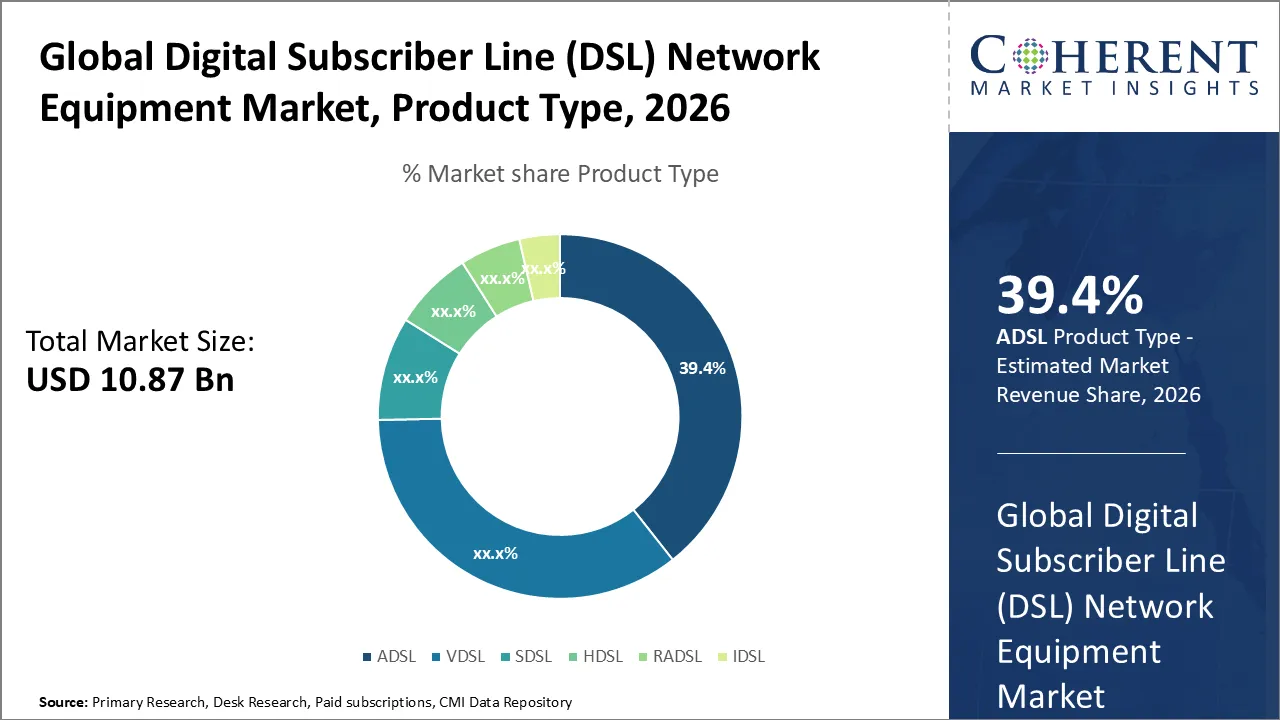
Why is the ADSL Segment Expected to Hold the Largest Digital Subscriber Line (DSL) Network Equipment Market Share?
Based on product type, the asymmetric digital subscriber line (ADSL) sub-segment is expected to hold the largest market share of 39.4% by 2026. The position is consolidated through its widespread historical deployment in residential broadband networks, which comes from its compatibility with conventional copper telephone lines and comparatively economical equipment requirements.
This persistent demand can be testified by copper-based DSL accounting for almost 6 subscriptions per 100 inhabitants across OECD countries at the end of 2024. Moreover, ADSL infrastructure continues to serve connectivity requirements in areas where advanced broadband technologies remain unavailable or where immediate replacement of existing networks is economically challenging.
In October 2026, Comtrend reaffirmed its commitment to supporting broadband providers operating legacy copper networks following FCC conditional approval of its PBL-6201 Wi-Fi 6 Bonded VDSL Gateway, as it found 40.8% of rural broadband providers still serving some customers through copper connections.
Why Does the Residential Segment Dominate the DSL Network Equipment Market?
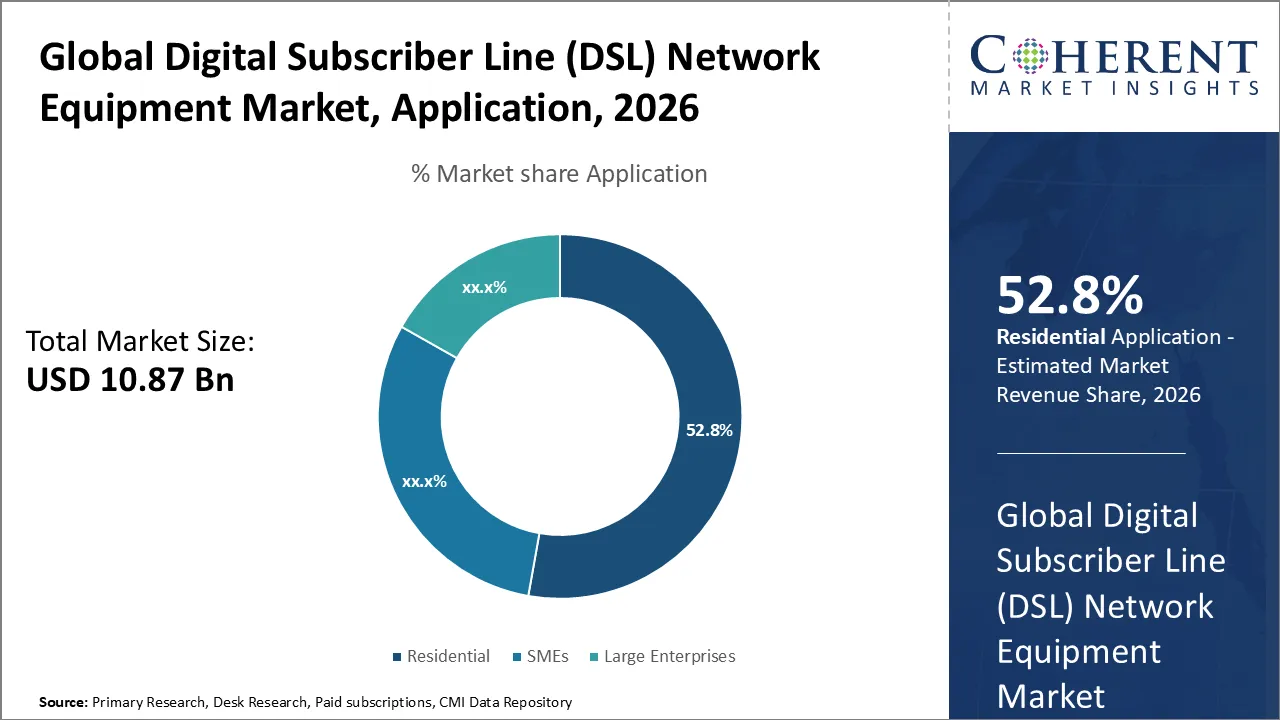
The residential application segment is poised to lead the digital subscriber line (DSL) network equipment market over 2026, with a share of 52.8%. The enlarging household broadband subscriber base, growing replacement requirements for existing DSL equipment, and representation as cost-effective home internet connectivity makes DSL the perfect option for users in this category.
According to Eurostat's digital infrastructure assessment, DSL technology covered approximately 70% of households across European Union (EU) till 2025. Furthermore, this substantial installed infrastructure indicates a continuing addressable marketplace for maintenance and replacement equipment as well. Capitalizing on this demand base, in February 2024, ZTE launched its LinkPro Wi-Fi 7 customer premises equipment (CPE) portfolio, which includes the ZXHN H5745 tri-mode DSL Home Gateway.
Digital Subscriber Line (DSL) Network Equipment Market Trends
- Increasing Integration of DSL and Multi-WAN Technologies: DSL network equipment manufacturers are nowadays developing specialized networking devices that combine copper broadband with Ethernet, cellular, and fiber-compatible interfaces. For instance, in September 2026, DrayTek introduced its Vigor2867be 4G/5G series, integrating VDSL2 35b/ADSL2+ broadband compatibility with 4G/5G cellular connectivity, 10GbE Ethernet, and 10G SFP+ interfaces.
- Growing Adoption of Integrated Network Security Features: Business-oriented DSL routers increasingly incorporate firewalls, VPN connectivity, quality-of-service controls, and centralized network management to serve organizations with distributed operations. Following this trend, in May 2024, LANCOM Systems expanded its 1800-series networking portfolio by launching the LANCOM 1803VA-5G and LANCOM 1800VA-5G SD-WAN gateways to provide secure connectivity for small and medium-sized businesses operating across multiple offices.
- Gradual Transition Toward Fiber-Based Access Networks: Telecom operators are progressively replacing conventional DSL connections with fiber infrastructure. This trend is expected to shift DSL equipment demand toward replacement devices, hybrid networking products, and legacy infrastructure maintenance. As evidence, in October 2026, Openreach shared its plans to discontinue new sales of conventional copper-based telephone and broadband services across 112 additional exchange locations, covering approximately 619,724 premises in the UK.
Regional Insights
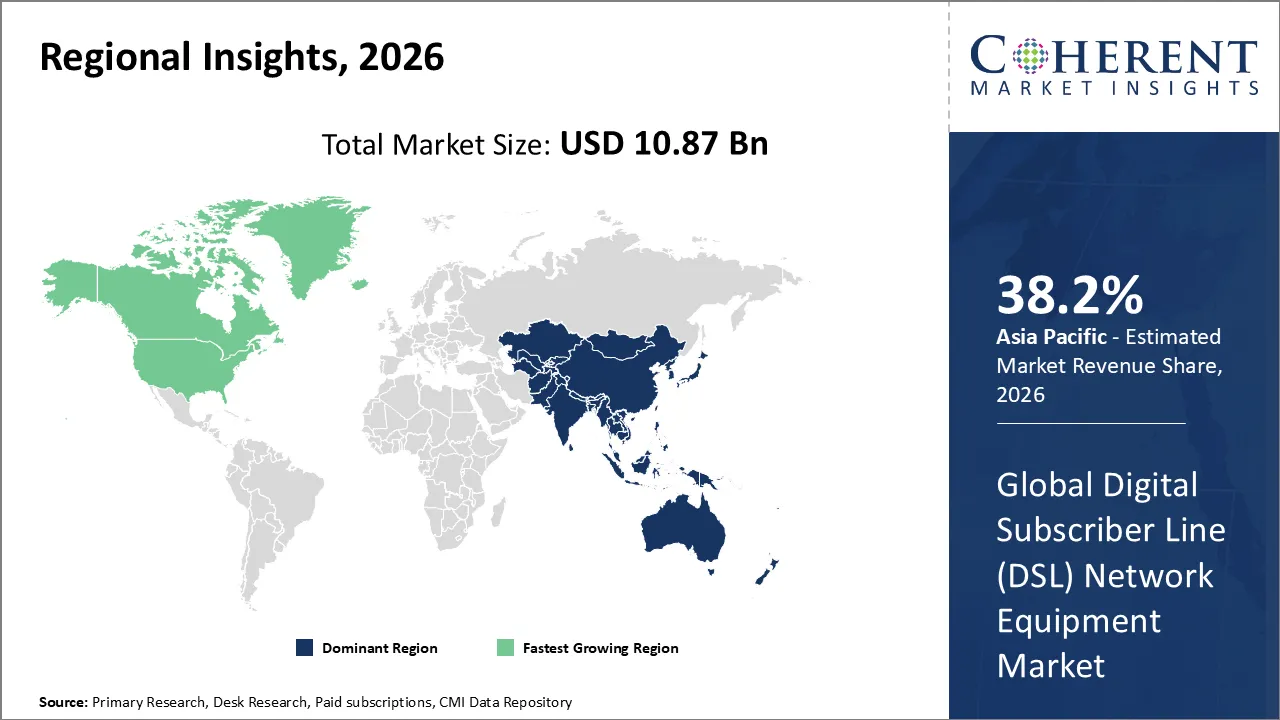
Asia Pacific Leads the Digital Subscriber Line (DSL) Network Equipment Market Through Broadband Connectivity Expansion
Asia Pacific is predicted to hold the leading revenue share of 38.2% in the global digital subscriber line (DSL) network equipment market till the end of 2026. The expanding telecommunications subscriber base, extending broadband infrastructure, and continued public investment in fulfilling connectivity requirements of underserved communities are solidifying the region's dominance in this sector.
Specifically, emerging and developed economies, such as China, India, Indonesia, and Vietnam, are rigorously expanding nationwide broadband infrastructure and digital service availability. In this regard, India's Department of Telecommunications reported that approximately 214,904 Gram Panchayats had been made service-ready under Phase-I and Phase-II of BharatNet as of December, 2025.
While fiber-optic networks are attracting increasing investment, existing copper access networks and mixed-technology connectivity requirements continue to generate demand for compatible DSL equipment across APAC countries. For instance, in March 2025, NetComm launched its NF71 Wi-Fi 7 Gateway and NS71 EasyMesh Satellite, which can integrate VDSL connectivity for NBN Fibre-to-the-Node (FTTN) and Fibre-to-the-Building (FTTB) networks, for customers across Australia and New Zealand.
North America Represents a Stable Consumer Base and Hub of Advancements for the DSL Network Equipment Market
North America is estimated to account the global digital subscriber line (DSL) network equipment market share with a massive domestic demand induced by the growing need to maintain existing broadband infrastructure, replacement of DSL-compatible networking hardware, and business connectivity requirements in areas without comprehensive fiber coverage. Specifically, the U.S. and Canada prioritizing improved broadband access through telecommunications investment and public connectivity programs adds federal support to the sector’s progress.
Government-backed broadband investments are the most prominent evidence for the same. For instance, in 2024, the country’s National Telecommunications and Information Administration (NTIA) started a USD 42.45 billion BEAD program, with Canada backing up through a USD 2.4 billion Universal Broadband Fund for 2020-2027.
However, increasing deployment of fiber and fixed wireless access is gradually changing the long-term demand outlook for traditional copper-based networking equipment. In October 2026, AT&T reported that it had discontinued legacy copper services in more than 500 communities, covering over 1.3 million locations across 18 states, while committing to cover more than 1.5 thousand communities by 2027.
United States DSL Network Equipment Market Trends
The U.S. is expected to continue leading the regional landscape of the DSL network equipment market by enabling a large legacy broadband infrastructure base. Nationwide demand is now increasingly being concentrated within the urge to maintain existing access networks, replacing customer premises hardware, and supporting business continuity applications. Moreover, 40.8% of rural telecom providers continuing the use of copper-wire infrastructure to deliver fixed broadband services to some customers till 2025 portrays the persistence of the consumer base, as surveyed by the NTCA–The Rural Broadband Association.
To maintain market relevance amid the heightening competition from alternative fiber-based solutions, U.S.-based DSL-compatible business routers are evolving beyond traditional copper modems through integration with Ethernet interfaces, cellular backup, VPN functionality, and advanced network security. For instance, in January 2025, California-based EnGenius Technologies launched its ESG320 Cloud-Managed VPN Router, which can be deployed behind an existing DSL modem or gateway through Ethernet connectivity.
China DSL Network Equipment Market Trends
China remains an important marketplace for the regional DSL network equipment market, as it has a large broadband subscriber base, extensive manufacturing ecosystem, and local demand for integrated connectivity devices. Thus, equipment manufacturers operating in the country are increasingly developing products that support multiple access technologies alongside conventional fixed-line infrastructure.
Exemplifying this, in March 2025, TP-Link expanded support for its multi-access broadband gateway portfolio through the Omada SDN Controller V5.15.20 early-access release. The update added centralized management support for the DR3220v-4G and DR3650v-4G dual-SIM gateways, alongside other networking devices. The DR3220v-4G combines copper-based ADSL/VDSL connectivity with 4G LTE and Ethernet interfaces, enabling businesses to maintain conventional fixed-line access while introducing mobile broadband redundancy and flexible WAN connectivity.
On the other hand, in 2025 alone, fixed broadband internet access services generated a significant revenue of 289.6 billion yuan in China, displaying a 5.9% rise from 2024, making its share in the domestic telecommunications revenue 16.5%. These figures and steady escalations demonstrate substantial regional broadband activity.
Who are the Major Companies in Digital Subscriber Line (DSL) Network Equipment Industry
Some of the major companies operating in the global Digital Subscriber Line (DSL) Network Equipment Market include Huawei Technologies Co., Ltd., ZTE Corporation, Nokia Corporation, Cisco Systems, Inc., Telefonaktiebolaget LM Ericsson, ADTRAN Holdings, Inc., TP-Link Systems Inc., Zyxel Group Corporation, D-Link Corporation, DrayTek Corp., Sagemcom Broadband SAS, and NETGEAR, Inc.
Key News
- In June 2026, DrayTek announced the expansion of its Wi-Fi 7 networking portfolio with the introduction of the Vigor2928be, Vigor2867be, and Vigor1220be routers, alongside the VigorAP 1070C BE19000 tri-band access point. The Vigor2867be integrates a built-in VDSL2 35b/ADSL modem with Gigabit Ethernet, 10GbE, and 10G SFP+ WAN connectivity, supporting the continued use of copper-based broadband alongside newer access technologies.
- In June 2026, AVM launched a DSL-compatible Wi‑Fi 7 router, the FRITZ!Box 7630, supporting all common DSL connections with speeds of up to 300 Mbit/s. The device also integrates a 2.5-Gbit/s WAN/LAN port, three gigabit LAN ports, USB 3.0, DECT telephony, and FRITZ!OS features including VPN functionality.
- In March 2026, DrayTek introduced its Vigor2767ax-4G Cellular xDSL Router, integrating VDSL2 35b Supervectoring connectivity with 4G LTE, SIM/eSIM-enabled cellular WAN, and a switchable 2.5GbE Ethernet WAN/LAN interface. The router incorporates Wi-Fi 6, VPN connectivity, URL/IP reputation-based security, and application-based Quality of Service (QoS) management and is designed for professional smart homes, small offices, and remote operations.
Digital Subscriber Line (DSL) Network Equipment Market Report Coverage
Report Coverage | Details | ||
Base Year: | 2025 | Market Size in 2026: | USD 10.87 Bn |
Historical Data for: | 2020 to 2024 | Forecast Period: | 2026 to 2033 |
CAGR: | 4.2% | 2033 Value Projection: | USD 14.5 Bn |
Geographies covered: |
| ||
Segments covered: |
| ||
Companies covered: | Huawei Technologies, ZTE, Nokia, Cisco Systems, Ericsson, ADTRAN, TP-Link, Zyxel, D-Link, DrayTek, Sagemcom Broadband, NETGEAR | ||
Growth Drivers: |
| ||
Restraints & Challenges: |
| ||
Analyst Opinion
- Broadband connectivity requirements will support selective opportunities for DSL network equipment manufacturers. This reflects demand for access infrastructure, replacement equipment, and integrated networking solutions. However, the increase in fiber-optic use is to be considered a major challenge, as it represents a broader equipment-market grasp and strong evidence of being an efficient alternative to copper access technology.
- Product diversification will become increasingly important for equipment suppliers. Specifically, manufacturers who are willing to offer DSL compatibility alongside Ethernet, cellular connectivity, and modern network management capabilities are better positioned to address changing customer requirements. In conclusion, developments in the broadband services market are expected to influence equipment procurement patterns, as service providers emphasize flexibility, reliability, and broadband access continuity.
- Infrastructure modernization will also create opportunities while limiting conventional DSL deployment. This is the result of the increasing adoption of high-speed access technologies, which is expected to influence the competitive positioning of DSL equipment suppliers. Furthermore, expansion of the fiber optic connectivity market could reduce demand for standalone copper access equipment, encouraging manufacturers to focus on integrated gateways, backward compatibility, and equipment replacement requirements.
Speak to the analyst
Want personalized insights?
Take the findings above to one of our principal consultants, or have the report rebuilt around the segments, geographies and competitors you actually track.
Market Segmentation
- By Source (Revenue, USD Bn, 2026-2033)
- ISDN Digital Subscriber Line (IDSL)
- Asymmetric Digital Subscriber Line (ADSL)
- Rate-Adaptive Digital Subscriber Line (RADSL)
- Symmetric Digital Subscriber Line (SDSL)
- High Bit-Rate Digital Subscriber Line (HDSL)
- Very High Bit-rate Digital Subscriber Line (VDSL)
- By Application (Revenue, USD Bn, 2026-2033)
- Small and Medium-sized Enterprises (SMEs)
- Large Enterprises
- Residential
- By Region (Revenue, USD Bn, 2026-2033)
- North America
- U.S.
- Canada
- Latin America
- Brazil
- Mexico
- Argentina
- Rest of Latin America
- Europe
- Germany
- U.K.
- France
- Italy
- Spain
- Russia
- Rest of Europe
- Asia Pacific
- China
- India
- Japan
- Australia
- South Korea
- ASEAN
- Rest of Asia Pacific
- Middle East
- GCC
- Israel
- Rest of Middle East
- Africa
- South Africa
- Central Africa
- North Africa
- North America
Sources
Primary Research Interviews
- Digital Subscriber Line (DSL) network equipment manufacturers and suppliers
- ADSL, VDSL, and DSLAM equipment manufacturers
- Telecommunications operators and fixed-line broadband service providers
- Customer premises equipment (CPE) manufacturers and distributors
- Broadband network infrastructure engineers and technical consultants
- Network modernization and copper-to-fiber migration specialists
- Enterprise networking equipment procurement managers
- DSL modem, router, and multi-WAN gateway product managers
- Telecommunications system integrators and network installation service providers
- Key opinion leaders (KOLs) in broadband access technologies
Databases
- International Telecommunication Union (ITU) – ICT Statistics and DataHub
- Organisation for Economic Co-operation and Development (OECD) – Broadband Portal
- World Bank – World Development Indicators and Digital Development
- Eurostat – Digital Economy and Society Statistics
- U.S. Federal Communications Commission (FCC) – National Broadband Map and Broadband Data Collection
- Telecom Regulatory Authority of India (TRAI) – Telecom Subscription Reports
- Ministry of Industry and Information Technology (MIIT), China – Telecommunications Industry Statistics
- UK Office of Communications (Ofcom) – Connected Nations Reports
- Bundesnetzagentur, Germany – Telecommunications Market Statistics
- European Commission – Digital Decade Monitoring and Broadband Coverage Reports
Magazines and Industry Publications
- Light Reading
- Broadband Communities
- Fierce Network
- Telecompaper
- Total Telecom
- Capacity Media
- Broadband Technology Report
- RCR Wireless News
- Network World
- Telecom Review
Journals
- IEEE Communications Magazine
- IEEE Network
- IEEE Access
- IEEE Transactions on Communications
- Computer Networks
- International Journal of Communication Systems
- IEEE Communications Surveys & Tutorials
- Optical Switching and Networking
- Journal of Network and Systems Management
- Telecommunications Policy
Newspapers
- Reuters
- Financial Times
- The Wall Street Journal
- The Economic Times
- Nikkei Asia
- The Guardian
- The Hindu BusinessLine
- South China Morning Post
Associations and Industry Bodies
- Broadband Forum
- International Telecommunication Union (ITU)
- European Telecommunications Standards Institute (ETSI)
- Telecommunications Industry Association (TIA)
- Fiber Broadband Association
- FTTH Council Europe
- NTCA – The Rural Broadband Association
- Internet Society (ISOC)
- GSMA
- IEEE Communications Society
Public Domain Sources
- DSL network equipment manufacturer websites, product catalogs, and technical datasheets
- DrayTek – Vigor2767ax-4G, Vigor2867be, and Wi-Fi 7 router product announcements
- AVM (FRITZ!) – FRITZ!Box 7630 launch announcement and technical specifications
- Comtrend – DSL gateway product announcements and FCC equipment certification records
- ZTE – Broadband customer premises equipment product announcements
- LANCOM Systems – SD-WAN gateway product announcements and specifications
- NetComm – Broadband gateway and networking equipment product documentation
- TP-Link – Omada SDN controller updates and broadband gateway specifications
- EnGenius Technologies – Enterprise router and networking product announcements
- Openreach – Copper network retirement and broadband modernization announcements
- AT&T – Copper network transition updates and investor presentations
- BharatNet – Government broadband infrastructure progress reports
- U.S. NTIA – Broadband Equity, Access, and Deployment (BEAD) Program documentation
- European Commission – State of the Digital Decade Reports
- UK Government – Project Gigabit progress publications
- U.S. FCC – Equipment authorization records and broadband regulatory publications
- International Telecommunication Union – ITU-T DSL transmission standards and recommendations
- Company annual reports, investor presentations, and official press releases
- Government telecommunications policies and digital infrastructure investment announcements
- Publicly available research on ADSL, VDSL, hybrid fiber-copper networks, and broadband access equipment
Proprietary Elements
- CMI Data Analytics Tool
- Proprietary CMI Existing Repository of Information for the Last 10 Years
Get access to 250+ pages report
Every segment, forecast, competitor profile and data table behind the analysis above — available for instant download.
- ESOMAR Member
- ISO 9001:2015 Certified
- D-U-N-S Registered
- GDPR & CCPA Compliant
Missing comfort of reading report in your local language? Find your preferred language:
Transform your Strategy with Exclusive Trending Reports
Frequently Asked Questions
The market is estimated to increase from USD 10.87 Bn in 2026 to approximately USD 14.5 Bn by 2033.
Major companies relevant to the market include Huawei Technologies, ZTE, Nokia, Cisco Systems, Ericsson, ADTRAN, TP-Link, Zyxel, D-Link, DrayTek, Sagemcom, and NETGEAR.
Expansion of fiber-optic broadband networks, retirement of aging copper infrastructure, transmission speed limitations, and competition from fixed wireless technologies are major market challenges.
Demand for affordable fixed broadband connectivity, modernization of existing DSL infrastructure, integrated multi-WAN networking solutions, and equipment replacement requirements are expected to support market revenue.
The global market is projected to grow at a CAGR of approximately 4.2% over the forecast period.
Asia Pacific is estimated to dominate with a market share of approximately 38.2% in 2026 under the adopted competitor-based market model.
Digital Subscriber Line network equipment refers to hardware designed to provide broadband data transmission using copper telephone lines. The equipment includes DSL modems, routers, customer premises gateways, and digital subscriber line access multiplexers.