

Global Fiber Optic Connectivity Market Size and Forecast – 2026 To 2033
The global fiber optic connectivity market is expected to grow from USD 8.25 Bn in 2026 to USD 17.20 Bn by 2033, registering a compound annual growth rate (CAGR) of 11.5% from 2026 to 2033. The global fiber optic connectivity market is driven by increasing government investments in digital infrastructure development. On June 11, 2025, Sterlite Technologies signed a USD 24 billion agreement with BSNL to develop the BharatNet middle-mile network in Jammu & Kashmir and Ladakh in India. (Source: CNBC)
Key Takeaways of the Global Fiber Optic Connectivity Market
- The hardware segment is expected to account for 51.0 % of the global fiber optic connectivity market share in 2026. Increasing cloud computing and video streaming traffic are driving the growth of the segment. On March 13, 2026, Amazon Web Services, Inc. and Cerebras Systems announced a collaboration to deliver the fastest AI inference solutions available for generative AI applications and LLM workloads. (Source: Amazon)
- The single-mode fiber segment is estimated to capture 46.0 % of the market share in 2026. Adoption of fiber backhaul for mobile networks is driving the growth of the segment. On March 31, 2025, Nokia announced that it will upgrade and expand Vodafone Idea Limited (VIL) optical transport network across key metro and circle locations in India. (Source: Nokia)
- The fiber optic cables segment is estimated to capture 36.0 % of the market share in 2026. Growing smart city and IoT network deployments are driving the growth of the fiber optic cables segment. On June 17, 2025, eCommunity Fiber, a leading open-access fiber network provider, announced the deployment of Ciena's routing and multi-layer network control solutions as the high-capacity backbone connecting The District in Morrow, Georgia, U.S. directly to the Atlanta Internet Gateway. (Source: Ciena)
- Asia Pacific is expected to dominate the fiber optic connectivity market in 2026 with a market share of 32.0 %. Growth in industrial automation and development of manufacturing facilities in Asia Pacific is driving the growth of the regional market. On March 19, 2026, Analog Devices, Inc. announced the opening of its new advanced manufacturing facility in Thailand, further strengthening its advanced manufacturing and test capacity while expanding resilient, sustainable semiconductor production in the Asia Pacific region. (Source: Analog Devices)
- North America is expected to account for 24.0 % share in 2026 and is projected to record the fastest growth over the forecast period. Steady expansion of data center infrastructure in North America is driving the growth of the regional market. On June 8, 2026, Amazon announced a multibillion-dollar agreement with Corning Incorporated, to supply the optical fiber, cable, and connectivity solutions that power Amazon's expanding data center infrastructure across the U. S. (Source: Amazon)
- AI Data Centers Driving Demand for High-Density Optical Connectivity: The rapid growth of artificial intelligence (AI) workloads is driving strong demand for high-speed fiber optic interconnects in hyperscale data centers. Operators are building high-fiber-count cabling systems, powerful optical transceivers and low-latency connectivity solutions to enable AI training clusters and high-performance computing environments.
- Accelerated Fiber-to-the-Home (FTTH) and Gigabit Broadband Expansion: Telecom operators and governments are still investing extensively in FTTH infrastructure to provide gigabit-speed internet services. Such large scale broadband projects in Asia Pacific, North America, and Europe are spreading fiber optic access to the unserved urban and rural areas, producing a sustained need for fiber optic connectivity equipment.
Segmental Insights
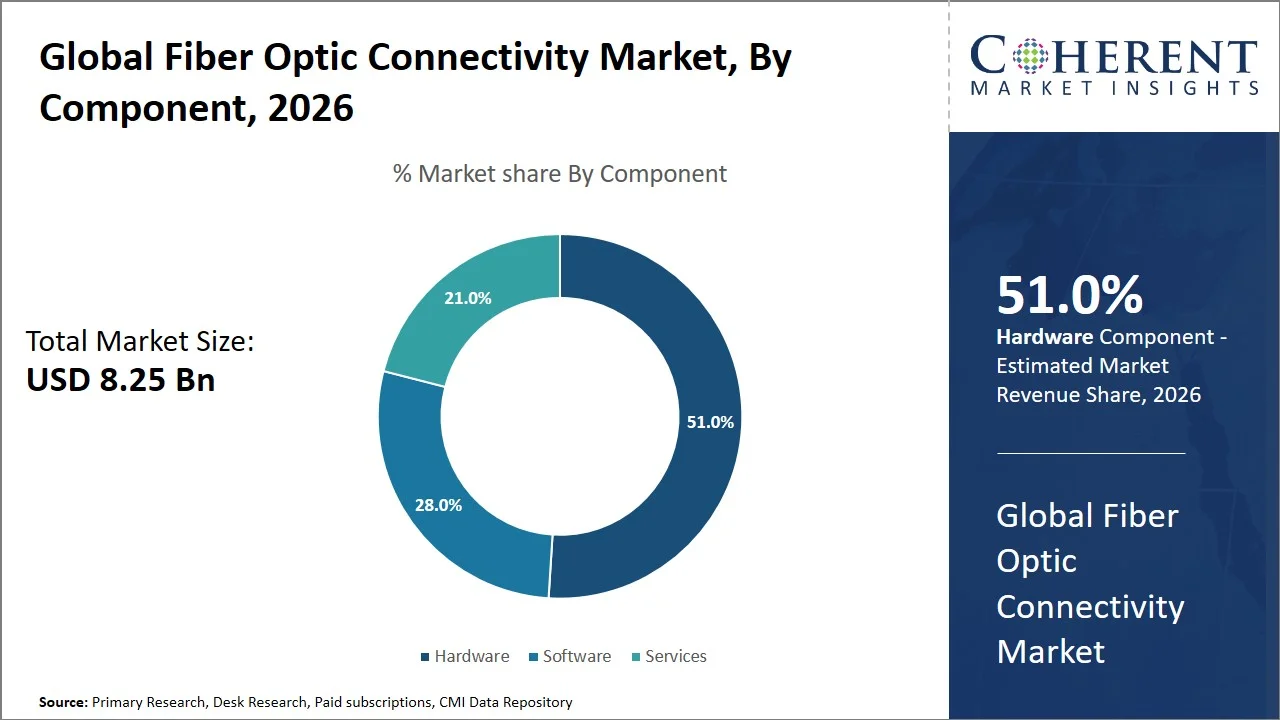
Why Does Hardware Dominate the Global Fiber Optic Connectivity Market?
The hardware segment is expected to account for 51.0% of the global fiber optic connectivity market share in 2026. Hardware dominates the global fiber optic connectivity market as the implementation of each fiber network involves extensive physical infrastructure such as fiber optic cables, connectors, transceivers, patch panels, splitters and distribution frames. The continued growth of FTTH networks, 5G backhaul systems, data centers, and enterprise connectivity projects drives ongoing demand for these hardware components. As a result, hardware is the largest revenue-generating segment in the industry.
On March 12, 2025, CommScope announced the launch of its Propel XFrame solution as the latest addition to the Propel portfolio of high-performance data center solutions. The Propel XFrame solution is a floor-mounted fiber frame designed to support and evolve with the demands of data centers and high-performance computing facilities. (Source: CommScope)
- Current Industry Events of 2026
- Market Size Estimation
- Regional Breakdown
- Competitive Landscape
- Customer Intelligence
- Segmental Analysis
- Pricing Analysis
- Key Market Drivers, Challenges & Future Trends
- Customized Insights Section
Why is Single-Mode Fiber the Most Preferred Fiber Type?
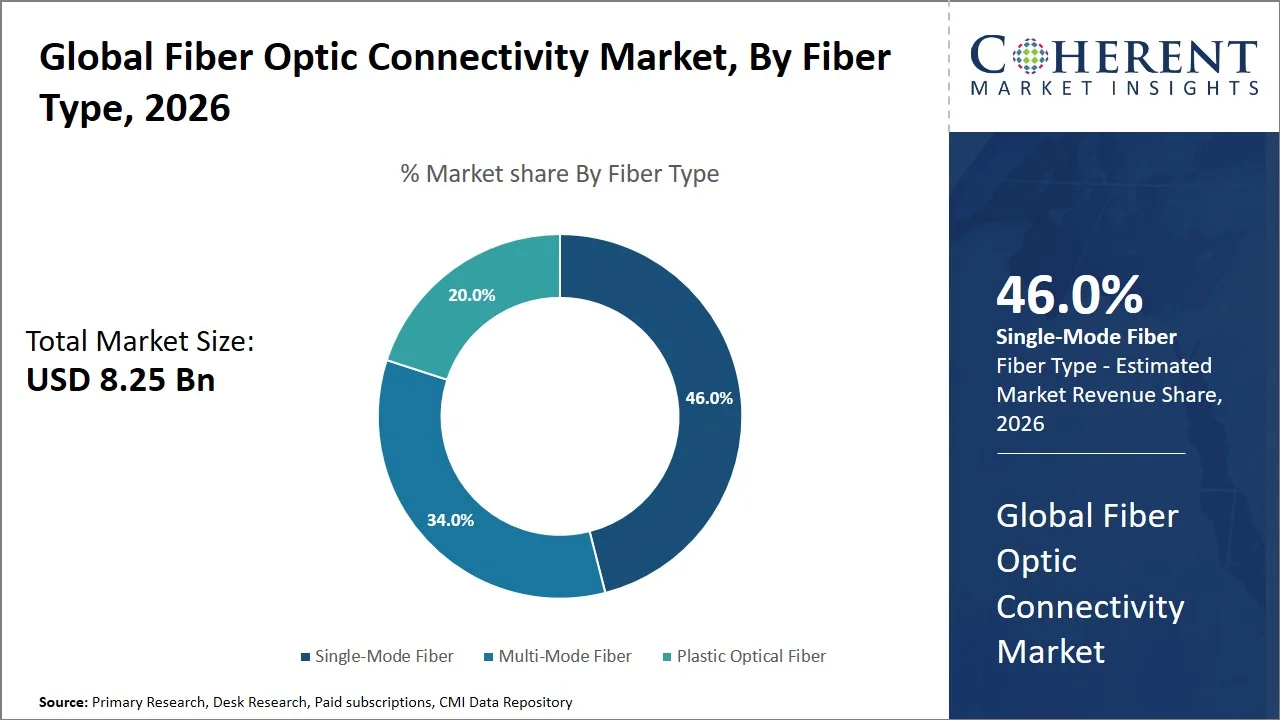
The single-mode fiber segment is expected to account for 46.0% of the global fiber optic connectivity market share in 2026. The single-mode fiber is the most popular because it can carry data over much longer distances with considerably lower attenuation of signal and little dispersion than the multimode fiber. This makes it the preferable solution for telecommunications networks, 5G backhaul infrastructure, metro fiber networks and long-haul data transfer applications where high bandwidth and reliable performance are required.
On March 31, 2026, Vodafone Idea Limited (Vi) announced it is modernizing its transport network with Ciena’s WaveLogic 6 Extreme (WL6e) coherent optical technology running on the 6500 platform. The network upgrade strengthens Vi’s ability to support growing bandwidth demands in India and pursue new business opportunities with hyperscalers, neoscalers, and enterprise customers. (Source: Ciena)
Fiber Optic Cables Dominates the Global Fiber Optic Connectivity Market
The fiber optic cables segment is expected to account for 36.0% of the global fiber optic connectivity market share in 2026. The global fiber optic connectivity market is dominated by fiber optic cables, as they are the main transmission medium in all fiber communication networks. The increasing deployment of broadband infrastructure, FTTH projects, 5G backhaul, data centers and enterprise connectivity solutions requires large quantities of fiber optic cables, which leads to a much higher demand and revenue generation than other connectivity components such as connectors, splitters and patch panels.
On July 23, 2025, Prysmian announced an investment in Relativity Networks, the leading at-scale provider of next-generation fiber-optic technology. This investment follows the agreement announced in March 2025 for the production and global deployment of hollow-core optical fiber and cable, a transformative innovation poised to redefine the future of optical networks. (Source: Prysmian)
Currents Events and their Impact
Current Events | Description and its Impact |
India Telecommunications Act, 2023 (implemented from 2024–2025) |
|
Telecommunications (Right of Way) Rules, 2024 - India |
|
(Source: eGazette, Telecom Regulatory Authority of India)
Fiber Optic Connectivity Market Dynamics
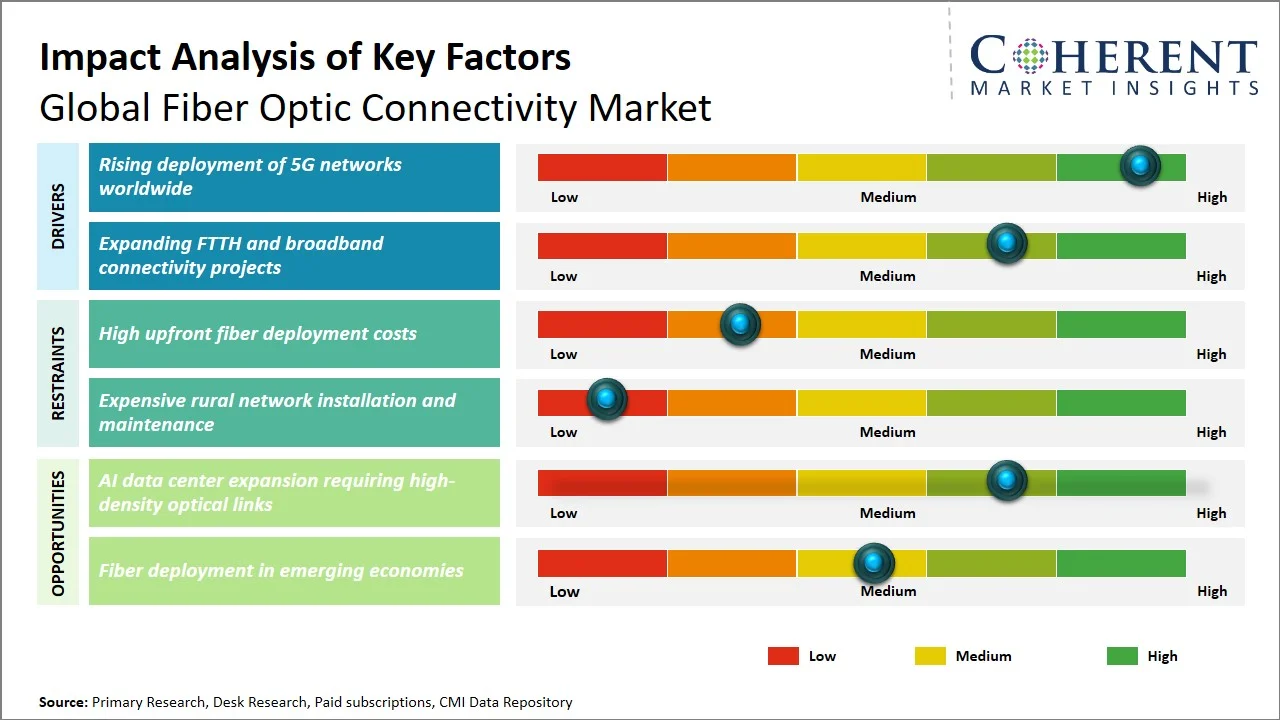
Market Drivers
Rising deployment of 5G networks worldwide
The rising deployment of 5G networks globally is a key driver of the fiber optic connectivity market as 5G infrastructure primarily relies on high-capacity fiber networks for fronthaul, midhaul, and backhaul connectivity. As telecom operators continue to extend 5G coverage and boost network densification with small cells and dispersed antenna systems, demand for fiber optic cables, connectors and optical transmission equipment is increasing substantially. Fiber optics provides the high bandwidth, low latency, and dependability needed to enable sophisticated 5G applications such as autonomous systems, smart cities, industrial automation, and ultra-high-definition video delivery.
On February 25, 2025, India’s Bharti Airtel and Ericsson strengthened their longstanding partnership through a new collaboration to deploy Ericsson's secure, high-performing 5G Core network offerings to the benefit of Airtel's millions of customers and enterprises across India. (Source: Ericsson)
Expanding FTTH and broadband connectivity projects
The Fiber-to-the-Home (FTTH) and broadband connectivity projects are expanding significantly and are driving growth in the fiber optic connectivity market as governments and telecom operators invest in high-speed internet infrastructure to meet increasing data consumption and digital service demand. Large scale broadband activities to increase connectivity in urban, suburban and rural regions are speeding the deployment of fiber optic cable and accompanying connectivity components. Fiber networks offer higher capacity, stability and scalability making it the preferred technology for delivering gigabit speed internet services and fueling ongoing expansion of FTTH deployments worldwide.
On March 20, 2025, CommScope announced the availability of its PON Evo products, a comprehensive suite of passive optical network (PON) active optical line terminal (OLT) solutions. The PON Evo suite is the result of a strategic partnership with Altice Labs, a leading R&D company, specializing in advanced telecommunications solutions. (Source: CommScope)
Emerging Trends
- Integration of Fiber Networks with 5G and Future 6G Infrastructure: Fiber optic connectivity is becoming the backbone of 5G deployments by providing high-capacity fronthaul, midhaul, and backhaul networks. As operators prepare for future 6G ecosystems, investment in dense fiber infrastructure is rising to provide ultra-low latency communications, enormous IoT connectivity and sophisticated mobile services.
- Growth of Smart Cities, Industrial Automation, and Edge Computing: The deployment of fiber networks closer to end users and industrial facilities is being driven by the usage of smart city technologies, Industry 4.0 efforts and edge computing architectures. Fiber optic communication is becoming more common to enable everything from real-time data transfer, to automated manufacturing systems, to intelligent transportation networks and mission-critical industrial applications.
Regional Insights
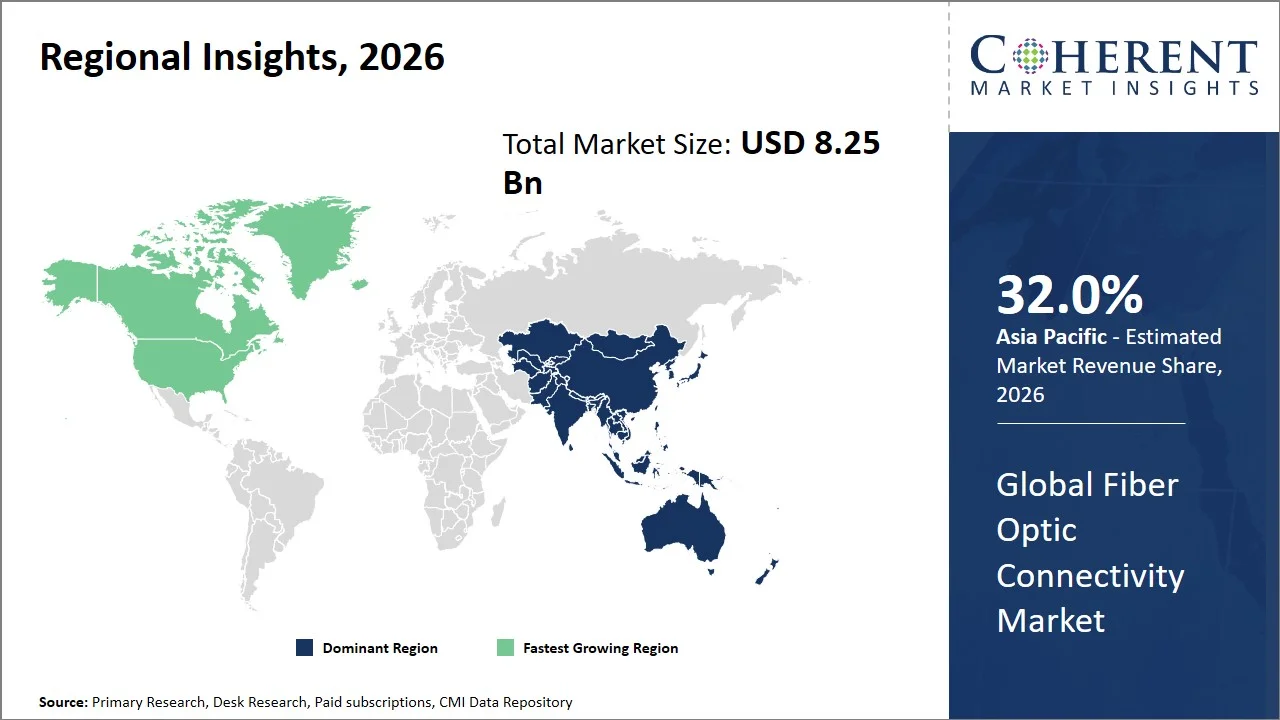
Why is Asia Pacific a Strong Market for Fiber Optic Connectivity?
Asia Pacific is expected to account for a market share of 32.0% in 2026. Asia Pacific continues to be the most dynamic market for fiber optic connectivity driven by aggressive national broadband projects and large scale 5G infrastructure investment. China is still rolling out gigabit fiber networks with large operators like China Mobile, China Telecom and China Unicom. India is fast-tracking fiberization with BharatNet and state-level broadband programs. Japan and South Korea are updating their existing fiber networks to handle AI-generated data traffic and advanced cloud services, driving substantial demand for high-capacity optical cables, connectors and transceivers. On March 13, 2026, NTT, Inc. announced it has developed a four-core multicore optical fiber that achieves a fourfold increase in transmission capacity of conventional optical fibers using a single fiber for communications. (Source: NTT)
Why Does the North America Fiber Optic Connectivity Market Exhibit High Growth?
North America is projected to account for 24.0% of the global fiber optic connectivity market and is expected to register the fastest growth. North America is mostly led by hyperscale data center expansion & AI infrastructure expenditures. Amazon Web Services, Microsoft and Google, for example, are deploying large scale optical connection systems in support of AI training clusters and high performance computing workloads. Telecom vendors like AT&T and Verizon continue to develop fiber-to-the-premises networks and increase fiber backhaul capacity for dense 5G builds across urban areas. On September 22, 2025, Lumen Technologies announced significant progress in its multi-year effort to build the backbone for the AI economy. Lumen is moving forward with a multi-billion-dollar investment plan to add 34 million new intercity fiber miles by the end of 2028, for a total of 47 million intercity fiber miles. (Source: Lumen Technologies)
Global Fiber Optic Connectivity Market Outlook for Key Countries
Why is China Emerging as a Major Hub in the Fiber Optic Connectivity Market?
China remains the world’s largest fiber deployer, continuing to invest in FTTH, 5G backhaul and smart-city infrastructure. Domestic producers such as Yangtze Optical Fibre and Cable (YOFC), FiberHome and Hengtong Group provide optical fiber and communication components. The country’s rapid buildout of AI computer centers and industrial digitalization initiatives further fuels demand for high-density optical networking solutions.
Is the U.S. the Next Growth Engine for the Fiber Optic Connectivity Market?
The U.S. fiber optic connectivity market is characterized by large investments in broadband upgrades and AI data center infrastructure. Fiber connectivity is being expanded into underserved and rural communities through Broadband Equity, Access, and Deployment (BEAD)-funded initiatives, while industry participants such as Lumen Technologies and Frontier Communications are accelerating fiber network rollouts to enhance broadband coverage, strengthen digital infrastructure, and support long-term connectivity objectives. Moreover, the increasing concentration of AI data centers in locations such as Texas, Virginia and Arizona is driving significant demand for high-speed optical interconnects and fiber networking gear.
Germany Fiber Optic Connectivity Market Analysis and Trends
The Germany fiber optic connectivity market is being driven by statewide gigabit broadband objectives and the digital revolution of manufacturing industries. Telecom providers such as Deutsche Telekom and Vodafone Germany are rolling out FTTH coverage and industrial enterprises are installing fiber-based communication networks to enable Industry 4.0 applications. Demand for resilient fiber backhaul infrastructure is also being driven by the growing deployment of private 5G networks in manufacturing plants.
India Fiber Optic Connectivity Market Analysis and Trends
India is witnessing fast fiber infrastructure growth fueled by BharatNet expansion, 5G rollout initiatives and increased internet penetration. Telecom carriers such as Bharti Airtel, Reliance Jio and BSNL are also fast-tracking fiberization of mobile towers and expanding FTTH services across urban and semi-urban areas. The government’s National Broadband Mission and rising demand from data centers in Mumbai, Chennai, Hyderabad and Pune are providing ongoing prospects for fiber optic cable and connectivity equipment suppliers.
Japan Fiber Optic Connectivity Market Analysis and Trends
Japan has one of the world’s most developed fiber broadband ecosystems and continues to upgrade its network capacity to suit growing cloud, AI, and digital content traffic. Operators like NTT and KDDI are investing in next-generation optical transmission technologies and high-capacity backbone networks. The country’s emphasis on smart industries, autonomous mobility and edge computing applications is also further driving demand for reliable fiber optic communication solutions.
Global Fiber Optic Connectivity Market - Fiber Connector Replacement Cycle by Industry
Industry | Typical Fiber Connector Replacement Cycle (Years) |
Hyperscale Data Centers | 3-5 |
Colocation Data Centers | 4-6 |
Telecommunications Carriers | 7-10 |
FTTH / Broadband Networks | 10-15 |
Mobile Network Operators (5G Backhaul) | 7-10 |
Enterprise IT Networks | 5-8 |
Cloud Service Providers | 3-5 |
Industrial Automation & Manufacturing | 8-12 |
Utilities & Smart Grid Networks | 10-15 |
Oil & Gas Facilities | 6-10 |
How is AI Data Center Expansion and Requirement of High-Density Optical Links Creating New Growth Opportunities in the Fiber Optic Connectivity Market?
The rapid expansion of AI data centers is creating huge growth opportunities in the fiber optic connectivity market due to the massive amounts of data that need to be transferred between GPUs, servers, storage systems and networking equipment with extremely low latency and high bandwidth in order to train and run AI training and inference workloads. To meet these needs, hyperscale operators are building high density optical links, sophisticated transceivers, fiber optic cables and optical interconnect solutions throughout their data center infrastructures. As more companies build facilities focused on AI, 400G, 800G and next-generation optical networking technologies are becoming more prevalent to meet the rising traffic volumes, creating a need for fiber connectivity hardware and increasing investment in high-capacity optical communication networks worldwide.
On March 18, 2025, NVIDIA unveiled NVIDIA Spectrum-X and NVIDIA Quantum-X silicon photonics networking switches, which enable AI factories to connect millions of GPUs across sites while drastically reducing energy consumption and operational costs. NVIDIA has achieved the fusion of electronic circuits and optical communications at massive scale. (Source: NVIDIA)
Market Players, Key Development, and Competitive Intelligence
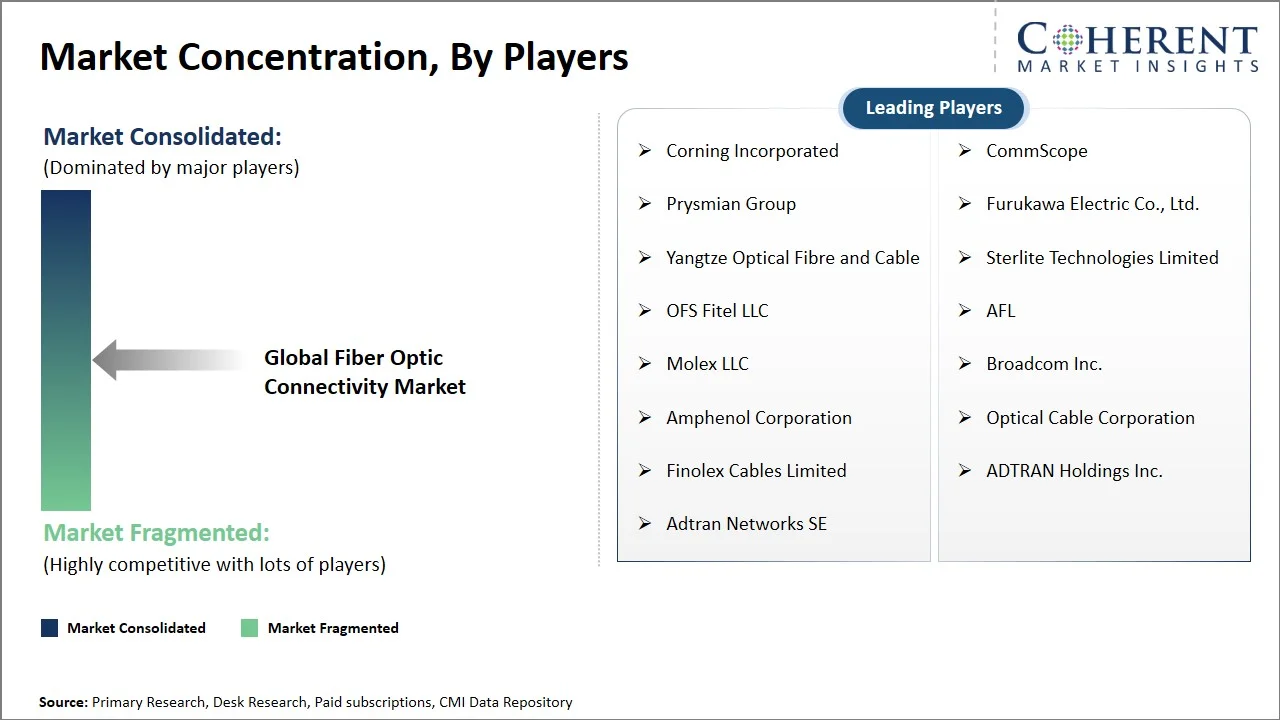
Key Developments
- On November 10, 2025, Prysmian announced the introduction of its BendBrightXS 160µm single-mode optical fiber, the world’s first of its kind. This breakthrough enables cables to be much smaller and pack more fibers together, which is essential for modern digital networks.
- On March 27, 2025, Corning Incorporated launched Corning GlassWorks AI solutions, a one-stop shop of customized data center products and services to help operators build the dense fiber infrastructure required for generative AI. The end-to-end portfolio provides industry-leading cable and connectivity solutions along with best-in-class network planning, design, and deployment support.
Competitive Landscape
The global fiber optic connectivity market is characterized by the presence of well-established fiber producers, connectivity solutions providers and optical networking equipment businesses competing in the industry through product innovation, capacity development, strategic partnerships and regional expansion. Key players such as Corning Incorporated, Prysmian Group, CommScope, Furukawa Electric, and YOFC are increasing their presence in the market with investments in innovative optical technologies, high-fiber-count cable solutions, and data center connection products. Competition is now shifting towards supporting AI infrastructure, 5G deployments, FTTH expansion, and hyperscale data center requirements.
Market Report Scope
Fiber Optic Connectivity Market Report Coverage
| Report Coverage | Details | ||
|---|---|---|---|
| Base Year: | 2025 | Market Size in 2026: | USD 8.25 Bn |
| Historical Data for: | 2020 To 2024 | Forecast Period: | 2026 To 2033 |
| Forecast Period 2026 to 2033 CAGR: | 11.5% | 2033 Value Projection: | USD 17.20 Bn |
| Geographies covered: |
| ||
| Segments covered: |
| ||
| Companies covered: | Corning Incorporated, CommScope, Prysmian Group, Furukawa Electric Co., Ltd., Yangtze Optical Fibre and Cable, Sterlite Technologies Limited, OFS Fitel LLC, AFL, Molex LLC, Broadcom Inc., Amphenol Corporation, Optical Cable Corporation, Finolex Cables Limited, ADTRAN Holdings Inc., and Adtran Networks SE | ||
| Growth Drivers: |
| ||
| Restraints & Challenges: |
| ||
Analyst Opinion (Expert Opinion)
- The fiber optic connectivity market is likely to be well-positioned for long-term growth given the rising reliance of global digital infrastructure on high-capacity optical networks. AI data centers, cloud computing development, broadband modernization projects and 5G network installations are all driving strong demand, with major economies continuing to invest in next-generation optical transmission technology. Despite high implementation costs and infrastructure complexity, the market expansion is predicted to continue as governments and corporations are focusing on high-speed, low-latency connectivity.
- Sustained growth of AI-enabled data centers, edge computing sites, smart city infrastructure and next generation telecom networks are likely to generate huge growth prospects. As network traffic levels increase and bandwidth requirements become more demanding, there will be greater adoption of 800G and future terabit-scale optical networking technologies. Moreover, fiber deployment projects in emerging economies, increasing tower fiberization for 5G and upcoming 6G networks, and rising enterprise digitalization are anticipated to propel market growth and support continuous industry growth in the coming years.
Speak to the analyst
Want personalized insights?
Take the findings above to one of our principal consultants, or have the report rebuilt around the segments, geographies and competitors you actually track.
Market Segmentation
- Component Insights (Revenue, USD Billion, 2021 - 2033)
- Hardware
- Software
- Services
- Fiber Type Insights (Revenue, USD Billion, 2021 - 2033)
- Single-Mode Fiber
- Multi-Mode Fiber
- Plastic Optical Fiber
- Connectivity Type Insights (Revenue, USD Billion, 2021 - 2033)
- Fiber Optic Cables
- Connectors
- Transceivers
- Patch Panels
- Optical Splitters
- Application Insights (Revenue, USD Billion, 2021 - 2033)
- Telecommunications
- Data Centers
- Enterprise Networks
- Industrial Networking
- Utilities and Smart Grids
- Others
- Regional Insights (Revenue, USD Billion, 2021 - 2033)
- North America
- U.S.
- Canada
- Latin America
- Brazil
- Argentina
- Mexico
- Rest of Latin America
- Europe
- Germany
- U.K.
- Spain
- France
- Italy
- Russia
- Rest of Europe
- Asia Pacific
- China
- India
- Japan
- Australia
- South Korea
- ASEAN
- Rest of Asia Pacific
- Middle East
- GCC Countries
- Israel
- Rest of Middle East
- Africa
- South Africa
- North Africa
- Central Africa
- North America
- Key Players Insights
- Corning Incorporated
- CommScope
- Prysmian Group
- Furukawa Electric Co., Ltd.
- Yangtze Optical Fibre and Cable
- Sterlite Technologies Limited
- OFS Fitel LLC
- AFL
- Molex LLC
- Broadcom Inc.
- Amphenol Corporation
- Optical Cable Corporation
- Finolex Cables Limited
- ADTRAN Holdings Inc.
- Adtran Networks SE
Sources
Primary Research Interviews
- Fiber optic cable manufacturers and suppliers
- Network infrastructure service providers
- Telecommunications equipment vendors
- Data center operators and IT managers
Magazines
- Fiber Optic Magazine
- Lightwave Magazine
- Network World
- Data Center Knowledge
- Telecommunications Magazine
Journals
- Journal of Lightwave Technology
- IEEE Communications Magazine
- Optical Engineering Journal
- Fiber and Integrated Optics
Associations
- Fiber Optic Association (FOA)
- Telecommunications Industry Association (TIA)
- International Telecommunication Union (ITU)
- European Telecommunications Network Operators' Association (ETNO)
- Broadband Now
Public Domain Sources
- Federal Communications Commission (FCC) reports
- International Telecommunication Union (ITU) statistics
- World Bank telecommunications data
- OECD broadband statistics
- European Commission digital reports
Proprietary Elements
- CMI Data Analytics Tool
- Proprietary CMI Existing Repository of information for last 10 years
Get access to 250+ pages report
Every segment, forecast, competitor profile and data table behind the analysis above — available for instant download.
- ESOMAR Member
- ISO 9001:2015 Certified
- D-U-N-S Registered
- GDPR & CCPA Compliant
Missing comfort of reading report in your local language? Find your preferred language:
Transform your Strategy with Exclusive Trending Reports
Frequently Asked Questions
The global fiber optic connectivity market is expected to stand at USD 8.25 Bn in 2026 and is expected to reach USD 17.20 Bn by 2033.
The CAGR of the global fiber optic connectivity market is projected to be 11.5% from 2026 to 2033.
Rising deployment of 5G networks worldwide and expanding FTTH and broadband connectivity projects are the major factors driving the growth of the global fiber optic connectivity market.
High upfront fiber deployment costs and expensive rural network installation and maintenance are the major factors hampering the growth of the global fiber optic connectivity market.
FTTH (Fiber-to-the-Home) is a broadband architecture that delivers fiber optic connectivity directly to residential premises.
AI workloads require ultra-high-bandwidth and low-latency optical interconnections between computing resources.
In terms of component, the hardware segment is estimated to dominate the market revenue share in 2026.