

Hyperscale Data Center Market Analysis & Forecast: 2026 to 2033
Hyperscale Data Center Market is estimated to be valued at USD 258.37 Bn in 2026 and is expected to reach USD 1,719.75 Bn in 2033, exhibiting a compound annual growth rate (CAGR) of 31.1% from 2026 to 2033.
Key Takeaways
- Based on IT Infrastructure, the Server Infrastructure segment is expected to lead the market with 52.9% share in 2026, driven by continuous innovations and advanced storage integration.
- Based on Electric Infrastructure, the UPS system segment is expected to hold the highest share of the market in 2026, driven by VRLA and lithium-ion battery adoption with innovative vendor solutions.
- Based on Mechanical Infrastructure, the Cooling System segment is projected to capture the greatest share of the market in 2026, driven by innovations enhancing efficiency and reducing power use.
- Based on General Construction, the Cose & Shell Development segment is projected to account for the maximum share of the market in 2026, through streamlining processes and saving time and costs.
- Based on Region, North America is set to lead the hyperscale data center market in 2026 with 29.4% share. While, Asia Pacific is anticipated to be the fastest growing region.
Market Overview
The massive volume of data that is generated by businesses and individuals today is one of the major drivers driving the hyperscale data center market. The hyperscale data center market is expected to continue growing in the future as businesses expand their capacity and need to manage more data. The increasing use of managed services in enterprise IT environments is also driving the market growth.
Current Events and Its Impacts on the Hyperscale Data Center Market
Current Event | Description and its Impact |
AI Revolution and Computing Demand Surge |
|
Global Energy Crisis and Sustainability Mandates |
|
Energy & Sustainability Innovations Shaping Hyperscale Data Centers Market
Carbon Capture – Google (U.S.)
- Google’s new hyperscale facility integrates carbon capture technology to achieve near zero emissions despite using fossil fuels.
- Hyperscale data centers typically consume 30–50MW per site, with some campuses exceeding 100MW.
- By capturing up to 90% of CO₂ emissions, Google’s model could reduce millions of tons of annual emissions across its U.S. operations.
- This approach balances AI-driven power demand with sustainability, setting a precedent for carbon-neutral fossil fuel usage.
Renewables – Microsoft & Actis
- Microsoft has pledged to run 100% of its data centers on renewable energy by 2030.
- Actis is investing over USD 1 billion in solar- and wind-powered campuses across Asia and Africa.
- Renewable-powered hyperscale sites can cut grid dependency by 40–60%, lowering operational costs and improving resilience.
- In India, renewable integration is critical: Chennai’s new 36MW AI-ready facility is expected to source over 50% of its power from renewables.
AI Grid Optimization – BluWave-ai Autopilot™
- BluWave-ai’s Data Center Autopilot™ uses machine learning to balance hyperscale electricity loads in real time.
- Hyperscale facilities can face electricity costs exceeding 30–40% of total OPEX.
- Autopilot™ reduces costs by 10–15% annually, while improving grid stability and preventing overloads.
- In regions like North America, where hyperscale demand is surging, this optimization could save hundreds of millions of dollars per year.
- Current Industry Events of 2026
- Market Size Estimation
- Regional Breakdown
- Competitive Landscape
- Customer Intelligence
- Segmental Analysis
- Pricing Analysis
- Key Market Drivers, Challenges & Future Trends
- Customized Insights Section
Segmental Insights
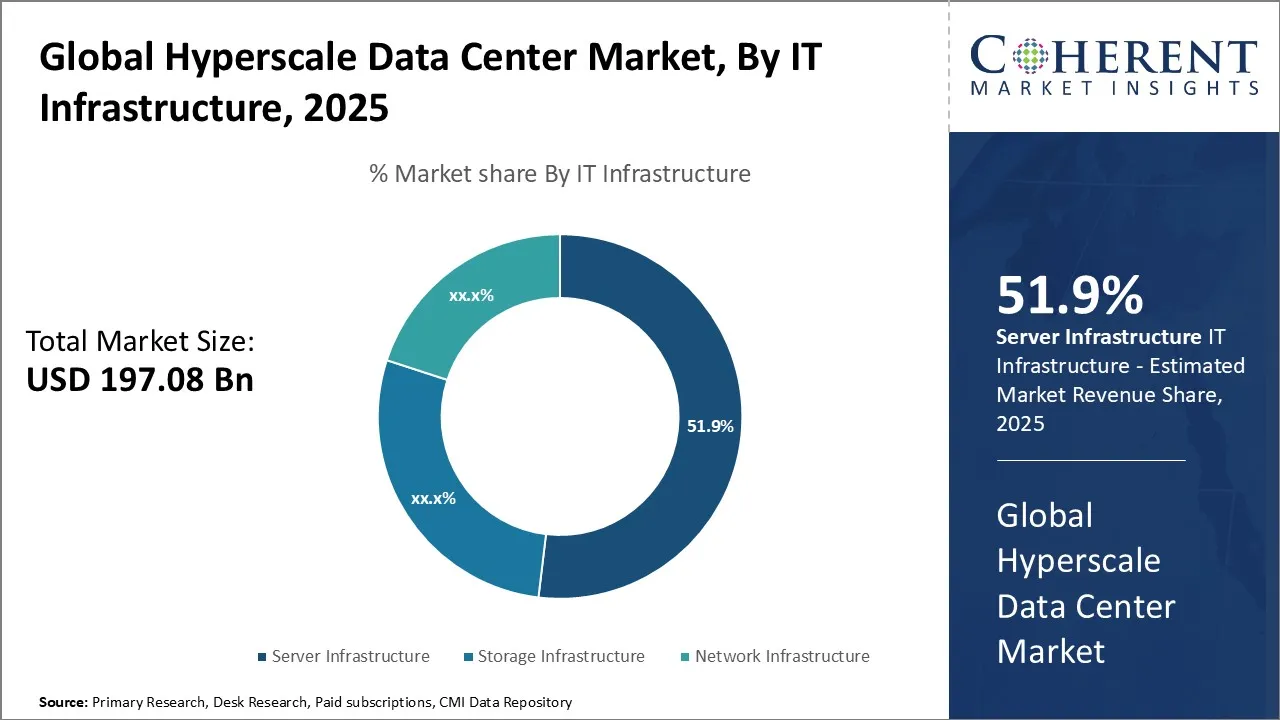
Global Hyperscale Data Center Market Insights, By IT Infrastructure - Server Infrastructure Dominance Is Driven by Continuous Innovations and Advanced Storage Integration
In terms of IT infrastructure, the server infrastructure segment is expected to dominate the global market with 52.9% share in 2026, attributed to the constant innovations by market vendors driving the adoption of various infrastructure components for server infrastructures. Modern server systems come with internal storage components that can be equipped with SSDs or HDDs or even both. These infrastructures have various advantages, and with increasing innovations adoption of server infrastructure is increasing, which is expected to propel growth of the segment.
For instance, in September 2025, Microsoft launched Fairwater, the world's most powerful AI datacenter, which has the latest server technology. Each rack has 72 NVIDIA GB200 GPU-powered servers, CPUs, memory, and exabyte-scale storage, giving it more computing power than ever before. This hyperscale facility shows how new technologies in server infrastructure are helping data centers grow around the world in 2025.
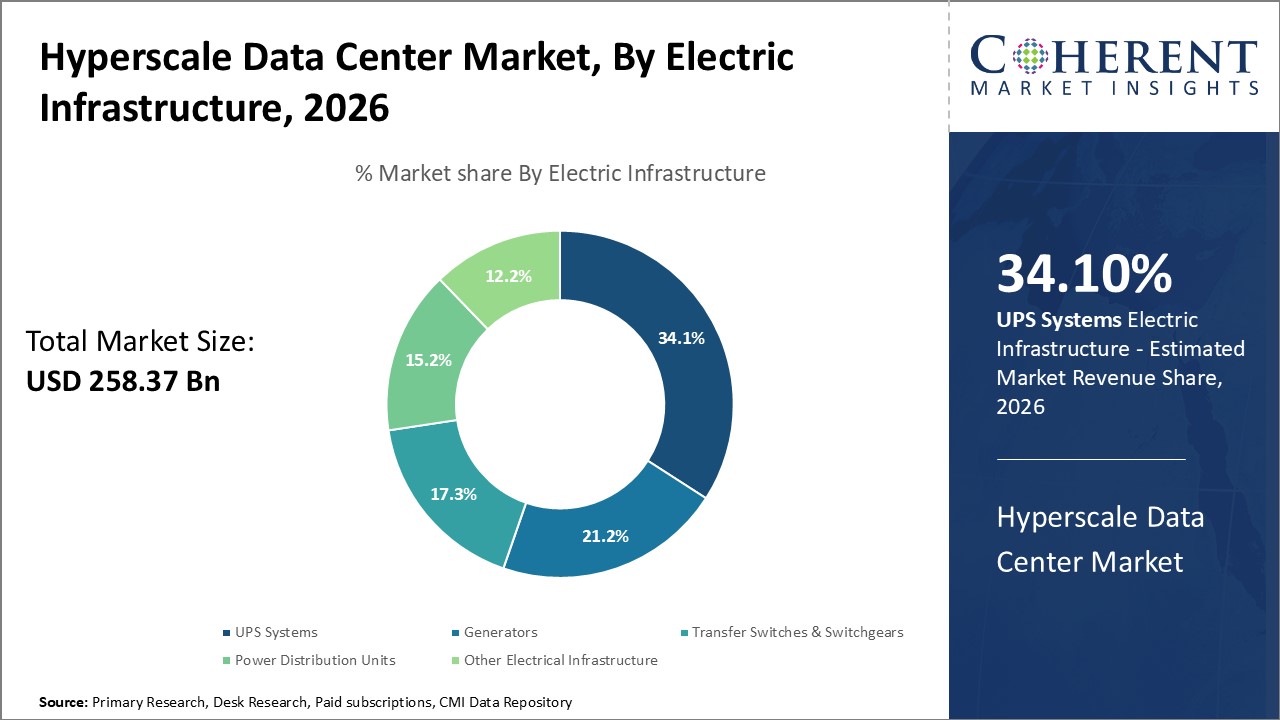
Global Hyperscale Data Center Market Insights, By Electric Infrastructure - UPS Systems Lead Is Driven by VRLA And Lithium-Ion Battery Adoption with Innovative Vendor Solutions
In terms of electric infrastructure, the UPS systems segment is expected to dominate the global market in 2026, with largest share. This is attributed to the rise in adoption of VRLA battery-powered systems that are being complemented by the procurement of lithium-ion batteries. Vendors are introducing various UPS solutions, which is further driving adoption of these systems. This in turn is likely to aid in growth of this segment.
For instance, in October 2026, ON.energy launched a groundbreaking medium-voltage UPS system designed for AI-driven hyperscale data centers. The solution enhances grid stability while ensuring uninterrupted power for GPU-intensive workloads. By integrating VRLA and lithium-ion battery technologies, the innovation addresses rising energy demands.
Global Hyperscale Data Center Market Insights, By Mechanical Infrastructure - Cooling Systems Dominance Is Driven by Innovations Enhancing Efficiency and Reducing Power Use
Based on mechanical infrastructure, the cooling systems segment is expected to dominate the global market over the forecast period and this is attributed to the increasing innovations in cooling systems for improved operational efficiency and decreasing consumption of power in hyperscale data center facilities. The demand for cooling systems is thus increasing all over the world, which is expected to support growth of this segment.
For instance, in September 2026, Schneider Electric released a new line of liquid cooling products for hyperscale data centers. These products are meant to meet the growing energy needs of AI and high-density workloads. The solutions help the company run more efficiently, use less power, and reach its sustainability goals.
Global Hyperscale Data Center Market Insights, By General Construction - Core & Shell Development Dominates Through Streamlining Processes and Saving Time and Costs
In terms of general construction, the core & shell development segment is expected to dominate the global market over the forecast period and this is attributed to the many benefits of core and shell development method for the construction process. This method speeds up the design and builds process in general by defining the core and shell elements of the building first, with the fittings to be determined at a later point. This allows progress to be made in the construction of other portions of the building while long-lead items for the core and shell are being designed, saving the project time and money.
For instance, in August 2025, Etix completed building the core and shell of a 28MW hyperscale data center in Bangkok, Thailand. The milestone shows how effective the core and shell method is, as it allows for faster construction times and lower costs by allowing interior fit-outs to happen later.
Regional Insights
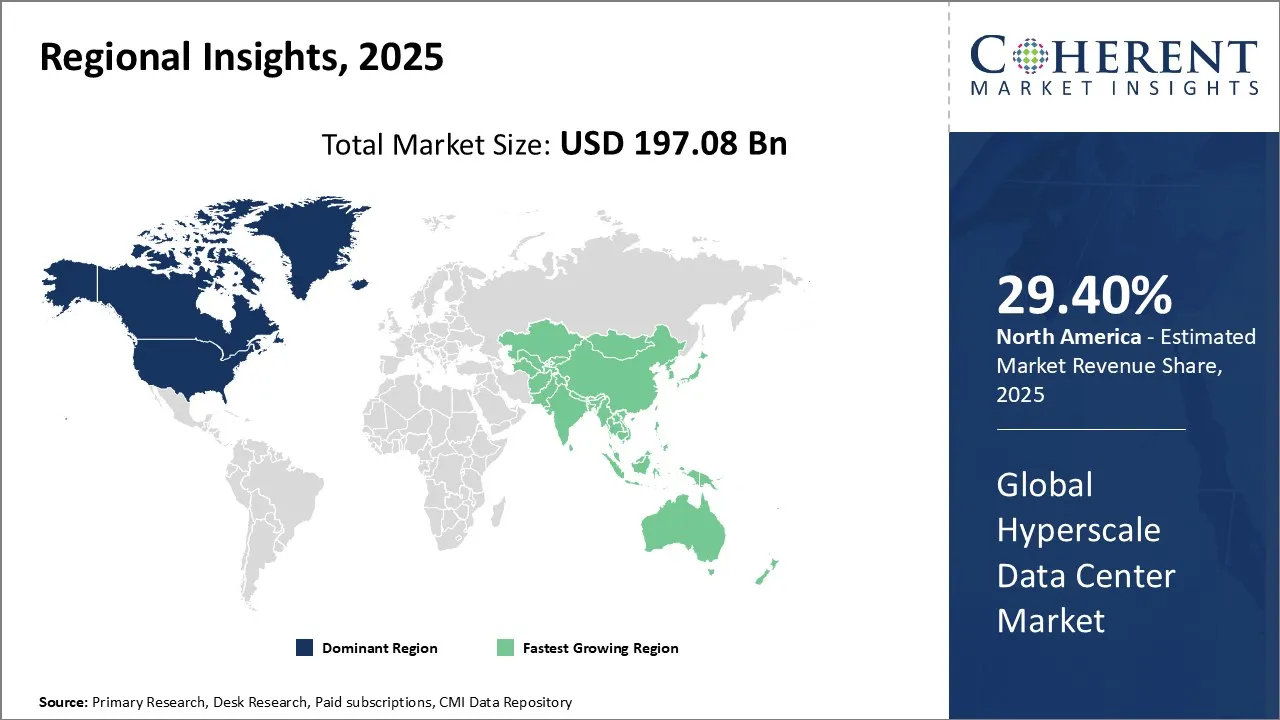
North America Hyperscale Data Center Market Analysis & Trends
North America is projected to show strong growth in the global hyperscale data center market with 29.4% share in 2026. The growth of this can be attributed to presence of major companies such as SanDisk Corporation, Cisco Systems, Inc. in the region. Among with this, rise in large firms with their global expansion through collaborations and product launch is also driving growth of the market in this region.
In December 2026, BluWave-ai released the Data Center Autopilot™ from Canada. This platform is meant to lower operating costs and make the electricity grid work better for big buildings. The solution improves energy efficiency and supports AI-driven workloads in hyperscale data centers. It meets the growing demand for power while also promoting sustainability in North America's rapidly growing digital infrastructure market.
Asia Pacific Hyperscale Data Center Market Analysis & Trends
Asia Pacific is projected to be the fastest growing region, owing to the fast growth of the cloud, 5G networks, and digital transformation projects in China, India, and Singapore. The demand for hyperscale investments in the region is growing on account of more people using the internet, more people shopping online, and workloads driven by AI. At the same time, government-backed digital infrastructure projects and efforts to be more environmentally friendly speed up these investments.
For instance, in December 2026, Vantage Data Centers opened a 16MW hyperscale facility in Kuala Lumpur, Malaysia. This represents an important leap forward for Southeast Asia's digital infrastructure. The new site is meant to handle the increased need for AI workloads and cloud services.
Hyperscale Data Center Market Outlook Country-Wise
The U.S. Hyperscale Data Center Market Trends
By 2026, the U.S. hyperscale data center market is booming owing to the growing need for AI workloads, cloud growth, and digital transformation projects. Providers have been investing a lot of funding into scalable, energy-efficient infrastructure since vacancy rates are at an all-time low and power needs are going up. This growth makes the U.S. the world leader in hyperscale development.
For instance, in December 2026, Google is building a new hyperscale data center in the US that functions on fossil fuels but uses advanced carbon capture technology to release almost no emissions. The project shows how new ideas for sustainability are changing hyperscale infrastructure, balancing the huge energy needs of AI and cloud workloads with being good to the environment in 2026.
China Hyperscale Data Center Market Trends
In 2026, China's hyperscale data center market is expected to expand quickly as more individuals are using the cloud, AI is spreading, and the government is supporting digital infrastructure projects. Chinese companies like Alibaba, Tencent, and Huawei are growing to meet the needs of businesses and consumers. China is a world leader in hyperscale development because it invests an extensive amount of assets and comes up with new ways to use energy.
For instance, in August 2026, Rolls-Royce released a new data center engine in China to help the country's hyperscale market grow swiftly. The advanced power solution is meant to provide reliable, scalable energy for large facilities that need it in response to the growing demand from AI and cloud workloads. This move shows the significance China is becoming in the development of global hyperscale infrastructure.
Market Report Scope
Hyperscale Data Center Market Report Coverage
| Report Coverage | Details | ||
|---|---|---|---|
| Base Year: | 2025 | Market Size in 2026: | USD 258.37 Bn |
| Historical Data for: | 2020 To 2024 | Forecast Period: | 2026 To 2033 |
| Forecast Period 2026 to 2033 CAGR: | 31.1% | 2033 Value Projection: | USD 1,719.75 Bn |
| Geographies covered: |
| ||
| Segments covered: |
| ||
| Companies covered: | Aecom, DPR Construction, Holder Construction, Jacobs, M+W Group (Exyte), Bouygues Construction, Mercury, Arup, and Benthem Crouwel Architects | ||
| Growth Drivers: |
| ||
| Restraints & Challenges: |
| ||
Global Hyperscale Data Center Market Drivers
Increase in adoption of cloud services to boost market growth
Large organizations around the world are increasingly inclining towards cloud solutions for organizing the work on cloud platforms. Different business sectors such as IT & Telecommunication, BFSI, consumer goods & retail, government, manufacturing, and healthcare are adopting cloud computing. In IT sector the adoption of cloud computing is growing for management and storing data. Thus, the demand for hyperscale data center in turn is likely to increase in the coming future, which is expected to propel growth of the global hyperscale data center market over the forecast period.
Rise in adoption of Big Data & IoT to fuel the market pace
Growing speed of internet along with rising number of internet users is leading to large amount of data being produced and growing penetration of social media with time. Many industries such as BFSI, healthcare, hospitality, and education are witnessing rise in amount of data generated, owing to technological developments as well as initiatives of digital transformation. Moreover, the fast development of data traffic can be attributed to the Internet of Things (IoT). These factors are therefore driving the need for hyperscale data centers. Thus, the market is anticipated to show substantial growth in the near future.
Global Hyperscale Data Center Market Opportunities
Rise in adoption of Artificial Intelligence on data center infrastructure to create substantial growth opportunities in the global hyperscale data center infrastructure market over the forecast period. Several countries around the world have begun to adopt AI for various operations. Liquid cooling is the highly adopted cooling technology utilized in High-Performance Computing (HPC) in data centers for supporting AI and ML workloads. As a result, with increasing adoption of AI in data center infrastructure, the market is anticipated to witness various opportunities.
Increasing growth of rack power density is expected to produce business opportunities in the global hyperscale data center market over the forecast period. In data center designing, capacity planning, as well as cooling and power provisioning, the rack power density is one of the most important factors. The rack power density in IT equipment has increased in past few years. Due to rise in adoption of AI, Augmented and Virtual Reality, and IoT, which are compute-intensive workloads and rise in trend of cryptocurrency mining, the data storage and processing needs are growing. This in turn is creating multiple opportunities in the global hyperscale data center market during the forecast period.
Global Hyperscale Data Center Market Trends
Rising adoption of renewable energy is a growing trend
The number of colocation and hyperscale data centers is increasing with time. However, along with this, the consumption of energy in data centers has also increased majorly leading to carbon emissions. Thus, government of countries around the world are focused on initiatives to control the emissions and consumption of power by data centers through adoption of renewable energy. This trend is likely to support growth of the global hyperscale data center market during the forecast period.
Analyst Opinion (Expert Opinion)
- The global hyperscale data center market is growing quickly since there is a growing need for infrastructure that can handle cloud computing, big data analytics, and AI workloads. A increasing number of individuals are choosing hyperscale facilities over traditional enterprise data centers since these structures can handle huge computational loads efficiently while keeping costs down.
- Hardware parts like servers, storage, and networking continue to take up the majority of revenue, which shows the significance that physical infrastructure is. Facilities that can handle more power are especially important because they fit with the trend toward mid- to large-scale deployments. The solutions segment, which includes infrastructure, power and cooling, networking, storage, and services, is still the most active part of the market.
- North America is still the leader in revenue and infrastructure footprint by region. The Asia-Pacific region is one of the fastest-growing markets, thanks to more people using digital technology, moving to the cloud, and businesses needing solutions that can grow with them. Increasingly, individuals are using hybrid strategies that mix on-premises and hyperscale environments to find a balance between control, flexibility, and following the rules.
- In the future, the market is expected to grow faster as businesses, cloud providers, and tech vendors add more capacity, make their systems more energy-efficient, and set up infrastructure that is ready for AI. To be successful in this changing market over the long term, you need to do strategic planning, diversify your locations, and use sustainable, modular designs.
Speak to the analyst
Want personalized insights?
Take the findings above to one of our principal consultants, or have the report rebuilt around the segments, geographies and competitors you actually track.
Global Hyperscale Data Center Market: Key Developments
- In December 2025, Actis launched Terranova, a new hyperscale data center platform in Latin America to speed up the region's digital growth. The goal of the project is to meet the growing need for cloud services, AI workloads, and business transformation.
- In September 2025, Techno Digital has opened a 36MW AI-ready data center in Chennai, India, which is intended to improve the country's hyperscale infrastructure. The facility was built to handle workloads that require an enormous number of GPUs, and it meets the growing need for cloud services and AI. This smart investment makes Chennai a key hub in India's quickly growing digital economy.
- In January 2023, Bharti Airtel Group, a telecom giant in India in collaboration with the state government of Telangana announced to invest Rs 2, 000 crore for setting up a huge hyperscale data center in Hyderabad, Telangana.
- In April 2023, Colt Data Center Services, a leader in large enterprise data center and global hyperscale solutions announced that the construction of its fourth data center in Inzai, Japan has begun. This region is the most competitive regions of data center real estates for research, enterprise, and technology consumers.
Market Segmentation
- Global Hyperscale Data Center Market, By IT Infrastructure (Revenue, USD Bn, 2021 - 2033)
- Server Infrastructure
- Storage Infrastructure
- Network Infrastructure
- Global Hyperscale Data Center Market, By Electric Infrastructure (Revenue, USD Bn, 2021 - 2033)
- UPS Systems
- Generators
- Transfer Switches & Switchgears
- Power Distribution Units
- Other Electrical Infrastructure
- Global Hyperscale Data Center Market, By Mechanical Infrastructure (Revenue, USD Bn, 2021 - 2033)
- Cooling Systems
- CRAC & CRAH Units
- Chiller Units
- Cooling Towers, Condensers and Dry Coolers
- Economizers & Evaporative Coolers
- Other Cooling Units
- Racks
- Other Mechanical Infrastructure
- Cooling Systems
- Global Hyperscale Data Center Market, By General Construction (Revenue, USD Bn, 2021 - 2033)
- Core & Shell Development
- Installation & Commissioning Services
- Engineering & Building Design
- Fire Detection and Suppression
- Physical Security
- DCIM/BMS Solutions
- Global Hyperscale Data Center Market, By Region (Revenue, USD Bn, 2021 - 2033)
- North America
- U.S.
- Canada
- Latin America
- Brazil
- Argentina
- Mexico
- Rest of Latin America
- Europe
- Germany
- U.K.
- Spain
- France
- Italy
- Russia
- Rest of Europe
- Asia Pacific
- China
- India
- Japan
- Australia
- South Korea
- ASEAN
- Rest of Asia Pacific
- Middle East & Africa
- GCC Countries
- Israel
- Rest of Middle East & Africa
- North America
- Global Hyperscale Data Center Market: Key Companies Insights (Revenue, USD Bn, 2021 - 2033)
- Aecom
- DPR Construction
- Holder Construction
- Jacobs, M+W Group (Exyte)
- Bouygues Construction
- Mercury
- Arup
- Benthem Crouwel Architects
Sources
Primary Research Interviews
- Hyperscale Data Center Operators
- Cloud Service Providers (CSPs) – AWS, Google Cloud, Microsoft Azure (representative interviews)
- Data Center Infrastructure Manufacturers
- Power & Cooling System Integrators
- Network Hardware & Connectivity Solution Providers
- IT Infrastructure Architects
- Colocation & Managed Service Providers
- Data Center Construction & Engineering Consultants
- Others
Databases
- Bloomberg Terminal
- Thomson Reuters Eikon
- IHS Markit
- Euromonitor International
- S&P Global Market Intelligence
- Statista
- Gartner Database
- IDC Market Scape
- Others
Magazines
- Data Center Knowledge Magazine
- Data Center Dynamics (DCD) Magazine
- Network World
- CIO Magazine
- Mission Critical Magazine
- DataCenter Journal
- Others
Journals
- IEEE Transactions on Cloud Computing
- Journal of Network & Computer Applications
- ACM Digital Library
- IEEE Transactions on Sustainable Computing
- International Journal of Data Center Management
- Others
Newspapers
- Financial Times
- The Wall Street Journal
- Reuters
- Bloomberg News
- The Economic Times (for APAC insights)
- Others
Associations
- Uptime Institute
- Data Center Alliance
- The Green Grid Association
- Open Compute Project (OCP)
- Telecom Infra Project (TIP)
- AFCOM (Association for Computer Operations Management)
- Others
Public Domain Sources
- U.S. Department of Energy (DOE) – Data Center Energy Reports
- International Energy Agency (IEA) – Digitalization & Energy
- European Commission – Digital Infrastructure & Energy Efficiency
- World Bank Open Data
- National Institute of Standards and Technology (NIST)
- Energy Star Data Center Program
- Others
Proprietary Elements
- CMI Data Analytics Tool
- Proprietary CMI Existing Repository of Information for the Last 8 Years
*Definition: Hyperscale data centers are massive, centralized facilities operated by large technology companies. They support a wide range of services from cloud computing to big data analytics and storage. They also require enormous amounts of electrical power to run their servers and cooling systems.
Get access to 250+ pages report
Every segment, forecast, competitor profile and data table behind the analysis above — available for instant download.
- ESOMAR Member
- ISO 9001:2015 Certified
- D-U-N-S Registered
- GDPR & CCPA Compliant
Missing comfort of reading report in your local language? Find your preferred language:
Transform your Strategy with Exclusive Trending Reports
Frequently Asked Questions
The Hyperscale Data Center Market is estimated to be valued at USD 258.37 Bn in 2026, and is expected to reach USD 1,719.75 Bn by 2033.
The CAGR of the Hyperscale Data Center Market is projected to be 31.1% from 2026 to 2033.
Increase in adoption of cloud services and rise in adoption of Big Data & IoT are fuelling the growth of market.
The Server Infrastructure segment is the leading component segment in the market.
Rise in carbon emissions and security concerns of data centers are the major factors restraining growth of the market.
Aecom, DPR Construction, Holder Construction, Jacobs, M+W Group (Exyte), Bouygues Construction, Mercury, Arup, and Benthem Crouwel Architects