

Digital Lending Market Size and Trends - 2026 to 2033
Global digital lending market is estimated to be valued at USD 19.86 Bn in 2026 and is expected to reach USD 43.64 Bn by 2033, exhibiting a compound annual growth rate (CAGR) of 11.9% from 2026 to 2033.
Key Takeaways
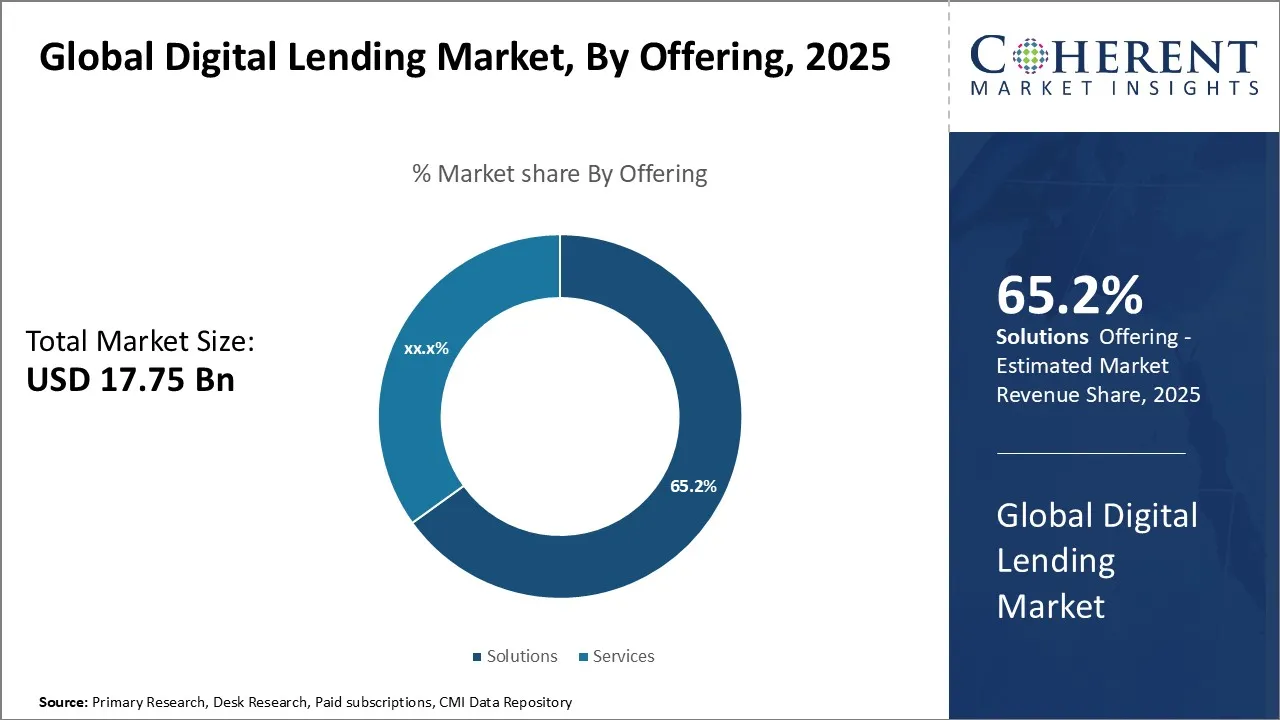
- Based on Offering, the Solution segment is expected to dominate the market with 66.2% share in 2026, due to growing demand for digital and automated lending platforms.
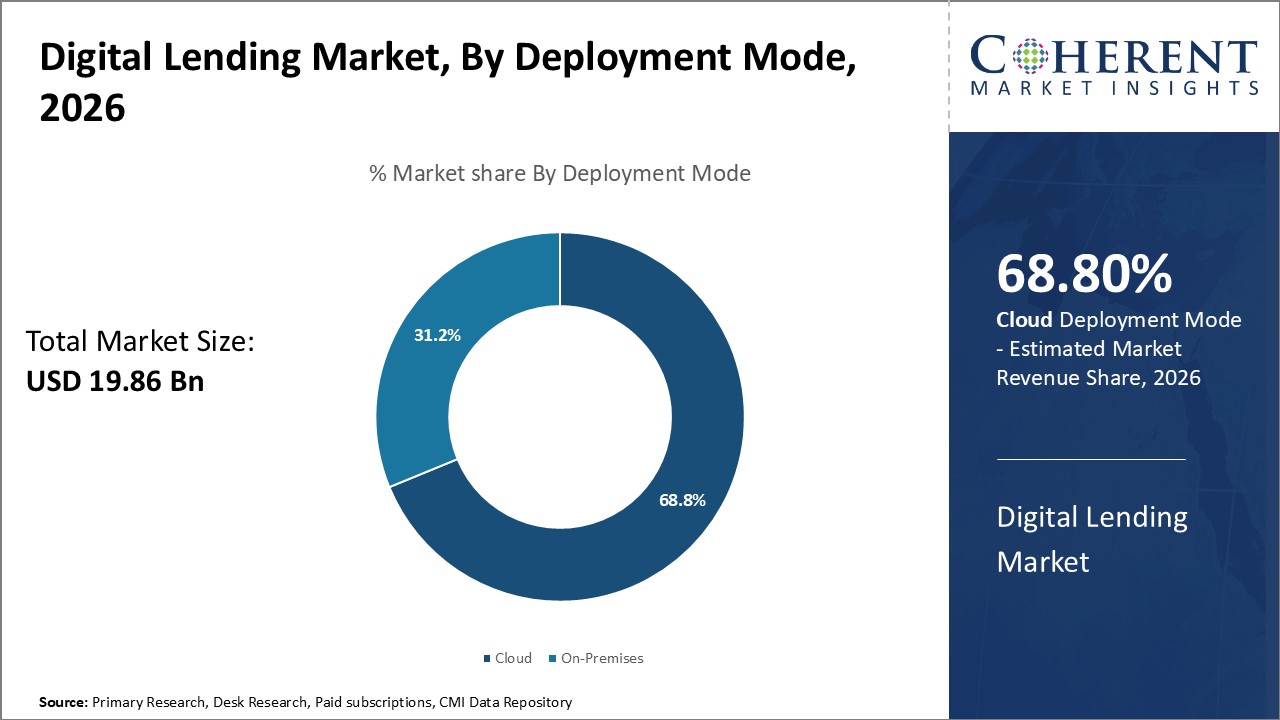
- Based on Deployment Mode, the Cloud segment is expected to capture the largest share of the market in 2026, driven by its superior flexibility, scalability, and cost-efficiency
- Based on End User, the Banks segment is projected to account for 70.6% share in 2026, due to their size, footprint, and resources.
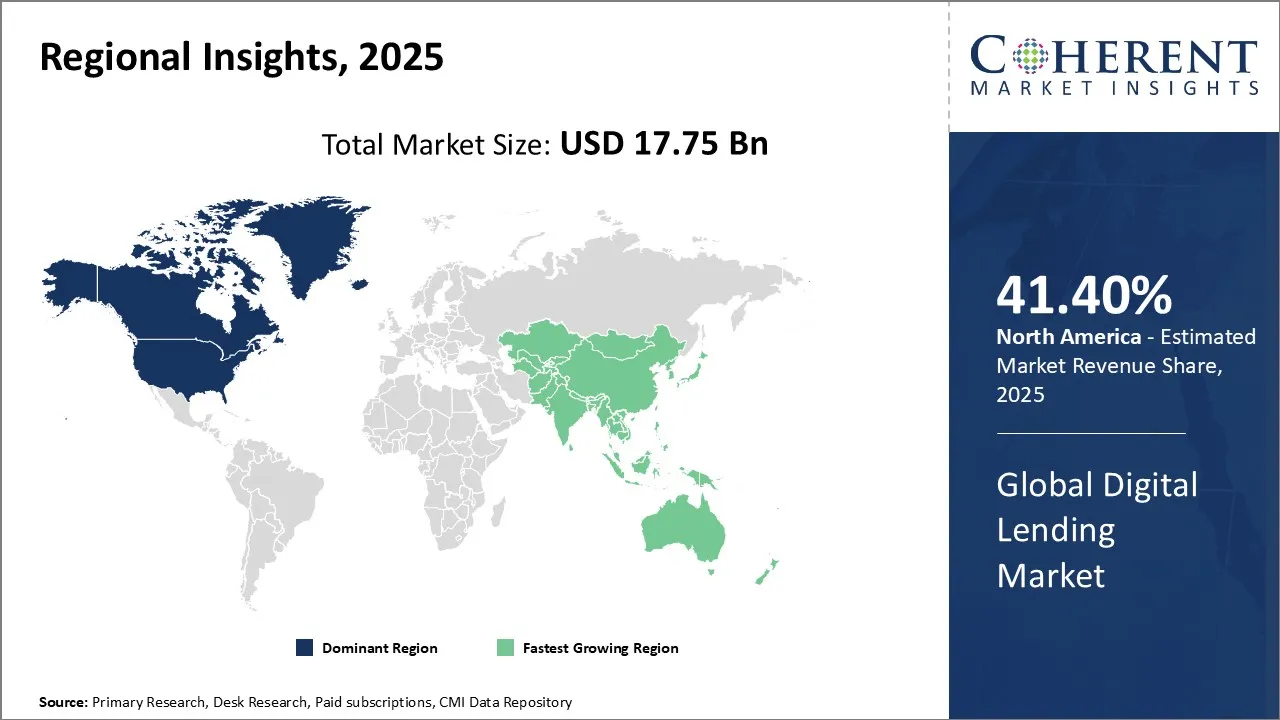
- Based on Region, North America is set to lead the digital lending market with 41.4% share in 2026. While, Asia Pacific is anticipated to be the fastest growing region.
Market Overview
Rising adoption of digital lending platforms for personal loans, business loans, and other financial services can drive the market growth. Consumers find digital lending platforms more convenient and easier to use as compared to traditional options as these provide faster loan approval and disbursals. These platforms help financial institutions to improve their credit underwriting and risk management.
Using advanced analytics helps understand customer risk better. By investing more in artificial intelligence and machine learning, online lending platforms are likely to become even more popular. Innovative businesses are leveraging these platforms to access credit and fulfill their financial needs easily.
Current Events and Its Impacts on the Digital Lending Market
Current Event | Description and its Impact |
Regulatory and Compliance Shifts in Key Regions |
|
Macroeconomic Instability and Credit Environment |
|
Role of Artificial Intelligence (AI) in Digital Lending Market
In 2025, artificial intelligence (AI) transforms the digital lending market by making the whole credit lifecycle faster, more accurate, and more personalized. AI-driven algorithms make the loan origination process easier by automatically collecting data and scoring credit in real time. This speeds up approvals and lowers operational costs. Machine learning models examine huge amounts of data, including non-traditional data like utility payments and social behavior, to determine creditworthiness. This makes it easier for people who do not possess access to credit to get it.
Chatbots and virtual assistants that use AI help customers by answering their questions right away. On the other hand, predictive analytics help collections by lowering the number of defaults. As rules change, AI may assist to stay in compliance by processing documents smartly and keeping an eye on risks. As the economy becomes more digital, AI gives lenders the tools they need to offer smarter, more inclusive, and scalable loans.
For instance, in October 2025, Intellect Design Arena released PF Credit, an AI-first lending suite that aims to change the way digital lending works. PF Credit is based on its Purple Fabric platform and has five smart agents that handle loan origination, underwriting, servicing, operations, and collections. Banks and other financial institutions can expect faster onboarding, fewer NPAs, and better customer service with this solution.
- Current Industry Events of 2026
- Market Size Estimation
- Regional Breakdown
- Competitive Landscape
- Customer Intelligence
- Segmental Analysis
- Pricing Analysis
- Key Market Drivers, Challenges & Future Trends
- Customized Insights Section
Segmental Insights
Digital Lending Market Insights, By Offering - Rise of Digitization Boosts Demand for Digital Lending Solutions
In terms of offering, solutions segment is estimated to contribute the highest share of the market owing 66.2% in 2026 due to growing demand for digital and automated lending platforms. As financial institutions aim to offer seamless digital experiences to their customers, there is increased focus on implementing innovative lending solutions. Various factors such as the proliferation of smartphones and growing Internet penetration have accelerated the shift towards digitization of financial services.
Customers now expect banking services to be online and on-the-go. Moreover, with rising security and privacy concerns regarding data stored online, lending solutions equipped with advanced technologies like blockchain and biometrics are gaining traction.
For instance, by 2026, public sector banks are expected to be ready to launch PSB Xchange, a single digital platform that will allow it possible to lend ₹3 lakh crore. The goal of the initiative is to make it easier to get credit by combining data sources and automating lending processes. This is a big step forward for India's digital lending infrastructure and efforts to include more people in the financial system.
Digital Lending Market Insights, By Deployment Mode - Cloud Deployment Dominance is Due to Its Scalability, Flexibility, And Cost-Efficiency
In terms of deployment mode, cloud segment is estimated to contribute the highest share of the market in 2026, driven by its superior flexibility, scalability, and cost-efficiency. Increasingly, financial institutions, from major financial institutions to new fintech companies, are using cloud solutions to make their operations more efficient, cut down on infrastructure costs, and speed up innovation.
Cloud platforms make it easy to connect with other digital services, allow access to data in real time, and improve the customer experience by processing loans quicker and offering personalized services. This significant shift is part of a larger trend in the industry toward digital-first, agile strategies that put efficiency, responsiveness, and long-term growth first.
For instance, in June 2024, Salesforce launched its Digital Lending for India platform, built on Financial Services Cloud, to streamline loan origination and underwriting. The cloud-native solution integrates Aadhaar, KYC, and employment verification, offering scalable, secure, and efficient lending operations. It supports mobile and branch channels, aiming to accelerate digital transformation across India’s financial services sector.
Digital Lending Market Insights, By End User - Banks Lead Digital Lending Adoption Owing to Size and Resources
In terms of end user, banks segment is estimated to contribute the highest share of 70.6% in 2026 of the market due to their size, footprint, and resources. Large banks have been quick to adopt digital lending capabilities to offer customized and competitive products. Their scale enables investments into developing advanced platforms and integrating innovative technologies.
Also, banks do business in many different areas, which helps them get a full picture of their customers. This helps them make personalized online loans and use data to predict what is going to occur.
For instance, in November 2025, Newgen and Mambu released a plug-and-play digital lending stack which is developed for banks and other financial institutions. The combined solution includes Newgen's Loan Origination System and Mambu's core banking platform. This makes it possible to fully automate the lending process. It supports retail, small and medium-sized businesses, mortgages, and Islamic banking. It also has cloud-native, AI-enabled features that make digital lending faster, more compliant, and more scalable.
Regional Insights
North America Digital Lending Market Anakysis & Trends
North America has established itself as the dominant region with 41.4% share in the digital lending market in 2026. Countries like the U.S. and Canada have widely adopted different digital lending solutions for both consumers and businesses. This is due to there are numerous of large financial institutions and fintech companies in these countries. The region's advanced technology and high internet usage make it easy to lend money online.
For instance, in June 2026, Fusion Credit Union in Canada teamed up with VeriPark to make modifications to both their CRM and Loan Origination System (LOS) at the same time. The goal of the project is to make lending easier and get more members involved by combining customer relationship management with automated loan processing. This is an important move toward modernizing the credit union's digital lending capabilities.
Asia Pacific Digital Lending Market Anakysis & Trends
Asia Pacific region has emerged as the fastest growing digital lending market globally. Several developing countries in South and Southeast Asia are experiencing exponential economic growth and witnessing a massive rise in internet and smartphone users each year. Countries such as India, Indonesia, and the Philippines are attracting huge investments from global fintech players looking to tap into the region's demographic dividends.
For instance, in November 2026, Ant International released bettr, a credit tech platform that aims to make digital lending accessible in Asia and other developing markets. The solution includes built-in finance, risk assessment, and loan management tools that let financial institutions and platforms offer credit services that can grow and are powered by technology. Ant's credit innovations have already helped more than 30 million people.
Digital Lending Market Outlook Country-Wise
The U.S. Digital Lending Market Trends
The U.S. digital lending market is doing well as there is an abundance of demand for quick, flexible credit and many people are using mobile banking. Fintech innovation, AI-driven underwriting, and open banking frameworks make it possible to approve loans faster and give each customer a unique experience. The rapid growth of digital lending solutions is also helped by clear rules and a well-developed financial system.
For instance, in October 2026, EXL has been recognized in the industry for its innovative work in digital lending, especially in point-of-sale financing. The company was honored for using AI and advanced analytics to speed up credit decisions and improve the buying experience for customers. This award shows that EXL is a leader in changing lending in the U.S. market with digital solutions that are based on real-time data.
India Digital Lending Market Trends
The digital lending market in India is growing swiftly considering a greater number of people are using smartphones, the fintech ecosystem is growing, and government-backed programs like Jan Samarth and Digital India are helping. Digital platforms offer faster loan approvals, wider reach, and better financial inclusion in both urban and rural areas because there are a lot of people who do not possess bank accounts and more people want instant, paperless credit.
For instance, in November 2026, the Startup Common Application Journey is now available on the Jan Samarth Portal from India's Department of Financial Services. This lets startups apply for loans online from all Public Sector Banks. The platform combines data from PAN, GST, and credit bureaus to make it easier to get credit up to ₹20 crore. Women entrepreneurs get special benefits.
Market Report Scope
Digital Lending Market Report Coverage
| Report Coverage | Details | ||
|---|---|---|---|
| Base Year: | 2025 | Market Size in 2026: | USD 19.86 Bn |
| Historical Data for: | 2020 To 2024 | Forecast Period: | 2026 To 2033 |
| Forecast Period 2026 to 2033 CAGR: | 11.9% | 2033 Value Projection: | USD 43.64 Bn |
| Geographies covered: |
| ||
| Segments covered: |
| ||
| Companies covered: | Abrigo, ARGO, Black Knight, Built Technologies, BNY Mellon, Cu Direct, Decimal Technologies, Docutech, EdgeVerv, Finastra, FIS, Fiserv, HES Fintech, ICE Mortgage Technology, Intellect Design Arena, JurisTech, Newgen Software, Nucleus Software, Oracle, Pega, Roostify, RupeePower, SAP, Sigma Infosolutions, Symitar, Tavant, TCS, Temenos, Turnkey Lenders, Wipro, Wizni | ||
| Growth Drivers: |
| ||
| Restraints & Challenges: |
| ||
Digital Lending Market Driver
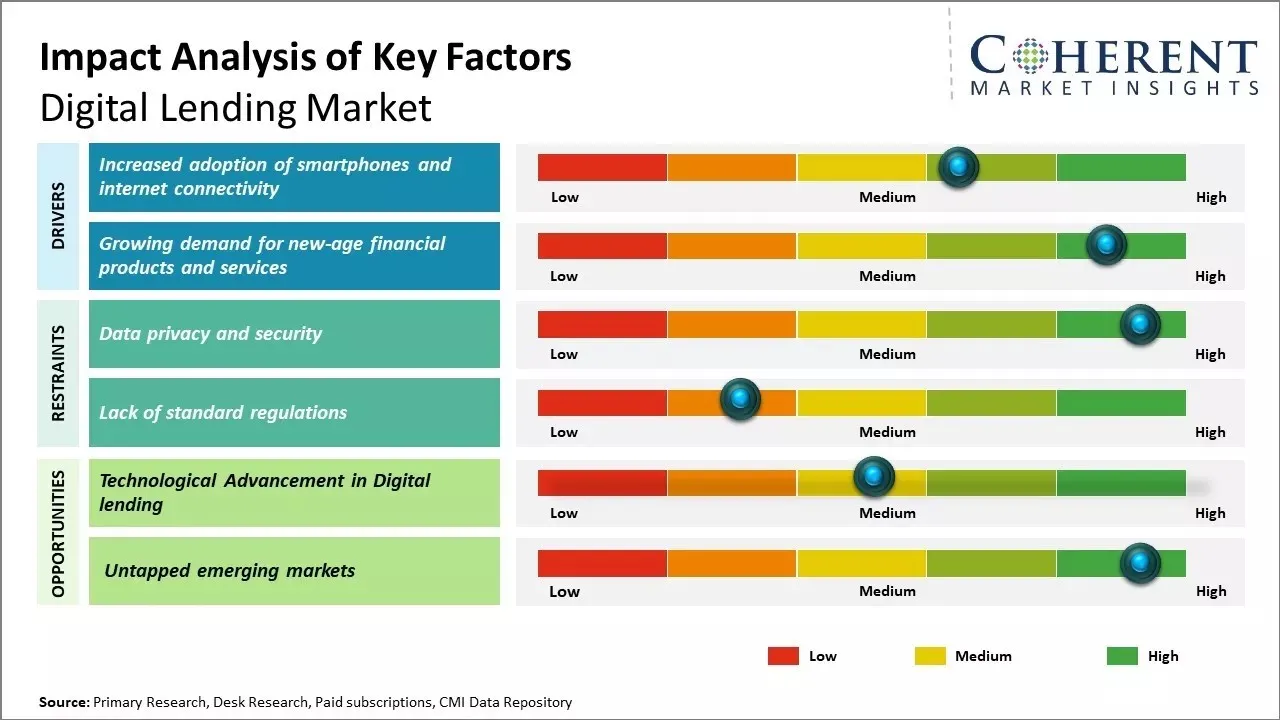
Increased adoption of smartphones and internet connectivity
Due to rapid growth of smartphone users and internet connectivity across both developed and developing economies, there has been huge demand for digital lending services. The number of people accessing the internet through their smartphones has increased exponentially in the last 5 years alone. Smartphones are now less expensive and even the most basic models can run a number of lending apps. This has made it possible for millions of people who were unable to obtain formal banking before to now get quick and easy loans on their phones.
The widespread availability of high-speed 4G networks makes digital lending more popular. People can now apply for loans from home or work without having to go to a bank branch. This is an immense additional for customers who need money quickly for unplanned costs. This digital change has also helped lenders as it lets them reach a lot more customers at a lower cost than traditional methods.
Growing demand for new-age financial products and services
With rising aspirations and changing lifestyles, there is a rising requirement for more customized and specialized financial solutions catering to diverse needs. Needs which were previously fulfilled through informal avenues or not addressed at all. The rigidity of traditional banks in terms of eligibility, documentation and turnaround times does not permit them to offer differentiated products at large scale. However, digital lending platforms have stepped in to fill this void with new-age solutions.
There has been huge demand for small-ticket personal loans for purposes like funding hobbies, one-time expenses, vacations and others. Millennials want instant credit solutions to shop online without having to use savings. New businesses need working capital or inventory funding at short notice to cater to spikes in demand. Digital lenders have designed loan programs tailored for each segment after thoroughly understanding their profile and risk appetite. Furthermore, their use of alternate data sets and new-age analytical models have enabled approval of loans to customers who would otherwise be rejected by banks. This shift towards a more inclusive and customized model of lending is driving the market growth.
Digital Lending Market Opportunity
Technological Advancement in Digital lending
As technology makes the lending process simpler, quicker and more convenient for borrowers, there has been rising demand for digital lending. Removal of physical branches allows for streamlined operations and lower overhead costs. Data analytics further expand access to credit by helping lenders better evaluate risk for more customer groups, driving strong momentum in the digital lending market forecast globally.
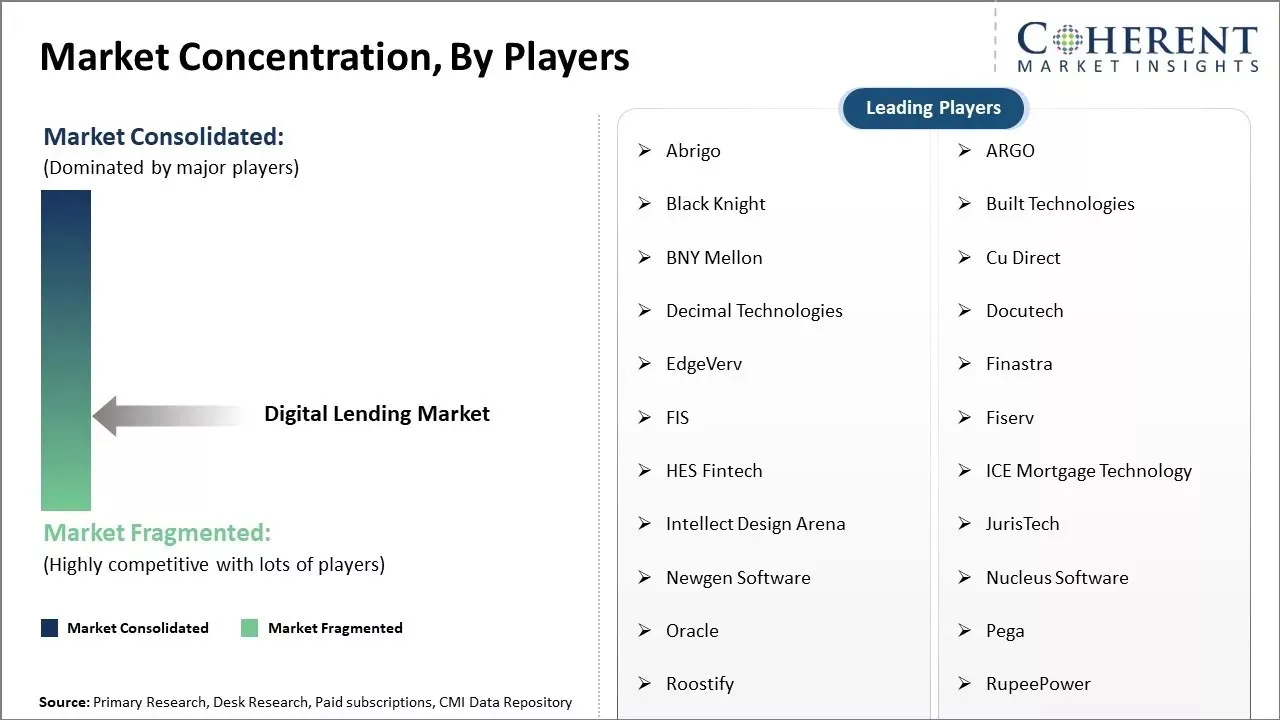
Market Concentration and Competitive Landscape
Analyst Opinion (Expert Opinion)
The digital lending market value is experiencing rapid expansion, driven by technological adoption, financial inclusion, and shifting consumer behavior. AI, machine learning, and cloud-based platforms are increasingly deployed to enhance underwriting, fraud detection, and operational efficiency, enabling lenders to scale rapidly and reduce costs.
Digital lending is significantly expanding access to credit, particularly in emerging markets. In India, fintech NBFCs sanctioned over 10 crore personal loans worth ₹1,06,548 crore in FY 2024–25, demonstrating how digital platforms reach underserved segments. Consumer adoption is also accelerating: in the U.S., digital channels are expected to account for over 60% of personal loan originations by 2025, with products such as buy‑now-pay-later gaining popularity.
However, risks persist. Rapid credit growth may increase default rates, and regulatory frameworks are still evolving in many regions. Operational challenges, including fraud prevention and KYC compliance, remain critical. Economic volatility could further pressure digital lenders, especially for high-frequency small loans.
Overall, the digital lending market presents a compelling growth opportunity, but sustainable expansion will depend on robust risk management, regulatory alignment, and technological sophistication to ensure secure, scalable, and inclusive credit access.
Speak to the analyst
Want personalized insights?
Take the findings above to one of our principal consultants, or have the report rebuilt around the segments, geographies and competitors you actually track.
Digital Lending Industry News
- In November 2025, Super.Money is a new fintech platform from Flipkart that offers Buy Now, Pay Later (BNPL) and UPI-based credit products. The service combines lending with e-commerce to offer instant credit at checkout. It is aimed at India's digital-first consumers. This move makes Flipkart's presence in the digital lending space stronger and supports people who do not have access to traditional credit through embedded, tech-driven credit solutions.
- In November 2025, VersaBank, a digital bank in Canada, started a new CMHC lending program for institutional borrowers. There should not be excessive operating costs, and the project should bring in at least CAD 2 million more in revenue in fiscal 2026. VersaBank continues to expand in the tech-driven mortgage lending space by using its digital infrastructure.
- In August 2023, The Reserve Bank of India (RBI) announced its plans to launch a new pilot project for digital lending on a public technology platform aimed at providing 'frictionless credit.' The platform is being developed by the Reserve Bank Innovation Hub (RBIH), a subsidiary owned solely by the central bank.
- In August 2023, Biz2X, a leading digital lending software-as-a-service (SaaS) platform under Biz2Credit, partnered with TruBoard, a prominent company specializing in asset performance management through the Maadhyam platform. The partnership aims to tackle the growing concern of Non-Performing Assets (NPAs) in retail and small business loans.
Market Segmentation
- Offering Insights (Revenue, USD Bn, 2026 - 2033)
- Solutions
- Services
- Deployment Mode Insights (Revenue, USD Bn, 2026 - 2033)
- Cloud
- On-Premises
- End User Insights (Revenue, USD Bn, 2026 - 2033)
- Banks
- Credit Unions
- NBFCs
- Regional Insights (Revenue, USD Bn, 2026 - 2033)
- North America
- U.S.
- Canada
- Latin America
- Brazil
- Argentina
- Mexico
- Rest of Latin America
- Europe
- Germany
- U.K.
- France
- Italy
- Russia
- Rest of Europe
- Asia Pacific
- China
- India
- Japan
- Australia
- South Korea
- ASEAN
- Rest of Asia Pacific
- Middle East & Africa
- GCC Countries
- South Africa
- Rest of Middle East & Africa
- North America
- Key Players
- Abrigo
- ARGO
- Black Knight
- Built Technologies
- BNY Mellon
- Cu Direct
- Decimal Technologies
- Docutech
- EdgeVerv
- Finastra
- FIS
- Fiserv
- HES Fintech
- ICE Mortgage Technology
- Intellect Design Arena
- JurisTech
- Newgen Software
- Nucleus Software
- Oracle
- Pega
- Roostify
- RupeePower
- SAP
- Sigma Infosolutions
- Symitar
- Tavant
- TCS
- Temenos
- Turnkey Lenders
- Wipro
- Wizni
Sources
Primary Research Interviews
- Banking & Financial Institutions Executives
- Digital Lending Platform Providers
- Fintech Solution Developers
- Credit Risk Analysts
- Others
Databases
- Bloomberg Terminal
- Thomson Reuters Eikon
- S&P Capital IQ
- CB Insights
- Crunchbase
- Others
Magazines
- Forbes Finance
- The Banker
- Finextra
- Banking Technology Magazine
- PaymentsSource
- Others
Journals
- Journal of Banking & Finance
- International Journal of Financial Studies
- Finance Research Letters
- Journal of Financial Services Research
- Others
Newspapers
- Financial Times
- The Wall Street Journal
- Reuters
- Bloomberg News
- Economic Times (India)
- Others
Associations
- Financial Services Information Sharing and Analysis Center (FS-ISAC)
- FinTech Association of Hong Kong
- European FinTech Association
- National Automated Clearing House Association (NACHA)
- Others
Public Domain Sources
- World Bank Open Data
- International Monetary Fund (IMF)
- U.S. Federal Reserve
- Bank for International Settlements (BIS)
- Government Financial Statistical Offices
- Others
Proprietary Elements
- CMI Data Analytics Tool
- Proprietary CMI Existing Repository of Information for the Last 8 Years
Definition: Digital lending market enables lending organizations to simplify, automate and digitize their lending processes using technologies like artificial intelligence, machine learning, cloud computing, blockchain and big data analytics. This allows lenders to quickly assess loan applications, verify identities, assess credit risks, customize loan offers and enable seamless disbursements and collections through digital platforms. The digital lending solution helps lenders improve lending operations, reduce costs and risks while enhancing customer experience through a fully digitized lending lifecycle.
Get access to 250+ pages report
Every segment, forecast, competitor profile and data table behind the analysis above — available for instant download.
- ESOMAR Member
- ISO 9001:2015 Certified
- D-U-N-S Registered
- GDPR & CCPA Compliant
Missing comfort of reading report in your local language? Find your preferred language:
Transform your Strategy with Exclusive Trending Reports
Frequently Asked Questions
The Digital Lending Market is estimated to be valued at USD 19.86 Bn in 2026, and is expected to reach USD 43.64 Bn by 2033.
The CAGR of the Digital Lending Market is projected to be 11.9% from 2026 to 2033.
Increased adoption of smartphones and internet connectivity and growing demand for new-age financial products and services are the major factors driving the growth of global digital lending market.
Data privacy and security and lack of standard regulations are the major factors hampering the growth of global digital lending market.
In terms of offering, solutions segment is estimated to dominate the market in 2026.
Abrigo, ARGO, Black Knight, Built Technologies, BNY Mellon, Cu Direct, Decimal Technologies, Docutech, EdgeVerv, Finastra, FIS, Fiserv, HES Fintech, ICE Mortgage Technology, Intellect Design Arena, JurisTech, Newgen Software, Nucleus Software, Oracle, Pega, Roostify, RupeePower, SAP, Sigma Infosolutions, Symitar, Tavant, TCS, Temenos, Turnkey Lenders, Wipro, Wizni are the major players.
North America is expected to lead the global digital lending market in 2026.