

Racing Drones Market Size and Trends
The global racing drones market is estimated to be valued at USD 259.6 Mn in 2026 and is expected to reach USD 866.9 Mn by 2033, exhibiting a compound annual growth rate (CAGR) of 18.8% from 2026 to 2033.
Key Takeaways
- Based on Drone Type, RTF segment is expected to lead the market holding an estimate share of 44.7% in 2026.due to tis simplest option of newcomers and casual flyers.
- Based Application, Rotor Cross segment is projected to dominate with a share of 48.2% in 2026 due to its fast-paced and dynamic racing format.
- Based Region, North America is estimated to lead the market a share of 42.9% in 2026 owing to a strong presence of companies. While, Asia Pacific is considered to be the fastest growing during the forecast period due to presence of tech-savvy youth population.
Market Overview
The global racing drones market is expected to witness considerable growth over the forecast period. The market is driven by the increasing popularity of drone racing as an appealing recreational and competitive sport. Drone racing provides enhanced user experience over traditional remote-controlled vehicles owing to first person view and thrilling racer perspective through onboard cameras. Manufacturers are focusing on developing high-performance racing drones with advanced features such as obstacle detection, follow-me, and autonomous flying. Integration of artificial intelligence and computer vision technologies will further augment the racing capabilities of drones.
Current Events and Its Impact
Current Events | Description and its Impacts |
Geopolitical Supply Chain Realignments |
|
Market Expansion and Competitive Pressures |
|
Role of Artificial Intelligence on the Racing Drones Market
The integration of artificial intelligence into racing drones is enhancing its capabilities and reducing the issues faced with manual operation. AI into racing drone is reducing the need for human involvement by allowing UAV drones to fly independently. Through this approach, drones can successfully accomplish the mission, avoid obstacles and map safe routes with the help of advance computer systems and onboard sensors. This will overall enhance the racing drone’s autonomy, intelligence, and decision-making abilities, encouraging the modern drones to execute progressively complex tasks with remarkable efficiency.
In April 2025, The Abu Dhabi Autonomous racing Leagues (A2RL), part of Advanced technology research Council (ATRC), collaborated with the Drone Champions Leagues (DCL), conducted a A2Rl X DCL Autonomous Drone Championship in the Middle East. The team MavLab’s AI drone outpaced a world-leading human pilot to win the AI vs Human Challenge.
- Current Industry Events of 2026
- Market Size Estimation
- Regional Breakdown
- Competitive Landscape
- Customer Intelligence
- Segmental Analysis
- Pricing Analysis
- Key Market Drivers, Challenges & Future Trends
- Customized Insights Section
Pricing Analysis of Racing Drones (FPV Drones)
DIY Builds: Budget-Friendly Options
Micro Racing Drone (USD 120): A compact build suitable for indoor racing, featuring components like the BetaFPV 1S 5A F4 flight controller, BetaFPV M03 VTX, and Newbie Drone 0802 motors.
5" Racing Drone (USD 230): A mid-sized drone ideal for outdoor racing, utilizing components such as the Source One V5 frame, T-Motor Velox 2207 motors, and SpeedyBee F405 V4 flight controller.
These builds offer performance at a fraction of the cost of pre-built models, making them attractive for hobbyists and those new to the sport.
Pre-Built Drones: Ready-to-Fly Kits
DJI FPV Combo: Priced at $999, this kit includes the drone, DJI FPV Goggles V2, and a controller, offering a comprehensive package for immersive flying experiences.
iFlight Nazgul5 V2: A popular choice among racers, this drone is known for its durability and performance, typically priced around $300.
Segmental Insights
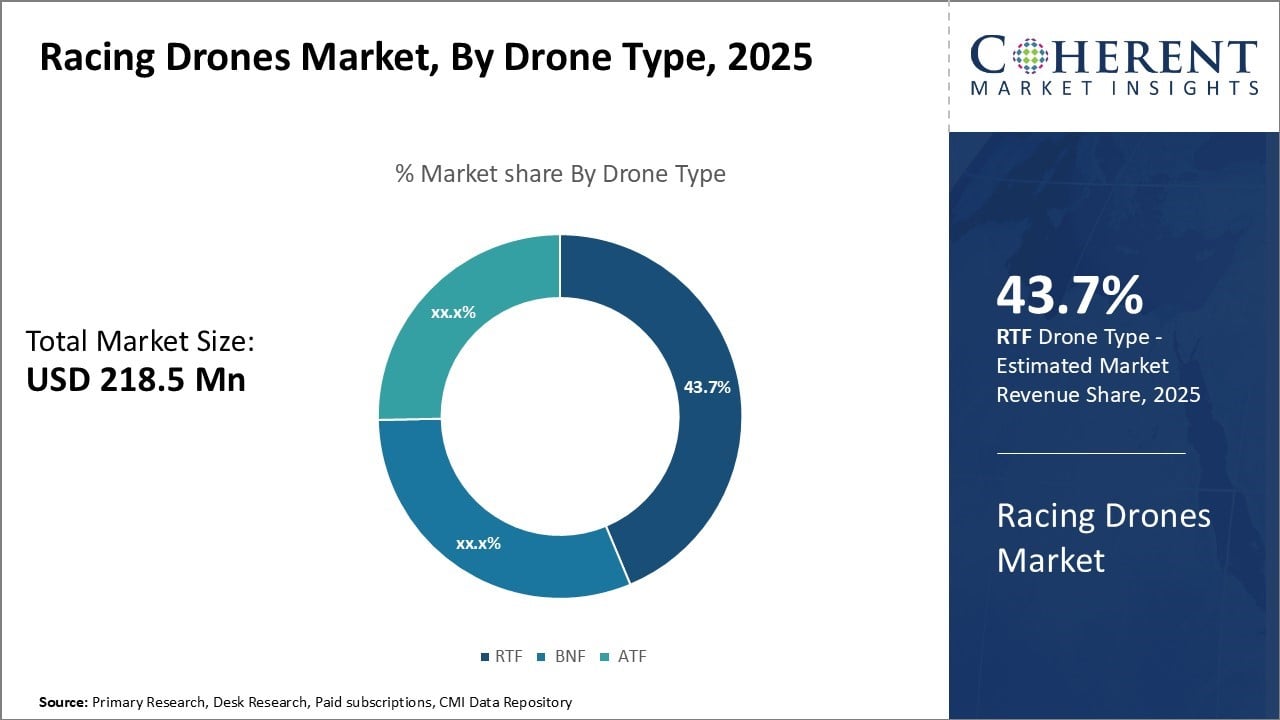
Racing Drones Market Insights, By Drone Type: RTF Contributes the Highest Share of the Market Owing to Its Ease of Use and Affordability For Beginners
RTF (Ready-to-Fly) segment is expected to dominate the global racing drones market share, accounting for 44.7% of the market share in 2026 as it is the simplest option for newcomers and casual flyers. RTF drones come fully assembled and ready for flight right out of the box. Pilots do not need to spend time assembling components or configuring transmitters, allowing them to get in the air faster. This reduces the initial learning curve and makes RTF drones attractive to those just starting in the hobby.
Their packaged nature also helps keep prices lower compared to build-it-yourself options like Bind-N-Fly (BNF) and Almost-Ready-To-Fly (ATF) drones. Being more affordable enables more budget-conscious consumers and casual recreational flyers to enter the market. The ease of use and lower upfront investment has helped expand the overall size of the racing drones user base globally.
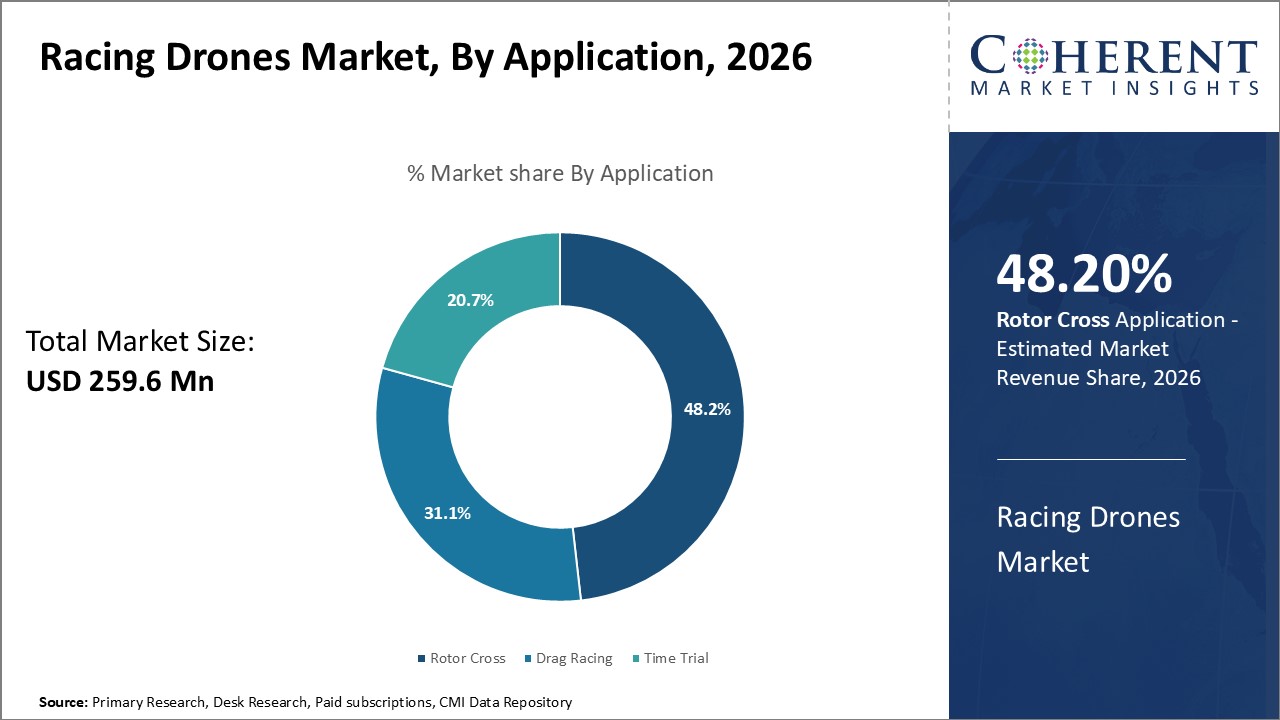
Racing Drones Market Insights, By Application: Rotor cross contributes the highest share of the global racing drones market based on application due its fast-paced and dynamic racing format
Based on application, rotor cross is expected to account for 48.2% of the market share in 2026. In rotor cross, up to four drone pilots race head-to-head through an obstacle course featuring gates and banners at high speeds. Pilots must navigate tight turns and precise flying through the course in the shortest time to win heats.
Rotor cross racing provides an exciting spectacle for both pilots and spectators. Its fast-paced, frenetic style through the course captures viewers' attention. In contrast to more drawn-out time trials, rotor cross delivers an immediate outcome as the first pilot to cross the finish line is declared the victor. This intensity and suspense have contributed to rotor cross' growth in popularity.
Regional Insights
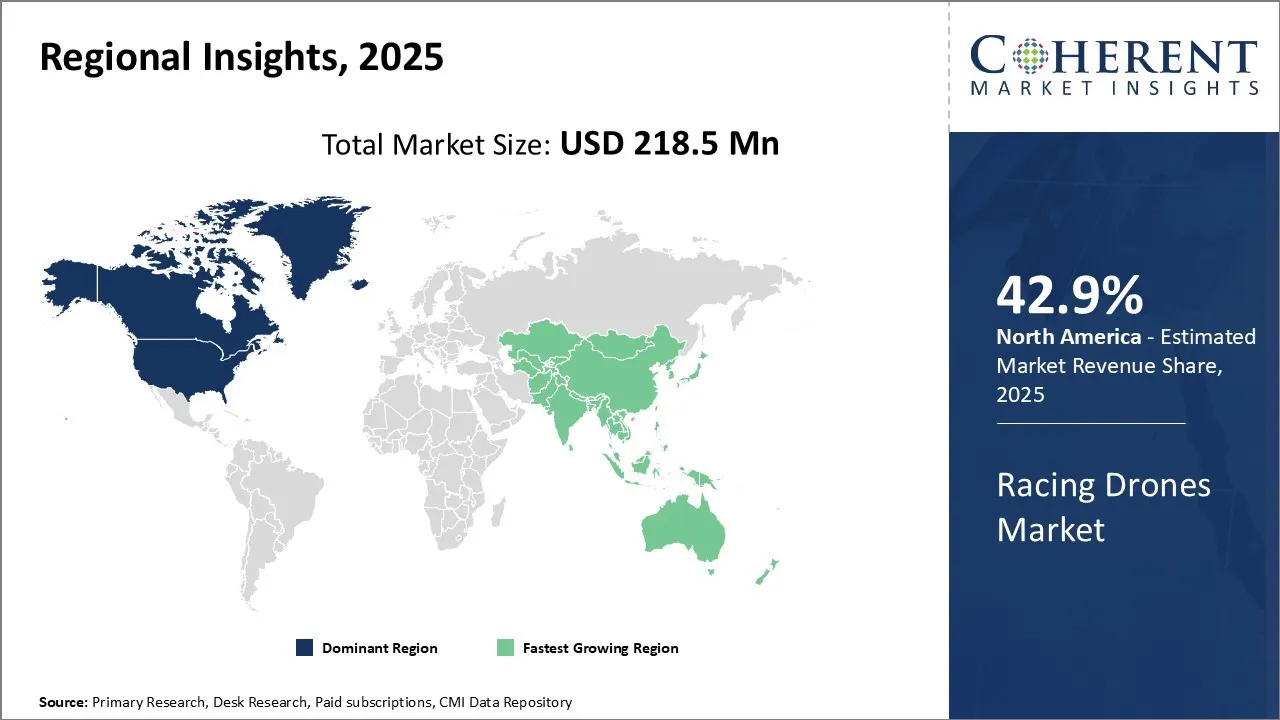
North America Racing Drones Market Analysis and Trends
North America holds the largest share of the global racing drones market. The region is expected to account for 42.9% of the market share in 2026. Currently, North America dominates the global racing drones market owing to a strong presence of companies based in the region. The leading racing drones companies in North America includes Skydio and AeroVironment, they focus on autonomous drones and develop unmanned aerial vehicles for military and commercial applications. The North America has over 1,620 drone companies in total including hardware manufactures and service provides. The U.S. is home to leading drone racing companies such as DRL Simulations, which holds the successful Drone Racing League tournaments. Major investments in drone technology by the government as well as private players have created conducive environment for the growth of the racing drones market in North America.
Asia Pacific Racing Drones Market Analysis and Trends
Asia Pacific is expected to witness fastest growth over the coming years. The presence of tech-savvy youth population along with growth of drone leagues is facilitating market expansion in the region. The southeast Asia region holds the largest, tech-savvy youth population with highly adaptable to new technologies. With over 660 million people and high smartphone penetration. The popularity of racing drones in Asia Pacific region is mostly observed due to the technological advancements, particularly in FPV (First Person View) systems, and the rise of competitive events.
In March 2026, Airbus and Drones Forge teamed up to enhance the Flexrotor UAS in Asia Pacific region. This collaboration includes, acquisition of Flexrotor systems, marking a critical step towards transforming uncrewed aviation with game-changing solution and technologies designed for tactical operations.
Europe Racing Drones Market Analysis and Trends
European countries also have reasonable drone laws and regulations in place compared to other parts of the world. This provides design and manufacturing companies an opportunity to test innovative racing drone models. The European Union Aviation safety Agency (EASA) has some strict regulations which includes visual observation, flying outside urban areas, maintaining distance for 150 meters away form buildings and people, and adhering to 120-meter altitude limit. The pilot age must be at lest 16 years old and the drone must weigh 250 grams or more. This is further positively influencing the racing drones market forecast.
Racing Drones Market Outlook Country-wise
The United States Racing Drones Market Trends
The United States is the home for major leagues of racing drones such as Drone racing League (DRL) and MultiGP. The United States is increasingly demanding for racing drones is due to the growing number of individuals having hobby for FPV base, robust e-commerce network and government funding for drone STEM programs. However, the pilots are required to have FAA regulation and certification for competitions.
In May 2026, The U.S. Marine Corps established an attack drone team as an arm race with Russia to respond to the rapid development of armed first-person view (FPV) drone technology and tactics, offering a glimpse into the evolving landscape of modern warfare and how future battles could be fought.
China Racing Drones Market Trends
Under Asia Pacific region, China is the leading ground for major drone manufacturing players including EMAX, DJI and iFlight. China mainly benefits from the local production of racing drones. China being the largest supplier of civilian drones, marking an output value exceeding 200 billion yuan by 2026. Another factor that drives the market is China is its innovation drone components in areas such as stealth, energy efficiency and AI-powered swarm technology.
In May 2026, Chinese researchers have developed a new algorithm that lets first-person-view (FPV) drones perform autonomous aerobatic maneuvers better than those by veteran human operators during flight missions.
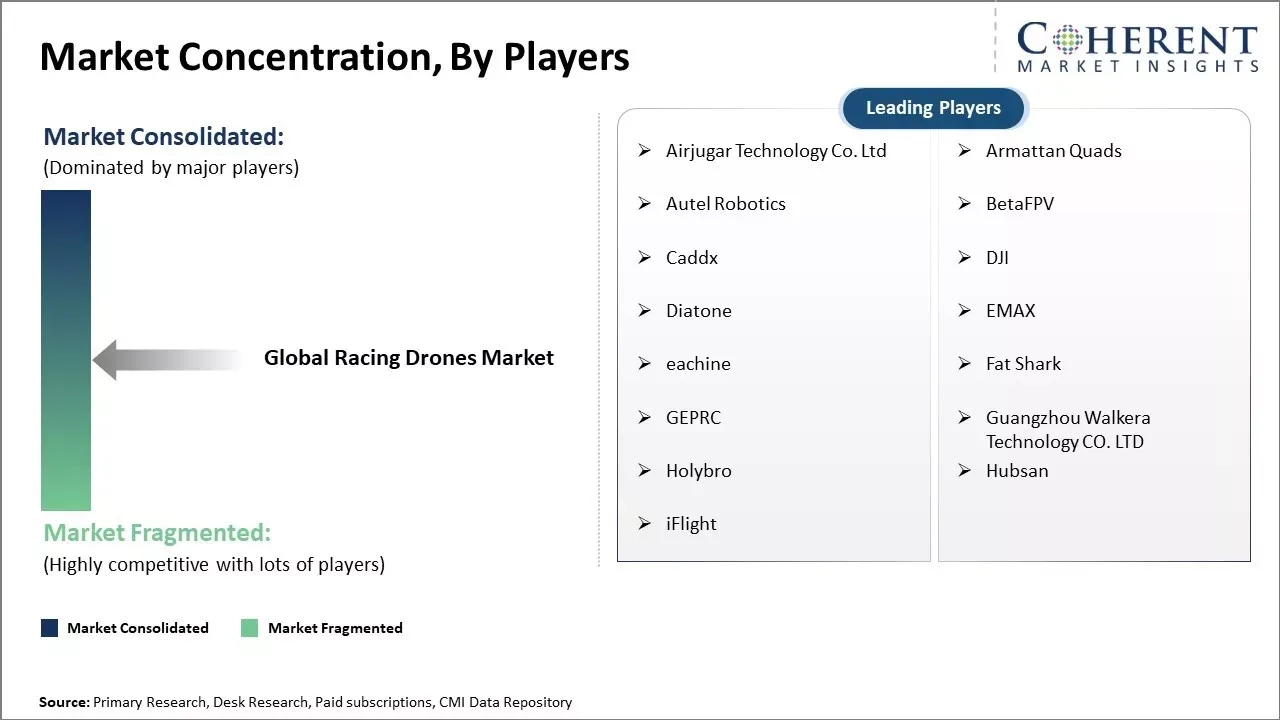
Market Concentration and Competitive Landscape
Key Developments
- In May 2025, RAF Chinook launched an groundbreaking development for modern warfare, the United Kingdom’s Royal Air force has successfully tested the deployment of a First-Person View drone from a CH-47 Chinook helicopter. This initiative is expected to reshape how militaries approach battlefield operations.
- In January 2025, DJI, the global leader in civilian drones and creative camera technology, launched DJI O4 Air Unit Series, a digital video transmission solution offering impressive rage, ultra-low latency, and crisp 4K/60fps video. The now launch is designed for content creation, the DJI O4 Air Unit Pro boasts an enhanced imaging capability with a 1/1.3-inch image sensor capable of recording 4K/120fps video. It is also embedded with impressive features such as a 10-bit D-Log M color mode and a 155° ultra-wide FOV1, capturing the vast expanse of the world in unparalleled detail.
- In April 2024, FAI E-Drone Racing World Cup launched the very first accessible sport with E-Drone racing World Cup. The EreaDrone 3D simulator permits designers to create a circuit around obstacles with amazing different environments, from mountains to cities, harbours to castles, and many more. The track was a closed circuit with several laps to be completed, or alternatively a track to be flown one time only. The total distance to complete during a race will be around 2-3km. The fastest pilots will be able to complete the race in just 60-90 seconds: quick reactions are everything in this exciting e-sport.
- In November 2023, DJI launched the DJI Avata, a new cinewhoop-style drone that caters to both racing enthusiasts and those seeking high-quality video capture for freestyle flying. The DJI Avata features a compact and durable design with built-in propeller guards, allowing pilots to fly aggressively through tight spaces while maintaining stability and impact resistance. Equipped with a 1/1.7-inch sensor and the ability to record 4K 60fps video, the DJI Avata delivers impressive image quality that elevates the aerial footage captured by freestyle pilots. This versatile drone strikes a balance between the performance of a racing drone and the cinematic capabilities of a professional-grade camera platform, making it an appealing choice for a wide range of FPV pilots.
- In May 2023, DJI, the world's leader in civilian drones and aerial imaging technology, launched the Matrice 350 RTK, a significant upgrade to their advanced commercial drone platform. The M350 RTK features an all-new video transmission system, more efficient battery system, and expanded payload capabilities, setting a new industry benchmark for commercial drone operations.
- In March 2023, Autel Robotics unveiled the "EVO II Pro Racing Edition Drone," a specialized model designed for the growing competitive drone racing market. This new drone features powerful, high-performance motors and advanced flight control systems that deliver improved stability and maneuverability, making it well-suited for the demanding requirements of professional drone racing.
Racing Drones Market Driver
Growing popularity of drone racing as a sport
The racing drones market has been gaining significant traction in recent years due to the growing popularity of drone racing as an organized competitive sport. What started off as just a fun hobby for drone enthusiasts to test their piloting skills through precise maneuvers at high-speed courses has now evolved into an international competitive multi-million-dollar industry. Major sporting events dedicated to drone racing are being held around the world that are attracting thousands of spectators and viewers online. The competitive and adrenaline pumping nature of drone racing has helped capture people's imagination and it is fast emerging as a mainstream spectator sport in many countries.
This rise of drone racing as an organized professional sport has caused many hobbyists and aspiring pilots to purchase specialized racing drones that are designed for high performance, endurance and precise control needed for competitive racing. These drones feature lightweight yet durable frames, powerful brushless motors that provide tremendous thrust to weight ratio, First-person view (FPV) camera systems for immersive first-person piloting experience and other performance enhancing components. Manufacturers are continuously innovating and introducing new products optimized specifically for the requirements of drone racing. The growing commercialization and popularity of drone racing as an action sport is a major driver propelling the demand for professional grade racing drones across both amateur and professional racing communities around the world.
For instance, in June 2023, Autel Robotics announced a strategic partnership with the "Drone Racing League China" (DRL China) to become the official drone provider and technical support partner for the country's premier drone racing series. This collaboration represents a significant milestone for Autel Robotics, as it solidifies the company's position as a leading player in the rapidly growing global racing drones market.
Increasing Technological Advancements
Drone technology is continuously evolving with manufacturers incorporating newer and better materials, designs, power sources, and electronics to deliver enhanced performance, functionality and experience. Areas seeing major technological improvements include computational power and algorithms for autonomous and self-stabilizing flight control, nano-coated lightweight frames and components, brushless motors with increased power to weight ratio, long range high definition FPV transmission systems, swappable modular battery solutions for longer flight times and artificial intelligence for advanced maneuvers. For instance, in May 2025, Latvian startup Origin Robotics launched BLAZE, an autonomous interceptor drone designed to destroy enemy drones by either ramming into them or detonating. BLAZE can be deployed on the battlefield in under a minute and comes in a compact briefcase that also serves as a launchpad and charging dock. Powered by computer vision, it can differentiate between aircraft and other objects like birds, using radar for precise tracking of aerial targets. This is further driving the racing drones industry.
Racing Drones Market Opportunities
Scope For Drone Racing as an Organized Professional Sport
As interest in drone technologies continues to grow among enthusiasts and the general public, drone racing can capitalize on this momentum by developing into a mainstream televised and spectator sport.
The growing popularity of drone technologies has created a captive audience that is eager to engage with the latest advancements in this field. Drone racing, with its thrilling aerial manoeuvres and the integration of cutting-edge technology, can tap into this enthusiasm and transform it into a commercially viable professional sport. The high-speed, high-stakes nature of drone racing, combined with the visual spectacle it offers, can appeal to a wide range of viewers, from tech-savvy enthusiasts to casual sports fans. Launched in 2024, the first FAI E-Drone Racing World Cup series is designed to bring newcomers and gamers into the cutting-edge world of drone racing, featuring an accessible format that makes it easy for anyone to participate. These are creating lucrative racing drones market opportunities.
Market Report Scope
Racing Drones Market Report Coverage
| Report Coverage | Details | ||
|---|---|---|---|
| Base Year: | 2025 | Market Size in 2026: | USD 259.6 Mn |
| Historical Data for: | 2020 To 2024 | Forecast Period: | 2026 To 2033 |
| Forecast Period 2026 to 2033 CAGR: | 18.8% | 2033 Value Projection: | USD 866.9 Mn |
| Geographies covered: |
| ||
| Segments covered: |
| ||
| Companies covered: | Airjugar Technology Co. Ltd, Armattan Quads, Autel Robotics, BetaFPV, Caddx, DJI, Diatone, EMAX, eachine, Fat Shark, GEPRC, Guangzhou Walkera Technology CO. LTD, Holybro, Hubsan, and iFlight | ||
| Growth Drivers: |
| ||
| Restraints & Challenges: |
| ||
Analyst Opinion (Expert Opinion)
The global racing drones market has significant growth potential driven by increasing popularity of drone racing as a competitive sport. Drone racing is attracting audiences worldwide and organized professional racing leagues are helping establish standardized rules and guidelines. Technological advancements in drone design have enhanced flying capabilities and made drones more maneuverable for racing purposes. Lithium-ion battery technology is enabling longer flight times allowing for longer and more competitive races.
However, regulations around drone usage differ widely in different parts of the world which can pose a challenge to the growth of international racing events and leagues. Safety concerns also remain a restraint especially with amateurs new to racing drones. High performance racing drones also tend to be more expensive which limits the addressable market size. Availability of open spaces suitable for racing is another factor that drone sports organizers need to contend with.
North America presently dominates the global racing drones market owing to the presence of major drone manufacturers and growing popularity of drone racing as a spectator sport in the region. Drone racing is expected to see increased participation in Asia Pacific as standardization efforts by racing organizations help make the sport more organized and accessible. Emerging markets like South America and Middle East also offer untapped growth opportunities for drone racing considering their young demographics profiles receptive to novel forms of entertainment.
Speak to the analyst
Want personalized insights?
Take the findings above to one of our principal consultants, or have the report rebuilt around the segments, geographies and competitors you actually track.
Market Segmentation
- Drone Type Insights (Revenue, US$ Mn, 2021 - 2033) (Revenue, USD Mn, 2021 - 2033)
- RTF
- BNF
- ATF
- Application Insights (Revenue, US$ Mn, 2021 - 2033) (Revenue, USD Mn, 2021 - 2033)
- Rotor Cross
- Drag Racing
- Time Trial
- Regional Insights (Revenue, US$ Mn, 2021 - 2033) (Revenue, USD Mn, 2021 - 2033)
- North America
- U.S.
- Canada
- Latin America
- Brazil
- Argentina
- Mexico
- Rest of Latin America
- Europe
- Germany
- U.K.
- Spain
- France
- Italy
- Russia
- Rest of Europe
- Asia Pacific
- China
- India
- Japan
- Australia
- South Korea
- ASEAN
- Rest of Asia Pacific
- Middle East & Africa
- GCC Countries
- Israel
- South Africa
- Rest of Middle East & Africa
Key Players Insights
- Airjugar Technology Co. Ltd
- Armattan Quads
- Autel Robotics
- BetaFPV
- Caddx
- DJI
- Diatone
- EMAX
- eachine
- Fat Shark
- GEPRC
- Guangzhou Walkera Technology CO. LTD
- Holybro
- Hubsan
- iFlight
Sources
Primary Research Interviews from the following stakeholders
Stakeholders
- Interviews with racing drone manufacturers, FPV (First Person View) component suppliers, drone assemblers, flight controller developers, and battery technology providers.
- Conversations with drone racing league organizers, competitive pilots, training academy heads, and drone park managers across North America, Europe, Asia-Pacific, and the Middle East.
- Interviews with representatives from drone retail chains, e-commerce platforms, and drone repair service providers.
Specific stakeholders
- Heads of product development at racing drone OEMs (e.g., T-Motor, EMAX, iFlight)
- Professional drone racing pilots and league participants (e.g., from DRL, MultiGP)
- Procurement managers at electronics and hobby retailers (e.g., HobbyKing, GetFPV, Banggood)
- Organizers of drone racing events at sports venues and academic institutions
- Directors at UAV training centers and drone pilot certification programs
- Battery R&D engineers focusing on high-discharge lithium-polymer (LiPo) technologies
- Firmware and flight controller developers (e.g., Betaflight, Cleanflight, INAV contributors)
Databases
- World Trade Organization (WTO) Trade Statistics
- UN Comtrade Database
- U.S. Federal Aviation Administration (FAA) UAS Registration Data
- European Union Aviation Safety Agency (EASA) Drone Operations Data
- Directorate General of Civil Aviation (DGCA), India – UAS & RPAS Statistics
- China Customs Statistics
- Japan Civil Aviation Bureau (JCAB) UAV Sector Reports
- Korea Customs Service Data Portal
Magazines
- RotorDrone Pro
- DroneLife
- Inside Unmanned Systems
- UAV Digest
- DroneDJ
- Make: Magazine (Drone & DIY Tech Section)
- HackSpace Magazine (FPV and Racing Drone Projects)
- FPV Drone Pilots Community Digest
Journals
- IEEE Transactions on Robotics and Automation
- Journal of Field Robotics
- Journal of Unmanned Vehicle Systems
- Drones (MDPI)
- IEEE Access – UAV and Aerial Systems Section
- International Journal of Micro Air Vehicles
Newspapers
- The Wall Street Journal – Tech & Mobility
- The Economic Times – Drone Industry and Startups
- Nikkei Asia – UAV & Robotics Coverage
- South China Morning Post – Emerging Tech (Drone Startups)
- The Hindu Business Line – Electronics & UAV Innovations
- Financial Times – Mobility and Aerospace Sections
Associations
- Drone Racing League (DRL) – Official Rules & Pilot Registry
- MultiGP Drone Racing League
- Association for Uncrewed Vehicle Systems International (AUVSI)
- Academy of Model Aeronautics (AMA)
- European UAV Association
- Asia Drone Federation
- Federal Aviation Administration (FAA) UAS Integration Office
- Indian Drone Racing Association (IDRA)
Public Domain Sources
- Ministry of Civil Aviation (India) – Drone Ecosystem Reports
- Federal Aviation Administration (FAA), U.S. – UAS Safety Reports
- U.S. Department of Transportation (DOT) – Advanced Mobility Data
- Ministry of Industry and Information Technology (MIIT), China
- Japan Ministry of Economy, Trade and Industry (METI) – Robotics and Drones
- European Commission – Drone Strategy 2.0
- Reserve Bank of India – Electronics and Startups Sector Reports
- Invest India – Drone Industry Insights
Proprietary Elements
- CMI Data Analytics Tool, and Proprietary CMI Existing Repository of information for last 8 years
*Definition: The global racing drones market consists of drones that are designed and optimized specifically for high-speed racing. These drones come equipped with powerful brushless motors, lightweight carbon fiber frames, GPS stabilization and tracking systems, FPV camera systems, and other features that enable rapid flight speeds exceeding 100 kph. The global racing drones market caters to enthusiasts who enjoy controlling drones in competitive racing environments and pushes the limits of drone technology for speed and maneuverability. Racing drones have become a popular extreme sport worldwide.
Get access to 250+ pages report
Every segment, forecast, competitor profile and data table behind the analysis above — available for instant download.
- ESOMAR Member
- ISO 9001:2015 Certified
- D-U-N-S Registered
- GDPR & CCPA Compliant
Missing comfort of reading report in your local language? Find your preferred language:
Transform your Strategy with Exclusive Trending Reports
Frequently Asked Questions
The Racing Drones Market is estimated to be valued at USD 259.6 Mn in 2026, and is expected to reach USD 866.9 Mn by 2033.
The CAGR of the Racing Drones Market is projected to be 18.8% from 2026 to 2033.
Growing popularity of drone racing as a sport and increasing technological advancements are the major factors driving the growth of the global racing drones market.
Regulatory policies and restrictions on drone usage and high technical expertise required for drone racing are the major factors hampering the growth of the global racing drones market.
In terms of drone type, RTF is estimated to dominate the market revenue share in 2026.
Airjugar Technology Co. Ltd, Armattan Quads, Autel Robotics, BetaFPV, Caddx, DJI, Diatone, EMAX, eachine, Fat Shark, GEPRC, Guangzhou Walkera Technology CO. LTD, Holybro, Hubsan, and iFlight are the major players.
In terms of drone type, RTF is estimated to dominate the market revenue share in 2026.