

Smart Glass Market Analysis & Forecast: 2026 to 2033
Smart Glass Market is estimated to be valued at USD 8.65 Bn in 2026 and is expected to reach USD 17.40 Bn in 2033, exhibiting a compound annual growth rate (CAGR) of 10.5% from 2026 to 2033.
Key Takeaways
- Based on Technology, the Electrochromic (EC) segment is expected to lead the market with 84.8% share in 2026, driven by energy efficiency and automotive visibility control.
- Based on Application, the architectural segment is projected to account for the largest share of the market in 2026, driven by energy-efficient building demands and green construction standards.
- Based on Region, North America is set to lead the smart glass market with 32% share in 2026. While, Asia Pacific is anticipated to be the fastest growing region.
Market Overview
The global smart glass market is projected to grow at a strong pace during the forecast period. This growth is primarily driven by the growing applications of smart glasses in building & construction, automotive, aerospace, and renewable energy plants, among others. The increasing demand for smart glasses in these regions will create lucrative opportunities for the industry players during the forecast period.
Current Events and Its Impacts on the Smart Glass Market
Current Event | Description and its Impact |
Automotive Industry Electrification and Regulatory Push |
|
Energy Efficiency Regulations and Green Building Standards |
|
Role of Artificial Intelligence (AI) in Smart Glass Market
AI is a crucial factor in the smart glass market as it makes advanced automation, personalization, and efficiency possible. AI improves transparency and tinting in buildings and cars based on the weather, which saves energy and makes people more comfortable. AI makes real-time translation, navigation, gesture recognition, and contextual overlays possible for smart glasses wearables. This turns them into intelligent assistants.
AI-powered smart glasses help people in fields like healthcare, manufacturing, and skilled trades by giving them hands-free instructions, diagnoses, and safety alerts. This makes them more productive and accurate. AI is not just an extra; it is a driving force behind new ideas and growth in the global smart glass market.
For instance, in November 2025, Zuper released the first smart glasses with AI that are made for skilled trades. They were shown off in Seattle. The new glasses use cutting-edge AI technology to help workers with safety, productivity, and real-time guidance. This is an immense step forward in wearable technology that will help the construction, maintenance, and industrial sectors with practical, hands-free augmented support.
- Current Industry Events of 2026
- Market Size Estimation
- Regional Breakdown
- Competitive Landscape
- Customer Intelligence
- Segmental Analysis
- Pricing Analysis
- Key Market Drivers, Challenges & Future Trends
- Customized Insights Section
Segmental Insights
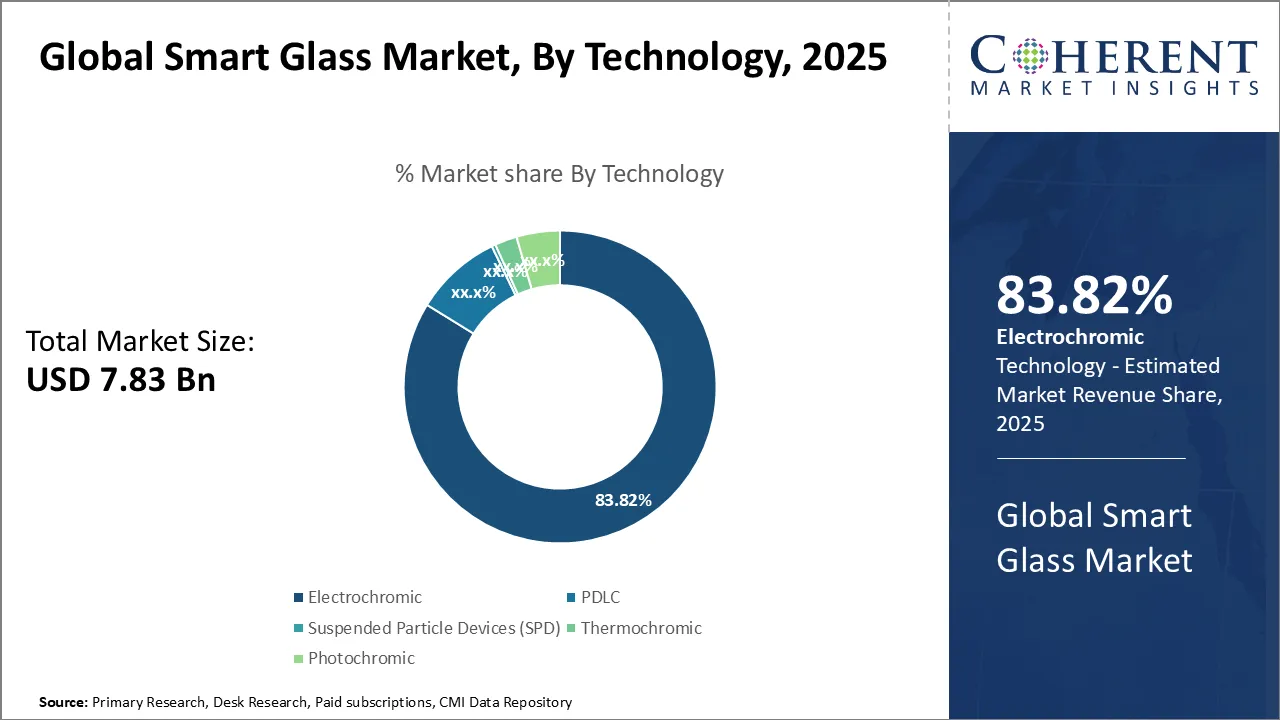
Global Smart Glass Market Insights, By Technology: Electrochromic Dominance Is Driven by Energy Efficiency and Automotive Visibility Control
In terms of technology, the Electrochromic segment is expected to dominate the global market with 84.8% in 2026. Electrochromic (EC) are the most commonly used smart glass technologies. These smart glass products can change their light transmission properties based on external stimuli, such as heat and electricity. They can also be used to regulate the amount of sunlight a room receives, which may help reduce air conditioning costs and glare from the sun, and they are increasingly being used in vehicles to control the level of visibility for safety reasons.
For instance, in March 2025, Argotec and Miru released the largest electrochromic sunroof window in the automotive industry, marking a big step forward in the development of smart glass. The breakthrough shows that greater numbers of cars are using electrochromic technology, which allows passengers to control sunlight, glare, and heat in real time to make the ride more comfortable, safe, and energy-efficient.
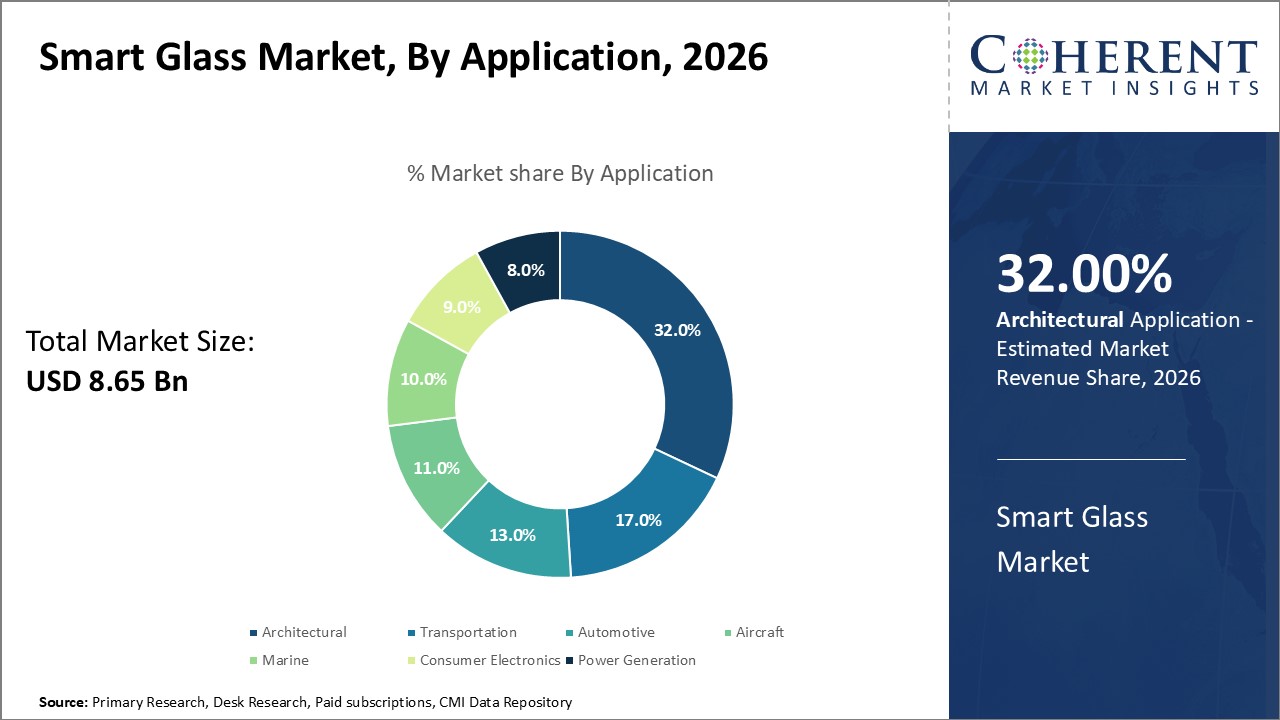
Global Smart Glass Market Insights, By Application: Architectural Dominance Is Driven by Energy-Efficient Building Demands and Green Construction Standards
In terms of application, the Architectural is expected to dominate the global market over the forecast period and this is attributed to the growing strict government requirements for energy-efficient construction. The architectural is driving by the increasing demand for energy-efficient building, green construction standards, and smart infrastructure projects. They are commonly used in curtain walls, facades, skylights, and interior partitions.
For instance, in April 2026, Gauzy unveiled a groundbreaking 11,000 sq ft smart glass projection display at MSC’s new Miami cruise terminal, the largest of its kind worldwide. Covering 75% of the terminal’s façade with PDLC smart film, the installation offers transparency by day and transforms into a massive digital art display at night.
Regional Insights
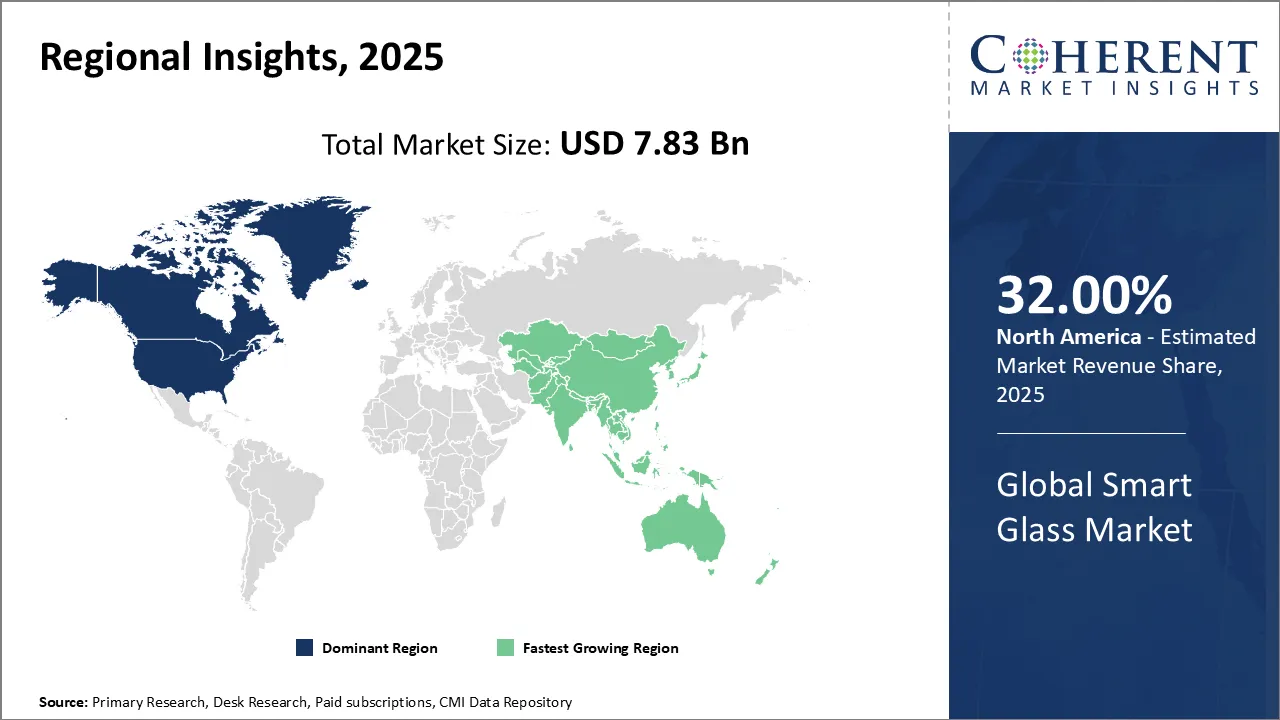
North America Smart Glass Market Analysis & Trends
North America leads the smart glass market with 32% share in 2026, due to strict energy-efficiency rules, its use in green building projects, and its strong use in the automotive and aviation industries. The region's advanced infrastructure, presence of key manufacturers, and consumer preference for sustainable technologies drive growth, making it the largest market for architectural and transportation applications.
Asia Pacific Smart Glass Market Analysis & Trends
Asia Pacific is projected to be the fastest growing region, considering cities are growing quickly, construction projects are booming, and governments are pushing for energy-efficient infrastructure. The region is a key hub for smart glass innovation and growth due to more people in countries like China, India, Japan, and South Korea want green buildings, luxury cars, and consumer electronics.
For instance, in December 2026, Alibaba released new smart glasses that are meant to compete with Meta's Ray-Ban models. These glasses use advanced display technology to create immersive augmented reality experiences. The launch shows that Alibaba is serious about wearable technology. The company wants to combine style and function while growing its presence in the global AR market and competing with established tech companies.
Smart Glass Market Outlook Country-Wise
The U.S. Smart Glass Market Trends
In 2026, the U.S. is expected to be a major driver of smart glass demand owing to strong energy-efficiency rules, quick adoption in green building projects, and use in both the automotive and aerospace industries. The country's leading role in smart glass innovation and market growth is supported by advanced infrastructure, consumers' preference for sustainable technologies, and the presence of major manufacturers.
In 2026, the U.S. is going to experience an immense amount of demand for smart glass given its strict energy-efficiency rules, quick use in green building projects, and use in the automotive and aerospace industries. The U.S. is a major market for smart glass innovation because people want eco-friendly technologies, there are big companies that make them, and the country has a lot of advanced infrastructure.
Japan Smart Glass Market Trends
Japan's demand for smart glass market in 2026 is due to rapid urbanization, a strong focus on sustainability, and government-supported green building projects. Rising adoption in commercial and residential infrastructure, coupled with applications in automotive and consumer electronics, fuels growth. Japan is a key center for smart glass innovation because of its focus on developing advanced technologies and saving energy.
For instance, in December 2024, Cellid released a reference design for its own lightweight AR smart glasses in Japan. This is a big step forward in wearable technology. The glasses use advanced optical waveguide technology to provide immersive augmented reality experiences in a small package. The launch shows how Asia-Pacific is becoming more important in the development of AR smart glasses around the world.
Market Report Scope
Smart Glass Market Report Coverage
| Report Coverage | Details | ||
|---|---|---|---|
| Base Year: | 2025 | Market Size in 2026: | USD 8.65 Bn |
| Historical Data for: | 2020 To 2024 | Forecast Period: | 2026 To 2033 |
| Forecast Period 2026 to 2033 CAGR: | 10.5% | 2033 Value Projection: | USD 17.40 Bn |
| Geographies covered: |
| ||
| Segments covered: |
| ||
| Companies covered: | DigiLens Inc, Corning Incorporated, OPPO, Meta, AGC INC., and CORNING INCORPORATED | ||
| Growth Drivers: |
| ||
| Restraints & Challenges: |
| ||
Global Smart Glass Market Drivers
Growing demand for smart glass-based products to propel market growth
A number of innovative technologies have been introduced to the market that are facilitating the growth of the Smart Glass Market. These include polymer dispersed liquid crystal (PDLC) smart glass, suspended particle display (SPD) smart glass, electrochromic glass, photochromic smart glass, thermochromic smart glass, and microblind smart glass. These technological advancements have enabled manufacturers to offer a wide range of smart glass products that can be controlled using remote or switchers. These products are highly functional and offer a great deal of convenience to users. Moreover, these products are cost-effective and easy to install.
Increasing adoption in transportation sector to augment market growth
Smart glass in the automotive & transportation sector is anticipated to witness strong growth over the study period due to increased R&D activities and use of smart glass in premium vehicles, owing to its potential to provide significant energy-efficiency, light & heat control, privacy, automated shading, and design innovation. Increased adoption of solar-powered heating & cooling systems in aircrafts and fighter jets to lower operational costs, as well as smart glass applications on cruise ships’ interior barriers are also anticipated to drive the market.
Global Smart Glass Market Opportunities
Increasing energy concerns and a growing awareness about the environment are expected to provide lucrative growth opportunities for smart glass market. Moreover, the market is gaining traction due to the presence of government programs for green buildings and eco-friendly structures. The demand for smart glass is expected to grow at a fast rate during the forecast period. It helps reduce heating, ventilation, and air conditioning (HVAC) equipment costs, and it also improves indoor environmental quality. It also helps prevent glare and increases safety by allowing drivers to take their eyes off the road. The technology can also be used to display text messages, warning signs, and other content on the front windscreen.
Increasing applications of smart glass in electronic devices, such as smartphones and televisions, are likely to offer bright market opportunities for smart glass market. Moreover, the increased R&D activities and growing awareness about renewable energy sources are expected to fuel the usage of these glasses in solar-powered panels.
Global Smart Glass Market Trends
Growing popularity of smart glass as UV ray’s protector
It can protect skin from UV rays. This is because it blocks over 95% of UV rays, which will keep skin from harmful rays that can cause skin cancer and other health problems. It can also be customized to suit needs, so user can have a specific level of privacy or glare. This type of technology is also ideal for rooms that need to be darkened or screened-off from the outside world, such as hospital rooms and boardrooms.
Effective at blocking noise from outside
Smart glass is very effective at blocking noise from outside. It can block out sound to as much as 39 DB, which is perfect for meeting rooms and other areas where sound locked is required. it is also extremely durable, so it’s unlikely to break down anytime soon. This is a great feature for anyone who wants to have a beautiful looking and long-lasting glass solution in their home or office.
Analyst Opinion (Expert Opinion)
The global smart glass market is growing rapidly since there is a growing need for energy-efficient, privacy-protecting, and adaptable solutions in the construction and transportation industries. Smart glass technology lowers lighting and HVAC loads in commercial, residential, and institutional buildings by dynamically controlling the amount of light and heat may travel through. This helps save energy. New regulations about sustainable construction are making it easier for people to adopt.
The transportation industry, which includes cars, planes, and trains, is becoming a major demanding factor. An increasing number of high-end cars are using smart glass for windows and sunroofs to make them more comfortable, look better, and use less energy. Electrochromic smart glass is the most popular technology as it can change its tint and requires not much power. On the other hand, suspended particle device (SPD) glass is becoming more popular for controlling light and privacy. More people are adopting the technology because of improvements like better coatings and the ability to work with smart-building or vehicle-control systems.
North America is the leader in the region as its construction and automotive industries are well-established. The Asia-Pacific region, on the other hand, is growing quickly on account of urbanization and infrastructure development. Some of the problems are higher initial costs, trade-offs in technology, and a market that is split up between different application sectors.
Smart glass is likely to be a key part of making buildings and transportation more environmentally friendly. Innovations and economies of scale are expected to lower costs, making smart glass more widely used and changing it from a luxury to a common material.
Speak to the analyst
Want personalized insights?
Take the findings above to one of our principal consultants, or have the report rebuilt around the segments, geographies and competitors you actually track.
Global Smart Glass Market: Key Developments
- In October 2025, Vuzix announced new developments in its AR smart glasses line, focusing on partnerships and improvements in waveguide optics and microLED displays. The updates make Vuzix stronger in both the business and consumer markets, with uses in healthcare, defense, and manufacturing. The company is still leading the way in new wearable augmented reality technology around the world.
- In July 2025, Gauzy unveiled the world's first prefabricated smart glass stack for cars, which is meant to make it easier for more people to use it in large numbers. The innovation is based in Israel and works around the world. It focuses on major markets in North America and Asia-Pacific, providing automakers with an easy way to add smart glass to cars, which improves energy efficiency, visibility control, and passenger comfort.
Market Segmentation
- Global Smart Glass Market, By Technology (Revenue, USD Bn, 2021 - 2033)
- Electrochromic
- PDLC
- Suspended Particle Devices (SPD)
- Thermochromic
- Photochromic
- Global Smart Glass Market, By Application (Revenue, USD Bn, 2021 - 2033)
- Architectural
- Transportation
- Automotive
- Aircraft
- Marine
- Consumer Electronics
- Power Generation
- Global Smart Glass Market, By Region (Revenue, USD Bn, 2021 - 2033)
- North America
- U.S.
- Canada
- Latin America
- Brazil
- Argentina
- Mexico
- Rest of Latin America
- Europe
- Germany
- U.K.
- Spain
- France
- Italy
- Russia
- Rest of Europe
- Asia Pacific
- China
- India
- Japan
- Australia
- South Korea
- ASEAN
- Rest of Asia Pacific
- Middle East & Africa
- GCC Countries
- Israel
- Rest of Middle East & Africa
- North America
- Key Companies Insights (Revenue, USD Bn, 2021 - 2033)
- DigiLens Inc
- Corning Incorporated
- OPPO
- Meta
- AGC INC.
Sources
Primary Research Interviews
- Smart Glass Manufacturers
- Electrochromic & Photochromic Technology Developers
- Architectural Glass & Façade Engineers
- Automotive OEM Design & Innovation Teams
- Building Automation & IoT Integration Experts
- Sustainability & Green Building Consultants
- Others
Databases
- Bloomberg Terminal
- Thomson Reuters Eikon
- Others
Magazines
- Glass International Magazine
- Architectural Record
- Smart Buildings Magazine
- Construction Week
- Automotive News
- Others
Journals
- Journal of Non-Crystalline Solids
- Solar Energy Materials & Solar Cells
- Building and Environment Journal
- Materials Science & Engineering B
- Journal of Architectural Engineering
- Others
Newspapers
- Financial Times
- The Wall Street Journal
- Reuters
- Bloomberg News
- The Economic Times
- Others
Associations
- Smart Glass International Association (SGIA)
- Glass Association of North America (GANA)
- American Institute of Architects (AIA)
- U.S. Green Building Council (USGBC)
- International Energy Agency (IEA) – Energy Efficiency Division
- Others
Public Domain Sources
- U.S. Department of Energy (DOE)
- International Energy Agency (IEA)
- European Commission – Energy Efficiency & Buildings
- World Bank Open Data
- National Renewable Energy Laboratory (NREL)
- U.S. Environmental Protection Agency (EPA)
- Others
Proprietary Elements
- CMI Data Analytics Tool
- Proprietary CMI Existing Repository of Information for the Last 8 Years
Definition: Smart glass is a type of transparent or translucent glass that undergoes a change in appearance or light transmission properties when a stimulus such as voltage, light, or heat is applied to it. It is used in a variety of applications including transportation, architecture, and power generation.
Get access to 250+ pages report
Every segment, forecast, competitor profile and data table behind the analysis above — available for instant download.
- ESOMAR Member
- ISO 9001:2015 Certified
- D-U-N-S Registered
- GDPR & CCPA Compliant
Missing comfort of reading report in your local language? Find your preferred language:
Transform your Strategy with Exclusive Trending Reports
Frequently Asked Questions
The Smart Glass Market is estimated to be valued at USD 8.65 Bn in 2026, and is expected to reach USD 17.40 Bn by 2033.
The CAGR of the Smart Glass Market is projected to be 10.5% from 2026 to 2033.
Growing demand for smart glass based products and increasing adoption in transportation sector are fuelling the market.
The Electrochromic segment is the leading technology segment in the market.
High price of smart glass is the major factors restraining growth of the market.
DigiLens Inc, Corning Incorporated, OPPO, Meta, AGC INC., and CORNING INCORPORATED