

Digital Marketing Software Market Size and Forecast — 2026 - 2033
The Global Digital Marketing Software Market size is estimated to be valued at USD 17.85 billion in 2026 and is expected to reach USD 37.94 billion by 2033, exhibiting a compound annual growth rate (CAGR) of 11.2% from 2026 to 2033.
Overview
The digital marketing software market is expanding rapidly, driven by increasing adoption of online channels, data-driven strategies, and the need for personalized customer engagement. Businesses across industries are investing in tools for social media management, search engine optimization, email marketing, and marketing automation to enhance brand visibility and ROI. The rise of artificial intelligence and analytics enables real-time insights, predictive targeting, and campaign optimization. Growing e-commerce activity and mobile usage further accelerate demand. Additionally, integration with customer relationship management systems and cloud-based platforms supports scalability, making digital marketing software essential for modern, competitive business environments.
Key Takeaways
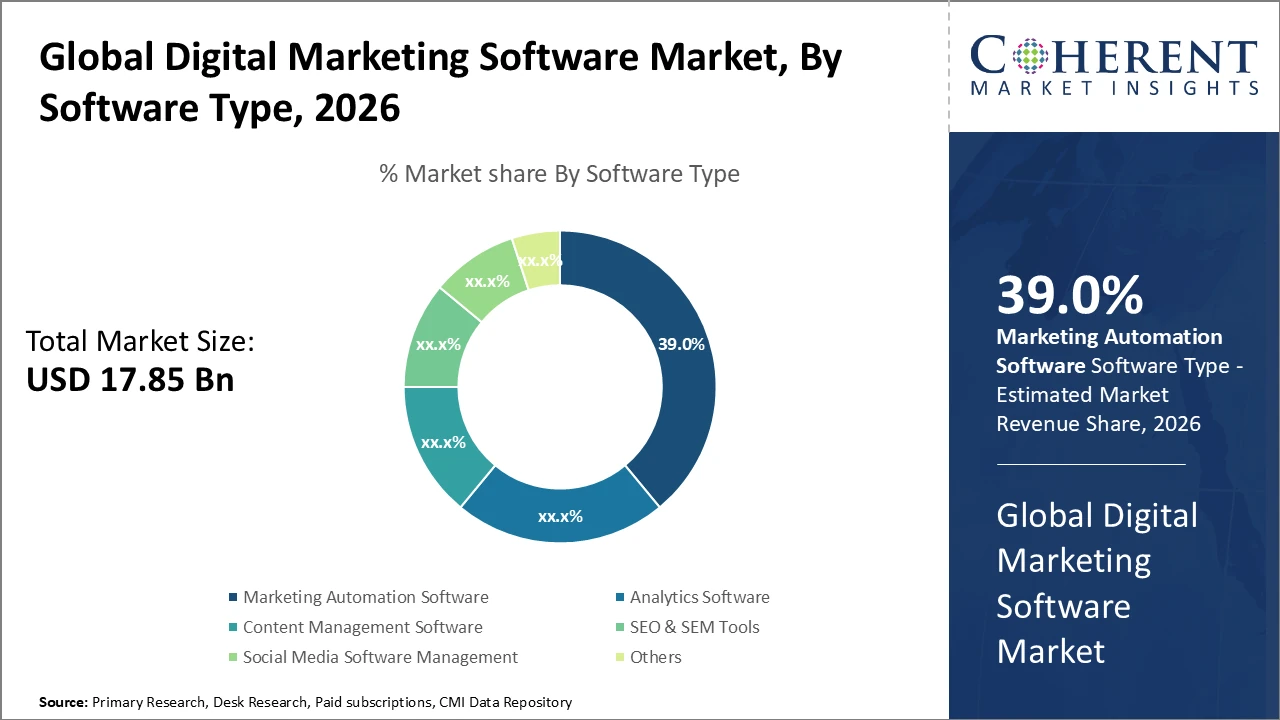
The Marketing Automation Software segment leads the market with a share of 39%, driven by widespread adoption across industries seeking enhanced campaign efficiency and effective lead nurturing.
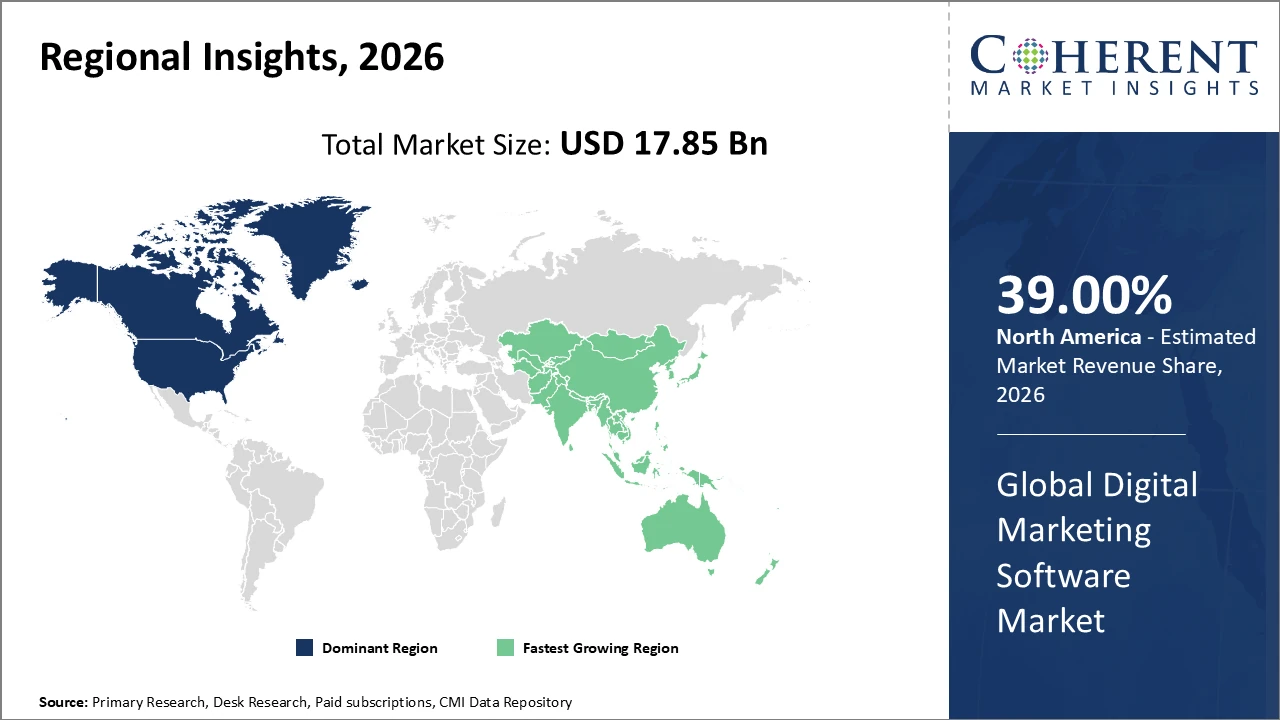
North America holds the highest market share due to advanced technology infrastructure and significant digital advertising expenditures, with U.S. companies leading innovation.
Asia Pacific, especially India and China, is the fastest-growing region, fueled by rapid digitization, supportive policies, and a growing SME sector.
Europe exhibits steady growth, supported by regulatory compliance and a mature digital marketing landscape.
Digital Marketing Software Market Segmentation Analysis
Digital Marketing Software Market Insights, By Software Type
Marketing Automation Software dominates the market due to its ability to streamline campaign management, nurture leads, and deliver measurable ROI, making it essential for enterprises across industries. Analytics Software is the fastest-growing subsegment, leveraging AI and big data to provide predictive insights and optimize marketing performance. Content Management Software supports digital asset organization and publishing workflows, while SEO and SEM tools improve organic and paid search visibility. Social Media Management Software enables audience engagement but holds a smaller share compared to automation and analytics platforms. The Others segment includes niche software catering to specialized marketing functions and emerging digital strategies.
Digital Marketing Software Market Insights, By Deployment Mode
Cloud-based deployment dominates the digital marketing software market, driven by its scalability, cost-effectiveness, and seamless integration with multiple marketing channels, accounting for over 60% of users. This approach enables rapid innovation cycles and frequent updates, aligning with evolving market demands. Hybrid deployment is the fastest-growing segment, offering a balance between on-premises control and cloud flexibility, appealing to enterprises seeking both data security and operational agility. On-premises solutions remain relevant for large organizations with stringent compliance requirements. The Others segment includes customized deployment models that provide tailored features and benefits to meet specific business needs.
Digital Marketing Software Market Insights, By Industry Type
Retail and E-commerce dominates the digital marketing software market due to intense competition and the need for personalized customer experiences enabled by advanced marketing tools. The BFSI sector is the fastest-growing subsegment, driven by regulatory requirements and the demand for compliance-integrated marketing solutions. Healthcare adopts digital marketing software to enhance patient engagement and promote telehealth services, while Telecom and IT sectors use it for customer retention and campaign optimization. Manufacturing and Education are gradually increasing adoption for brand building and student enrollment, respectively. Media and Entertainment rely heavily on content management and social media tools, with Others including government and non-profit organizations.
Digital Marketing Software Market Trends
Integration of artificial intelligence and machine learning enhances targeted advertising and customer engagement, with AI-powered marketing tools improving campaign effectiveness by 20-30%, according to McKinsey.
Growing focus on data privacy and security is reshaping software features, with solutions increasingly embedding compliance tools, especially in European markets adhering to GDPR mandates.
Adoption of real-time analytics is rising, with companies investing in tools for live campaign tracking, leading to faster decision-making and increased marketing agility.
Digital Marketing Software Market Insights, By Geography
North America Digital Marketing Software Market Analysis and Trends
In North America, the digital marketing software market is dominated by high digital advertising expenditures, exceeding USD 130 billion in 2025, robust technological infrastructure, and early adoption of AI-driven marketing tools. Leading U.S.-based companies, including Adobe and Salesforce, drive innovation through advanced automation, analytics, and multi-channel campaign management, significantly contributing to market share and revenue growth. The region also benefits from a mature ecosystem of technology providers, skilled professionals, and supportive regulatory frameworks that encourage adoption of digital marketing solutions. These factors collectively position North America as a key leader in the global digital marketing software market.
Asia Pacific Digital Marketing Software Market Analysis and Trends
Asia Pacific exhibits the fastest growth in the digital marketing software market, with a CAGR exceeding 14%, driven by rapid digital adoption in key countries such as China and India. Government initiatives promoting digitization and support for small and medium-sized enterprises, combined with the rapid expansion of e-commerce, are major growth enablers. Local software providers are innovating affordable, region-specific solutions to meet the unique needs of businesses, further strengthening market dynamics. Rising internet penetration, mobile device usage, and increasing investment in online advertising contribute to the accelerated adoption of digital marketing software, positioning the region as a key global growth hub.
Digital Marketing Software Market Outlook for Key Countries
USA Digital Marketing Software Market Analysis and Trends
The USA continues to lead global innovation in digital marketing software, with 2025 data indicating that over 75% of enterprises adopted AI-powered marketing platforms. Industry leaders such as Salesforce and Adobe drive market revenue growth through the launch of cloud-native and AI-integrated solutions that enhance campaign efficiency and personalization. Robust digital advertising expenditures, surpassing USD 120 billion in 2026, further support market expansion. Additionally, regulatory alignment on data security encourages the development of privacy-first marketing applications, reinforcing consumer trust. These factors collectively solidify the USA’s position as a dominant and innovative hub in the global digital marketing software market.
Germany Digital Marketing Software Market Analysis and Trends
The Germany digital marketing software market is experiencing steady growth, driven by increasing digital adoption across enterprises and a strong focus on data privacy and regulatory compliance, particularly under GDPR. Businesses are deploying marketing automation, analytics, and content management solutions to enhance customer engagement, optimize campaigns, and improve ROI. The rise of e-commerce and mobile marketing, coupled with growing AI integration, is boosting demand for advanced tools capable of real-time analytics and personalized experiences. Additionally, the adoption of hybrid and multi-channel marketing strategies supports market expansion, while local vendors continue innovating to cater to SMEs and large enterprises seeking efficient, compliant, and scalable digital marketing solutions.
Analyst Opinion
The surge in demand for integrated digital marketing platforms is expanding market size, with 2025 adoption of multichannel campaign management tools rising by 17%, primarily driven by retail and BFSI sectors leveraging data-driven personalization, correlating with a 22% increase in marketing ROI from unified analytics platforms.
Pricing strategies and subscription-based models influence market revenue, with SaaS-based digital marketing software accounting for over 65% of total revenue in 2024; flexible pricing enabled SMEs to enter the market, contributing to a 14% market share increase in emerging economies.
Increasing imports of advanced marketing automation software in North America and Europe support demand-side growth, with North America’s imports rising 19% in 2026 due to investments in AI-powered campaign optimization by Fortune 500 companies.
Use case diversification drives growth, as healthcare and education adopt digital marketing software for patient engagement and student recruitment; healthcare digital marketing budgets rose 25% in 2026, reflecting increased industry-specific software utilization.
- Current Industry Events of 2026
- Market Size Estimation
- Regional Breakdown
- Competitive Landscape
- Customer Intelligence
- Segmental Analysis
- Pricing Analysis
- Key Market Drivers, Challenges & Future Trends
- Customized Insights Section
Market Scope
| Report Coverage | Details | ||
|---|---|---|---|
| Base Year: | 2025 | Market Size in 2026: | USD 17.85 billion |
| Historical Data for: | 2020 To 2024 | Forecast Period: | 2026 To 2033 |
| Forecast Period 2026 to 2033 CAGR: | 11.2% | 2033 Value Projection: | USD 37.94 billion |
| Geographies covered: |
| ||
| Segments covered: |
| ||
| Companies covered: | Adobe Inc., Oracle Corporation, IBM Corporation, ZOHO Corporation, Cheetah Digital, SAS Institute Inc., HubSpot Inc., Sprout Social Inc., ActiveCampaign, Salesforce.com Inc. | ||
| Growth Drivers: |
| ||
Digital Marketing Software Market Growth Factors
The digital marketing software market is primarily driven by several key factors. The integration of AI and machine learning in marketing solutions is enhancing personalization and campaign effectiveness, with AI users achieving up to 30% higher conversion rates in 2026. Rising global digital advertising expenditure is also fueling adoption, with Asia Pacific digital ad spends growing 19% annually between 2024 and 2026. The shift to omnichannel marketing requires sophisticated tools to unify cross-channel data, evidenced by a 25% increase in ROI among early adopters. Additionally, real-time analytics adoption reduces customer churn by 20%, further boosting market growth.
Digital Marketing Software Market Development
In April 2026, Reshift Media, a leading digital marketing firm for franchises, launched Franify, a platform designed to streamline and optimize digital marketing across franchise networks.
Key Players
Leading Companies of the Market
Adobe Inc.
IBM Corporation
Salesforce.com Inc.
SAS Institute Inc.
HubSpot Inc.
Cheetah Digital
Zoho Corporation
ActiveCampaign
Oracle Corporation
Sprout Social Inc.
Several leading companies in the digital marketing software market have successfully implemented strategies centered on AI integration and ecosystem partnerships. Adobe Inc. enhanced its Marketing Cloud by incorporating advanced AI-driven predictive analytics, achieving a 15% increase in customer retention among enterprise clients in 2025. Salesforce.com expanded its market presence by acquiring AI marketing startups, strengthening its CRM-integrated marketing automation capabilities and boosting North American market share by approximately 12% in 2024. HubSpot, meanwhile, emphasizes user-friendly interfaces tailored to SMEs, driving adoption by over 18% in emerging markets during 2026, demonstrating the impact of targeted innovation on market growth.
Digital Marketing Software Market Future Outlook
The digital marketing software market is poised for robust growth, driven by increasing adoption of AI, machine learning, and real-time analytics to optimize campaigns and enhance customer experiences. The rise of omnichannel marketing and personalized content strategies will further accelerate demand, particularly in retail, BFSI, and e-commerce sectors. Cloud-based and SaaS deployment models will continue to gain traction due to scalability and cost-efficiency, while hybrid and multi-cloud solutions will address data security concerns. Emerging markets in Asia Pacific and Latin America are expected to witness significant expansion, supported by digitalization initiatives and growing SME adoption, shaping a dynamic and competitive future landscape.
Digital Marketing Software Market Historical Analysis
The digital marketing software market has experienced significant growth over the past decade, driven by the increasing shift from traditional to digital marketing channels. Early adoption focused on email marketing and basic analytics, gradually evolving to comprehensive marketing automation and CRM-integrated platforms. The proliferation of social media, mobile devices, and e-commerce accelerated demand for multi-channel campaign management solutions. Between 2015 and 2020, AI and machine learning began transforming personalization and performance tracking, enhancing ROI for enterprises. North America and Europe led adoption due to advanced infrastructure and high digital advertising spends, while Asia Pacific and Latin America gradually emerged as high-growth regions, laying the foundation for future expansion.
Sources
Primary Research Interviews:
Marketing managers, digital strategists, and IT leaders from companies developing digital marketing software solutions.
Technical specialists from firms providing marketing automation, AI-driven analytics, CRM integration, and omnichannel campaign management platforms.
Industry experts from organizations focused on social media management, SEO/SEM tools, and real-time analytics solutions.
Magazines:
Marketing Week – Trends in digital marketing technologies, software innovations, and campaign strategies.
Ad Age – Insights on marketing software adoption, campaign effectiveness, and emerging digital tools.
Campaign – Updates on digital advertising, automation platforms, and analytics tools.
Journals:
Journal of Interactive Marketing – Research on digital marketing software applications, customer engagement, and analytics performance.
International Journal of Research in Marketing – Studies on campaign optimization, personalization, and marketing automation effectiveness.
Journal of Marketing Analytics – Insights on AI integration, predictive analytics, and ROI measurement in marketing software.
Newspapers:
The Wall Street Journal – Corporate strategies, mergers, and investments in digital marketing software.
Financial Times – Market trends, regulatory impacts, and industry growth affecting digital marketing adoption.
Reuters – News on software deployments, AI-powered marketing tools, and market performance.
Bloomberg – Company strategies, revenue trends, and global digital marketing software market insights
Associations:
Digital Marketing Institute (DMI) – Standards, research, and data on marketing software best practices.
Interactive Advertising Bureau (IAB) – Updates on digital advertising, analytics tools, and market regulations.
American Marketing Association (AMA) – Research and insights on marketing technologies, campaign strategies, and software adoption.
Get access to 250+ pages report
Every segment, forecast, competitor profile and data table behind the analysis above — available for instant download.
- ESOMAR Member
- ISO 9001:2015 Certified
- D-U-N-S Registered
- GDPR & CCPA Compliant
Missing comfort of reading report in your local language? Find your preferred language:
Transform your Strategy with Exclusive Trending Reports
Frequently Asked Questions
The market is dominated by key companies including Adobe Inc., Salesforce.com, HubSpot, Oracle, and IBM, which lead through innovation, market revenue, and a broad client base across multiple industries.
The market is projected to grow from USD 17.85 billion in 2026 to USD 37.94 billion by 2033, reflecting a CAGR of 11.2%, driven by rising digital marketing investments and technological advancements.
Retail and E-commerce, followed by BFSI and healthcare, represent major growth opportunities due to high digital marketing adoption, evolving customer engagement strategies, and increasing marketing software budgets.
Trends will emphasize AI-driven personalization, real-time analytics, omnichannel integration, and privacy-compliant technologies, moving the market toward smarter and more secure digital marketing ecosystems.
The market is highly competitive, characterized by continuous innovation and consolidation through mergers and acquisitions. Challenges include data privacy issues, integration complexities, and the need for constant innovation to address evolving marketing requirements.
Common strategies include freemium pricing models, AI integration, strategic alliances with cloud providers, and industry-specific customization, all aimed at expanding customer bases and enhancing user engagement.