

Sensor Fusion Market Size and Forecast — 2026 - 2033
The Global Sensor Fusion Market size is estimated to be valued at USD 7.4 billion in 2026 and is expected to reach USD 16.3 billion by 2033, exhibiting a compound annual growth rate (CAGR) of 11.5% from 2026 to 2033.
Overview
The sensor fusion market is driven by the increasing adoption of autonomous and connected vehicles, growing deployment of Internet of Things (IoT) devices, and rising demand for advanced safety and monitoring systems. Sensor fusion technology combines data from multiple sensors, such as cameras, radar, LiDAR, GPS, and inertial sensors, to improve accuracy, reliability, and real-time decision-making. The expansion of Industry 4.0, smart manufacturing, robotics, and intelligent transportation systems is further accelerating market growth. Additionally, advancements in artificial intelligence and machine learning are enhancing sensor fusion capabilities, enabling more precise object detection, navigation, predictive maintenance, and situational awareness across various industries.
Key Takeaways
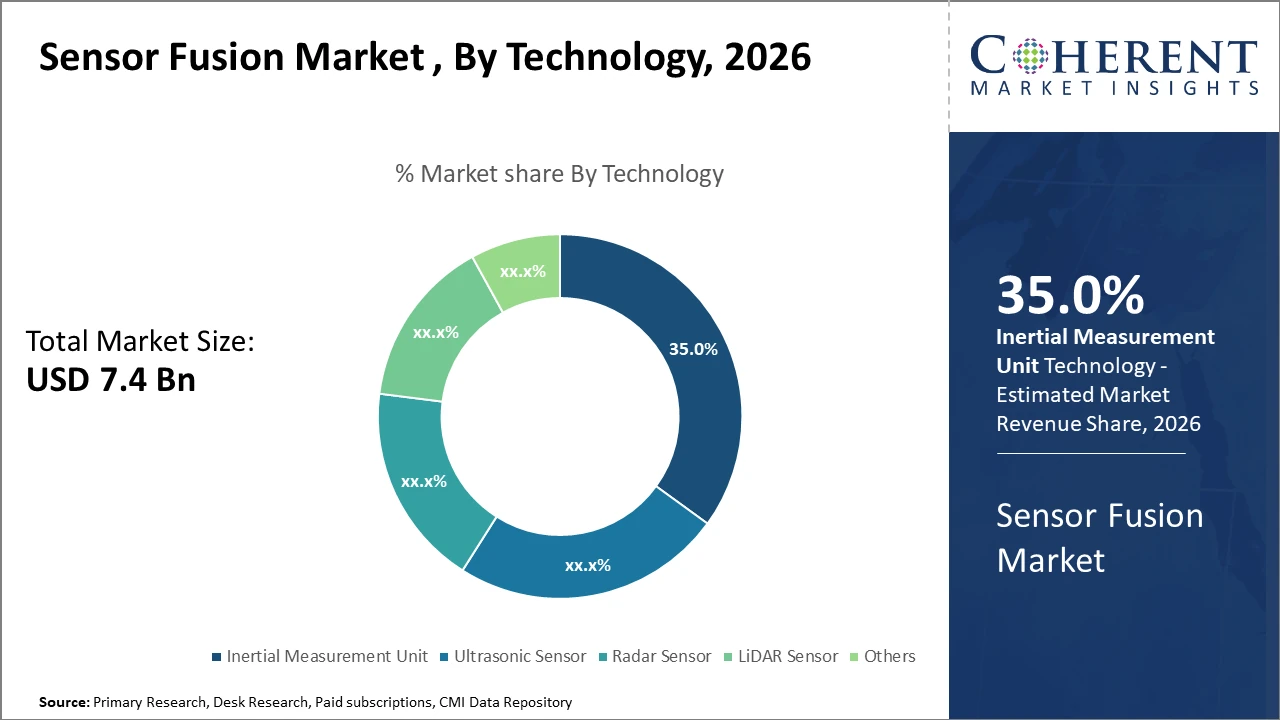
Inertial Measurement Units (IMUs) hold a dominant share due to their critical role in automotive navigation, motion tracking, and vehicle stability systems across advanced mobility applications.
LiDAR sensors represent the fastest-growing subsegment, driven by increasing adoption of advanced driver assistance systems (ADAS), autonomous vehicles, and high-precision environmental sensing technologies.
The automotive sector leads overall market revenue because of stringent vehicle safety regulations, growing autonomous driving developments, and rising integration of intelligent sensing systems, while consumer electronics is expanding rapidly through wearable health monitoring and smart device innovations.
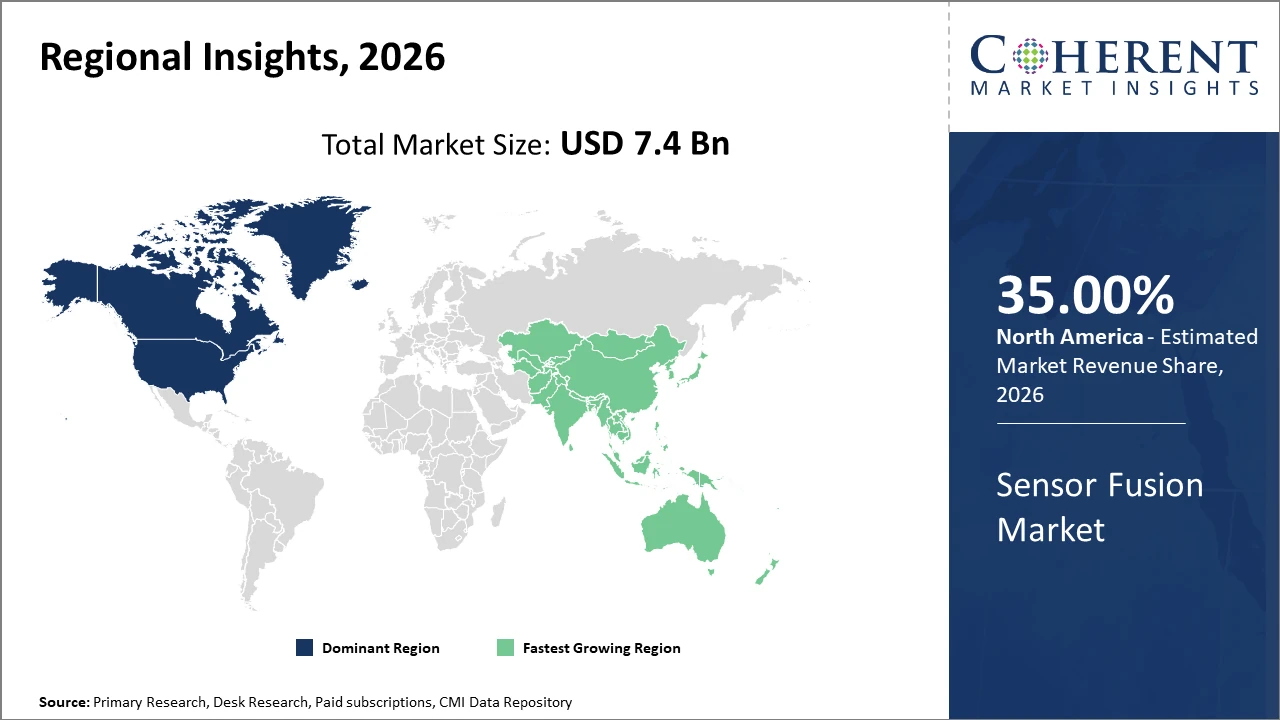
North America accounts for the largest market share due to strong automotive R&D infrastructure and technological advancements, whereas Asia Pacific records the highest CAGR supported by expanding electronics manufacturing capabilities and favorable government incentives.
Sensor Fusion Market Segmentation Analysis
Sensor Fusion Market Insights, By Technology
The IMU segment dominates the Sensor Fusion market due to its vital role in vehicle navigation, motion sensing, and stability control systems across automotive and industrial applications. Its ability to provide accurate motion tracking and orientation data makes it essential for advanced driver assistance systems and autonomous technologies. LiDAR sensors are the fastest-growing segment, driven by their high spatial resolution and increasing use in autonomous vehicles, robotics, and intelligent mapping systems. Ultrasonic sensors remain important for short-range obstacle detection and parking assistance applications, while radar sensors support reliable long-range detection under poor visibility conditions.
Sensor Fusion Market Insights, By Application
The automotive segment dominates the Sensor Fusion market due to increasing regulatory requirements for advanced driver assistance systems (ADAS), vehicle safety technologies, and autonomous driving capabilities. Sensor fusion solutions are widely integrated into navigation, collision avoidance, and vehicle stability systems to enhance driving performance and safety. Aerospace & Defense applications continue to grow steadily because of rising demand for accurate navigation, surveillance, and situational awareness technologies. Consumer electronics represent a rapidly expanding segment, driven by wearable devices and smart home applications utilizing intelligent sensing features. Healthcare applications use sensor fusion for remote patient monitoring and diagnostics, while industrial automation benefits from predictive maintenance and operational efficiency improvements.
Sensor Fusion Market Insights, By End User Industry
OEMs dominate the Sensor Fusion market as the primary developers and adopters of integrated sensing technologies across automotive, aerospace, consumer electronics, and industrial platforms. These companies incorporate sensor fusion systems directly into hardware architectures to enhance performance, safety, and automation capabilities. The aftermarket segment is gaining momentum through retrofitting and upgrading existing systems with advanced sensor fusion modules and intelligent sensing features. System integrators are expanding their role by delivering customized multi-sensor integration solutions for industrial and commercial applications. Service providers are increasingly offering sensor fusion-based analytics, predictive monitoring, and data management services, while other niche sectors continue adopting tailored sensor fusion technologies for specialized operational requirements.
Sensor Fusion Market Trends
The Sensor Fusion market is increasingly integrating artificial intelligence directly into sensor modules to improve real-time decision-making, processing speed, and operational efficiency across autonomous systems.
In 2026, Qualcomm introduced AI-enhanced sensor fusion platforms capable of reducing latency and accelerating data processing for autonomous vehicle and robotics applications.
LiDAR sensors are becoming a critical component within modern sensor fusion frameworks, complementing radar and camera systems to improve environmental perception and navigation accuracy.
The growing adoption of edge computing with sensor fusion technologies is reducing dependence on cloud-based processing while enhancing responsiveness and energy efficiency in connected devices.
Increasing deployment of sensor fusion solutions in smart wearables, industrial IoT platforms, robotics, and autonomous mobility systems highlights the ongoing technological evolution shaping market competition and innovation strategies.
Sensor Fusion Market Insights, By Geography
North America Sensor Fusion Market Analysis and Trends
North America dominates the Sensor Fusion market with a share of 35% due to substantial investments in automotive innovation, semiconductor development, and autonomous mobility technologies. Regulatory mandates from agencies such as the National Highway Traffic Safety Administration have accelerated the integration of advanced sensor fusion systems in vehicles to improve safety and driver assistance capabilities. The strong presence of companies including Bosch and Texas Instruments further strengthens the region’s technological leadership and manufacturing capabilities. Extensive automotive R&D infrastructure, coupled with rapid adoption of AI-enabled sensing systems, has enabled North America to maintain more than 35% of the global Sensor Fusion market share.
Asia Pacific Sensor Fusion Market Analysis and Trends
Asia Pacific is the fastest-growing region in the Sensor Fusion market, registering a CAGR exceeding 14% due to rapid expansion of electronics manufacturing and increasing investments in intelligent sensing technologies. China’s growing LiDAR production capacity and strong presence in automotive and semiconductor manufacturing are significantly accelerating regional market growth. India is also emerging as a major contributor through expansion of its electronics manufacturing ecosystem and rising adoption of smart technologies. Government initiatives supporting smart city development, industrial automation, connected infrastructure, and advanced mobility solutions are further strengthening demand for sensor fusion systems. Increasing automotive production and IoT deployment continue to reinforce the region’s strong market expansion outlook.
Sensor Fusion Market Outlook for Key Countries
USA Sensor Fusion Market Analysis and Trends
The United States Sensor Fusion market is driven by the strong presence of major automotive OEMs, semiconductor manufacturers, and advanced technology companies investing heavily in next-generation sensing solutions. Rapid deployment of advanced driver assistance systems and autonomous vehicle technologies has accelerated adoption across the automotive sector, with more than 65% of newly launched vehicle models integrating sensor fusion systems by 2025. Companies such as Texas Instruments and Honeywell have significantly expanded research and development investments to advance AI-enabled sensing, navigation, and safety technologies, strengthening the country’s leading contribution to global Sensor Fusion market revenue and technological innovation.
Germany Sensor Fusion Market Analysis and Trends
Germany represents a significant market for sensor fusion technologies due to its strong automotive manufacturing base, advanced industrial automation sector, and growing investments in autonomous systems. Increasing adoption of advanced driver assistance systems (ADAS), robotics, and Industry 4.0 technologies is driving demand for high-precision sensor fusion solutions across automotive and industrial applications. The country is witnessing rising integration of AI-enabled sensor platforms that improve real-time data processing, navigation accuracy, and operational safety. Government support for smart manufacturing and connected mobility initiatives further strengthens market growth. Collaborations between automotive companies, semiconductor manufacturers, and research institutions continue to accelerate innovation in Germany’s sensor fusion industry.
Analyst Opinion
Over 60% of newly manufactured vehicles in North America integrated Sensor Fusion technologies in 2025, driven by increasing adoption of advanced driver-assistance systems (ADAS) and vehicle safety features.
Semiconductor advancements, particularly AI-integrated sensor modules, increased production capacity by nearly 18% year-over-year in 2024, supporting scalable manufacturing and lower system costs.
Consumer electronics applications recorded approximately 22% growth in Sensor Fusion adoption during 2025, especially in smart wearables and biometric monitoring devices, expanding market opportunities beyond automotive applications.
Asia Pacific increased exports of Sensor Fusion hardware components by around 15% in 2024, while Europe witnessed rising imports due to stricter vehicle safety and emissions regulations supporting advanced sensing technologies.
- Current Industry Events of 2026
- Market Size Estimation
- Regional Breakdown
- Competitive Landscape
- Customer Intelligence
- Segmental Analysis
- Pricing Analysis
- Key Market Drivers, Challenges & Future Trends
- Customized Insights Section
Market Scope
| Report Coverage | Details | ||
|---|---|---|---|
| Base Year: | 2025 | Market Size in 2026: | USD 7.4 billion |
| Historical Data for: | 2020 To 2024 | Forecast Period: | 2026 To 2033 |
| Forecast Period 2026 to 2033 CAGR: | 11.5% | 2033 Value Projection: | USD 16.3 billion |
| Geographies covered: |
| ||
| Segments covered: |
| ||
| Companies covered: | Bosch, Analog Devices, Honeywell International Inc., Texas Instruments, Continental AG, Mobileye, Qualcomm, Infineon Technologies, NXP Semiconductors, E2V Technologies | ||
| Growth Drivers: |
| ||
Sensor Fusion Market Growth Factors
The Sensor Fusion market is expanding rapidly due to the growing adoption of autonomous vehicles requiring advanced environmental perception and real-time decision-making capabilities. Increasing government regulations on automotive safety, including mandates from the U.S. National Highway Traffic Safety Administration implemented in 2025, are accelerating demand for multi-sensor integration technologies in vehicles. The rise of smart consumer electronics and wearable health monitoring devices is also creating new revenue opportunities for sensor fusion solutions. Additionally, integration of AI-driven analytics within sensor fusion platforms is improving operational intelligence across industrial automation applications. These technological advancements and expanding application areas continue to strongly support global market growth and innovation.
Sensor Fusion Market Development
In May 2026, FocalPoint Positioning launched Precise+, a software-defined GNSS receiver technology capable of delivering sub-meter positioning accuracy in challenging environments without relying on inertial sensors, dead reckoning, or sensor fusion.
Key Players
Leading Companies of the Market
Bosch
Analog Devices
Texas Instruments
Honeywell International Inc.
NXP Semiconductors
E2V Technologies
Continental AG
Mobileye
Qualcomm
Infineon Technologies
Several leading companies in the Sensor Fusion market are increasing investments in multi-modal sensing and AI-enabled integration technologies to strengthen their competitive positions. For example, Bosch developed an advanced sensor suite integrating radar and LiDAR technologies to improve object detection accuracy, contributing to a 12% increase in OEM contract wins during 2025. Similarly, Texas Instruments expanded its automotive sensor fusion integrated circuit portfolio and secured a partnership with a major European automotive manufacturer, helping increase regional market revenue by nearly 8% in 2024.
Sensor Fusion Market Future Outlook
The future outlook for the Sensor Fusion market remains highly promising, driven by rapid advancements in artificial intelligence, autonomous technologies, and connected devices. Increasing adoption of advanced driver assistance systems, autonomous vehicles, robotics, and smart industrial automation is expected to accelerate demand for high-performance sensor fusion solutions. Growth in IoT ecosystems and wearable technologies will further expand applications across healthcare, consumer electronics, and smart city infrastructure. Technological innovations in LiDAR, radar, computer vision, and embedded processing systems are improving real-time decision-making and operational efficiency. In addition, rising investments in Industry 4.0 and intelligent mobility solutions will continue supporting long-term global market expansion.
Sensor Fusion Market Historical Analysis
The Sensor Fusion market has evolved significantly over the past decade due to rapid advancements in sensing technologies, artificial intelligence, and connected systems. Initially used primarily in aerospace and defense applications, sensor fusion gradually expanded into automotive, consumer electronics, robotics, and industrial automation sectors. Between 2015 and 2025, increasing adoption of smartphones, wearable devices, autonomous vehicles, and advanced driver assistance systems accelerated market growth. Improvements in radar, LiDAR, cameras, accelerometers, and embedded processors enhanced real-time data integration and decision-making capabilities. Growing demand for automation, navigation accuracy, and operational safety further strengthened market adoption across both commercial and industrial applications worldwide.
Sources
Primary Research Interviews:
Sensor manufacturers, semiconductor companies, automotive OEMs, robotics developers, industrial automation providers, IoT solution integrators, and distributors involved in sensor fusion technology deployment and embedded system integration.
AI researchers, electronics engineers, autonomous vehicle specialists, robotics experts, regulatory consultants, and R&D directors specializing in LiDAR systems, radar technologies, inertial sensors, computer vision, and intelligent data processing solutions.
Magazines:
Electronics Weekly – Insights into semiconductor technologies, sensor innovations, and embedded system developments.
EE Times – Coverage of sensor fusion technologies, AI processors, IoT devices, and autonomous systems advancements.
Automotive World – Updates on ADAS technologies, autonomous mobility solutions, and automotive sensor integration trends.
Journals:
IEEE Sensors Journal – Research on sensor technologies, data fusion algorithms, and intelligent sensing systems.
Sensors – Studies focused on multi-sensor integration, robotics, AI-enabled sensing, and industrial automation applications.
Journal of Intelligent & Robotic Systems – Research related to autonomous navigation, robotics perception systems, and sensor fusion technologies.
Newspapers:
Financial Times – Coverage of semiconductor investments, AI innovation, and autonomous technology market developments.
Reuters – Reporting on sensor technology launches, automotive automation initiatives, and semiconductor industry updates.
Bloomberg – Insights into mergers, acquisitions, and strategic collaborations among global technology and semiconductor companies.
Associations:
IEEE Sensors Council – Research developments, industry standards, and innovations in sensing technologies and sensor fusion systems.
Semiconductor Industry Association – Insights into semiconductor manufacturing, embedded systems, and electronics market trends.
Association for Advancing Automation – Information on robotics, industrial automation, autonomous systems, and intelligent sensing technologies.
Get access to 250+ pages report
Every segment, forecast, competitor profile and data table behind the analysis above — available for instant download.
- ESOMAR Member
- ISO 9001:2015 Certified
- D-U-N-S Registered
- GDPR & CCPA Compliant
Missing comfort of reading report in your local language? Find your preferred language:
Transform your Strategy with Exclusive Trending Reports
Frequently Asked Questions
Key companies operating in the Sensor Fusion market include Bosch, Texas Instruments, Honeywell, Analog Devices, and Infineon Technologies, all actively investing in advanced multi-sensor integration technologies and global OEM partnerships.
The Sensor Fusion market is projected to grow from USD 7.4 billion in 2026 to approximately USD 16.3 billion by 2033, registering a CAGR of 11.5% during the forecast period.
The automotive sector represents the largest growth opportunity due to increasing adoption of autonomous driving systems, advanced driver assistance technologies, and stringent vehicle safety regulations. Consumer electronics and industrial automation are also emerging as important growth segments.
Market trends are expected to focus on deeper AI integration, wider adoption of LiDAR technologies, enhanced edge computing capabilities, and increased collaboration between semiconductor manufacturers, software developers, and OEMs.
The market is highly competitive and innovation-driven, characterized by strong R&D investments, strategic alliances, and continuous technological advancements. Key challenges include high integration costs, data processing complexity, and evolving regulatory requirements.
Leading companies commonly adopt strategies such as strategic partnerships, vertical integration, technology licensing, regional manufacturing expansion, and continuous product innovation to strengthen their competitive positioning and global market reach.