

Digital Trust Market Analysis & Forecast: 2026-2033
Digital Trust Market is estimated to be valued at USD 487.43 Bn in 2026 and is expected to reach USD 1,265.33 Bn in 2033, exhibiting a compound annual growth rate (CAGR) of 14.6% from 2026 to 2033.
Key Takeaways
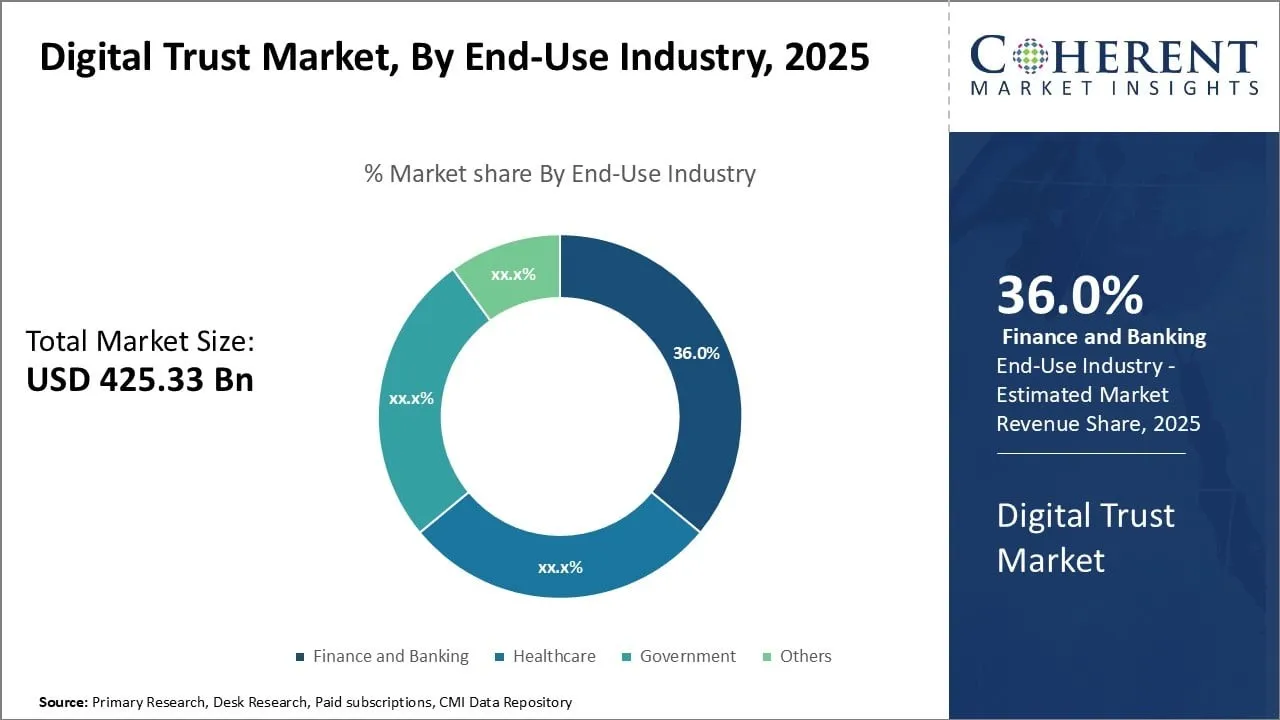
- According to End-Use Industry, the Finance and Banking Category is anticipated to account for the largest share of 37% for the digital trust market in 2026.
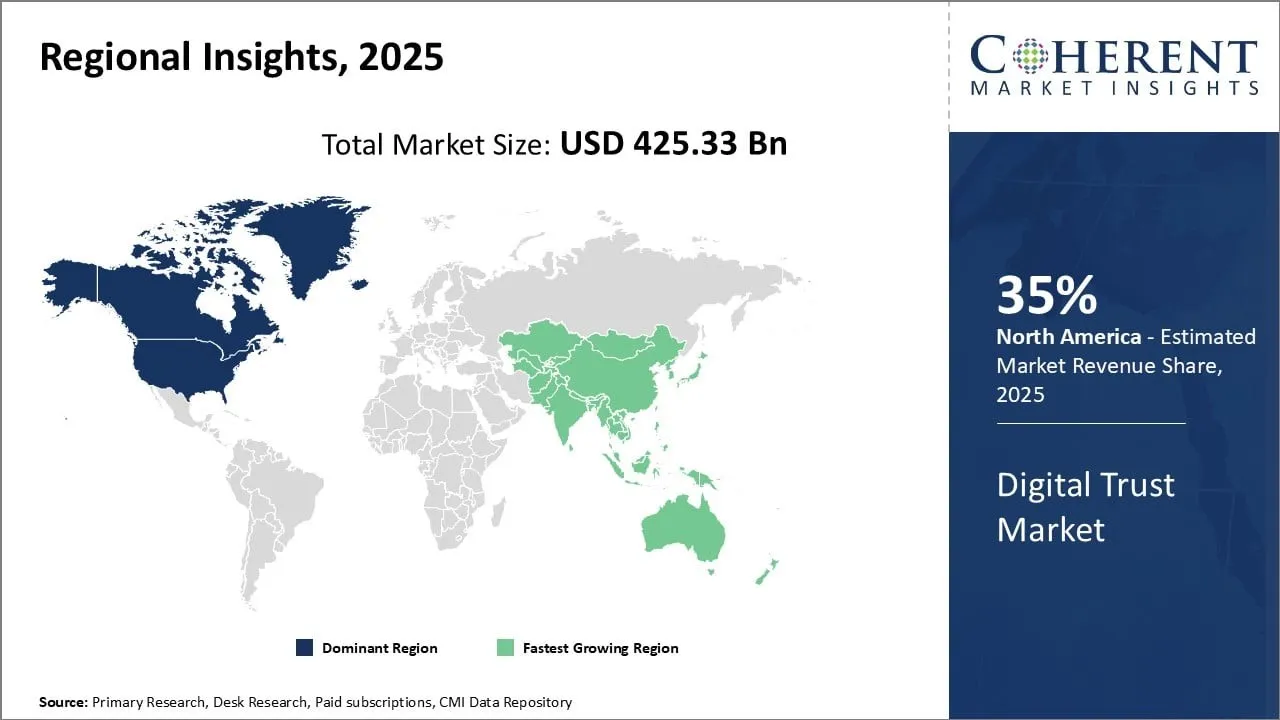
- According to region, North America holds the largest market share of 35% for digital trust market growth by 2026.
- Europe is considered to be the second dominating region and holds largest market share of 30% for digital trust market by 2026.
- Asia Pacific is considered to be the third largest region with 20% of market share by 2026 for digital trust market.
Market Overview
The digital trust market size is expected to focus on security, privacy, data protection, identity verification, authentication, encryption, digital signatures, and fraud detection. The digital trust market is a rapidly growing sector that revolves around establishing and maintaining trust in digital interactions and transactions. As businesses and individuals increasingly rely on digital technologies for various activities, trust becomes a critical factor in ensuring security, privacy, and reliability.
For instance, in February 2026, DEKRA introduces the Digital Trust Service, which reflects a combination of cybersecurity, functional safety, and artificial intelligence (AI) testing and certification. DEKRA's experience and knowledge, based on its distinct, comprehensive approach, help businesses provide reliable products and win over customers globally.
Current Events and Its Impact on the Digital Trust Market
Event | Description and Impact |
Integration of Industry 4.0 |
|
Expansion of Online Banking and E-commerce |
|
Segmental Insights
- Current Industry Events of 2026
- Market Size Estimation
- Regional Breakdown
- Competitive Landscape
- Customer Intelligence
- Segmental Analysis
- Pricing Analysis
- Key Market Drivers, Challenges & Future Trends
- Customized Insights Section
Digital Trust Market Insights, by End-Use Industry
In terms of End-Use Industry, the Finance and Banking segment is expected to contribute largest share of the Digital Trust market trends in 2026. Stringent regulations, such as the General Data Protection Regulation (GDPR) and the Smart Payment System Directive 2 (PSD2) in Europe, have driven the need for digital trust solutions in the finance sector. Banks and financial institutions must comply with these regulations to protect customer data and maintain trust.
For instance, in April 2026, in a move to bolster digital banking security and boost customer trust, the Reserve Bank of India (RBI) has directed all Indian banks to shift their net banking platforms to a new, exclusive internet domain “.bank.in”.
Digital Trust Market Insights, by Solution Type
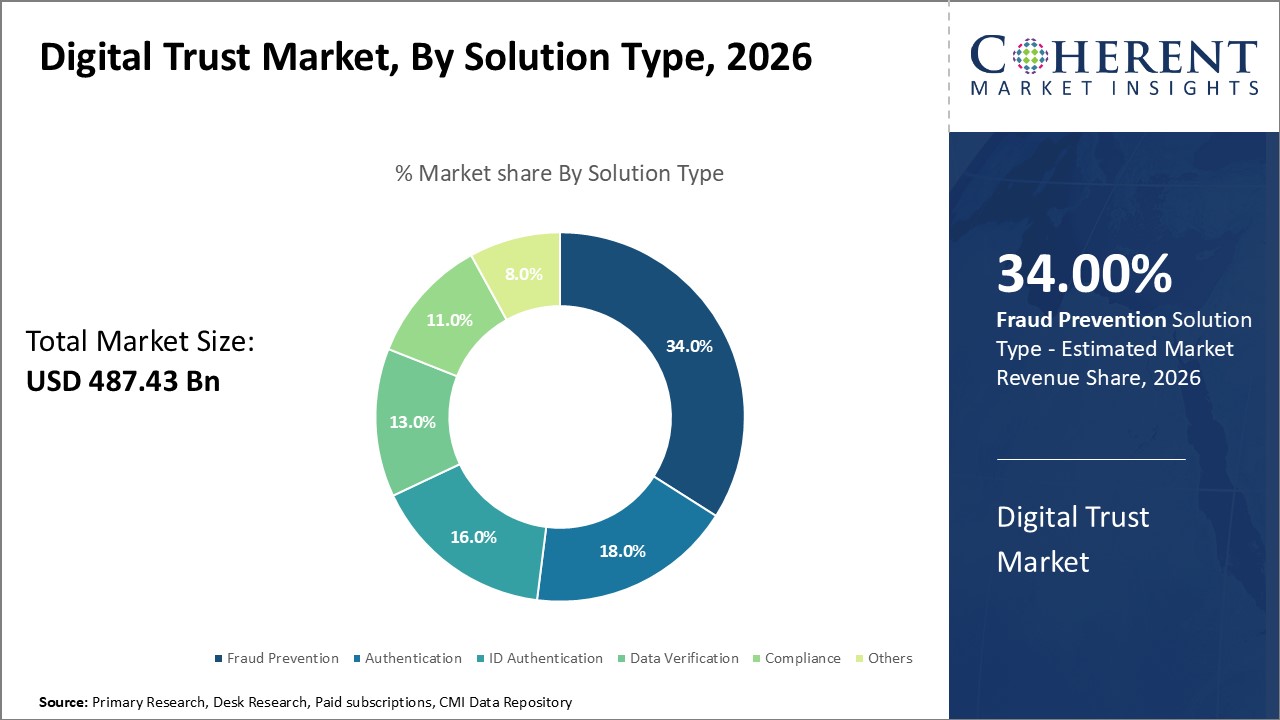
In terms of Solution Type, the Fraud prevention segment is expected to contribute largest share of the Digital Trust market trends in 2026. Since the growth of online interactions and digital transactions has greatly raised the risk and sophistication of fraudulent operations, fraud prevention is a fundamental tenet of the digital trust market.
Digital Trust Market Insights, by Deployment Model
In terms of Deployment Model, the On-Premise segment is expected to contribute largest share of the Digital Trust market trends in 2026. The on-premise segment holds a significant position in the digital trust market, consistently accounting for the largest share in recent years. Organizations across sectors such as financial services, government, and healthcare prefer on-premise digital trust solutions because they offer greater control over sensitive data, minimize dependency on third parties, and enable strict compliance with regulatory requirements.
Digital Trust Market Insights, by Organization Size
In terms of Organization Size, the Large Enterprise segment is expected to contribute largest share of the Digital Trust market trends in 2026. Their significant financial resources, which allow them to make significant investments in cutting-edge cybersecurity and digital trust solutions, are the main reason for their leadership. The need to safeguard valuable digital assets, regulatory compliance, and growing cybersecurity risks are all addressed by these solutions.
Digital Trust Market Insights by, Digital Identity Type
In terms of Digital Identity Type, the Decentralized identity segment is expected to contribute largest share of the Digital Trust market trends in 2026. Decentralized identity is rapidly emerging as a cornerstone of the digital trust market, fundamentally transforming how individuals and organizations manage, verify, and share digital credentials.
Regional Insights
North America Digital Trust Market
North America is the largest market for digital trust market, which accounted for a share of over 35% in 2026. North America, led by the U.S., has been a prominent player in the digital trust market. The region's advanced digital infrastructure, high internet penetration, and strong cyber security ecosystem have fostered the adoption of digital trust solutions. The presence of numerous tech companies and financial institutions has also contributed to the growth of the market in this region.
Asia Pacific Digital Trust Market
Asia Pacific is the fastest-growing market for digital trust market, which accounted for a share of over 20% in 2026. The Asia Pacific region has seen a surge in digitalization, driven by expanding e-commerce markets and a growing number of tech-savvy consumers. Governments in countries like China, India, and Singapore have been investing in digital infrastructure and promoting digital transformation, creating opportunities for digital trust solution providers.
Digital Trust Market In Europe
Europe is the second-largest market for digital trust market, which accounted for a share of over 30% in 2026. European countries have been actively adopting digital trust technologies to comply with stringent data protection regulations such as the General Data Protection Regulation (GDPR). Privacy and security concerns have driven the demand for authentication and identity verification solutions in various sectors including finance, healthcare, and government.
Digital Trust Market Dominating Countries
U.S Digital Trust Market
Due to its high rates of digital adoption, sophisticated technological infrastructure, and strict data privacy laws, the United States dominates the global market for digital trust. The United States has established itself as a leading force in the implementation of digital trust solutions due to the existence of significant technological businesses and a strong focus on cybersecurity.
India Digital Trust Market
Driven by a spike in online transactions and a broad digital revolution across industries, India is quickly becoming a major participant in the digital trust industry. The nation's emphasis on industry-specific digital trust solutions, especially in the financial and healthcare sectors, is a reflection of the growing demand for strong cybersecurity measures.
Digital Trust Market In China
China’s digital trust market is rising quickly, driven by the country’s vast digital economy, government-led digitalization programs, and significant development in e-commerce and mobile payments. The need for sophisticated digital identity management and authentication solutions is being fueled by the growth of blockchain technology, cloud apps, and Internet of Things devices.
Market Report Scope
Digital Trust Market Report Coverage
| Report Coverage | Details | ||
|---|---|---|---|
| Base Year: | 2025 | Market Size in 2026: | USD 487.43 Bn |
| Historical Data for: | 2020 To 2024 | Forecast Period: | 2026 To 2033 |
| Forecast Period 2026 to 2033 CAGR: | 14.6% | 2033 Value Projection: | USD 1,265.33 Bn |
| Geographies covered: |
| ||
| Segments covered: |
| ||
| Companies covered: | IBM Corporation, Microsoft Corporation, NASDAQ, Oracle Corporation, Symantec Corporation, Thales Group, DigiCert, Inc., Entrust Datacard Corporation, Verizon Communications Inc., Trustwave Holdings, Inc., ForgeRock, Ping Identity Corporation, Cisco Systems, Inc., RSA Security LLC (a subsidiary of Dell Technologies), OneSpan Inc., Okta, Inc., Nok Labs, Inc., Signicat AS, and Jumio Corporation | ||
| Growth Drivers: |
| ||
| Restraints & Challenges: |
| ||
Digital Trust Market: Growth Drivers
- Growing Cyber Security Threats
The rising frequency and sophistication of cyber-attacks and data breaches have raised concerns about online security and privacy. Organizations and individuals are increasingly seeking robust digital trust solutions to protect sensitive data and prevent unauthorized access. According to data from Interpol's Global Cybercrime Digest (2022), ransom ware attacks increased by 151% in 2021 as compared to 2020. Such incidents have severely dented the digital trust between internet users, businesses, and governments.
- Increasing Digitalization
The ongoing digital transformation across industries, including finance, healthcare, retail, and government, has amplified the need for secure and reliable digital interactions. As more services and transactions move online, the demand for digital trust solutions to establish trust and confidence among users grows. The United Nations published a report in 2022 noting that strengthening cyber security and enabling digital identification will be crucial for achieving sustainable development goals related to areas like education, healthcare, and financial inclusion over the coming years.
- Regulatory Compliance
Stringent data protection and privacy regulations, such as GDPR services in Europe and CCPA in California, mandate organizations to implement strong security measures and ensure trust in digital interactions. Compliance with these regulations drives the adoption of digital trust technologies. According to a 2021 report by the United Nations Conference on Trade and Development (UNCTAD), the volume of global e-commerce rose from 16% to 19% during 2020 due to the pandemic.
- Rise of E-commerce and Online Banking
The surge in e-commerce and online banking activities has created a demand for secure payment systems and user authentication mechanisms. Digital trust solutions play a crucial role in providing secure and seamless experiences for customers engaging in online transactions. According to data from the United Nations Conference on Trade and Development, global e-commerce sales amounted to around US$ 26.7 trillion in 2019 and are estimated to reach US$ 39 trillion in 2023.
Digital Trust Market: Trends
- Decentralized Identity and Self-sovereign Identity (SSI)
There is a growing interest in decentralized identity solutions and self-sovereign identity frameworks. These technologies empower individuals to have more control over their personal data and digital identities, reducing reliance on centralized identity providers and enhancing privacy. According to official data from the Ontario Digital ID program launched in 2021, over 1 million decentralized identities have already been created by residents to access over 140 government and private sector services.
- Biometric Authentication
Biometric authentication methods, such as facial recognition, fingerprint scanning, and voice recognition, are becoming more prevalent in digital trust solutions. Biometrics offer secure and convenient user authentication, and their integration into various applications is on the rise.
According to a 2021 survey by the United States Office of Personnel Management, about 80% of U.S. federal government employees are now using fingerprint or facial recognition to access networks and databases containing sensitive work-related information. This shows how biometric authentication is becoming the primary method of digital verification even for mission-critical government applications.
- Zero Trust Security
The Zero Trust security model is gaining traction in the digital trust market. This approach assumes that no user or device can be inherently trusted, and access is granted based on continuous verification of identity and behavior, leading to enhanced security in an increasingly connected and distributed environment. According to a 2021 survey by the U.K.'s National Cyber Security Centre, zero trust adoption rates doubled year-over-year as organizations dealt with increased cyber threats from remote work.
Digital Trust Market: Opportunities
- Expansion of E-commerce
With the continued growth of e-commerce globally, there is a vast opportunity for digital trust solutions to enhance the security and reliability of online transactions. Implementing secure payment gateways, fraud detection systems, and robust authentication methods can boost consumer confidence and drive e-commerce growth. According to the 2022 data from the United Nations Conference on Trade and Development (UNCTAD), the value of global e-commerce reached US$ 26.7 trillion in 2020 - a jump of 4.9% compared to the previous year.
- Digital Identity Solutions
The demand for secure and verifiable digital identities is increasing, especially with the rise of digital services and government initiatives for digital identification. Developing innovative digital identity solutions, such as decentralized identity platforms or self-sovereign identity systems, presents a substantial opportunity in the market.
According to the 2022 data from the United Nations Conference on Trade and Development, globally over 53% of individuals now lack officially recognized identification documents limiting their access to essential public and financial services.
- Internet of Things (IoT) Security
As the number of connected IoT devices grows exponentially, ensuring the security and trustworthiness of these devices becomes paramount. Developing specialized solutions for IoT security, including secure device authentication and data encryption, opens up opportunities in this emerging market segment.
According to the GSMA study 2020, enterprise IoT connections will be overtake consumers in 2024, and will almost triple between 2019 and 2025 to reach 13.3 billion. This will account for just over half of all IoT connections in 2025.
- Biometric Authentication Technologies
Advancements in biometrics, such as facial recognition and fingerprint scanning, offer opportunities to create secure and convenient authentication solutions. Biometric-based digital trust solutions can find applications in various industries including finance, healthcare, and government.
According to the UN Department of Economic and Social Affairs report 2021, over 83% of government services in the European Union now allow biometric authentication using fingerprints or facial recognition for citizens to access public services digitally.
Digital Trust Market: Key Developments
- February 2025, Scotland is launching a new institution focused on bringing innovation into payments and other industries. Over the next two years, the Scottish Centre of Excellence in Digital Trust and Distributed Ledger Technology will be focusing on research and skills training in areas such as digital payments, digital assets and digital identity, the organization announced last week.
- February 2025, Nomura Research Institute, Ltd. (NRI) has been advancing its multicloud strategy to enable customers to maximize the diverse services offered by public clouds while ensuring high-level governance and security to meet digital sovereignty and financial control requirements. These aspects have gained increasing attention in the context of economic security.
- April 2025, A strategic partnership between Círculo de Crédito, a Mexican credit information provider, and Seedstars, a global investment and acceleration organization, aims to fortify the Trust-Tech Fund in an effort to expand the technological ecosystem associated with credit and digital trust. The program, which is a division of Círculo de Crédito's Corporate Venture Capital (CVC) division, supports entrepreneurs that create products that improve the credit cycle, prevent fraud, and verify identities.
- September 2024, The Ministry of Electronics and Information Technology (MeitY) launched the Vishvasya-Blockchain Technology Stack, a framework offering Blockchain-as-a-Service (BaaS) through a geographically distributed infrastructure. The new framework, introduced by MeitY Secretary Shri S. Krishnan, aims to strengthen digital trust and service delivery.
Analyst Opinion
- The global digital trust market continues to grow rapidly due to rising digital transformation across industries and the need for organizations to securely integrate digital technologies and ensure customer trust.
- North America currently dominates the digital trust market due to high digital adoption and strict data privacy regulations like General Data Protection Regulation (GDPR). However, Asia Pacific is expected to emerge as the fastest growing region backed by countries like China, India.
- Key drivers of the market growth include the need for securely facilitating e-commerce and online transactions, rising emphasis on data privacy and protection of personally identifiable information, expanding mobile workforce, and Bring your own device (BYOD) trends.
- Additionally, he proliferation of cloud applications, IoT (Internet Of Things) devices, and Blockchain technologies are fueling the demand for robust digital identity manage ment and authentication solutions.
Speak to the analyst
Want personalized insights?
Take the findings above to one of our principal consultants, or have the report rebuilt around the segments, geographies and competitors you actually track.
Market Segmentation
- By End-use Industry (Revenue, USD Bn, 2021 - 2033)
- Finance and Banking
- Healthcare
- Government
- Others (Insurance, Retail etc.)
- By Solution Type (Revenue, USD Bn, 2021 - 2033)
- Data Verification
- Authentication
- ID Authentication
- Fraud Prevention
- Compliance
- Others (Data Management, Encryption etc.)
- By Deployment Type (Revenue, USD Bn, 2021 - 2033)
- On-Premises
- Cloud-based
- Hybrid
- By Organization Size (Revenue, USD Bn, 2021 - 2033)
- Large Enterprises
- Midmarket
- Small Business
- Others (non-profits, government)
- By Digital Identity Type (Revenue, USD Bn, 2021 - 2033)
- Centralized Identity
- Decentralized Identity
- Federated Identity
- By Region (Revenue, USD Bn, 2021 - 2033)
- North America
- U.S.
- Canada
- Latin America
- Brazil
- Argentina
- Mexico
- Rest of Latin America
- Europe
- Germany
- U.K.
- Spain
- France
- Italy
- Russia
- Rest of Europe
- Asia Pacific
- China
- India
- Japan
- Australia
- South Korea
- ASEAN
- Rest of Asia Pacific
- Middle East & Africa
- GCC Countries
- Israel
- Rest of Middle East & Africa
- Company Profiles
- IBM Corporation
- Microsoft Corporation
- NASDAQ
- Oracle Corporation
- Symantec Corporation
- Thales Group
- DigiCert, Inc.
- Entrust Datacard Corporation
- Verizon Communications Inc.
- Trustwave Holdings, Inc.
- ForgeRock
- Ping Identity Corporation
- Cisco Systems, Inc.
- RSA Security LLC (a subsidiary of Dell Technologies)
- OneSpan Inc.
- Okta, Inc.
- Nok Labs, Inc.
- Signicat AS
- Jumio Corporation
Sources
Primary Research interviews
- Cardiologists and Electrophysiologists
- Biomedical Engineers at device manufacturers
- Procurement leads at hospitals or hospital groups (e.g., Apollo Hospitals, Mayo Clinic)
- Product Managers at Medtronic, Abbott, Boston Scientific
- Distributors of cardiac implants in regional markets
- Regulatory Affairs specialists (FDA, CE-marking consultants)
Databases
- WHO Global Health Observatory (GHO)
- World Bank Health Indicators
- OECD Health Statistics
- US CMS (Centers for Medicare & Medicaid Services)
- Indian National Health Authority (NHA)
Magazines
- MedTech Dive
- Medical Device Network
- BioSpectrum Asia
- Fierce Biotech / Fierce MedTech
- The MedTech Strategist
- Healthcare IT News
Journals
- Journal of the American College of Cardiology (JACC)
- European Heart Journal
- Heart Rhythm (by Heart Rhythm Society)
- Circulation (AHA)
- Journal of Cardiovascular Electrophysiology
- The Lancet Digital Health
Newspapers
- The Wall Street Journal (Health & Life Sciences section)
- Financial Times (Healthcare sector)
- The Economic Times (India – Health & Pharma)
- Nikkei Asia (Japan’s medical device market)
- The Hindu BusinessLine
- Business Standard
Associations
- American College of Cardiology (ACC)
- Heart Rhythm Society (HRS)
- European Society of Cardiology (ESC)
- Asia Pacific Heart Rhythm Society (APHRS)
- Advanced Medical Technology Association (AdvaMed)
- Association of Indian Medical Device Industry (AiMeD)
- Medical Device Innovation Consortium (MDIC)
Proprietary Elements
- CMI Data Analytics Tool, Proprietary CMI Existing Repository of information for last 8 years
*Definition: Digital trust refers to the confidence and assurance in the security, authenticity, and reliability of digital interactions, transactions, and data exchange. It involves the use of authentication, encryption, and identity verification technologies to establish a trusted environment in the digital realm, ensuring that users' sensitive information remains secure and protected from cyber threats.
Get access to 250+ pages report
Every segment, forecast, competitor profile and data table behind the analysis above — available for instant download.
- ESOMAR Member
- ISO 9001:2015 Certified
- D-U-N-S Registered
- GDPR & CCPA Compliant
Missing comfort of reading report in your local language? Find your preferred language:
Transform your Strategy with Exclusive Trending Reports
Frequently Asked Questions
The Digital Trust Market size is estimated to be valued at USD 487.43 Bn in 2026, and is expected to reach USD 1,265.33 Bn by 2033.
The key factors hampering the growth of the market are lack of awareness, integration complexity, and cost constraints.
The major factors driving the market growth are rising cyber security threats, increasing digitalization, and regulatory compliance.
The major players operating in the market are IBM Corporation, Microsoft Corporation, NASDAQ, Oracle Corporation, Symantec Corporation, Thales Group, DigiCert, Inc., Entrust Datacard Corporation, Verizon Communications Inc., Trustwave Holdings, Inc., ForgeRock, Ping Identity Corporation, Cisco Systems, Inc., RSA Security LLC (a subsidiary of Dell Technologies), OneSpan Inc., Okta, Inc., Nok Labs, Inc., Signicat AS, and Jumio Corporation.
North America will lead the market.
The CAGR of the Digital Trust Market is projected to be 14.6% from 2026 to 2033.