

Electric Bicycles Market Size and Share Analysis- Growth Trends and Forecasts (2026-2033)
The Electric Bicycles Market size is anticipated to grow at a CAGR of 10.1%, with USD 41.46 Bn in 2026, and is expected to reach USD 81.32 Bn by 2033. The primary market drivers include increasing adoption of sustainable urban mobility solutions, rising fuel and transportation costs, growing consumer preference for convenient and low-emission transportation, and increasing government support for electric mobility. In March 2026, Germany’s bicycle industry association ZIV reported that around 2 million e-bikes were sold in Germany in 2025, accounting for 52.7% of total bicycle and e-bike sales.
Key Takeaways
- The Lead Acid battery segment is likely to dominate the market with 52.5% in 2026. The segment’s growth is owing to lower upfront cost, established manufacturing capacity, high recyclability, and strong demand from price-sensitive Asian markets.
- The City/Urban segment is estimated to account for 57.5% in 2026. This segment is expanding driven by an increase in short-distance commuting, traffic congestion, expansion of cycling infrastructure and increasing adoption of e-bikes as an alternative to private cars and public transport.
- Hub Motor segment is expected to lead with 65.5% in 2026. The segment is expanding due to its simplified architecture, lower manufacturing cost, compact integration, easy maintenance and high suitability for commuter and entry level electric bicycles. Hero Motors said it has launched a lower-cost X-Value hub motor, with a ₹540 reduction in cost, and has developed a new cassette-compatible hub motor for European e-bike applications in its 2024–25 Annual Report.
- The Battery segment is expected to hold the largest share, 71.5% by 2026. Rechargeable battery-powered e-bikes, better battery safety, longer riding distances and the ongoing development of standardized battery systems are fueling the growth of the segment.
- The Battery/Pedal Operated segment is set to dominate with 73.0% in 2026. The segment’s growth is due to improved riding range, lowered physical effort, regulatory acceptance of pedal-assist systems, and increasing preference for conventional bicycle-like riding characteristics. Existing EU legislation excludes pedal-assisted cycles with motors up to 250 W, which have to progressively cut assistance and stop it completely at 25 km/h, and where assistance is only provided when the rider is pedaling. This supports widespread use of pedal-assist configurations in the EU.
- The Class 1 segment is likely to lead with 48.5% in 2026. The segment’s growth is owing to its pedal-assist operation, lower assisted speed, broader compatibility with cycling infrastructure, and favorable treatment under bicycle regulations. PeopleForBikes reported that the three-class e-bike regulatory framework had been adopted by 43 U.S. states, strengthening regulatory clarity for Class 1, Class 2, and Class 3 e-bikes; Class 1 models provide pedal assistance up to 20 mph.
- The OEMs segment is expected to dominate the sales channel with 63.5% in 2026. The segment’s growth is owing to established brand networks, integrated manufacturing, authorized retail channels, warranty support, and increasing production by major electric bicycle manufacturers. According to China’s Ministry of Commerce, production by the top 10 electric bicycle brands increased 27.6% year-on-year in the first half of 2025, while approximately 82,000 sales stores participated in the national e-bike trade-in program.
- Asia Pacific is anticipated to dominate the global market with 74.0% in 2026. The region’s growth is owing to the large installed base of electric bicycles in China, high-volume domestic manufacturing, government replacement incentives, dense urban populations, and strong two-wheeler commuting culture. In 2025, China’s trade-in program sold over 12.5 million electric bicycles, and the country’s total bicycle output reached 110.8 million units, an increase of 11.3% year on year.
Market Drivers
Expansion of Urban Cycling Infrastructure and Commuter Mobility is Accelerating Electric Bicycle Adoption
The electric bicycles market is witnessing a rapid growth due to the widespread development of cycling infrastructure, increasing adoption of bicycles for short distance urban commuting and growing demand for convenient alternatives to passenger cars. E-bikes enable people to cover longer distances with less effort, but retain all the flexibility and space saving of a regular bike.
In June 2026, the European Commission said the EU had over 900,000 km of cycling paths and lanes, and almost 24% of EU residents cycle at least once a week. More dedicated cycling networks make it easier and safer for the everyday bicycle and e-bike commuter.
Government Incentives and Decarbonization Policies are Strengthening Electric Bicycle Demand
Government support for affordable and low-emission mobility is emerging as a key driver of the Electric Bicycles Market. Public authorities are increasingly integrating e-bikes into transport decarbonization programs, mobility-access initiatives, cycling infrastructure investment and financial incentive schemes.
In October 2025, the European Commission reported that 26 EU Member States were participating through national cycling contact points and that over 270 cycling-related measures had been identified. The Commission also called on Member States to invest in infrastructure and financial support for bicycles, e-bikes and cargo bikes, especially for lower-income households.
Current Events and Their Impact on the Electric Bicycles Market
Current Event | Description and its Impact |
European Union Advances Battery Passport Requirements for E-Bike Batteries (2026–2027) |
|
EU Building Regulations Expand Bicycle Parking Infrastructure (2026) |
|
- Current Industry Events of 2026
- Market Size Estimation
- Regional Breakdown
- Competitive Landscape
- Customer Intelligence
- Segmental Analysis
- Pricing Analysis
- Key Market Drivers, Challenges & Future Trends
- Customized Insights Section
Segmental Insights
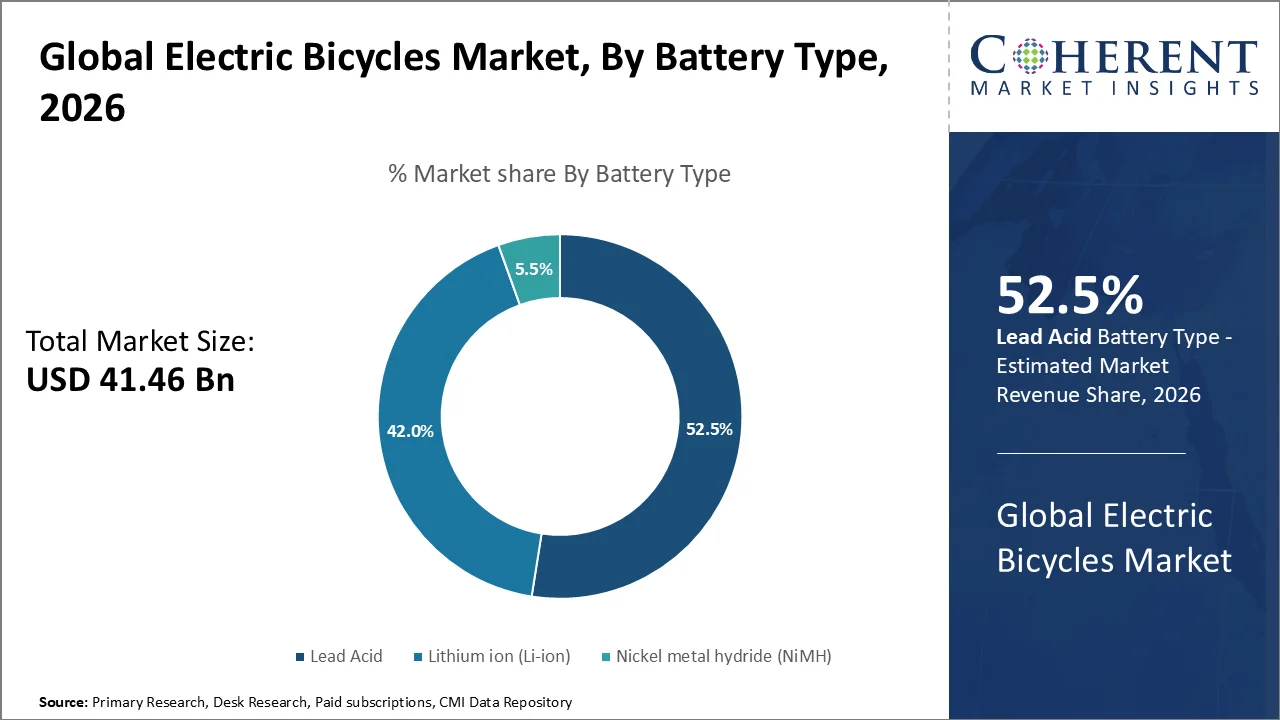
Why is the Lead Acid Battery Segment Acquiring the Largest Share?
On the basis of battery type, the Lead Acid battery segment is projected to account for the largest Electric Bicycles Market share of 52.5% in 2026. The segment’s growth is owing to its comparatively lower acquisition cost, established manufacturing ecosystem, mature recycling infrastructure, and continued suitability for price-sensitive electric bicycle applications.
In February 2025, Batteries International said that an electric bicycle replacement scheme covered over 1.38 million e-bikes in 2024, with subsidies of some USD 84 million. The updated incentive scheme provided stronger incentives to consumers switching from lithium-battery e-bikes to lead-acid ones, which underscores the continued commercial viability of lead-acid technology for high-volume e-bike applications.
Why is the City/Urban Segment Acquiring the Largest Share?
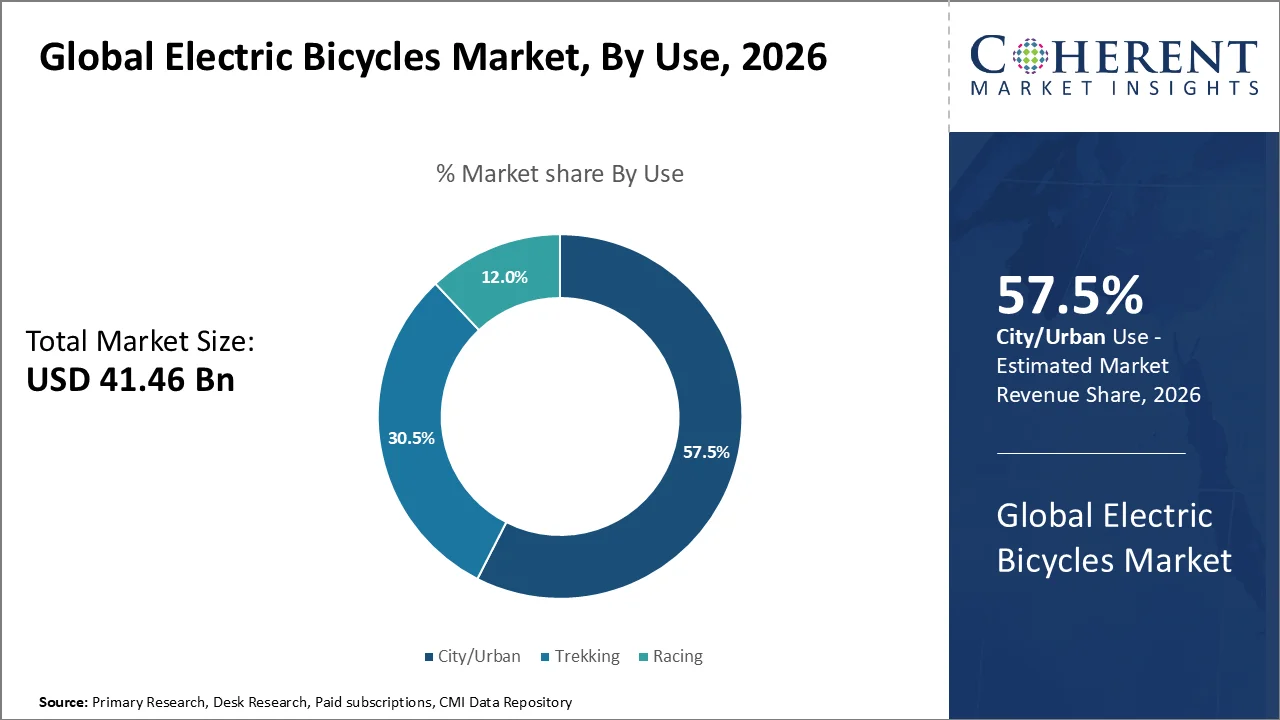
On the basis of use, the City/Urban segment is projected to hold the largest Electric Bicycles Market share of 57.5% in 2026. The segment’s growth is owing to rising demand for short-distance commuting, increasing traffic congestion, expansion of dedicated cycling networks, and growing preference for flexible mobility solutions in densely populated cities.
The European Commission also reported that bike-sharing systems were available across the vast majority of the nearly 300 EU cities with populations above 150,000, representing a combined fleet of approximately 300,000 bicycles. This expanding urban cycling ecosystem supports greater integration of electric bicycles into commuting and shared-mobility networks.
In June 2026, Gazelle launched the Curb, a new urban e-bike developed specifically for city mobility. The model integrates Bosch’s latest 45 Nm Hub Line rear motor, a 360 Wh removable battery, integrated lighting, app-based navigation support, hydraulic disc brakes, and optional front and rear carriers.
Why is the Hub Motor Segment Acquiring the Largest Share?
On the basis of driver mechanism, the Hub Motor segment is projected to account for the largest Electric Bicycles Market share of 65.5% in 2026. The segment’s growth is owing to its compact configuration, comparatively simple drivetrain architecture, cost advantages, ease of integration, and suitability for commuter and mass-market electric bicycle platforms.
According to Hero Motors’ 2024–25 Annual Report, its e-bike powertrain business developed a new hub motor specifically to meet the European requirements for 8–10-speed cassette e-bikes. The company also developed a new hub-motor platform with real-time measurement of winding temperature to avoid overheating and extend the operational life of the motor.
In June 2026, Bosch eBike Systems introduced the Hub Line, their very first hub motor for e-bikes. Specifically designed for urban e-bikes, the rear-hub drive has a torque of 45 Nm, weighs roughly 2.3 kg and boasts a diameter of approximately 100 mm.
Why is the Battery Segment Acquiring the Largest Share?
On the basis of power configuration, the Battery segment is anticipated to hold the largest Electric Bicycles Market share of 71.5% in 2026. The segment’s growth is owing to improvements in rechargeable battery systems, battery-management technologies, energy density, charging performance, and increasing regulatory emphasis on safer electrical systems for e-bikes.
In April 2025, the U.S. Consumer Product Safety Commission reported that compliance with applicable voluntary electrical safety standards was below 11% for e-bikes, compared with approximately 45% across micromobility products overall. The Commission consequently advanced proposed mandatory lithium-ion battery safety requirements for electric bicycles and other micromobility products.
Why is the Battery/Pedal Operated Segment Acquiring the Largest Share?
On the basis of operating mode, the Battery/Pedal Operated segment is projected to dominate the Electric Bicycles Market with 73.0% in 2026. The segment’s growth is owing to the combination of motor assistance with conventional pedaling, enabling riders to extend travel distances, reduce physical effort, and retain bicycle-like operation across commuting and recreational applications.
Germany provides a strong indication of consumer acceptance of electrically assisted bicycles. On March 11, 2026, the German Bicycle Industry Association reported that approximately 2 million e-bikes were sold in Germany during 2025, accounting for 52.7% of total bicycle and e-bike sales. The installed e-bike fleet also exceeded 17 million units.
Why is the Class 1 Segment Acquiring the Largest Share?
On the basis of class, the Class 1 segment is projected to account for the largest Electric Bicycles Market share of 48.5% in 2026. The segment’s growth is owing to its pedal-assist design, moderate assisted speed, compatibility with conventional bicycle infrastructure, and comparatively broad regulatory acceptance for recreational and commuting applications.
In October 2025, PeopleForBikes reported that 17,686 additional miles of U.S. trails were opened to Class 1 electric mountain bikes during 2025, representing the largest single-year expansion recorded by the organization. Oregon also expanded Class 1 access to locations where conventional bicycles are permitted, including natural-surface trails, beaches, and state parks.
Why are OEMs Acquiring the Largest Share?
On the basis of sales channel, the OEMs segment is expected to account for the largest Electric Bicycles Market share of 63.5% in 2026. The segment’s growth is owing to integrated manufacturing capabilities, established dealer and distribution networks, stronger warranty support, product certification capabilities, and increasing investment in complete e-bike powertrain and electrical systems.
According to the German Bicycle Industry Association, Germany produced approximately 1.285 million e-bikes in 2025, while e-bike exports increased by 12% during the year. The scale of domestic manufacturing and growing international shipments demonstrate the continuing importance of established manufacturers in supplying electric bicycles across regional and export markets.
In July 2026, EMotorad, a leading electric bicycle manufacturer in India, announced the establishment of a new electric cycle manufacturing facility in Kuppam, Andhra Pradesh, after signing an MoU with the state government.
Electric Bicycles Market Trends
- Increased corporate bike leasing is expanding access to premium electric bikes. Nearly 2.2 million bicycles were included in company leasing schemes in Germany in 2025, and more than 340,000 employers allowed their employees to lease bikes.
- The growth of refurbishment and second-hand e-bikes is driving circular business models. Bosch announced a digital certification program called Certified by Bosch in June 2026, which provides data on the condition of batteries and drive-units for used e-bikes.
- Shifting focus on battery traceability and circularity is changing electric bicycle product development and lifecycle management. In August 2026, the European Commission released an updated Digital Battery Passport guidance document, which includes 71 data points for battery categories such as light means of transport, including e-bikes.
Regional Insights
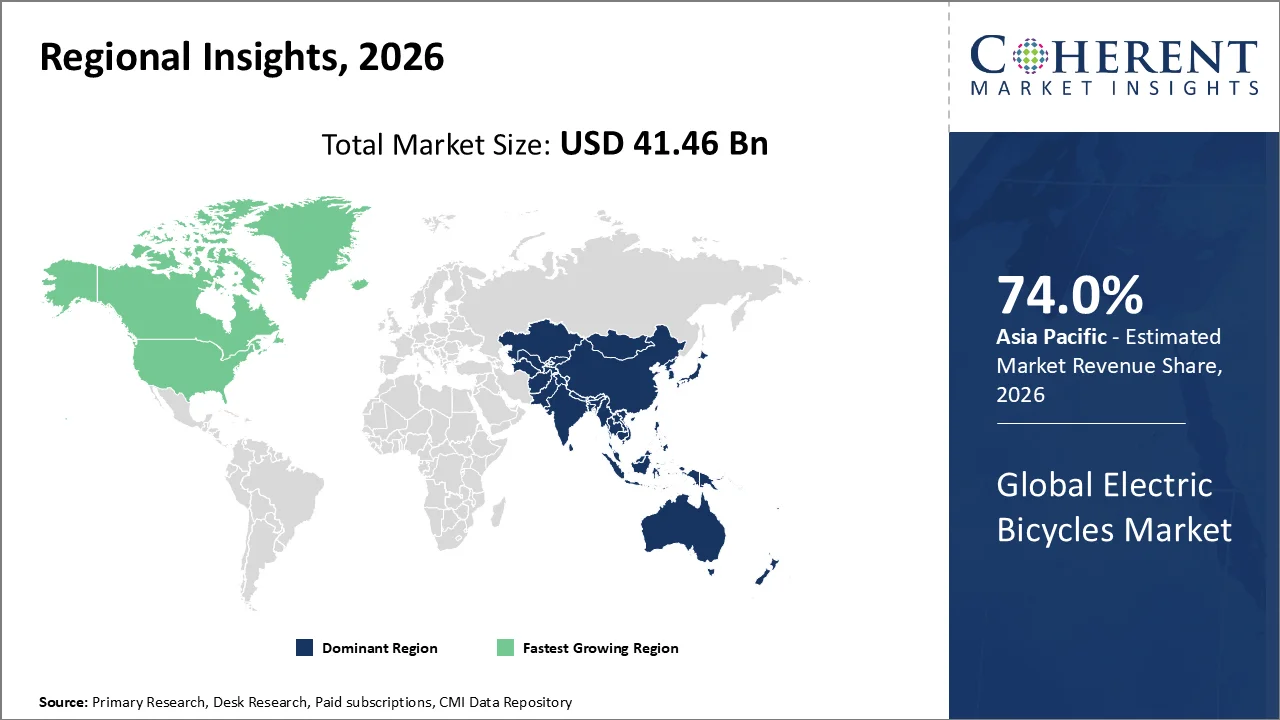
Asia Pacific Dominates Owing to Large-Scale E-Bike Production and Strong Consumer Adoption
The Asia Pacific Electric Bicycles Market dominates the overall market with a share of 74% in 2026. The regional dominance is due to the large base of electric bicycle manufacturing, high penetration of electric two-wheel mobility, dense urban population, well-established supply chains of components, and increasing use of pedal-assisted bicycles for commuting and daily transportation.
In November 2025, Autocar Professional reported that electric bicycles already represented approximately 5–6% of India’s overall bicycle market. EMotorad data also showed that its kids and youth e-cycle segment grew more than 80% year-on-year in 2025, while around 60% of its e-cycle sales were parent-initiated purchases for children.
North America is the Fastest-Growing Region Owing to Expanding Consumer Adoption and Cycling Infrastructure
North America is expected to emerge as the fastest-growing region in the Electric Bicycles Market over the forecast period. Regional growth is being supported by increasing use of e-bikes for commuting and family transportation, expansion of direct-to-consumer sales, development of protected cycling infrastructure, and improving regulatory clarity for electric bicycles.
In June 2026, PeopleForBikes stated that around 450,000 e-bikes were sold in 2024, with a value of around USD 800 million, directly through brand websites in the U.S., a sales channel that is largely not represented in traditional bicycle retail data sets. In 2024, sales of e-bikes in the U.S. reached nearly 1 million, with about 80,000 of those sales being peer-to-peer.
In June 2026, Lectric eBikes, one of the leading North American electric bicycle companies, backed the launch of Monarc, a new premium e-bike brand based in Minnesota. Monarc introduced its first model, the Marker adventure e-bike, at USD 1,999, equipped with two 720 Wh batteries providing 1,440 Wh of combined battery capacity, smart connectivity features, and a five-year warranty.
Strong Product Innovation and Changing Mobility Preferences are Accelerating the Electric Bicycles Market in the United States
The U.S. Electric Bicycles Market is projected to grow at a robust pace. Increasing adoption of e-bikes for commuting and regular transportation, launch of models with throttle controls, growth of OEM product lines and increasing consumer acceptance beyond traditional cycling applications are some of the factors driving growth.
According to PeopleForBikes published June 24, 2026, showed that e-bikes represented roughly 7% of total U.S. bicycle unit sales in 2024, compared with about 53% in Germany. Despite a large bicycle consumer base, the relatively low penetration indicates significant headroom for future adoption of electric bicycles in the U.S.
China Electric Bicycles Market Trends
China continues to represent a major growth and manufacturing center for the Electric Bicycles Market owing to its large installed base, extensive domestic production capacity, government-supported replacement programs, established retail ecosystem, and tightening product-safety requirements.
China is simultaneously tightening product quality and safety standards. New mandatory electric bicycle safety standards took effect on September 1, 2025, strengthening oversight across manufacturing, sales, registration, and vehicle modification. During the first half of 2025, the country recorded 7,048 e-bike-related fires, a 44.7% decline year-on-year, indicating how safety regulation and replacement of older vehicles are becoming important elements of market modernization.
Who are the Major Companies in Electric Bicycles Industry
Some of the major key players in Electric Bicycles Market are Accell Group, Derby Cycle AG, Easy Motion, Jiangsu Xinri E-Vehicle Co. Ltd., Panasonic, Pedego, Stromer, Yadea Technology Group Co. Ltd., BionX, Bosch, Electric Bike Technologies LLC, Giant Bicycles, GRACE, Superpedestrian, and Trek.
Key News
- In April 2026, Accell announced several new and updated e-bike models across its portfolio, including the Ghost E-Riot EMTB, Haibike AllMtn ABS, HYBE, and Winora Yucatan trekking e-bike.
- In July 2026, Pedego introduced the Ridge Rider 2 and Latch 2, the first models under its new Pedego 2.0 portfolio. Both use a 750 W motor producing 90 Nm torque and an 835 Wh battery; the Ridge Rider 2 provides an estimated range of up to 90 miles, while the folding Latch 2 provides up to 84 miles.
Market Report Scope
Electric Bicycles Market Report Coverage
| Report Coverage | Details | ||
|---|---|---|---|
| Base Year: | 2025 | Market Size in 2026: | USD 41.46 Bn |
| Historical Data for: | 2020 To 2024 | Forecast Period: | 2026 To 2033 |
| Forecast Period 2026 to 2033 CAGR: | 10.1% | 2033 Value Projection: | USD 81.32 Bn |
| Geographies covered: |
| ||
| Segments covered: |
| ||
| Companies covered: | Accell Group, Derby Cycle AG, Easy Motion, Jiangsu Xinri E-Vehicle Co. Ltd., Panasonic, Pedego, Stromer, Yadea Technology Group Co. Ltd., BionX, Bosch, Electric Bike Technologies LLC, Giant Bicycles, GRACE, Superpedestrian, and Trek. | ||
| Growth Drivers: |
| ||
| Restraints & Challenges: |
| ||
Analyst Opinion
- The Electric Bicycles Market is moving from its post-pandemic inventory correction toward a more structurally balanced growth phase, supported by increasing use of e-bikes for commuting, utility mobility, recreation, and premium cycling. Analysts anticipate that future growth will be increasingly driven by product innovation, affordability, battery safety, connected features and stronger distribution networks rather than short-term demand spikes.
- Recent trade figures suggest that demand for e-bikes is strong in foreign markets. Imports of e-bikes into the EU rose 36% year-over-year to about 422,000 units in the first half of 2026, reflecting continued replenishment and cross-border demand despite pressure in a number of mature European bicycle markets.
- The market is also moving more to high-value electric bicycles rather than just unit growth. In 2025, the contribution of e-bikes to the total turnover generated by the bicycle market in Spain reached 35.2%, while they constituted only 21.5% of the bicycle units sold. The overall bicycle market in Spain increased by 9% YoY reaching €1.4 billion, while overall bicycle unit sales declined slightly by 0.7%.
Speak to the analyst
Want personalized insights?
Take the findings above to one of our principal consultants, or have the report rebuilt around the segments, geographies and competitors you actually track.
Market Segmentation
- By Battery Type (Revenue, USD Bn, 2021-2033)
- Lead Acid
- Lithium ion (Li-ion)
- Nickel metal hydride (NiMH)
- By Use (Revenue, USD Bn, 2021-2033)
- City/Urban
- Trekking
- Racing
- By Driver Mechanism (Revenue, USD Bn, 2021-2033)
- Hub Motor
- Mid Motor
- By Plug-in/Battery (Revenue, USD Bn, 2021-2033)
- Plug-in
- Battery
- By Operating Mode (Revenue, USD Bn, 2021-2033)
- Battery/Peddle Operated
- Throttle Operated
- By Class (Revenue, USD Bn, 2021-2033)
- Class 1
- Class 2
- Class 3
- By Sales Channel (Revenue, USD Bn, 2021-2033)
- OEM’s
- Aftermarket
- By Region (Revenue, USD Bn, 2021-2033)
- North America
- U.S.
- Canada
- Latin America
- Brazil
- Mexico
- Argentina
- Rest of Latin America
- Europe
- Germany
- U.K.
- France
- Italy
- Spain
- Russia
- Rest of Europe
- Asia Pacific
- China
- India
- Japan
- Australia
- South Korea
- ASEAN
- Rest of Asia Pacific
- Middle East
- GCC
- Israel
- Rest of Middle East
- Africa
- South Africa
- Central Africa
- North Africa
- North America
Sources
Primary Research Interviews
- Electric bicycle manufacturers and OEMs
- E-bike battery manufacturers and suppliers
- Electric motor and drivetrain manufacturers
- Bicycle component and powertrain suppliers
- E-bike distributors and specialty bicycle retailers
- Urban mobility and bike-sharing operators
- Fleet, delivery, and last-mile logistics operators
- Cycling infrastructure and transportation planning experts
- Key opinion leaders (KOLs) in electric mobility and cycling
Databases
- World Bank
- Organisation for Economic Co-operation and Development (OECD)
- Eurostat
- UN Comtrade Database
- International Trade Centre (ITC) Trade Map
- U.S. Department of Transportation (DOT) transportation databases
- European Commission mobility and transport databases
Magazines
- Bike Europe
- Bicycle Retailer and Industry News
- News
- BikeBiz
- Electric Bike Report
- Autocar Professional
Journals
- Transportation Research Part A: Policy and Practice
- Transportation Research Part D: Transport and Environment
- Journal of Transport Geography
- Sustainable Cities and Society
- Journal of Cleaner Production
- Applied Energy
- International Journal of Sustainable Transportation
Newspapers
- Financial Times
- The Guardian
- The New York Times
- The Wall Street Journal
- The Economic Times
- Financial Express
Associations
- PeopleForBikes
- Cycling Industries Europe (CIE)
- Confederation of the European Bicycle Industry (CONEBI)
- German Bicycle Industry Association (ZIV)
- European Cyclists’ Federation (ECF)
- Bicycle Association of Great Britain
- All India Cycle Manufacturers’ Association (AICMA)
Public Domain Sources
- Company annual reports and investor presentations
- Electric bicycle manufacturer product catalogs and technical specifications
- Government electric mobility and cycling policy publications
- National transportation and urban mobility statistics
- Battery safety and certification publications from regulatory authorities
- Import and export statistics for bicycles, e-bikes, batteries, and components
- Government incentive and e-bike subsidy program publications
- Cycling infrastructure and bicycle-use statistics
- Company press releases covering new e-bike launches, manufacturing expansion, and partnerships
- Regulatory publications covering battery safety, e-bike classification, and product standards
Proprietary Elements
- CMI Data Analytics Tool
- Proprietary CMI Existing Repository of Information for the Last 10 Years
Get access to 250+ pages report
Every segment, forecast, competitor profile and data table behind the analysis above — available for instant download.
- ESOMAR Member
- ISO 9001:2015 Certified
- D-U-N-S Registered
- GDPR & CCPA Compliant
Missing comfort of reading report in your local language? Find your preferred language:
Transform your Strategy with Exclusive Trending Reports
Frequently Asked Questions
The Electric Bicycles Market is expected to reach USD 81.32 Bn in 2033, increasing from USD 41.46 Bn in 2026.
Major players operating in the global Electric Bicycles Market include Accell Group, Derby Cycle AG, Easy Motion, Jiangsu Xinri E-Vehicle Co. Ltd., Panasonic, Pedego, Stromer, Yadea Technology Group Co. Ltd., BionX, Bosch, Electric Bike Technologies LLC, Giant Bicycles, GRACE, Superpedestrian, and Trek.
The high upfront cost of electric bicycles and battery safety and fire-related concerns are the key factors hampering growth of the market.
The increasing adoption of electric bicycles for urban commuting, rising government support for sustainable and low-emission mobility, expanding cycling infrastructure, and growing preference for convenient alternatives to passenger cars are boosting demand for electric bicycles.
The Electric Bicycles Market is anticipated to grow at a CAGR of 10.1% between 2026 and 2033.
Among regions, Asia Pacific is expected to account for the largest market share in the global Electric Bicycles Market, with an estimated 74.0% share in 2026. The dominance is supported by large-scale manufacturing, high penetration of electric two-wheel mobility, dense urban populations, and established component supply chains.
An electric bicycle is a bicycle equipped with an electric motor and battery system that assists or powers riding. The market includes both battery/pedal-operated and throttle-operated models, with different motor and battery configurations.