

Agricultural Tires Market Size and Trends- (2026-2033)
Global agricultural tires market is estimated to be valued at USD 7.04 Bn in 2026 and is expected to reach USD 10.33 Bn by 2033, exhibiting a compound annual growth rate (CAGR) of 5.6% from 2026 to 2033.
Key Takeaways
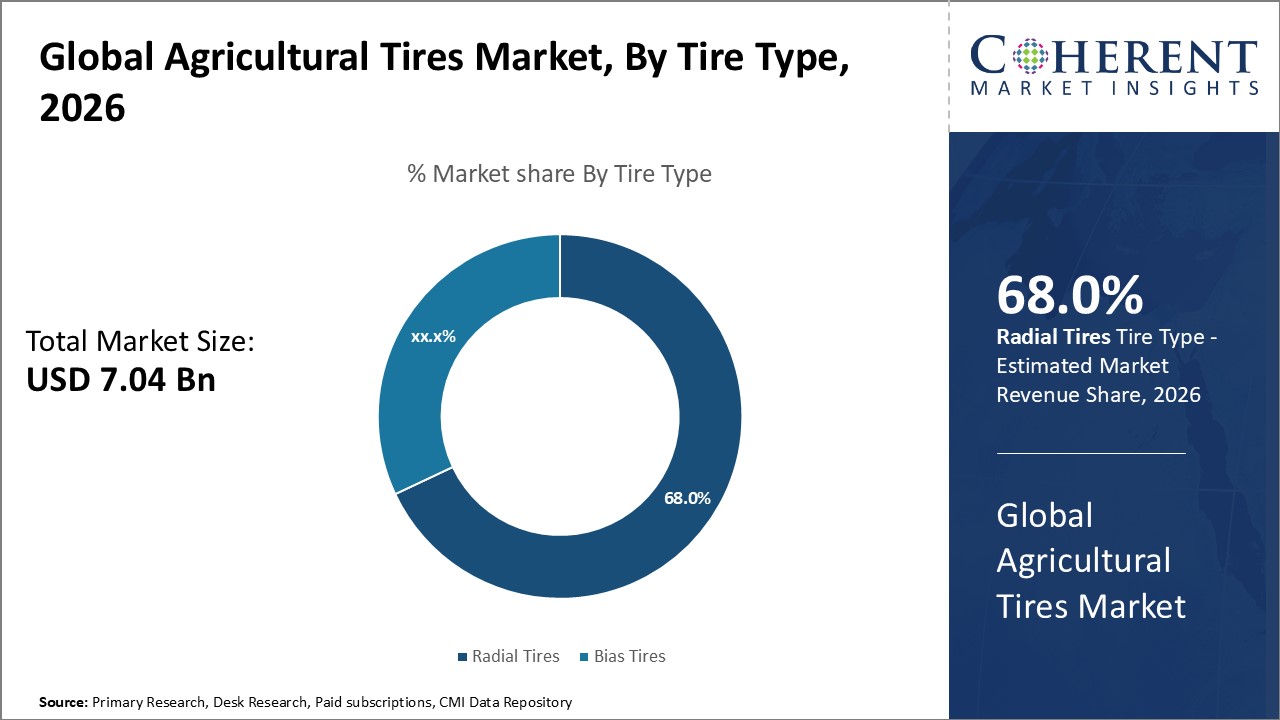
- Based on Tire Type, Radial Tires segment is projected to account for 68% share of the market in 2026.
- Based on Sales Channel, the OEM segment is expected to hold 72.81% share in 2026.
- Based on Application, the tractor segment is expected to lead the market with 71% share in 2026.
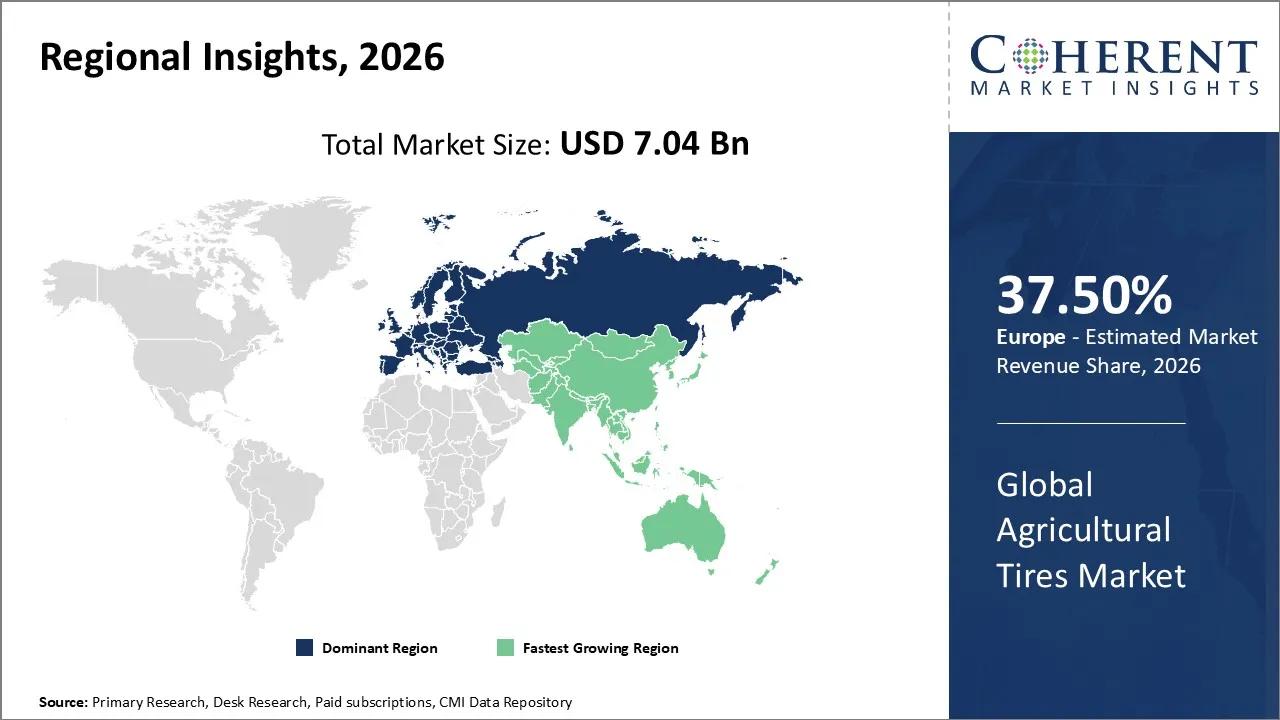
- Based on Region, Europe is set to lead the agricultural tires market with 37.5% share in 2026. While, Asia Pacific is anticipated to be the fastest growing region.
Market Overview
Growing demand for farm equipment and the need to improve agricultural productivity are major factors that are expected to boost demand for agricultural tires. Technological advancements in tire design for improved traction, load-bearing capacity and reduced soil compaction are increasing the adoption of specialized agricultural tires. Furthermore, growing mechanization in developing markets is creating new opportunities for various agriculture equipment and attached tires. Tire manufacturers are focusing on introducing value-added and customized products with added features as per customer requirements to gain higher market share.
Current Event and Its Impacts on Agricultural Tires Market
Current Event | Description and its Impact |
China's Agricultural Modernization and Food Security Policies |
|
Technological Advancement in Smart Agriculture |
|
What keeps tractor tire demand steady every 5–7 years?
- Fuel Savings: Radial tires reduce fuel consumption by 5–15% compared to bias tires.
- Load Capacity: Advanced radial designs increase load capacity by 14%, extending service life.
- Rolling Resistance: New-generation tires cut rolling resistance by 25–30%, improving efficiency.
- Replacement Cycle: Average tractor tire replacement occurs every 5–7 years, sustaining aftermarket demand.
- Current Industry Events of 2026
- Market Size Estimation
- Regional Breakdown
- Competitive Landscape
- Customer Intelligence
- Segmental Analysis
- Pricing Analysis
- Key Market Drivers, Challenges & Future Trends
- Customized Insights Section
Segmental Insights
How does durable performance drive bias tire dominance in the agricultural tires market?
By tire type, the radial tires segment is estimated to contribute the highest share of 68% in 2026, due to last longer, use less fuel, and have better traction. Their design helps keep the soil compaction, which is good for long-term farming. OEMs are putting radial tires on a rising number of tractors and harvesters, which is driving adoption. Even though it costs more, radial technology is the best choice around the world simply due to its performance benefits.
How do direct sales drive OEM segment leadership in the agricultural tires market?
By sales channel, OEM segment is estimated to contribute the highest share of 72.81% in 2025, due to the strategic advantages of direct sales between tire manufacturers and agricultural machinery producers. Original equipment manufacturers (OEMs) leverage established partnerships with tire brands to pre-install optimized tire models during vehicle assembly. This bundling facilitates one-stop shopping convenience for farmers and ensures equipment arrives production-ready straight from the factory.
For instance, in October 2025, the launch of the Mahindra Oja tractor in Australia, with help from CEAT Specialty Tires, demonstrates that OEMs are involved in agricultural tires. CEAT sells tires directly to new tractors, which makes OEMs even more powerful. This partnership shows that there is a growing need for advanced radial technology. It fits with global trends in mechanized farming and sustainability, which helps OEM stay on top of the market.
How does versatility drive tractor tire dominance in the agricultural tires market?
By application, tractors segment is estimated to contribute the highest share of 71% in 2025, owing to their versatile multifunctional usage. Tractors serve as the backbone vehicle for a wide variety of field tasks from basic plowing and disking to advanced operations like planting, fertilizing and harvesting. Unlike other machinery, tractors fulfill various sequential roles seamlessly throughout the entire crop cycle without needing to be swapped in and out repeatedly.
For instance, in September 2025, Tolins Tyres added heavy-duty rear tires for tractors to its agricultural line. These tires are sold through more than 1,200 dealers across India. This launch is aimed directly at tractors, which are the major market for agricultural tires. The move makes Tolins more important in the farming equipment market and shows that tractors are still the most popular type of tire and that the agricultural market is growing.
Regional Insights
Europe Agricultural Tires Market Analysis & Trends
Europe is expected to dominant the agricultural tires market with 37.5% in 2026, due to mechanized farming is becoming more common, radial tires are becoming increasingly prevalent, and major manufacturers like Michelin and Trelleborg have a strong presence in the region. Europe is the largest regional market in the world due to there is an immense amount of demand for sustainable, efficient equipment and well-established distribution networks.
For instance, in November 2025, Mitas added the Granterra VF PFO tire line for high-horsepower tractors, which strengthens its position in the agricultural tire market. These tires are built to last and work well, and they use cutting-edge technology to meet the needs of modern farming. Mitas' launch shows how committed the company is to coming up with new ideas that meet the need for environmentally friendly, high-performance solutions in the agricultural equipment market.
Asia Pacific Agricultural Tires Market Analysis & Trends
One of the fastest growing regions in the agricultural tires market is Asia Pacific with 7.33% in 2025, led by increasing mechanization of farms chiefly in India and China. These countries are the largest producers of rice, wheat and other commodities worldwide and have witnessed rising demand for high-capacity harvesting equipment in the last decade. Subsequently, operators prefer specialized tire fits incorporating advanced rubber compounds for intensive grain collection activities. An expanding middle-class with greater access to machinery loans is enabling more smallholder farms to upgrade their vehicle fleets as well.
For instance, in December 2025, India-based Tolins Tyres has added a heavy-duty rear tractor tire to its line of agricultural tires. The tire is built to last and work well, and it helps farmers during tough harvest seasons. This growth makes Tolins a stronger player in the Indian agricultural market by giving them a full range of tires for the front, back, trailer, and tiller.
Agricultural Tires Market Outlook Country-Wise
Germany Agricultural Tires Market Trends
In 2026, the agricultural tire market in Germany is going to be competitive driven by high levels of mechanization in farming, a strong need for replacements, rules about sustainability, and the use of advanced machinery. Germany's vast farms, forestry operations, and EU rules on sustainability all help the market for specialized agricultural tires grow steadily.
For instance, October 2025, At Agritechnica 2025 in Hanover, Germany, Mitas showcased its newest innovations in agricultural tires. The company plans to launched a new product that will be added to its line of products, focusing on durability and performance. People will also see Mitas PowerPull tires on the Green Monster Stage V tractor, which shows how strong and dependable they are.
China Agricultural Tires Market Trends
In 2026, the agricultural tire market in China is extremely competitive due to farming is becoming more mechanized quickly, the government is supporting modern agriculture, tractor sales are going up, and new technologies are being used to make tires. China's huge agricultural sector and drive for efficiency make it one of the fastest-growing markets in the world.
For instance, in October 2025, At the China International Agricultural Machinery Exhibition 2025 in Wuhan, Aulice Tire showcased new radial agricultural tires. The Unicorn 460/85R38 and other tractor models were some of the bests. They had less rolling resistance, saved fuel, and could carry more weight. These new ideas help Aulice become more well-known in China's farming areas, which helps with efficiency and durability.
Market Report Scope
Agricultural Tires Market Report Coverage
| Report Coverage | Details | ||
|---|---|---|---|
| Base Year: | 2025 | Market Size in 2026: | USD 7.04 Bn |
| Historical Data for: | 2020 To 2024 | Forecast Period: | 2026 To 2033 |
| Forecast Period 2026 to 2033 CAGR: | 5.6% | 2033 Value Projection: | USD 10.33 Bn |
| Geographies covered: |
| ||
| Segments covered: |
| ||
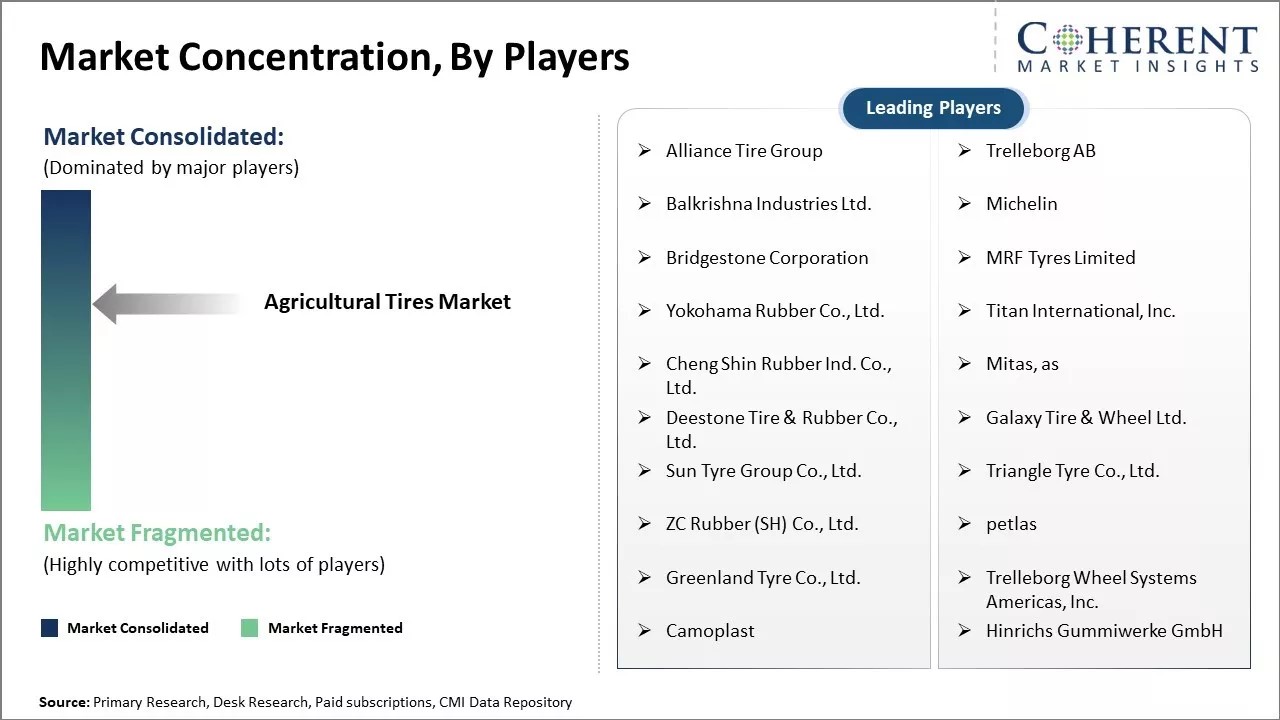
| Companies covered: | Alliance Tire Group, Trelleborg AB, Balkrishna Industries Ltd., Michelin, Bridgestone Corporation, MRF Tyres Limited, Yokohama Rubber Co., Ltd., Titan International, Inc., Cheng Shin Rubber Ind. Co., Ltd. , Mitas, as, Deestone Tire & Rubber Co., Ltd., Galaxy Tire & Wheel Ltd., Sun Tyre Group Co., Ltd., Triangle Tyre Co., Ltd., ZC Rubber (SH) Co., Ltd., petlas, Greenland Tyre Co., Ltd., Trelleborg Wheel Systems Americas, Inc., Camoplast, Hinrichs Gummiwerke GmbH | ||
| Growth Drivers: |
| ||
| Restraints & Challenges: |
| ||
Agricultural Tires Market Driver
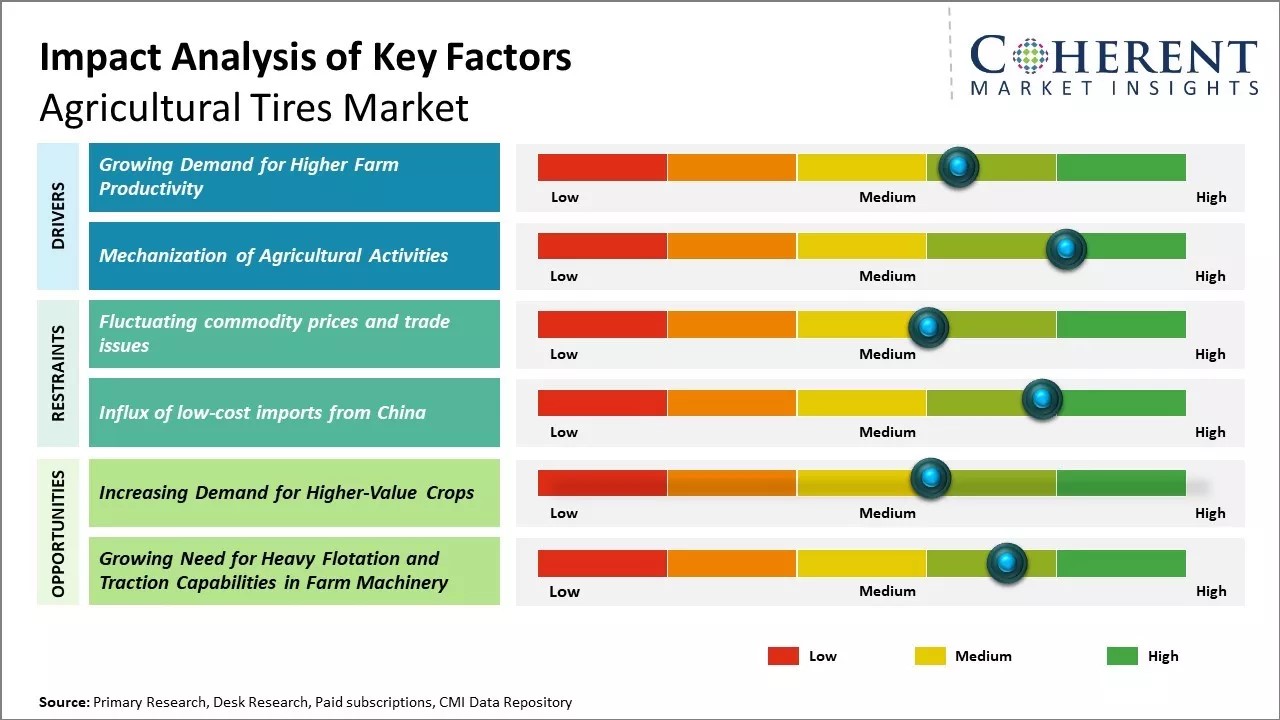
Growing Demand for Higher Farm Productivity
Growing global population and rising demand for food leads to increased pressure on farmers to boost their agricultural productivity and output. Agricultural tires play a vital role in enabling higher farm productivity through their various functional benefits. Tires with deeper tread patterns and larger surface areas are able to effectively maneuver through soil and withstand heavier loads, allowing farmers to plow deeper and transport more crops per trip. This helps increase the per-acre yield for various commodities.
The tires also provide better traction and floatation to farming vehicles and equipment, reducing compaction of soil. This helps preserve the quality of farmland and supports repeatable high yields over many harvest seasons. As countries aim to meet the rising demand for food through domestic production, farmers are increasingly adopting high-performance agricultural tires to maximize their output through higher productivity per acre. This growing focus on boosting agricultural yields through advanced tire technologies boosts demand for agricultural tires worldwide.
Mechanization of Agricultural Activities
Traditional manual practices are increasingly being replaced by modern machinery for various farming activities such as tilling, planting, fertilizing, crop protection, harvesting and post-harvest management. While mechanization helps improve efficiency, reduce costs and boost overall farm output, it has also led to a steep rise in the quantity of tractors, harvesters, applicators and other vehicles used on the fields. All of these machines depend highly on robust and heavy-duty tire sets to effectively navigate varied terrains and carry heavier loads. Moreover, modern tires allow faster transition between operations while maintaining safety and control.
For instance, in May 2023, Yokohama Off-Highway Tires (YOHT) launched AGRI STAR II R – I, a cutting-edge agricultural tire in India. Featuring radial construction and incorporating 'Stratified Layer Technology' (SLT), this tire is engineered to meet the evolving requirements of modern tractor owners.
Agricultural Tires Market Opportunities
Increasing Demand for Higher-Value Crops
Demand for higher-value crops from specialty agriculture is growing. As farms consolidate and machinery expands, heavier flotation and traction capabilities are needed. Technological advancements in materials and tread design can enhance durability. The development of digital farming practices also enables
Market Concentration and Competitive Landscape
Analyst Opinion (Expert Opinion)
- The global agricultural tires market shows steady demand due to the mechanization of farming and the growth of modern farming methods. Most of the demand for tires comes from tractors, harvesters, and other farm equipment. Tractor tires are the most popular type of tire as they are used on both small and large farms. Data from the industry show that more than two million tractors are made every year, which directly supports the steady demand for replacement and OEM tires.
- Increasing number of people are choosing radial agricultural tires over bias tires as they provide better traction, less soil compaction, and a longer service life. Radial designs now make up a large part of new installations in developed markets, especially in North America and Europe, where precision farming and maximizing yield are important. Bias tires, on the other hand, are still useful in areas where cost is a concern as they are less expensive to buy up front and work well on rough terrain.
- Replacement demand makes up most of overall consumption because agricultural tires need to be replaced often because they have to deal with heavy loads and difficult working conditions. The agricultural tires market is influenced by the level of mechanization on farms, improvements in tire technology, and a growing awareness of the need to protect soil. This means that demand for these tires will remain stable over time around the world.
Speak to the analyst
Want personalized insights?
Take the findings above to one of our principal consultants, or have the report rebuilt around the segments, geographies and competitors you actually track.
Agricultural Tires Industry News
- In July 2025, Trelleborg's new TM800 Powerflex tire in South Africa adds to its line of agricultural tires. This tire is made for tractors and gives them more durability, flexibility, and better performance in tough farming conditions. This new product shows that Trelleborg is dedicated to helping African farmers with cutting-edge tools that make modern farming more efficient and reliable.
- In April 2025, Continental may continue to make agricultural tires and will instead focus on material handling, earthmoving, and port operations. The Lousado, Portugal plant is going to cease making tires, but it will still honor its contracts for TractorMaster, Tractor70, Tractor85, CombineMaster, and CompactMaster tires until they are finished.
- In February 2023, Continental introduced its largest-ever tractor tire, tailored for high-horsepower tractors, boasting improved load-carrying capacity, enhanced traction, and reduced soil compaction. With its sturdy build and advanced tread design, this tire is engineered to meet the demands of modern agriculture, delivering heightened efficiency and productivity in the field.
Market Segmentation
- Tire Type Insights (Revenue, USD Bn, 2026 - 2033)
- Bias Tires
- Radial Tires
- Sales Channel Insights (Revenue, USD Bn, 2026 - 2033)
- OEM
- Aftermarket
- Application Insights (Revenue, USD Bn, 2026 - 2033)
- Tractors
- Combine Harvesters
- Sprayers
- Trailers
- Loaders
- Others
- Regional Insights (Revenue, USD Bn, 2026 - 2033)
- North America
- U.S.
- Canada
- Latin America
- Brazil
- Argentina
- Mexico
- Rest of Latin America
- Europe
- Germany
- U.K.
- Spain
- France
- Italy
- Russia
- Rest of Europe
- Asia Pacific
- China
- India
- Japan
- Australia
- South Korea
- ASEAN
- Rest of Asia Pacific
- Middle East & Africa
- South Africa
- GCC Countries
- Israel
- Rest of Middle East & Africa
- Key Players Insights
- Alliance Tire Group
- Trelleborg AB
- Balkrishna Industries Ltd.
- Michelin
- Bridgestone Corporation
- MRF Tyres Limited
- Yokohama Rubber Co., Ltd.
- Titan International, Inc.
- Cheng Shin Rubber Ind. Co., Ltd.
- Mitas, as
- Deestone Tire & Rubber Co., Ltd.
- Galaxy Tire & Wheel Ltd.
- Sun Tyre Group Co., Ltd.
- Triangle Tyre Co., Ltd.
- ZC Rubber (SH) Co., Ltd.
- petlas
- Greenland Tyre Co., Ltd.
- Trelleborg Wheel Systems Americas, Inc.
- Camoplast
- Hinrichs Gummiwerke GmbH
Sources
Primary Research Interviews
- Agricultural Tire Manufacturers
- OEMs of Agricultural Machinery & Tractors
- Farm Equipment Dealers & Distributors
- Agricultural Machinery Engineers & Design Consultants
- Large-Scale Farm Operators & Agri-Cooperatives
- Raw Material Suppliers (Rubber & Reinforcement Materials)
- Others
Databases
- Bloomberg Terminal
- Thomson Reuters Eikon
- IHS Markit
- Euromonitor International
- S&P Global Market Intelligence
- FAO Statistical Databases
- Others
Magazines
- Farm Equipment Magazine
- AgriBusiness Global
- Tire Technology International
- Rubber World Magazine
- Modern Agriculture Magazine
- Others
Journals
- Journal of Terramechanics
- Biosystems Engineering
- International Journal of Agricultural Engineering
- Journal of Rubber Research
- Applied Engineering in Agriculture
- Others
Newspapers
- Financial Times
- The Wall Street Journal
- Reuters
- Bloomberg News
- The Economic Times (Agri & Auto Segments)
- Others
Associations
- European Tyre and Rubber Manufacturers’ Association (ETRMA)
- Tire Industry Association (TIA)
- Agricultural Machinery Manufacturers Association (AMMA)
- Association of Equipment Manufacturers (AEM)
- International Rubber Study Group (IRSG)
- Others
Public Domain Sources
- Food and Agriculture Organization of the United Nations (FAO)
- U.S. Department of Agriculture (USDA)
- European Commission – Agriculture & Rural Development
- World Bank Open Data
- International Trade Centre (ITC) Trade Map
- National Bureau of Statistics (Country-Level Data)
- Others
Proprietary Elements
- CMI Data Analytics Tool
- Proprietary CMI Existing Repository of Information for the Last 8 Years
*Definition: The agricultural tires market refers to the market for tires that are specifically designed for agricultural vehicles and equipment. These tires are built to withstand tough operating conditions such as abrasive soil, mud, and off-road terrain. Agricultural tires are wider and have deeper tread patterns for better traction compared to standard tires. These are more durable and offer improved traction to handle heavy loads on farms and in agricultural applications. The demand for agricultural tires depends on the sale of new agricultural machinery and replacement of the existing fleet of agricultural vehicles.
Get access to 250+ pages report
Every segment, forecast, competitor profile and data table behind the analysis above — available for instant download.
- ESOMAR Member
- ISO 9001:2015 Certified
- D-U-N-S Registered
- GDPR & CCPA Compliant
Missing comfort of reading report in your local language? Find your preferred language:
Transform your Strategy with Exclusive Trending Reports
Frequently Asked Questions
The Agricultural Tires Market is estimated to be valued at USD 7.04 Bn in 2026, and is expected to reach USD 10.33 Bn by 2033.
The CAGR of the Agricultural Tires Market is projected to be 5.6% from 2026 to 2033.
Growing demand for higher farm productivity and mechanization of agricultural activities are the major factors driving the growth of global agricultural tires market.
Fluctuating commodity prices and trade issues and Influx of low-cost imports from China are the major factors hampering the growth of global agricultural tires market.
In terms of Tire type, bias tires segment is estimated to dominate the market in 2026.
Alliance Tire Group, Trelleborg AB, Balkrishna Industries Ltd., Michelin, Bridgestone Corporation, MRF Tyres Limited, Yokohama Rubber Co., Ltd., Titan International, Inc., Cheng Shin Rubber Ind. Co., Ltd. , Mitas, as, Deestone Tire & Rubber Co., Ltd., Galaxy Tire & Wheel Ltd., Sun Tyre Group Co., Ltd., Triangle Tyre Co., Ltd., ZC Rubber (SH) Co., Ltd., petlas, Greenland Tyre Co., Ltd., Trelleborg Wheel Systems Americas, Inc., Camoplast, Hinrichs Gummiwerke GmbH are the major players.
North America is expected to lead the global agricultural tires market in 2026.