

Bulk Terminals Market Size and Share Analysis - 2026 To 2033
The Bulk Terminals Market is anticipated to grow at a CAGR of 3.6% with USD 20,720.0 Mn share in 2026 and is expected to reach USD 25,800.0 Mn in 2033. The global bulk terminals industry remains a cornerstone of maritime logistics, handling vast volumes of dry and liquid commodities that underpin global trade. For instance, in January 2025, according to the U.S. Bureau of Transportation Statistics’ 2025 Annual Port Performance Report, U.S. ports processed over 965.9 Mn short tons of dry bulk in 2022, led by Gulf Coast terminals. In India, Major Ports achieved a record cargo throughput of 915 Mn tonnes in FY 2025‑26 (reported by the Ministry of Ports, Shipping & Waterways, 2026). Robust port efficiency enhancements, digitalization, and infrastructure upgrades continue strengthening handling capacity worldwide.
Source: U.S. Department of Transportation
Key Takeaways
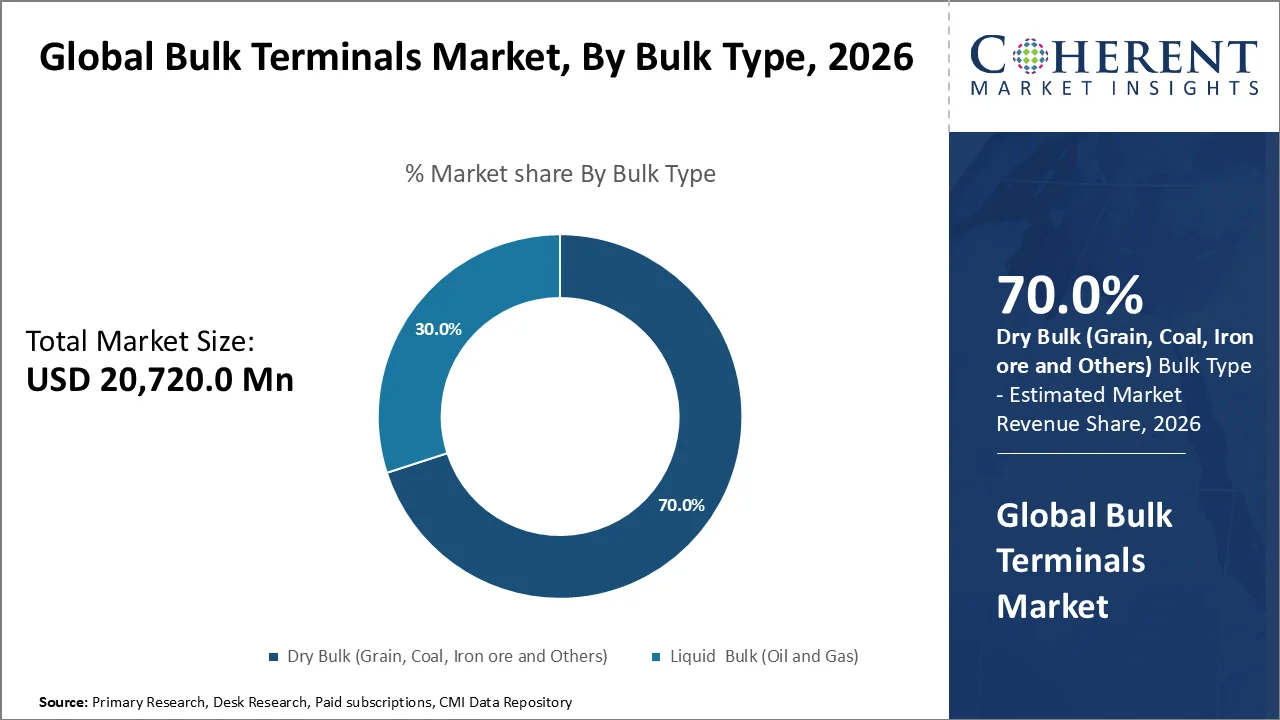
- Dry Bulk is expected to account the largest share of 70.0% in 2026, mainly because it underpins global trade in raw materials such as iron ore, coal and grains that feed industry, energy and food supply chains, supported by high port throughput and infrastructure investment. For instance, in January 2026, the US Bureau of Transportation Statistics reports 119 U.S. ports each handled over 1 M dry bulk short tons in 2023, with the top 25 handling ~618 M short tons of dry bulk cargo. Additionally, in April 2026, in India, Ministry of Ports, Shipping and Waterways data show dry bulk cargo growing ~16.7% at major ports in FY 2025–26, outpacing overall cargo categories. In the EU, Eurostat’s 2025 figures indicate dry bulk remains a significant cargo type in major ports alongside liquid bulk and containers, reflecting its continued trade importance (data accessed 2026). These institutional datasets underscore consistent high volumes and growth dynamics for dry bulk shipments, making it the dominant bulk terminal segment.
Source: U.S. Department of Transportation; Ministry of Ports, Shipping and Waterways; European Union
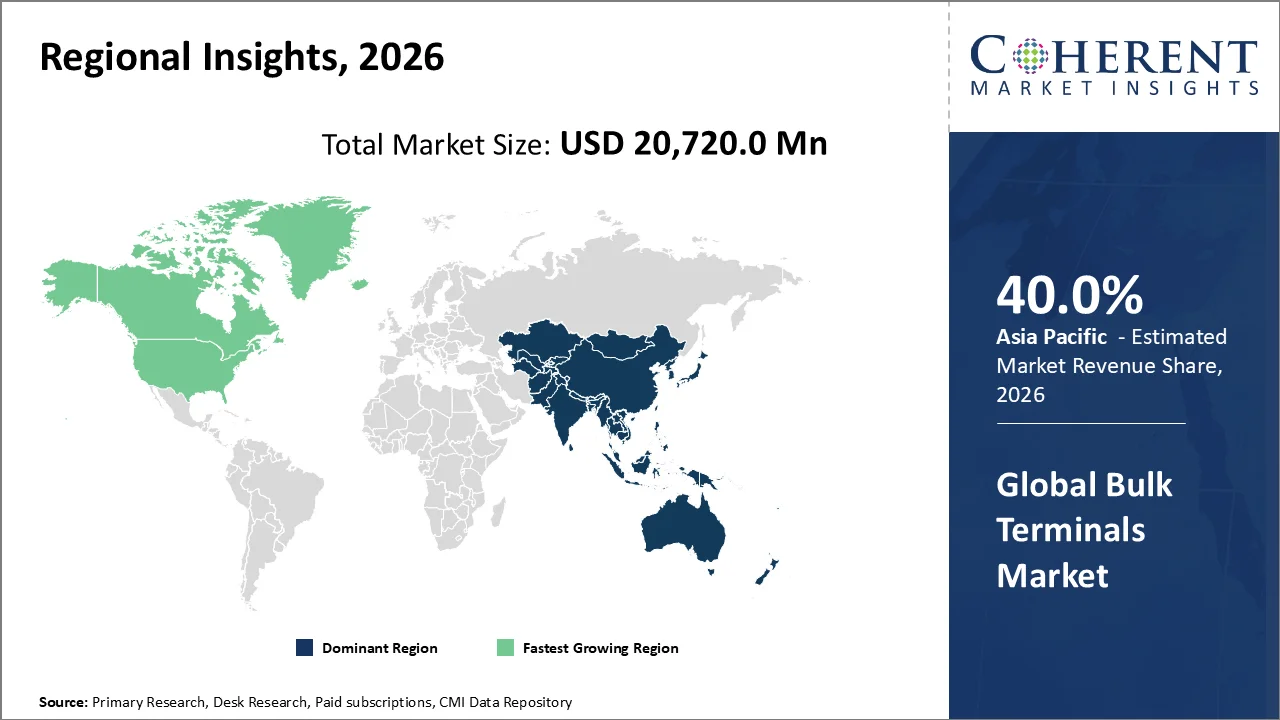
- Asia Pacific is expected to acquire the dominant share of 40.0% in 2026, it anchors the world’s largest volumes of bulk commodity trade and port throughput, driven by rapid industrialization, infrastructure expansion, and high import demand for raw materials such as iron ore, coal and grains. For instance, in April 2026, India’s major ports handled a record 915 Mn tonnes of cargo in FY 2025–26, highlighting expanding handling capacity and multimodal connectivity under the Ministry of Ports, Shipping and Waterways’ initiatives.
Segmental Insights
Why is Dry Bulk Acquiring the Largest Market Share?
Dry Bulk is projected to account for the largest share of bulk terminals market in 2026, representing approximately 70.0% of the total volume. The dry bulk segment dominates the bulk terminals market because it handles massive volumes of essential raw materials such as iron ore, coal, grains and fertilizers that underpin global industrial and agricultural supply chains, making it structurally central to seaborne trade and port operations. For instance, according to the US Bureau of Transportation Statistics’ 2026 Port Performance Freight Report, 255 U.S. ports handled dry bulk cargo in 2023, with 119 ports moving over 1 million dry bulk short tons, and the top 25 ports managing 617.9 million short tons of dry bulk in that year, concentrated across Gulf Coast and Great Lakes hubs, highlighting the sheer volume requiring terminal capacity. In EU maritime quarterly data published April 2026, major ports such as Rotterdam, Amsterdam, Constanta, Zeeland Seaports and Hamburg ranked as the top dry bulk handlers in Q3 2025, reflecting consistent dry bulk throughput leadership among EU ports. These institutional datasets underscore dry bulk’s pivotal role in global trade flows and port terminal utilization.
Source: U.S. Department of Transportation; European Commission
- Current Industry Events of 2026
- Market Size Estimation
- Regional Breakdown
- Competitive Landscape
- Customer Intelligence
- Segmental Analysis
- Pricing Analysis
- Key Market Drivers, Challenges & Future Trends
- Customized Insights Section
Market Drivers
Increasing Trade of Natural Gas
Rising trade of natural gas has driven the global bulk terminals market growth over the forecast period. Increasing trade of natural gas, mainly LNG, is driving the Bulk Terminals Market because LNG requires dedicated liquid-bulk infrastructure such as cryogenic storage tanks, loading arms, pipelines, regasification units, berths, and safety systems. For instance, in April 2026, the U.S. EIA reported that U.S. LNG exports are expected to rise by 1.9 Bcf/d in 2026 to average 17.0 Bcf/d, while net U.S. natural gas exports are forecast to grow 18% to 18.7 Bcf/d. The EIA also reported on April 23, 2026 that Golden Pass LNG shipped its first cargo on April 22, 2026, adding new LNG export capacity. Additionally, the Port of Rotterdam Authority reported on April 22, 2026 that LNG throughput increased by 1.7% in Q1 2026, showing stronger LNG movement through major European terminals. Therefore, rising LNG trade directly supports terminal expansion, higher utilization, and modernization of bulk handling infrastructure.
Source: U.S. Energy Information Administration, Port of Rotterdam Authority, U.S. Energy Information Administration
Growing Demand for Grain and Minor Bulks
The growing demand for grain and minor bulks is a significant driver for the growth of the bulk terminals market, particularly in handling agricultural commodities. As global trade in grains like wheat, corn, and barley expands, bulk terminals must enhance their capabilities to handle larger volumes. For instance, in April 2026, Europe’s grain exports, especially wheat, saw a 3.8% increase in 2026, driven by high demand from Africa and Asia. Similarly, in April 2026, Australia's Bureau of Statistics reported a 7% rise in grain exports from Australian ports in the first quarter of 2026. Moreover, in April 2026, in Australia’s International Trade in Goods release, detailed export figures reflect diversified merchandise movements, including bulk commodities that rely on terminal infrastructure for efficient loading, storage, and dispatch. This surge in grain and minor bulk export/import activity boosts terminal throughput, drives terminal capacity upgrades, and supports investment in modern bulk handling technologies reinforcing market growth. This surge necessitates infrastructure upgrades at bulk terminals to accommodate high-volume loading/unloading systems and specialized storage for grains. In addition to grain, the trade of minor bulks like fertilizers, timber, and other agricultural by-products is also rising. This trend pushes demand for terminal expansions, greater automation, and more specialized equipment to manage diverse bulk materials efficiently.
Source: Australian Bureau of Statistics, European Commission, European Commission
Revolutionizing Bulk Terminals: How Innovation is Shaping the Future of Global Trade and Logistics
Increasing innovation in the bulk terminals has created significant opportunity for the global bulk terminals market expansion over the forecast period. Innovation in bulk terminals is transforming how global trade and logistics operate by dramatically improving efficiency, connectivity, and cargo handling capability. In 2026, major ports are actively adopting digital and automation technologies to enhance terminal performance. For instance, in April 2026, the Port of Rotterdam Authority reported that its Automated Stacking Crane (ASC) systems and digital planning tools have increased throughput efficiency and reduced vessel turnaround times at key bulk terminals.
Similarly, the Australian Bureau of Statistics’ April 2026 cargo report highlights that bulk terminals in Australia are deploying real‑time tracking and IoT solutions to optimize grain and mineral shipments across export supply chains.
Technologies like AI‑based berth scheduling, autonomous handling equipment, and integrated data platforms are enabling accurate forecasting, lower operating costs, and greener operations. These innovations not only support larger cargo volumes but also strengthen the resilience and sustainability of global trade networks.
Current Events and Their Impact on the Bulk Terminals Market
Current Event | Description and its Impact |
India’s LNG & Natural Gas Infrastructure Policy Expandability |
|
Increasing Government Initiatives |
|
Green & Smart Port Policy Emphasis in 2026 Bulk Port Sector |
|
International LNG Trade Dynamics & Regulatory Shifts |
|
Increasing Government Initiatives & Regulatory Support |
|
Bulk Terminals Market Trends
- Dry bulk terminals are gaining stronger throughput importance. Bulk terminals are increasingly supported by coal, iron ore, grains, fertilizers, salt, and other dry commodities. In March 2026, Eurostat published that all top five EU dry bulk ports grew in Q3 2025 versus Q3 2024, including Zeeland Seaports up 21.7%, Constanta up 18.3%, Amsterdam up 4.8%, Hamburg up 4.4%, and Rotterdam up 2.3%. This shows that dry bulk cargo is still a major terminal-use category in mature port systems.
Source: European Comission
- Port modernization and mechanized handling are becoming key priorities. Bulk terminals are moving toward deeper drafts, automated mooring, high-capacity unloading arms, and improved safety systems to handle larger bulk vessels. In March 2026, India’s MoPSW approved redevelopment of Berth No. 9 at New Mangalore Port with 10.90 MTPA capacity, 14-meter draft expandable to 19.8 meters, and capability to handle vessels up to 200,000 DWT. This reflects a clear shift toward larger vessel handling and faster cargo evacuation.
- Multi-modal connectivity is becoming a major investment trend. Bulk terminals are not only investing inside the port but also in road, rail, and hinterland connectivity to reduce congestion. In April 2026, India approved a ₹132.51 crore road-over-bridge project at Deendayal Port, Kandla, under Sagarmala and PM Gati Shakti. The project is aimed at improving cargo evacuation, reducing rail-crossing bottlenecks, and improving port-bound cargo flow.
- Private terminal participation and port concessions are increasing. Governments are using PPPs, concessions, and terminal leases to expand bulk-handling capacity. In February 2026, Brazil’s Ministry of Ports and Airports announced three port terminal leases with more than R$226 million in private investment. The projects included solid bulk vegetable cargo at Santana, mineral bulk at Natal, and grains/fertilizers at Porto Alegre, showing direct private investment in bulk terminal capacity.
- Commodity-export hubs are driving bulk terminal activity. Bulk terminals remain highly linked to iron ore, coal, soybean, fertilizers, petroleum, and LNG movements. In February 2026, Brazil’s ANTAQ reported that Brazilian waterway cargo reached 1.4 billion tons in 2025, up 6.1% from 2024. Solid bulk reached 839.7 million tons, up 6.3%, while iron ore alone reached 425.8 million tons. This confirms the strong role of commodity-export economies in bulk terminal growth.
- Regional bulk hubs are becoming more concentrated around high-volume ports. Large ports continue to dominate cargo movement because they offer scale, deeper berths, storage, and better inland connectivity. In March 2026, Eurostat data showed Rotterdam handled 99.0 million tons in Q3 2025, far ahead of Antwerp-Bruges at 56.5 million tons and Hamburg at 25.3 million tons. For dry bulk specifically, Rotterdam remained the top EU port, followed by Amsterdam, Constanta, Zeeland Seaports, and Hamburg.
- Bulk terminal demand is becoming more volatile due to commodity-price and trade-flow shifts. In May 2026, the Australian Bureau of Statistics reported March 2026 commodity movements showing iron ore lump export quantity up 11.4% month-on-month, iron ore fines up 16.4%, hard coking coal up 14.7%, and thermal coal up 13.9%. Such movements show that bulk terminals must manage sudden shipment changes, stockpile planning, vessel scheduling, and berth availability based on commodity cycles.
Source: Australian Bureau of Statistics
- Digital and data-based port planning is becoming more important. Governments are publishing more port dashboards and statistical panels to support investment planning and terminal benchmarking. In February 2026, ANTAQ stated that its statistical panel supports private-sector planning and includes filters by cargo profile, operation type, and port installation. It also projected Brazilian port movement at 1.44 billion tons in 2026 and 1.59 billion tons by 2030.
Regional Insights
Asia Pacific dominates owing to Strong Raw Material Import Demand
Asia Pacific account 40.0% market share in 2026, supported by strong raw material import demand, Rapid industrialization & urbanization, large domestic commodity exports, and port expansion & modernization initiatives. Asia Pacific is the world’s largest importer of bulk commodities like iron ore, coal, grains and fertilizers to feed manufacturing, power generation and food supply chains. Countries such as China and India consistently account for major shares of global bulk imports. For instance, China’s iron ore imports in early 2026 climbed 10% year‑on‑year to 210.02 million tonnes in January–February 2026 to support steel and manufacturing demand, based on customs and trade data reported in March 2026. Governments and private investors are upgrading ports (deeper berths, automated handling systems, expanded storage yards) to handle larger bulk vessels and increase efficiency. Initiatives such as India’s Sagarmala and China’s Belt and Road port connectivity reinforce this trend. Under Sagarmala, 120 port modernization projects and 106 road/rail connectivity projects were completed by March 2026, significantly strengthening cargo evacuation efficiency key for bulk terminals handling volumes.
North America Bulk Terminals Market Trends
The North America region is poised to be as the fastest-growing region through 2026-2033. North America has its large industrial base, extensive port infrastructure, and integrated trade corridors that support high volumes of bulk commodity movements. For instance, according to the U.S. Bureau of Transportation Statistics’ 2026 Port Performance Freight Statistics Program, numerous U.S. ports handled significant dry bulk volumes in 2023, with key hubs such as South Louisiana and Plaquemines leading the top 25 dry bulk tonnage rankings, emphasizing extensive throughput capacity and specialized terminal infrastructure. The region’s cross‑border freight activity remains vital, as the BTS Transborder Freight Data for January 2026 showed total North American transborder freight valued at USD 126.9 billion, highlighting ongoing integration of U.S.–Canada–Mexico supply chains that support commodity flows through bulk terminals. Strong manufacturing and energy sectors require steady imports of inputs (e.g., coal, iron ore) and exports of agricultural and mineral products, underpinning terminal activity. Furthermore, federally funded port performance programs and continuous capacity measurement initiatives underscore strategic investment in throughput and connectivity across North America’s bulk terminals.
Source: U.S. Department of Transportation; Bureau of Transportation Statistics; United States Department of Transportation
Large Bulk-Handling Port Network and Diversified Commodity Production/Export base is Accelerating the Bulk Terminals Market Demand in United States
The U.S. dominates the North American bulk terminals market due to its vast industrial demand, diversified commodity production/export base, and world‑class port infrastructure capable of handling massive dry and liquid bulk volumes. According to the U.S. Bureau of Transportation Statistics (BTS) 2026 Port Performance Report, U.S. ports handled more than 617.9 million short tons of dry bulk cargo in 2023 across the top 25 dry bulk ports, underscoring extensive throughput capacity and specialized terminals for iron ore, coal, grains and minerals. The country’s integrated inland waterway system (e.g., Mississippi River, Great Lakes) and rail connectivity facilitate efficient cargo movement between agricultural and mining regions to Gulf and Pacific bulk terminals. The U.S. market also benefits from strong energy sector demand, with coal and petroleum products moving through major bulk terminals year‑on‑year. Additionally, U.S. federal statistics programs (BTS, Army Corps Waterborne Commerce) provide continuous monitoring and investment prioritization for bulk terminals, supporting operational optimization and capacity expansion across the country.
Additionally, The U.S. also has a deep dry-bulk base, with 255 ports handling dry bulk cargo and 119 ports handling more than 1 million short tons in 2023. Energy exports further strengthen dominance, as the U.S. exported 4.0 million barrels/day of crude oil in 2025, while NGPL exports reached a record 3.1 million barrels/day. In 2026, Golden Pass became the 9th U.S. LNG export terminal, adding further liquid bulk capacity. Additionally, U.S. grain exports support dry-bulk demand, with 51% of 2025 grain export shipments moving through the U.S. Gulf.
Source: U.S. Department of Transportation; Bureau of Transportation Statistics;
China Bulk Terminals Market Trends
China has become the biggest player in the Asia Pacific cognitive systems expenditure market in 2026. China is the dominant country in the Asia Pacific bulk terminals market because it combines large port throughput, heavy raw material imports, strong industrial demand, and advanced port infrastructure. For instance, the National Bureau of Statistics of China, in data published in February 2026, reported that China’s ports handled 18.3 billion tons of freight in 2025, up 4.2%, including 5.7 billion tons of foreign trade cargo, up 4.7%, showing the scale of cargo moving through Chinese terminals. Its bulk demand is supported by steel, power, construction, and manufacturing sectors. China Customs data published in April 2026 showed that China imported 314.76 million tons of iron ore and concentrates and 116.28 million tons of coal and lignite during January–March 2026, directly supporting dry bulk terminal utilization. In addition, China’s high thermal power capacity and large manufacturing base sustain coal, ore, and mineral cargo flows, making the country a key bulk terminal hub in Asia Pacific.
Who are the Major Companies in Bulk Terminals Market
Some of the major key players in Bulk Terminals Market are Thessaloniki Port Authority SA., Ultramar Group, Global Ports Investments PLC, Noatum Ports, S.L.U., Ports America, Inc., DP World Ltd., China Merchants Port Holdings Co. Ltd, Yilport Holding Inc., APM Terminals, HES International B.V., DaLian Port (PDA) Company Limited, Puerto Ventanas S.A., and Euroports Holdings S.a r.l.
Key News
- In March 2026, Mitsui O.S.K. Lines, transport company; Hitachi, Ltd., Japanese multinational conglomerate; and Hitachi Systems formalized an MoU to jointly develop, operate, and commercialize “Floating Data Centers (FDCs)” converted from second‑hand vessels. These floating facilities are designed to provide digital infrastructure that meets growing AI and cloud demand while reducing the need for large land parcels and enabling relocation flexibility. The partners will now conduct feasibility studies, demand verification, and basic design reviews, with commercialization targeted to begin in 2027 or later. The project will leverage MOL’s maritime operational expertise and Hitachi’s land‑based data center know‑
Source: Mitsui O.S.K.Lines
- On May 7, 2026, JSW Infrastructure announced that it has been granted approval by the Principal Commissioner of Customs (Port) to start operations at Berth No. 7 and its backup area at Netaji Subhash Dock, Kolkata. Operational activities will be managed by JSW Kolkata Container Terminal Pvt Ltd, a wholly owned subsidiary, under a 30‑year concession signed in September 2025 with the Syama Prasad Mookerjee Port Authority. The berth is part of a larger project that includes the reconstruction of Berths 7 and 8 and will allow operations to run even as construction continues. The estimated capital expenditure for this project is around ₹740 crore, and it will significantly enhance container handling capacity on India’s eastern coast.
Source: JSW Infrastructure Limited
- On March 14, 2026, Prime Minister Modi commissioned the Haldia Bulk Terminal (HBT), developed by HDC Bulk Terminal Ltd under a 30‑year DBFOT concession within the Syama Prasad Mookerjee Port’s Haldia Dock Complex. This state‑of‑the‑art facility is India’s first fully automated dry bulk terminal, with an annual handling capacity of 4 million metric tonnes (MMTPA). It features advanced automation including stacker‑cum‑reclaimers, conveyor systems, mobile harbour cranes, and a dedicated railway wagon loading system with 1.54 km direct rail line, enabling efficient direct ship‑to‑train evacuation of cargo. The facility is strategically positioned to support dry bulk imports (like coal, bauxite, limestone) for industries in West Bengal, Odisha, and Jharkhand, lowering logistics costs and improving supply chain efficiency under India’s Sagarmala and PM Gati Shakti programmes.
Market Report Scope
Bulk Terminals Market Report Coverage
| Report Coverage | Details | ||
|---|---|---|---|
| Base Year: | 2025 | Market Size in 2026: | USD 20,720.0 Mn |
| Historical Data for: | 2020 To 2024 | Forecast Period: | 2026 To 2033 |
| Forecast Period 2026 to 2033 CAGR: | 3.6% | 2033 Value Projection: | USD 25,800.0 Mn |
| Geographies covered: |
| ||
| Segments covered: |
| ||
| Companies covered: | Thessaloniki Port Authority SA., Ultramar Group, Global Ports Investments PLC, Noatum Ports, S.L.U., Ports America, Inc., DP World Ltd., China Merchants Port Holdings Co. Ltd, Yilport Holding Inc., APM Terminals, HES International B.V., DaLian Port (PDA) Company Limited, Puerto Ventanas S.A., and Euroports Holdings S.a r.l. | ||
Analyst Opinion
- The Global Bulk Terminals Market is poised for significant growth as the demand for efficient logistics solutions continues to rise, particularly driven by the increasing volume of global trade. The expansion of bulk terminals is vital to handling the surge in bulk commodities, including coal, oil, grains, and construction materials. In 2026, global investments in bulk terminal infrastructure are expected to exceed USD 17.5 billion, with major projects underway across Europe, North America, and Asia, reflecting a 10% increase from the previous year. This surge in investments highlights the importance of modernizing and expanding terminal facilities to accommodate growing trade flows and reduce logistics bottlenecks.
- The demand for bulk terminal capacity is heavily influenced by the industrialization and urbanization of emerging markets, particularly in Asia and Africa. As nations like China, India, and Indonesia expand their manufacturing and construction sectors, bulk terminals play a crucial role in supporting the inflow and outflow of raw materials. A key driver is the increased demand for steel, cement, and energy-related bulk goods. For example, in China, government investments in port expansion, including new dry bulk terminals in the Tianjin Port, are expected to handle over 200 million tonnes of dry bulk cargo annually by 2027, positioning Asia as a major contributor to the future growth of the global bulk terminals market.
- Industry leaders are increasingly prioritizing automation and digitization within bulk terminal operations to improve efficiency, reduce operating costs, and enhance supply chain visibility. Technologies like automated cranes, digital twin models, and real-time cargo tracking systems are expected to become standard in newly developed and retrofitted terminals. A recent survey by the Port of Rotterdam Authority indicates that 65% of global bulk terminals plan to integrate smart technologies by 2027, with a specific focus on automation to address labor shortages and optimize port operations. This trend is expected to drive 30% improvement in throughput capacity at major bulk terminals over the next five years.
- Asia Pacific remains the dominant region for bulk terminal infrastructure, driven by rising commodity imports and exports in countries like India, China, and Vietnam. The region’s expanding manufacturing sector demands higher bulk handling capacity for raw materials such as coal, iron ore, and fertilizers. Additionally, governments in countries like India have launched port modernization programs to ensure that their bulk terminals can handle the increasing trade flows. India’s Sagarmala Programme aims to upgrade 14 major ports, with new bulk terminal capacity coming online in the Mundra and Chennai Ports. These initiatives position Asia Pacific as a key contributor to the global bulk terminal market, with investments in the sector expected to reach USD 12 billion by 2028.
Speak to the analyst
Want personalized insights?
Take the findings above to one of our principal consultants, or have the report rebuilt around the segments, geographies and competitors you actually track.
Market Segmentation
- By Bulk Type (Revenue, USD Mn, 2021-2033)
- Dry Bulk
- Grain
- Coal
- Iron ore
- Others
- Liquid Bulk
- Oil
- Gas
- Dry Bulk
- By Region (Revenue, USD Mn, 2021-2033)
- North America
- U.S.
- Canada
- Latin America
- Brazil
- Mexico
- Argentina
- Rest of Latin America
- Europe
- Germany
- U.K.
- France
- Italy
- Spain
- Russia
- Rest of Europe
- Asia Pacific
- China
- India
- Japan
- Australia
- South Korea
- ASEAN
- Rest of Asia Pacific
- Middle East
- GCC
- Israel
- Rest of Middle East
- Africa
- South Africa
- Central Africa
- North Africa
- North America
Sources
Primary Research Interviews
- Interviews with Port Authorities, Terminal Operators, and Logistics Managers to understand challenges in adopting automation, digitalization, and integrating real-time data tracking technologies.
- Discussions with Tech Providers and Automation Experts on advancements in AI, machine learning, digital twins, and IoT for improving efficiency and throughput in bulk terminals.
- Conversations with Analysts and Consultants to evaluate market trends, competitive landscape, and technology adoption in bulk terminal operations.
- Interviews with Decision-Makers in Terminal Operations and Government Agencies to assess investment priorities, implementation challenges, and data privacy concerns in bulk terminal management.
Databases
- UNCTADstat / UNCTAD Data Hub – maritime transport, seaborne trade, port calls, and cargo flow data.
- World Bank Data360 Maritime Transport Dataset – port call and performance statistics.
- U.S. Army Corps of Engineers – Waterborne Commerce Statistics Center
- Bureau of Transportation Statistics – Port Performance Freight Statistics
- Eurostat Maritime Transport Statistics – port-level cargo and maritime freight data for Europe.
- Indian Ports Association – Major Port Statistics and monthly traffic data.
- Ministry of Ports, Shipping and Waterways – Basic Port Statistics of India.
- Japan MLIT Ports and Harbours Bureau – cargo volume and port statistics.
- China Ports and Harbours Association / China port data resources.
- Clarksons Research – Shipping Intelligence Network
Magazines
- Dry Cargo International
- WorldCargo News
- Port Technology International
- Port Strategy
- Ports & Harbors Magazine by IAPH
- Seatrade Maritime News
- Bulk Terminals International / ABTO updates
- AAPA Seaports Magazine
Journals
- Maritime Policy & Management
- Maritime Economics & Logistics
- WMU Journal of Maritime Affairs
- Research in Transportation Business & Management
- Transportation Research Part E: Logistics and Transportation Review
- Journal of Marine Science and Engineering
- International Journal of Shipping and Transport Logistics
- Case Studies on Transport Policy
Newspapers
- Lloyd’s List
- Journal of Commerce
- TradeWinds
- The Maritime Executive
- Hellenic Shipping News
- Splash247
- Financial Times – Commodities and Transport Section
- The Wall Street Journal – Logistics and Supply Chain Section
Associations
- International Association of Ports and Harbors (IAPH)
- Association of Bulk Terminal Operators (ABTO)
- American Association of Port Authorities (AAPA)
- European Sea Ports Organisation (ESPO)
- China Ports and Harbours Association (CPHA)
- Indian Ports Association (IPA)
- British Ports Association
- International Chamber of Shipping
Public Domain Sources
- UNCTAD Review of Maritime Transport
- International Maritime Organization reports and maritime safety guidelines
- U.S. Maritime Administration Port Infrastructure Development Program.
- U.S. Department of Transportation port and freight infrastructure reports
- U.S. Army Corps of Engineers Waterborne Commerce Statistics
- Eurostat maritime transport datasets and quarterly freight reports
- Ministry of Ports, Shipping and Waterways, Government of India
- Japan Ministry of Land, Infrastructure, Transport and Tourism port reports
- China Ministry of Transport port throughput releases
- Company annual reports and investor presentations of bulk terminal operators and port authorities.
Proprietary Elements
- CMI Data Analytics Tool
- Proprietary CMI Existing Repository of information for last 10 years
Get access to 250+ pages report
Every segment, forecast, competitor profile and data table behind the analysis above — available for instant download.
- ESOMAR Member
- ISO 9001:2015 Certified
- D-U-N-S Registered
- GDPR & CCPA Compliant
Missing comfort of reading report in your local language? Find your preferred language:
Transform your Strategy with Exclusive Trending Reports
Frequently Asked Questions
The Bulk Terminals Market is expected to reach USD 25,800.0 Mn in 2033.
Major players operating in the global Bulk Terminals Market include Thessaloniki Port Authority SA., Ultramar Group, Global Ports Investments PLC, Noatum Ports, S.L.U., Ports America, Inc., DP World Ltd., China Merchants Port Holdings Co. Ltd, Yilport Holding Inc., APM Terminals, HES International B.V., DaLian Port (PDA) Company Limited, Puerto Ventanas S.A., and Euroports Holdings S.a.r.l.
High capital investment and supply chain disruptions are the major factors hampering the growth of the bulk terminals market.
Increasing trade of natural gas and growing demand for grain and minor bulks are the factors driving the growth of the bulk terminals market.
The Bulk Terminals Market is anticipated to grow at a CAGR of 3.6% between 2026 and 2033.
Among regions, North America is expected to account for a largest market share in the global Bulk Terminals Market over the forecast period.
Bulk terminals are port facilities specialized in handling large quantities of raw materials, including coal, grain, cement, ores, and petroleum products. They are crucial for the efficient storage, transportation, and distribution of bulk cargo, supporting global supply chains and industrial sectors.