

Mild Hybrid Vehicle Market Analysis & Forecast: 2026-2033
Global mild hybrid vehicle market is estimated to be valued at USD 146.71 Bn in 2026 and is expected to reach USD 435.08 Bn by 2033, exhibiting a compound annual growth rate (CAGR) of 16.8% from 2026 to 2033.
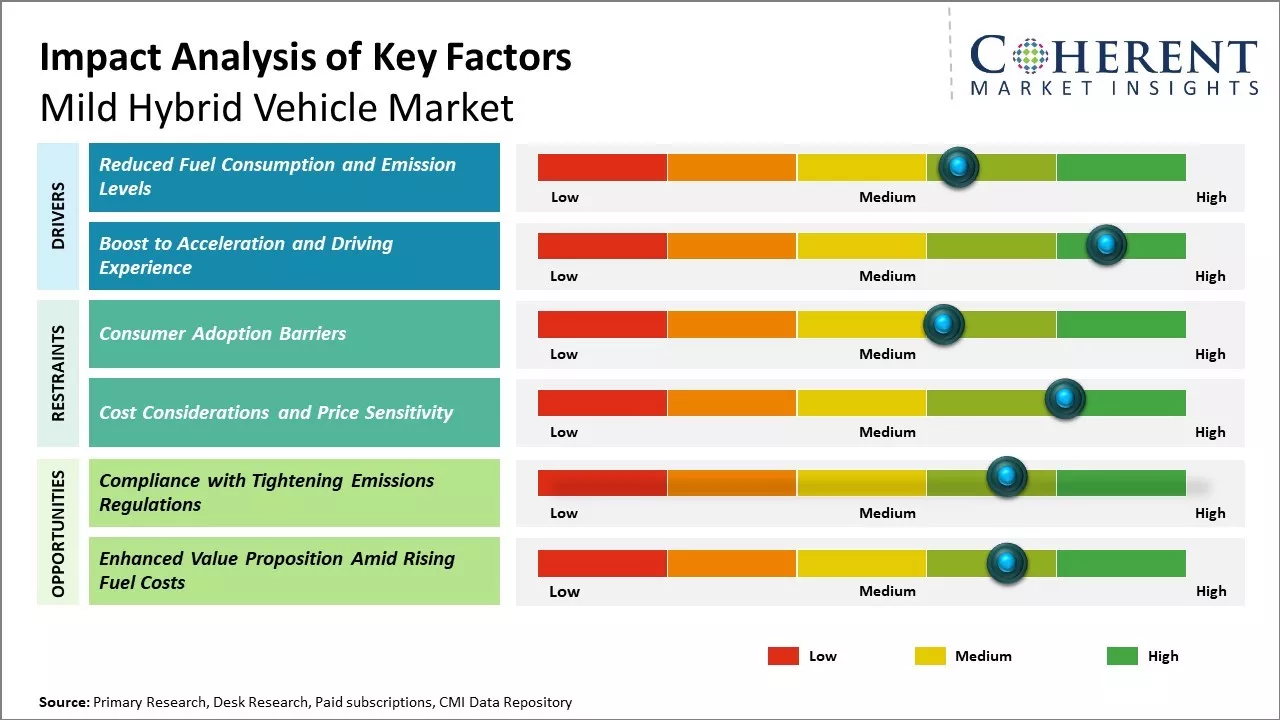
Key Takeaways:
- Based on Battery Capacity, the 48V and the above battery segment is projected to dominate with a 79.6% share in 2026, driven by advancements in high-voltage battery technology offering better performance and compliance with emission regulations.
- On the basis of Vehicle Type, the passenger vehicle segment is set to lead with a 70.9% share in 2026, driven by higher sales volumes, strict emission regulations, and demand for cost-effective fuel savings. Mild hybrids systems align well with urban driving patterns and make them ideal for mainstream passenger vehicles.
- The Asia Pacific region is projected to dominate the mild hybrid vehicle market with a 42.6% share and a rapid 22.28% CAGR in 2026, driven by the rising middle class, and surging shift towards affordable fuel-efficient vehicles.
Market Overview
The global mild hybrid vehicle market is experiencing significant growth, driven by the increasing demand for fuel-efficient and environmentally friendly transportation options. Mild hybrid vehicle market is poised for continued growth, supported by technological innovations, favorable government policies, and increasing consumer demand for sustainable transportation.
Current Events and Its Impact
Current events | Description and its impact |
Advancements in mild hybrid technology |
|
Changing consumer preferences and awareness |
|
Role of AI (Artificial Intelligence) in the Mild Hybrid Vehicle Market.
Artificial Intelligence (AI) plays a pivotal and crucial role in the mild hybrid vehicles (MHRV) market by enhancing energy and efficiency, safety, and user experience. AI has helped in the Intelligent Energy management and optimization as systems are transforming how hybrid vehicles manage power distribution between electric motors and internal combustion engines. For instance, a novel machine learning control system has demonstrated a 20% reduction in fuel consumption and extended electric range under diverse driving conditions. Additionally, reinforcements learning algorithms are being employed to optimize energy management strategies in hybrid electric vehicles, leading to improved energy efficiency.
- Current Industry Events of 2026
- Market Size Estimation
- Regional Breakdown
- Competitive Landscape
- Customer Intelligence
- Segmental Analysis
- Pricing Analysis
- Key Market Drivers, Challenges & Future Trends
- Customized Insights Section
Government Policies in the Mild Hybrid Vehicle Market.
Reimbursement policies and incentives for mild hybrid vehicles vary globally, reflecting each country’s environmental goals and automotive strategies. For instance, the Netherlands plans to phase out tax incentives on hybrid vehicles electric vehicles starting from 2025, plug-in hybrid electric vehicles will no longer receive a 50% Motor Vehicle Tax Discount and BPM exemption for electric cars will expire. By 2030, zero emission cars will incur higher Motor Vehicle tax due to their greater weight.
Pricing Analysis
Pricing Drivers and Regional Variations
Several factors play a significant role in shaping the pricing of mild-hybrid vehicles:
- Battery and 48V System Costs: The inclusion of a 48V hybrid system and battery typically accounts for 15-20% of the total vehicle cost, adding a premium over traditional internal combustion engine (ICE) vehicles.
- Tax Incentives and Subsidies: In regions like Europe and China, government incentives for hybrids play a crucial role in influencing prices. Subsidies and tax benefits are key to making these vehicles more affordable.
- Competition: Pricing strategies are also influenced by the competition between traditional automakers and electric vehicle (EV)-focused brands, each trying to attract consumers with different value propositions.
- Local Manufacturing: Local production in emerging markets helps reduce import duties, which in turn lowers the overall price of the vehicle for consumers.
Regional Pricing Overview
In North America, the average price range for mild-hybrid vehicles falls between $28,000 and $50,000. The demand for premium SUVs, such as the Ford Maverick Hybrid, alongside higher disposable incomes, drives this price range.
In Europe, mild-hybrid vehicles are priced between €30,000 and €55,000, with CO2 emission penalties playing a key role. Additionally, VAT exemptions for hybrid vehicles in some countries help reduce costs.
In the Asia-Pacific region, prices range from $18,000 to $35,000, influenced by local production, such as the Suzuki Ertiga Hybrid in India, and fuel price sensitivity in the region.
In Latin America, prices typically range between $22,000 and $40,000, influenced by import tariffs of up to 35% and limited charging infrastructure, which affects the adoption of hybrid and electric vehicles.
Segmental Insights
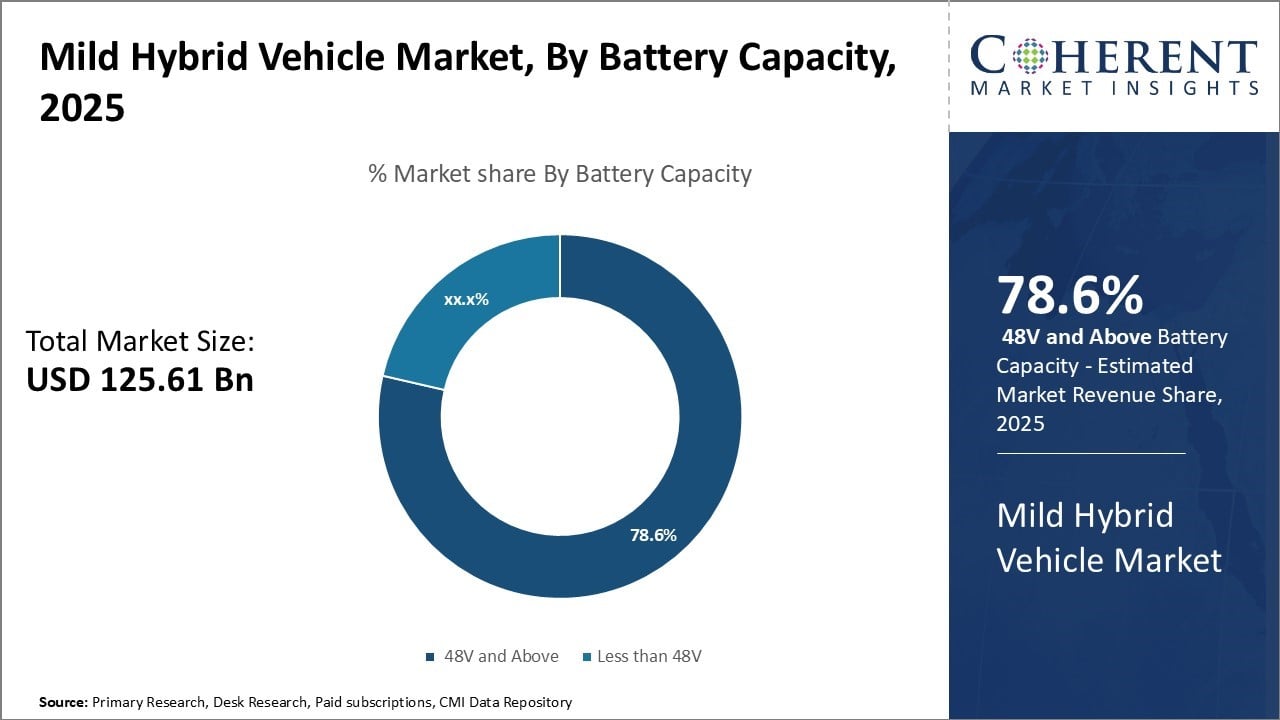
Mild Hybrid Vehicle Market Insights, By Battery Capacity
Escalating Technological Advancements Drives Growth of 48V and Above Battery Capacity
In terms of battery capacity, 48V and above segment is estimated to contribute the highest share of 79.6% in 2026, owing to improvements in high-voltage battery technologies. Vehicles in this segment are able to offer more powerful electrical boosting and coasting capabilities compared to lower-voltage mild hybrids. The additional electric torque assist provided by high-voltage batteries allows for quicker acceleration and helps automakers comply with increasingly stringent fuel efficiency and emissions regulations.
Advanced lithium-ion battery chemistries have enabled the development of higher energy density 48V+ battery packs that take up less space under the hood while offering greater electric driving range. This makes them an attractive option for automakers seeking to hybridize larger vehicle classes like SUVs and trucks. Battery manufacturers are also working on new lithium-ion battery cell designs optimized for high-power applications in automotive mild hybrid systems. Improved battery lifespans and reduced costs will drive further uptake of 48V+ mild hybrid technology across a wider range of vehicle in the near future.
Governments around the world continue to introduce new policies and incentives promoting electrified vehicles as a means to curb transport sector emissions. The 48V+ mild hybrid category provides a lower-cost hybridization solution for automakers compared to full hybrids or plug-in hybrids, while still allowing them to offer hybrid versions of their most popular nameplates. For instance, the U.S set a goal to cut greenhouse gas emission by 50-52% from 2005 levels by 2030, aligning with Paris Agreement and the 1.5-degree Celsius climate target. As regulatory compliance pressures increase and consumers become more environmentally conscious, the business case for adopting 48V+ mild hybrid powertrains will strengthen. This is further expected to proliferate the mild hybrid vehicle market revenue.
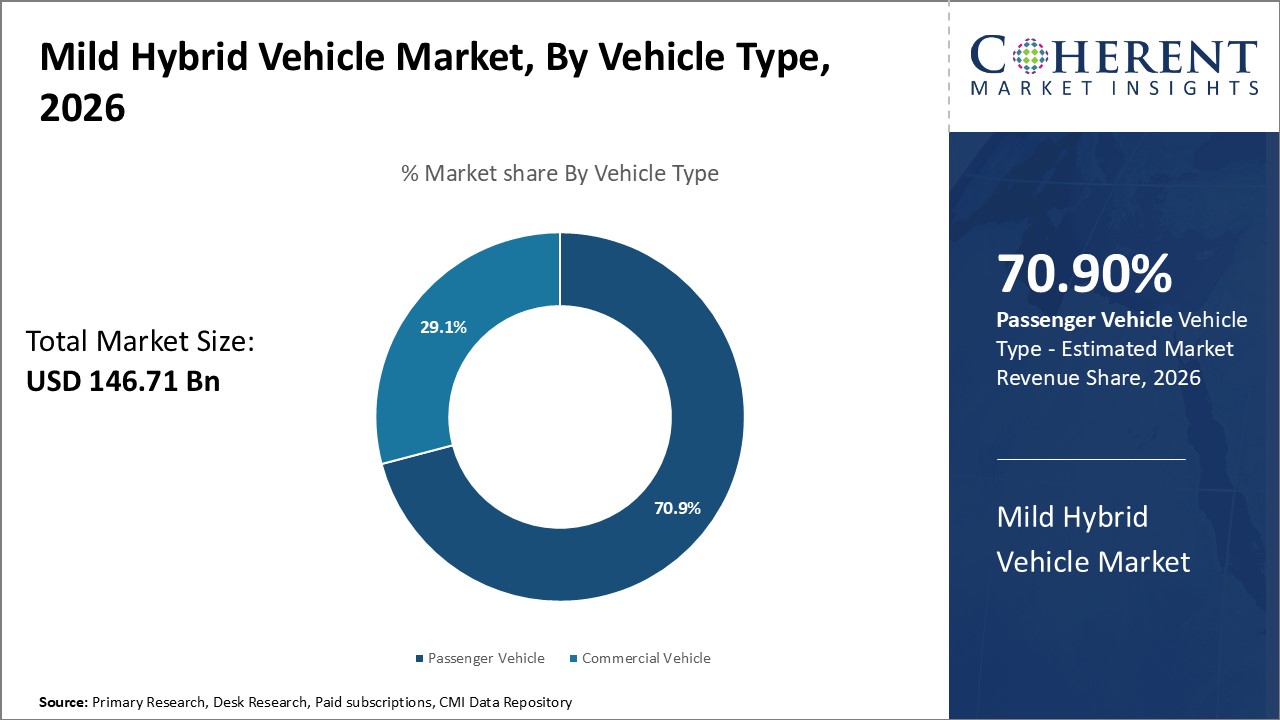
Mild Hybrid Vehicle Market Insights, By Vehicle Type
Economic Growth Contributing to Passenger Vehicle Dominance
Passenger vehicle segment is estimated to account for the major share of 70.9% in 2026, due to bulk sales in the mild hybrid market due largely to higher unit volumes and fleet turnover rates compared to commercial vehicles. Passenger car buyers are increasingly influenced by reported fuel economy figures and seek hybrid versions of in-demand nameplates to reduce ownership costs. With many new emission rules applying specifically to passenger vehicle fleets, automakers prioritize introducing mild hybrid technology into their mainstream passenger car lines to lower reported average emissions.
Electric boosting and extended idle stop-start functionality provide the largest real-world fuel savings in city driving cycles that mirror most passenger vehicle usage profiles. For instance, the European Commission's aims to further tighten CO2 targets for new cars and vans by 50%-5% by 2030 and require all new cars to be zero-emission by 2035. Mild hybrid systems are ideally suited for passenger cars, which typically complete more short trips with frequent stops, further contributing to the mild hybrid vehicle market share.
Regional Insights
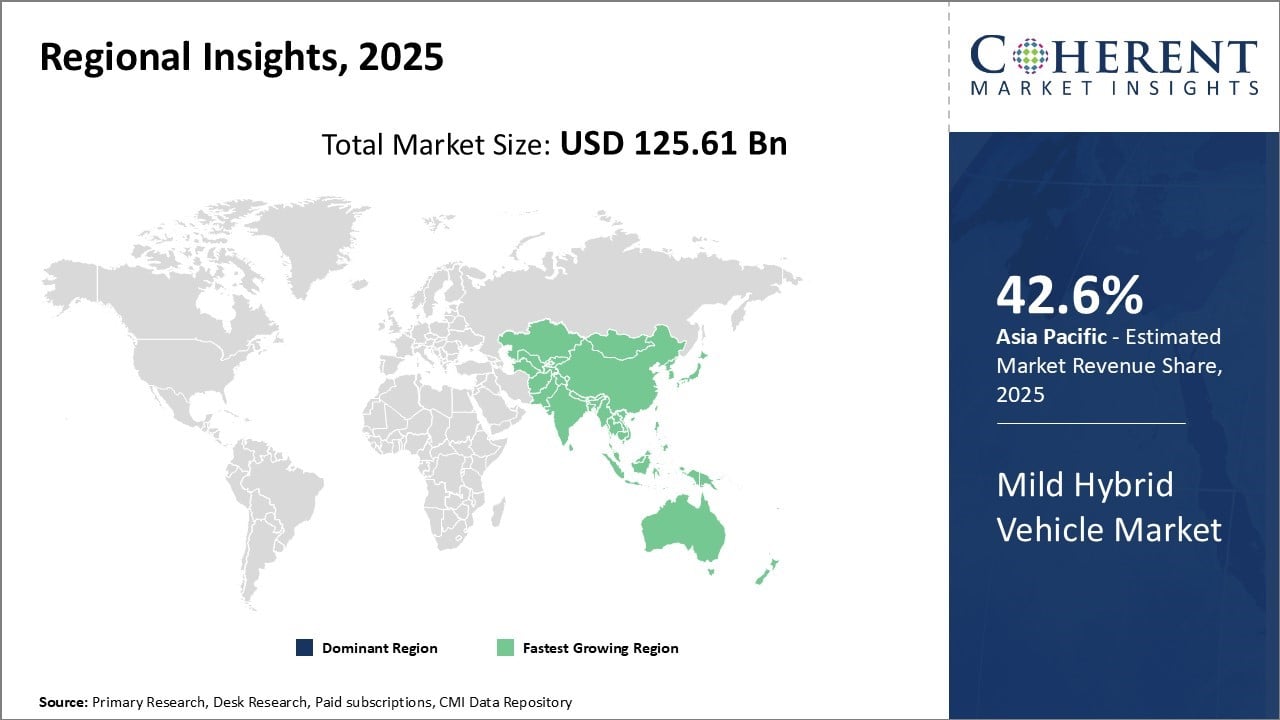
Asia Pacific Mild Hybrid Vehicle Market Trends
Asia Pacific region is expected to hold the dominant market share of 42.6% in 2026. Several countries in Asia Pacific are experiencing rapid economic growth, leading to a rising middle class with more disposable income. This translates to increased demand for personal vehicles, and mild hybrids offer an attractive option due to their fuel efficiency and affordability compared to full hybrids or electric vehicles.
Governments in the region are actively promoting fuel efficiency and environmental sustainability. For instance, the Asia-Pacific region is accounted for approximately 40% of the global mild hybrid vehicle market in 2023. These are implementing stricter emission regulations and offering incentives for purchasing eco-friendly vehicles, such as tax breaks or subsidies. For example, in September 2024, Karnataka, a southern state in India, intends to reduce taxes and provide financial incentives to businesses in the clean mobility sector, including a significant tax reduction for hybrid cars, which will benefit Toyota. This is further anticipated to propel the mild hybrid market growth.
North America Mild Hybrid Vehicle Market Trends
The North America mild hybrid vehicle market is experiencing significant growth, driven by technological advancements, regulatory pressures, and evolving consumer preferences. The industry dynamics of the North American Mild Hybrid Vehicle is driven by automakers strategies where major manufacturers like Toyota, Ford, Honda, and Hyundai are expanding their Mild Hybrid Vehicles portfolio. For instance, Toyota has made the 2026 Camry (XV80) an all-hybrid model in North America, reflecting a strategic shift towards hybridization. Therefore, the North American mild hybrid vehicle market is poised for continued growth, supported by regulatory incentives and technological advancements. So as the infrastructure for fully electric vehicle develops, mild hybrid vehicles serve as a practical interim solution, offering improved fuel efficiency and reduced emission without the need for extensive charging infrastructure.
United States Mild Hybrid Vehicle Market
The market in U.S. is experiencing significant growth, driven by consumer demand for fuel-efficiency, cost effective alternatives to fully electric vehicles. For instance, as of 2023, hybrid vehicles sales in the U.S surged by 53% compared to 2022, indicating a significant shift in consumer preferences. This growth is attributed to hybrids' affordability, fuel efficiency, and the absence of charging infrastructure requirements. With ongoing technological advancements and strategic investments by automakers, mild hybrid vehicles are becoming an increasingly attractive option for consumers seeking efficiency without the constraints of EV infrastructure.
China Mild Hybrid Vehicle Market
The market in China is experiencing significant innovation, driven by consumer demand for extended range, improved efficiency, and advanced technology. Where automakers introduced new models and hybrid systems to meet these expectations. For instance, manufacturers like BYD have developed dedicated hybrid engines (DHEs). For instance, BYD’s fifth-generation DM-i system boasts a thermal efficiency of 46.06% contributing to a combined driving range of up to 2,100 km.
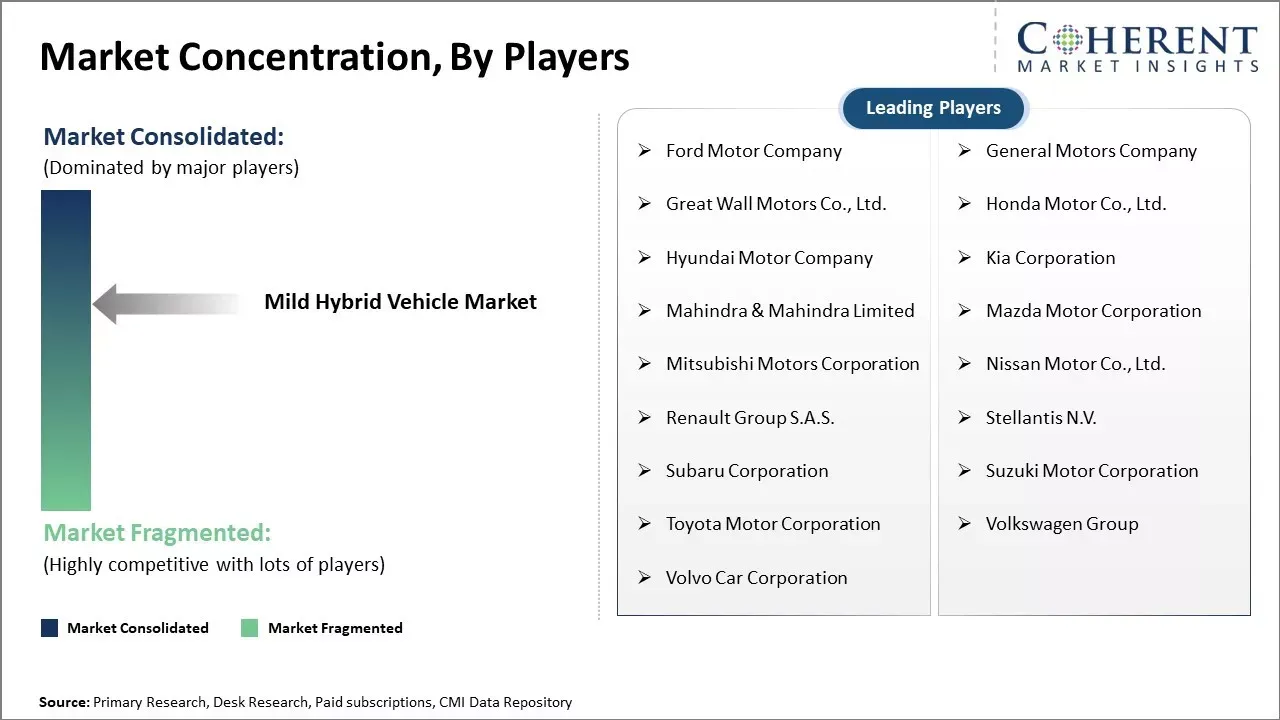
Market Concentration and Competitive Landscape
Mild Hybrid Vehicle Industry News
- Stellantis planned to commence the production of Fiat 500 Hybrid at its Mirafiori Sud plant in Turin, Italy in November 2025. This company aims to produce over 100,000 units annually, aligning with its strategy to revitalize the Fiat brand in Europe.
- In May 2025, Toyota unveiled the Fortuner mild-hybrid version, featuring a 48V mild-hybrid system paired with a 2.8-liter four-cylinder GD engine. The alternator will be replaced by a belt-integrated starter generator powered by a 48V battery. This setup is expected to boost fuel efficiency by 10% compared to the current diesel powertrain.
- In March 2025, Toyota launched the Hilux Hybrid in the UK, featuring a 48V mild-hybrid system. The pickup continues to use the 2.8-liter four-cylinder diesel engine but now includes an electric motor-generator and a 48V lithium-ion battery.
- In February 2025, Maruti announced its plan to introduce a small car featuring a mild-hybrid engine, designed for those with an annual income of Rs 5 lakh.
- In December 2024, the Mazda CX-70 introduced the a two-row mid-size SUV equipped with mild hybrid inline-6 turbo engine. This model offers improved fuel efficiency and performance, catering to consumers seeking a balance between power and sustainability.
Market Report Scope
Mild Hybrid Vehicle Market Report Coverage
| Report Coverage | Details | ||
|---|---|---|---|
| Base Year: | 2025 | Market Size in 2026: | USD 146.71 Bn |
| Historical Data for: | 2020 To 2024 | Forecast Period: | 2026 To 2033 |
| Forecast Period 2026 to 2033 CAGR: | 16.8% | 2033 Value Projection: | USD 435.08 Bn |
| Geographies covered: |
| ||
| Segments covered: |
| ||
| Companies covered: | Ford Motor Company, General Motors Company, Great Wall Motors Co., Ltd., Honda Motor Co., Ltd., Hyundai Motor Company, Kia Corporation, Mahindra & Mahindra Limited, Mazda Motor Corporation, Mitsubishi Motors Corporation, Nissan Motor Co., Ltd., Renault Group S.A.S., Stellantis N.V., Subaru Corporation, Suzuki Motor Corporation, Toyota Motor Corporation, Volkswagen Group, Volvo Car Corporation | ||
| Growth Drivers: |
| ||
| Restraints & Challenges: |
| ||
Market Dynamics
Reduced Fuel Consumption and Emission Levels
Mild hybrid vehicles help to reduce fuel consumption and emission levels as compared to conventional vehicles which depend solely on internal combustion engines. The integration of battery and electric motor assists the engine especially during acceleration and helps capture energy during braking which is then stored in the battery. This allows the engine to run more efficiently at optimal speeds and loads. Owners benefit from lower fuel costs as these vehicles tend to provide higher fuel economy in city driving conditions. The regenerative braking feature is particularly useful in stop-start traffic situations common in urban transportation. This directly impacts the operating costs for owners in a positive way.
Lower fuel consumption translates to reduced emission of pollutants from the vehicle. As more automakers focus on expanding their electrified vehicle portfolio to comply with tightening emission regulations, mild hybrids serve as a sensible transitional technology. The hybrid system helps optimize the internal combustion engine operations to boost efficiency. Although not as extensive as full hybrids, mild hybrid setups cut down significantly on harmful exhaust from the tailpipe. This benefits the environment as well as the reputation of automakers striving to be seen as sustainable mobility providers. The hybrid technology provides partial electrification benefits without the high battery costs of full hybrids, making it an attractive choice for those looking to minimize their carbon footprint from personal transport. For instance, according to research report published by U.S. Environmental Protection Agency in December, 2023, vehicle fuel efficiency hit an all-time high, while emissions hit a record low in 2022. This is further propelling the mild hybrid vehicle market demand.
Market Opportunities: Compliance with Tightening Emissions Regulations
Tighter emissions regulations being introduced by governments around the world are increasing the pressure on automakers to enhance the efficiency of new cars. Mild hybridization provides an effective solution for reducing fleets' average CO2 emissions. Rising fuel costs also enhance the value proposition of even modest hybridization. As battery and component costs fall further, the payback period for mild hybrid technologies will shorten, boosting their accessibility.
Market Segmentation
- Battery Capacity Insights (Revenue, USD Bn, 2021 - 2033)
- Less than 48V
- 48V and Above
- Vehicle Type Insights (Revenue, USD Bn, 2021 - 2033)
- Passenger Vehicle
- Commercial Vehicle
- Regional Insights (Revenue, USD Bn, 2021 - 2033)
- North America
- U.S.
- Canada
- Latin America
- Brazil
- Argentina
- Mexico
- Rest of Latin America
- Europe
- Germany
- U.K.
- Spain
- France
- Italy
- Russia
- Rest of Europe
- Asia Pacific
- China
- India
- Japan
- Australia
- South Korea
- ASEAN
- Rest of Asia Pacific
- Middle East & Africa
- South Africa
- GCC Countries
- Israel
- Rest of Middle East & Africa
- North America
- Key Players Insights (Revenue, USD Bn, 2021 - 2033)
- Ford Motor Company
- General Motors Company
- Great Wall Motors Co., Ltd.
- Honda Motor Co., Ltd.
- Hyundai Motor Company
- Kia Corporation
- Mahindra & Mahindra Limited
- Mazda Motor Corporation
- Mitsubishi Motors Corporation
- Nissan Motor Co., Ltd.
- Renault Group S.A.S.
- Stellantis N.V.
- Subaru Corporation
- Suzuki Motor Corporation
- Toyota Motor Corporation
- Volkswagen Group
- Volvo Car Corporation
Sources
Primary Research Interviews:
- Automotive Manufacturers
- Mild Hybrid Vehicle Component Suppliers
- Industry Experts
- Market Analysts
- Others
Databases:
- Automotive Industry Associations' Databases
- Others
Magazines:
- Automotive News
- Electric & Hybrid Vehicle Technology International
- Green Car Reports
- Charged Electric Vehicles Magazine
- Others
Journals:
- International Journal of Automotive Technology
- IEEE Transactions on Vehicular Technology
- SAE International Journal of Electrified Vehicles
- Others
Newspapers:
- The Wall Street Journal
- Financial Times
- The New York Times
- Automotive News Europe
- Others
Associations:
- Society of Automotive Engineers (SAE)
- International Organization of Motor Vehicle Manufacturers (OICA)
- European Automobile Manufacturers' Association (ACEA)
- Alliance of Automobile Manufacturers
- Others
Public Domain Sources:
- U.S. Department of Energy
- European Commission
- International Energy Agency (IEA)
- National Highway Traffic Safety Administration (NHTSA)
- Others
Proprietary Elements:
- CMI Data Analytics Tool, and Proprietary CMI Existing Repository of information for last 8 years
*Definition: Mild hybrid vehicle market refers to the automotive industry segment focused on producing and selling vehicles that are partially electrified with mild-hybrid technology. These vehicles have small battery packs and electric motors that provide auxiliary power assistance to improve fuel efficiency but do not enable full electric-only driving ranges like regular hybrids or plug-in hybrids. Mild hybrid systems are integrated into traditional internal combustion engine vehicles to reduce emissions and boost fuel economy by a few miles per gallon through features like start/stop functionality, regenerative energy system.
Get access to 250+ pages report
Every segment, forecast, competitor profile and data table behind the analysis above — available for instant download.
- ESOMAR Member
- ISO 9001:2015 Certified
- D-U-N-S Registered
- GDPR & CCPA Compliant
Missing comfort of reading report in your local language? Find your preferred language:
Transform your Strategy with Exclusive Trending Reports
Frequently Asked Questions
The Mild Hybrid Vehicle Market is estimated to be valued at USD 146.71 Bn in 2026, and is expected to reach USD 435.08 Bn by 2033.
The CAGR of the Mild Hybrid Vehicle Market is projected to be 16.8% from 2026 to 2033.
Reduced fuel consumption and emission levels and boost to acceleration and driving experience are the major factors driving the growth of global mild hybrid vehicle market.
Consumer adoption barriers and cost considerations and price sensitivity are the major factors hampering the growth of global mild hybrid vehicle market.
In terms of battery capacity, 48V and above segment is estimated to dominate the market in 2026.
Ford Motor Company, General Motors Company, Great Wall Motors Co., Ltd., Honda Motor Co., Ltd., Hyundai Motor Company, Kia Corporation, Mahindra & Mahindra Limited, Mazda Motor Corporation, Mitsubishi Motors Corporation, Nissan Motor Co., Ltd., Renault Group S.A.S., Stellantis N.V., Subaru Corporation, Suzuki Motor Corporation, Toyota Motor Corporation, Volkswagen Group, Volvo Car Corporation are the major players.
Asia Pacific is expected to lead the global mild hybrid vehicle market in 2026