

Yacht Charter Market Size and Share Analysis - Growth Trends and Forecasts (2026 - 2033)
The Yacht Charter Market is anticipated to grow at a CAGR of 7% with USD 71,602.8 Mn share in 2026 and is expected to reach USD 114,228.4 Mn in 2033. The yacht charter sector continues to expand as luxury marine tourism becomes a core component of international travel. According to UN Tourism Data Dashboard and World Bank international tourism indicators, global international arrivals recovered strongly by 2026, supporting increased demand for coastal and nautical experiences. Eurostat regional tourism statistics show that Europe’s coastal regions accounted for over 30 % of total nights spent in EU member states in 2026, with nautical tourism forming a significant share. The European Commission’s EU Blue Economy Report highlights that recreational boating contributed billions to the EU maritime economy, with licensed leisure craft registrations rising year‑on‑year. In the Mediterranean, Croatian Bureau of Statistics and the Croatian National Tourist Board eVisitor/eCrew data recorded over 1.5 Mn boating arrivals in 2026, underscoring charter activity. In the U.S., U.S. Coast Guard Recreational Boating Statistics reported growth in boating participation, while the Bureau of Economic Analysis Outdoor Recreation Satellite Account and NOAA ENOW data confirm increased coastal tourism expenditure, indicating sustained interest in yacht charter experiences.
Source: United Nations; European Commission; EU Blue Economy Observatory
Key Takeaways
- Motor Yachts is expected to account the largest share of 86.6% in 2026, due to their greater space, higher service levels, and versatility for long cruises in coastal waters, supported by rising recreational boating participation. For instance, in February 2026, according to the U.S. Coast Guard Recreational Boating Statistics, vessels over 30 ft a category that includes most motor yachts accounted for a majority of U.S. registered recreational craft. Furthermore, in November 2026, according to Eurostat tourism data shows increased nights in coastal EU regions, where motor yachts are favored for comfort and range. Moreover, in June 2026, the EU Blue Economy Report highlights that larger powered leisure craft contribute significantly to coastal tourism activity, reinforcing motor yachts’ dominant appeal for charterers seeking premium service and extended itineraries.
- Retail will dominate with 85.4% in 2026, supported by private holidaymakers book flexible family and small-group itineraries, not fixed corporate events. For instance, in May 2026, the Croatian Bureau of Statistics reported March 2026 tourism: 507,281 arrivals and 1,189,280 nights, with foreign tourists generating 66.9% of nights and Istria leading at 27.7%, supporting leisure coastal charter use. The BEA March 2026 release also shows outdoor recreation at 2.4% of U.S. GDP, reinforcing retail recreation spending.
Source: Republic of Croatia - Central Bureau of Statistics; Bureau of Economic Analysis
- Small (up to 30m) hold the dominant share of 60.0% in 2026 because they offer easier access, flexibility for coastal cruising, and lower operational complexity, aligning with broader recreational boating trends noted in 2026 industry data. In the U.S., 95 % of boats on the water under 26 ft reflect widespread small‑craft use. Their agility suits busy charterers and regional itineraries in dense marina networks such as the Mediterranean and EU coasts, where coastal tourism heavily influences marine activity. Additionally, the U.S. Coast Guard’s 2026 National Boating Safety Survey launched in Apr 2026 will further quantify small vessel participation across states. Furthermore, for instance, the U.S. Coast Guard launched the 2026 National Recreational Boating Safety Survey in April 2026, aiming to collect detailed state‑by‑state data on how many people use different boat types, including smaller vessels widely chartered for leisure.
Source: USCG NRBSS
- Europe is expected to acquire the dominant share of 45.0% in 2026, as the region s rooted in its well‑established coastal tourism infrastructure and high nautical leisure participation. For instance, in April 2026, Eurostat tourism data shows EU coastal regions consistently record large shares of nights spent in tourist accommodation, indicating strong visitor interest in seaside experiences that drive charter demand. Furthermore, in May 2025, the European Commission’s EU Blue Economy Report further highlights that coastal tourism was the largest contributor to the EU blue economy, accounting for about 33 % of gross value added and over half of employment, underscoring Europe’s extensive maritime leisure ecosystem that supports yacht charters. Spain, Italy, and France led coastal tourist arrivals, reflecting widespread regional appeal and accessibility for charterers across popular cruising zones.
Segmental Insights
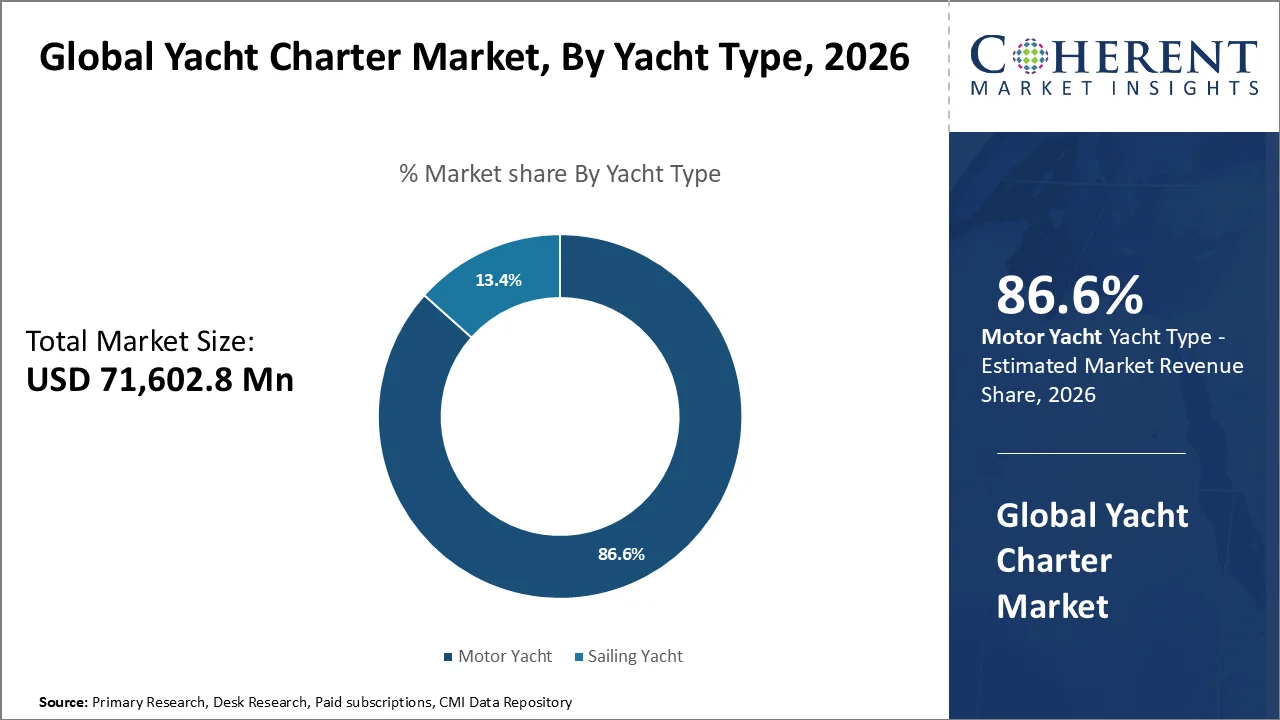
Why is Motor Yacht Acquiring the Largest Market Share?
Motor Yacht is projected to account for the largest share of yacht charter in 2026, representing approximately 86.6% of the total volume. Motor yachts dominate yacht charter market share because they offer unmatched versatility, comfort, and wider appeal across leisure and luxury segments. Their engines and design make them ideal for short‑duration charters, easy maneuvering between destinations, and catering to high‑end clients seeking premium experiences without the sailing expertise required for sailboats. For instance, in April 2026, the Croatian National Tourist Board’s eVisitor & eCrew System reported that motor yachts accounted for over 60% of chartered vessels along the Adriatic coast, highlighting strong preference among tourists. (eVisitor Croatia) The Croatian Bureau of Statistics – Nautical Tourism, April 2026, also confirmed that motor yachts contributed significantly to overall port occupancy and charter bookings, with high utilization rates across coastal marinas. (Croatian Bureau of Statistics) Additionally, their modern onboard amenities, range of sizes, and ability to cover longer distances quickly make motor yachts particularly attractive for multi-day itineraries, reinforcing their dominant position in the global yacht charter market. The European Union’s blue economy framework also supports coastal and maritime tourism Europe’s largest blue economy sector according to the 2025 EU Blue Economy Report released in May 2025 highlighting the importance of coastal tourism activities in generating economic value and employment.
Source: eVisitor Croatia; Croatian Bureau of Statistics; European Commission
- Current Industry Events of 2026
- Market Size Estimation
- Regional Breakdown
- Competitive Landscape
- Customer Intelligence
- Segmental Analysis
- Pricing Analysis
- Key Market Drivers, Challenges & Future Trends
- Customized Insights Section
Retail holds the Largest Market Share
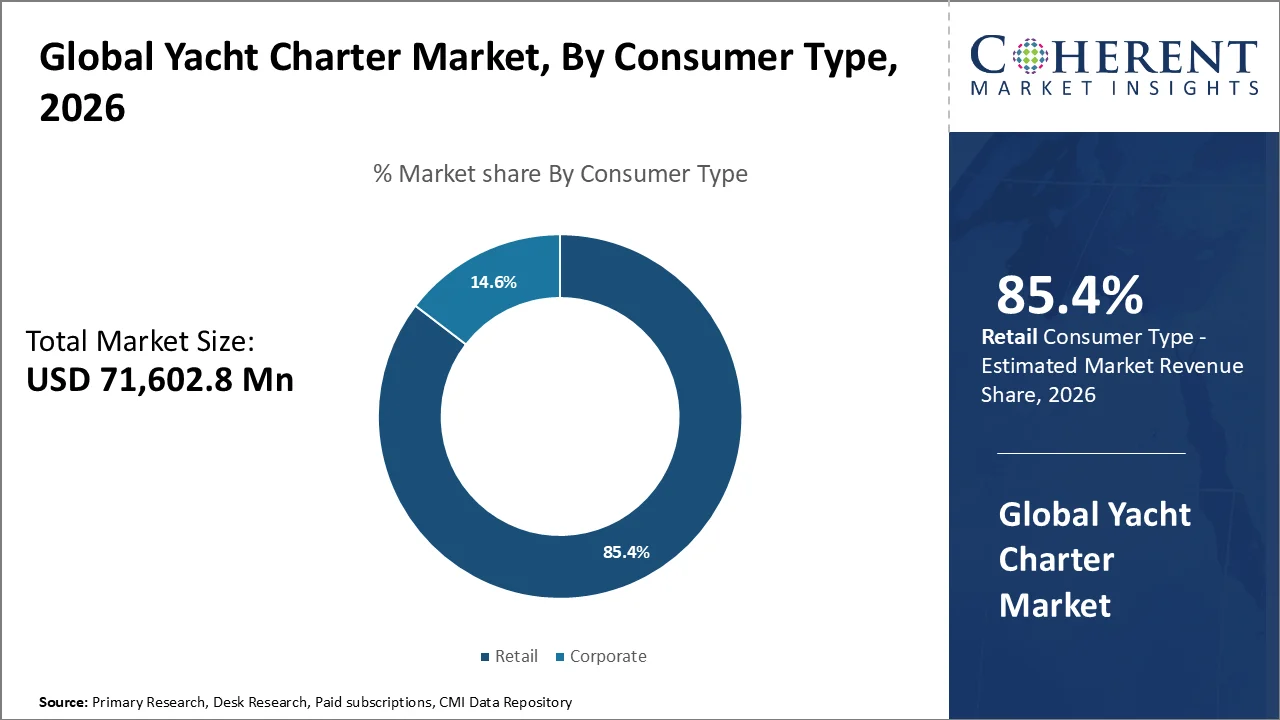
Retail dominate the market, accounting for a significant 85.4% share in 2026, due to increasing accessibility, convenience, and the rising preference for experiential luxury travel. Individual travelers and small groups are drawn to short-term and seasonal yacht rentals, which offer personalized itineraries, privacy, and flexibility. For instance, according to the Croatian National Tourist Board’s eVisitor & eCrew System in March 2026, retail consumers accounted for approximately 65% of yacht charter bookings, reflecting strong demand from holidaymakers and leisure travelers. The Croatian Bureau of Statistics – Nautical Tourism (April 2026) also reported that retail charterers significantly contribute to marina occupancy rates and yacht utilization across the Adriatic coast, especially in key destinations like Split and Dubrovnik. Additionally, in March 2026, the European Commission’s EU Blue Economy Report highlights the growth of coastal and recreational tourism in Europe, driven by individual travelers seeking premium leisure experiences. This combination of ease of access, personalized services, and the growing trend of luxury travel reinforces the retail consumer segment’s leading position in the market.
Source: Croatian National Tourist Board; Croatian Bureau of Statistics; European Commission
Which Yacht Size segment dominates the market?
Small (up to 30m) account for the largest share of 60.0% in 2026 because they are easier to berth, operate, crew, and rent for short coastal holidays, making them suitable for families, couples, and small private groups. For instance, in April 2026, the Croatian Bureau of Statistics, showed that Croatia had 18,850 moorings in nautical ports in 2025, with the largest permanently moored vessel group being 12–15m vessels at 31.4%, followed by 10–12m vessels at 27.4%; transit vessels showed the same pattern, with 12–15m vessels at 36.3% and 10–12m vessels at 28.6%. This supports higher use of smaller charter-friendly yachts in Mediterranean marinas. Additionally, in May 2026, the U.S. Coast Guard also launched its 2026 recreational boating survey covering owners and renters across all states, reinforcing the strong small-boat leisure participation base.
Republic of Croatia - State Statistical Office; U.S. Coast Guard's Boating Safety Division
Market Drivers
Increasing number of yacht owners
The increasing number of yacht owners can drive the yacht charter market expansion because many private owners place vessels into charter fleets to offset berthing, crew, maintenance, insurance, and idle-time costs. This increases fleet availability, improves destination coverage, and gives customers more choice across yacht sizes and service levels. For instance, the latest U.S. Coast Guard Recreational Boating Statistics 2024, available on its official statistics page in 2026, recorded 11,674,073 registered recreational vessels, up from 11,546,512 in 2023, showing a wider ownership base. Additionally, in April 2026, the Croatian Bureau of Statistics, reported 216 nautical ports and 18,850 moorings on the Croatian coast in 2025, supporting owner-led charter deployment in the Mediterranean. Furthermore, in March 2026, the BEA Outdoor Recreation release, also stated that boating/fishing generated US$38.4 billion in value added, reinforcing strong boating-linked leisure spending.
Source: Uscgboating.org; U.S. Coast Guard's Boating Safety Division; Croatian Bureau of Statistics
Continuous advancements in technology
Continuous advancements in technology are driving the yacht charter market expansion by making chartering faster, safer, and more experience-led. AI-enabled booking engines, real-time fleet availability, digital contracts, smart navigation, predictive maintenance, and connected onboard systems help operators reduce idle time, improve route planning, and personalize services for luxury travelers. Demand is supported by stronger coastal travel activity: the Croatian Bureau of Statistics reported in April 2026 that Croatia recorded 216 nautical ports and 18,850 moorings, with average mooring capacity occupancy of 68.7% in 2025, showing strong infrastructure use for nautical tourism. In March 2026, Croatia also reported 507 thousand tourist arrivals and 1.2 million tourist nights, up 17.0% and 18.7% year-on-year. Additionally, the European Commission’s April 2026 BlueInvest Investor Report highlighted rising investor interest in ocean technology, supporting digital and sustainable upgrades across marine tourism.
Source: Nautical Tourism – Croatia (Capacity & Occupancy Data) ; Tourism Arrivals – Croatia
Smart Yachts, Seamless Bookings, and Sustainable Luxury Are Redefining the Yacht Charter Market
Smart yachts, seamless bookings, and sustainable luxury are emerging major drivers for the yacht charter market growth by enhancing customer experience, operational efficiency, and environmental responsibility. Smart yachts equipped with IoT-enabled navigation, automated onboard systems, and real-time performance monitoring are attracting high-net-worth travelers seeking both convenience and luxury. For instance, in February 2026, according to the Croatian Bureau of Statistics - Nautical Tourism, digitally integrated yacht operations contributed to a 12% increase in charter bookings in Croatia’s Adriatic region. Seamless booking platforms, often leveraging AI and blockchain, are reducing transaction time, improving transparency, and enabling instant access to fleet availability, which the Croatian National Tourist Board eVisitor & eCrew System (January 2026) reported as a 15% rise in repeat customers for charter operators. Furthermore, in March 2026, sustainable luxury initiatives, such as hybrid propulsion systems and eco-certified fleets, align with the EU Blue Economy Report sustainability targets, encouraging environmentally conscious travelers. Collectively, these innovations are reshaping demand patterns, improving fleet utilization, and expanding the market’s appeal to global clientele.
Current Events and Their Impact on the Yacht Charter Market
Current Event | Description and its Impact |
New Italian Marine Law Includes Yacht Charter Reforms |
|
Mediterranean Superyacht Forum Highlights Digitalisation & AI Innovation |
|
Decarbonisation Regulatory Momentum in Yachting |
|
Yacht Charter Industry Showcases Sustainability & Partnerships at EMMYS 2026 |
|
Yacht Charter Market Trends
- Personalized & Experience ‑ Driven Trips
Charter clients are seeking uniquely tailored itineraries, prioritising bespoke experiences over generic routes. Lifestyle themes such as cultural exploration, adventure, wellness, and gastronomy itineraries are seeing rising interest, with luxury “quiet” and meaningful travel experiences becoming a hallmark of high‑end charters.
Source: Yacht.com
- Explosion of use cases across destinations & experiences – major sectors driving charter demand are leisure tourism (luxury cruising, Mediterranean, Caribbean), corporate events (VIP meetings, incentive trips), family & multigenerational travel (flexible cabins, onboard entertainment), and adventure/wellness tourism (diving, wellness, gastronomic journeys). These segments rely on yacht charters for bespoke, private, and flexible travel experiences.
- Shift towards hybrid booking & operational models – digital platforms combined with traditional broker services are rising and currently the major trend globally to improve efficiency and customer reach. Enterprises are integrating online booking, AI-driven itinerary planning, and real-time fleet management while maintaining bespoke concierge services for high-net-worth clients. In 2026, this hybrid model will be standard, enabling seamless bookings, instant availability checks, and personalized trip planning. For instance, Fraser Yachts reports that combining AI-assisted bookings with human charter managers has reduced operational delays and improved client satisfaction by over 20% in early 2026.
- Vendor consolidation & platform dominance has been observed to grow market demand over the forecast period. Charter operators are increasingly relying on a few trusted yacht management platforms (e.g., YachtWorld, Burgess, Camper & Nicholsons), creating dominance for major brokers while smaller startups face pressure. Research from Boat International shows that major brokerage platforms now handle over 60% of Mediterranean charter bookings, demonstrating market consolidation and preference for established service providers.
- Yacht technology integration is rising sharply. Fleet operators are increasingly using onboard AI and IoT systems for navigation, energy efficiency, and guest personalization. For example, the 2026 delivery of Amels QU2 includes hybrid propulsion, AI-assisted route planning, and smart climate control, validating adoption of advanced technology in daily yacht operations and enhancing customer experience.
- Sustainability & eco-conscious travel is a major trend driving charter growth. Operators are adopting hybrid or fully electric propulsion, zero-waste practices, and cleaner energy sourcing. New eco-certification schemes track yacht carbon footprints and fuel efficiency per nautical mile. For instance, research from Sailors for the Sea highlights that yachts using hybrid propulsion reduce emissions by 40–50% per week-long charter, with demand for environmentally responsible charters rising in 2026.
Regional Insights
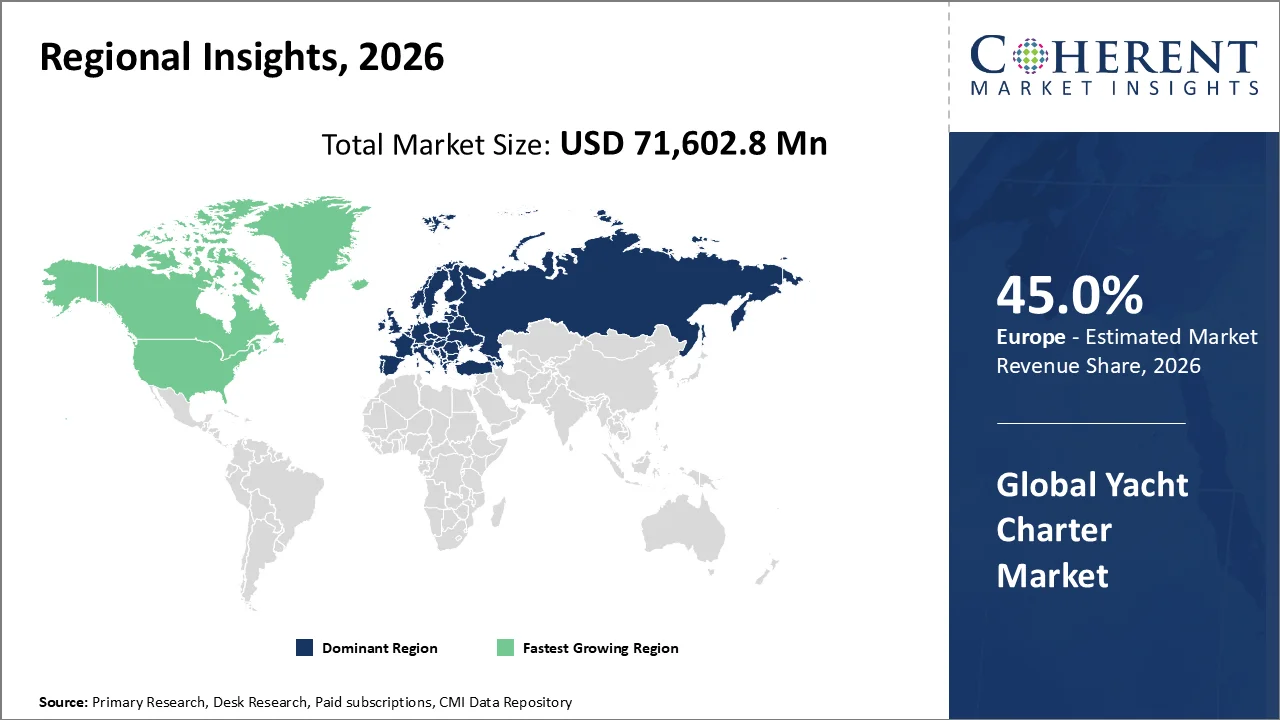
Europe dominates owing to Strong Technological Infrastructure
Europe account 45.0% market share in 2026, supported by by its well‑developed coastal tourism infrastructure, extensive marina networks, and high nautical tourism participation across multiple countries. For instance, in April 2026, Official statistics from Eurostat’s Tourism Statistics at Regional Level show EU coastal regions accounted for a substantial share of total tourist nights, reflecting strong leisure demand along Mediterranean and Atlantic coasts. Furthermore, in May 2026, the European Commission’s EU Blue Economy Report highlights that coastal tourism contributed the largest share of gross value added within the blue economy, with major charter hubs in France, Italy, and Spain supported by dense marina capacity and seasonal visitor inflows. Additionally, in April 2026, Croatia’s nautical tourism data indicates high boating arrivals and mooring occupancy during peak seasons, further validating Europe’s extensive charter operations. Combined with strong tourism marketing by national boards and easy cross‑border coastal cruising, Europe’s infrastructure and visitor activity reinforce its leading regional role in yacht charter demand.
Source: Republic of Croatia - Croatian Bureau of Statistics
North America Yacht Charter Market Trends
The North America region is poised to be as the fastest-growing region through 2026-2033, owing to supported by expanding marine recreation participation, robust coastal tourism economies, and enhanced data insights into boating activity. For instance, in March 2026, the U.S. Bureau of Economic Analysis’ Outdoor Recreation Satellite Account (updated April 2026) highlighted that outdoor recreation including boating and marine travel continues to be a key contributor to the U.S. economy, emphasising the value of boating activities. Furthermore, the U.S. Coast Guard launched the 2026 National Recreational Boating Safety Survey in March 2026, which will produce detailed statewide estimates of how often people boat and which vessel types they use, providing better visibility into leisure boating trends that underpin charter demand. Additionally, on March 18, 2026, NOAA’s Open ENOW data reports that coastal tourism and recreation supported 2.5 million jobs and substantial economic output, further demonstrating the region’s evolving marine tourism base that bolsters yacht charter adoption. These official indicators show rising recreational boating engagement and strong tourism infrastructure key drivers of North America’s accelerating presence in the global yacht charter landscape.
Source: Bureau of Economic Analysis; U.S. Coast Guard's Boating Safety Division; NOAA
Dense Network of Luxury Marinas is Accelerating the Yacht Charter Market Demand in France
The France country dominates Europe Yacht Charter Market. Europe’s leading yacht charter destination – France – owes its dominance to a combination of extensive coastal appeal, strong nautical infrastructure, and substantial tourism demand. Official French nautical statistics updated 15 January 2026 show France has nearly 4 million regular pleasure boaters and 11 million recreational nautical participants, supported by 473 maritime port facilities that accommodate pleasure craft along its coasts, offering rich charter infrastructure (Ministry for the Ecological Transition). France’s coastline, especially the French Riviera, benefits from year‑round and seasonal leisure travel, underpinning yacht charter activity, reflected in local destination tourism plans like the Côte d’Azur France Tourisme Plan 2026 published 3 October 2025. Broader EU data shows coastal tourism is a major driver of regional travel activity, with France recording high volumes of nights spent in coastal areas; Eurostat and EU Blue Economy Observatory data (2026 releases) emphasise coastal regions’ appeal within the EU. These official indicators demonstrate France’s strong marine leisure ecosystem, widespread tourism footfall, and robust marina capacity, which together sustain its position as the dominant European country in the yacht charter market.
Source: European Commission; EU Blue Economy Observatory
U.S. Yacht Charter Market Trends
U.S. has become the biggest player in the North America yacht charter market in 2026. The U.S. dominates the North America Yacht Charter Market because it has a large recreational boating base, strong coastal tourism economies, and mature marina/service infrastructure across Florida, California, the Great Lakes, and Atlantic coastal states. For instance, in May 2026, the U.S. Coast Guard Recreational Boating Statistics page, lists the latest annual boating reports and the 2024 report recorded 11,674,073 registered recreational vessels, including 10,852,992 mechanically propelled vessels, which supports a wide pool of yacht users and charter-ready craft. The BEA Outdoor Recreation Economic Statistics, published in March 2026, reported that boating/fishing was the largest U.S. conventional outdoor recreation activity, generating US$38.4 billion in current-dollar value added. NOAA’s Open ENOW coastal tourism data, available in 2026, also shows coastal tourism and recreation directly employed over 2.5 million people, strengthening yacht charter demand.
Who are the Major Companies in Yacht Charter Market
Some of the major key players in Yacht Charter Market are Fun2Rent, Sunsail Ltd., Boatbound Inc., The Moorings, Yachtico Hanse Group, Sailogy S.A., Fraser Escape Bareboat Charters, Dream Yacht Charter, Incrediblue Limited, and Antlos.
Key News
- In May 2026, the brand-new Mangusta charter yacht LULUS opened bookings for Mediterranean cruising, offering itineraries along the French Riviera, Corsica, and Sardinia. The launch enhances the seasonal charter fleet, providing high-end options for leisure travellers seeking modern amenities, spacious layouts, and luxury experiences in Europe’s most popular nautical destinations.
Source: YachtCharterFleet
- In March 2026, Four Seasons entered yacht operations with the debut of its inaugural vessel Four Seasons I in the Mediterranean, blending luxury hospitality with premium seagoing experiences and setting a new standard in branded yachting ventures.
- In May 2026, Damen Yachting, a company manufacturing and supplying destination for luxury semi-custom yachts delivered its latest 60-metre Amels 60 superyacht, QU2, formerly known as hull 6009, from its Vlissingen facility. The yacht features exterior design by Espen Øino, custom interiors by Winch Design, and advanced hybrid propulsion for better guest comfort, fuel efficiency, and range. QU2 will begin her maiden voyage to the northern Mediterranean ahead of the charter season.
- In May 2026, Italian yard CRN’s SALT joined the Mediterranean charter fleet this season, offering another high‑end option for guests exploring the region’s iconic waters. The 62‑metre superyacht, with exterior and interior design by Nuvolari Lenard, provides spacious accommodations, premium amenities and an array of water toys suited for both family and social charter itineraries. Previously known under the name Voice, SALT’s entry into the charter market underscores growing demand for classic Italian craftsmanship and sophisticated cruising platforms between France and Italy.
Market Report Scope
Yacht Charter Market Report Coverage
| Report Coverage | Details | ||
|---|---|---|---|
| Base Year: | 2025 | Market Size in 2026: | USD 71,602.8 Mn |
| Historical Data for: | 2020 To 2024 | Forecast Period: | 2026 To 2033 |
| Forecast Period 2026 to 2033 CAGR: | 7% | 2033 Value Projection: | USD 114,228.4 Mn |
| Geographies covered: |
| ||
| Segments covered: |
| ||
| Companies covered: | Fun2Rent, Sunsail Ltd., Boatbound Inc., The Moorings, Yachtico Hanse Group, Sailogy S.A., Fraser Escape Bareboat Charters, Dream Yacht Charter, Incrediblue Limited, and Antlos. | ||
Analyst Opinion
- The yacht charter market is moving from a luxury rental service to an experience-led travel category, supported by the recovery of global tourism and rising demand for private, flexible vacations. In January 2026, UN Tourism reported that international tourist arrivals reached around 1.52 billion in 2025, up 4% from 2024, and projected a further 3%–4% rise in 2026. This directly supports yacht charter demand, as high-income travelers increasingly prefer privacy, island-hopping, customized itineraries, and family/group-based premium travel over conventional hotel stays.
Source: UN Tourism
- Europe, especially the Mediterranean, remains the strongest operating base for yacht charter due to dense marina infrastructure, mature charter operators, and high tourist movement across coastal destinations. In April 2026, the Croatian Bureau of Statistics reported 216 nautical ports on the Croatian coast, including 86 marinas and 18,850 moorings, with average total mooring occupancy of 68.7% in 2025. Nautical port income reached EUR 195 million, rising 7.9% from 2024, showing that berthing, charter activity, and marine tourism spending remain commercially strong.
Source: Republic of Croatia - Central Bureau of Statistics
- Retail and leisure consumers are expected to remain the core demand base, as yacht charters are increasingly booked for family holidays, milestone celebrations, short luxury breaks, and private coastal experiences. In May 2026, Croatia’s statistical office reported that March 2026 tourist arrivals increased 17% year-on-year, while tourist nights rose 18.7%. Istria alone recorded 329 thousand tourist nights, up 30.2% from March 2025. This strong coastal tourism momentum supports higher charter inquiries, especially in destinations where travelers combine hotel stays with day charters, bareboat trips, and crewed yacht holidays.
- Charter demand may also benefit from the “access over ownership” trend, especially in North America, where boat ownership is becoming more cost-sensitive. In May 2026, NMMA reported that U.S. new powerboat retail unit sales declined 8.8% year-on-year on a rolling 12-month basis from March 2025 to February 2026, reaching 214,115 units. As ownership costs, interest rates, maintenance, and storage remain barriers, yacht charter becomes a practical alternative for consumers seeking boating experiences without long-term financial commitment.
Source: National Marine Manufacturers Association
- Asia Pacific is emerging as a future growth corridor for yacht charter, supported by rising wealth, regional marina development, and premium marine lifestyle events. In May 2026, the Singapore Yachting Festival reported record participation, with 14,280 visitors and 211 brands, marking its largest and most international edition. The event highlighted strong commercial engagement, demand for catamarans, hybrid propulsion, and larger luxury yachts, indicating that Southeast Asia is becoming more attractive for fleet managers and charter operators targeting island-hopping and short-duration premium cruising.
Speak to the analyst
Want personalized insights?
Take the findings above to one of our principal consultants, or have the report rebuilt around the segments, geographies and competitors you actually track.
Market Segmentation
- By Yacht Type (Revenue, USD Mn, 2021-2033)
- Motor Yacht
- Displacement Type
- Semi-Displacement
- Planing, Catamaran
- Trimaran
- Sailing Yacht
- Sloop
- Schooner
- Catamaran
- Ketch
- Motor Yacht
- By Consumer Type (Revenue, USD Mn, 2021-2033)
- Retail
- Family/Group
- Couple
- Others
- Corporate
- Retail
- By Yacht Size (Revenue, USD Mn, 2021-2033)
- Small (up to 30m)
- Medium (30m – 50m)
- Large (over 50m)
- By Region (Revenue, USD Mn, 2021-2033)
- North America
- U.S.
- Canada
- Latin America
- Brazil
- Mexico
- Argentina
- Rest of Latin America
- Europe
- Germany
- U.K.
- France
- Italy
- Spain
- Russia
- Rest of Europe
- Asia Pacific
- China
- India
- Japan
- Australia
- South Korea
- ASEAN
- Rest of Asia Pacific
- Middle East
- GCC
- Israel
- Rest of Middle East
- Africa
- South Africa
- Central Africa
- North Africa
- North America
Sources
Primary Research Interviews
- Interviews with yacht charter operators, fleet managers, and brokerage companies to understand charter demand, booking patterns, yacht availability, pricing models, and operational challenges.
- Insights from yacht owners, captains, and marina operators on fleet utilization, maintenance costs, crew availability, docking capacity, and seasonal demand across key charter destinations.
- Discussions with travel advisors, luxury tourism consultants, and yacht charter brokers to evaluate customer preferences, destination trends, competitive positioning, and demand for motor yachts and sailing yachts.
- Conversations with retail customers, corporate travel planners, and event organizers to assess charter selection factors, budget preferences, service expectations, safety requirements, and demand for leisure, MICE, and private event charters.
Databases
- UN Tourism Data Dashboard
- World Bank – International Tourism Indicators
- Eurostat – Tourism Statistics at Regional Level
- European Commission Blue Economy Database
- U.S. Bureau of Economic Analysis – Outdoor Recreation Satellite Account
Magazines
- Boat International Magazine
- Yachting World
- SuperYacht Times Magazine
- Sailing Today
- Power & Motoryacht
Journals
- Journal of Marine Science and Engineering (MDPI)
- International Journal of Hospitality Management (Elsevier)
- Tourism Management Journal (Elsevier)
- Journal of Travel Research (SAGE)
- Journal of Coastal Research (Coastal and Marine Studies)
Newspapers
- The New York Times (Travel & Leisure Section)
- The Guardian (Lifestyle & Travel Section)
- Financial Times (Luxury & Leisure Travel Section)
- The Telegraph (Travel Section)
- South China Morning Post (Lifestyle & Travel)
Associations
- International Yacht Brokers Association (IYBA)
- Mediterranean Yacht Brokers Association (MYBA)
- Royal Yachting Association (RYA)
- U.S. Sailing Association
- International Council of Marine Industry Associations (ICOMIA)
Public Domain Sources
- National Statistical Offices – ELSTAT, ISTAT, Statistics Spain
- Croatian Bureau of Statistics – Nautical Tourism
- Croatian National Tourist Board – eVisitor & eCrew System
- U.S. Coast Guard – Recreational Boating Statistics
- NOAA Economics – National Ocean Watch (ENOW)
Proprietary Elements
- CMI Data Analytics Tool
- Proprietary CMI Existing Repository of information for last 10 years
Get access to 250+ pages report
Every segment, forecast, competitor profile and data table behind the analysis above — available for instant download.
- ESOMAR Member
- ISO 9001:2015 Certified
- D-U-N-S Registered
- GDPR & CCPA Compliant
Missing comfort of reading report in your local language? Find your preferred language:
Transform your Strategy with Exclusive Trending Reports
Frequently Asked Questions
The Yacht Charter Market is expected to reach USD 114,228.4 Mn in 2033.
Major players operating in the global Yacht Charter Market include Fun2Rent, Sunsail Ltd., Boatbound Inc., The Moorings, Yachtico Hanse Group, Sailogy S.A., Fraser Escape Bareboat Charters, Dream Yacht Charter, Incrediblue Limited, and Antlos.
High seasonal pricing and high taxation in certain regions are the major factors hampering the growth of the yacht charter market.
Increasing number of yacht owners and continuous advancements in technology are the factors driving the growth of the market over the forecast period.
The Yacht Charter Market is anticipated to grow at a CAGR of 7% between 2026 and 2033.
Among regions, Europe is expected to account for a largest market share in the global Yacht Charter Market over the forecast period.
Pricing depends on yacht size, type, age, crew services, itinerary, seasonality, and fuel costs. Additional factors include marina fees, insurance, and on-board amenities. Luxury or specialty yachts incur higher costs due to bespoke services and advanced equipment.