

Automotive Electronics Market Size and Trends - 2026 to 2033
The global automotive electronics market is estimated to be valued at USD 300.49 Bn in 2026 and is expected to reach USD 538.81 Bn by 2033, exhibiting a compound annual growth rate (CAGR) of 8.7% from 2026 to 2033.
Key Takeaways
- Based on Component, the Infotainment Systems segment is expected to lead the automotive electronics market with 26.7% share in 2026, driven by increasing demand for connected vehicles, advanced driver information, and enhanced in-car entertainment.
- Based on Vehicle Type, the Passenger Cars segment is projected to hold the highest share at 55.6% in 2026, due to rising consumer preference for technologically advanced personal vehicles.
- Based on Sales Channel, the Original Equipment Manufacturers (OEMs) segment is anticipated to dominate with 74.7% share in 2026, supported by their control over vehicle production and integration of electronics at the manufacturing stage.
- Based on Region, North America is set to lead the global automotive electronics market with 35.7% share in 2026, owing to advanced automotive infrastructure and high adoption of electronic systems.
Market Overview
Th rising demand for advanced safety, infotainment, and comfort features from consumers can drive the automotive electronics market growth. Technologies such as advanced driver assistance systems (ADAS), autonomous driving, connected cars, and car-to-car communication can witness huge demand due to increasing focus of automakers on safety and connectivity
Current Events and their Impact on the Automotive Electronics Market
Current Events | and its impact |
Global Semiconductor Supply Chain Crisis |
|
Autonomous Driving Technology Development |
|
Cybersecurity and Connected Vehicle Regulations |
|
Smart and Connected Automotive Electronics in the Automotive Market
Smart and connected automotive electronics are transforming the automotive industry in 2025 by integrating intelligence, connectivity, and enhanced functionality to meet evolving consumer expectations and regulatory standards.
In the automotive electronics sector, smart systems refer to components such as infotainment units, advanced driver-assistance systems (ADAS), telematics, and electronic control modules, which enhance vehicle safety, comfort, and user experience. These technologies enable real-time navigation, vehicle diagnostics, remote monitoring, and driver assistance features such as lane-keeping, adaptive cruise control, and collision detection. For instance, infotainment systems provide seamless smartphone integration and personalized in-car experiences, while ADAS components actively prevent accidents and improve traffic efficiency.
The rising demand for connected cars, stricter safety regulations, and growing consumer interest in autonomous and semi-autonomous vehicles are accelerating the adoption of advanced automotive electronics. Moreover, Original Equipment Manufacturers (OEMs) are increasingly investing in these technologies to differentiate their offerings, ensure regulatory compliance, and enhance brand loyalty.
In addition, the push towards electrification and sustainable mobility is driving innovations in power electronics, battery management systems, and energy-efficient components, aligning with global efforts to reduce emissions and optimize vehicle performance. North America currently leads in adoption due to advanced automotive infrastructure, high consumer purchasing power, and early deployment of connected vehicle technologies.
As automotive electronics become central to the modern vehicle ecosystem, they are no longer just functional components but strategic tools that enhance safety, connectivity, and the overall driving experience. By bridging digital intelligence with mechanical performance, these systems are redefining mobility for the next generation of vehicles.
For instance, in October 2025, HARMAN was named “Connected Car Solution Provider of The Year” for its Ready Connect TCU suite that integrates 4G/5G + satellite communications for always‑on connectivity.
- Current Industry Events of 2026
- Market Size Estimation
- Regional Breakdown
- Competitive Landscape
- Customer Intelligence
- Segmental Analysis
- Pricing Analysis
- Key Market Drivers, Challenges & Future Trends
- Customized Insights Section
Segmental Insights
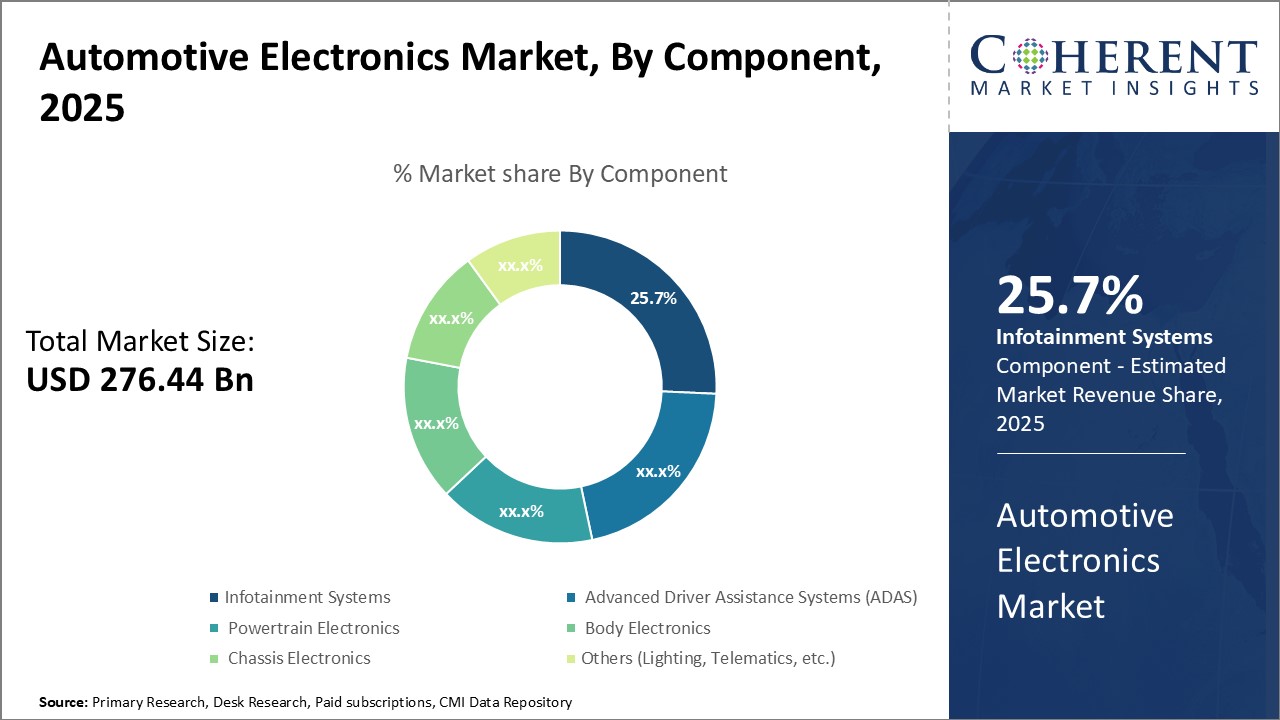
Automotive Electronics Market Insights, By Component: Technology Evolution Boosts Adoption of Infotainment Systems
In terms of component, infotainment systems segment is estimated to contribute the highest market share of 26.7% in 2026, owing to rapid technological advancement in connectivity and multimedia entertainment solutions for automobiles. Vehicles are increasingly becoming mobile connectivity hubs with sophisticated infotainment systems that integrate smartphones, onboard applications and cloud services. Automakers are recognizing that in-car entertainment and communication technology helps enhance the driving experience for consumers and strengthen brand value. Thus, automakers are investing heavily in developing advanced infotainment platforms that offer seamless integration of functions like navigation, audio/video playback, app store compatibility and rear seat displays.
For instance, in October 2025, Hyundai Motor India unveiled India’s first fully native Android Automotive Operating System (AAOS)‑based infotainment system in Q1 2027 across compact hatchback and SUV models.
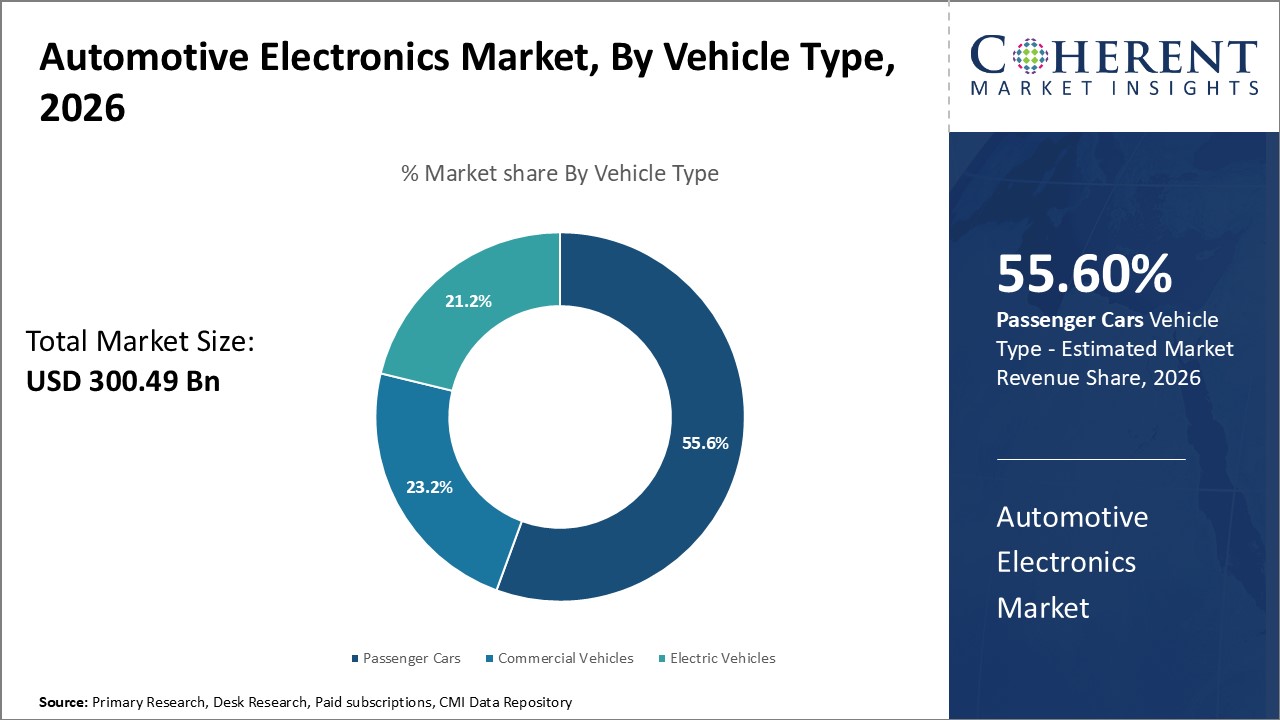
Automotive Electronics Market Insights, By Vehicle Type: Passenger Vehicle Proliferation Boosts Electronics Adoption
In terms of vehicle type, passenger cars segment is estimated to contribute the highest market share of 55.6% in 2026, owing to the sheer volumes in which these are produced worldwide. Sedans, SUVs, coupes and other commercial passenger vehicle models together dominate global vehicle sales. As personal mobility becomes an integral part of modern lifestyles, rising incomes especially in developing nations facilitates car ownership rates. Passenger car manufacturing is proceeding on an unprecedented scale in major automotive hubs to cater to burgeoning demand. Extensive use of electronics across different zones within contemporary passenger vehicles like cabin, cockpit, chassis, and powertrain has become indispensable from both customer satisfaction and safety perspectives in recent years.
For instance, in September 2025, Qualcomm and BMW launched their automated driving system “Snapdragon Ride Pilot”, which will debut in the BMW iX3 passenger vehicle and offers hands‑free highway driving, automatic lane changes, and parking assistance.
Automotive Electronics Market Insights, By Sales Channel: Expanding Original Equipment Manufacturers (OEMS) Functionality Boosts Demand For Safety Systems
In 2026, the automotive electronics market is expected to be significantly dominated by the Original Equipment Manufacturers (OEMs) segment, which is projected to capture a substantial 74.7% share. This dominance is primarily attributed to the inherent advantages that OEMs offer, such as the provision of high-quality, durable, and reliable electronic components that are specifically designed to meet the stringent requirements of modern vehicles. OEMs ensure that the electronic systems integrated into vehicles are optimized for performance and longevity, which instills greater consumer confidence compared to aftermarket alternatives.
For instance, in April 2025, Tata Elxsi Ltd. announced a strategic deal worth €50 million with a major European automotive OEM to support its software‑platform roadmap (software‑defined vehicle, electrification, body/chassis systems.
Regional Insights
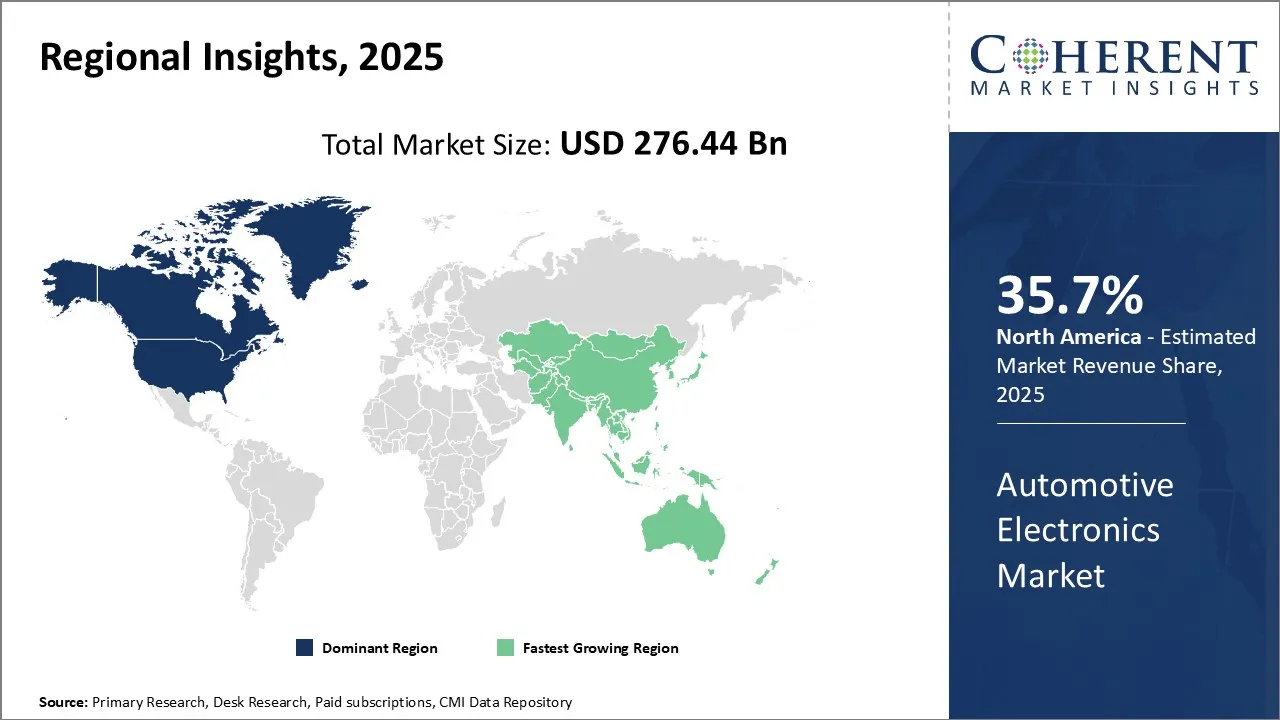
North America Automotive Electronics Market Analysis & Trends
North America dominates the automotive electronics with an estimated market share of 35.7% in 2026. The large presence of major automakers such as General Motors, Ford, and Tesla along with major automotive electronics suppliers like Delphi, Bosch, and Continental have ensured that North America leads in sourcing automotive electronics components locally. Automotive sector is highly integrated in the U.S. economy, and vehicles have increasingly become connected mobile devices necessitating advanced electronic components. North America accounts for over 35.5% of the global demand for infotainment systems, engine control units, braking systems and other electronic components used in vehicles.
For instance, in September 2026, Qualcomm & BMW announced their “Snapdragon Ride Pilot” automated driving system (for use in passenger vehicles).
Asia Pacific Automotive Electronics Market Analysis & Trends
Asia Pacific is expected to emerge as the fastest growing regional market, primarily driven by China and India. The booming automobile manufacturing industry in China catering to its own massive domestic market as well as being export hubs for countries in other regions has fueled demand. Vehicle production in China has surged at a double-digit rate annually. Companies like BYD, Great Wall, and Chery have grown rapidly as homegrown auto brands. This has boosted demand for sophisticated automotive electronic offerings to be embedded across entry and luxury segments in China.
For instance, in September 2026, Kyocera Asia Pacific Pte. Ltd. showcased advanced ceramic and semiconductor components for automotive applications (including MLCCs, varistors, anti‑surge components) at Electronica India 2026.
Automotive Electronics Market Outlook Country-Wise
U.S. Automotive Electronics Market Trends
The United States remains a leading hub for automotive electronics, driven by high adoption of advanced technologies such as ADAS (Advanced Driver Assistance Systems), electric vehicles (EVs), connected cars, and software-defined vehicles (SDVs). Major U.S. automakers, including General Motors, Ford, and Tesla, are heavily investing in in-vehicle infotainment, power electronics, and semiconductor integration. Recent initiatives, like Qualcomm’s collaboration with BMW for the Snapdragon Ride Pilot automated driving system (September 2026), reflect a focus on high-tech software-hardware integration.
For instance, in July 2026, Pioneer India Launched Automotive 360° Surround View Camera System and Announces OEM Deal with Leading Automaker”.
India Automotive Electronics Market Trends
India’s automotive electronics market is rapidly expanding, fueled by growing EV adoption, increasing vehicle production, and the rise of connected and intelligent mobility solutions. Leading suppliers such as HARMAN International are investing in advanced manufacturing facilities, like their Rs 345 crore expansion in Pune (October 2026), to support both domestic and export demands. Indian OEMs are also collaborating with global technology partners to develop infotainment, telematics, and ADAS systems tailored for emerging market needs. Government policies supporting EV adoption and localized electronics manufacturing are further accelerating growth, positioning India as a strategic hub for automotive electronics in the Asia-Pacific region.
For instance, in October 2026, HARMAN International announced an investment of ₹345 crore (USD 42 million) to expand its automotive electronics manufacturing facility in Pune, India.
Market Report Scope
Automotive Electronics Market Report Coverage
| Report Coverage | Details | ||
|---|---|---|---|
| Base Year: | 2025 | Market Size in 2026: | USD 300.49 Bn |
| Historical Data for: | 2020 To 2024 | Forecast Period: | 2026 To 2033 |
| Forecast Period 2026 to 2033 CAGR: | 8.7% | 2033 Value Projection: | USD 538.81 Bn |
| Geographies covered: |
| ||
| Segments covered: |
| ||
| Companies covered: | Analog Devices, Inc., Aptiv PLC, Autoliv Inc., Bosch (Robert Bosch GmbH), Continental AG, Delphi Technologies, Denso Corporation, Hitachi Automotive Systems, Ltd., Hyundai Mobis Co., Ltd., Infineon Technologies AG, Intel Corporation, Lear Corporation, NXP Semiconductors N.V., Panasonic Corporation, Texas Instruments Incorporated | ||
| Growth Drivers: |
| ||
| Restraints & Challenges: |
| ||
Automotive Electronics Market Driver
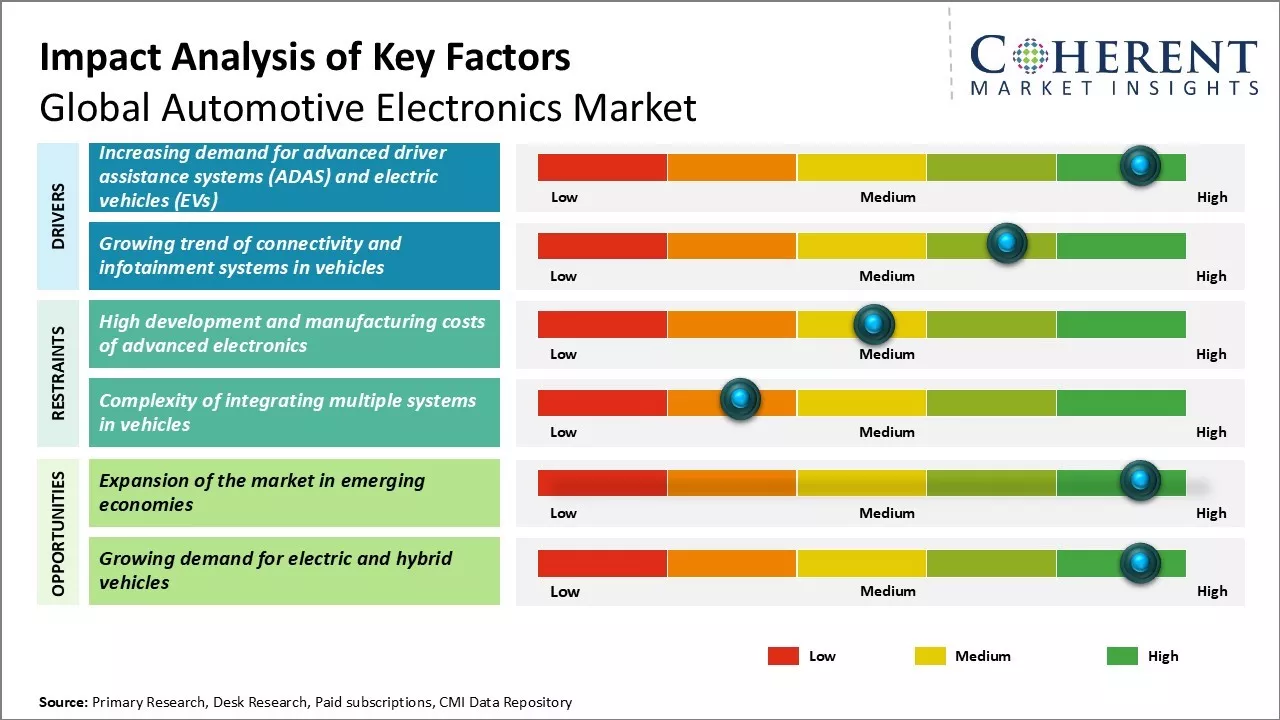
Increasing demand for advanced driver assistance systems (ADAS) and electric vehicles (EVs)
The automotive industry has witnessed huge demand for vehicles equipped with advanced driver assistance systems and technologies that enhance vehicle and road safety. ADAS technologies like adaptive cruise control, lane departure warning, automatic emergency braking, blind spot monitoring, and park assist are becoming increasingly popular among consumers. Automakers are also proactively making these systems a standard feature in many new vehicles recognizing their importance. With advancements in technologies like radar, ultrasonic sensors, cameras, and computer vision, ADAS systems can now provide drivers with active assistance and automated features that take some control tasks away from the driver and make driving safer.
Electric vehicles are also transforming the automotive landscape, supported by government policies and regulations to curb vehicle emissions. There has been huge demand for electric passenger cars, and all major automakers now have ambitious EV production targets and product launch plans to switch a part of their fleet to electric. As battery technologies improve and costs decline, there will be increase in driving range of EVs that can help to overcome consumer range anxiety. The rapid expansion of public charging networks across cities and major highways is further incentivizing consumers to choose electric vehicles. Automakers are pouring billions into electrification of their lineups and development of advanced batteries, powertrains, and vehicle electronics that power EVs. This boosts automotive electronics industry as electronic components become more critical in electric vehicles.
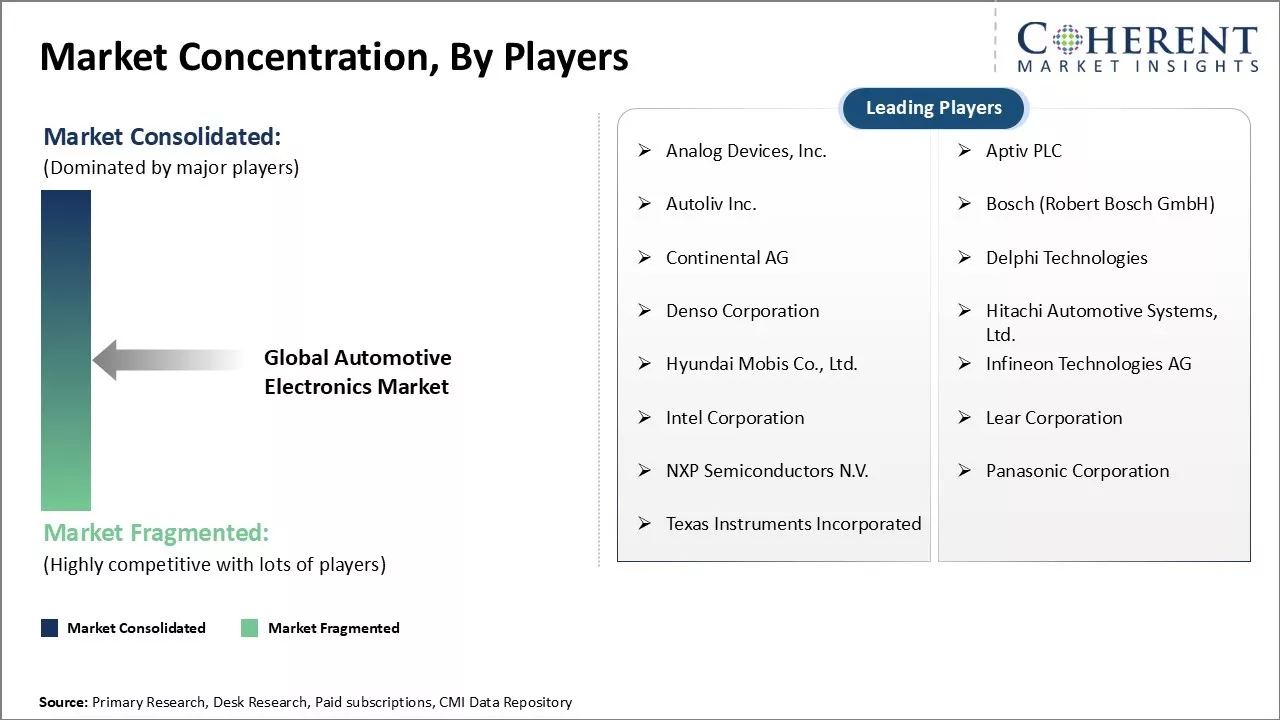
Market Concentration and Competitive Landscape
Growing Trend of Connectivity and Infotainment Systems in Vehicles
Vehicles are increasingly becoming mobile networking devices and there has been huge demand for advanced connectivity and digital capabilities from drivers and passengers. Technologies like embedded telematics control units, multimedia, and navigation systems, and smartphones integrations that allow features like in-vehicle apps witnesses widespread adoption.
Consumers want to be constantly connected even while driving and access entertainment, information and productivity features seamlessly within their vehicles. This has pushed automakers to equip even basic trim level vehicles with touchscreen infotainment systems, advanced connectivity features like wifi hotspots, advanced speech recognition and connectivity options like Apple CarPlay and Android Auto.
Automotive Electronics Market Opportunities
Expansion of the market in emerging economies
The expansion of global automotive electronics market in emerging economies provides tremendous growth opportunities. As developing countries like China, India, Indonesia and others witness rising middle class and increasing disposable incomes, there has been huge demand for vehicles. However, most markets in emerging nations are still in the early expansion stage with large potential to grow further in the near future. This provides automotive electronics manufacturers an opportunity to enter these markets with customized offerings suitably priced for customers in price-sensitive developing countries. The establishment of local manufacturing facilities could also help lower costs and boost market penetration. Emerging markets offer a platform to test and refine new products before rolling them out on a larger scale globally. Therefore, tapping into the large untapped markets in developing economies can drive significant revenues for automotive electronics companies in the future.
Analyst Opinion (Expert Opinion)
The automotive electronics market is undergoing a profound transformation driven by electrification, vehicle autonomy, and connected mobility. Regulatory mandates, such as the EU’s General Safety Regulation (GSR 2019/2144) and India’s Bharat Stage VI norms, are accelerating the integration of advanced sensors, ADAS modules, and infotainment systems across vehicle segments. For instance, ADAS penetration in passenger cars is projected to exceed 45% by 2025 in North America, reflecting OEMs’ commitment to safety and compliance.
Leading automotive OEMs, including Tesla and Hyundai, are redefining in-vehicle experiences by standardizing over-the-air (OTA) updates and infotainment platforms across their global fleets. Tesla’s Full Self-Driving (FSD) suite, with continual software upgrades, exemplifies how software-defined electronics can extend vehicle lifecycle value and revenue streams, creating a competitive moat that traditional component-driven approaches cannot match. Similarly, Maruti Suzuki’s recent adoption of integrated telematics and connected services in India highlights how regional OEMs are leapfrogging legacy architectures to meet consumer demand for connectivity.
The strategic advantage now lies not in volume alone, but in the orchestration of electronics, software, and vehicle architecture. Firms prioritizing modular electronics, scalable OTA infrastructure, and cybersecurity-enabled infotainment platforms are positioned to dominate, while legacy suppliers risk obsolescence. With North America accounting for over 35% of advanced automotive electronics adoption and Asia Pacific emerging as a testing ground for affordable connected technologies, the market is clearly bifurcating between high-end software-driven vehicles and cost-sensitive, electronics-integrated mobility solutions.
Speak to the analyst
Want personalized insights?
Take the findings above to one of our principal consultants, or have the report rebuilt around the segments, geographies and competitors you actually track.
Automotive Electronics Industry News
- In January 2025, Infineon Technologies AG, Launched new CoolSiC™ Automotive MOSFET 1200 V in Q‑DPAK package for EV traction/inverter applications.
- In January 2025, Aptiv PLC, announced world‑class ADAS, next‑gen in‑cabin experience, and advanced power distribution at CES 2025 (software‑defined vehicles).
- In January 2023, ZF Friedrichshafen AG, a leading global supplier of automotive technology, launched Smart Camera 6, its next-generation camera designed for automated driving and safety systems.
Market Segmentation
- By Component Insights (Revenue, USD Bn, 2026 - 2033)
- Infotainment Systems
- Advanced Driver Assistance Systems (ADAS)
- Powertrain Electronics
- Body Electronics
- Chassis Electronics
- Others (Lighting, Telematics, etc.)
- By Vehicle Type Insights (Revenue, USD Bn, 2026 - 2033)
- Passenger Cars
- Commercial Vehicles
- Electric Vehicles
- By Sales Channel Insights (Revenue, USD Bn, 2026 - 2033)
- Original Equipment Manufacturers (OEMs)
- Aftermarket
- By Regional Insights (Revenue, USD Bn, 2026 - 2033)
- North America
- U.S.
- Canada
- Latin America
- Brazil
- Argentina
- Mexico
- Rest of Latin America
- Europe
- Germany
- U.K.
- Spain
- France
- Italy
- Russia
- Rest of Europe
- Asia Pacific
- China
- India
- Japan
- Australia
- South Korea
- ASEAN
- Rest of Asia Pacific
- Middle East
- GCC Countries
- Israel
- Rest of Middle East
- Africa
- South Africa
- North Africa
- Central Africa
- Key Players Insights (Revenue, USD Bn, 2021 - 2033)
- Analog Devices, Inc.
- Aptiv PLC
- Autoliv Inc.
- Bosch (Robert Bosch GmbH)
- Continental AG
- Delphi Technologies
- Denso Corporation
- Hitachi Automotive Systems, Ltd.
- Hyundai Mobis Co., Ltd.
- Infineon Technologies AG
- Intel Corporation
- Lear Corporation
- NXP Semiconductors N.V.
- Panasonic Corporation
- Texas Instruments Incorporated
Sources
Primary Research Interviews from the following stakeholders
Stakeholders
- Interviews with automotive OEMs, Tier-1 & Tier-2 suppliers, semiconductor manufacturers, automotive software & electronics solution providers, and R&D heads across major regional markets.
Specific stakeholders
- Engineering and R&D heads at leading automotive OEMs
- Electronics and embedded systems managers at Tier-1 suppliers
- Operations and production managers at automotive semiconductor manufacturers
- ADAS, infotainment, and EV electronics innovation leads at OEMs and suppliers
- Procurement and quality control teams in vehicle electronics divisions
- Software and firmware engineers specializing in connected car solutions, cybersecurity, and sensor fusion
- Regulatory compliance and safety officers ensuring adherence to automotive electronics standards
Databases
- United Nations Comtrade Database – Automotive Electronics Exports/Imports
- World Trade Organization (WTO) Trade Statistics – Automotive Components
- Eurostat – Motor Vehicle and Electronics Trade Data
- U.S. Census Bureau – Automotive Parts & Electronics Statistics
- China Customs Statistics – Vehicle Electronics Components
- Directorate General of Commercial Intelligence and Statistics (DGCIS), India – Auto Parts Data
- Japan External Trade Organization (JETRO) – Automotive Components
- Korea Customs Service Data Portal – Automotive Electronics
- Society of Automotive Engineers (SAE) Vehicle & Electronics Database
- Indian Ministry of Commerce & Industry – Automotive Components Export Data
Magazines
- Automotive News
- Automotive Electronics Magazine
- EE Times – Automotive Section
- Automotive World
- Electronics for You – Automotive Electronics Section
- Car Electronics Magazine
- SAE Automotive Engineering News
- Automotive Design & Production
- Embedded Computing Design – Automotive Section
- EE Journal – Automotive Solutions
Journals
- IEEE Transactions on Vehicular Technology
- IEEE Transactions on Intelligent Transportation Systems
- SAE International Journal of Passenger Cars – Electronics and Electrical Systems
- International Journal of Automotive Technology
- Journal of Automotive Safety and Electronics
- Journal of Advanced Transportation Systems
- Sensors – Automotive Electronics Applications Section
- Vehicle System Dynamics – Electronics & Control Systems Section
Newspapers
- The Wall Street Journal – Automotive & Technology
- The Economic Times – Auto Industry & Electronics
- Automotive News – Industry Updates
- Financial Times – Automotive & Innovation
- Nikkei Asia – Automotive Electronics & Supply Chain
- The Hindu Business Line – Automobile Sector
- South China Morning Post – Automotive Electronics
- The Guardian – Automotive Technology
Associations
- Society of Automotive Engineers (SAE International)
- Automotive Electronics Council (AEC)
- European Association of Automotive Suppliers (CLEPA)
- Automotive Electronics Suppliers Association (India)
- International Organization of Motor Vehicle Manufacturers (OICA) – Electronics Committee
- Consumer Electronics Association (CEA) – Automotive Electronics Forum
- Automotive Components Manufacturers Association of India (ACMA)
- Institute of Electrical and Electronics Engineers (IEEE) – Vehicular Electronics Section
- Japan Automobile Manufacturers Association (JAMA) – Electronics Division
- Korea Automotive Electronics Association
Public Domain Sources
- Ministry of Heavy Industries & Public Enterprises, India – Automotive Electronics Policies
- U.S. Department of Transportation – Vehicle Electronics & Safety Reports
- European Commission – Automotive Electronics & Connectivity Reports
- Japan Ministry of Economy, Trade and Industry (METI) – Vehicle Electronics Policy Data
- Organisation for Economic Co-operation and Development (OECD) – Automotive Electronics Reports
- Central Pollution Control Board (CPCB), India – Electric Vehicles & Electronics Initiatives
- Society of Automotive Engineers (SAE) – Public Standards & Guidelines
- United Nations Economic Commission for Europe (UNECE) – WP.29 Vehicle Regulations
- Reserve Bank of India (RBI) – Industrial Production & Automotive Sector Reports
- Department for Promotion of Industry and Internal Trade (DPIIT), India – Automotive Electronics Sector Initiatives
Proprietary Elements
- CMI Data Analytics Tool
- Proprietary CMI Existing Repository of information for last 8 years
*Definition: Global automotive electronics market consists of electronic components and systems that are used in motor vehicles, including infotainment systems, advanced driver-assistance systems (ADAS), powertrain systems, communication & navigation systems, body electronics, and vehicle security systems. As automotive technologies continue to evolve with more focus on safety, autonomous driving, and connectivity features, demand for advanced electronic components in cars is growing significantly.
Get access to 250+ pages report
Every segment, forecast, competitor profile and data table behind the analysis above — available for instant download.
- ESOMAR Member
- ISO 9001:2015 Certified
- D-U-N-S Registered
- GDPR & CCPA Compliant
Missing comfort of reading report in your local language? Find your preferred language:
Transform your Strategy with Exclusive Trending Reports
Frequently Asked Questions
The Automotive Electronics Market is estimated to be valued at USD 300.49 Bn in 2026, and is expected to reach USD 538.81 Bn by 2033.
The CAGR of the Automotive Electronics Market is projected to be 8.7% from 2026 to 2033.
Increasing demand for advanced driver assistance systems (ADAS) and electric vehicles (EVs) and growing trend of connectivity and infotainment systems in vehicles are the major factors driving the growth of global automotive electronics market.
High development and manufacturing costs of advanced electronics and complexity of integrating multiple systems in vehicles are the major factors hampering the growth of global automotive electronics market.
In terms of component, infotainment systems segment is estimated to dominate the market in 2026.
Analog Devices, Inc., Aptiv PLC, Autoliv Inc., Bosch (Robert Bosch GmbH), Continental AG, Delphi Technologies, Denso Corporation, Hitachi Automotive Systems, Ltd., Hyundai Mobis Co., Ltd., Infineon Technologies AG, Intel Corporation, Lear Corporation, NXP Semiconductors N.V., Panasonic Corporation, Texas Instruments Incorporated are the major players.
North America is expected to lead the global automotive electronics market in 2026.