

Autonomous Underwater Vehicle Manufacturers Market Size and Forecast – 2026 To 203 3
The Autonomous Underwater Vehicle Manufacturers Market is anticipated to grow at a CAGR of 7.2% with USD 11.4 Bn in 2026 and is expected to reach USD 18.7 Bn in 2033. Growing offshore oil and gas exploration activities, increasing underwater infrastructure inspections, expanding environmental monitoring programs, and rising investments in ocean mapping, renewable energy projects, and autonomous maritime operations are driving the growth of the Autonomous Underwater Vehicle (AUV) manufacturers market. India’s oil and gas sector is expanding steadily, with ONGC launching over 45 exploration and development wells in early 2025 and the Dabhol LNG terminal increasing capacity from 5 to 6.3 MMTPA. The government aims to raise natural gas’s share in the energy mix from 6% to 15% by 2030, enhancing energy security and supporting sustainability goals.
Key Takeaways
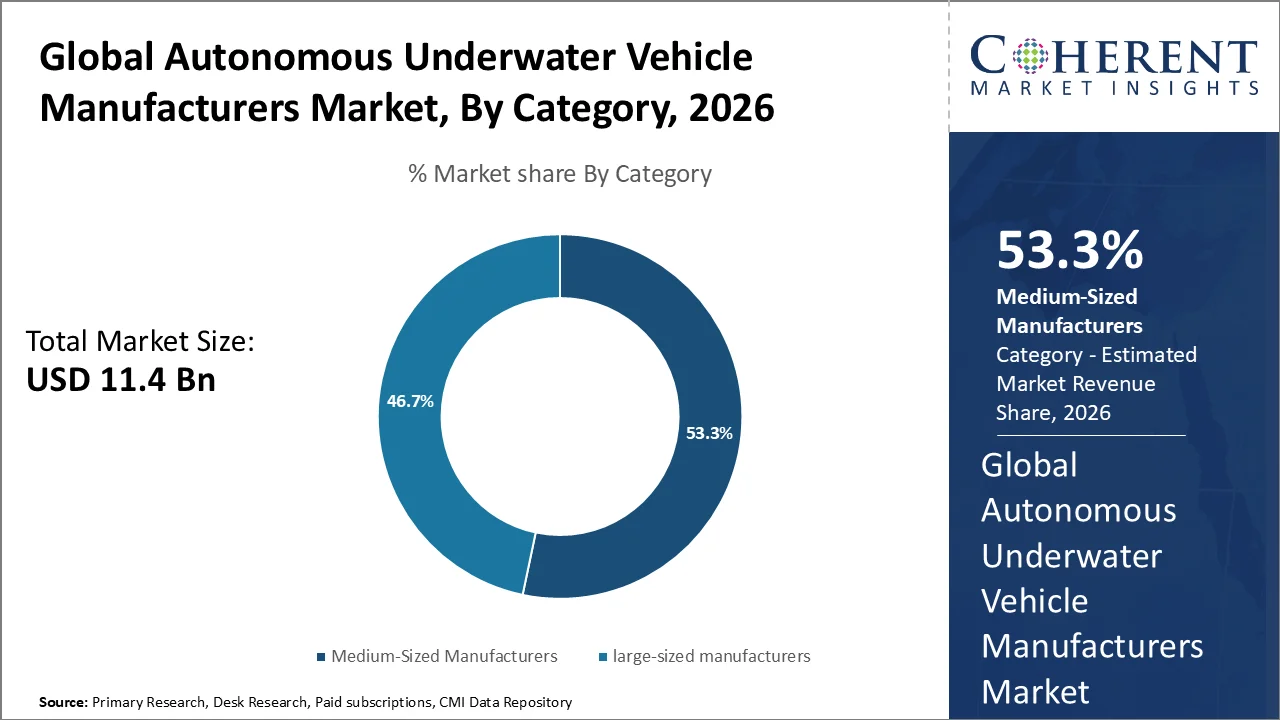
- Medium-Sized Manufacturers hold the largest market share of 53.3% in 2026 owing to its rising defense and maritime security spending. According to our research, maritime security industry is anticipated to surpass USD 47 Bn by 2033.
- North America acquired the largest market share of 39.3% in 2026 owing to the protection of critical undersea infrastructure. In May 2026, the United States, the United Kingdom, and Australia launched a joint initiative to develop advanced underwater drones, reinforcing their security partnership and enhancing military capabilities amid rising concerns over China’s growing maritime influence.
Current Events and Their Impact
Current Event | Description and its Impact |
India's Deep Ocean Mission and Blue Economy Investments |
|
Increased Naval Modernization Budgets Across Indo-Pacific Nations |
|
Segmental Insights
- Current Industry Events of 2026
- Market Size Estimation
- Regional Breakdown
- Competitive Landscape
- Customer Intelligence
- Segmental Analysis
- Pricing Analysis
- Key Market Drivers, Challenges & Future Trends
- Customized Insights Section
Why is Medium-Sized Manufacturers Acquiring the Largest Market Share?
Medium-Sized Manufacturers hold the largest market share of 53.3% in 2026 owing to its advances in sensors, sonar, and navigation systems. Medium-sized manufacturers are driving growth in the Autonomous Underwater Vehicle (AUV) market by delivering cost-effective, mission-specific solutions for defense, offshore energy, scientific research, and environmental monitoring applications. They leverage their flexibility to develop customized designs, modular platforms, and new products more quickly, helping them meet specialized customer needs efficiently. By integrating advanced sensors, sonar systems, artificial intelligence, battery technologies, and autonomous navigation capabilities, they continue to enhance product performance. These manufacturers also expand their market presence and strengthen innovation through strategic partnerships with government agencies, research institutions, and commercial operators. For instance, in October 2025, the UK Ministry of Defence plans to achieve initial operating capability for a torpedo tube launch and recovery AUV system on Royal Navy Astute-class submarines in 2026–27. In May 2025, Project Scylla successfully tested launching and recovering an Iver4 900 medium AUV from HMS Astute.
Autonomous Underwater Vehicle Manufacturers Market Trends
- Integration of artificial intelligence, machine learning, advanced sonar, and autonomous navigation technologies is enhancing vehicle performance. Modern AUVs increasingly incorporate AI-enabled mission planning, autonomous obstacle avoidance, real-time data processing, and sensor fusion technologies. Recent AI-powered underwater systems have demonstrated the ability to analyze more than 55,000 underwater images for automated object detection and marine environment assessment, reducing operational costs and improving mission efficiency.
- Strategic government funding, defense modernization programs, and collaborative research initiatives are accelerating AUV innovation. The U.S. Navy's FY2026 budget request includes approximately USD 185 million for Large Unmanned Undersea Vehicle (LUUV) research and development programs focused on enhancing endurance, payload capacity, and modular mission capabilities.
- Military procurement programs are transitioning AUVs from prototype development to large-scale deployment. In 2025, the U.S. Navy received its first Lionfish small uncrewed undersea vehicles under a program that could scale to 200 vehicles with a contract value exceeding USD 347 million, demonstrating growing commercialization opportunities for AUV manufacturers.
Regional Insights
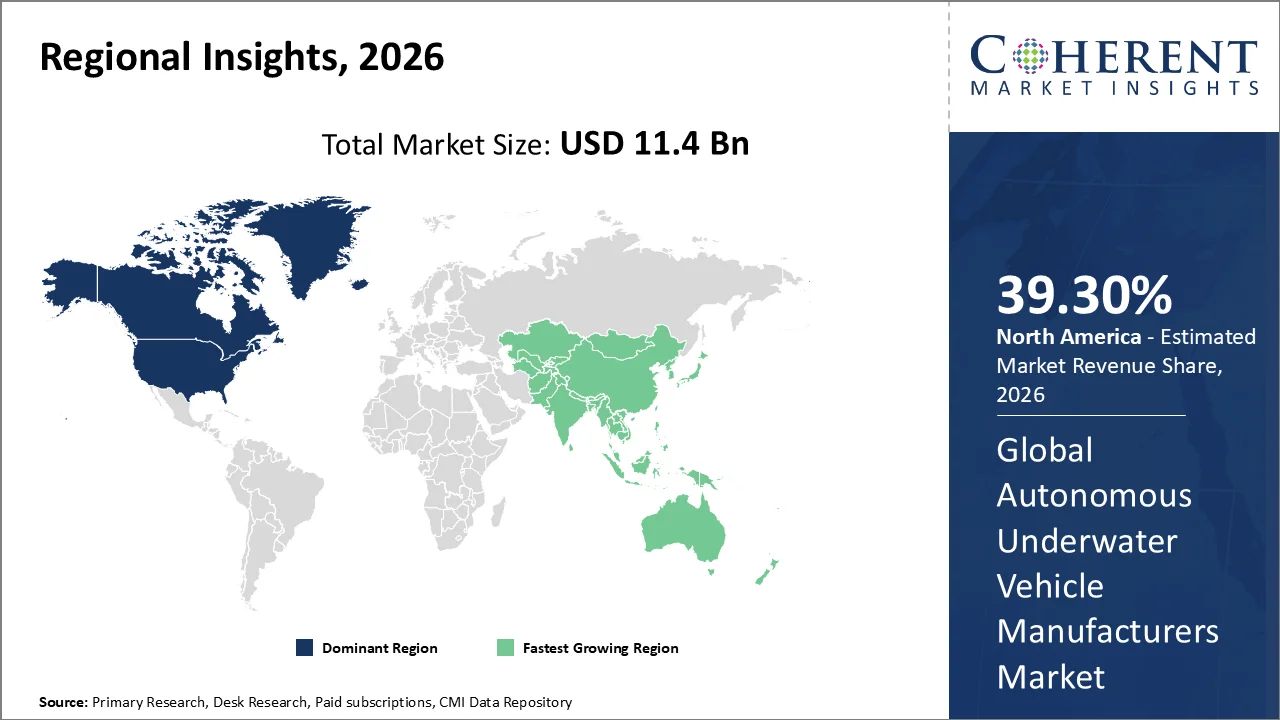
North America dominates owing to strong regional R&D ecosystem
North America acquired the largest market share of 39.30% in 2026. North America strengthens the Autonomous Underwater Vehicle (AUV) manufacturers market by investing heavily in defense programs, advancing maritime security initiatives, and increasing the deployment of underwater surveillance and reconnaissance systems. The region fosters innovation through its established marine technology ecosystem, strong research infrastructure, and ongoing advancements in autonomous navigation, sensors, and sonar technologies. Companies and organizations expand the use of AUVs for offshore energy operations, subsea infrastructure inspections, and oceanographic research. Government agencies, defense bodies, research institutions, and private firms actively collaborate to accelerate AUV development and deployment. For instance, in January 2026, HII announced the successful deployment and recovery of a REMUS autonomous underwater vehicle using its Sea Launcher automated launch and recovery system during shipboard operations.
Asia Pacific Autonomous Underwater Vehicle Manufacturers Market Trends
Rising investments in maritime security, naval modernization, offshore energy exploration, and oceanographic research drive the Asia Pacific Autonomous Underwater Vehicle (AUV) manufacturers market. Government initiatives such as Sagarmala, Maritime India Vision 2030, and Maritime Amrit Kaal Vision 2047 are driving over US$1 trillion in investments by 2047 to enhance port infrastructure, shipbuilding, coastal shipping, and logistics efficiency. Demand for underwater surveillance, seabed mapping, environmental monitoring, and offshore infrastructure inspection encourages the adoption of advanced AUVs. Governments and research institutions expand marine science programs, while growing commercial activities in fisheries, renewable energy, and deep-sea resource exploration generate new opportunities. Advancements in sensors, navigation systems, artificial intelligence, and battery technologies further strengthen market growth across the region. For instance, in March 2026, Sagar Defence Engineering introduced Autonomous Maritime Shipbuilding and Systems Centre at Juvvaladinne Fishing Harbour in Andhra Pradesh, marking a key step in boosting India’s indigenous defence manufacturing and maritime innovation.
United States Autonomous Underwater Vehicle Manufacturers Market Trends
The United States autonomous underwater vehicle manufacturers market is driven by rising naval defense demand for surveillance, mine countermeasures, and intelligence gathering. Offshore oil and gas operators expand exploration activities and increase subsea infrastructure inspection, which boosts adoption. Oceanographic research, climate studies, and seabed mapping further drive usage. Advances in artificial intelligence, sensor systems, and autonomous navigation improve performance and efficiency. Government funding and defense modernization programs support innovation, while commercial uses such as search and rescue and environmental monitoring expand applications. For instance, in March 2026, the US Navy enhanced its undersea warfare capabilities by adopting a system that enables submarines to launch and recover autonomous underwater vehicles without surfacing. Under an Other Transaction Authority contract, the Defense Innovation Unit has awarded L3Harris Technologies to deliver the Torpedo Tube Launch and Recovery (TTLR) system.
China Autonomous Underwater Vehicle Manufacturers Market Trends
Rising demand for marine exploration, naval modernization, and offshore energy development drives China’s autonomous underwater vehicle manufacturing market. The government strongly supports maritime security and oceanographic research, which stimulates domestic innovation and production. Expanding use in environmental monitoring, deep-sea mining, and underwater infrastructure inspection increases adoption. Advances in artificial intelligence, sensors, and robotics improve AUV performance. Research institutions and industry players increasingly collaborate, accelerating technological development and commercialization across civil and defense maritime sectors and sustaining market growth momentum.
Who are the Major Companies in Autonomous Underwater Vehicle Manufacturers Industry
Some of the major key players in Autonomous Underwater Vehicle Manufacturers are Kongsberg Maritime, Teledyne Marine, Bluefin Robotics, ECA GROUP, Saab AB, Lockheed Martin Corporation, Fugro, ATLAS ELEKTRONIK GmbH, Boston Engineering Corporation, and International Submarine Engineering.
Key News
- In September 2025, BeeX, a leading developer of AI-powered autonomous underwater vehicles, has launched an SGD 10 million Series A round as demand for its hovering AUVs grows. The company’s move aligns with rising global focus on nearshore and offshore infrastructure and increasing subsea inspection needs across industries.
Market Report Scope
Autonomous Underwater Vehicle Manufacturers Market Report Coverage
| Report Coverage | Details | ||
|---|---|---|---|
| Base Year: | 2025 | Market Size in 2026: | USD 11.4 Bn |
| Historical Data for: | 2020 To 2024 | Forecast Period: | 2026 To 2033 |
| Forecast Period 2026 to 2033 CAGR: | 7.2% | 2033 Value Projection: | USD 18.7 Bn |
| Geographies covered: |
| ||
| Segments covered: |
| ||
| Companies covered: | Kongsberg Maritime, Teledyne Marine, Bluefin Robotics, ECA GROUP, Saab AB, Lockheed Martin Corporation, Fugro, ATLAS ELEKTRONIK GmbH, Boston Engineering Corporation, and International Submarine Engineering. | ||
Analyst Opinion
- The Autonomous Underwater Vehicle (AUV) manufacturers market is increasingly driven by operational necessity rather than discretionary investment. Over 80% of the ocean remains unmapped at high resolution, forcing governments and offshore operators to rely on AUVs for deep-sea exploration, seabed mapping, and mission-critical data collection that cannot be achieved through manned vessels alone. This persistent data gap is the core structural driver of demand.
- Defense applications dominate high-value deployments, with more than 30 countries actively integrating AUVs into naval fleets for mine countermeasures, anti-submarine warfare, and persistent underwater surveillance. For example, the U.S. Navy’s Knifefish program and China’s increasing deployment of Tianjin-class and Haima-class AUVs reflect a clear shift toward autonomous underwater dominance in contested maritime zones.
- Offshore energy inspection and subsea infrastructure monitoring are major commercial accelerators. The offshore oil and gas sector operates more than 190,000 kilometers of subsea pipelines globally, requiring continuous inspection where AUVs significantly reduce operational risk and downtime compared to ROVs.
- Technological progress in autonomy, navigation, and sensor fusion is redefining capability thresholds. Modern AUVs can execute multi-day missions at depths exceeding 6,000 meters, with advanced sonar systems enabling centimeter-level seabed resolution, making them indispensable for deep-sea mining exploration and scientific oceanography programs such as NOAA’s deep ocean mapping initiatives.
Speak to the analyst
Want personalized insights?
Take the findings above to one of our principal consultants, or have the report rebuilt around the segments, geographies and competitors you actually track.
Market Segmentation
- By Category: (Revenue, USD Bn, 2026-2033)
- Medium-sized manufacturers
- Large-sized manufacturers
- By Region: (Revenue, USD Bn, 2026-2033)
- North America
- U.S.
- Canada
- Latin America
- Brazil
- Mexico
- Argentina
- Rest of Latin America
- Europe
- Germany
- U.K.
- France
- Italy
- Spain
- Russia
- Rest of Europe
- Asia Pacific
- China
- India
- Japan
- Australia
- South Korea
- ASEAN
- Rest of Asia Pacific
- Middle East
- GCC
- Israel
- Rest of Middle East
- Africa
- South Africa
- Central Africa
- North Africa
- North America
- Key Players
- Kongsberg Maritime
- Teledyne Marine
- Bluefin Robotics
- ECA GROUP
- Saab AB
- Lockheed Martin Corporation
- Fugro
- ATLAS ELEKTRONIK GmbH
- Boston Engineering Corporation
- International Submarine Engineering.
Sources
Primary Research interviews
- Interviews with naval procurement officers, offshore energy project engineers, subsea robotics manufacturers, and marine research scientists involved in AUV deployment and operations
- Discussions with defense technology specialists and oceanographic institute researchers working on deep-sea mapping and autonomous systems integration
Databases
- National oceanographic and hydrographic data repositories
- Defense equipment procurement and fleet modernization databases
- Offshore energy infrastructure and subsea asset monitoring databases
- Scientific mission and marine exploration datasets from public and institutional sources
Magazines
- Marine technology and offshore engineering publications
- Defense and naval technology magazines covering autonomous systems
- Robotics and unmanned systems industry magazines focusing on underwater innovation
Journals’
- IEEE Journal of Oceanic Engineering
- Ocean Engineering research publications
- Journal of Field Robotics (underwater autonomy studies)
- Marine Technology Society Journal
Newspapers
- Financial and business newspapers reporting on defense modernization and offshore energy expansion
- National newspapers covering maritime security developments and deep-sea exploration initiatives
- Technology-focused newspaper sections highlighting robotics and AI integration in marine systems
Associations
- Marine Technology Society (MTS)
- International Hydrographic Organization (IHO)
- IEEE Oceanic Engineering Society
- Regional naval and maritime research associations
Public Domain sources
- Government naval modernization reports and defense white papers
- Public ocean exploration mission data (e.g., deep-sea mapping expeditions)
- National hydrographic survey publications
- Academic institution research outputs on underwater robotics and autonomy
Proprietary Elements
- CMI Data Analytics Tool, and Proprietary CMI Existing Repository of information for last 10 years
Get access to 250+ pages report
Every segment, forecast, competitor profile and data table behind the analysis above — available for instant download.
- ESOMAR Member
- ISO 9001:2015 Certified
- D-U-N-S Registered
- GDPR & CCPA Compliant
Missing comfort of reading report in your local language? Find your preferred language:
Transform your Strategy with Exclusive Trending Reports
Frequently Asked Questions
AUVs are used for seabed mapping, marine research, offshore oil and gas inspection, naval surveillance, deep-sea exploration, and environmental monitoring where human access is limited or risky.
Defense and naval forces are the largest users, followed by offshore energy (oil and gas, wind), scientific research institutions, and commercial subsea survey companies.
AUVs operate without real-time human control, allowing deeper, longer, and more cost-efficient missions compared to remotely operated vehicles (ROVs) and manned submersibles.
Key technologies include advanced sonar imaging, inertial navigation systems, AI-based autonomy, high-capacity batteries, and sensor fusion for precise underwater mapping and decision-making.
High development costs, limited underwater communication range, battery endurance constraints, and difficulties in deep-sea navigation remain major technical and operational challenges.