

E-Bike Market Size and Forecast – 2026 to 2033
The global E-Bike market is estimated to be valued at USD 41.35 Bn in 2026 and is expected to reach USD 101.58 Bn by 2033, exhibiting a compound annual growth rate (CAGR) of 13.7% from 2026 to 2033.
Key Takeaways
- By Battery Type, Lithium-ion hold the largest market share of 62.9% in 2026 owing to the rising demand for eco-friendly & efficient transport.
- By Motor Type, Mid-drive expected to hold largest market share of 56.7% in 2026 owing to its superior performance & torque / terrain versatility.
- By Application, Mountain Bikes acquired the prominent market share of 39.1% in 2026 owing to the rising popularity of off‑road recreation & adventure riding.
- By Region, North America dominates the overall market with an estimated share of 39.4% in 2026 owing to the growing demand for eco‑friendly, urban mobility solutions.
Market Overview
The global e-bike market is rapidly expanding as consumers increasingly demand sustainable and efficient transportation solutions. Urbanization, traffic congestion, and environmental concerns are prompting more people to choose electric bicycles for commuting, leisure, and recreational purposes. Advances in battery efficiency, lightweight frames, and motor performance are improving usability and attractiveness. Governments are supporting the market through favorable policies, while expanding infrastructure and rising interest in fitness and outdoor activities are driving adoption, positioning e-bikes as a preferred alternative to traditional bicycles and vehicles.
Current Events and their Impact on the E-Bike Market
Current Events | Description and its impact |
Geopolitical and Regulatory Developments |
|
Technological Innovations |
|
Environmental and Social Trends |
|
Segmental Insights
- Current Industry Events of 2026
- Market Size Estimation
- Regional Breakdown
- Competitive Landscape
- Customer Intelligence
- Segmental Analysis
- Pricing Analysis
- Key Market Drivers, Challenges & Future Trends
- Customized Insights Section
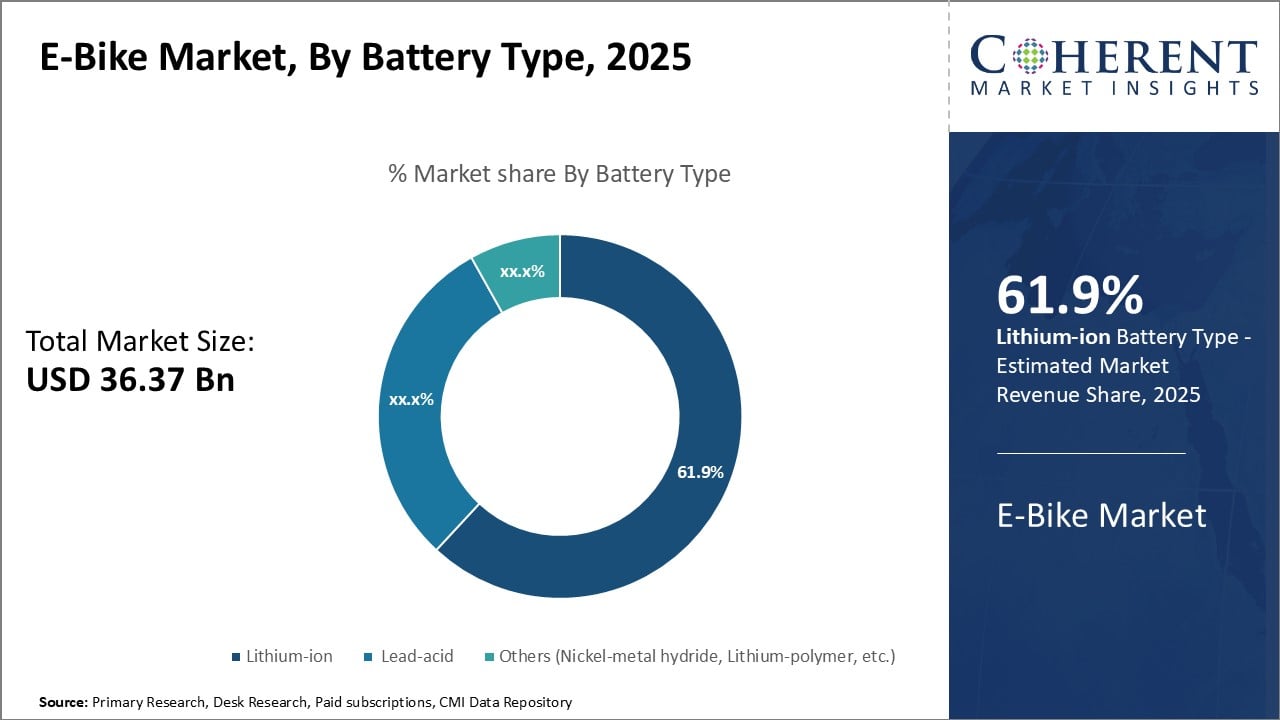
E-Bike Market Insights, By Battery Type: Lithium-ion contribute the highest share of the market owing to its Technological advances and improving battery performance.
Lithium-ion hold the largest market share of 62.9% in 2026. E-bike manufacturers are driving the adoption of lithium-ion batteries by highlighting their higher energy density, lighter weight, and longer lifespan compared to older battery types. These advantages enable riders to travel longer distances, charge faster, and enjoy more responsive performance. At the same time, falling production costs and government incentives for clean transportation are making e-bikes more accessible. Consequently, riders increasingly choose lithium-ion batteries for their high performance, efficiency, and environmentally friendly benefits. For instance, in June 2025, Boson Cell has started commercial production of lithium-ion batteries in India, introducing two models designed for drones, electric vehicles, and renewable energy systems. The company plans to cut import dependence and secure a 10% share of the domestic battery market.
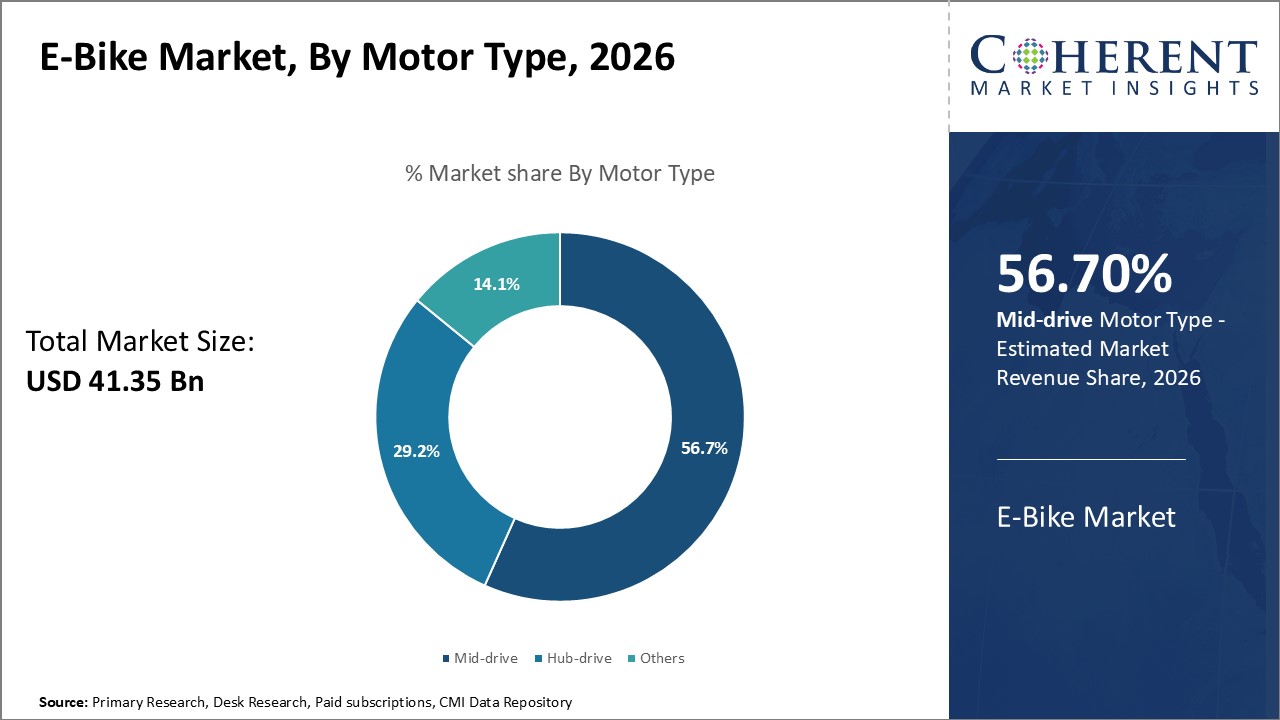
E-Bike Market Insights, By Motor Type: Mid-drive contributes the highest share of the market owing to its growing demand for premium / performance e‑bike segments.
Mid-drive expected to hold largest market share of 56.7% in 2026. E-bike manufacturers are adopting mid-drive systems to provide riders with precise power delivery through the chain and gears, enhancing hill-climbing performance, natural pedaling, and overall balance. Riders favor these systems in premium, cargo, and mountain bikes where performance is critical. Advances in motor intelligence, lightweight design, and gear compatibility continue to elevate expectations, while both individual riders and fleet operators increasingly choose mid-drive setups for their superior ride quality, versatility, and long-lasting durability. For instance, in June 2025, Germany’s Mahle, known as one of the world’s largest automotive component manufacturers, also produces e-bike motors and has now entered the eMTB segment with a mid-drive system that it claims is “one of the most powerful on the market.”
E-Bike Market Insights, By Application: Mountain Bikes contribute the highest share of the market owing to its sustainability / eco‑mobility trends.
Mountain Bikes acquired the prominent market share of 39.1% in 2026. Riders are increasingly driving demand for mountain-style e-bikes as outdoor adventure and trail exploration gain popularity. Manufacturers are introducing high-torque motors, enhanced battery packs, and advanced suspension systems, allowing riders to navigate challenging terrain more easily. The trend toward eco-friendly recreation and active lifestyles motivates more consumers to choose off-road options that blend fitness and enjoyment. Additionally, expanded access to bike parks and rental fleets is encouraging casual riders and newcomers to enter the mountain e-bike segment. For instance, in January 2025, AOKI Mobility has launched a new lineup of e-bicycles aimed at sustainable urban transportation. The range features the Sherpa for mountainous terrain, the Flex folding model, and the Cadence for city riding. The Flex stands out for its lightweight design and 80 km travel range.
Regional Insights
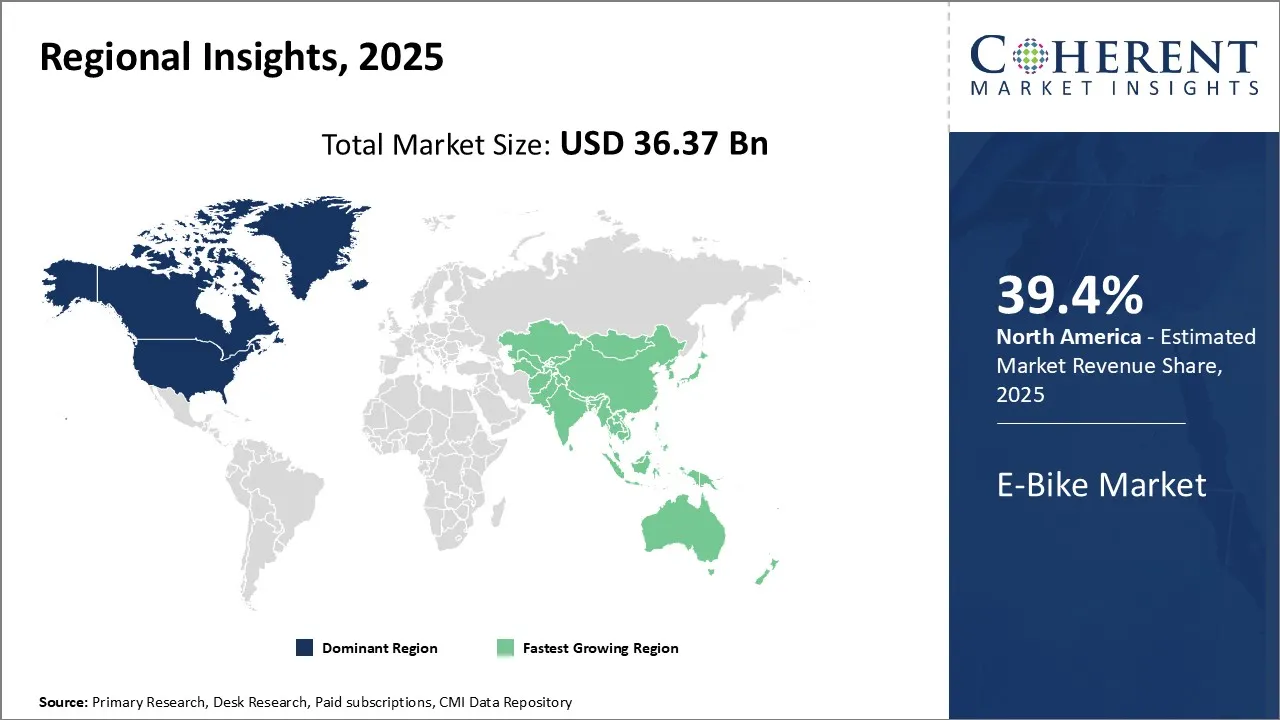
North America E-Bike Market Trends
North America dominates the overall market with an estimated share of 39.4% in 2026. Riders in North America are reshaping the e‑bike market by increasingly using them for urban commuting and embracing smarter, tech-enabled bikes. They are opting for pedal-assist and speed-pedelec models as traffic congestion and rising fuel costs encourage alternative mobility. Manufacturers are adding connected features such as GPS, smartphone integration, and anti-theft systems to appeal to tech-savvy consumers. At the same time, shared-mobility programs and cargo e-bikes for last-mile delivery are expanding e-bikes’ use from leisure to essential everyday transportation. For instance, in July 2026, Bird and Segway, a developer of electric vehicle technologies, have formed a strategic alliance to launch advanced electric scooters and e-bikes in key North American markets. The next-generation fleet leverages Segway’s engineering expertise and Bird’s operational capabilities.
Asia Pacific E-Bike Market Trends
In the Asia Pacific region, urban congestion and rising environmental awareness are pushing more people toward e‑bikes for efficient short‑distance commuting. Governments in China, India and Southeast Asia are supporting the shift with subsidies, infrastructure upgrades and tougher emissions norms. Meanwhile, manufacturers are introducing smarter e‑bikes with better battery tech and connectivity to meet rising consumer expectations. The market is also branching into delivery fleets and premium bike models, expanding beyond basic city transport into broader mobility applications. For instance, in September 2024, India’s Hero MotoCorp, one of the world’s largest motorcycle and scooter manufacturers, plans to launch e-scooters in the UK and at least two other European countries next year, marking its first entry into a developed market.
United States E-Bike Market Trends
Consumers in the United States are driving rapid growth in the e‑bike market as they look for greener and more flexible transportation options. Urban riders are choosing bikes with connected features such as GPS, app integration, and anti‑theft systems. Manufacturers are expanding into delivery services, shared mobility, and commuter segments by offering cargo models and subscription plans. Meanwhile, government rebates and enhanced infrastructure are increasing accessibility, transforming e‑bikes from primarily recreational devices into essential tools for daily urban transportation. For instance, in October 2026, Macfox, a U.S.-based electric bike company recognized for youth-focused innovations, has officially introduced its latest model, the Macfox M16. Designed specifically for young riders, this electric bike blends safety, style, and performance, all priced affordably under $1,000.
China E-Bike Market Trends
Urban commuters in China are increasingly driving demand for e-bikes as traffic congestion and rising fuel costs encourage greener transportation. Manufacturers are capitalizing on China’s strong supply chain to launch smarter models featuring improved batteries, lightweight frames, and advanced connectivity. The government is promoting safety and quality standards through regulations and incentives, which also boost demand for high-performance bikes. Meanwhile, delivery fleets and export-focused production are transforming the market, establishing China as both a major domestic consumer base and a global e-bike manufacturing hub. For instance, in June 2026, Honda, in collaboration with local partner Wuyang, has launched its first electric motorcycle in China, the E-VO. This sleek café racer offers two battery options and advanced features, targeting eco-conscious riders in China’s expanding electric vehicle market.
End-user Feedback and Unmet Needs in the E-Bike Market
End-user Feedback and Unmet Needs
- Battery Life and Range Limitations: Users often express concerns about e-bike batteries not lasting long enough for extended rides or hilly terrain. Many riders seek longer-range solutions without increasing weight. Fast-charging options and durable battery designs remain critical unmet needs, especially for commuters and long-distance riders who rely on consistent performance.
- High Initial Cost: Consumers frequently mention that e-bikes are expensive compared to traditional bicycles, which deters potential buyers. Financing options, subscription models, or affordable mid-range models are still limited. Reducing upfront cost while maintaining performance and durability is a key unmet need in both urban and recreational segments.
- Maintenance and Service Accessibility: Riders report challenges in finding reliable service centers, especially in suburban or rural areas. Regular maintenance for motors, batteries, and electronics can be costly and inconvenient. Expanding service networks and offering user-friendly maintenance solutions are essential to enhance long-term user satisfaction.
E-Bike Market Trend
Urban Commuting Shift
Increasing traffic congestion and rising fuel costs are pushing urban dwellers toward e-bikes as a practical commuting option. Cities are expanding bike lanes and mobility infrastructure, encouraging daily e-bike use. Riders prefer models with pedal-assist, lightweight frames, and integrated safety features. Companies are also introducing subscription services and shared e-bike fleets, transforming e-bikes from recreational tools into essential urban transportation solutions for efficient, eco-friendly, and cost-effective commuting.
Technological Advancements
E-bike manufacturers are integrating smarter technologies such as GPS navigation, smartphone apps, anti-theft systems, and regenerative braking. Battery improvements and lightweight motor designs enhance efficiency, distance, and performance. Riders increasingly value these innovations for convenience, safety, and customization. Continuous R&D in AI-assisted controls and IoT connectivity is making e-bikes more intuitive, responsive, and adaptable to varied terrains, expanding their appeal to tech-savvy consumers seeking a high-performance riding experience.
E-Bike Market Opportunity
Expansion into Delivery & Logistics Fleets
The surge in e‑commerce and urban delivery services gives manufacturers and fleet operators a valuable opportunity to deploy e‑bikes for last‑mile logistics. E‑bikes offer lower operational costs, ease of navigation in congested city zones, and zero emissions, making them well‑suited for courier, food‑delivery and rental‑fleet firms. By designing cargo‑specific models with higher payload, enhanced durability and swappable battery systems, businesses can capture this growing application beyond pure consumer use.
Market Report Scope
E-Bike Market Report Coverage
| Report Coverage | Details | ||
|---|---|---|---|
| Base Year: | 2025 | Market Size in 2026: | USD 41.35 Bn |
| Historical Data for: | 2020 To 2024 | Forecast Period: | 2026 To 2033 |
| Forecast Period 2026 to 2033 CAGR: | 13.7% | 2033 Value Projection: | USD 101.58 Bn |
| Geographies covered: |
| ||
| Segments covered: |
| ||
| Companies covered: | Accell Group NV, Aima Technology Group Co. Ltd, BIONX International Corporation, Bosch, Canyon Bicycle, Derby Cycle Holding GmbH, Giant Manufacturing Co., Ltd., Kalkhoff Werke GmbH, Merida Industry Co. Ltd, Prodeco Technologies LLC, Rad Power Bikes, Riese & Müller, Robert Bosch GmbH, Trek Bicycle Corporation, and Yamaha Motor Group | ||
| Growth Drivers: |
| ||
| Restraints & Challenges: |
| ||
E-Bike Market News
- In October 2025, Tenways has launched the Wayfarer, a 27.5-inch e-bike in the US designed for city commuting. It features a 500 W Bafang rear hub motor and a removable 720 Wh battery, delivering a top speed of 28 mph and a range of up to 85 miles per charge.
- In August 2025, Oben Electric has expanded its Rorr electric motorcycle lineup by introducing the new Sigma trim. The variant is available for a limited time at an introductory ex-showroom price starting from Rs 1.27 lakh and comes with two battery options: 3.4 kWh and 4.4 kWh.
Analyst Opinion (Expert Opinion)
- The transformation of the e‑bike market is no longer simply about growth—it’s about redefinition of mobility paradigms. To illustrate: over 130 million e‑bikes were sold globally between 2020‑2023. That level of penetration underscores that we’re past novelty and nearing structural shift. In regions such as Europe, e‑bikes now account for more than half of all bicycle sales in certain countries.
- Moreover, technology‑driven segmentation is sharpening. Lithium‑ion batteries already capture almost all of the market for battery tech in e‑bikes. At the same time, tech stacks—smart connectivity, IoT, performance‑tracking—are becoming table stakes rather than luxuries. Over a quarter of new models in 2024 featured IoT‐enabled GPS or performance tracking. This shift means future winners will not just deliver motor and battery— they’ll deliver software, ecosystem, and service.
- Apart from this, product‑mix is skewing toward higher value and utility use cases. It’s no longer just about urban commuters replacing battery‑less bikes. The rise of cargo e‑bikes, mid‑drive systems for hill/terrain, and premium consumer models signals a bifurcation: on one side mass‑market replacement, on the other side value‑rich mobility.
- Also, regional leadership and supply‑chain dynamics are locking in competitive moats. With China producing over 40 million units in 2023 alone, and controlling a dominant share of global output, the cost base advantage remains formidable. However, that is also creating regulatory and trade pressure—observed in Europe and North America—so supply‑chain resilience (material sourcing, manufacturing footprint) will be a key strategic differentiator.
- Besides this, infrastructure, fleet, and business‑model innovation are becoming as important as the hardware. The rise of shared‑mobility e‑bike fleets, last‑mile delivery platforms adopting e‑cargo bikes, and corporate mobility (‘bike‐as‐benefit’) are expanding addressable markets.
Speak to the analyst
Want personalized insights?
Take the findings above to one of our principal consultants, or have the report rebuilt around the segments, geographies and competitors you actually track.
Market Segmentation
- Battery Type Insights (Revenue, US$ Bn, 2021 - 2033)
- Lithium-ion
- Lead-acid
- Others (Nickel-metal hydride, Lithium-polymer, etc.)
- Motor Type Insights (Revenue, US$ Bn, 2021 - 2033)
- Mid-drive
- Hub-drive
- Others (Rear-drive, Front-drive, etc.)
- Application Insights (Revenue, US$ Bn, 2021 - 2033)
- Mountain Bikes
- City/Hybrid Bikes
- Cargo Bikes
- Others (Folding Bikes, Fat Bikes, etc.)
- Regional Insights (Revenue, US$ Bn, 2021 - 2033)
- North America
- U.S.
- Canada
- Latin America
- Brazil
- Argentina
- Mexico
- Rest of Latin America
- Europe
- Germany
- U.K.
- Spain
- France
- Italy
- Russia
- Rest of Europe
- Asia Pacific
- China
- India
- Japan
- Australia
- South Korea
- ASEAN
- Rest of Asia Pacific
- Middle East
- GCC Countries
- Israel
- Rest of Middle East
- Africa
- South Africa
- North Africa
- Central Africa
- Key Players Insights
- Accell Group NV
- Aima Technology Group Co. Ltd
- BIONX International Corporation
- Bosch
- Canyon Bicycle
- Derby Cycle Holding GmbH
- Giant Manufacturing Co., Ltd.
- Kalkhoff Werke GmbH
- Merida Industry Co. Ltd
- Prodeco Technologies LLC
- Rad Power Bikes
- Riese & Müller
- Robert Bosch GmbH
- Trek Bicycle Corporation
- Yamaha Motor Group
Sources
Primary Research interviews
- Executives and product managers from leading e-bike manufacturers
- Fleet operators and urban mobility service providers
- Retailers and distributors of electric bicycles
- Urban planners and local government officials involved in cycling infrastructure
- End-users and consumer focus groups
Databases
- World Bank Open Data
- International Energy Agency (IEA) statistics
- UN Environment Programme (UNEP) mobility datasets
- National transportation and cycling databases (e.g., U.S. Department of Transportation, Eurostat)
Magazines
- Electric Bike Action
- Bike Europe
- Cycling Weekly
- Bicycle Retailer & Industry News
Journals
- Journal of Transport Geography
- Transportation Research Part D: Transport and Environment
- Renewable and Sustainable Energy Reviews
- International Journal of Sustainable Transportation
Newspapers
- The New York Times (mobility & transportation sections)
- The Guardian (environment & transport coverage)
- South China Morning Post (mobility & urban transport news)
- The Wall Street Journal (technology & green mobility coverage)
Associations
- PeopleForBikes
- European Cyclists’ Federation (ECF)
- China Bicycle Association
- National Association of City Transportation Officials (NACTO)
Public Domain sources
- Government reports and whitepapers on electric mobility
- Urban transport planning documents
- Publicly available e-bike safety and regulatory guidelines
- News articles and press releases from manufacturers
Proprietary Elements
- CMI Data Analytics Tool
- Proprietary CMI Existing Repository of information for last 8 years
Get access to 250+ pages report
Every segment, forecast, competitor profile and data table behind the analysis above — available for instant download.
- ESOMAR Member
- ISO 9001:2015 Certified
- D-U-N-S Registered
- GDPR & CCPA Compliant
Missing comfort of reading report in your local language? Find your preferred language:
Transform your Strategy with Exclusive Trending Reports
Frequently Asked Questions
The E-Bike Market is estimated to be valued at USD 41.35 Bn in 2026, and is expected to reach USD 101.58 Bn by 2033.
The CAGR of the E-Bike Market is projected to be 13.7% from 2026 to 2033.
Rising fuel prices and the desire to save on commuting costs and growing urbanization and the need for efficient last-mile connectivity are the major factor driving the growth of the Global E-Bike Market.
Limited infrastructure and charging facilities and high upfront costs of some e-bikes are the major factors hampering the growth of the Global E-Bike Market.
In terms of battery type, lithium-ion is estimated to dominate the market revenue share in 2026.
Accell Group NV, Aima Technology Group Co. Ltd, BIONX International Corporation, Bosch, Canyon Bicycle, Derby Cycle Holding GmbH, Giant Manufacturing Co., Ltd., Kalkhoff Werke GmbH, Merida Industry Co. Ltd, Prodeco Technologies LLC, Rad Power Bikes, Riese & Müller, Robert Bosch GmbH, Trek Bicycle Corporation, and Yamaha Motor Group are the major players.
North America is expected to lead the Global E-Bike Market.