

Automotive Washer System Market Size and Share Analysis: 2026 - 2033
The global automotive washer system market size is projected to grow from USD 28,800 Mn in 2026 to USD 41,100 Mn by 2033, registering a compound annual growth rate (CAGR) of 5.2% during the forecast period (2026-2033). This growth is mostly due to increasing vehicle production worldwide, rising demand for enhanced driver visibility and safety features, and technological advancements in automated and sensor-based washer systems.
Key Takeaways from the Automotive Washer System Market Report
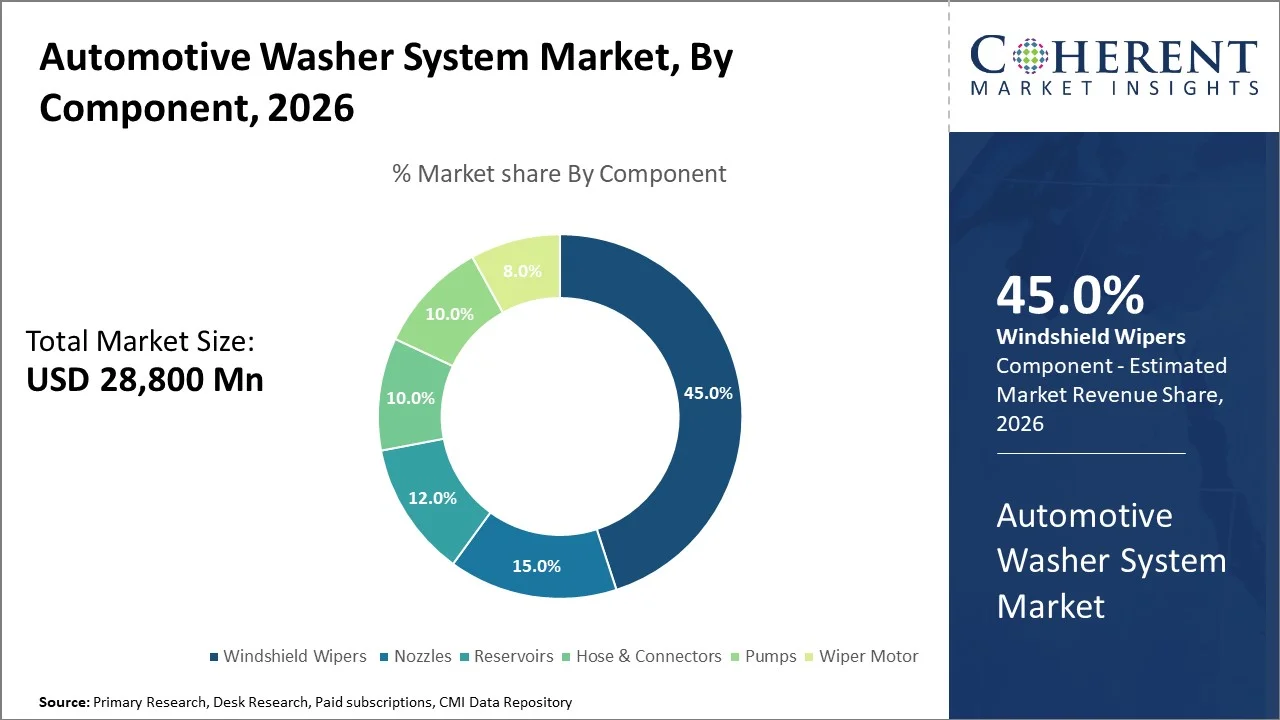
- Windshield wipers segment is expected to lead the market with a share of 45% in 2026 thanks to their high replacement frequency. According to the National Highway Traffic Safety Administration, rain accounts for nearly 46% of all weather-related vehicle crashes annually in the U.S. This shows the importance of effective wiper systems in improving road safety.
- In terms of technology, electrical automotive washer systems segment is projected to hold a prominent market share of nearly 70% in 2026 because of increasing adoption of ADAS, growing need for sensor cleaning, and rising automation.
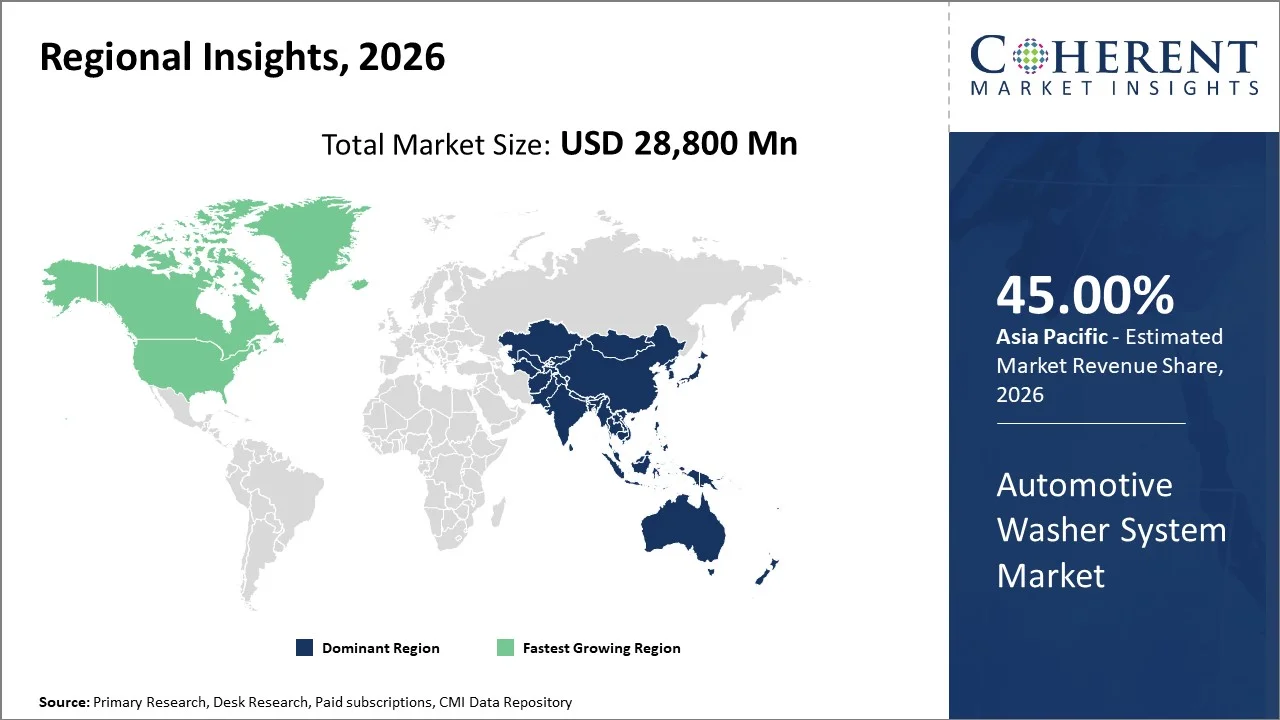
- Asia Pacific is expected to dominate the global automotive washer system industry with a share of 45% in 2026, owing to high vehicle production in nations like China, India, and Japan. Data from the International Organization of Motor Vehicle Manufacturers (OICA) shows that Asia-Pacific accounts for over 55% of global vehicle production.
- Europe, with a market share of 22% in 2026, is anticipated to offer lucrative growth opportunities for automotive washer system manufacturers during the forecast period as a result of increasing demand for ADAS, high vehicle quality standards, and growing focus on safety features.
Segmental Insights
Why Is Demand for Windshield Wipers Rising Rapidly in the Market?
High Replacement Rates Fueling Windshield Wiper Demand
According to Coherent Market Insights’ latest automotive washer system market analysis, the windshield wipers segment is projected to dominate the market with a 45% share in 2026. This dominance is primarily driven by the high replacement frequency of windshield wipers and their essential role in ensuring driver visibility and road safety.
Windshield wipers play a key role in improving the safety and visibility of vehicles. According to the U.S. Department of Transportation, nearly 745,000 weather-related vehicle crashes occur each year in the United States. This highlights the critical role of visibility maintenance in preventing accidents, thereby supporting steady demand for windshield wipers.
- Current Industry Events of 2026
- Market Size Estimation
- Regional Breakdown
- Competitive Landscape
- Customer Intelligence
- Segmental Analysis
- Pricing Analysis
- Key Market Drivers, Challenges & Future Trends
- Customized Insights Section
Which Technology Segment Leads the Automotive Washer System Market?
Electric Automotive Washer Systems Dominate the Automotive Washer System Industry
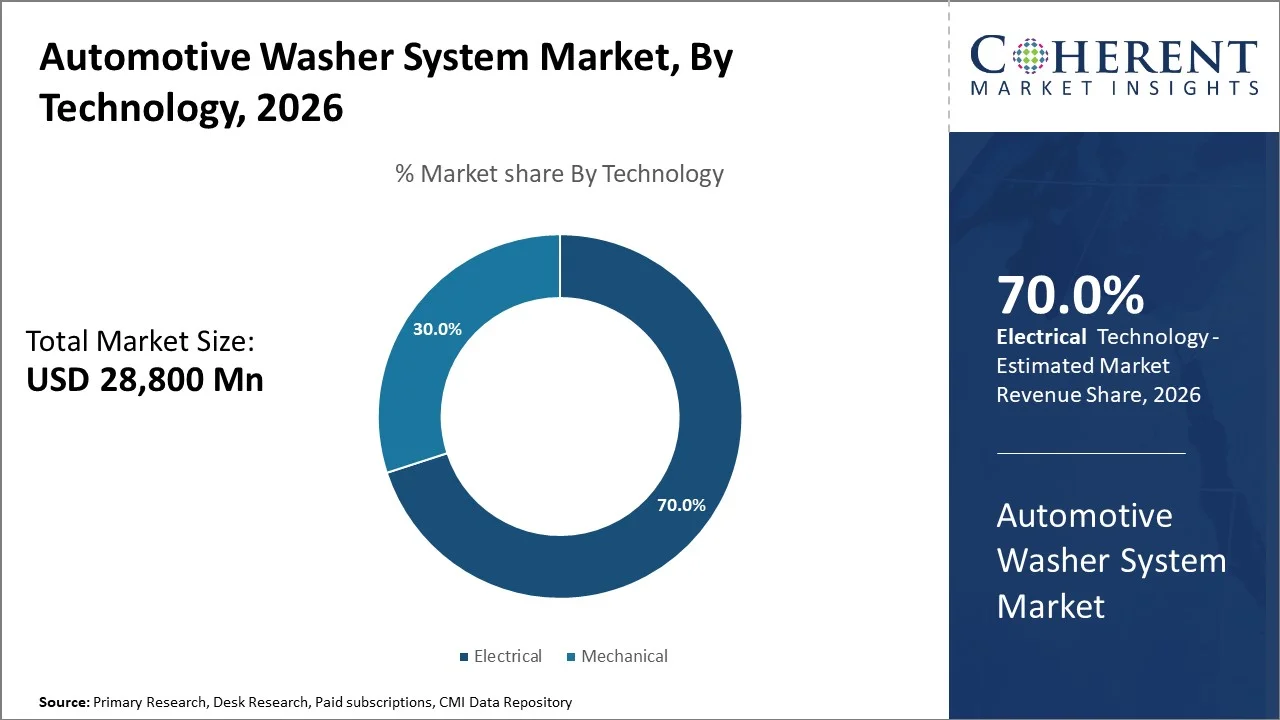
Based on technology, electrical systems segment is projected to hold a major market share of about 70% in 2026. This is mostly due to their high efficiency, improved performance, and growing adoption in modern vehicles. Electrical automotive washer systems provide better control of fluid distribution, require less maintenance, and are more compatible with advanced vehicle designs compared to traditional mechanical systems.
Most passenger cars use electrically driven washer pumps to deliver fluid to the windshield. They have the tendency to offer reliable operation, easy integration with vehicle electrical architectures, and compatibility with modern safety and driver-assistance systems that may require camera and sensor cleaning. Mechanical washer systems are now largely limited to older or non-standard applications. Increasing demand for passenger comfort, safety features, and automated vehicle technologies is expected to boost growth of electrical automotive washer systems segment during the forecast period.
Automotive Washer System Market Growth Drivers
Rising Global Vehicle Production: Increasing production of passenger and commercial vehicles is providing a strong impetus for the growth of the automotive washer system market. According to the World Population Review, global motor vehicle production reach approximately 96.4 million units in 2025. As vehicle production increases, demand for automotive washer systems also rises because these components are essential for maintaining windshield cleanliness as well as ensuring driver visibility and safety.
Expansion of Advanced Driver Assistance Systems (ADAS): Modern vehicles increasingly rely on cameras and sensors for features such as lane assist, automatic braking, and parking assistance. These systems require clean lenses, thereby driving strong demand for sensor and camera cleaning washer systems. Thus, the rising adoption of ADAS in the automotive industry is anticipated to boost sales of automotive washer systems during the forecast period.
Automotive Washer System Market Innovations
Growth of Electric and Autonomous Vehicles
The rising adoption of electric vehicles (EVs) and autonomous driving technologies is creating new opportunities for the automotive washer system market. Modern EV platforms and ADAS-enabled vehicles require compact, lightweight, and energy-efficient washer systems that are integrated with electronic controls.
In addition to traditional windshield cleaning, these systems are increasingly being designed to clean cameras, LiDAR, and other sensor units essential for autonomous driving functionality. This shift is driving innovation toward smart, sensor-driven washer systems with optimized fluid usage, electric pumps, and adaptive spray mechanisms, ultimately reshaping product design toward more intelligent and integrated cleaning solutions.
Current Events and Their Impact on the Automotive Washer System Market
Current Event | Description and its Impact |
Stricter Vehicle Safety and Visibility Regulations (Global) |
|
Rising EV Production and Lightweight Vehicle Design Trends |
|
Regional Insights
Strong Vehicle Production Making Asia Pacific a Dominant Market
Asia Pacific is expected to lead the global automotive washer system market, capturing a share of 45% in 2026. This can be attributed to increasing vehicle production, expanding urban population, and increasing demand for passenger and commercial vehicles across nations like China, Japan, and South Korea.
The region’s diverse driving conditions also contribute to higher automotive washer system demand. Many areas face heavy dust, pollution, monsoon rains, and fog, which increase the need for clear windshields and reliable washer systems for safer driving. As vehicle usage grows, consumers are also becoming more aware of road safety and maintenance features like advanced washer systems.
For example, according to the International Organization of Motor Vehicle Manufacturers (OICA), Asia accounts for more than half of global vehicle production, with China alone producing over 30 million vehicles annually in recent years. This large vehicle base directly supports high demand for washer pumps, nozzles, reservoirs, and sensors across the region.
In addition, local and global automotive component suppliers are expanding production in Asia to reduce costs as well as serve OEM demand more efficiently. Companies such as Denso and Mitsuba are increasing investment in compact and energy-efficient washer systems tailored for modern vehicles, including EVs and SUVs, further supporting market expansion.
Vehicle Safety Regulations Boosting Sales in Automotive Washer Systems
Europe is poised to emerge as a highly lucrative market for manufacturers of automotive washer systems during the forecast period, accounting for a share of 22.0% in 2026. This is mostly due to rising strict vehicle safety standards, rising demand for premium vehicles, and increasing focus on road safety across countries such as Germany, France, the UK, Italy, and Spain.
A key factor driving growth of Europe automotive washer system market is the region’s cold and wet weather conditions, especially in Northern and Central Europe, where snow, rain, fog, and road salt are common. These conditions make windshield cleanliness critical for safe driving, which increases the demand for efficient and reliable washer systems, including heated washer nozzles and high-pressure pumps.
In addition, Europe has some of the world’s most stringent vehicle safety regulations. Euro NCAP safety ratings influence automakers to improve driver visibility as well as use advanced safety systems. This is pushing manufacturers to adopt improved washer technologies, especially those that support camera and sensor cleaning for ADAS (Advanced Driver Assistance Systems).
For example, headlamp washers are mainly found in premium European vehicles, such as models from BMW, Mercedes-Benz, and some Volkswagen variants, while windshield washer systems are standard across vehicles. These systems have the tendency to maintain clear visibility in harsh weather and support sensor-based safety features. This trend is also supported by the growing adoption of electric vehicles in Europe, where efficient, low-energy washer systems are integrated to support sustainability goals.
Automotive Washer System Market Outlook – Country-wise
U.S. Automotive Washer System Market Trends
The automotive washer system market in the U.S. is poised to grow steadily during the forecast period. This growth is mostly due to factors like rising vehicle parc, increasing adoption of advanced driver-assistance systems (ADAS), growing demand for enhanced driver visibility, and strict road safety regulations.
A key growth factor is the rapid integration of ADAS-equipped vehicles, which require high-performance windshield and sensor-cleaning systems to ensure uninterrupted functioning of cameras and radar units. As semi-autonomous and autonomous driving technologies become more widespread, OEMs are increasingly incorporating intelligent washer systems capable of cleaning both windshields and front-facing sensors, thereby significantly boosting market demand in the U.S.
China Automotive Washer System Market Forecast
China is expected to remain a leading market for automotive washer system manufacturers during the forecast period. This growth is driven by expanding automotive production, rising penetration of electric vehicles (EVs), increasing urban traffic congestion, and growing consumer emphasis on vehicle safety and maintenance features.
Rising adoption of electric vehicles is acting as a catalyst triggering sales of automotive washer systems. Electric vehicles typically feature advanced aerodynamic designs and integrated sensor-based systems, which require compact and high-efficiency washer technologies for good performance. As Chinese automakers rapidly increase EV production and integrate advanced driver-assistance systems (ADAS), the demand for energy-efficient and smart-compatible washer systems is showing steady growth.
Who are the Key Players in the Automotive Washer System Market?
Some of the major players in Automotive Washer System Market are Kautex Textron GmbH & Co. KG, Robert Bosch GmbH, Trico Products Corporation, Denso Corporation, Mergon Group, Valeo SA, Mitsuba Corporation, Continental AG, Ningbo Joyson Electronic Corp, and HELLA KGaA Hueck & Co.
Key Strategies Adopted by Industry Players
Leading automotive washer system companies are focusing on developing advanced, as well as efficient, washer solutions that support modern vehicle technologies such as ADAS and electric vehicles. They are investing heavily in research and development to design smart washer systems that can clean cameras, sensors, and windshields more effectively, ensuring better driving safety and visibility.
Many players are also working on lightweight and energy-efficient components to meet the growing demand for fuel-efficient and electric vehicles. In addition, companies are strengthening their market position through partnerships and collaborations with automobile manufacturers and OEM suppliers to ensure early integration of washer systems in new vehicle models. For example,
- In March 2026, DENSO introduced its ClearJet wiper blades with integrated fluid delivery technology for premium vehicles. The system uses micro-jets embedded in the blade to distribute washer fluid evenly across the windshield, improving visibility in all weather conditions.
- In May 2025, Valeo added five new flat wiper blades to its Valeo First range. This expansion increased car parc coverage by around 5% to better match new wiper arm designs introduced by vehicle manufacturers.
Market Report Scope
Automotive Washer System Market Report Coverage
| Report Coverage | Details | ||
|---|---|---|---|
| Base Year: | 2025 | Market Size in 2026: | USD 28,800 Mn |
| Historical Data for: | 2020 To 2024 | Forecast Period: | 2026 To 2033 |
| Forecast Period 2026 to 2033 CAGR: | 5.2% | 2033 Value Projection: | USD 41,100 Mn |
| Geographies covered: |
| ||
| Segments covered: |
| ||
| Companies covered: | Kautex Textron GmbH & Co. KG, Robert Bosch GmbH, Trico Products Corporation, Denso Corporation, Mergon Group, Valeo SA, Mitsuba Corporation, Continental AG, Ningbo Joyson Electronic Corp, and HELLA KGaA Hueck & Co. | ||
| Growth Drivers: |
| ||
| Restraints & Challenges: |
| ||
Analyst Opinion (Expert Opinion)
- The automotive washer system is not optional—it is a baseline safety requirement across nearly all vehicles. With over 1.4–1.5 billion vehicles in operation globally, every passenger car and commercial vehicle relies on washer systems to maintain windshield visibility, and regulations in regions like Europe (ECE safety standards) mandate fully functional windshield cleaning systems for roadworthiness.
- Visibility-related risks keep washer usage structurally high, not cyclical. Road safety studies consistently show that roughly 15–30% of accidents are linked to poor visibility conditions such as rain, dust, or glare, making washer systems a constant-use safety component rather than a comfort feature. In real driving conditions, drivers activate washer systems multiple times per week in mixed climates.
- Technology integration is reshaping washer demand patterns, not reducing them. Even as advanced driver assistance systems expand, premium vehicles are adding sensor-cleaning washer jets for ADAS cameras and LiDAR units, increasing system complexity. In high-end segments, automated spray control can reduce unnecessary fluid use, but overall system dependency is rising due to additional cleaning points beyond just the windshield.
- Reliability and maintenance cycles make this a part that needs to be replaced regularly. Windshield wiper blades usually need to be replaced every 6–12 months, and washer pumps, nozzles, and hoses are also commonly serviced during vehicle maintenance. In colder regions, demand is even higher because heated washer systems are needed, as freezing temperatures can stop normal fluid flow without heat support.
Speak to the analyst
Want personalized insights?
Take the findings above to one of our principal consultants, or have the report rebuilt around the segments, geographies and competitors you actually track.
Automotive Washer System Market Segmentation
- By Component Insights
- Nozzles
- Reservoirs
- Hose & Connectors
- Pumps
- Windshield Wipers
- Wiper Motor
- By Vehicle Type Insights
- PC
- LCV
- HCV
- By Product Type Insights
- Windshield Wiper System
- Headlamp Wiper System
- By Technology Insights
- Electrical
- Mechanical
- By Sales Channel Insights
- OEM
- AM
- By Region Insights
- North America
- U.S.
- Canada
- Latin America
- Brazil
- Argentina
- Mexico
- Rest of Latin America
- Europe
- Germany
- U.K.
- Spain
- France
- Italy
- Russia
- Rest of Europe
- Asia Pacific
- China
- India
- Japan
- Australia
- South Korea
- ASEAN
- Rest of Asia Pacific
- Middle East & Africa
- GCC Countries
- Israel
- Rest of Middle East & Africa
- North America
Sources
Primary Research interviews
- Interviews with automotive OEM engineers, tier-1 and tier-2 automotive component manufacturers, aftermarket suppliers, dealership service managers, and industry technical experts
Databases
- Government transportation databases
- Automotive registration databases
- International trade statistics databases
- Customs/import-export data portals
- Vehicle production databases maintained by national transport authorities
Magazines
- Automotive industry trade magazines
- Mobility and transport technology publications
- Auto component manufacturing magazines
- EV-focused industry magazines
Journals
- Peer-reviewed automotive engineering journals, mechanical engineering journals, materials science journals, and transportation technology research journals.
Newspapers
- Leading national and international newspapers covering automotive industry developments, manufacturing news, mobility trends, and economic updates impacting the auto sector.
Associations
- Society of Automotive Engineers (SAE)
- International Organization for Standardization (ISO)
- Automotive component manufacturers associations
- National automobile manufacturers associations
- Road transport regulatory bodies
Public Domain sources
- Government transport ministry reports
- Environmental and emission regulation bodies
- International organizations (e.g., UN transport and mobility data)
- Patent databases, and publicly available company filings and annual reports
Proprietary Elements
- CMI Data Analytics Tool
- Proprietary CMI Existing Repository of information for last 8 years
Get access to 250+ pages report
Every segment, forecast, competitor profile and data table behind the analysis above — available for instant download.
- ESOMAR Member
- ISO 9001:2015 Certified
- D-U-N-S Registered
- GDPR & CCPA Compliant
Missing comfort of reading report in your local language? Find your preferred language:
Transform your Strategy with Exclusive Trending Reports
Frequently Asked Questions
The global market is estimated to be valued at USD 28,800 Mn in 2026.
The global Automotive Washer System Market value is expected to reach USD 41,100 Mn by 2033.
The global market is poised to exhibit a CAGR of 5.2% from 2026 to 2033.
Major growth factors include increasing vehicle production and growing emphasis on improving passenger safety.
Windshield wipers segment, with about 45% share in 2026, dominates the market.
Some major companies in the Automotive Washer System Market include Kautex Textron GmbH & Co. KG, Robert Bosch GmbH, Trico Products Corporation, Denso Corporation, Mergon Group, Valeo SA, Mitsuba Corporation, Continental AG, Ningbo Joyson Electronic Corp, and HELLA KGaA Hueck & Co.
Asia Pacific, with 45% share in 2026, is set to lead the market during the forecast period.