

Delivery Drones Market Size and Trends
The delivery drones market is estimated to be valued at USD 1013.7 Mn in 2026 and is expected to reach USD 12,335.3 Mn by 2033, exhibiting a compound annual growth rate (CAGR) of 42.9% from 2026 to 2033.
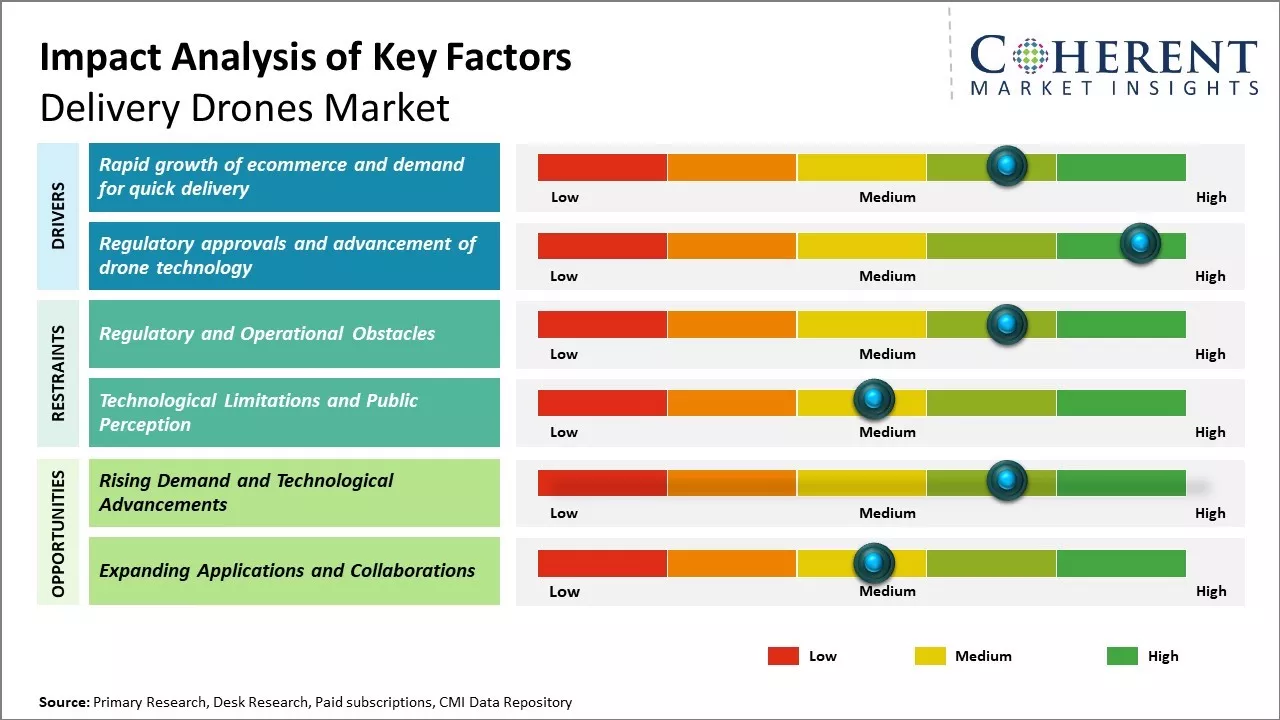
Key Takeaways
- Based on Drone Type, Multi-rotor Wings segment is expected to lead the market with 48.7% share in 2026, due to its unmatched agility and cost-efficiency for urban deliveries.
- Based on Component, the Hardware segment projected to account for 67.9% share in 2026, as the core investment area, powering drone performance and reliability.
- Based on End Use Industry, the Food Delivery segment is expected to hold the largest share of the market in 2026, driven by rising demand for fast, contactless service in cities.
- Based on Region, North America is set to lead the global delivery drones market with 41.8% share in 2026. While, Asia Pacific is anticipated to be the fastest growing region.
Market Overview
This growth is driven by the expanding e-commerce and logistics industry worldwide along with advancements in drone technology which is enhancing their delivery carrying capacity and flight duration. The delivery drones market is expected to witness significant growth over the forecast period. Regulatory norms are being amended to allow for the commercial use of drones for delivery purposes. Several companies are investing in research and development to introduce improved delivery drones with VTOL capability, autonomous navigation, and advanced battery technology enabling longer flight times. Drone delivery is emerging as a cost-effective method for last mile deliveries for retail, food, and logistics companies.
Current Events and their Impacts on the Delivery Drones Market
Current Event | Description and its Impact |
Regulatory Framework Evolution and Airspace Integration |
|
Supply Chain Disruptions and Last-Mile Delivery Challenges |
|
Segmental Insights
- Current Industry Events of 2026
- Market Size Estimation
- Regional Breakdown
- Competitive Landscape
- Customer Intelligence
- Segmental Analysis
- Pricing Analysis
- Key Market Drivers, Challenges & Future Trends
- Customized Insights Section
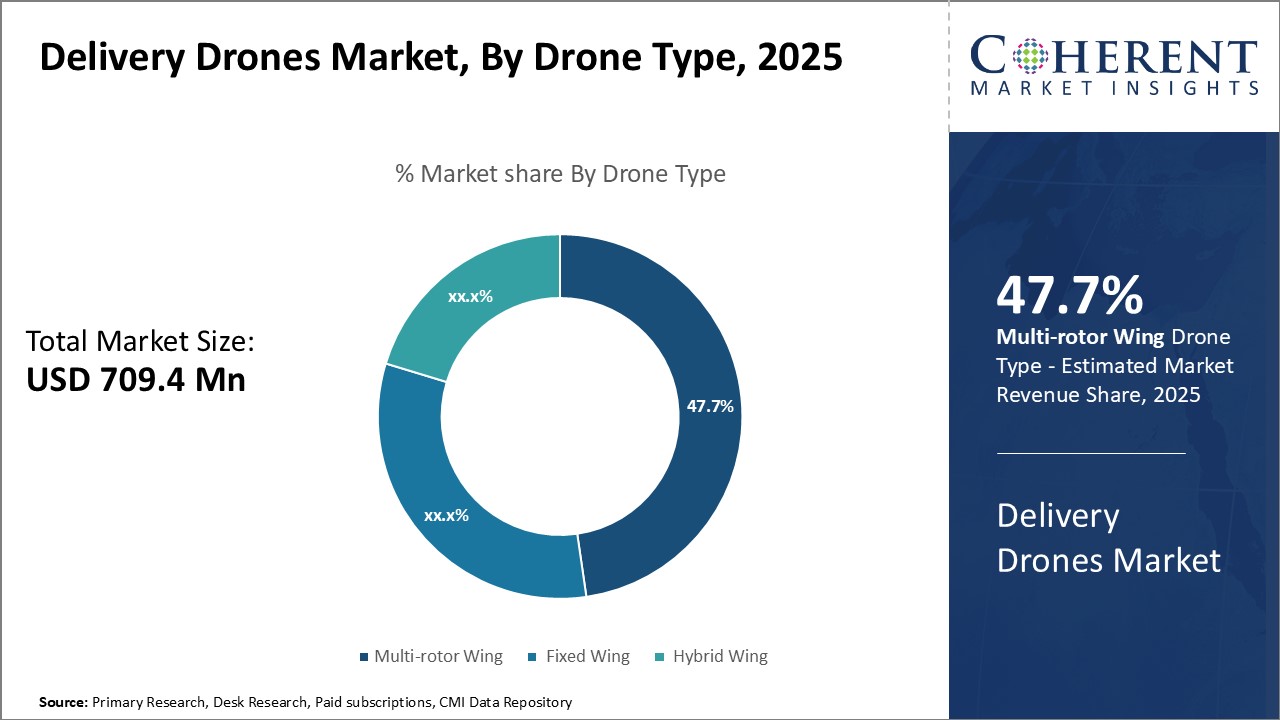
Delivery Drones Market Insights, By Drone Type: Multi-rotor Wings Leads with Unmatched Agility and Cost-Efficiency for Urban Deliveries
In terms of drone type, multi-rotor wing is expected to contribute the highest share of 48.7% in 2026, due to their versatility, ease of use, and cost-effectiveness. These drones are particularly well-suited for short-range deliveries in urban and suburban environments, where maneuverability and vertical take-off and landing (VTOL) capabilities are crucial. Their ability to hover and navigate tight spaces makes them ideal for last-mile delivery applications such as food, retail, and medical supplies. Additionally, the relatively low maintenance and operational costs of multi-rotor drones have made them the go-to choice for startups and established logistics companies alike. While fixed-wing and hybrid drones offer advantages in range and speed, their higher costs and complex infrastructure requirements limit their widespread adoption compared to multi-rotor models.
For instance, in May 2025, the Royal Netherlands Aerospace Centre launched the Quick Response Drone Facility (QRDF) to accelerate drone innovation for defense applications. In collaboration with the Dutch Ministry of Defence, the initiative includes a fleet of four multi-rotor and one fixed-wing drone, supporting rapid deployment and operational testing under the SYNERGY project.
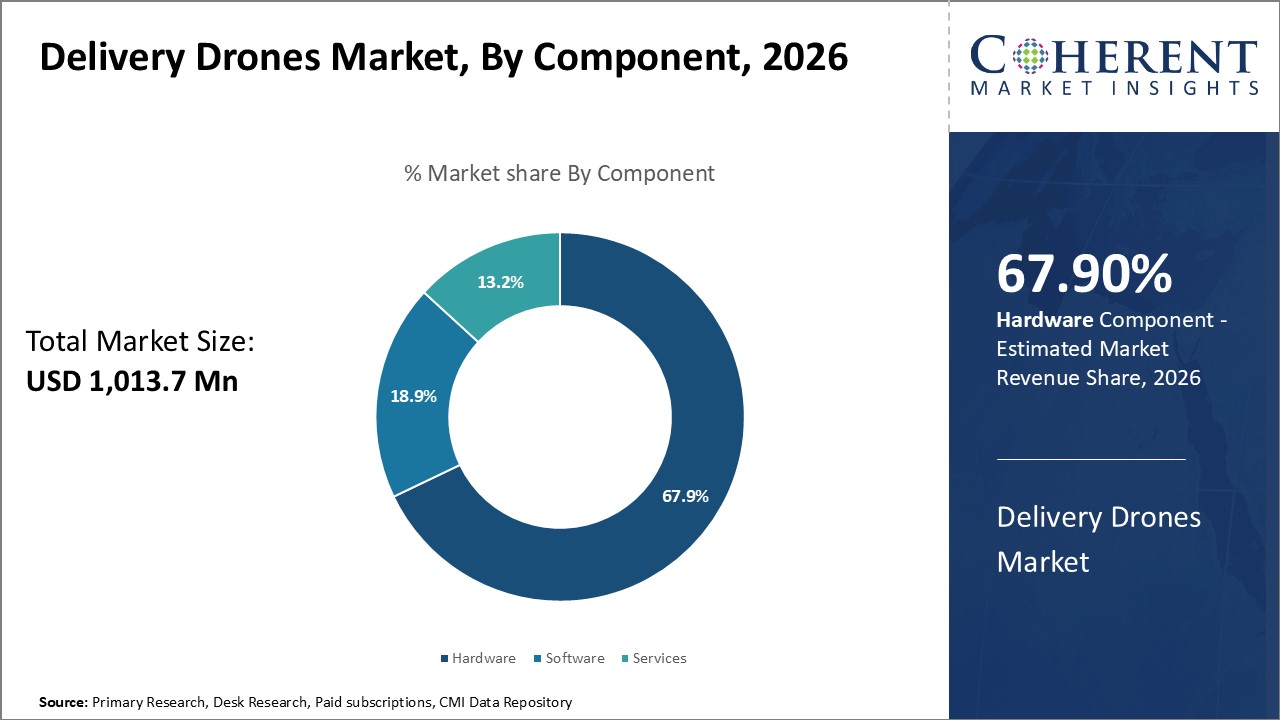
Delivery Drones Market Insights, By Component: Hardware Dominates as the Core Investment Area, Powering Drone Performance and Reliability
In terms of component, hardware is expected to contribute the highest share of 67.9% in 2026. This segment encompasses the physical parts of the drone, including airframes, propulsion systems, batteries, sensors, and navigation units. These components represent the bulk of the investment in drone manufacturing and deployment, especially as companies strive to enhance payload capacity, flight stability, and energy efficiency. The demand for advanced sensors and high-performance batteries has surged, driven by the need for longer flight times and safer autonomous operations. While software and services are growing rapidly, particularly in areas like route optimization and fleet management, the hardware segment continues to lead in terms of revenue due to its foundational role in drone functionality.
For instance, in July 2025, a startup in Tiruchi showcased a large cargo drone capable of delivering goods during a demonstration at a local school. The drone, designed for heavy payloads, highlights advancements in drone hardware and logistics technology. Students and faculty witnessed the potential of aerial delivery systems, signaling growing interest in drone-based solutions for transportation and supply chain efficiency.
Delivery Drones Market Insights, By End Use Industry: Food delivery Tops the Chart, Driven by Rising Demand for Fast, Contactless Service in Cities
In terms of End Use Industry, the food delivery segment is expected to capture the largest share of the market in 2026, driven by rising consumer expectations for fast, contactless, and convenient meal services. Major players such as Uber Eats, Zomato, and Domino’s have significantly expanded their drone logistics capabilities, capitalizing on the efficiency and speed drones offer in urban environments. These aerial systems help bypass traffic congestion and reduce delivery times, making them ideal for densely populated areas. Regulatory support in several countries has enabled pilot programs and commercial deployments, further solidifying food delivery as the most mature and commercially viable application of drone technology. While other sectors like medical aid and retail goods delivery are gaining traction, food delivery continues to lead in adoption and market share.
For instance, in August 2025, GoTo Foods, in partnership with DoorDash and Wing, launched drone-based food delivery in Plano, Frisco, and Fort Worth, Texas. The initiative uses Wing’s autonomous drones to deliver meals from brands like Jimmy John’s, marking a significant step in integrating aerial logistics into mainstream food service and enhancing delivery speed and convenience.
Regional Insights
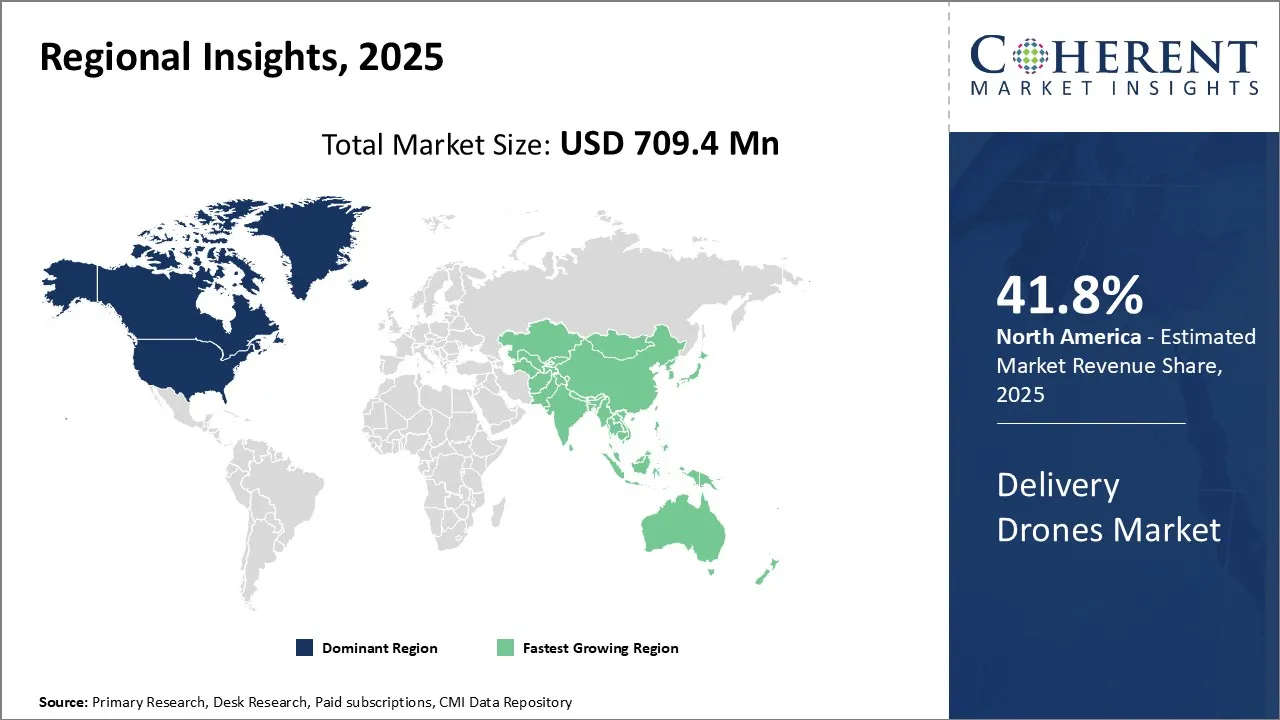
North America Delivery Drones Market Analysis & Trends
North America has established itself as the clear leader in the delivery drones market. The region is expected to account for a market share of 41.8% in 2026. The region hosts major drone manufacturers and innovators, especially in the U.S., where startup activity and commercialization of unmanned aerial vehicles thrive. Progressive regulations, including BVLOS approvals in several states, have enabled early testing and deployment. Companies have successfully piloted drone deliveries for healthcare, retail, and food services. This blend of technological leadership, favorable policies, and rapid adoption gives North America a significant edge over other regions in shaping the future of drone logistics.
For instance, in August 2026, Walmart expanded its ultra-fast drone delivery service across the U.S., aiming to reach millions of households. Partnering with drone companies, the retail giant now offers rapid aerial delivery of groceries and essentials in select states. This move strengthens Walmart’s logistics capabilities and highlights growing consumer demand for faster, tech-driven shopping experiences.
Asia Pacific Delivery Drones Market Analysis & Trends
Asia Pacific has emerged as the fastest growing regional market for delivery drones over the forecast period, driven by vast populations, remote communities, and rising demand for rapid e-commerce logistics. Countries like China and India offer significant opportunities for drone-based delivery due to geographic and demographic diversity. Economic growth has fueled online shopping, while governments across the region actively support commercial drone programs. Notably, China and Singapore have introduced pioneering BVLOS regulations, enabling advanced operations. These favorable conditions, combined with early adoption efforts, position Asia Pacific to surpass other regions in drone usage and innovation over the coming years.
For instance, in September 2026, the Hong Kong Hospital Authority launched a pilot program using drones to deliver medicine between Cyberport and St John Hospital in Cheung Chau. Partnering with SF Express, the initiative cuts delivery time from over 45 minutes to just 20. It’s part of Hong Kong’s push to expand drone use in healthcare and logistics.
Delivery Drones Market Outlook Country-Wise
The U.S. Delivery Drones Market Trends
The U.S. delivery drones market is booming in 2026 due to strong tech innovation, supportive BVLOS regulations, and widespread adoption by major players like Amazon and Walmart. High consumer demand for fast, contactless delivery and successful pilot programs across healthcare, retail, and food sectors further fuel growth, making the U.S. a global leader in drone logistics.
For instance, in September 2026, Uber partnered with Flytrex to launch a drone delivery service in the U.S., expanding its logistics capabilities. The collaboration aims to offer faster, contactless delivery of food and retail items using autonomous drones. This move marks Uber’s latest step in embracing aerial technology to enhance convenience and efficiency in last-mile delivery solutions.
China Delivery Drones Market Trends
China’s delivery drone market is booming in 2026 due to rapid e-commerce growth, vast geographic coverage, and strong government support. Major logistics firms are deploying drones to cut last-mile delivery times, while regulators enable BVLOS operations through sandbox programs and UAV corridors. Technological advances like AI navigation and precision drops further drive demand.
For instance, in August 2026, Hangzhou launched its first regular drone delivery route, connecting Xiaoshan and Fuyang districts. Operated by Antwork, the service uses autonomous drones to transport medical and commercial goods, reducing delivery times and boosting logistics efficiency. This milestone marks a major step in integrating drone technology into urban transportation and supply chain infrastructure in China.
Market Report Scope
Delivery Drones Market Report Coverage
| Report Coverage | Details | ||
|---|---|---|---|
| Base Year: | 2025 | Market Size in 2026: | USD 1013.7 Mn |
| Historical Data for: | 2020 To 2024 | Forecast Period: | 2026 To 2033 |
| Forecast Period 2026 to 2033 CAGR: | 42.9% | 2033 Value Projection: | USD 12,335.3 Mn |
| Geographies covered: |
| ||
| Segments covered: |
| ||
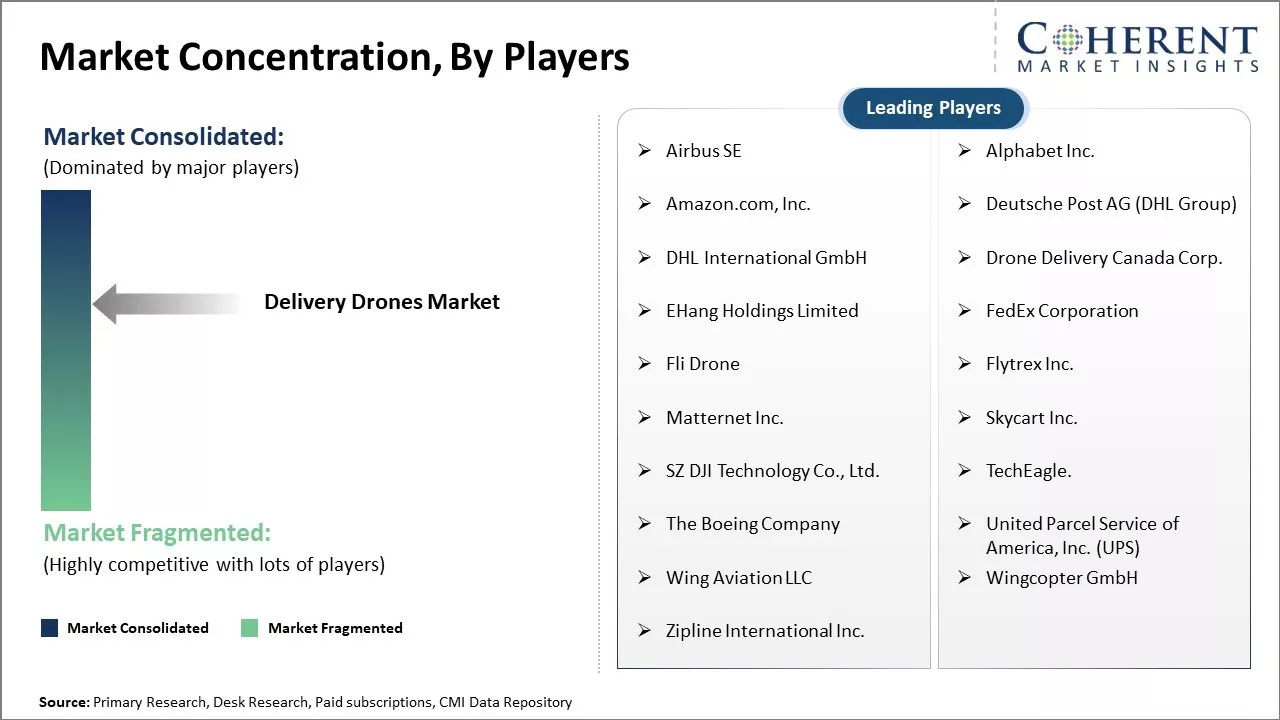
| Companies covered: | Airbus SE, Alphabet Inc., Amazon.com, Inc., Deutsche Post AG (DHL Group), DHL International GmbH, Drone Delivery Canada Corp., EHang Holdings Limited, FedEx Corporation, Fli Drone, Flytrex Inc., Matternet Inc., Skycart Inc., SZ DJI Technology Co., Ltd., TechEagle., The Boeing Company, United Parcel Service of America, Inc. (UPS), Wing Aviation LLC, Wingcopter GmbH, and Zipline International Inc. | ||
| Growth Drivers: |
| ||
| Restraints & Challenges: |
| ||
Delivery Drones Market Driver
Rapid growth of ecommerce and demand for quick delivery
With the ever-increasing popularity of online shopping, the demand for quick and convenient delivery of items purchased online has also been rising rapidly. Many e-commerce retailers and food delivery companies are constantly looking for innovative ways to cut down delivery times and provide a superior delivery experience to their customers. Traditional delivery methods that rely on road transport can often get slowed down due to traffic congestion in urban areas. This is where drone delivery seems to provide a very attractive alternative as drones have the capability to take the aerial route and avoid traffic bottlenecks on the ground. Drones can reach locations much faster than ground vehicles in many cases, significantly boosting efficiency and contributing to the growing delivery drones market share worldwide.
Market Concentration and Competitive Landscape
Regulatory approvals and advancement of drone technology
While delivery drones seem like a promising solution, stringent regulations around their use were limiting the growth of this industry until recently. However, many countries and local aviation authorities are now slowly easing restrictions and providing more approvals and guidelines for commercial drone operations within their territories. They recognize the benefits that drones can bring for last-mile delivery especially in remote and inaccessible locations. As regulations continue to be relaxed in phases with safety measures, it will help boost the adoption of drones among delivery companies. Moreover, ongoing research and development is helping drone technology to advance rapidly with innovations making drones safer, more reliable and capable of carrying heavier payloads over longer distances, contributing significantly to the rising delivery drones market value.
Delivery Drones Market Opportunity
Rising Demand and Technological Advancements
The delivery drones market forecast indicates robust growth driven by rising demand and rapid technological advancements. Increasing e-commerce activity and consumer expectations for faster, contactless delivery are fueling adoption across sectors. Innovations in AI, GPS navigation, and battery efficiency are enhancing drone capabilities, enabling longer flight times and precise drop-offs. Regulatory support and pilot programs by logistics giants further validate market potential. As urban congestion and sustainability concerns grow, drones offer a scalable, eco-friendly alternative. With expanding applications in healthcare, retail, and food delivery, the delivery drones market is poised for transformative impact and exponential expansion over the coming years.
Analyst Opinion (Expert Opinion)
The delivery drones market is evolving into a specialized logistics enabler rather than a universal delivery solution. Operational maturity is visible in high-density, mission-specific use cases such as medical logistics and industrial campus deliveries. Zipline, for instance, has surpassed 1 million deliveries and 100 million autonomous miles, while Alphabet’s Wing completes over 1,000 deliveries per day in select regions, proving commercial viability where routes are repetitive and regulated.
Regulation remains the decisive factor shaping scalability. FAA Part 135 certification, achieved by UPS Flight Forward and others, acts as a regulatory moat, restricting large-scale expansion to compliant operators. However, safety concerns, including ongoing probes into Amazon Prime Air incidents, underscore that urban-scale operations still face public and technical scrutiny.
Sustained growth will rely on predictable demand density, high-value or time-critical payloads, and local regulatory cooperation. Investment should prioritize operational control systems, certified maintenance chains, and sense-and-avoid technologies rather than fleet expansion alone. Over-optimistic projections of mass consumer drone delivery remain detached from regulatory and infrastructural realities.
Speak to the analyst
Want personalized insights?
Take the findings above to one of our principal consultants, or have the report rebuilt around the segments, geographies and competitors you actually track.
Delivery Drones Industry News
- In October 2025, India Post launched drone-based mail delivery in Gadchiroli, a remote Naxal-affected district in Maharashtra. The initiative aims to improve connectivity and speed up postal services in hard-to-reach areas. This marks a significant step in leveraging drone technology for public service delivery in challenging terrains across India.
- In October 2025, MightyFly launched a medical drone delivery service in California, aiming to revolutionize healthcare logistics. The autonomous aircraft can carry up to 100 pounds of cargo and travel 600 miles, enabling rapid transport of medical supplies to remote areas. This initiative marks a major advancement in drone-based healthcare delivery across the U.S.
- In June 2025, Wing and Walmart announced the world’s largest drone delivery expansion, set to reach 60 million U.S. households by year-end. The partnership will scale operations across multiple states, offering rapid aerial delivery of thousands of items. This milestone marks a major leap in commercial drone logistics and retail innovation.
- In March 2025, Bengaluru launched its first drone delivery service, enabling rapid transport of medicines and goods in just seven minutes. Operated by TechEagle, the service connects key locations like Narayana Health City and the airport, aiming to reduce delivery time and improve logistics efficiency. This marks a major step in urban drone adoption in India.
Market Segmentation
- Drone Type Insights (Revenue, USD Mn, 2026 - 2033)
- Multi-rotor Wing
- Fixed Wing
- Hybrid Wing
- Component Insights (Revenue, USD Mn, 2026 - 2033)
- Hardware
- Software
- Services
- End Use Industry Insights (Revenue, USD Mn, 2026 - 2033)
- Food delivery
- Retail goods delivery
- Postal delivery
- Medical aids delivery
- Precision agriculture delivery
- Industrial delivery
- Weapon & ammunition delivery
- Others
- Regional Insights (Revenue, USD Mn, 2026 - 2033)
- North America
- U.S.
- Canada
- Latin America
- Brazil
- Argentina
- Mexico
- Rest of Latin America
- Europe
- Germany
- U.K.
- Spain
- France
- Italy
- Russia
- Rest of Europe
- Asia Pacific
- China
- India
- Japan
- Australia
- South Korea
- ASEAN
- Rest of Asia Pacific
- Middle East & Africa
- South Africa
- GCC Countries
- Israel
- Rest of Middle East & Africa
- Key Players Insights (Revenue, USD Mn, 2021 - 2033)
- Airbus SE
- Alphabet Inc.
- Amazon.com, Inc.
- Deutsche Post AG (DHL Group)
- DHL International GmbH
- Drone Delivery Canada Corp.
- EHang Holdings Limited
- FedEx Corporation
- Fli Drone
- Flytrex Inc.
- Matternet Inc.
- Skycart Inc.
- SZ DJI Technology Co., Ltd.
- TechEagle.
- The Boeing Company
- United Parcel Service of America, Inc. (UPS)
- Wing Aviation LLC
- Wingcopter GmbH
- Zipline International Inc.
Sources
Primary research — Interviews from the following stakeholders
Stakeholders to target for interviews, qualitative insights, and validation
- Logistics & parcel carriers (operations, last-mile strategy, pilot program leads)
- E-commerce fulfilment heads and supply-chain leads
- Last-mile delivery operators and aggregators (urban and rural focus)
- Retail & grocery chain digital transformation and distribution leads
- Food delivery platform operations and partnerships teams
- Healthcare & pharma logistics heads (blood, vaccine, urgent meds delivery)
- Municipal & regional transport planners (city logistics, curbside policy)
- Airport operations and airspace managers (for UTM integration)
- Civil aviation regulator policy teams and UAS certification units
- Telecom & connectivity leads (5G/LTE network provisioning for BVLOS)
- Insurance underwriters (aviation & liability teams)
- Air traffic management / UTM providers and system integrators
- Drone OEM product managers, flight-control engineers, and ops leads
- Battery, motor and avionics component suppliers (R&D/product leads)
- Safety, compliance & security officers (enterprise customers)
- Pilots, remote pilots, and field operations managers running trials
- Procurement and legal heads involved in drone purchase and contracting
Specific stakeholders
Logistics & parcel carriers
- Amazon Prime Air (operations / partnerships leads)
- DHL Parcel / DHL Innovation Center (last-mile & air freight teams)
- UPS Flight Forward (operations/product leads)
- FedEx SameDay Bot / FedEx Express innovation teams
- SF Express (China) — drone delivery pilots
E-commerce and retail
- Walmart (last-mile & innovation teams)
- Flipkart / Walmart India (logistics/product leads)
- Reliance Retail — digital transformation / supply chain leads
- Carrefour, Tesco, Aldi — logistics/digital store teams
Food & grocery delivery
- Zomato, Swiggy — operations / cloud kitchens / new delivery channels leads
- Instacart, Delivery Hero (regional ops leads)
Healthcare & emergency delivery
- Zipline (operations & country program leads)
- Swoop Aero, Matternet — hospital/health programme managers
- Hospital logistics leads (e.g., Mayo Clinic, Apollo Hospitals, NHS trusts)
Drone OEMs & tech suppliers
- DJI (enterprise product & government programmes)
- Zipline, Wing (Alphabet), Skydio, Volansi, Flytrex — product managers / ops
- Component suppliers — battery, propulsion, sensor OEMs (product managers)
Airspace/airport & regulators
- Heathrow Airport — airside / innovation teams
- Chhatrapati Shivaji Maharaj International Airport — operations / regulatory liaison
- JFK / JFK Concessions / Jacobs (airport operations contacts)
- DGCA (India) — UAS policy & BVLOS programme leads
- FAA (U.S.) — UAS integration / waiver units
- EASA — RPAS policy and rulemaking leads
Telecom & connectivity
- National and private 5G operators — enterprise & IoT product teams
- Satellite connectivity providers supporting BVLOS telemetry
Insurance & legal
- Aviation insurance product leads at major insurers (liability, hull)
- Legal counsel for aviation and procurement contracts at large retailers/logistics firms
Databases (quantitative / trade / customs / economic)
- World Trade Organization (WTO) — trade statistics
- UN Comtrade Database — trade flows for drone components and electronics
- Federal Aviation Administration (FAA) — UAS registration, waiver, and operations data (U.S.)
- European Union Aviation Safety Agency (EASA) — RPAS rules and safety data
- Directorate General of Civil Aviation (DGCA), India — UAS approvals and guidance
- Eurostat — transport & tech industry datasets
- China Customs Statistics — exports/imports of UAV components
- Korea Customs Service data portal
- Japan External Trade Organization (JETRO) — aerospace & components trade data
- National statistical bodies (e.g., National Statistical Office / Bureau of Economic Analysis) for country-level transport and tech indicators
- ICAO / EUROCONTROL data and studies on UAS integration and airspace usage
Magazines & trade press
- DroneLife
- sUAS News
- RotorDrone Magazine
- UAV Expert News / The Drone Magazine
- Aviation Week (UAS & urban air mobility coverage)
- Unmanned Airspace / Unmanned Systems Technology
- Drone Industry Insights (trade coverage)
- TechCrunch — drones / delivery tech coverage (for ecosystem trends)
Academic & industry journals
- Journal of Field Robotics
- IEEE Transactions on Robotics
- IEEE Transactions on Intelligent Transportation Systems
- Remote Sensing (MDPI) — sensors & payloads for drones
- Drones (MDPI) — applications, operations, policy research
- Transportation Research Part C / Part A — logistics and last-mile modelling
- IEEE Transactions on Aerospace and Electronic Systems
- Journal of Air Transport Management — airspace integration and regulatory studies
Newspapers & business press (for policy, corporate moves, funding)
- The Wall Street Journal — Tech & Logistics coverage
- Financial Times — Aviation, Supply Chain & Tech deals
- The Economic Times (India) — logistics, retail & aviation updates
- The Hindu Business Line — technology and policy stories (India)
- Nikkei Asia — supply-chain, manufacturing and aerospace in Asia
- South China Morning Post — Chinese drone companies and policy
Associations, standards bodies & industry groups
- AUVSI — Association for Unmanned Vehicle Systems International
- Drone Federation of India (DFI) / Regional drone industry associations
- International Civil Aviation Organization (ICAO) — UAS frameworks
- European Union Aviation Safety Agency (EASA) — RPAS rulemaking groups
- FAA UAS Integration Office (U.S.) / UAS team
- ASTM International Committee F38 — Unmanned Aircraft Systems standards
- RTCA SC-228 — standards for UAS C2 and detect-and-avoid
- SESAR / EUROCONTROL — UTM and UAS integration projects
- International Air Transport Association (IATA) — for cargo interface discussions
Public-domain government & research sources
- FAA — UAS Data, Part 107 waivers, UTM pilot programme reports (U.S.)
- EASA — Special Condition / rulemaking documents and safety reports (EU)
- DGCA India — UAS rules, registration portal, BVLOS corridors announcements
- ICAO — RPAS studies, safety framework documents
- NASA UTM research and technical reports (U.S.)
- US Department of Transportation / Volpe Center reports on UTM and drone trials
- Ministry of Civil Aviation (India) / MoCA reports and whitepapers
- National labs and research institutes (NIST — applicable guidance on sensors/standards)
- Ministry of Electronics & IT (for electronics component policies relevant to drone hardware)
- State / city pilot programme documents (e.g., municipal pilot corridors, permissions)
Proprietary / internal elements
- CMI Data Analytics Tool
- Proprietary CMI Existing Repository of information for last 8 years
Definition: The delivery drones market consists of companies manufacturing drones dedicated for delivery purposes. These drones are designed to autonomously transport packages, food orders, medicines and other goods to customers within a limited range. Generally powered by electric motors, delivery drones use GPS and other sensors for navigation. They aim to make deliveries faster and more cost-effective than traditional delivery methods. The market has grown recently due to the rise in e-commerce and demand for quick deliveries of online orders straight to customers' doors.
Get access to 250+ pages report
Every segment, forecast, competitor profile and data table behind the analysis above — available for instant download.
- ESOMAR Member
- ISO 9001:2015 Certified
- D-U-N-S Registered
- GDPR & CCPA Compliant
Missing comfort of reading report in your local language? Find your preferred language:
Transform your Strategy with Exclusive Trending Reports
Frequently Asked Questions
The Delivery Drones Market is estimated to be valued at USD 1013.7 Mn in 2026, and is expected to reach USD 12,335.3 Mn by 2033.
The CAGR of the Delivery Drones Market is projected to be 42.9% from 2026 to 2033.
Rapid growth of ecommerce and demand for quick delivery and regulatory approvals and advancement of drone technology are the major factors driving the growth of the Delivery Drones Market.
Regulatory and operational obstacles and technological limitations and public perception are the major factors hampering the growth of the Delivery Drones Market.
In terms of drone type, multi-rotor wing is estimated to dominate the market revenue share in 2026.
Airbus SE, Alphabet Inc., Amazon.com, Inc., Deutsche Post AG (DHL Group), DHL International GmbH, Drone Delivery Canada Corp., EHang Holdings Limited, FedEx Corporation, Fli Drone, Flytrex Inc., Matternet Inc., Skycart Inc., SZ DJI Technology Co., Ltd., TechEagle., The Boeing Company, United Parcel Service of America, Inc. (UPS), Wing Aviation LLC, Wingcopter GmbH, and Zipline International Inc. are the major players.
North America is expected to lead the Delivery Drones Market in 2026.