

Automotive Seat Belt Market
Automotive Seat Belt Market size is estimated to be valued at USD 16,523.5 Mn in 2026 and is expected to reach USD 23,925.0 Mn in 2033, exhibiting a compound annual growth rate (CAGR) of 5.4% from 2026 to 2033.
Key Takeaways
- Based on Vehicle Type, the Passenger Car segment is expected to account for highest share of the market, driven by extension safety purpose.
- Based on Design Type, the Three Point Belt segment is projected to hold a 41.0% share of ht global automotive seat belt market in 2026, owing to is ability to provide comprehensive restraints.
- Based on Seat Belt Technology, Pretensioners segment holds the largest share in the market in 2026, widely adopted by its enhanced safety.
- Based on Region, Asia Pacific is poised to lead the global automotive seat belt market in 2026 with a 50.0% share due to rising passenger vehicle demand and rising vehicle production. While, North America is considered to be the fastest growing region during the forecast period.
Market Overview
A seat belt is a safety device for cars that protects the driver and passengers from severe movement in the event of a collision or sudden stop. By reducing the force of secondary impacts with interior strike hazards, a seat belt reduces the likelihood of death or serious injury during a collision. With increasing awareness and stricter safety regulations, automotive seat belt market demand is witnessing steady growth worldwide. Many nations have imposed severe financial penalties on those who do not adhere to the law for wearing seat belts while traveling.
Current Events and Its Impact
Current Events | Description and its Impact |
Regulatory Shifts in Vehicle Safety Standards |
|
Raw Material Market Volatility |
|
Role of Artificial Intelligence (AI) in Automotive Seat Belt Market
The integration of artificial intelligence into automotive seat belt market has transformed the automotive industry in terms of safety and adjustability. AI-powered seat belts are the latest innovations designed to adapt to the passengers. This new system adjusts to different body type in the events of a collision. With Advanced AI algorithms and vision sensors system, the system is able to recognize unsafe practices such as distracted driving, cellphone use, fatigued driving, or tailgating and alert the driver in real-time to avoid dangerous situation.
In June 2025, Volvo launched its latest innovation of multi-adaptive safety belt. It is designed with artificial intelligence and advanced sensor technology to significantly enhance occupant protection. This new seatbelt system aims to optimize the combined performance of these systems to maximize occupant protection.
- Current Industry Events of 2026
- Market Size Estimation
- Regional Breakdown
- Competitive Landscape
- Customer Intelligence
- Segmental Analysis
- Pricing Analysis
- Key Market Drivers, Challenges & Future Trends
- Customized Insights Section
Pricing Analysis of Automotive Seat Belts
- Cost Components:
- Raw Materials: Seat belts primarily use high-strength polyester webbing, metal buckles, retractors, and pretensioners. Material quality directly impacts cost.
- Manufacturing Process: Costs include weaving, stitching, assembly, and quality testing. Advanced safety features like pretensioners and load limiters increase complexity and cost.
- Technology Integration: Modern seat belts often integrate sensors (for seatbelt reminders, occupant detection) and electronic components, which add to the price.
- Regulatory Compliance: Meeting global safety standards (FMVSS, ECE, AIS) involves certification and testing costs.
- Price Range:
- Basic manual seat belts can cost anywhere between $15 to $40 per unit.
- Advanced seat belts with pretensioners, load limiters, and sensors typically range from $50 to $150 per unit.
- Premium or customized belts with enhanced safety tech or luxury finishes may cost even more.
Segmental Insights
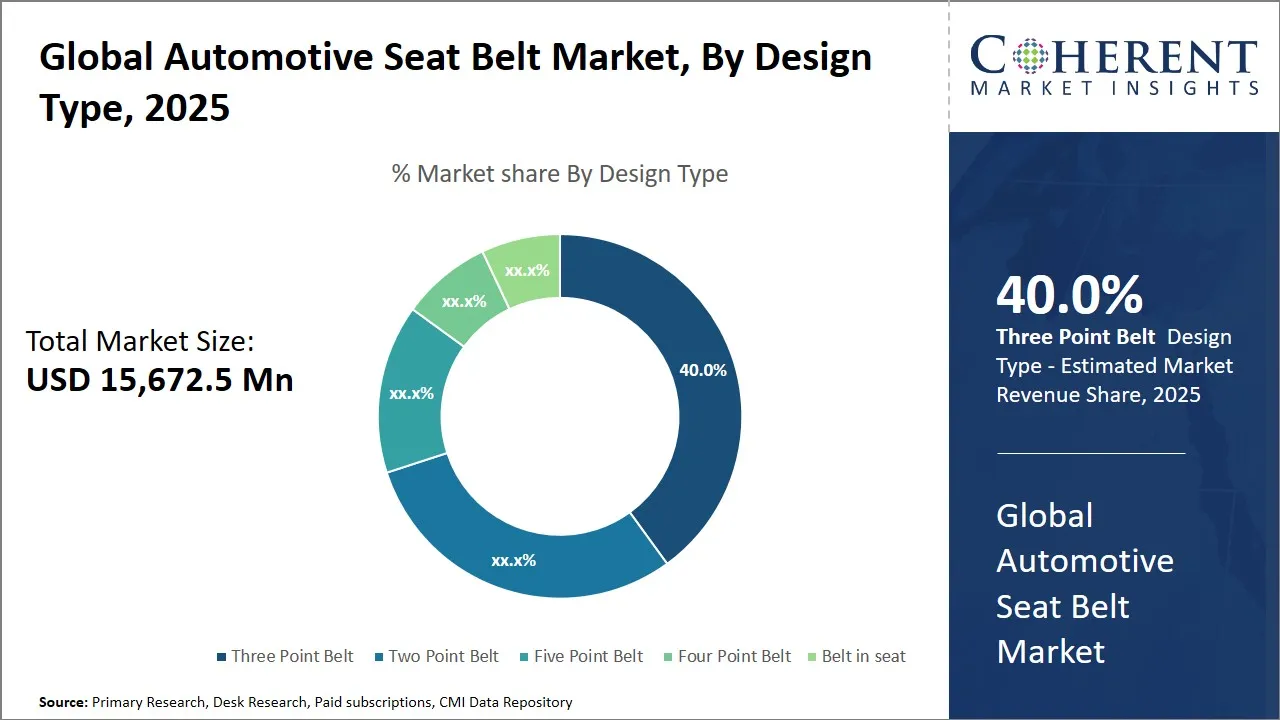
Automotive Seat Belt Market Insights, By Design Type - Three Point Belt Holds the Dominant Market Share
In terms of design type, the three point belt segment is expected to acquire 41.0% share of the global automotive seat belt market in 2026, due to the comprehensive restraints it provides, and distributes the force of impact across the chest, shoulders, and pelvis. This reduces the risk of serious injuries and saves lives.
In June 2026, Maruti Suzuki announced that its popular Baleno hatchback will now be equipped with a 3-point seat belt for the rear middle passenger, along with an adjustable headrest and a seatbelt reminder, across all variants. Such innovations are positively influencing the seat belt market forecast.
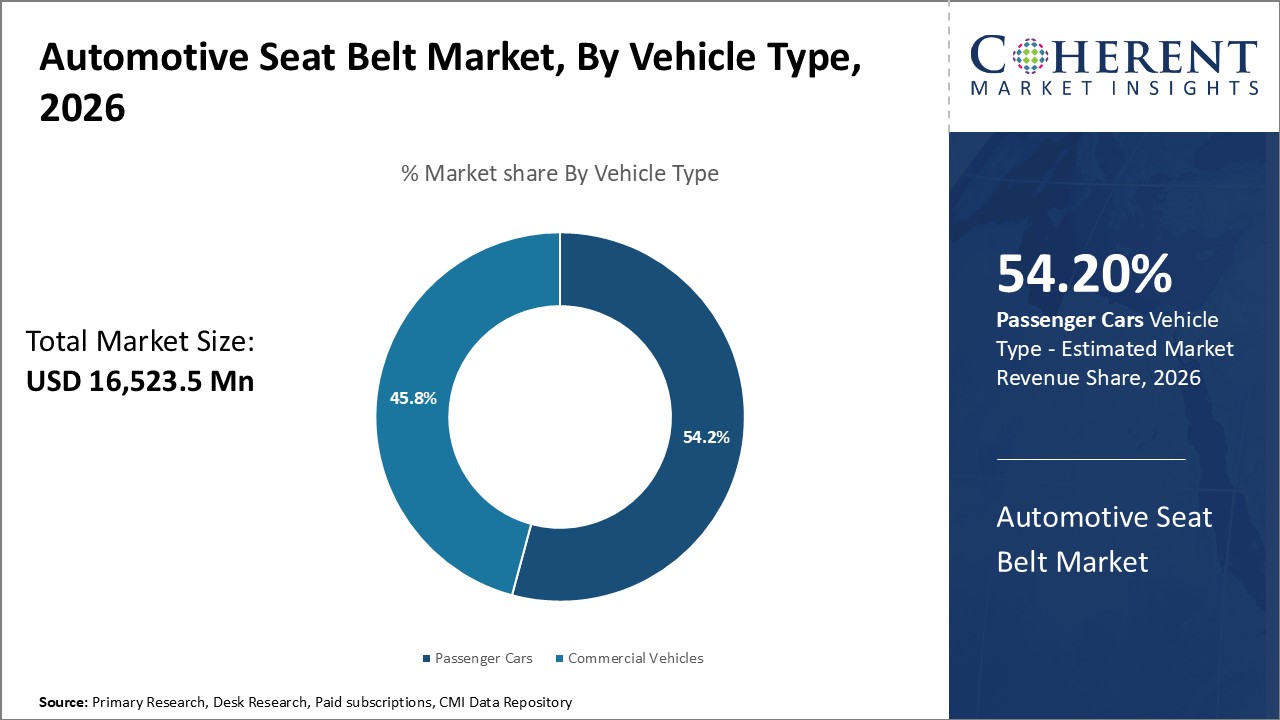
Automotive Seat Belt Market Insights, By Vehicle Type - Passenger Cars Acquires the Largest Share
In terms of vehicle type, the passenger cars are expected to contribute highest market share in 2026. This growth is driven by the extensive safety is offers. Seat belts in passenger cars significantly reduce the risk of death and serious injury in car accidents. They restrain occupants, prevent ejection, and distribute crash forces over stronger body parts, making them a critical safety feature. The primary aim of a seat belt is to safeguard passengers during a car crash. According to Volvo Buses, the seat belt has been credited with saving more than one million lives and is widely considered among the most cost-effective public health interventions. This is further accelerating the automotive seat belt market demand.
Automotive Seat Belt Market Insights, By Seat Belt Technology - Pretensioners is the Most Widely Adopted Technology
In terms of seat belt technology, the pretensioners segment is anticipated to contribute the largest share of the market in 2026, due to their role in significantly enhancing safety during a collision. Pretensioners work by tightening the seat belt before or at the onset of a crash, reducing slack and ensuring passengers are tightly secured, thus minimizing the risk of injury. They are highly demanding due to factors such as improved safety regulations, growing consumer awareness about advanced restraint systems, and the effectiveness of pretensioners in protecting occupants.
In June 2025, the MG 5 small sedan climbed from a zero‑star to a three‑star ANCAP safety rating after significant upgrades to models built from November 2024. Enhancements include seatbelt pre‑tensioners on front and rear outboard seats, seatbelt reminders for all five positions, and an upgraded AEB system with pedestrian, cyclist, and motorcycle detection, alongside newly added lane‑keep assist and emergency lane‑keeping.
Regional Insights
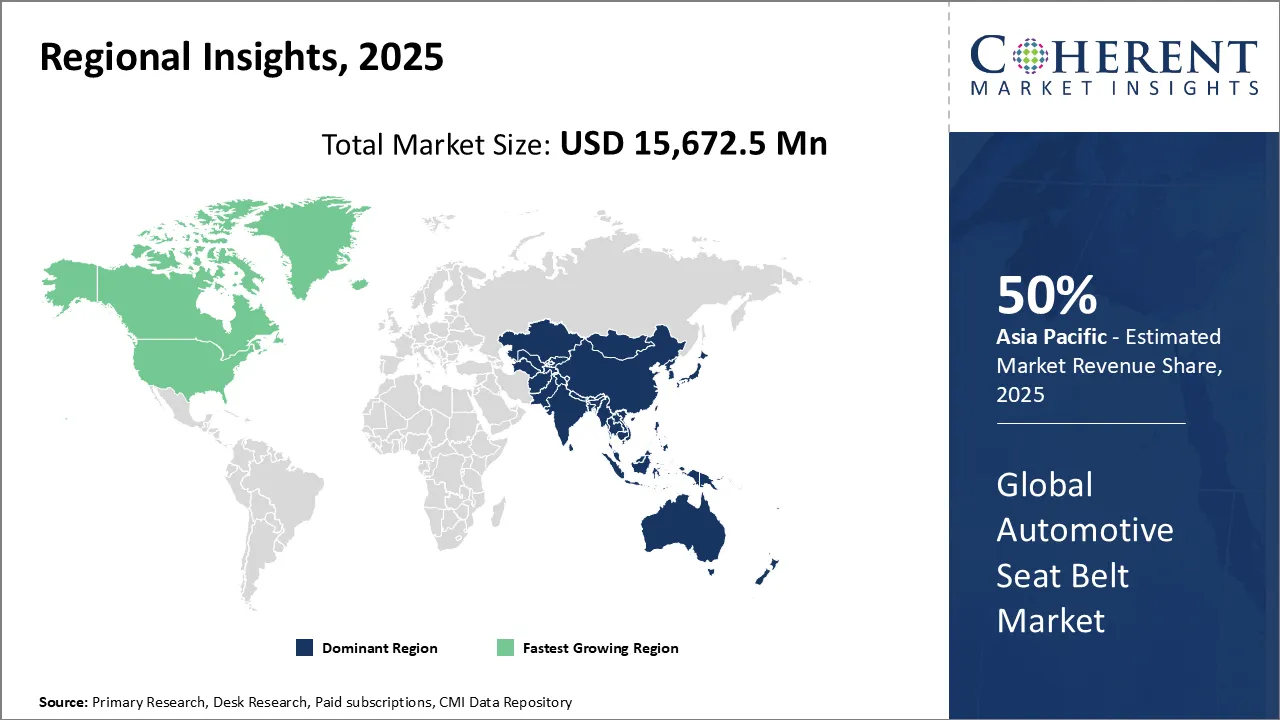
Asia Pacific Automotive Seat Belt Market Analysis & Trends
Asia Pacific dominated the global market in 2026 with 50.0% share, overpowers the business impacted by extending vehicle bargains joined with emerging rules in a couple of countries to take on 100% seat straps in vehicles. The market is expected to expand in this region due to rising passenger vehicle demand and rising vehicle production. According to the April 2026 data, China holds the largest global car production sales, gaining 5.7%. China has accounted for more than 70% of the global production and shipped nearly 1.25 million electric cars to other countries in 2024. This significant number drives the automotive seat belt market demand across the region.
North America Automotive Seat Belt Market Analysis & Trends
North America is the second largest market, owing to enactment of stringent government policy to ensure the safety of passengers. During the forecast period, numerous safety programs such as the 5-Star Safety Ratings Program, implemented by National Highway Traffic Safety Association (NHTSA) in the U.S. to improve occupant safety. Largest US Municipal Fleet to adopt FIA Road Safety Index, supported by FIA Foundation. New York City Department of Citywide Administrative Services (DCAS) will be the first municipal fleet in the world to adopt the international framework for measuring and improving road safety performance is expected to drive the market growth. For instance, in May 2026, Local police departments in Minnesota collaborated with state officials to launch a new road safety initiative that uses artificial intelligence (AI) to help prevent crashes before they happen. Such initiatives are expected to proliferate the automotive seat belt market revenue.
Automotive Seat Belt Market Outlook Country-wise
India Automotive Seat Belt Market Trends
The India automative seat belt market continues to thrive, driven by the Indian government’s mandate implementation of rear seatbelt alarm system from April 2026. Automotive landscape is significantly observing an impact on both regulatory and commercial standpoint. The regulation aims to enhance passenger safety, aligning India with global road safety norms. Apart from this, with around 4 million passenger vehicles sold annually in India, even a conservative average system cost of $35–$40 per vehicle would generate a robust and recurring demand for OEM-grade sensor kits, control modules, and integrated alert solutions.
The U.S. Automotive Seat Belt Market Trends
The U.S. automotive seat belt market is witnessing significant growth in recent year, with the help of Department of Transportation and Traffic safety law. FMCSA (Federal Motor Carrier Safety Administration) encourages CMV drivers to always buckle up. For instance, in May 2026, The U.S. Department of Transportation’s National Highway Traffic Safety Administration launched its annual Click It or Ticket seat belt high-visibility enforcement campaign, urging drivers and passengers to always buckle up and reminding them of the potentially deadly consequences of not wearing a seat belt.
Market Report Scope
Automotive Seat Belt Market Report Coverage
| Report Coverage | Details | ||
|---|---|---|---|
| Base Year: | 2025 | Market Size in 2026: | USD 16,523.5 Mn |
| Historical Data for: | 2020 To 2024 | Forecast Period: | 2026 To 2033 |
| Forecast Period 2026 to 2033 CAGR: | 5.4% | 2033 Value Projection: | USD 23,925.0 Mn |
| Geographies covered: |
| ||
| Segments covered: |
| ||
| Companies covered: | Tokai Rika Co. Ltd., Autoliv Inc., Hyundai Mobis Co. Ltd., ZF TRW Automotive Holdings Corp., Toyoda Gosei Co. Ltd., Takata Corporation, Key Safety Systems Inc., Robert Bosch GMBH, Denso Corporation, and Continental AG. | ||
| Growth Drivers: |
| ||
| Restraints & Challenges: |
| ||
Global Automotive Seat Belt Market Trends
Installation of Cutting-edge Safety System
Installation of cutting-edge safety systems in brand-new automobiles is mandatory, as various governments have implemented safety laws and regulations. In passenger cars, vans, and SUVs (Sport Utility Vehicle), the government of Australia mandated the installation of sophisticated seat belt reminder systems. Such regulations are significantly contributing to the automotive seat belt market value, as OEMs prioritize compliance and occupant protection.
Increasing Growth of EV Vehicles
Manufacturers of seat belts are producing seat belts made for electric vehicles. These seat belts are lighter and more flexible, and reduces weight that is important to increase efficiency. According to the IEA, in 2024, globally, 17.3 million electric cars were manufactured, a quarter more than in 2023. This growth was largely driven by increased production in China, which reached 12.4 million electric cars. This further drives the automotive seat belt market demand.
Global Automotive Seat Belt Market Drivers
Increasing Road Accident
Rising incidence of road accidents is expected to propel the global automotive seat belt market growth over the forecast period. High incidence of road accidents across the globe, especially in North America and Europe has boosted the demand for automotive seat belts.
Rising Demand for Inflated Seat Belts and Active Pretensioners
The market is driven by rising demand for luxury automobiles, and growing usage of technologically advanced inflated seat belts in both developed and developing nations. In the event of an accident, these seat belts serve as mini-airbags, and protects back passengers from head injuries caused by front seats. They further go about as a pad to delicate bones of grown-ups and youngsters, assisting with abstaining from breaking or cracking of collar bones. During the forecast period, the global automotive seat belts market is expected to witness growth, owing to rising demand for the installation of inflated seat belts in passenger cars, particularly luxury cars.
Global Automotive Seat Belt Market Opportunities
Expansion of Multi Type Seat Belts
Manufacturers of automobiles focus on implementing various safety belt wellness frameworks that include high-level components. Drivers and passengers' safety is improved by using burden limiters, pretensioners, movable anchors, inflatable seat straps, and pretensioners. In 2024, Tesla’s refreshed Model 3 included upgraded seat belt reminder systems and pretensioners for all seating positions, underscoring the shift toward high-end, multi-feature restraint technology.
Key Developments
- In May 2025, Tata Motors unveiled updated Altroz, starting at an attractive ex-showroom price of Rs. 6.89 lakh. The revamped Altroz comes loaded with advanced safety features such as a 360-degree camera, Tire Pressure Monitoring System (TPMS), ISOFIX anchor mounts, and three-point seat belts with reminder.
- In April 2024, Honda Cars India announced a major upgrade to its popular models, Honda City and Honda Elevate, which will now be equipped with six airbags, enhanced 3‑point Emergency Locking Retractor (ELR) seatbelts, and advanced seatbelt reminder systems.
- In January 2024, German Auto-supplier ZF Passive Safety Systems introduced its next generation smart seat-belt system, featuring a Multi-Stage Lead Limiter (MSLL). The system dynamically adjusts belt force throughout a crash sequence based on occupant size and weight offering tailored protection for smaller individual in moderate impact and heavier occupants in high-speed collision. Integrating sensors, cameras, and vehicle data, the smart belt adapts in real time, aligning with NCAP Roadmap 2030 safety mandates.
- In April 2023, a new tech-enabled safety feature for Uber India's passengers has been introduced. Even when seated in the second row, the brand-new feature reminds passengers to fasten their seat belts.
Analyst Opinion (Expert Opinion)
- The automotive seat belt market is at a critical inflection point—not because of innovation, but due to regulatory complacency and OEMs’ over-reliance on legacy safety systems. While the global push for advanced driver-assistance systems (ADAS) accelerates, seat belt innovation has stagnated, relying heavily on three-point inertia reel systems developed more than five decades ago. This is not just technologically lazy—it’s a missed opportunity in an era of rising road fatalities and shifting consumer safety expectations.
- Despite a 2023 WHO report highlighting that seat belts reduce the risk of death among front-seat passengers by 45–50%, usage remains inconsistent across regions. In India, for example, front-seat belt usage barely crosses 27%, while rear-seat usage is under 10%—a figure that barely changed over the past decade. Yet, OEMs in these markets prioritize infotainment systems and turbo variants over safety upgrades. This misallocation of R&D budget is concerning.
- More critically, regulatory gaps continue to undermine the potential of seat belts as lifesaving tools. The U.S. NHTSA has not mandated rear-seat seat belt reminders, even though 63% of fatalities in rear-seat crashes involve unbelted passengers, according to a 2022 IIHS study. In contrast, the European Union now mandates intelligent seat belt reminders for all seats under GSR II—a regulatory divergence that will soon fragment product development strategies.
- Apart from this, pre-tensioners and load limiters are becoming baseline, but active restraint systems like motorized belts remain under-deployed. Toyota and Mercedes-Benz have experimented with motorized seat belts integrated with collision prediction systems, but these are confined to luxury segments. This bifurcation—basic belts for economy cars, smarter systems for high-end models—will perpetuate safety inequality unless mid-tier OEMs adopt modular, scalable restraint technologies.
- Moreover, electric vehicle (EV) platforms present a latent opportunity for seat belt redesign. With cabin architecture being reimagined, seat positioning is shifting, creating new biomechanical safety challenges. Yet, most EV makers are retrofitting legacy belt designs rather than reengineering restraint systems for new occupant dynamics. Tesla, for example, has retained conventional seat belt hardware in the Model Y despite shifting the seatback recline profile and reducing front overhang—both of which affect force trajectories during frontal crashes.
Speak to the analyst
Want personalized insights?
Take the findings above to one of our principal consultants, or have the report rebuilt around the segments, geographies and competitors you actually track.
Market Segmentation
- Global Automotive Seat Belt Market, By Vehicle Type (Revenue, USD Mn, 2021 - 2033)
- Passenger Cars
- Commercial Vehicles
- Light Commercial Vehicles
- Heavy Trucks
- Buses and Coaches
- Global Automotive Seat Belt Market, By Design type (Revenue, USD Mn, 2021 - 2033)
- Belt-in-Seat
- Two-point Belts ( Lap Belts)
- Three-point Belts
- Four-point Belts
- Five-point Belts
- Six-point Belts
- Global Automotive Seat Belt Market, By Seat Belt Technology (Revenue, USD Mn, 2021 - 2033)
- Retractor
- Pretensioners
- Active Seat Belts
- Bag-in-Belts
- Load Limiters
- Seat Belt Reminder System
- Global Automotive Seat Belt Market, By Region (Revenue, USD Mn, 2021 - 2033)
- North America
- U.S.
- Canada
- Latin America
- Brazil
- Argentina
- Mexico
- Rest of Latin America
- Europe
- Germany
- U.K.
- Spain
- France
- Italy
- Russia
- Rest of Europe
- Asia Pacific
- China
- India
- Japan
- Australia
- South Korea
- ASEAN
- Rest of Asia Pacific
- Middle East
- GCC Countries
- Israel
- Rest of Middle East
- Africa
- South Africa
- North Africa
- Central Africa
- North America
- Company Profiles
- Tokai Rika Co. Ltd.
- Autoliv Inc.
- Hyundai Mobis Co. Ltd.
- ZF TRW Automotive Holdings Corp.
- Toyoda Gosei Co. Ltd.
- Takata Corporation
- Key Safety Systems Inc.
- Robert Bosch GMBH
- Denso Corporation
- Continental AG.
Sources
Primary Research Interviews from the following stakeholders:
Stakeholders
- Interviews with automotive OEMs, Tier-1 component suppliers, vehicle safety engineers, manufacturing plant heads, R&D directors, regulatory compliance officers, and procurement managers across global automotive hubs.
Databases
- UN Comtrade Database
- World Bank – Global Transport Database
- World Trade Organization (WTO) Trade Statistics
- International Organization of Motor Vehicle Manufacturers (OICA)
- European Automobile Manufacturers Association (ACEA)
- National Highway Traffic Safety Administration (NHTSA), U.S.
- Ministry of Road Transport and Highways (MoRTH), India
- Japan Automobile Manufacturers Association (JAMA)
- China Association of Automobile Manufacturers (CAAM)
Magazines
- Automotive World
- Autocar Professional
- Car and Driver – Tech Section
- Automotive Manufacturing Solutions (AMS)
- SAE Automotive Engineering Magazine
- AutoTech Review
- Motor Trend – Engineering Features
- Traffic Technology International
Journals
- SAE International Journal of Transportation Safety
- Accident Analysis & Prevention (Elsevier)
- Traffic Injury Prevention
- Journal of Automobile Engineering
- Vehicle System Dynamics
- International Journal of Automotive Technology
- Journal of Safety Research
Newspapers
- The Economic Times – Auto Section
- Business Standard – Manufacturing & Auto
- The Wall Street Journal – Automotive and Tech
- Financial Times – Global Autos
- Nikkei Asia – Mobility and Components
- South China Morning Post – Auto and Industrial News
Associations
- Society of Automotive Engineers (SAE)
- International Organization for Standardization (ISO) – Technical Committee on Road Vehicles
- Automotive Component Manufacturers Association of India (ACMA)
- European Committee for Standardization (CEN)
- Global NCAP (New Car Assessment Program)
- Transport Research Laboratory (TRL), UK
- National Automotive Testing and R&D Infrastructure Project (NATRiP), India
Public Domain Sources
- National Highway Traffic Safety Administration (NHTSA), U.S.
- Ministry of Road Transport and Highways (MoRTH), India
- European Commission – Mobility and Transport Reports
- Japan Ministry of Land, Infrastructure, Transport and Tourism (MLIT)
- International Energy Agency (IEA) – Transport Sector
- Bureau of Transportation Statistics (U.S.)
- Reserve Bank of India (RBI) – Auto Industry Insights
- United Nations Economic Commission for Europe (UNECE) – Vehicle Regulations
Proprietary Elements
- CMI Data Analytics Tool, and Proprietary CMI Existing Repository of information for last 8 years
*Definition: In the event of a collision or sudden stop, a seat belt protects the driver and passengers from significant movement. A seat belt lowers the risk of death or serious injury in a collision by reducing the force of secondary impacts caused by interior strike hazards. Numerous countries have forced serious monetary punishments on the individuals who don't comply with the law for wearing safety belts while voyaging.
Get access to 250+ pages report
Every segment, forecast, competitor profile and data table behind the analysis above — available for instant download.
- ESOMAR Member
- ISO 9001:2015 Certified
- D-U-N-S Registered
- GDPR & CCPA Compliant
Missing comfort of reading report in your local language? Find your preferred language:
Transform your Strategy with Exclusive Trending Reports
Frequently Asked Questions
The Automotive Seat Belt Market is estimated to be valued at USD 16,523.5 Mn in 2026, and is expected to reach USD 23,925.0 Mn by 2033.
The CAGR of the Automotive Seat Belt Market is projected to be 5.4% from 2026 to 2033.
Rising Demand for Inflated Seat Belts and Active Pretensioners.
The three- point belts segment is the leading design type segment in the Market.
Major companies operating in the market are Tokai Rika Co. Ltd., Autoliv Inc., Hyundai Mobis Co. Ltd., ZF TRW Automotive Holdings Corp., Toyoda Gosei Co. Ltd., Takata Corporation, Key Safety Systems Inc., Robert Bosch GMBH, Denso Corporation, and Continental AG.
Global economic conditions affect vehicle production, consumer spending, and regulatory investment, directly impacting seat belt demand and supply chain stability.
Suppliers provide essential safety components, ensure regulatory compliance, support OEM design integration, and maintain just-in-time delivery across global markets.