

Electric Powertrain Market Analysis & Forecast: 2026-2033
Electric Powertrain Market is estimated to be valued at USD 150.24 Bn in 2026 and is expected to reach USD 440.22 Bn in 2033, exhibiting a compound annual growth rate (CAGR) of 16.6% from 2026 to 2033.
Key Takeaways
- By Vehicle Type, The Battery Electric Vehicle (BEV) Segment is expected to dominate the global electric powertrain market in 2026, accounting for the largest share at 65%.
- By Region, Asia-Pacific is projected to lead the global electric powertrain market in 2026, capturing a significant 40% share.
Market Overview
The expansion of the Electric Powertrain Market is on the increase spurred by the greater need for Electric Vehicles (EVs) and increasingly strict emission regulations globally. Take, for example, Tesla's expansion of the production of advanced electric powertrains with greater efficiency and a wider range, which supports the shift towards sustainable transport in 2024. Also, technological innovations together with increased use of EVs, more e-enabled consumer adoption, and government incentives are critical factors stimulating the market growth.
Current Events and Its Impact on the Electric Powertrain Market
Event | Description and Impact |
US-China Technology and Trade Relations |
|
Critical Mineral Supply Chain Disruptions |
|
European Green Deal and Regulatory Framework |
|
Pricing Analysis
The global electric powertrain market displays diverse pricing across vehicle segments, driven by powertrain capacity, technology, and regional factors. Passenger electric vehicles range widely in price, starting from economy models like the Nissan Leaf ($28,140–$36,040) to ultra-luxury offerings such as the Lucid Air Dream ($169,000). Powertrain costs typically represent 20-40% of the total vehicle price, with higher-end models carrying a premium for advanced battery and motor technologies.
Mid-range EVs like the Volkswagen ID.4 and Ford Mustang Mach-E are priced between $40,000 and $60,000, reflecting a balance between performance and affordability. Premium electric vehicles such as the Mercedes EQS and Audi e-tron GT command prices from $83,000 to over $140,000, with powertrain components costing up to $25,000.
Commercial electric vehicles also demonstrate variability; for example, the Ford E-Transit’s powertrain package ranges from $11,000 to $13,000 depending on configuration. Regional price differences are notable, with European models often priced 10-15% higher than their Asia-Pacific counterparts due to market dynamics and production costs.
Ongoing advances in battery technology and scaling production are expected to gradually reduce powertrain costs, improving affordability and accelerating market adoption globally.
- Current Industry Events of 2026
- Market Size Estimation
- Regional Breakdown
- Competitive Landscape
- Customer Intelligence
- Segmental Analysis
- Pricing Analysis
- Key Market Drivers, Challenges & Future Trends
- Customized Insights Section
Role of Advanced Technologies
Advanced technologies are pivotal in shaping the environment for electric powertrain innovation, enabling electric powertrain manufacturers to deliver highly efficient, reliable, and cost-effective solutions for electric powertrains. Breakthroughs in battery technology, such as solid-state batteries and silicon nanowire anodes, are significantly enhancing the energy density and charging speed of BEV electric powertrain systems, addressing range anxiety and safety concerns.
Electric powertrain manufacturers are also pioneering advanced motor technologies, including permanent magnet synchronous motors with rare-earth-free materials and axial flux motors that offer superior power density in compact designs. These innovations improve torque and reduce weight, enhancing vehicle performance.
Integration of powertrain components into multi-in-one systems optimizes efficiency and reduces manufacturing complexity. Silicon carbide (SiC) semiconductors improve inverter performance, further boosting powertrain efficiency.
Thermal management advancements like immersion cooling and heat pumps maintain optimal operating temperatures, extending powertrain longevity and preserving vehicle range. Additionally, smart control systems incorporating artificial intelligence enable predictive maintenance and adaptive performance, transforming electric powertrain management.
Together, these technologies empower electric powertrain manufacturers to meet growing market demands while fostering sustainable mobility solutions across passenger and commercial BEV electric powertrain applications.
Segmental Insights
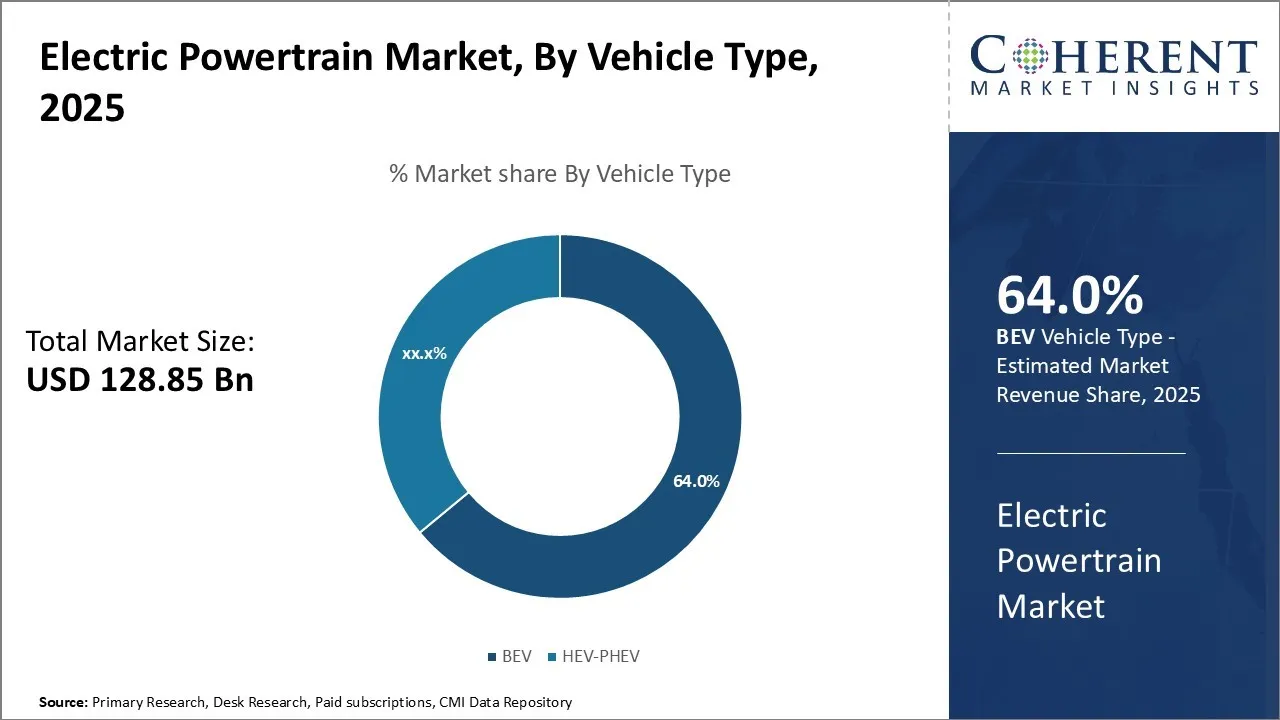
Global Electric Powertrain Market Insights, By Vehicle Type
Among vehicle types, Battery Electric Vehicles (BEVs) are set to lead the market segmentation by vehicle type in 2026. This dominance stems from regulatory pressures on ICE vehicles and the growing consumer preference for zero-emission mobility solutions. BEVs not only help meet environmental targets but also provide long-term economic benefits through lower operational and maintenance costs.
Improvements in battery technology and supportive policies, including subsidies and infrastructure development, are expected to further accelerate BEV market penetration globally. Hybrid Electric Vehicles (HEVs) and Plug-in Hybrid Electric Vehicles (PHEVs) will continue to play a complementary role, particularly in regions with slower BEV adoption rates.
Global Electric Powertrain Market Insights, By Electric Type
By electric type, the Battery Electric Vehicle (BEV) segment is expected to dominate the global electric powertrain market with a 65% share in 2026. This leadership position is primarily driven by declining sales of Internal Combustion Engine (ICE) vehicles and increasingly stringent CO2 emission targets worldwide. BEVs offer a compelling solution to reduce pollution and lower total cost of ownership over time, making them the preferred choice for consumers and manufacturers alike.
Additionally, ongoing advancements in battery technology, coupled with declining lithium-ion battery prices, are anticipated to further boost BEV adoption in the coming years. The HEV/PHEV segment is also poised for steady growth, supported by transitional demand in markets where full electrification is still emerging.
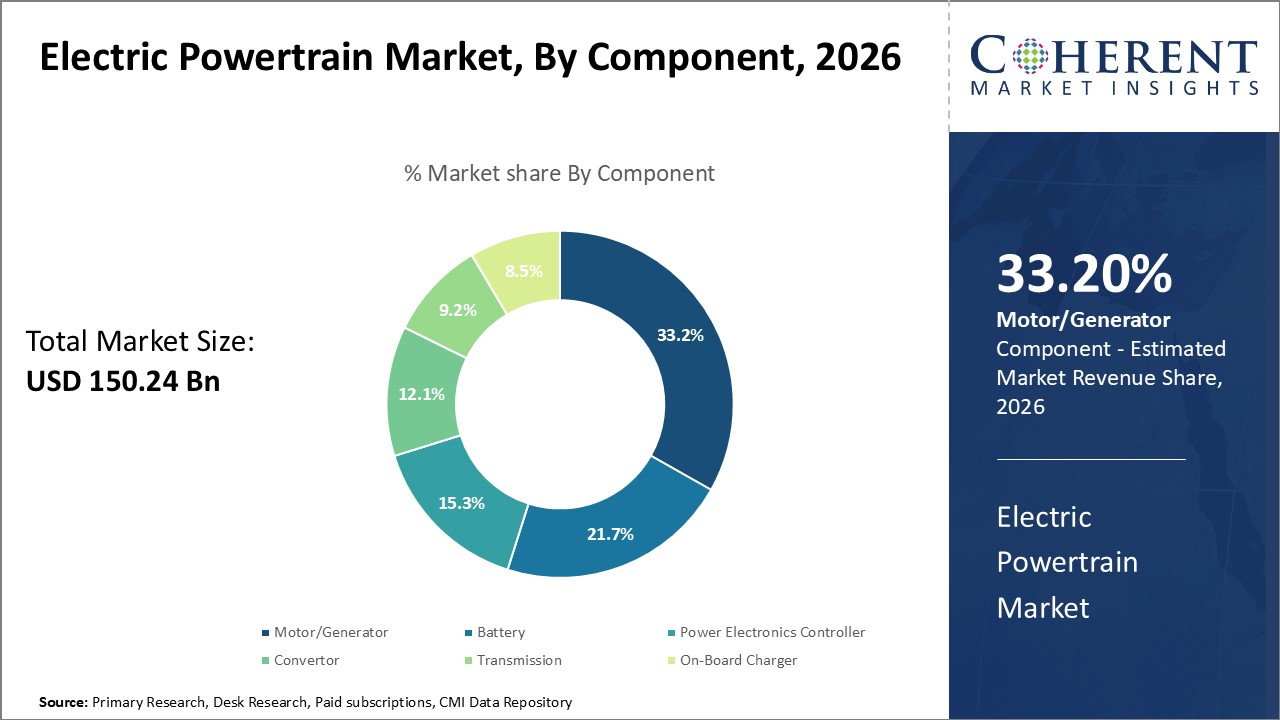
Global Electric Powertrain Market Insights, By Component
In terms of components, the Battery segment is expected to command a significant portion of the market owing to its critical role in determining vehicle range, efficiency, and cost. Innovations in battery chemistry and manufacturing techniques continue to enhance performance and reduce costs, driving demand across all electric vehicle types.
The Motor/Generator and Power Electronics Controller segments are also forecasted to experience robust growth, fueled by increasing investments in motor efficiency and power management technologies. Meanwhile, components such as Convertors, Transmission systems, and On-Board Chargers are expected to evolve with the overall market shift toward integrated and optimized electric powertrain architectures.
Regional Insights
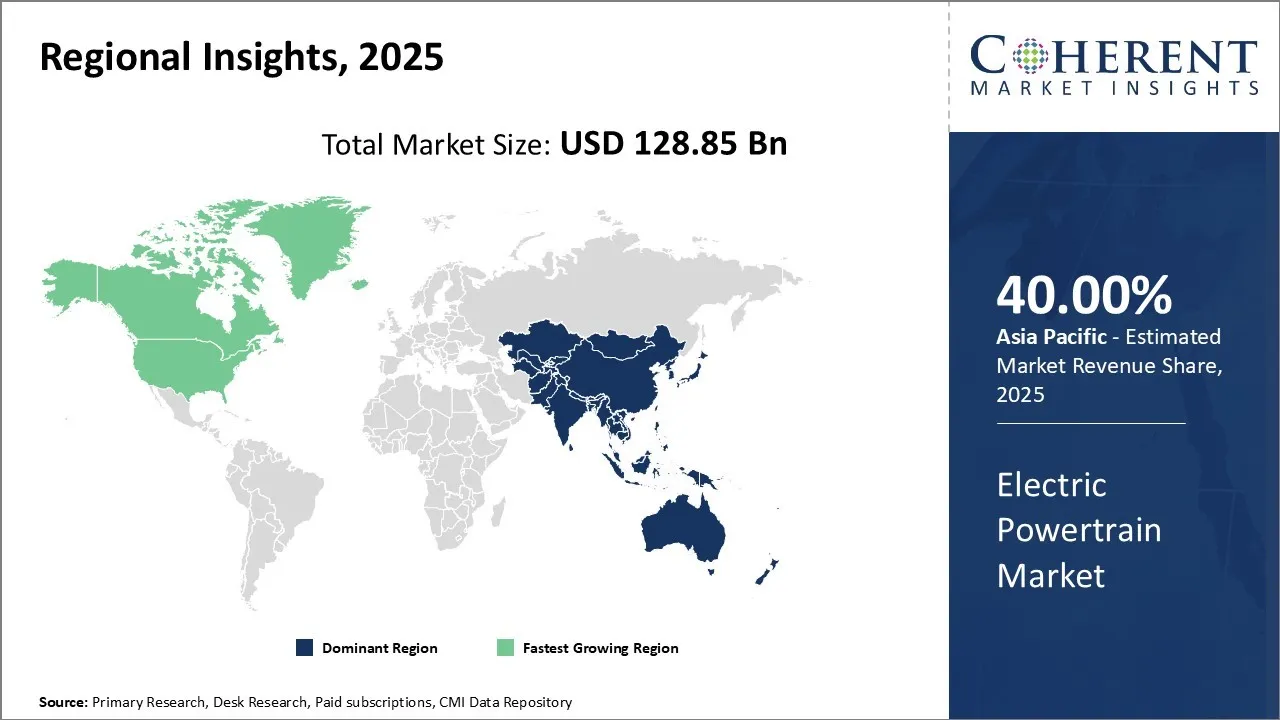
Asia Pacific Electric Powertrain Market Analysis and Trends
Asia Pacific is set to dominate the global electric powertrain market in 2026, holding the largest share at 40.00%. The region’s growth is primarily driven by stringent government regulations and emission standards aimed at mitigating CO2 emissions and addressing global warming concerns.
The presence of numerous original equipment manufacturers (OEMs) and rapidly growing electric vehicle (EV) adoption further propel market expansion. Rising investments in EV infrastructure and supportive policies in key economies such as China, India, and Japan are expected to sustain the region’s leadership throughout the forecast period.
Europe Electric Powertrain Market Analysis and Trends
Europe is projected to be a significant market for electric powertrains, fueled by widespread EV adoption across countries like the Netherlands, Norway, France, and Sweden. The region benefits from a strong automotive manufacturing base, with leading companies such as Audi AG, Volkswagen AG, and BMW AG focusing heavily on EV production.
Germany, as one of the world’s largest automotive hubs, plays a crucial role in driving demand for electric powertrain components. Government incentives, emission regulations, and expanding charging infrastructure also bolster market growth in Europe.
North America Electric Powertrain Market Analysis and Trends
North America holds a key position in the electric powertrain market, supported by major players such as Tesla, Chevrolet, and Ford. The U.S. and Canada have developed extensive electric vehicle supply equipment (EVSE) networks, including widespread charging station installations, which facilitate greater EV adoption. Strong consumer demand for electric vehicles and government incentives are expected to drive further growth of the electric powertrain market in the region over the coming years.
Dominating Countries in the Asia Pacific Electric Powertrain Market
China
China leads the Asia Pacific electric powertrain market with aggressive government policies promoting clean energy vehicles, large-scale EV manufacturing, and growing domestic demand.
India
India’s electric powertrain market is expanding rapidly, driven by governmental initiatives focused on reducing vehicular emissions and encouraging electric mobility infrastructure development.
Japan
Japan remains a significant player, supported by strong automotive technology development and a focus on hybrid and electric vehicle production.
Market Report Scope
Electric Powertrain Market Report Coverage
| Report Coverage | Details | ||
|---|---|---|---|
| Base Year: | 2025 | Market Size in 2026: | USD 150.24 Bn |
| Historical Data for: | 2020 To 2024 | Forecast Period: | 2026 To 2033 |
| Forecast Period 2026 to 2033 CAGR: | 16.6% | 2033 Value Projection: | USD 440.22 Bn |
| Geographies covered: |
| ||
| Segments covered: |
| ||
| Companies covered: | Borgwarner Inc., Continental Ag, Magna International Inc., Marelli Holdings Co Ltd., Mitsubishi Electric Corporation, Nidec Corporation, Robert Bosch Gmbh, Schaeffler Group Usa Inc., and Valeo Sa. | ||
| Growth Drivers: |
| ||
| Restraints & Challenges: |
| ||
Global Electric Powertrain Market - Drivers
- Growing vehicle electrification demand in automotive industry
The demand for electric vehicles significantly increased due to massive vehicle electrification investments by major automotive OEMs such as Tesla, Honda, Ford, Toyota, and General Motors. Additionally, the budding partnerships between automotive and electric motor manufacturers are expected to propel the demand for electric vehicles.
For instance, General Motor Co. (designs, builds, and markets cars, SUVs, crossovers trucks, and automobile parts) and Honda Motor Co. (manufacturer of automobiles, motorcycles, and power equipment) announced a partnership to establish a North America automotive alliance. General Motors plans to sell 20 electric vehicle models by 2023 and Honda would develop two plug-in electric vehicle models using the battery pack of General Motors.
The lucrative nature of the market is expected to attract more and more conventional vehicle manufacturers to shift to the electric vehicle space, thus driving the growth of the global electric powertrain market.
- Rising crude oil prices and stringent emission norms
Petrol and diesel are the most commonly used fuel sources for vehicles with internal combustion engine. Although internal combustion engines have a lower purchase price, the overall cost of owning the vehicles is inclusive of the fuel costs incurred over the vehicle's lifespan.
Thus, the rise in fuel prices ultimately adds up to the cost of ownership of the vehicle. As crude oil prices increased, it had a direct impact on the automotive industry, particularly on traditional internal combustion engine vehicles that heavily rely on fossil fuels.
The continuous usage of these fuels on a large-scale also leads to the depletion of their reserves. Thus, one of the reasons contributing to the rising prices is to discourage its usage among consumers. The increasing fuel prices contribute to the adoption of electric powertrain vehicles as a substitute for petrol and diesel vehicles. Owing to all the mentioned factors, rising crude oil prices are expected to favor electric vehicles' demand, subsequently driving the global electric powertrain market growth.
Global Electric Powertrain Market - Opportunities
- Increasing Demand for Electric Vehicles
The rising demand for Electric Vehicles (EVs) creates a significant opportunity for the global electric powertrain market. As more consumers and governments prioritize sustainability and emissions reduction, the demand for EVs is expected to continue growing. This increased demand directly translates into opportunities for electric powertrain manufacturers.
- Technological Advancements
The global electric powertrain market is witnessing continuous technological advancements. These advancements include improvements in battery technology, power electronics, electric motors, and energy management systems. Companies that can develop innovative and efficient electric powertrain components have the opportunity to gain a competitive edge and capture a larger market share.
- Expansion of Charging Infrastructure
The establishment of a robust charging infrastructure is crucial for the widespread adoption of electric vehicles. As the global electric powertrain market grows, there is a need for an extensive network of charging stations, including fast-charging options. This presents opportunities for companies involved in charging infrastructure development, such as charging station manufacturers, operators, and energy service providers.
Global Electric Powertrain Market - Trends
- Expansion of Charging Infrastructure
The development of a robust charging infrastructure is vital for the widespread adoption of electric powertrains. Governments and private companies are investing in the expansion of charging networks, including fast-charging stations, to address the range anxiety of EV owners. The growth of charging infrastructure is crucial for the continued expansion of the global electric powertrain market.
- Integration of Autonomous and Electric Technologies
The convergence of autonomous driving and electric powertrains is gaining momentum. Companies are exploring the integration of autonomous technology into electric vehicles, which would enable self-driving EVs. This trend has the potential to revolutionize the transportation industry and shape the future of electric powertrains.
- Rise of Shared Mobility and Ride-Hailing Services
The rise of shared mobility services, including ride-hailing and car-sharing platforms, has created new opportunities for electric powertrains. Companies operating in the shared mobility sector are increasingly adopting electric vehicles due to their lower operating costs and environmental benefits. This trend is likely to drive the demand for electric powertrains in the commercial vehicle segment.
Analyst Viewpoint
- The electric powertrain market is undergoing a profound transformation, propelled by stringent emissions regulations and ambitious government mandates aimed at achieving carbon neutrality across key global economies.
- Consumer demand is swiftly pivoting towards sustainable mobility solutions, as electric vehicles (EVs) become increasingly mainstream thanks to notable improvements in driving range and overall performance.
- Expansion of charging infrastructure is steadily alleviating range anxiety, while the continual decline in battery costs is driving electric powertrains closer to cost parity with traditional internal combustion engines (ICE).
- Despite these positive trends, the market faces several challenges. Supply chain constraints, particularly for critical raw materials like lithium, cobalt, and rare earth elements, threaten to disrupt manufacturing processes.
- Additionally, limited charging infrastructure in rural and emerging markets restricts the pace of EV adoption. Consumer concerns about battery degradation and the associated replacement costs also act as significant barriers to widespread acceptance.
- Nevertheless, the market offers substantial growth potential driven by technological innovations. Advances in solid-state battery technology and wireless charging systems promise to enhance efficiency and user convenience.
- The integration of artificial intelligence and machine learning into powertrain management systems is enabling improved energy efficiency and predictive maintenance, which can reduce operational costs and downtime. Furthermore, the electrification of commercial fleets, especially in last-mile delivery and public transportation, presents a lucrative opportunity for market expansion.
- Geographically, the Asia-Pacific region leads the electric powertrain market, bolstered by China’s extensive manufacturing capabilities and supportive regulatory policies. Europe, meanwhile, is exhibiting the fastest growth, fueled by aggressive emissions reduction targets and strong governmental incentives.
- The ongoing convergence between the automotive and technology sectors is catalyzing innovative partnerships, accelerating development timelines, and fundamentally reshaping the global mobility ecosystem.
Global Electric Powertrain Market: Key Developments
- In July 2021, Mercedes-Benz, (a Germany-based luxury and commercial vehicle automotive brand) revealed that it had acquired Yasa, (a manufacturer of electric motors and motor controllers for use in automotive and industrial applications) a provider of advanced electric propulsion technology. It offers the automobile sector solutions for electric and hybrid powertrains. Yasa will continue to function as a wholly-owned Mercedes-Benz subsidiary.
- In July 2021, an electric powertrain joint venture between LG electronics, (Multinational conglomerate corporation) and Magna International, (Canadian parts manufacturer for automakers) was formulated to serve the EV industry. Both firms have formally signed the transaction agreement. The new business will be situated in Incheon, South Korea, and will go by the name LG Magna e-powertrain. It will initially employ 1,000 people.
- In August 2021, BorgWarner Inc., (a U.S.-based automotive supplier) announced a Series C equity investment in CelLink Corporation, a provider of high-conductance flexible circuits for the automotive industry. The investment would allow the company to expand its electrification strategy.
Market Segmentation
- Global Electric Powertrain Market, By Vehicle Type (Revenue, USD Bn, 2021 - 2033)
- BEV
- HEV/PHEV
- Global Electric Powertrain Market, By Component (Revenue, USD Bn, 2021 - 2033)
- Motor/Generator
- Battery
- Power Electronics Controller
- Convertor
- Transmission
- On-Board Charger
- Global Electric Powertrain Market, By Region (Revenue, USD Bn, 2021 - 2033)
- North America
- U.S.
- Canada
- Latin America
- Brazil
- Argentina
- Mexico
- Rest of Latin America
- Europe
- Germany
- U.K.
- Spain
- France
- Italy
- Russia
- Rest of Europe
- Asia Pacific
- China
- India
- Japan
- Australia
- South Korea
- ASEAN
- Rest of Asia Pacific
- Middle East
- GCC Countries
- Israel
- Rest of Middle East
- Africa
- South Africa
- North Africa
- Central Africa
- North America
- Company Profiles
- Borgwarner Inc.
- Continental Ag
- Magna International Inc.
- Marelli Holdings Co.Ltd.
- Mitsubishi Electric Corporation
- Nidec Corporation
- Robert Bosch Gmbh
- Schaeffler Group Usa Inc.
- Valeo Sa
Sources
Primary Research Interviews
- Electric vehicle manufacturers and OEMs
- Battery technology providers and suppliers
- Automotive component manufacturers
- Electric powertrain system integrators
- Others
Databases
- Bloomberg New Energy Finance (BNEF)
- IHS Markit Automotive Database
- S&P Global Mobility Database
- Automotive News Data Center
- Others
Magazines
- Electric Vehicle Magazine
- Automotive Engineering International
- Motor Trend Electric
- Green Car Magazine
- Others
Journals
- Journal of Power Sources
- IEEE Transactions on Vehicular Technology
- International Journal of Electric and Hybrid Vehicles
- Others
Newspapers
- Financial Times
- The Wall Street Journal
- Reuters Business News
- Automotive News
- Others
Associations
- Electric Drive Transportation Association (EDTA)
- Society of Automotive Engineers (SAE International)
- International Association of Electric Vehicle Manufacturers
- Global EV Alliance
- Others
Public Domain Sources
- International Energy Agency (IEA) Reports
- U.S. Department of Energy Publications
- European Environment Agency Data
- National Renewable Energy Laboratory (NREL)
- Others
Proprietary Elements
- CMI Data Analytics Tool
- Proprietary CMI Existing Repository of information for last 8 years
Get access to 250+ pages report
Every segment, forecast, competitor profile and data table behind the analysis above — available for instant download.
- ESOMAR Member
- ISO 9001:2015 Certified
- D-U-N-S Registered
- GDPR & CCPA Compliant
Missing comfort of reading report in your local language? Find your preferred language:
Transform your Strategy with Exclusive Trending Reports
Frequently Asked Questions
The Electric Powertrain Market size is estimated to be valued at USD 150.24 Bn in 2026, and is expected to reach USD 440.22 Bn by 2033.
The key players operating in the global market are Borgwarner Inc., Continental Ag, Magna International Inc., Marelli Holdings Co., Ltd., Mitsubishi Electric Corporation, Nidec Corporation, Robert Bosch Gmbh, Schaeffler Group Usa Inc., and Valeo Sa.
Growing vehicle electrification demand in the automotive industry is positively influencing the market.
The market is estimated at USD 81.7 Bn in 2026 and is estimated to reach USD 236.9 Bn by 2033 during the forecast period (2026-2033).
The CAGR of the Electric Powertrain industry is projected to be 16.6% from 2026 to 2033.
The Market is segmented on the by vehicle type, by component & geography.
The e powertrain market is rapidly growing, valued at several billion dollars globally, driven by the rising adoption of electric vehicles (EVs) and advancements in battery and motor technologies.