

Automotive Screenwash Products Market Analysis & Forecast: 2026-2033
Automotive screenwash products market size is estimated to be valued at USD 3,046.35 Mn in 2026 and is expected to reach USD 8,101.83 Mn in 2033, exhibiting a compound annual growth rate (CAGR) of 15% from 2026 to 2033.
Key Takeaways
- Based on Product Type, the All-season automotive screenwash products segment is projected to account for USD 43 share in 2026.
- Based on Sales Channel, the Indirect sales segment is expected to lead the market with 52% share in 2026.
- Based on Vehicle Type, the Passenger vehicle segment is expected to hold 68% share in 2026.
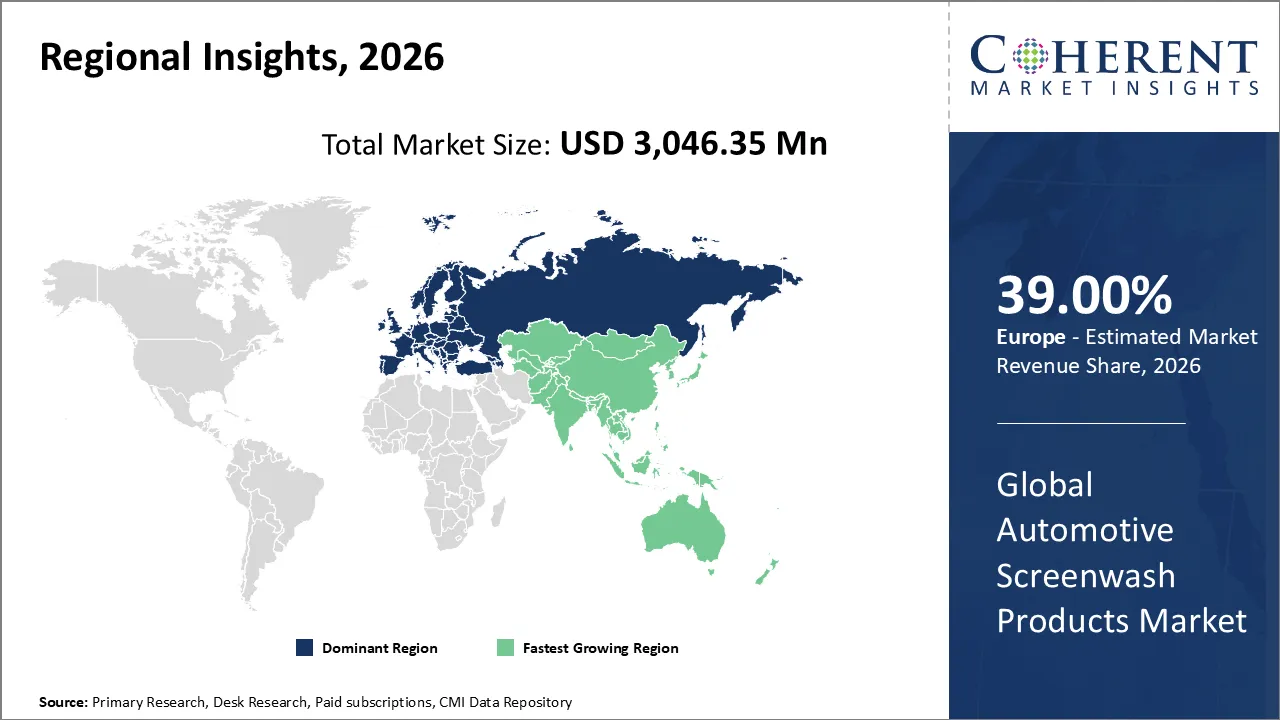
- Based on Region, Europe is set to lead the automotive screenwash products market with 39% share in 2026. While, Asia Pacific is anticipated to be the fastest growing region.
Market Overview
Automotive screenwash products are used to keep car windshields clean and safe to drive in all types of weather. The accumulation of dust, water, and snow weakens the quality of the wind screen. Some screenwash products are designed to be mixed with water, while some screen wash products can be used straight from the bottle. Furthermore, some of these compounds are available as powders that can be combined with reagents and used. Distilled water is one of the suggested agents for dilution of cleaning solution rather than tap water. Tap water contains impurities and harmful minerals that might block the jet system and leave deposits on the glass.
Current Events and Its Impacts on the Automotive Screenwash Products Market
Current Event | Description and its Impact |
European Union Environmental Regulations and Sustainability Mandates |
|
North American Winter Weather Patterns and Climate Change |
|
Are Smart & Connected Screenwash Systems the Future of Automotive Visibility?
Smart and connected screenwash systems represent a cutting-edge innovation in vehicle maintenance. By integrating IoT sensors, these systems can automatically detect windshield dirt, dust, or insect residue and dispense the precise amount of fluid required, optimizing usage and reducing waste. This technology enhances driver safety by ensuring clear visibility at all times. Furthermore, OEM partnerships offer opportunities to embed smart reservoirs directly into EVs and luxury cars, aligning with premium features and sustainability goals while creating a differentiated aftermarket advantage.
Britannia Wash Systems, a leader in automated car wash innovation, introduced Smart Wash—an advanced system that uses artificial intelligence and state-of-the-art sensors to provide a highly efficient, personalized vehicle cleaning experience.
- Current Industry Events of 2026
- Market Size Estimation
- Regional Breakdown
- Competitive Landscape
- Customer Intelligence
- Segmental Analysis
- Pricing Analysis
- Key Market Drivers, Challenges & Future Trends
- Customized Insights Section
Segmental Insights

Passenger vehicles dominate the automotive screenwash market
In terms of vehicle type, the passenger vehicles segment is projected to account for 68% share in 2026. Their sheer global volume ensures the highest consumption, with millions of individual car owners consistently driving steady aftermarket sales. This widespread usage firmly establishes passenger vehicles as the leading segment compared to commercial fleets.
For instance, in September 2025, Uno Minda's introduction of a line of car care products for the Indian aftermarket indicates that it is focused on passenger vehicles. The range includes windshield washer fluids and is aimed directly at individual car owners, who make up the largest group of customers. This move makes the aftermarket stronger and increases the need for automotive screenwash products.
Which product type leads the 2026 automotive screenwash market?
In terms of product type, the all-season automotive screenwash products segment is expected to lead the market with 43% share in 2026, due to their adaptability across diverse climates. Their year-round effectiveness makes them the preferred choice for both individual car owners and fleet operators, ensuring consistent demand and widespread adoption compared to specialized alternatives like de-icers or bug removers.
Which sales channel is projected to dominate the automotive screenwash market?
In terms of sales channel, the indirect sales segment is expected to hold 52% share of the market in 2026. Their strength lies in widespread availability through retail outlets, service stations, and supermarkets, ensuring easy consumer access. This established aftermarket presence drives consistent demand, making indirect sales the most influential channel.
Regional Insights
Europe Automotive Screenwash Products Market Analysis & Trends
Europe is expected to dominate the automotive screenwash products market with 39% share in 2026, driven by high passenger car density, strict road safety regulations, and diverse climates requiring all-season solutions. Strong aftermarket networks through retail and service stations ensure easy access, while consumer preference for visibility and maintenance sustains consistent demand across the region.
Asia Pacific Automotive Screenwash Products Market Analysis & Trends
Asia Pacific is anticipated to exhibit the fastest growth, due to rapid passenger car ownership in China and India, expanding commercial fleets, and urbanization. Rising awareness of vehicle safety and maintenance, coupled with growing aftermarket networks and preference for affordable, eco-friendly solutions, makes APAC the fastest-growing regional market globally.
Automotive Screenwash Products Market Outlook Country-Wise
Germany Automotive Screenwash Products Market Trends
Germany is going to require a lot of automotive screenwash products in 2026 because it has a lot of cars, strict safety rules, and a climate that changes with the seasons and needs de-icers and bug removers. Sustainability rules are making eco-friendly products more popular, and a strong aftermarket culture and consumers' focus on safety and visibility are also helping the market grow.
China Automotive Screenwash Products Market Trends
China's need for automotive screenwash products in 2026 is driven by the rapid growth of car ownership, pollution in cities that makes it hard to see, and different climates that need different seasonal formulations. Increased numbers of individuals are becoming aware of road safety, the aftermarket car care industry is growing, and people are choosing eco-friendly, concentrated screenwash solutions. All of these factors are driving strong market demand across the country.
Market Report Scope
Automotive Screenwash Products Market Report Coverage
| Report Coverage | Details | ||
|---|---|---|---|
| Base Year: | 2025 | Market Size in 2026: | USD 3,046.35 Mn |
| Historical Data for: | 2020 To 2024 | Forecast Period: | 2025 To 2032 |
| Forecast Period 2026 to 2033 CAGR: | 15% | 2033 Value Projection: | USD 8,101.83 Mn |
| Geographies covered: |
| ||
| Segments covered: |
| ||
| Companies covered: | Gold Eagle, CRC Industries Inc., Milazzo Industries Inc., ITW Global Brands, Kristall Klar, Ostrem Chemical Co. LTD, Prestone Products Corporation, CAF, Reccochem Inc., Magnum Research Corp,Michelin, Cyclo Industries, ACDello, and Viva Green Industries | ||
| Growth Drivers: |
| ||
| Restraints & Challenges: |
| ||
Automotive Screen wash Products Market Driver
Vehicle Ownership & Expansion of Car Parc
Growing global vehicle ownership expands the consumer base for screen wash products, as more passenger cars and commercial fleets require regular maintenance. In emerging markets like China and India, rapid urbanization and rising incomes fuel car sales, driving aftermarket demand. Seasonal climates and safety awareness further reinforce consistent product consumption.
Road Safety Regulations
Governments worldwide enforce strict visibility and road safety standards, making screenwash products indispensable for compliance. In Europe, regulations extend beyond performance to chemical composition, pushing manufacturers toward biodegradable, eco-friendly formulations. These rules ensure drivers maintain clear windshields, reduce environmental impact, and promote safer, more sustainable vehicle maintenance practices.
Automotive Screen wash Products Market Opportunity
Eco-Friendly & Biodegradable Formulations
Expanding environmental compliance mandates in Europe and North America are reshaping the automotive screen wash market, driving demand for biodegradable, non-toxic formulations. Manufacturers can seize this opportunity by innovating with green chemistry solutions that reduce ecological impact, meet regulatory standards, and appeal to sustainability-conscious consumers, strengthening brand differentiation and market competitiveness.
Automotive Screenwash Products Market Trends
Seasonal & Climate-Specific Demand
Seasonal and climate-specific demand plays a crucial role in shaping the automotive screenwash products market forecast. In colder regions such as the Nordics, Canada, and Germany, de-icer formulations dominate due to harsh winters and icy conditions. Conversely, warmer climates like India, China, and the Southern US favor bug removers and anti-smear fluids to combat insects and dust. This seasonal diversification ensures consistent, year-round demand, allowing manufacturers to tailor products to regional needs while maximizing growth opportunities across diverse global markets.
Aftermarket Expansion
Aftermarket expansion is a major driver of automotive screenwash products market growth, particularly in regions like Europe and North America where car care culture is deeply established. Fleet operators, including logistics companies, taxis, and ride-hailing services, purchase screenwash in bulk to maintain operational efficiency. Additionally, partnerships with car wash chains and service centers ensure recurring demand, creating stable revenue streams. This aftermarket ecosystem not only sustains consistent consumption but also opens opportunities for innovative, eco-friendly formulations tailored to diverse customer needs.
Analyst opinion (Expert Opinion)
- The market for automotive screenwash products keeps growing in a structured way. This is due to the number of vehicles on the road around the world is growing and people are becoming more interested in safety and visibility solutions. Windshield washer fluids and other screenwash products are popular for keeping glass surfaces clear in all kinds of weather and environmental conditions. This has kept demand high in both the personal use and professional auto maintenance markets. Europe is still a leading regional market upon account of its long history of using cars and strong government support for road safety and maintenance standards. The Asia-Pacific region is growing quickly because car production is increasing and disposable incomes are rising. This is making people in both developed and developing markets more likely to buy cars.
- Product segmentation shows that all-season screenwash solutions are the most popular choice. This shows that most people prefer fluids that can handle everyday dirt and grime. Specialized formulations, like bug removers and de-icers, are also becoming more common, especially in places with a lot of different weather.
- Sales channels show that traditional retail stores like auto parts stores and supermarkets are doing well in the aftermarket. Online platforms are also becoming more popular because they are more convenient and offer a wider range of products to digitally native consumers.
- Innovation in eco-friendly, high-performance, and water-repellent screenwash products is still going strong. This is because customers want products that work better and are better for the environment.
Speak to the analyst
Want personalized insights?
Take the findings above to one of our principal consultants, or have the report rebuilt around the segments, geographies and competitors you actually track.
Market Segmentation
- By Product Type
- All-Season Automotive Screenwash Products
- Bug Remover Automotive Screenwash Products
- De-Icer Automotive Screenwash Products
- Water-Repellent Windshield Washer Fluid
- By Sales Channel
- Direct sales
- Indirect sales
- Online sales
- By Vehicle Type
- Passenger vehicle
- Commercial vehicle
- By Region
- North America
- U.S.
- Canada
- Latin America
- Brazil
- Argentina
- Mexico
- Rest of Latin America
- Europe
- Germany
- U.K.
- Spain
- France
- Italy
- Benelux
- Denmark
- Norway
- Sweden
- Russia
- Rest of Europe
- Asia Pacific
- China
- Taiwan
- India
- Japan
- South Korea
- Indonesia
- Malaysia
- Philippines
- Singapore
- Australia
- Rest of Asia Pacific
- Middle East & Africa
- Bahrain
- Kuwait
- Oman
- Qatar
- Saudi Arabia
- United Arab Emirates
- Israel
- South Africa
- North Africa
- Central Africa
- Rest of MEA
- North America
- Automotive Screenwash Products Market Companies
- Gold Eagle
- CRC Industries Inc.
- Milazzo Industries Inc.
- ITW Global Brands
- Kristall Klar
- Ostrem Chemical Co. LTD
- Prestone Products Corporation
- CAF
- Reccochem Inc.
- Magnum Research Corp
- Michelin
- Cyclo Industries
- ACDello
- Viva Green Industries
Sources
Primary Research Interviews
- Automotive Screenwash Product Manufacturers
- Automotive Aftermarket Distributors & Retailers
- Chemical Formulation & Additive Suppliers
- Automotive OEM Service & Maintenance Experts
- Automotive Care Product Consultants
- Others
Databases
- Bloomberg Terminal
- Thomson Reuters Eikon
- Euromonitor International
- Others
Magazines
- Automotive News
- Aftermarket Business World
- Chemical Weekly
- ICIS Chemical Business
- European Coatings Journal
- Others
Journals
- Journal of Surfactants and Detergents
- International Journal of Automotive Technology
- Journal of Cleaner Production
- Industrial & Engineering Chemistry Research
- Tribology International
- Others
Newspapers
- Financial Times
- The Wall Street Journal
- Reuters
- Bloomberg News
- The Economic Times
- Others
Associations
- Automotive Aftermarket Suppliers Association (AASA)
- Society of Automotive Engineers (SAE International)
- European Automobile Manufacturers’ Association (ACEA)
- International Carwash Association (ICA)
- American Chemistry Council (ACC)
- Others
Public Domain Sources
- U.S. Environmental Protection Agency (EPA)
- European Chemicals Agency (ECHA)
- U.S. Department of Transportation (DOT)
- Eurostat
- National Highway Traffic Safety Administration (NHTSA)
- Others
Proprietary Elements
- CMI Data Analytics Tool
- Proprietary CMI Existing Repository of Information for the Last 8 Years
Get access to 250+ pages report
Every segment, forecast, competitor profile and data table behind the analysis above — available for instant download.
- ESOMAR Member
- ISO 9001:2015 Certified
- D-U-N-S Registered
- GDPR & CCPA Compliant
Missing comfort of reading report in your local language? Find your preferred language:
Transform your Strategy with Exclusive Trending Reports
Frequently Asked Questions
The Automotive Screenwash Products Market is estimated to be valued at USD 3,046.35 Mn in 2026, and is expected to reach USD 8,101.83 Mn by 2033.
The CAGR of the Automotive Screenwash Products Market is projected to be 15% from 2026 to 2033.
Vehicle Ownership & Expansion of Car Parc and Road Safety Regulations are expected to drive the market growth.
The All-Season automotive screenwash products is the leading product type segment in the market.
Seasonal dependencyis expected to hinder the global Automotive Screenwash Products Market over the forecast period
The major players operating in the market include Gold Eagle, CRC Industries Inc., Milazzo Industries Inc., ITW Global Brands, Kristall Klar, Ostrem Chemical Co. LTD, Prestone Products Corporation, CAF, Reccochem Inc., Magnum Research Corp,Michelin, Cyclo Industries, ACDello, and Viva Green Industries