

Global Surface Vehicle Market Size and Forecast – 2026-2033
Coherent Market Insights estimates that the global surface vehicle market is expected to reach USD 2 Bn in 2026 and will expand to USD 5 Bn by 2033, registering a CAGR of 11% between 2026 and 2033.
Key Takeaways of the Surface Vehicle Market
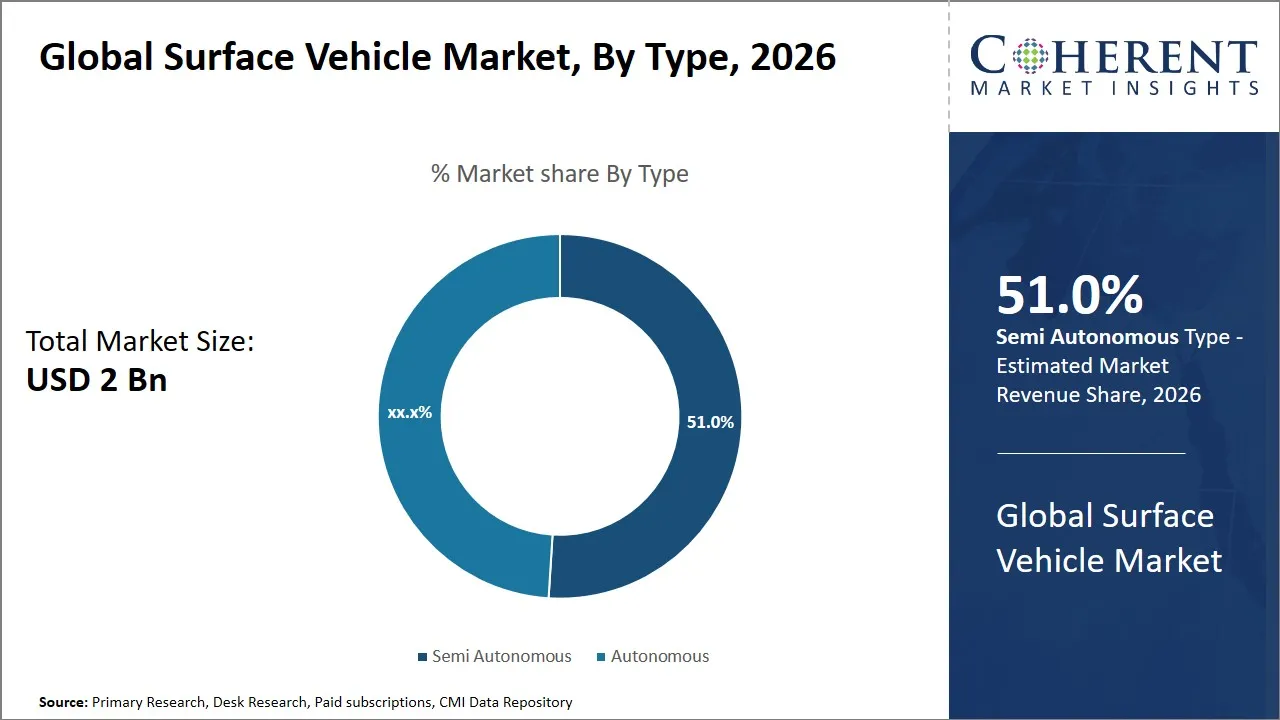
- The semi-autonomous segment is expected to account for 51% of the surface vehicle market share in 2026.
- The medium segment is estimated to capture 44% of the market share in 2026.
- The defense segment is projected to hold 56% of the global surface vehicle market share in 2026.
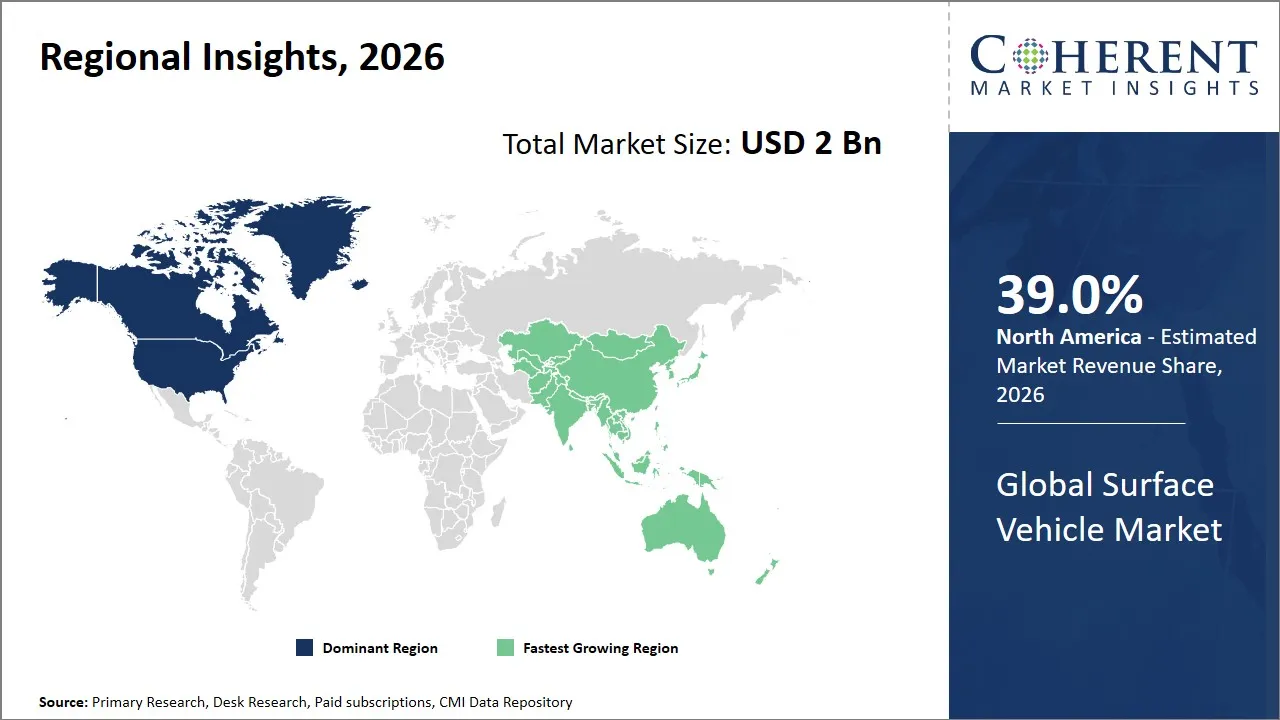
- North America will dominate the surface vehicle market in 2026 with an estimated 39% share.
- Asia Pacific will hold 26% share in 2026 and is expected to record the fastest growth over the forecast period.
Current Events and Its Impact
Current Events | Description and its Impact |
Waymo Expansion Plans |
|
Segmental Insights
- Current Industry Events of 2026
- Market Size Estimation
- Regional Breakdown
- Competitive Landscape
- Customer Intelligence
- Segmental Analysis
- Pricing Analysis
- Key Market Drivers, Challenges & Future Trends
- Customized Insights Section
Why Does Semi-Autonomous Segment Dominate the Global Surface Vehicle Market in 2026?
The semi-autonomous segment is expected to account for 51.0% of the global surface vehicle market share in 2026. The growth can largely be attributed to their unique position at the intersection of technological innovation and practical usability. These vehicles provide a strategic advantage by combining automated functionalities with a degree of human oversight, which enhances operational safety, adaptability, and efficiency. When sudden changes occur, human involvement proves essential, stepping in should automated tools fail.
Medium Segment Dominates the Global Surface Vehicle Market
The medium segment is projected to account for 44.0% of the global surface vehicle market share in 2026. The growth is because they effectively combine mobility, payload capacity, and ease of deployment. Unlike small surface vehicles, which may be limited in power and operational endurance, medium-sized vehicles offer enhanced capabilities that extend mission duration and expand functional possibilities. Conversely, they avoid many operational constraints associated with large surface vehicles, such as high energy consumption, complex handling requirements, and limited accessibility in constrained environments. This makes medium-sized vehicles highly adaptable for a range of missions that demand moderate endurance and payloads without the logistical headaches tied to larger platforms.
Why is Defense the Most Widespread Application in the Surface Vehicle Market?
The defense segment is expected to capture 56.0% of the global surface vehicle market share in 2026. With global tensions climbing, demand grows for stronger coastlines and control at sea. Owing to such shifts, unmanned surface platforms gain importance across military uses. These vessels support missions like data collection, watching key zones, identifying threats, clearing hazards, while shielding troops from risk. Where human presence falters, automated systems move in. As conflict shifts away from fixed boundaries, constant awareness gains importance. Without pause, surveillance by machine allows quicker decisions when time shrinks. Clarity emerges through unbroken watchfulness where hesitation once ruled.
For instance, on October 29, 2025, Lockheed Martin announced a USD 50 million investment in Saildrone, a global leader in maritime autonomous systems. This strategic collaboration will deliver commercially available unmanned surface vehicles (USV) equipped with lethal, combat-proven defense technology.
(Source: news.lockheedmartin.com)
Defense Modernization Program Mapping
Country | Defense Modernization Program | Procurement / Budget Figures |
U.S. | Ground Combat Vehicle & JLTV/ACV modernization | ~2,689 total armored vehicles planned |
Germany | Bundeswehr Upgrade / Zeitenwende | USD 7–10+ billion for 424-3,000 armored vehicles |
Poland | K2 Main Battle Tank Orders | ~296 tanks by 2030; ~USD 6.5 Billion contract |
Finland, Sweden, Latvia | Common Armoured Vehicle System | ~425 vehicles to be delivered by 2030 |
India | FRCV & FICV Programs (Future Combat Systems) | Allocated ~USD 21.6 Billion capital for procurement & modernization |
NATO | Armor modernization & retrofit | ~USD 12 Billion allocated for armor upgrades |
Regional Insights
North America Surface Vehicle Market Analysis and Trends
The North America region is projected to lead the market with a 39% share in 2026. A rise in operations takes shape where older infrastructures enable advancement via strong connections, broad industry involvement, consistency guided by civic priorities, plus continuous funding directed toward emerging techniques. Across the U.S. and Canada, top manufacturers of ground vehicles function widely, supported by bodies committed to defense readiness and research centers developing autonomous navigation, electric mobility solutions, and durable field-deployable machines.
When governance focuses on intelligent transit networks, updated physical frameworks, also advancements in defense equipment, transformation takes place. Firms gain resilience through consistent logistical routes, tied to global alliances but rooted in local collaboration, strength emerges gradually. Firms such as General Motors, Ford, Lockheed Martin, and Textron shape outcomes via breakthroughs in emission-free cars, combat-ready ground machines, robotic navigation setups applied across civilian and operational zones.
Asia Pacific Surface Vehicle Market Analysis and Trends
The Asia Pacific region is expected to exhibit the fastest growth in the market contributing 26% share in 2026. The growth is propelled by rapid urbanization, expanding industrial activity, and increasing government investments in transportation infrastructure and defense modernization. Countries like China, India, Japan, and South Korea lead substantial market expansion by embracing smart city initiatives, electric vehicle adoption, and autonomous vehicle technologies.
The region benefits from a large manufacturing base, government subsidies encouraging green and smart mobility, and growing consumer demand for surface vehicles. Trade dynamics are influenced by extensive export opportunities and strategic collaborations with global market leaders.
Among key players, Tata Motors contributes significantly, while Hyundai Motor Company aids in accessible electric vehicle designs. Efforts by BYD drive progress in public transport vehicles, whereas Mitsubishi Heavy Industries fosters innovation in ground defense technology. Mobility pathways form differently now, shaped by each entity avoiding conventional methods. Solutions take new forms where standard blueprints no longer apply.
Global Surface Vehicle Market Outlook for Key Countries
Why is the U.S. Emerging as a Major Hub in the Surface Vehicle Market?
Innovation shapes much of the U.S. surface vehicle market’s direction, where technology progress stands central. Major firms in automotive and defense sectors set the pace. General Motors, along with Lockheed Martin, advances electric and self-driving surface vehicles, backed by substantial research funding. From strict emission standards to defense spending, state involvement shapes automotive progress. When companies work alongside national agencies, deployment of advanced transport solutions moves faster. A well-developed supplier base supports operations across the region. Infrastructure maturity adds stability to North American positioning.
Is China the Next Growth Engine for the Surface Vehicle Market?
Influence from national policy shapes how business evolves across China, pushing rapid advances in electric vehicles along with smart transportation systems - part of larger goals tied to environmental balance and modernized industry. Driven by firms such as BYD and SAIC Motor, production frameworks meet home market needs while gradually expanding beyond borders. In urban centers nationwide, regionally managed projects unfold under overarching policy signals, accelerating innovation in land-based travel infrastructure. Manufacturing scale, paired with deliberate export strategies, supports widespread rollout across Asian markets and into distant regions.
Germany Surface Vehicle Market Analysis and Trends
Despite global shifts, Germany holds a central role in Europe's surface transport sector due to its established auto manufacturing base. Major companies like Volkswagen, Daimler, and BMW operate within this framework. Precision in design remains a priority, alongside progress in battery-powered models and self-navigating systems. Through government-supported initiatives, cleaner manufacturing and improved transportation systems receive backing. Efficiency gains emerge via a tightly connected web of parts suppliers. Global commerce plays a central role in guiding output strategies. Collaboration between automakers, universities, and oversight agencies sustains innovation capacity. Long-range relevance hinges on seamless system integration.
India Surface Vehicle Market Analysis and Trends
As urban areas grow, changes in economic patterns start influencing how commerce evolves across India. Higher earnings gradually shift family spending into personal transportation, particularly when nearby builders supply affordable alternatives. Facing varied needs, Tata Motors and Mahindra & Mahindra craft models that shift from electric options to flexible utility types. Behind these shifts lies steady backing: official moves favoring clean transport, along with efforts strengthening local manufacturing, build a subtle foundation. Long-term growth becomes more accessible where sustainable infrastructure receives policy backing. With its position playing a role, India links into wider trade routes, improving movement between nearby areas.
Japan Surface Vehicle Market Analysis and Trends
Still evident across Japan’s economy are high-level skills, rooted in strong industrial output together with attention to growth in battery-driven and automated vehicles. Firms such as Toyota, Honda, and Nissan dedicate significant funding toward research, seeking advances in fuel-efficient hybrids and hydrogen-fueled designs. Guidance comes through government policies promoting lower emissions plus sustainable transit networks, fostering continuous innovation. Despite shifts in global demand, steady investment maintains momentum behind next-generation transportation solutions. Well-rooted supply partnerships combined with strategic international commerce guidelines allow smooth adoption of novel tools, preserving strength abroad. Remaining ahead globally links directly to consistent refinement behind the scenes.
Market Players, Key Development, and Competitive Intelligence
Key Developments
- On May 24, 2024, Kongsberg Maritime announced the opening of a new facility in Kochi, India, as part of a strategic drive to enhance customer support and prepare for future assembly of its waterjet products. The facility is poised for further expansion and investment to enable the assembly and overhaul of Kongsberg Maritime’s Kamewa waterjets.
- On April 8, 2024, L3Harris Technologies announced a collaboration with Performance Marine to showcase Unmanned Surface Vehicle (USV) capabilities during the eighth edition of the Doha International Maritime Defense Exhibition and Conference (DIMDEX).
Top Strategies Followed by Global Surface Vehicle Market Players
- A shift marks the worldwide transport equipment sector - rivalry runs deep, spanning multiple levels of operation where firms adopt unique paths to secure standing and encourage expansion. Progress begins where long-term inquiry takes priority over short-term gain. Step by step, advances emerge through careful adjustments - less energy consumed, safeguards strengthened, fewer pollutants released. These shifts mirror what users expect, shaped just as much by rules in place. Outcomes reflect a quiet match between expectation and requirement. What drives innovation is long-term thinking shaped by external pressures.
- What matters most shapes decisions at many transport equipment companies. By selecting materials with care, performance aligns with cost considerations. Construction approaches define how well balance is achieved across function and expense. One common path involves refining assembly workflows to reduce waste. Modular frameworks appear frequently, allowing adaptation without high expenses. Materials are chosen for accessibility rather than novelty. Performance stays stable even when budgets tighten. Attention shifts toward regions where spending power shapes demand. Economic climates influence design decisions more than innovation trends. Production efficiency becomes a quiet priority behind the scenes. Cost control does not always mean reduced durability. Buyers respond when products match their financial limits. Simplicity gains ground over complexity in key markets.
- A few smaller firms move quickly, choosing narrow markets instead of broad ones. Their focus shifts toward distinct traits in design rather than mass appeal. Innovation becomes evident when new tools appear - battery methods improve, material weight drops, digital links form. Progress takes shape quietly through these additions. Leadership emerges not from size but from timing and precision. Advancement rests in subtle changes others overlook.
Market Report Scope
Surface Vehicle Market Report Coverage
| Report Coverage | Details | ||
|---|---|---|---|
| Base Year: | 2025 | Market Size in 2026: | USD 2 Bn |
| Historical Data for: | 2020 To 2024 | Forecast Period: | 2026 To 2033 |
| Forecast Period 2026 to 2033 CAGR: | 11% | 2033 Value Projection: | USD 5 Bn |
| Geographies covered: |
| ||
| Segments covered: |
| ||
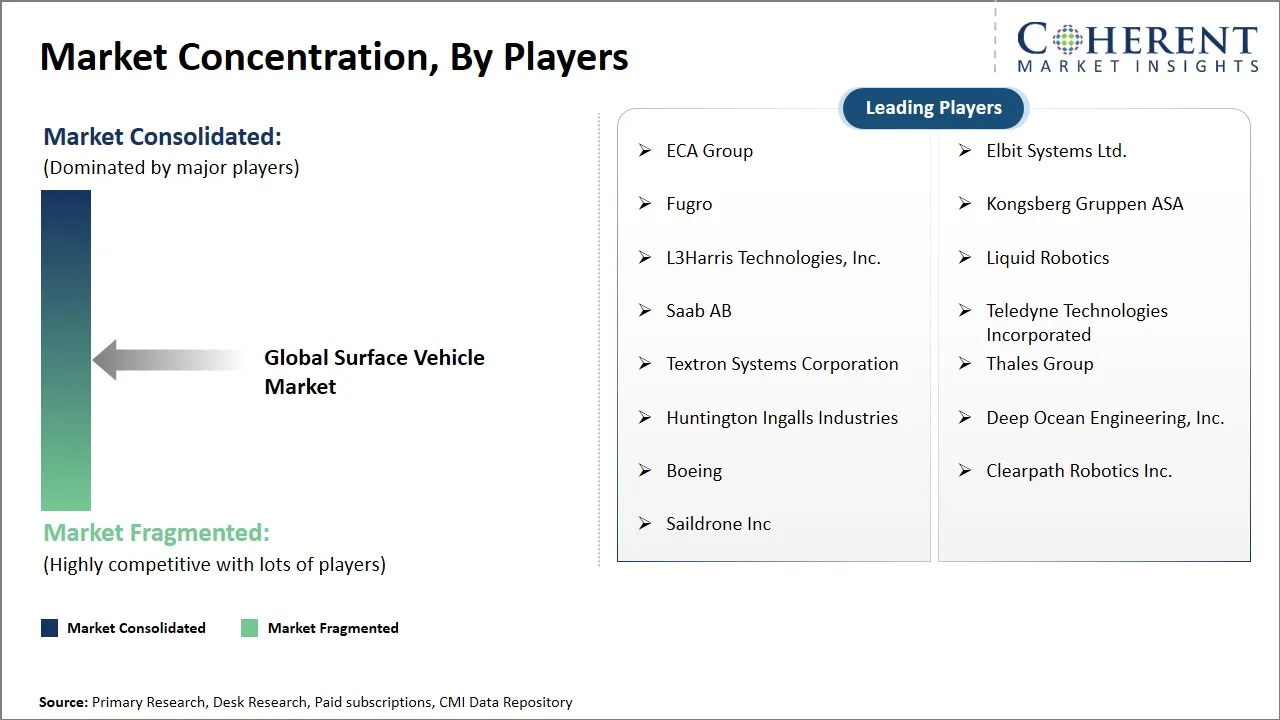
| Companies covered: | ECA Group, Elbit Systems Ltd., Fugro, Kongsberg Gruppen ASA, L3Harris Technologies, Inc., Liquid Robotics, Saab AB, Teledyne Technologies Incorporated, Textron Systems Corporation, Thales Group, Huntington Ingalls Industries, Deep Ocean Engineering, Inc., Boeing, Clearpath Robotics Inc., and Saildrone Inc | ||
| Growth Drivers: |
| ||
| Restraints & Challenges: |
| ||
Global Surface Vehicle Market Dynamics
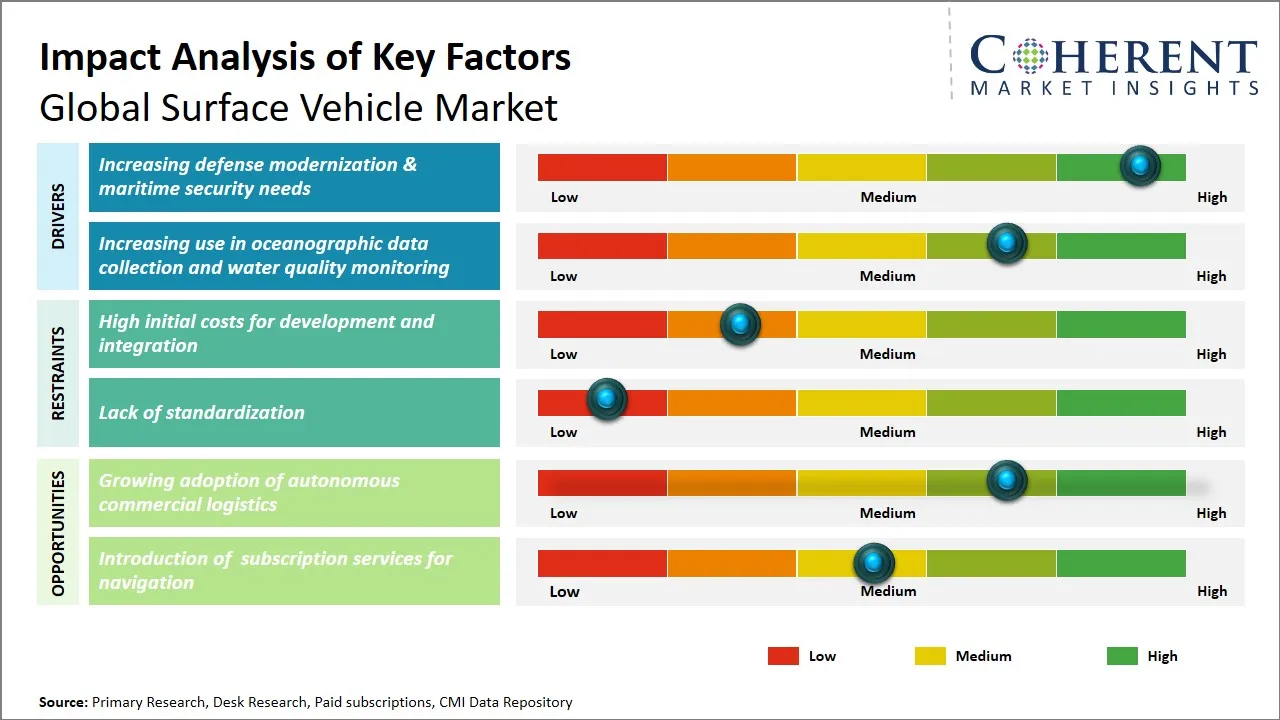
Global Surface Vehicle Market Driver - Increasing Defense Modernization & Maritime Security Needs
The growing emphasis on defense modernization across various countries is a significant driver propelling the global surface vehicle market. Navy modernization now takes focus within global defense planning, driven by shifting international dynamics. Equipped vessels, featuring updated detection tools, armaments, and data networks, allow quicker reactions when facing irregular dangers at sea. Monitoring ocean spaces becomes more precise through these platforms, supporting broader security objectives over time.
For instance, on December 29, 2025, the State Department, Washington made a determination approving a possible Foreign Military Sale to the Government of Denmark of Multi-Mission Maritime Patrol and Reconnaissance Aircraft P-8A with Indirect Fire Protection Capability and related equipment for an estimated cost of USD 1.8 billion.
(Source: dsca.mil)
Global Surface Vehicle Market Opportunity - Growing Adoption of Autonomous Commercial Logistics
With each passing year, progress in self-driving transport gains momentum across global markets. Efficiency improvements now emerge through automated freight solutions rather than traditional methods. Greater accuracy in autonomous vehicles comes from progress in sensor technology alongside improved algorithms. Worldwide growth in retail e-commerce shapes how goods move across distances. Human-driven transport now shares space with automated alternatives in logistics networks. Regulatory limits on work hours push firms to explore alternatives. Communication between vehicles and infrastructure supports smoother operations. Safety outcomes improve under consistent automation protocols. Growth appears most evident where supply chains face pressure to adapt quickly. In such cases, reliability matters more than speed alone.
Analyst Opinion (Expert Opinion)
- A shift marks global surface vehicle trends, shaped by rising interest in self-driving, battery-powered, multipurpose models used widely in public and armed services. Driven forward through defense priorities, spending on unmanned sea units grows fast, led by firms such as Lockheed Martin and Textron exploring deeper automation for monitoring and battle tasks. Because machines reduce human exposure, lower long-term costs, allow flexible mission setups, militaries adopt them at increasing speed.
- Commercial interest grows in electric and self-driving technology, where city transit increasingly includes EVs alongside automated taxis. Leading firms such as Waymo and Hyundai now deploy advanced electric models designed for shared urban travel. Within these vehicles, sensor networks combined with artificial intelligence plus protective mechanisms redefine how people move through metropolitan areas. Cities may benefit from reduced traffic while improving long-term movement strategies.
Speak to the analyst
Want personalized insights?
Take the findings above to one of our principal consultants, or have the report rebuilt around the segments, geographies and competitors you actually track.
Market Segmentation
- Type Insights (Revenue, USD Billion, 2021 - 2033)
- Semi-Autonomous
- Autonomous
- Size Insights (Revenue, USD Billion, 2021 - 2033)
- Medium
- Small
- Large
- Application Insights (Revenue, USD Billion, 2021 - 2033)
- Defense
- Commercial
- Regional Insights (Revenue, USD Billion, 2021 - 2033)
- North America
- U.S.
- Canada
- Latin America
- Brazil
- Argentina
- Mexico
- Rest of Latin America
- Europe
- Germany
- U.K.
- Spain
- France
- Italy
- Russia
- Rest of Europe
- Asia Pacific
- China
- India
- Japan
- Australia
- South Korea
- ASEAN
- Rest of Asia Pacific
- Middle East
- GCC Countries
- Israel
- Rest of Middle East
- Africa
- South Africa
- North Africa
- Central Africa
- North America
- Key Players Insights
- ECA Group
- Elbit Systems Ltd.
- Fugro
- Kongsberg Gruppen ASA
- L3Harris Technologies, Inc.
- Liquid Robotics
- Saab AB
- Teledyne Technologies Incorporated
- Textron Systems Corporation
- Thales Group
- Huntington Ingalls Industries
- Deep Ocean Engineering, Inc.
- Boeing
- Clearpath Robotics Inc.
- Saildrone Inc
Sources
Primary Research Interviews
- Automotive OEMs and Manufacturers
- Surface Vehicle Component Suppliers
- Fleet Management Companies
- Government Transportation Officials
Databases
- MarkLines Automotive Database
- JATO Dynamics Vehicle Database
- Ward's Automotive Intelligence Database
Magazines
- Automotive News
- Fleet Owner Magazine
- Commercial Vehicle Magazine
- Vehicle Dynamics International
Journals
- International Journal of Automotive Technology
- Vehicle System Dynamics Journal
- Transportation Research Journal
Newspapers
- Financial Times
- The Wall Street Journal
- Reuters Automotive News
- Bloomberg Transportation
Associations
- Society of Automotive Engineers (SAE)
- International Association of Public Transport (UITP)
- Global Fleet Champions
- Commercial Vehicle Safety Alliance (CVSA)
Public Domain Sources
- International Energy Agency (IEA) Reports
- World Bank Transportation Data
- Government Statistical Offices
- UN Transport Statistics
Proprietary Elements
- CMI Data Analytics Tool
- Proprietary CMI Existing Repository of information for last 8 years
Get access to 250+ pages report
Every segment, forecast, competitor profile and data table behind the analysis above — available for instant download.
- ESOMAR Member
- ISO 9001:2015 Certified
- D-U-N-S Registered
- GDPR & CCPA Compliant
Missing comfort of reading report in your local language? Find your preferred language:
Transform your Strategy with Exclusive Trending Reports
Frequently Asked Questions
The global surface vehicle market is expected to stand at USD 2 Bn in 2026 and is expected to reach USD 5 Bn by 2033.
The CAGR of global surface vehicle market is projected to be 11% from 2026 to 2033.
Increasing defense modernization & maritime security needs and increasing use in oceanographic data collection and water quality monitoring are the major factors driving the growth of the global surface vehicle market.
High initial costs for development and integration and lack of standardization are the major factors hampering the growth of the global surface vehicle market.
In terms of type, semi-autonomous is estimated to dominate the market revenue share in 2026.
Electrification is reshaping the market by increasing demand for electric vehicles and reducing reliance on internal combustion engines.
Regulations influence emissions standards, safety requirements, and the adoption of clean energy vehicles.