

Electric Vehicle Battery Recycling Market Size and Forecast – 2026 to 2033
Electric Vehicle Battery Recycling Market is estimated to be valued at USD 6.52 Bn in 2026 and is expected to reach USD 37.93 Bn in 2033, exhibiting a compound annual growth rate (CAGR) of 28.6% from 2026 to 2033.
Key Takeaways
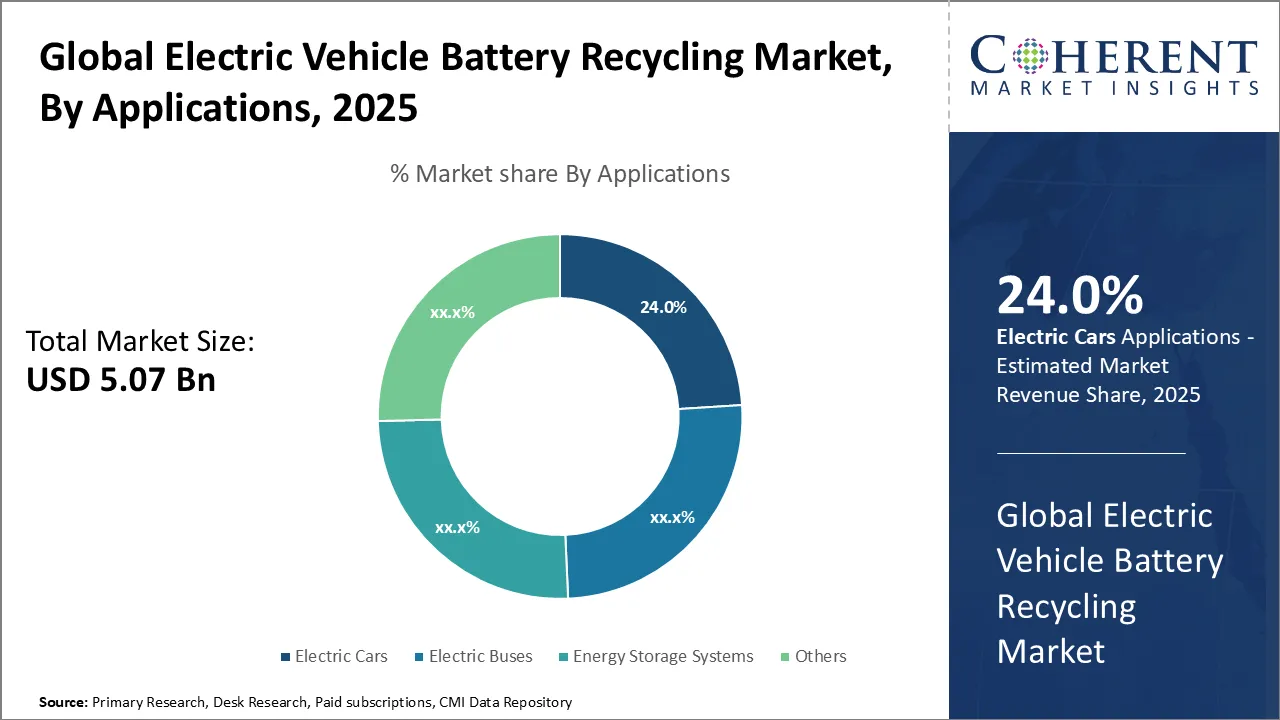
- By Application, Electric Cars hold the largest market share of 27% in 2026 owing to its rapid growth in electric vehicles.
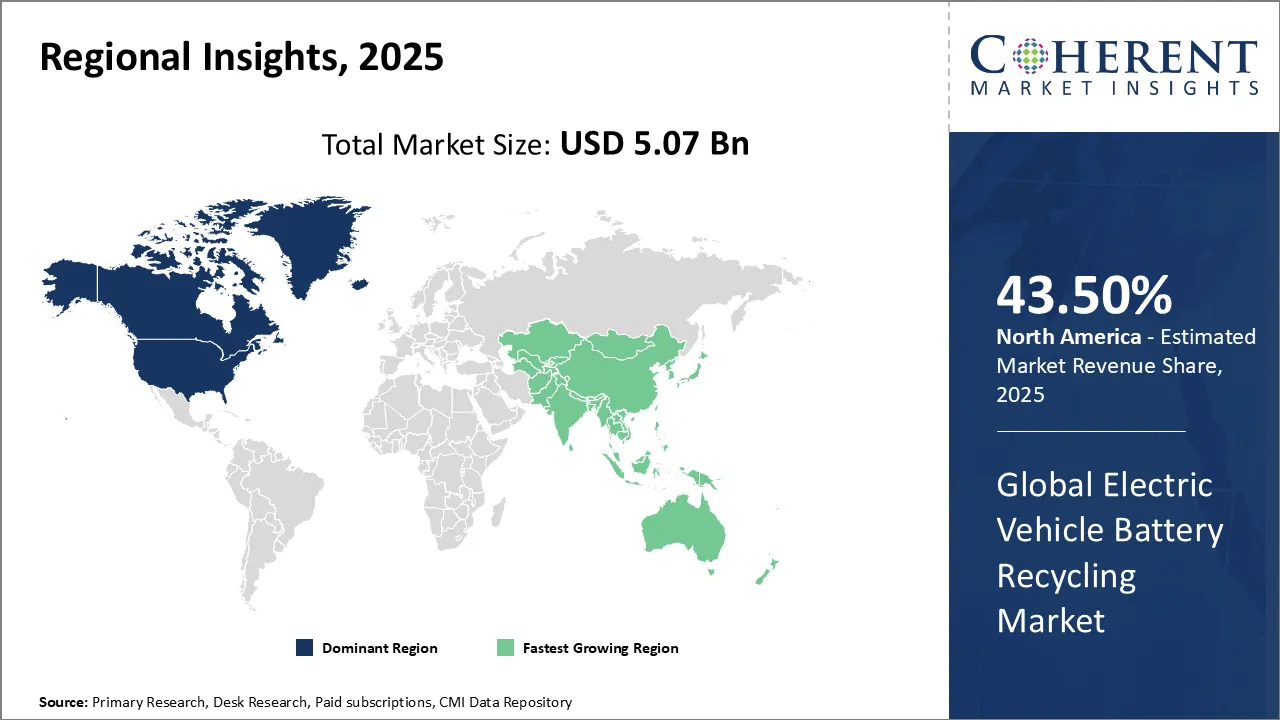
- By Region, North America dominates the overall market with an estimated share of 43.5% in 2026 owing to the rapid EV adoption & growing EV battery stock.
Market Overview
The Electric Vehicle Battery Recycling Market actively collects, processes, and recovers valuable materials from end-of-life and spent EV batteries. Rapid electric vehicle adoption, growing demand for critical raw materials such as lithium, cobalt, and nickel, and tightening environmental and regulatory pressures are driving market growth. Recycling technologies are advancing, and the shift toward a circular economy is improving material recovery efficiency, while investments in domestic infrastructure are enabling sustainable and cost-effective recycling solutions worldwide.
Current Events and Its Impact on the Electric Vehicle Battery Recycling Market
Current Events | Description and its impact |
Geopolitical and Regulatory Developments |
|
Technological Innovations and Industry Advancements |
|
Environmental and Social Governance (ESG) Trends |
|
Segmental Insights
- Current Industry Events of 2026
- Market Size Estimation
- Regional Breakdown
- Competitive Landscape
- Customer Intelligence
- Segmental Analysis
- Pricing Analysis
- Key Market Drivers, Challenges & Future Trends
- Customized Insights Section
Electric Vehicle Battery Recycling Market Insights, By Applications: Electric Cars contribute the highest share of the market owing to its environmental concerns & regulatory pressure.
Electric Cars hold the largest market share of 27.0% in 2026. The increasing adoption of electric cars drives the Electric Vehicle Battery Recycling Market, as more EVs on the road produce a growing volume of spent batteries that require proper disposal and material recovery. High costs and limited availability of critical materials like lithium, cobalt, and nickel make recycling a profitable solution. Environmental concerns, government regulations, and sustainability initiatives promote battery recycling, while advancements in recycling technologies improve efficiency, actively strengthening the market through the expanding EV user base. For instance, in October 2025, BMW’s local subsidiary collaborated with Victorian battery recycler EcoBatt to launch a new electric vehicle (EV) battery recycling program.
Role of AI (Artificial Intelligence) in the Electric Vehicle Battery Recycling Market
Artificial Intelligence (AI) actively transforms the Electric Vehicle Battery Recycling Market by optimizing the collection, sorting, and processing of spent batteries. AI-powered systems efficiently identify battery types, detect defects, and predict end-of-life stages, enabling precise material recovery. Machine learning algorithms streamline recycling processes, minimize waste, and reduce operational costs. AI also manages supply chains and advances sustainability initiatives by forecasting battery demand and recovery requirements, driving faster, smarter, and more cost-effective recycling solutions across the expanding electric vehicle ecosystem. For instance, in June 2025, Ex-Tesla CTO JB Straubel’s Redwood Materials launched Redwood Energy to repurpose second-life EV batteries for energy storage and partnered with AI infrastructure provider Crusoe to develop a solar-powered microgrid.
Regional Insights
North America Electric Vehicle Battery Recycling Market Trends
North America dominates the overall market with an estimated share of 43.5% in 2026. The North American electric‑vehicle battery recycling market is gaining momentum as rising EV adoption, expanding recycling infrastructure, and stronger regulatory support drive growth. Recyclers in the U.S., Canada, and Mexico are investing in advanced facilities and collection networks to handle increasing volumes of spent batteries. Growing demand for recovered materials like lithium, nickel, and cobalt promotes circular‑economy goals and reduces import dependence. Automakers and battery manufacturers partner with recyclers to secure material supply and meet recycled-content mandates, while technological advances enhance lithium‑ion battery recovery, increase efficiency, and lower processing costs across the region. For instance, Stelco Holdings Inc. has signed a Memorandum of Understanding (MOU) with Primobius GmbH to commercialize advanced electric vehicle battery recycling and processing technologies in North America.
Asia Pacific Electric Vehicle Battery Recycling Market Trends
The Asia‑Pacific electric‑vehicle battery recycling market is rapidly expanding as rising EV adoption and government initiatives actively promote sustainable battery disposal and recovery. Recycling facilities, particularly for lithium‑ion and LFP batteries, are increasing to meet growing demand for critical metals like lithium, nickel, and cobalt. Meanwhile, the expanding use of energy storage systems and renewable energy integration generates additional volumes of spent batteries. Technological advancements and the region’s shift toward circular‑economy practices actively enhance material recovery, making recycling more efficient and cost-effective. For instance, in June 2026, Indonesian President Prabowo Subianto attended the groundbreaking of a $6 billion EV battery megaproject in Karawang, West Java, covering nickel mining, battery materials production, manufacturing, and recycling.
United States Electric Vehicle Battery Recycling Market Trends
The U.S. electric‑vehicle battery recycling market is growing as rising EV adoption, increasing lithium‑ion battery waste, and stronger regulations actively drive recycling demand. Recyclers are deploying specialized facilities and advanced processing methods to recover critical materials like lithium, nickel, and cobalt from spent batteries, reducing dependence on imported raw materials. At the same time, manufacturers and recyclers are collaborating to promote material reuse and build sustainable supply chains, supported by rising environmental awareness and the region’s shift toward circular‑economy practices. For instance, in July 2026, Toyota Tsusho has formed a strategic partnership with South Korean lithium-ion battery maker LG Energy Solution to create a joint venture for recycling electric vehicle (EV) batteries in the United States.
India Electric Vehicle Battery Recycling Market Trends
The India electric‑vehicle battery recycling market is strengthening as rising EV adoption and government initiatives actively promote sustainable battery disposal and resource recovery. The growing use of lithium‑ion batteries, particularly in two‑ and three‑wheelers, generates an increasing flow of spent batteries for recycling. Stringent regulations, including the Battery Waste Management Rules, 2022, and incentives under the Production‑Linked Incentive (PLI) Scheme, motivate companies to adopt formal recycling practices and invest in processing facilities. Rising demand for critical battery metals and circular‑economy goals drive investment in advanced recycling infrastructure and efficient recovery technologies. For instance, in October 2026, NavPrakriti begun operations at Eastern India’s first lithium-ion battery recycling facility near Kolkata, enabling the region to manage expected battery waste from electric vehicles, consumer electronics, and industrial applications.
End-user Feedback and Unmet Needs in the Electric Vehicle Battery Recycling Market
- Lack of Convenient Collection & Return Options: Many EV owners and consumers report difficulty in returning spent batteries due to limited or poorly‑distributed collection infrastructure. The absence of convenient drop‑off points or pick‑up services makes it hard for users to participate in recycling, leading to batteries being stored, discarded improperly, or abandoned.
- Confusion & Low Transparency about Recycling Processes: Users often express uncertainty about what happens after they hand over batteries — unclear procedures, lack of standard guidelines, and limited information on safety, environmental impact, and end‑use of recovered materials reduce trust and participation.
- High Cost & Economic Burden for Owners: Because recycling and transport infrastructure is limited, owners may bear costs or inconveniences when returning battery packs. The costly and complex processes for safe collection, transport and recycling often discourage users — especially if there is no incentive or compensation.
Electric Vehicle Battery Recycling Market Trend
Expansion of Closed‑Loop Recycling and In‑House Recycling by OEMs
Many automakers and battery producers are integrating recycling into their own supply chains, building in‑house or partnered recycling facilities. This closed‑loop model takes manufacturing scrap, rejected cells, and retired EV batteries and reintroduces recovered metals directly into new battery production. Such vertical integration reduces reliance on virgin raw materials, lowers logistics costs, and supports long‑term resource security — making recycling part of the standard battery‑production life cycle.
Shift to Cleaner, More Efficient Recycling Technologies
The industry increasingly favors advanced recycling methods — especially hydrometallurgical recovery — over traditional, energy‑intensive processes. These newer techniques recover lithium, cobalt, nickel and other materials with lower energy usage and fewer emissions. Meanwhile, “direct recycling” methods that retain cathode structure and recovery of “black mass” are gaining attention for preserving battery value and improving material yield. These technological improvements help make recycling cleaner, cheaper and more scalable.
Electric Vehicle Battery Recycling Market Opportunity
Advancements in Efficient, Low‑Impact Recycling Technologies
New recycling methods — such as hydrometallurgical and direct recycling — offer higher recovery rates for metals and lower environmental impact compared to older, energy-intensive processes. As technology improves, recycling becomes more cost‑effective and scalable, increasing profitability and environmental benefits.
Market Report Scope
Electric Vehicle Battery Recycling Report Coverage
| Report Coverage | Details | ||
|---|---|---|---|
| Base Year: | 2025 | Market Size in 2026: | USD 6.52 Bn |
| Historical Data for: | 2020 To 2024 | Forecast Period: | 2026 To 2033 |
| Forecast Period 2026 to 2033 CAGR: | 28.6% | 2033 Value Projection: | USD 37.93 Bn |
| Geographies covered: |
| ||
| Segments covered: |
| ||
| Companies covered: | Accurec Recycling GmbH, American Manganese Inc. Battery Solutions, Li-Cycle Corp., G & P Batteries, Recupyl, Retriev Technologies, Sitrasa, Floridienne (SNAM S.A.S.), and Umicore | ||
| Growth Drivers: |
| ||
| Restraints & Challenges: |
| ||
Electric Vehicle Battery Recycling Market News
- In July 2025, Vietnamese electric vehicle maker VinFast signed a strategic agreement with India’s BatX Energies to recycle, recover, and repurpose high-voltage EV batteries.
- In July 2025, Formosa Smart Energy (FSET) has completed Taiwan’s first integrated LFP battery recycling demonstration line, combining physical crushing with chemical extraction to recover valuable metals like lithium, nickel, and cobalt, addressing the growing global demand for energy storage and EV battery recycling.
- In May 2025, Fortum Battery Recycling has launched its Battery Box service in Germany and Finland, streamlining lithium-ion EV battery collection and recycling while ensuring regulatory compliance and material recovery.
Analyst Opinion (Expert Opinion)
- The electric‑vehicle battery recycling market stands at a pivotal moment, emerging as a vital lever in addressing raw‑material security, supply‑chain risk, and environmental impact. Recent data reveals that spent EV batteries — especially lithium‑ion packs — are becoming the dominant “feedstock” for recyclers worldwide.
- In practice, forward‑looking initiatives already showcase what a mature recycling‑driven ecosystem can deliver. For example, Redwood Materials, based in the US, annually processes over 20 GWh of used lithium‑ion batteries — roughly equivalent to 250,000 EVs — and repurposes many into large‑scale stationary energy storage systems. Meanwhile, European firms are testing “second‑life first, recycle later” battery strategies: Altilium and Jaguar Land Rover (JLR) recently began trialing EV batteries remade from recycled cathode materials for next‑gen electric vehicles.
- These examples underscore two critical strategic imperatives. Moreover, establishing closed‑loop supply chains underpins resource independence and shields manufacturers from the volatility of raw‑material sourcing. Second, leveraging second‑life reuse — before full recycling — maximizes value extraction per battery and reduces environmental burden. As battery chemistries diversify and global EV fleets expand, the recyclers that embed robust sorting, recovery, and reuse‑capable logistics will define the sustainability and profitability of the next‑generation EV supply chain.
Speak to the analyst
Want personalized insights?
Take the findings above to one of our principal consultants, or have the report rebuilt around the segments, geographies and competitors you actually track.
Market Segmentation
- Global Electric Vehicle Battery Recycling Market, By Application
- Electric Cars
- Electric Buses
- Energy storage systems
- Others
- Regional Insights (Revenue, USD Bn, 2021 - 2033)
- North America
- U.S.
- Canada
- Latin America
- Brazil
- Argentina
- Mexico
- Rest of Latin America
- Europe
- Germany
- U.K.
- Spain
- France
- Italy
- Russia
- Rest of Europe
- Asia Pacific
- China
- India
- Japan
- Australia
- South Korea
- ASEAN
- Rest of Asia Pacific
- Middle East
- GCC Countries
- Israel
- Rest of Middle East
- Africa
- South Africa
- North Africa
- Central Africa
- North America
- Key Players Insights
- Accurec Recycling GmbH
- American Manganese Inc. Battery Solutions
- Li-Cycle Corp.
- G & P Batteries
- Recupyl
- Retriev Technologies
- Sitrasa
- Floridienne (SNAM S.A.S.)
- Umicore
Sources
Primary Research interviews
- EV battery manufacturers (Tesla, CATL, LG Energy Solution, Panasonic)
- EV OEMs (Toyota, Hyundai, Ford)
- Recycling facility operators and managers
- Government regulators and policymakers in the EV and recycling sectors
- Environmental NGOs and sustainability experts
Databases
- International Energy Agency (IEA) database
- US Department of Energy (DOE) Energy Data eXchange
- European Environment Agency (EEA) datasets
- UN Comtrade Database
- World Bank Energy Statistics
Magazines
- IEEE Spectrum
- Green Car Reports
- EV Magazine
- Renewable Energy World
- Automotive News
Journals
- Journal of Power Sources
- Waste Management Journal
- Journal of Cleaner Production
- Energy Storage Materials
- Resources, Conservation & Recycling
Newspapers
- The New York Times (Technology & Environment sections)
- The Guardian (Sustainable Business & Environment sections)
- Financial Times (Energy & Automotive sections)
- The Wall Street Journal (Autos & Energy sections)
Associations
- International Battery Association (IBA)
- International Council on Clean Transportation (ICCT)
- Battery Recycling Association (BRA)
- European Battery Alliance (EBA)
- Society of Automotive Engineers (SAE)
Public Domain sources
- Government reports on EV and battery recycling (US, EU, China)
- UN Environment Programme reports on e-waste
- Patent filings related to battery recycling technologies
- Technical whitepapers and open-access research publications
Proprietary Elements
- CMI Data Analytics Tool
- Proprietary CMI Existing Repository of information for last 8 years
Get access to 250+ pages report
Every segment, forecast, competitor profile and data table behind the analysis above — available for instant download.
- ESOMAR Member
- ISO 9001:2015 Certified
- D-U-N-S Registered
- GDPR & CCPA Compliant
Missing comfort of reading report in your local language? Find your preferred language:
Transform your Strategy with Exclusive Trending Reports
Frequently Asked Questions
The Electric Vehicle Battery Recycling Market is estimated to be valued at USD 6.52 Bn in 2026, and is expected to reach USD 37.93 Bn by 2033.
The CAGR of the Electric Vehicle Battery Recycling Market is projected to be 28.6% from 2026 to 2033.
Limited metal resources and rise in demand for zero emission vehicles are fuelling the market.
The electric cars segment is the leading segment in the market.
Re-usable electric vehicle batteries and high cost of building recycling plants are the major factors restraining growth of the market.
Accurec Recycling GmbH, American Manganese Inc. Battery Solutions, Li-Cycle Corp., G & P Batteries, Recupyl, Retriev Technologies, Sitrasa, Floridienne (SNAM S.A.S.), and Umicore