

Battery Recycling Market Size and Trends - 2026 to 2033
The battery recycling market is estimated to be valued at USD 28.60 Bn in 2026 and is expected to reach USD 51.22 Bn by 2033, exhibiting a compound annual growth rate (CAGR) of 8.7% from 2026 to 2033.
Key Takeaways
- Based on Chemistry, the Lithium-ion segment is expected to hold 40.7% share of the market in 2026, driven by EV adoption and electronics demand.
- Based on Application, the Transportation segment is expected to lead with 25% share of the market in 2026, driven by rising EV adoption and mounting battery recycling needs.
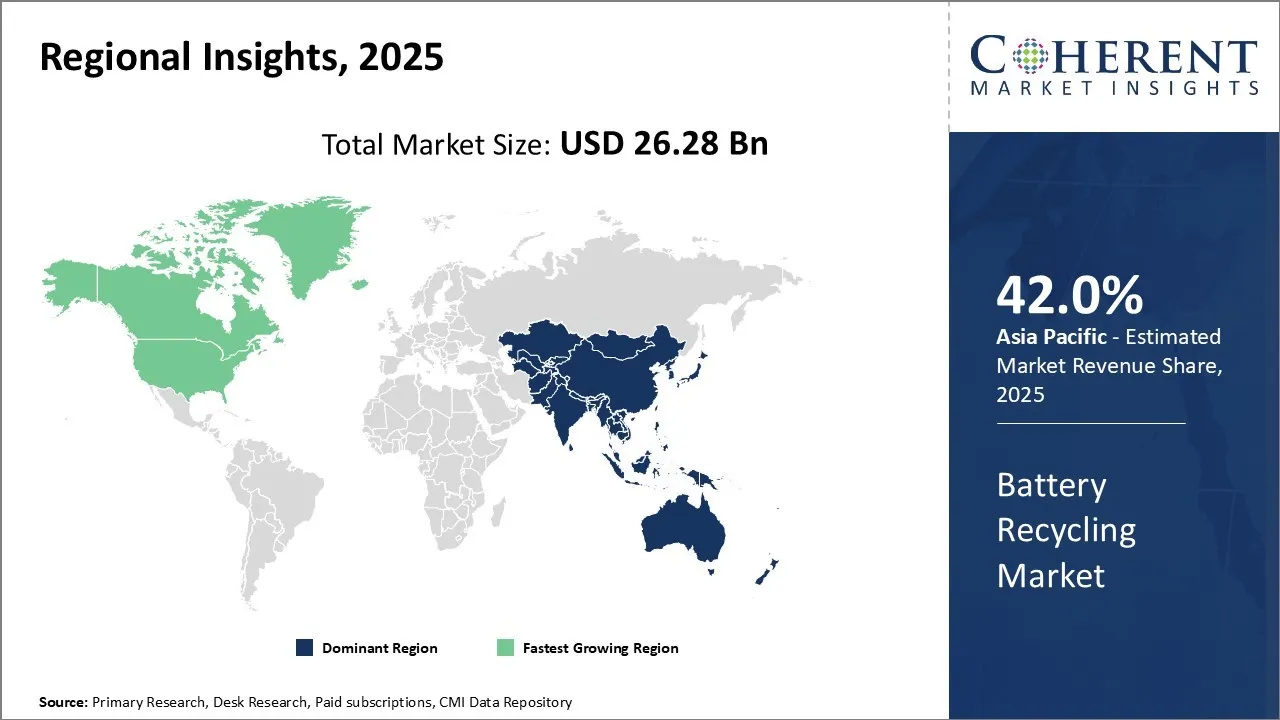
- Based on Region, Asia Pacific is set to lead the battery recycling market with 42% share in 2026. While, North America is anticipated to be the fastest growing region,
Market Overview
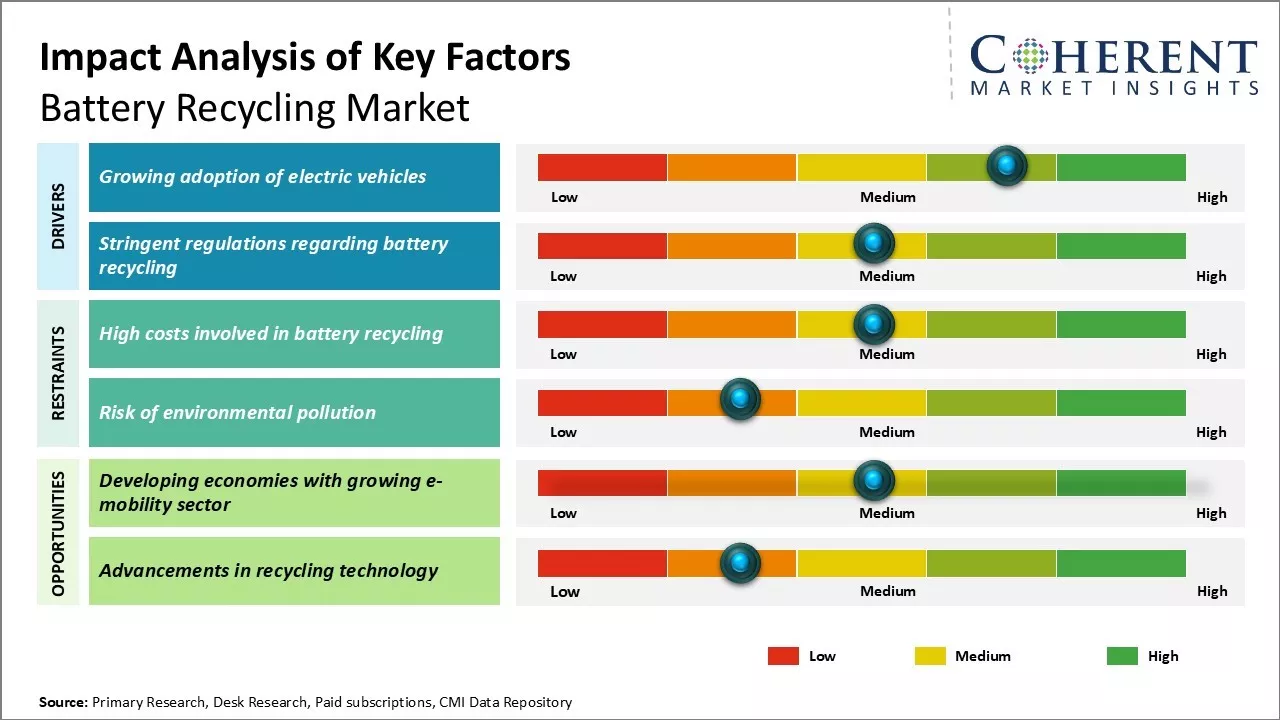
Rising adoption of electric vehicles across the globe is driving the market growth. Stringent government regulations regarding proper disposal of obsolete batteries are also fueling the market growth. Moreover, growing emphasis on sustainability and circular economy have encouraged organizations to implement effective battery recycling programs. However, the lack of collection infrastructure in some underdeveloped regions and complex chemistry of new batteries are some of the challenges adversely impacting this market.
Current Events and Its Impacts on the Battery Recycling Market
Current Events | Description and its Impact |
Regulatory Framework Intensification and Compliance Mandates |
|
Critical Mineral Supply Chain Disruptions and Geopolitical Realignment |
|
Advanced Innovations in Battery Recycling Market
- Second-Life Applications
- Retired EV batteries often retain 70–80% of capacity.
- Repurposing them for stationary energy storage could add 10–12% of market revenues by 2030.
- Example: Community microgrids powered by second-life batteries reduce costs by 20–30% compared to new storage units.
- Urban Mining Potential
- By 2030, over 11 million tons of spent lithium-ion batteries are expected globally.
- Recycling could replace 25% of mined lithium and 35% of cobalt demand, reducing reliance on unstable supply chains.
- Economic Impact
- Recycled cobalt contributes ~30% of recycling revenue due to high commodity prices.
- Lithium carbonate prices have fluctuated between USD 12,000–70,000 per ton (2021–2025), making recycling a hedge against volatility.
- Regional Leadership
- China: Expected to recycle >1.2 million tons of EV batteries annually by 2030.
- EU: Mandates 70% recycling efficiency for lithium-ion batteries by 2030.
- India: Market projected at USD 557 million by 2032, doubling from 2025 levels.
- Technology Innovations
- Hydrometallurgical recycling yields 95% recovery rates for lithium and cobalt.
- Direct recycling (preserving cathode structure) could cut costs by 40% compared to smelting.
- AI-driven sorting systems improve efficiency by 15–20% in large-scale plants.
- Environmental Benefits
- Recycling 1 ton of lithium-ion batteries saves 1.6 tons of CO₂ emissions compared to mining.
- Lead-acid battery recycling already achieves >95% recovery rates, making it the most mature segment.
- Future Outlook
- By 2035, recycled materials could supply up to 50% of EV battery demand.
- Circular economy practices may reduce raw material imports by 20–25% in major economies.
- Corporate partnerships (Toyota–LG, BASF, Novocycle) are setting the stage for global recycling hubs.
- Current Industry Events of 2026
- Market Size Estimation
- Regional Breakdown
- Competitive Landscape
- Customer Intelligence
- Segmental Analysis
- Pricing Analysis
- Key Market Drivers, Challenges & Future Trends
- Customized Insights Section
Segmental Insights
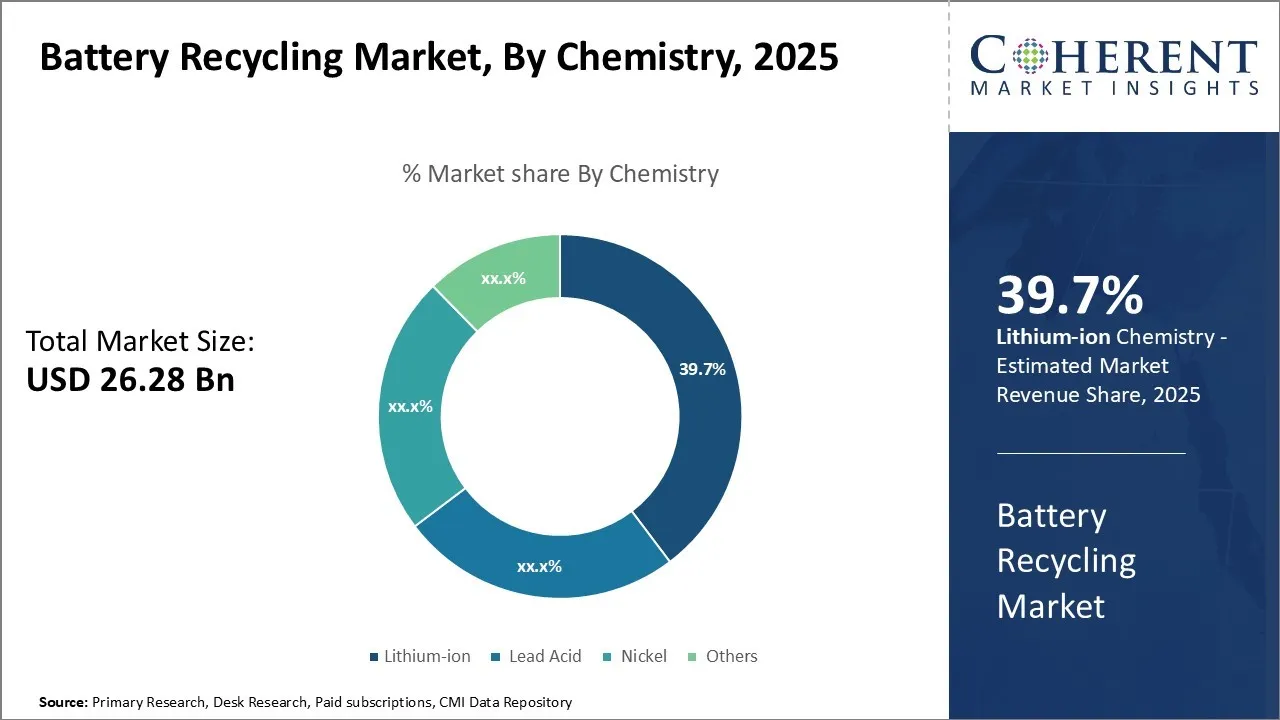
Battery Recycling Market Insights, By Chemistry - Lithium-ion batteries lead to growing adoption in EVs
In terms of chemistry, lithium-ion segment is expected to contribute 40.7% market share in 2026, owing to increasing adoption in electric vehicles and portability demand for electronics. Lithium-ion batteries have seen immense popularity owing to their high energy density, minimal self-discharge, and trickle charging capability. The automotive industry is experiencing a seismic shift towards electrification with many countries announcing plans to phase out petrol/diesel vehicles.
For instance, in October 2026, Navprakriti opened a lithium-ion battery recycling plant in Eastern India, which is an important advancement forward in environmentally friendly waste management. The facility's goal is to recycle batteries in a way that helps India reach its clean energy and electric mobility goals, recovers valuable metals, and lowers environmental risks.
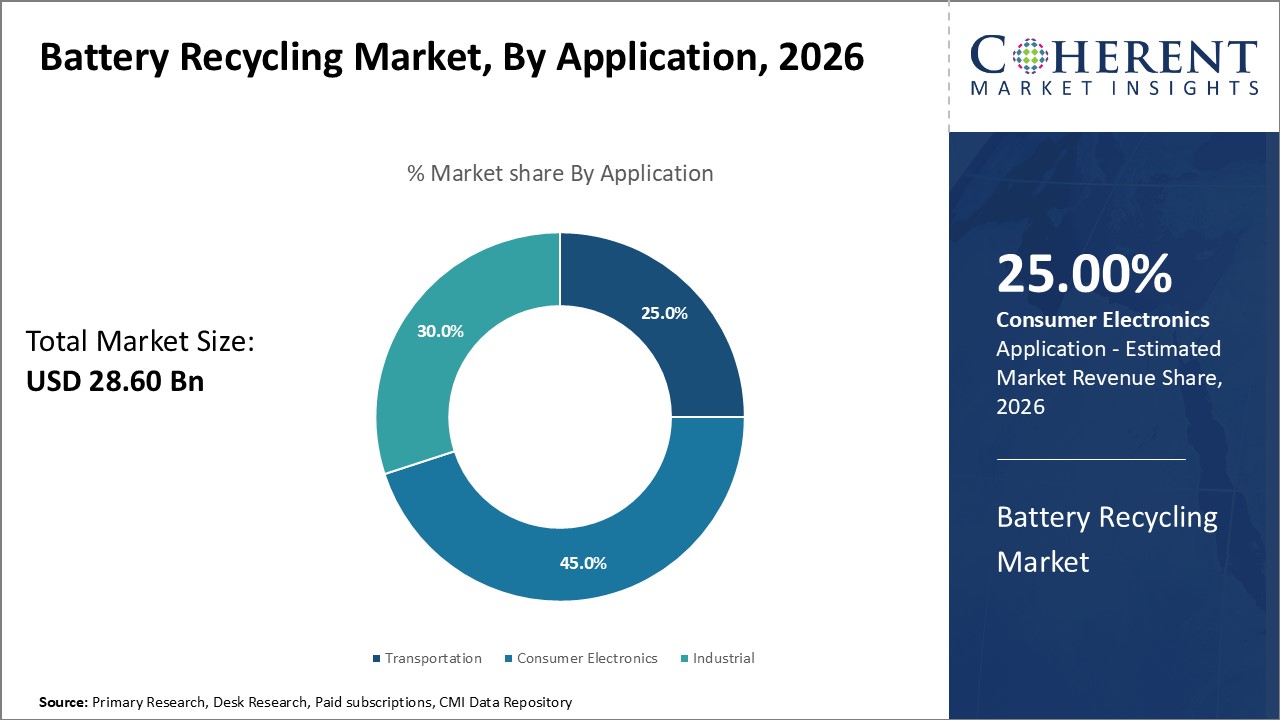
Battery Recycling Market Insights, By Application - Increasing battery replacement needs drives application in transportation sector
In terms of application, transportation segment is expected to contribute 25% market share in 2026, owing to sheer volume of vehicles that need battery replacement or recycling annually. Even though electric vehicles currently represent a small fraction of total road vehicles, that percentage is increasing at a breakneck pace yearly. More automakers are committing to all-electric lineups which means mounting battery waste in the coming years from retired vehicles.
For instance, in December 2026, The BMW Group and Encory started a new direct recycling process to get raw materials back from electric vehicle batteries. The project helps sustainable transportation by lowering the need for mining and encouraging circular economy practices. This new development makes it easier to recycle batteries in transportation, which means cleaner, more resource-efficient solutions for the car industry.
Regional Insights
Asia Pacific Battery Recycling Market Analysis & Trends
Asia Pacific is expected to dominate the market in 2026 with an estimated share of 42.0%. This dominance is largely due to strict government regulations on e-waste management and battery recycling practices. Countries like India, China, and Japan have undertaken initiatives to set up recycling infrastructure and mandate producers to implement take-back programs for used batteries.
For instance, in December 2026, Ace Green Recycling is speeding up its global growth by sending equipment to Asia to improve the infrastructure for recycling batteries. The company focuses on lithium-ion and lead-acid batteries. Its goal is to improve sustainable waste management, recover valuable materials, and promote clean energy and electric mobility through eco-friendly recycling solutions.
North America Battery Recycling Market Analysis & Trends
North America region exhibits the fastest growth driven by a rising consumer base for electronic products and electric vehicles. Though recycling initiatives still lag behind developed markets, countries like the U.S. and Canada have been emphasizing on sustainable waste management. Combined with the growth in lithium-ion battery usage, the recycling potential is significant in the coming years.
For instance, in November 2026, The U.S. Environmental Protection Agency has chosen American Battery Technology Company to run a large recycling project for lithium-ion batteries. The goal of the program is to get back important raw materials, improve recycling in the US, and help the goals of clean energy. ABTC's technology helps the US move toward a circular economy and find long-term solutions for dealing with battery waste.
Battery Recycling Market Outlook for Key Countries
The U.S. Battery Recycling Market Trends
The U.S. battery recycling market is dominated by Call2Recycle and Retriev Technologies, with over 6,000 collection sites across the country. Stakeholders are focusing on setting up large-scale recycling facilities to cater to batteries from electric vehicles. Increased adoption of lithium-ion batteries in smartphones to improve their longevity and performance is also anticipated to fuel the market expansion in North America in the years ahead.
For instance, in November 2026, with more operations in South Carolina, Clarios, which is based in Wisconsin, USA, is speeding up the recycling of batteries and the processing of important minerals. The goal of the initiative is to recover important materials to make supply chains stronger, have less of an impact on the environment, and support long-term energy solutions. This aims to assist the US stay ahead in circular economy and advanced battery technologies.
China Battery Recycling Market Trends
China's battery recycling market continues to expand on the back of a booming electronics industry and sales of electric vehicles. While informal recycling still exists, organizations like Aqua Metals are partnering with local players to develop a formal collection infrastructure. China is the largest producer and consumer of batteries, particularly lithium-ion batteries used in EVs.
For instance, in October 2026, the market for recycling power batteries in China is expected to reach 100 billion yuan, due to the rapid growth of electric vehicles and energy storage. The growth of the sector shows the importance it is to get back important raw materials, lower environmental risks, and promote circular economy practices for long-term energy development.
Germany Battery Recycling Market Trends
Germany's battery recycling market lags only the U.S. in terms of collection volumes, with legislation backing producer responsibility schemes. Companies like Duesenfeld and ACCUREC strive to increase lithium-ion battery recycling through innovative hydrometallurgical processes. Institutions in Germany are involved in R&D to improve recycling processes and technologies.
For instance, in June 2026, BASF opened a battery recycling plant in Schwarzheide, Germany, to get useful materials out of old lithium-ion batteries. By making sure that important raw materials like lithium, nickel, and cobalt are used again in new batteries, the facility helps Europe's circular economy, lowers its impact on the environment, and promotes sustainable energy and electric mobility.
India Battery Recycling Market Trends
India is witnessing rapid growth in the EV sector, leading to an increase in battery usage. The government is focusing on sustainable practices such as Extended Producer Responsibility (EPR) and has introduced policies to encourage battery recycling. Limited infrastructure and technology for effective recycling pose challenges, but there is potential for growth as awareness increases.
For instance, in January 2026, BatX Energies opened a lithium battery recycling plant in India, which is going to enhance the country's infrastructure for sustainable energy. The facility's main goal is to get important materials like lithium, nickel, and cobalt back from batteries that are no longer useful. This project helps clean energy, lowers environmental risks, and moves India's electric mobility forward in the circular economy.
Japan Battery Recycling Market Trends
Japan's battery recycling market is led by the likes of JX Nippon Mining, with focus on both lead-acid and lithium-ion battery recycling streams. Initiatives to recover cobalt from spent batteries should aid raw material security. Japan has a well-established battery recycling industry, leveraging advanced technologies for efficient recovery.
For instance, in October 2026, Japan is joining the worldwide effort to recycle lithium batteries in order to lower the risks of e-waste. The country wants to get back essential resources like lithium and cobalt owing to the rise in electric vehicles and consumer electronics. The initiative helps Japan reach its circular economy goals, makes things more sustainable, and reduces environmental risks.
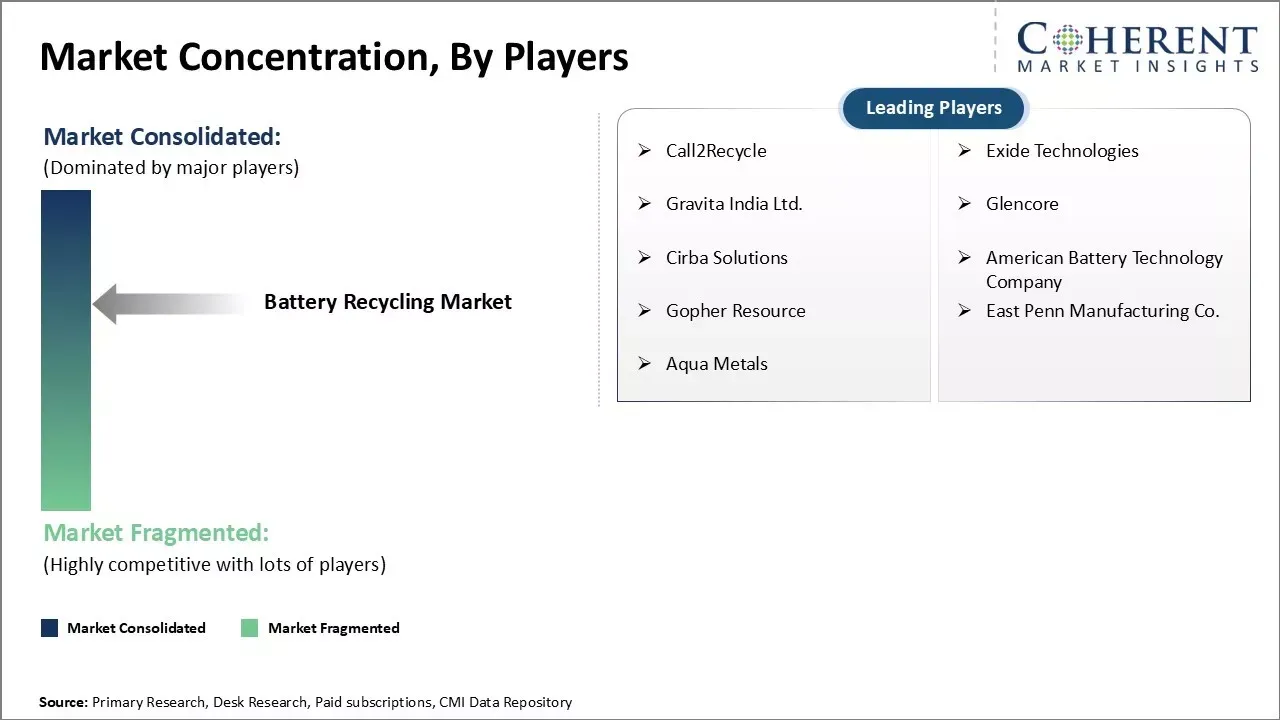
Market Concentration and Competitive Landscape
Market Report Scope
Battery Recycling Market Report Coverage
| Report Coverage | Details | ||
|---|---|---|---|
| Base Year: | 2025 | Market Size in 2026: | USD 28.60 Bn |
| Historical Data for: | 2020 To 2024 | Forecast Period: | 2026 To 2033 |
| Forecast Period 2026 to 2033 CAGR: | 8.7% | 2033 Value Projection: | USD 51.22 Bn |
| Geographies covered: |
| ||
| Segments covered: |
| ||
| Companies covered: | Call2Recycle, Exide Technologies, Gravita India Ltd., Glencore, Cirba Solutions, American Battery Technology Company, Gopher Resource, East Penn Manufacturing Co., and Aqua Metals | ||
| Growth Drivers: |
| ||
| Restraints & Challenges: |
| ||
Market Dynamics
Battery Recycling Market Driver
Growing adoption of electric vehicles
The automotive industry has rapidly adopted electric vehicles (EVs) and plug-in hybrids, driven by lower running costs and reduced environmental impact. Recycling spent lithium-ion batteries recovers valuable materials like lithium, cobalt, nickel, and manganese. Data reported in February 2024, according to the U.S. Department of Energy’s Argonne National Laboratory, recycling just 5% of these materials from retired EV batteries could meet about 7-15% of the critical demand projected for 2030.
Battery Recycling Market Opportunity
Developing economies with growing e-mobility sector
One major opportunity for this market lies in the developing economies witnessing rapid growth of the e-mobility sector. With concerns rising over sustainability and environmental impact of electric vehicles, many developing nations are heavily investing in electric transport infrastructure and offering purchase incentives. Data reported on 2024, According to United Nations Industrial Development Organization (UNIDO), investing $2.5 billion in battery recycling infrastructure in developing countries could create over 30,000 green jobs by 2030.
Analyst Opinion (Expert Opinion)
The battery recycling market is becoming a key part of ensuring there is enough raw materials and reaching our circular economy goals. The number of end-of-life batteries that are sent to formal recycling streams is growing quickly due to the rapid growth of electric vehicles and stationary energy storage installations. According to industry estimates, the world's recycling capacity was around 300 GWh in the early 2020s. By the end of the decade, announced projects are expected to raise planned capacity to over 1,500 GWh. Capacity continues to be concentrated in certain areas, especially Asia, which causes imbalances between where batteries are retired and where processing infrastructure is located.
Lead-acid batteries remain to make up the majority of recycling as there are well-established collection networks and recovery rates that are close to 99%, which means there is a steady supply of lead. Lithium-ion battery recycling, on the other hand, is growing rapidly but is more complicated due to the different chemistries and safety concerns. Increasingly, commercial recycling facilities are reporting recovery rates of over 90% for cobalt and nickel. The efficiency of lithium recovery is also getting improved due to new hydrometallurgical and direct-recycling technologies.
Policy frameworks that require minimum recovery efficiencies and recycled content are making the case for investing in recycling in local areas stronger. Partnerships between recyclers, battery makers, and car manufacturers are an important component of competitive dynamics. These partnerships help secure feedstock and make it easier to trace materials. Overall, the market will be affected by the actual commissioning of announced capacity, better lithium recovery yields, and how well battery collection systems can handle the growing number of batteries that need to be recycled.
Speak to the analyst
Want personalized insights?
Take the findings above to one of our principal consultants, or have the report rebuilt around the segments, geographies and competitors you actually track.
Battery Recycling Industry News
- In August 2025, Novocycle is speeding up battery recycling in the Netherlands by focusing on getting important materials back from old batteries. The project helps Europe move toward a circular economy, lowers environmental risks, and supports clean energy goals. Novocycle helps the development of sustainable energy and makes sure that important resources are available for making batteries in the future by improving recycling infrastructure.
- In July 2025, Toyota and LG Energy Solution have started a battery recycling business in the U.S. to get important materials back from batteries that are hardly usable. The partnership makes recycling in the U.S. stronger, has less of an effect on the environment, and helps the goals of clean energy. This program promotes circular economy practices and strengthens America's electric mobility supply chain.
- In February 2024, Cirba Solutions and EcoPro signed an MoU to improve lithium-ion battery recycling. This collaboration is crucial due to the increasing demand for battery materials and the focus on clean energy production in the US.
- In February 2023, Contemporary Amperex Technology Co., Limited, Mercedes-Benz, and GEM Co., Ltd. signed a memorandum of understanding for the recycling of cobalt, nickel, manganese, and lithium metals from spent EV batteries of Mercedes-Benz and remanufacture them into battery cathode materials
Top Strategies Followed by Battery Recycling Market Players
- Established players focus heavily on research and development to come up with innovative products. Companies like Battery Solutions, Aqua Metals, and UMICORE invest over 10% of their annual revenues in R&D. They are employing sophisticated technologies like hydrometallurgy and pyrometallurgy to recover over 95% of materials from spent batteries. Leading players also focus on strategic partnerships with automotive giants and OEMs. In September 2024, Retriev Technologies partnered with Tesla and BMW to collect and recycle lithium-ion batteries from electric vehicles.
- Mid-level players leverage their cost-effective solutions. For example, Global Battery Solutions offers pocket-friendly products and services for SMEs and startups who want to dispose batteries safely but on a budget. These companies may also form collaborations with other mid-sized players. For instance, TES-AMM joined hands with SungEel HiTech to boost sulfuric acid regeneration technologies as well as end-to-end battery recycling capabilities.
- Small-scale players often specialize in niche segments. RECUPYL focuses specifically on recycling button cell batteries containing silver oxide, lithium-ion, and other specialty battery chemistries. Some small firms adopt cutting-edge technologies to stay competitive. For example, Neometals deploys innovative lithium extraction methods like selective leaching to efficiently recover materials.
Emerging Startups in the Battery Recycling Market
Many startups are developing advanced technologies. For instance, Li-Cycle uses innovative hydrometallurgical processes to sustainably recover over 95% of lithium, cobalt, nickel and aluminum from lithium-ion battery material. This paves way for closed loop manufacturing.
Sustainable solutions are gaining ground. Companies like Battery Resourcers focus on producing recycled materials with zero waste generation. Their methods eliminate greenhouses gases emissions up to 85% compared to mining. Other emerging startups like SNAM focus on producing high-quality battery precursors from recycled materials.
Some startups target niche sectors. For instance, Lithion Recycling specializes in recovering materials from electric vehicle batteries and energy storage systems using hydrometallurgy. Anthropic addresses the gap in recycling non-automotive batteries like power tools, medical devices and consumer electronics. Many partners with OEMs, academic institutions and other players. For example, Tesla invested in Redwood Materials to develop next-gen recycling technologies.
Market Segmentation
- Chemistry Insights (Revenue, USD Bn, 2026 - 2033)
- Lithium-ion
- Lead Acid
- Nickel
- Others
- Application Insights (Revenue, USD Bn, 2026 - 2033)
- Transportation
- Consumer Electronics
- Industrial
- Regional Insights (Revenue, USD Bn, 2026 - 2033)
- North America
- U.S.
- Canada
- Latin America
- Brazil
- Argentina
- Mexico
- Rest of Latin America
- Europe
- Germany
- U.K.
- Spain
- France
- Italy
- Russia
- Rest of Europe
- Asia Pacific
- China
- India
- Japan
- Australia
- South Korea
- ASEAN
- Rest of Asia Pacific
- Middle East
- GCC Countries
- Israel
- Rest of Middle East
- Africa
- South Africa
- North Africa
- Central Africa
- Key Players Insights (Revenue, USD Bn, 2021 - 2033)
- Call2Recycle
- Exide Technologies
- Gravita India Ltd.
- Glencore
- Cirba Solutions
- American Battery Technology Company
- Gopher Resource
- East Penn Manufacturing Co.
- Aqua Metals
Sources
Primary Research Interviews
- Battery Recycling Companies & Process Operators
- Lithium-ion Battery Manufacturers
- EV OEMs & Automotive Battery Suppliers
- Waste Management & Collection Service Providers
- Metallurgical & Hydrometallurgical Technology Experts
- Energy Storage & Sustainability Consultants
- Others
Databases
- Bloomberg Terminal
- Thomson Reuters Eikon
- S&P Global Market Intelligence
- IHS Markit
- Factiva
- Others
Magazines
- Battery Technology Magazine
- Recycling Today
- Chemical Engineering Magazine
- Energy Storage News
- Industrial Waste & Recycling Magazine
- Others
Journals
- Journal of Power Sources
- Resources, Conservation & Recycling
- Journal of Cleaner Production
- Waste Management Journal
- Electrochimica Acta
- Others
Newspapers
- Financial Times
- The Wall Street Journal
- Reuters
- Bloomberg News
- The Economic Times
- Others
Associations
- International Battery Recycling Association (IBRA)
- Battery Council International (BCI)
- European Battery Alliance (EBA)
- International Solid Waste Association (ISWA)
- Global Battery Alliance (GBA)
- Others
Public Domain Sources
- U.S. Environmental Protection Agency (EPA)
- U.S. Department of Energy (DOE)
- International Energy Agency (IEA)
- European Commission – Batteries Regulation & Circular Economy Unit
- World Bank Open Data
- Others
Proprietary Elements
- CMI Data Analytics Tool
- Proprietary CMI Existing Repository of Information for the Last 8 Years
Get access to 250+ pages report
Every segment, forecast, competitor profile and data table behind the analysis above — available for instant download.
- ESOMAR Member
- ISO 9001:2015 Certified
- D-U-N-S Registered
- GDPR & CCPA Compliant
Missing comfort of reading report in your local language? Find your preferred language:
Transform your Strategy with Exclusive Trending Reports
Frequently Asked Questions
The Battery Recycling Market is estimated to be valued at USD 28.60 Bn in 2026, and is expected to reach USD 51.22 Bn by 2033.
The CAGR of the Battery Recycling Market is projected to be 8.7% from 2026 to 2033.
Growing adoption of electric vehicles and stringent regulations regarding battery recycling are the major factors driving the market growth for battery recycling.
High costs involved in battery recycling and risk of environmental pollution are the major factors hampering the growth of the battery recycling market.
In terms of chemistry, lithium-ion is estimated to dominate the market revenue share in 2026.
Call2Recycle, Exide Technologies, Gravita India Ltd., Glencore, Cirba Solutions, American Battery Technology Company, Gopher Resource, East Penn Manufacturing Co., Aqua Metals are the major players.
Asia Pacific is expected to lead the Battery Recycling Market in 2026.