

Smart Mobility Market Size and Forecast: 2026 to 2033
Smart Mobility Market is estimated to be valued at USD 57.24 Bn in 2026 and is expected to reach USD 218.64 Bn in 2033, exhibiting a compound annual growth rate (CAGR) of 21.1% from 2026 to 2033.
Key Takeaways
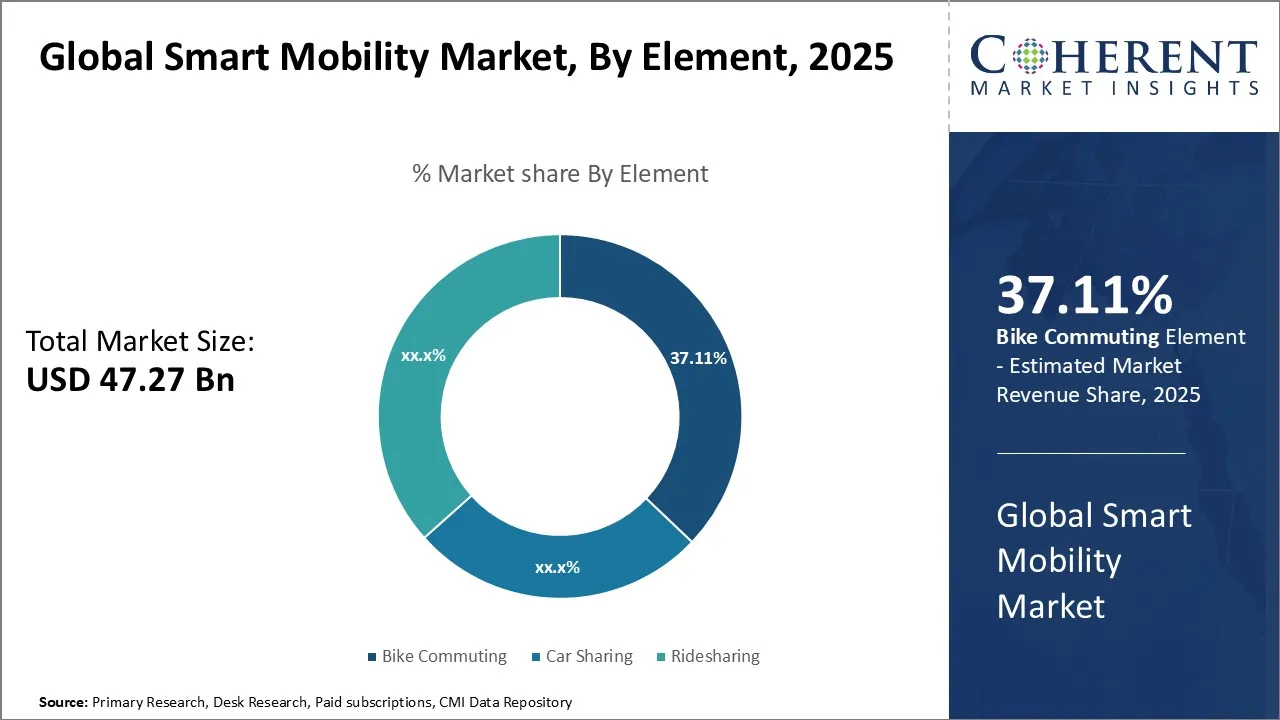
- By Element, Bike Commuting hold the largest market share of 38.1% in 2026 owing to its urbanization, traffic congestion & last‑mile pressure.
- By Solution, Traffic Management expected to hold largest market share in 2026 owing to the rapid urbanization, vehicle growth & congestion pressure.
- By Technology, 3G & 4G acquired the prominent market share in 2026 owing to the widespread network coverage & established infrastructure.
- By Region, Europe dominates the overall market with an estimated share of 35.5% in 2026 owing to the regulatory push & strong environmental.
Market Overview
The Smart Mobility Market actively integrates advanced technologies to deliver efficient, safe, and sustainable transportation systems. It offers solutions including connected vehicles, electric and autonomous vehicles, traffic management systems, mobility-as-a-service platforms, and micro-mobility options. Urbanization, environmental concerns, and growing demand for seamless commuting drive the market to transform traditional transport infrastructure. Governments, technology providers, and mobility operators collaborate to implement intelligent, data-driven solutions that improve urban mobility, reduce congestion, and promote eco-friendly, cost-effective transportation.
Current Events and Its Impact on the Smart Mobility Market
Current Events | Description and its impact |
Geopolitical Shifts in Asia-Pacific |
|
Technological Advances in AI and Connectivity |
|
Economic Factors and Supply Chain Dynamics |
|
Segmental Insights
- Current Industry Events of 2026
- Market Size Estimation
- Regional Breakdown
- Competitive Landscape
- Customer Intelligence
- Segmental Analysis
- Pricing Analysis
- Key Market Drivers, Challenges & Future Trends
- Customized Insights Section
Smart Mobility Market Insights, By Element - Bike Commuting contribute the highest share of the market owing to its government policies, urban planning & infrastructure push
Bike Commuting hold the largest market share of 38.1% in 2026. Cities are increasingly adopting bike commuting in the Smart Mobility Market to achieve efficient, flexible, and sustainable transportation. Urban congestion, environmental awareness, and growing demand for cost-effective travel encourage people to use bicycles and e-bikes. Innovations such as app-based sharing platforms, GPS tracking, and electric assistance make biking easier and more accessible. Governments implement supportive policies, build dedicated cycling infrastructure, and promote health-conscious lifestyles, driving bike usage and establishing it as a practical, eco-friendly, and essential component of modern urban mobility. For instance, in December 2025, EMotorad launched the T-Rex Smart, positioning it as India’s first electric bicycle featuring Bluetooth and GPS connectivity. This introduction marks the company’s entry into the smart mobility segment, targeting urban commuters who seek connected riding experiences.
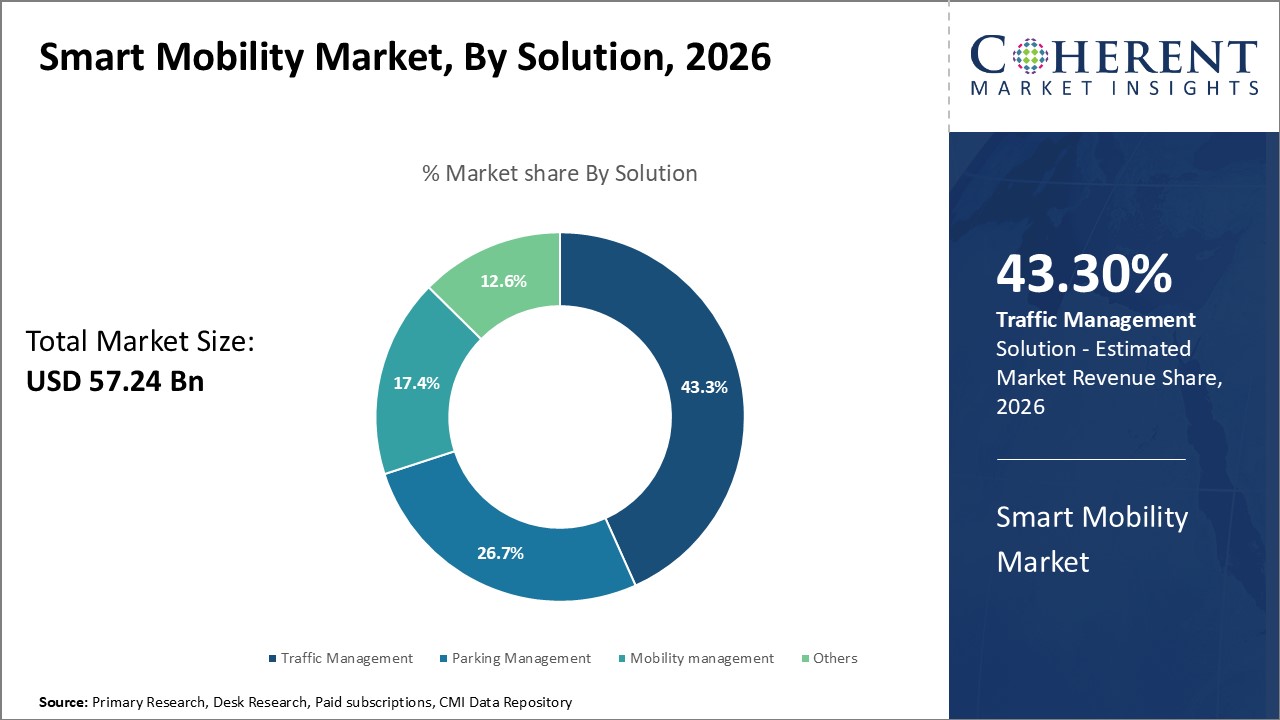
Smart Mobility Market Insights, By Solution - Traffic Management contribute the highest share of the market owing to its environmental & sustainability concerns
Cities are advancing traffic management in the Smart Mobility Market to optimize transportation efficiency and safety. Increasing urban congestion, higher vehicle volumes, and the demand for seamless mobility drive governments and operators to deploy intelligent traffic solutions. Real-time monitoring, IoT-enabled sensors, AI-powered signal control, and connected infrastructure improve traffic flow and minimize delays. By implementing supportive policies, smart-city initiatives, and promoting sustainable transport, stakeholders actively position traffic management as a crucial component in building efficient, safe, and eco-friendly urban mobility networks. For instance, in July 2025, GVMC Commissioner Ketan Garg announced the launch of ‘Project SARTHI’ (Systematic Augmented Radial Traffic & Hoop Induction), a pilot initiative to deploy an AI-based Integrated Traffic Management System (ITMS) in the city.
Smart Mobility Market Insights, By Technology - 3G & 4G contribute the highest share of the market owing to its cost‑effectiveness & maturity
3G and 4G technologies actively drive the Smart Mobility Market by delivering reliable, widespread connectivity for diverse transportation solutions. Their broad network coverage allows connected vehicles, fleet management, traffic monitoring, and mobility-as-a-service platforms to communicate seamlessly across urban and suburban areas. Offering cost-effective and mature solutions, these networks support real-time data transfer, telematics, and IoT integration. By linking legacy systems with modern smart mobility applications, 3G and 4G enable governments, operators, and technology providers to offer efficient, accessible, and fully connected transportation services.
Regional Insights
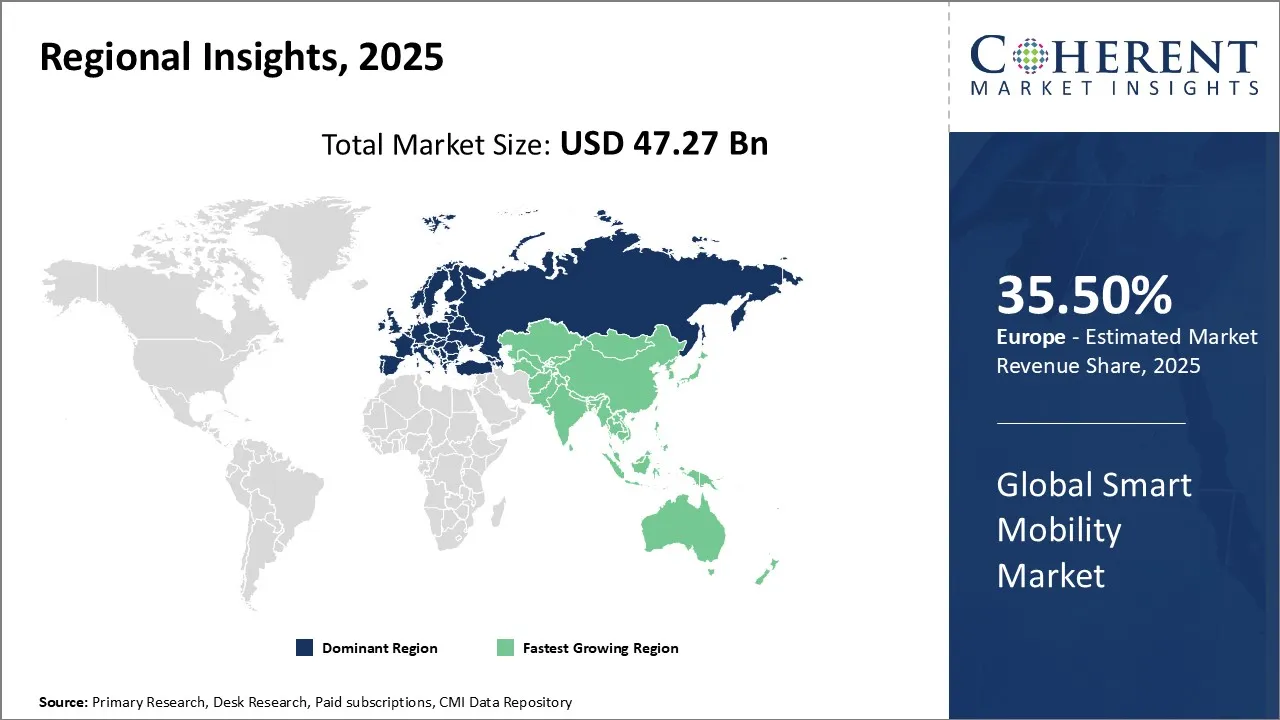
Europe Smart Mobility Market Trends
Europe dominates the overall market with an estimated share of 35.5% in 2026. Europe is rapidly transforming its smart-mobility landscape as cities adopt efficient, clean, and connected transportation systems. Strict environmental and air-quality regulations, along with the growing shift toward electric and shared mobility, are prompting urban centers to replace private cars with EVs, micro-mobility solutions, and multimodal transport platforms. Technology drives this change, as widespread use of IoT sensors, data analytics, AI-powered traffic management, and digital mobility-as-a-service platforms actively converts legacy transport infrastructure into smart, adaptive, and responsive urban networks. For instance, TOYOTA Connected launched TOYOTA Connected Europe (TCEU) in London to expand its technology-driven mobility solutions and support the growing European market with tailored products and services.
Asia Pacific Smart Mobility Market Trends
Urbanization, rising smartphone use, and growing demand for convenient transportation are rapidly transforming Asia‑Pacific’s smart‑mobility landscape. Cities and companies are integrating public transit, ride‑hailing, micro-mobility, and shared transport into seamless digital platforms through Mobility-as-a-Service (MaaS), making commuting easier and greener. Governments actively support this shift by investing in smart-transport infrastructure, expanding intelligent transport systems (ITS), and promoting EV adoption and data-driven mobility, accelerating the region’s transition toward efficient, sustainable, and fully connected transit networks. For instance, in January 2026, XPENG launched its flagship X9 premium electric MPV in Malaysia, advancing its Southeast Asia expansion and building on the success of the XPENG G6 in the country.
United Kingdom Smart Mobility Market Trends
Cities across the United Kingdom are rapidly transforming the smart mobility market by adopting electrification, digital infrastructure, and shared mobility solutions. London and other urban centres are rolling out zero-emission buses, expanding EV-charging networks, and implementing smart ticketing, contactless payments, and open-data platforms to deliver seamless transport services. At the same time, micro-mobility options—such as e-scooters, bikes, and e-bikes—and ride-sharing are gaining popularity as alternatives to private car ownership, driven by increasing investments in data-driven traffic management and multi-modal connectivity. For instance, in February 2026, Xpeng, in partnership with International Motors Ltd (IML), launched in the UK, highlighting its smart mobility offerings, says Xpeng president and vice-chairman Dr. Brian Gu.
India Smart Mobility Market Trends
Cities and policymakers in India are actively transforming the smart mobility landscape by prioritizing electrification, micromobility, and digital infrastructure. Electric two- and three-wheelers are becoming increasingly popular across urban and semi-urban areas, lowering pollution and providing affordable, compact commuting options. To facilitate this transition, authorities and private players are expanding charging infrastructure—including public chargers, battery-swapping stations, and fast-charging networks—across major cities and highways, making EV adoption more convenient and alleviating range anxiety
End-user Feedback and Unmet Needs in the Smart Mobility Market
- Reliability & Service Consistency: Users often report that services like shared micro‑mobility or EV‑based transit suffer from unpredictable availability or breakdowns, undermining trust and discouraging regular use.
- Safety and Infrastructure Gaps: Many riders cite safety concerns: lack of dedicated lanes, poor road conditions, and mixed traffic with cars make micromobility feel risky.
- Parking and Docking Difficulties: Users of shared bikes or scooters often struggle to find secure and designated parking spots — improper or cluttered parking frustrates pedestrians and commuters alike.
Smart Mobility Market Trend
Electrification and EV ecosystem expansion
Electric mobility increasingly defines smart‑mobility systems worldwide. Automakers and urban transit providers are rolling out electric cars, buses, scooters and bikes to replace fossil‑fuel vehicles. Simultaneously, investment in charging infrastructure — including public chargers, fast‑charging hubs and battery‑swap stations — is accelerating, making EV adoption more practical for commuters. This shift supports cleaner air and encourages broader public and commercial use of electric fleets rather than traditional combustion vehicles.
Rise of micromobility and shared transport solutions
Cities and consumers are embracing small, flexible vehicles — e‑scooters, e‑bikes, and light EVs — along with shared mobility services like ride‑pooling and scooter‑sharing. This trend reflects growing demand for convenient, low‑cost, short‑distance transport alternatives. As urban populations swell and traffic congestion worsens, micromobility provides agility, lowers noise and carbon emissions, and offers a viable alternative to private vehicle use.
Smart Mobility Market Opportunity
Urban congestion relief and sustainable transit demand
Rapid urbanization and growing traffic congestion create strong demand for smarter, sustainable transport systems. As cities expand and traditional infrastructure strains under car‑heavy usage, there is a growing need for intelligent mobility solutions — including EVs, shared transport, and efficient public transit — to ease congestion, reduce emissions, and improve urban livability.
Market Report Scope
Smart Mobility Market Report Coverage
| Report Coverage | Details | ||
|---|---|---|---|
| Base Year: | 2025 | Market Size in 2026: | USD 57.24 Bn |
| Historical Data for: | 2020 To 2024 | Forecast Period: | 2026 To 2033 |
| Forecast Period 2026 to 2033 CAGR: | 21.1% | 2033 Value Projection: | USD 218.64 Bn |
| Geographies covered: |
| ||
| Segments covered: |
| ||
| Companies covered: | Cisco Systems, Inc., Excelfore, Ford Motor Company, Robert Bosch GmbH, and TomTom International N.V. | ||
| Growth Drivers: |
| ||
| Restraints & Challenges: |
| ||
Smart Mobility Market News
- In September 2025, Hyundai Motor Group launched the Next Urban Mobility Alliance (NUMA), a public-private partnership aimed at transforming urban transportation with advanced mobility technologies. The alliance seeks to tackle social and environmental challenges by promoting inclusive mobility innovation and accelerating smart city development.
- In November 2025, The initiative, launched at DRIFTx—Abu Dhabi’s flagship smart and autonomous mobility exhibition during Abu Dhabi Autonomous Week (ADAW)—creates a structured pathway that integrates high-potential mobility startups into the emirate’s transport ecosystem
Analyst Opinion (Expert Opinion)
- The smart mobility market is reaching a point of irreversible transformation, driven by rapid adoption of micromobility and robust technology-led integration. Global shared micromobility fleets currently number approximately 25.7 million vehicles, with projections indicating growth to nearly 37.8 million by 2029. In densely populated urban areas, this shift is redefining commuting patterns, as e-scooters, e-bikes, and shared electric vehicles become core components of transportation rather than fringe alternatives.
- At the same time, the proliferation of IoT and data-driven fleet management systems is enhancing reliability and improving the user experience. Advanced telematics, AI-based routing, and smart charging frameworks reduce downtime and optimize utilization, addressing traditional challenges in shared mobility such as unpredictable availability and maintenance issues. This technological foundation renders scaling not only feasible but sustainable.
- In emerging markets, particularly India, the rise of everyday electric vehicles is influencing modal preferences. By mid-2025, over 6.5 million EVs were in operation in India, demonstrating a clear shift among consumers and fleet operators away from internal combustion engine vehicles. This trend establishes a foundation for the convergence of electrification, shared mobility, and digital infrastructure, positioning it as a dominant urban transport paradigm rather than a niche trend.
- Nevertheless, uniform growth cannot be assumed. Regulatory barriers, infrastructure gaps—such as inconsistent charging and parking availability—and safety concerns, especially in micromobility, remain significant challenges. Overall, smart mobility is transitioning from an experimental initiative to an integrated ecosystem. For stakeholders investing in technology-driven fleet operations, open data integration, and enhanced user convenience, the market represents a strategic inflection point at the intersection of mobility, sustainability, and urbanization.
Speak to the analyst
Want personalized insights?
Take the findings above to one of our principal consultants, or have the report rebuilt around the segments, geographies and competitors you actually track.
Market Segmentation
- Global Smart Mobility Market, By Elements
- Bike Commuting
- Car Sharing
- Ridesharing
- Global Smart Mobility Market, By Solution
- Traffic Management
- Parking Management
- Mobility management
- Others
- Global Smart Mobility Market, By Technology
- 3G & 4G
- Wi-Fi
- GPS
- RFID
- Embedded Systems
- Others
- Regional Insights (Revenue, USD Mn, 2021 - 2033)
- North America
- U.S.
- Canada
- Latin America
- Brazil
- Argentina
- Mexico
- Rest of Latin America
- Europe
- Germany
- U.K.
- Spain
- France
- Italy
- Russia
- Rest of Europe
- Asia Pacific
- China
- India
- Japan
- Australia
- South Korea
- ASEAN
- Rest of Asia Pacific
- Middle East
- GCC Countries
- Israel
- Rest of Middle East
- Africa
- South Africa
- North Africa
- Central Africa
- North America
- Key Players Insights
- Cisco Systems, Inc.
- Excelfore
- Ford Motor Company
- Robert Bosch GmbH
- TomTom International N.V.
Sources
Primary Research interviews
- Fleet operators and shared mobility service providers
- Urban transport authorities and regulators
- EV manufacturers and micromobility OEMs
- IoT and telematics solution providers
- City planners and smart mobility infrastructure experts
Databases
- International Energy Agency (IEA) EV and mobility statistics
- World Bank urban transport and infrastructure data
- Government transport department databases (e.g., MoRTH, NITI Aayog in India)
- National vehicle registration and EV adoption statistics
Magazines
- Wired
- MIT Technology Review
- IEEE Spectrum
- Smart Cities Dive
Journals
- Transportation Research Part A: Policy and Practice
- Journal of Urban Mobility and Transportation
- Energy Policy Journal
- IEEE Internet of Things Journal
Newspapers
- The Times of India
- The Hindu
- The Economic Times
- Hindustan Times
Associations
- International Association of Public Transport (UITP)
- Society of Automotive Engineers (SAE)
- Electric Vehicle Association of India (EVAI)
- Micromobility Industries Forum
Public Domain sources
- Government policy documents and reports on EV adoption and urban mobility
- Census and demographic reports related to urban transportation
- Press releases from major EV and shared mobility companies
- Open-access technical papers on smart mobility technologies
Proprietary Elements
- CMI Data Analytics Tool
- Proprietary CMI Existing Repository of information for last 8 years
Get access to 250+ pages report
Every segment, forecast, competitor profile and data table behind the analysis above — available for instant download.
- ESOMAR Member
- ISO 9001:2015 Certified
- D-U-N-S Registered
- GDPR & CCPA Compliant
Missing comfort of reading report in your local language? Find your preferred language:
Transform your Strategy with Exclusive Trending Reports
Frequently Asked Questions
The Smart Mobility Market is estimated to be valued at USD 57.24 Bn in 2026, and is expected to reach USD 218.64 Bn by 2033.
The CAGR of the Smart Mobility Market is projected to be 21.1% from 2026 to 2033.
Increasing need for on-demand transportation services and rise in smart city initiatives are fuelling the market.
The bike commuting segment is the leading element in the market.
Lack of internet penetration in developing regions and concerns regarding safety of data are the major factors restraining growth of the market.
Cisco Systems, Inc., Excelfore, Ford Motor Company, Robert Bosch GmbH, and TomTom International N.V.