

Secure Logistics Market Size & Trends
Secure Logistics Market is estimated to be valued at USD 113.51 Bn in 2026 and is expected to reach USD 197.08 Bn in 2033, exhibiting a compound annual growth rate (CAGR) of 8.2% from 2026 to 2033.
Key Takeaways
- Based on Service Type, the Cash Services segment is projected to account for 78.3% of the global secure logistics market inn 2026, due to the continued reliance on physical currency across various sectors and regions.
- Based on End User, the Financial Institutions segment is expected to account for the largest share of the global secure logistics market in 2026, attributed to their critical need to safely manage and transport large volumes of cash, valuable assets, and sensitive documents.
- Based on Region, Europe is projected to lead the global secure logistics market in 2026 with a 33.3% share. While, Asia Pacific will be the fastest growing region during forecast period.
Market Overview
The global market for secure logistics is expanding rapidly, driven by several key factors. Rising global cash circulation, advancements in warehouse technology, and the surge in e-commerce transactions are significantly boosting the need for secure transportation and handling services. Additionally, the secure logistics market demand is being shaped by challenges such as a shortage of skilled personnel, growing cybersecurity threats, and fluctuating fuel costs. Despite these hurdles, the market is poised for continued growth, particularly in emerging economies where increasing commercial activity and urbanization are amplifying the need for reliable, secure logistics solutions.
Current Events and their impact on the Secure Logistics Market
Current Event | Description and Its Impact |
Regional Market Developments and Nano-Level Dynamics |
|
Regulatory and Compliance Shifts |
|
Role of Artificial Intelligence (AI) in Secure Logistics
AI plays a vital role in enhancing security across the logistics industry. By analyzing vast amounts of data in real time, AI can detect anomalies, predict risks, and prevent fraud. It enables secure identity verification through biometric tools like voice and facial recognition, ensuring only authorized personnel access sensitive systems. AI-powered tracking and monitoring systems provide end-to-end visibility, reducing the chances of theft or tampering. In addition, AI strengthens cybersecurity by identifying threats and automating responses.
In August 2025, CloneOps.ai, an AI-driven business communication platform, partnered with Verified Carrier, a leading name in logistics fraud prevention, to launch CloneOps.ai-Voice ID—a real-time, voice-based authentication system. Using a brief 15 to 60-second voice sample, the system creates a unique voice profile. During live calls, two advanced technologies compare the caller’s voice to the stored model, enabling instant and secure identity verification when both confirm a high-confidence match.
- Current Industry Events of 2026
- Market Size Estimation
- Regional Breakdown
- Competitive Landscape
- Customer Intelligence
- Segmental Analysis
- Pricing Analysis
- Key Market Drivers, Challenges & Future Trends
- Customized Insights Section
Segmental Insights
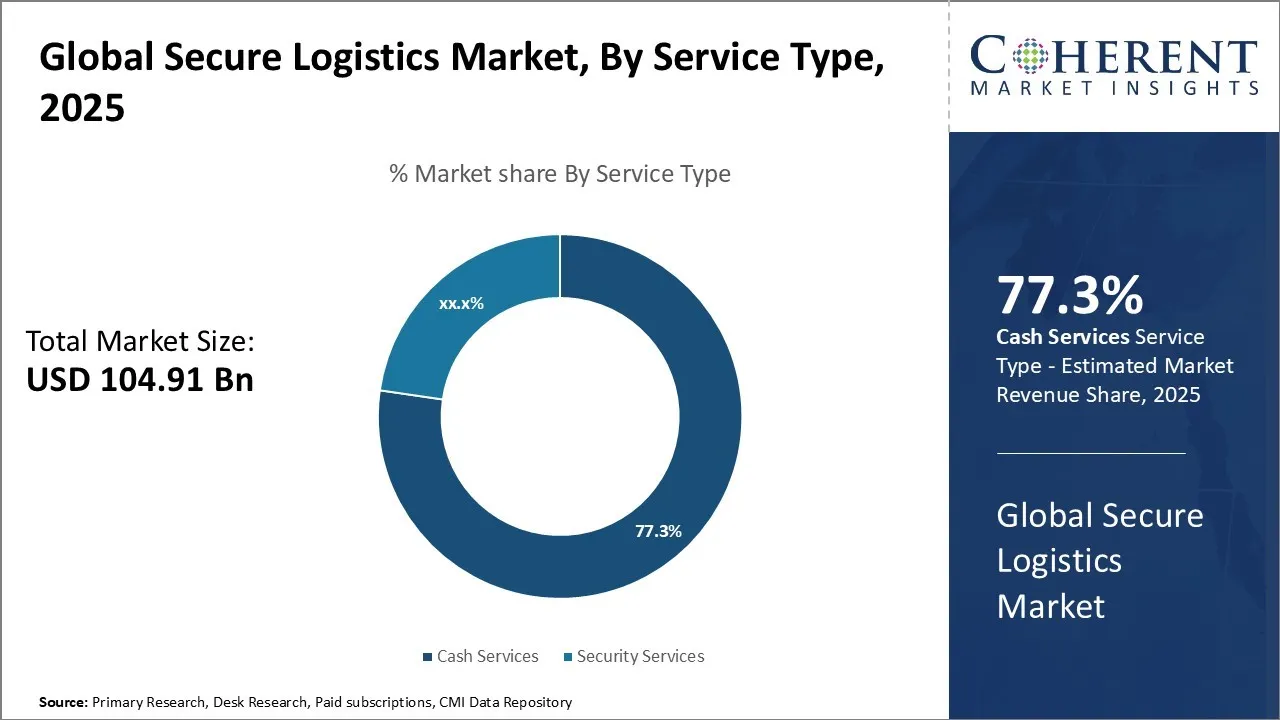
Secure Logistics Market Insights, By Service Type: Cash Services Holds the dominant share owing to Continuous Reliance on Physical Currency
In terms of service type, the cash services segment is expected to dominate the global market with an estimated share of 78.3% in 2026, due to the continued reliance on physical currency across various sectors and regions. Despite the rise of digital payment systems, cash remains a dominant mode of transaction in many parts of the world, especially in developing economies, rural areas, and industries like retail, transportation, and hospitality. This widespread usage drives the need for secure handling, transportation, and management of cash. Banks and financial institutions heavily depend on secure logistics companies for services such as ATM replenishment, servicing, and maintenance, ensuring cash availability and operational efficiency.
Additionally, businesses dealing with large daily cash volumes, such as supermarkets and fuel stations, require regular cash pickups and deposits, further boosting the secure logistics market demand. The rising security concerns, including theft and fraud, also push organizations to outsource cash logistics to specialized firms. Moreover, increasing regulatory scrutiny and compliance requirements around cash traceability are encouraging the adoption of professional cash handling services. In many emerging markets, where digital infrastructure is still evolving, cash remains the primary payment method, making secure cash services critical to both economic activity and public trust.
In June 2025, UK payments firm allpay collaborated with card‑processing specialist PAYA Group to launch Toucan Cash, a new in‑app cash‑deposit solution tailored for charities struggling with declining high‑street banking infrastructure.
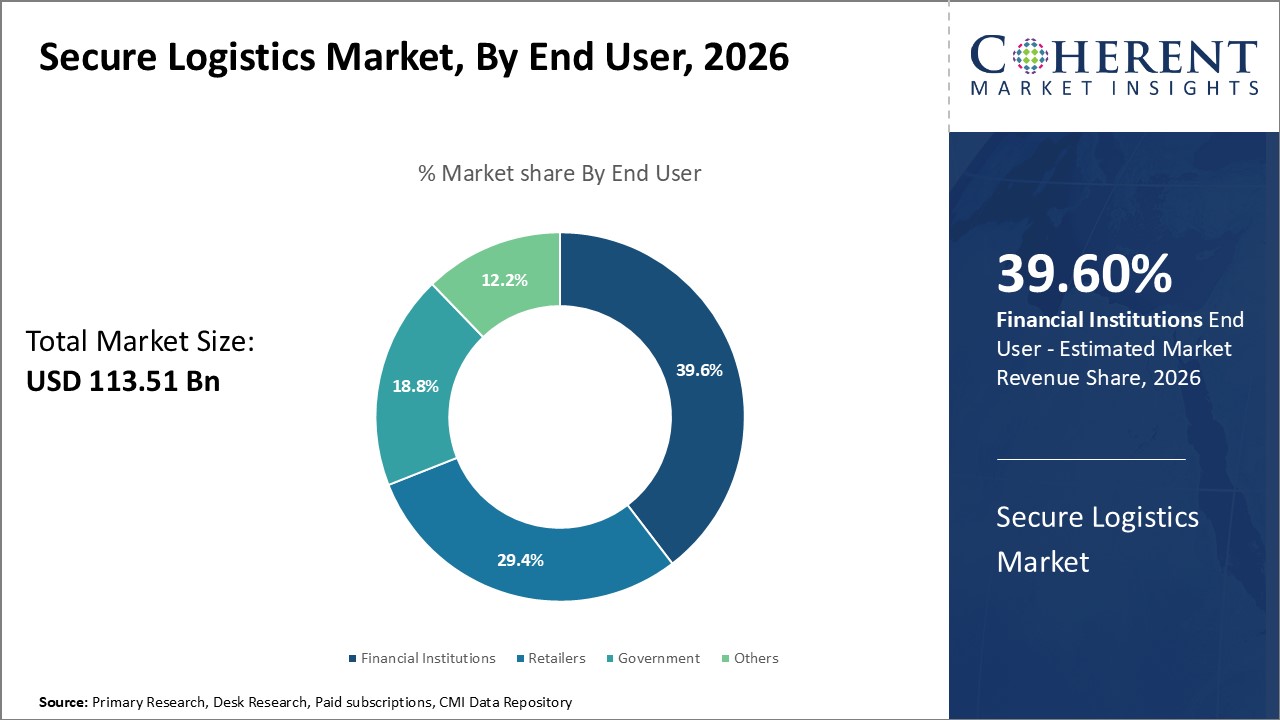
Secure Logistics Market Insights, By End User: Financial Institutions holds the dominant share as it Safely Manage and Transport Large Volumes of Cash, Valuable Assets, And Sensitive Documents
In terms of end user, the financial institutions segment is expected to dominate the global market with largest share in 2026, attributed to their critical need to safely manage and transport large volumes of cash, valuable assets, and sensitive documents. Banks, ATMs, and financial service providers rely heavily on secure logistics partners for cash replenishment, vault storage, and inter-branch transfers. As they are prime targets for theft and fraud, financial institutions depend on advanced security features such as armored vehicles, GPS tracking, and real-time monitoring. Moreover, compliance with strict regulatory standards for asset movement and data protection further drives the need for professional secure logistics services. In developing regions, the increasing number of ATMs and bank branches has led to a surge in demand, while even in digitally advancing economies, physical banking operations still require secure document and cash handling. As a result, financial institutions continue to play a dominant role in fueling Secure Logistics Market demand.
In January 2025, the London Bullion Market Association (LBMA) launched the Gold Bar Integrity Database, a blockchain-powered system to track gold bars from accredited refiners to London vaults, aiming to weed out illicit sources and enhance supply-chain transparency.
Regional Insights
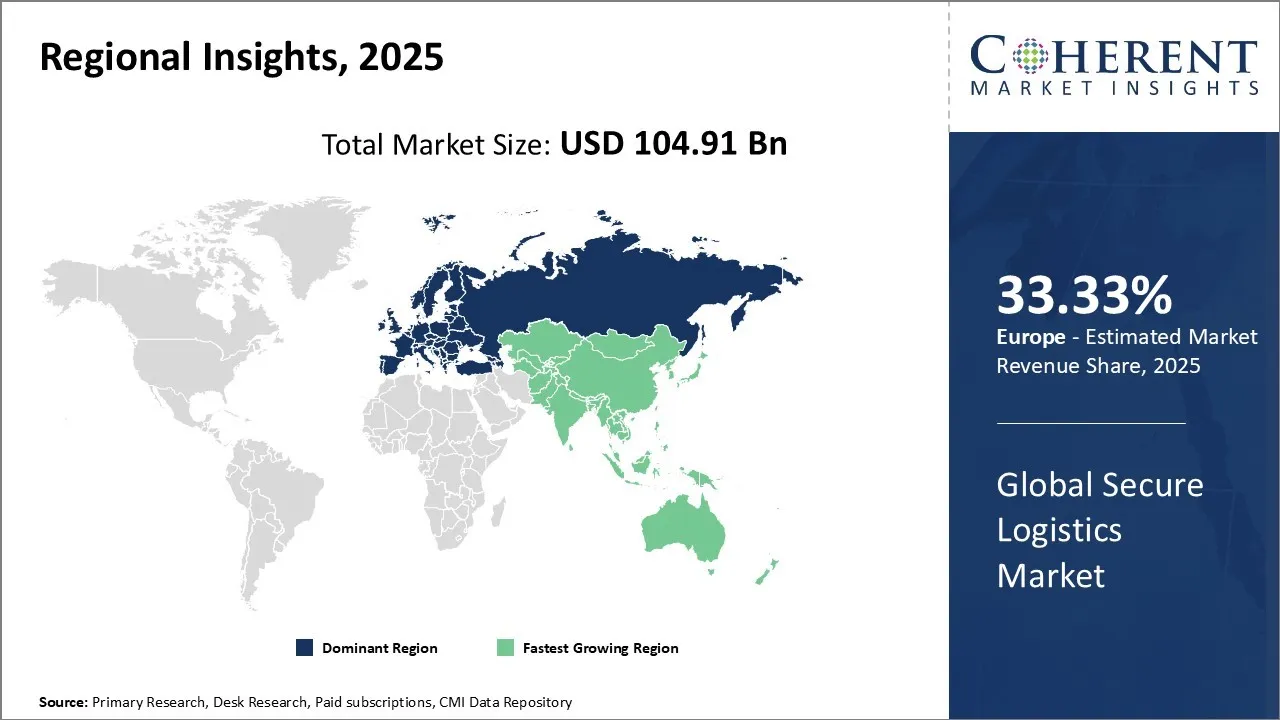
Europe Secure Logistics Market Analysis & Trends
Europe region is projected to lead the market with a 33.3% share in 2026, due to its robust banking infrastructure, strict security regulations, and growing e-commerce of high-value goods. The region’s advanced manufacturing and pharmaceutical sectors rely on secure, traceable transport, while adoption of technologies like IoT and blockchain ensures real-time tracking and risk mitigation. Additionally, seamless cross-border trade within the EU further drives the need for reliable secure logistics services, making Europe one of the most mature and demanding markets globally.
In February 2026, TikTok expanded its TikTok Shop fulfilment operations by preparing to launch its Fulfilled by TikTok (FBT) program in Germany. The company is hiring logistics and management staff in its Munich office to support the service, which offers warehousing, packaging, and shipping for merchants.
Asia Pacific Secure Logistics Market Analysis & Trends
Asia Pacific is also anticipated to gain promising growth in the global secure logistics market over the forecast period, owing to rise in demand for secure transit in urbanizing cities around the region, expanding banking facilities in remote locations, and growing cash circulation. The region is witnessing a growth in number of ATM installation. Along with this, the population density and economic size of major cities is developing countries is positively impacting the financial sector. Thus, the region is expected to show strong growth in the global secure logistics market in the coming years.
For instance, in July 2026, Freightos, the leading global digital freight booking and payments platform, announced a strategic partnership with SriLankan Cargo, integrating the airline's services into its WebCargo system.
Secure Logistics Market Outlook Country-Wise
Germany Secure Logistics Market Trends
Germany plays a pivotal role in the Secure Logistics Market share, serving as a central hub for financial operations, manufacturing, and high-value supply chains in Europe. Its strategic location and advanced infrastructure support the secure transport of cash, luxury goods, aftermarket automotive parts, and sensitive documents across borders. Strong demand for cash-in-transit (CIT) services stems from Germany’s position as home to major banks and insurers.
The country’s robust automotive industry also drives the need for secure movement of high-value components and prototypes. Advanced warehousing with strict security, tracking, and climate controls further boosts market growth. Increasing regulatory requirements are prompting German providers to invest in cybersecurity and compliance systems, reinforcing demand.
For instance, in February 2026, Uniphar, a global provider of pharmaceutical and medtech services, expanded its international infrastructure with three cutting‑edge facilities in Raleigh (USA), Lelystad (Netherlands), and Dublin (Ireland). The 65,000 sq ft Raleigh site offers ambient, cold‑chain and freezer storage, clean rooms for clinical trials, and a DEA‑approved vault, all integrated into an FDA, ISO and DSCSA‑compliant warehouse management system.
India Secure Logistics Market Trends
India is a key growth market for the secure logistics market due to its continued reliance on cash, despite growing digital adoption. High demand stems from ATM replenishment, cash collection, and bullion logistics, driven by the country’s strong gold consumption and expanding retail sector. Regulatory requirements from the RBI for secure transport and handling further fuel demand. With rising e-commerce and financial services penetration in smaller cities, India continues to see strong momentum in secure logistics operations.
For instance, in August 2026, Sequel Logistics, a leading Indian precious‑cargo and supply‑chain specialist, inaugurated its third bullion vault at the Madras Export Processing Zone (MEPZ), marking the largest Free Trade Warehousing Zone (FTWZ) vault in the country. The expansion significantly boosts Sequel’s bullion handling infrastructure, offering enhanced security and customs‑compliant services for gold, silver, and other high‑value assets.
Market Report Scope
Secure Logistics Market Report Coverage
| Report Coverage | Details | ||
|---|---|---|---|
| Base Year: | 2025 | Market Size in 2026: | USD 113.51 Bn |
| Historical Data for: | 2020 To 2024 | Forecast Period: | 2026 To 2033 |
| Forecast Period 2026 to 2033 CAGR: | 8.2% | 2033 Value Projection: | USD 197.08 Bn |
| Geographies covered: |
| ||
| Segments covered: |
| ||
| Companies covered: | Garda World, Brinks, Securitas, G4s, and Loomis | ||
| Growth Drivers: |
| ||
| Restraints & Challenges: |
| ||
Global Secure Logistics Market Drivers
- Increasing Cash Circulation All Over the World to Propel Growth of the Market
The retail and business sectors across the globe are witnessing rise in global cash circulation. Region such as Asia Pacific, and Middle East and Africa are witnessing high volumes of cash circulation. The high cash circulations in these regions are a result of restructuring of banks and financial operations, along with rising fiscal activities in developing countries. South Africa is witnessing a large number of cash circulation, as the country has high unbaked population.
For instance, in February 2025, Shadowfax, an e‑commerce logistics provider, launched SF Shield, a cutting‑edge, AI‑powered security framework designed to redefine digital commerce logistics. SF Shield integrates two core innovations, Track & Trace Solution and SF Eye, to deliver real‑time oversight, fraud detection, and enhanced operational transparency.
Global Secure Logistics Market Opportunities
Growing demand for ATMs in developing countries is expected to create growth opportunities in the secure logistics market forecast period. As cash transactions remain prevalent in many emerging economies, the global ATM market is expanding, with a surge in installations to meet rising cash withdrawal needs. This growth is directly boosting the demand for secure logistics services, particularly for cash replenishment and transit.
Moreover, increasing reliance on cash payments in regions such as Asia Pacific, where rural areas are experiencing higher cash circulation, is further propelling market growth. As ATM usage and cash-in-transit requirements grow, these trends are anticipated to generate sustained business opportunities in the global secure logistics market during the forecast period.
Analyst Opinion (Expert Opinion)
The secure logistics market value is at a decisive inflection point, where operational complexity, regional volatility, and the demand for physical asset protection converge to redefine its strategic relevance. From a professional view, the market is poised not for incremental evolution but for structural transformation, particularly driven by the geopolitical fragmentation of supply chains, financial inclusion efforts in developing economies, and rising threats to high-value physical assets across regions.
Moreover, the overreliance on legacy armored transportation models is fast becoming a liability. This is evident in Latin America and sub-Saharan Africa, where violent thefts targeting cash-in-transit (CIT) vehicles have surged. In Brazil alone, the number of CIT robberies has increased by nearly 37% over the past two years, according to data from the Brazilian Association of Security Transport Companies. These attacks are no longer spontaneous; they are orchestrated using military-grade tactics, highlighting the urgent need to shift from purely physical deterrents to digitally integrated, intelligence-driven secure logistics ecosystems.
Moreover, the growth in ATM installations in Tier II and Tier III cities in Asia and Africa presents a deceptive opportunity. While these installations support financial penetration, they simultaneously increase vulnerabilities for asset carriers and cash recyclers, particularly in countries like India, Nigeria, and Indonesia. In India, for example, the Reserve Bank’s push for cash availability in rural zones has increased demand for CIT services, but service providers are grappling with limited local infrastructure and inadequate security cover. This mismatch is creating bottlenecks that only tech-enabled secure logistics providers will be able to overcome.
A significant trend shaping the future of this industry is the convergence of cybersecurity and physical security. As banks and retailers digitize their back-end cash handling and vault management systems, secure logistics firms must also invest in real-time tracking, blockchain-based audit trails, and AI-enabled threat prediction models. The partnership between Brink's and Honeywell to implement advanced IoT sensors and predictive analytics in cash vaults is one such noteworthy step. This approach not only reduces insurance risk but also enhances accountability in cross-border cash flows, an area often under-regulated and high-risk.
Speak to the analyst
Want personalized insights?
Take the findings above to one of our principal consultants, or have the report rebuilt around the segments, geographies and competitors you actually track.
Global Secure Logistics Market: Key Developments
- In October 2025, Peli BioThermal, a global leader in temperature‑controlled packaging, unveiled its latest innovation: Crēdo Vault™, a reusable bulk shipper engineered for the rigorous needs of pharmaceutical and life sciences logistics. The new Crēdo Vault offers extended thermal reliability across common cold‑chain ranges, delivering up to 144 hours at +2 °C to +8 °C, 168 hours at +15 °C to +25 °C, and 120 hours below, 20 °C to meeting ISTA 7D standards.
- In September 2024, Maersk West & Central Asia has formally named Pakistan’s Secure Logistics Group Limited (Secure Logistics / SLGL) as its onshore logistics partner in a strategic agreement announced via a Pakistan Stock Exchange filing. The collaboration is part of Secure Logistics’s push to broaden its logistics portfolio and Maersk's regional expansion ambitions.
Market Segmentation
- Global Secure Logistics Market, By Service Type (Revenue, USD Bn, 2021 - 2033)
- Cash Services
- Security Services
- Global Secure Logistics Market, By End-User (Revenue, USD Bn, 2021 - 2033)
- Financial Institutions
- Retailers
- Government
- Others
- Global Secure Logistics Market, By Geography (Revenue, USD Bn, 2021 - 2033)
- North America
- U.S.
- Canada
- Latin America
- Brazil
- Argentina
- Mexico
- Rest of Latin America
- Europe
- Germany
- U.K.
- Spain
- France
- Italy
- Russia
- Rest of Europe
- Asia Pacific
- China
- India
- Japan
- Australia
- South Korea
- ASEAN
- Rest of Asia Pacific
- Middle East
- GCC Countries
- Israel
- Rest of Middle East
- Africa
- South Africa
- North Africa
- Central Africa
- North America
- Secure Logistics Market Companies
- Garda World
- Brinks
- Securitas
- G4s
Sources
Primary Research Interviews from the following stakeholders
Stakeholders
- Interviews with secure transport providers, cash-in-transit (CIT) service firms, ATM servicing technicians, armored vehicle fleet managers, financial services operations heads, and security technology suppliers across North America, Europe, Middle East, and Asia-Pacific.
Specific Stakeholders
- Security and operations heads at global banks and financial institutions (e.g., HSBC, Deutsche Bank, State Bank of India)
- ATM operations managers and fleet logistics heads at managed service providers (e.g., Diebold Nixdorf–India Ops, NCR)
- Risk and compliance officers in cash handling and vault management companies
- Procurement leads at retail chains managing cash-heavy stores (e.g., Walmart, Tesco, Future Retail)
- Airport and seaport cargo security managers (e.g., Dubai Ports World, Rotterdam Port Authority)
- Logistics technology vendors and armored vehicle OEM product leads (e.g., Mahindra Defence, Streit Group)
- Facility security officers and cash audit heads at central banks and bullion vaults (e.g., Reserve Bank of India, Bank of England)
Databases
- UN Comtrade Database
- World Bank Logistics Performance Index (LPI)
- Eurostat – Security and Transport Data
- International Air Transport Association (IATA) – Cargo and Security Reports
- OECD International Trade and Transport Statistics
- RBI – Payment System Indicators and Vault Operations Reports
- U.S. Federal Reserve – Cash Handling and Distribution Reports
- Japan Ministry of Land, Infrastructure, Transport and Tourism – Secure Cargo Movement Data
- UK Home Office – Private Security Industry Reports
- Directorate General of Commercial Intelligence and Statistics (DGCIS), India
Magazines
- Security Management Magazine
- Logistics Insight Asia
- ATM Marketplace
- Transport Security International
- International Security Journal
- Global Banking & Finance Review – Secure Transport & CIT Focus
- Modern Security Magazine
- Cash & Payment News
- Airport Business Magazine – Ground Operations and Security
- Port Strategy – Security and Freight Protection
Journals
- Journal of Transportation Security
- Journal of Risk Research
- Journal of Banking Regulation
- International Journal of Logistics Management
- Journal of Physical Security
- European Journal of Criminology – Financial & Transit Security
- Transportation Research Part E Logistics and Transportation Review
Newspapers
- The Economic Times – Banking, Logistics, and Security
- Financial Times – Banking Operations & Technology
- The Hindu Business Line – Logistics & Retail Finance
- Business Standard – Vault & Cash Logistics
- South China Morning Post – Asia Supply Chain & Security
- The Wall Street Journal – Security & Logistics Section
- The Times of India – ATM and Retail Cash Flow Reports
- Nikkei Asia – Cash Transport, Automation, and Financial Safety
Associations
- ATM Industry Association (ATMIA)
- International Security Transport Association (ISTA)
- International Association of Professional Security Consultants (IAPSC)
- Institute of Supply Chain Management (IoSCM) – Secure Logistics Chapter
- Transported Asset Protection Association (TAPA)
- Cash Learning Partnership (CaLP)
- National Association of Security Companies (NASCO)
- Confederation of Indian Industry (CII) – Logistics and Security Division
- Security Industry Authority (SIA), UK
- Logistics Skill Council (India)
Public Domain Sources
- Ministry of Home Affairs (India) – Private Security Agency Regulation
- Ministry of Road Transport & Highways (MoRTH), India – Armored Vehicle Policy
- U.S. Department of Homeland Security (DHS) – Transport Security Guidelines
- European Commission – Secure Transport Initiatives
- RBI – Annual Reports on Currency Management
- Central Bank of Nigeria – Cash Management and Logistics Reports
- EUROPOL – Cash and Transit Crime Statistics
- Indian Ministry of Finance – Vault Infrastructure Initiatives
- National Crime Records Bureau (NCRB), India – Transport Crime Data
- African Union Border and Transit Security Frameworks
Proprietary Elements
- CMI Data Analytics Tool, and Proprietary CMI Existing Repository of information for last 8 years
*Definition: A secure logistics service is provided to protect the cargo during transport, storage, and delivery. It involves providing a wide range of services such as armored car transportation, cross-border transport, armed security personnel, ATM management, cash-in-transit, and more.
Get access to 250+ pages report
Every segment, forecast, competitor profile and data table behind the analysis above — available for instant download.
- ESOMAR Member
- ISO 9001:2015 Certified
- D-U-N-S Registered
- GDPR & CCPA Compliant
Missing comfort of reading report in your local language? Find your preferred language:
Transform your Strategy with Exclusive Trending Reports
Frequently Asked Questions
The Secure Logistics Market is estimated to be valued at USD 113.51 Bn in 2026, and is expected to reach USD 197.08 Bn by 2033.
The CAGR of the Secure Logistics Market is projected to be 8.2% from 2026 to 2033.
Increasing cash circulation all over the world and rise in preference for outsourcing cash management solutions are fuelling the market.
The Service Type segment is the leading component segment in the market.
Highly competitive market for cash logistics and rise in use of electronic payment are the major factors restraining growth of the market.
Garda World, Brinks, Securitas, G4s, and Loomis are some of the key players.