

Automotive DC-DC Converter Market Size and Forecast – 2026 to 2033
The global automotive DC-DC converter market is expected to exhibit a compound annual growth rate (CAGR) of 5.9% during the forecast period, reaching USD 22.27 Bn by 2033, up from USD 14.91 Bn in 2026.
Key Takeaways from the Automotive DC-DC Converter Market Report
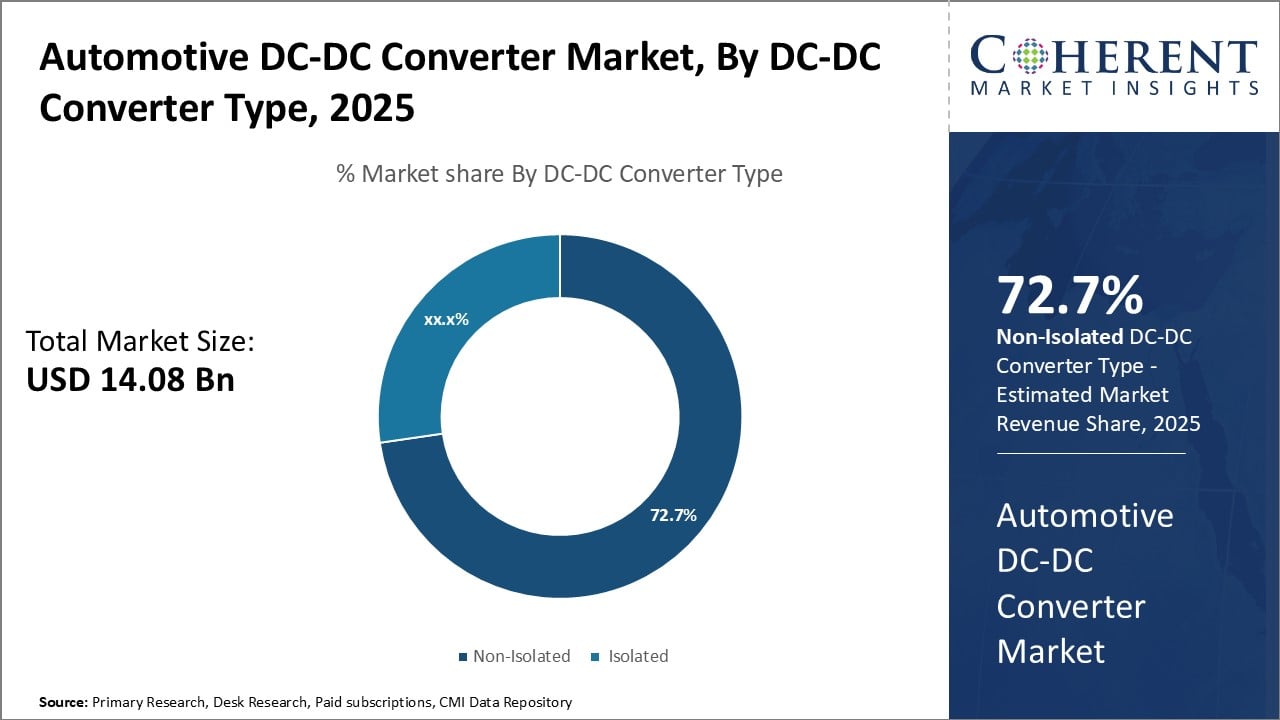
- Demand remains high for non-isolated automotive DC-DC converters, with the target segment expected to account for a 73.0% market share in 2026.
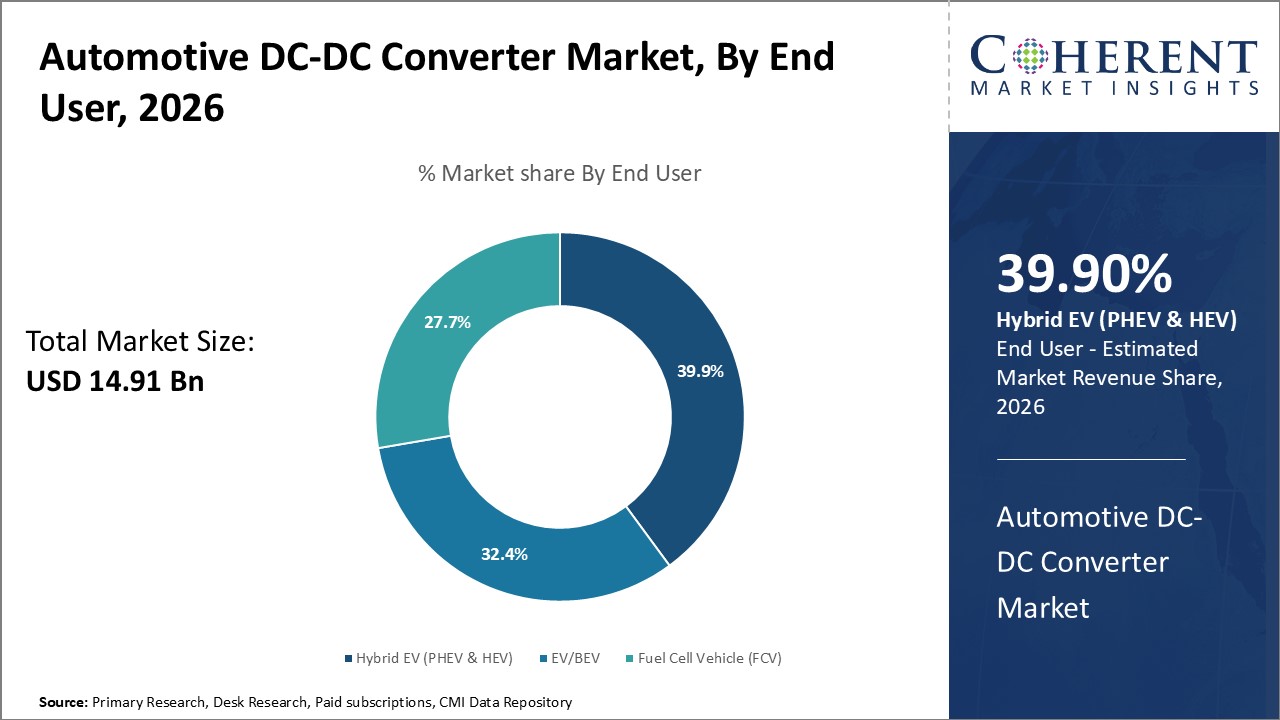
- By end user, hybrid EV (PHEV & HEV) segment is slated to account for 39.9% of the global automotive DC-DC converter market share in 2026.
- Based on system, 12 V system is projected to dominate the industry, capturing 36.9% of the global DC-DC converter industry share by 2026.
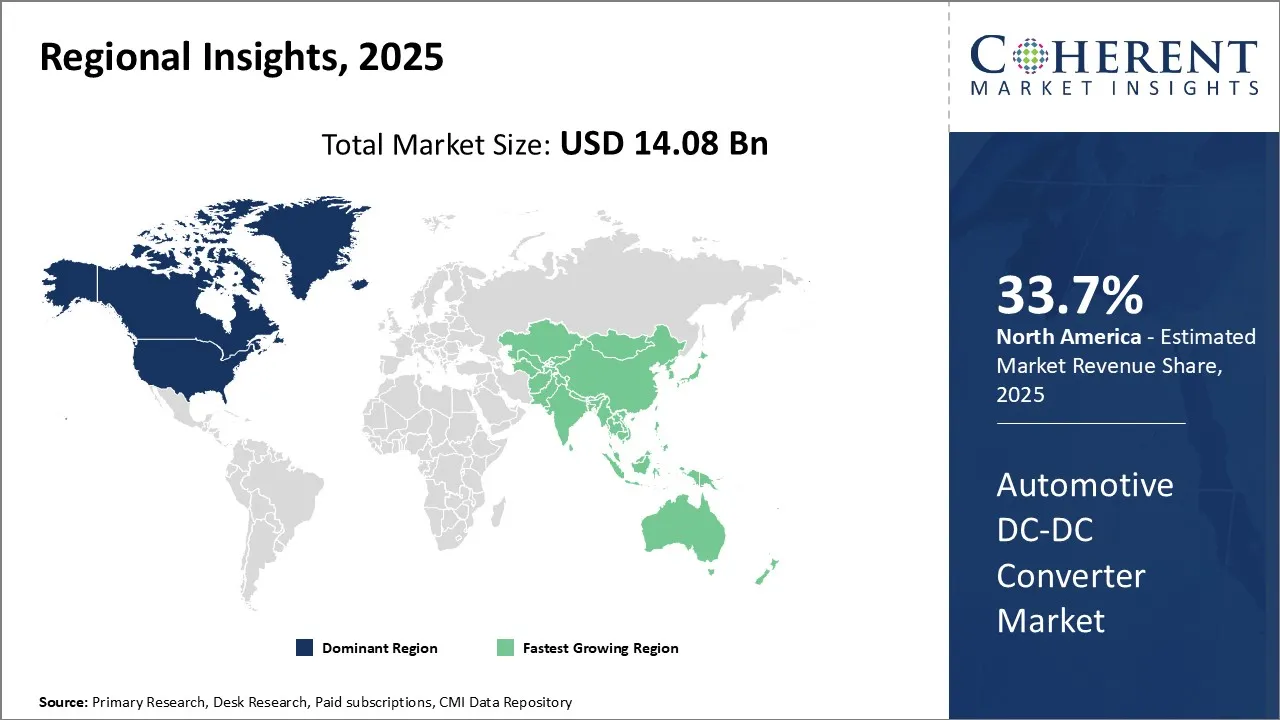
- On the basis of region, North America acquires the largest share of 33.7%.
Automotive DC-DC Converter Market Overview
The global automotive DC-DC converter market is expected to witness significant growth over the forecast period. This is mostly due to rising demand for electric vehicles across the globe and growing need for efficient power management systems in cars.
Expansion of EV charging infrastructure is expected to boost the automotive DC-DC converter market value in the coming years. Similarly, increasing government initiatives to promote sustainable transportation will positively impact automotive DC-DC converter sales.
Demand for electric and hybrid vehicles is rising rapidly across both developed and developing nations due to stringent emission norms and growing environmental concerns. According to the International Energy Agency (IEA), the global electric car sales will likely surpass 20 million in 2025.
This surge in electric vehicle sales is expected to uplift demand for automotive DC-DC converters during the forecast period. Moreover, increasing vehicular production is also fueling the need for effective automotive power management components like DC-DC converters.
Current Events and Their Impact on the Automotive DC-DC Converter Market
Current Event | Description and its Impact |
Global Electric Vehicle Adoption Acceleration |
|
Silicon Carbide (SiC) and Wide Bandgap Semiconductor Revolution |
|
Segmental Insights
- Current Industry Events of 2026
- Market Size Estimation
- Regional Breakdown
- Competitive Landscape
- Customer Intelligence
- Segmental Analysis
- Pricing Analysis
- Key Market Drivers, Challenges & Future Trends
- Customized Insights Section
Automotive DC-DC Converter Market Insights, By DC-DC Converter Type: Non-Isolated DC-DC Converters Gain Traction as Variable Voltage Needs Rise
Based on DC-DC converter type, the non-isolated (buck, boost, etc.) segment is estimated to hold the highest share of the market of 73.0% in 2026. This is attributed to their ability to efficiently regulate variable voltage requirements within vehicles.
Non-isolated converters are simpler in design, which helps reduce manufacturing costs compared to isolated converters. Their configurable nature allows them to step up or step-down voltages as needed to power different electrical components and systems inside modern automobiles.
Leading manufacturers of automotive DC-DC converters are constantly updating their non-isolated portfolios to meet growing end user demand as well as boost their sales. For instance, in October 2024, Vicor launched three new automotive-grade power modules, including the non-isolated PRM3735, aimed at 48 V zonal architectures from 800 V traction battery systems.
Automotive DC-DC Converter Market Insights, By End User: Growing Hybridization Drives Higher Demand in Hybrid EV Segment
Based on end user, hybrid EV (PHEV & HEV) segment is projected to lead the industry, capturing 39.9% of the market share in 2026. This is mostly due to increases in hybrid electric vehicle production volumes.
Hybrid powertrains, which combine traditional internal combustion engines with electric motors and batteries, are seeing widespread adoption as an efficient stepping stone toward fully electric drivetrains. This transition is expected to boost sales of automotive DC-DC converters during the forthcoming period.
Automotive DC-DC Converter Market Insights, By End User: Growing Hybridization Drives Higher Demand in Hybrid EV Segment
Based on end user, hybrid EV (PHEV & HEV) segment is projected to lead the industry, capturing 39.9% of the market share in 2026. This is mostly due to increases in hybrid electric vehicle production volumes.
Hybrid powertrains, which combine traditional internal combustion engines with electric motors and batteries, are seeing widespread adoption as an efficient stepping stone toward fully electric drivetrains. This transition is expected to boost sales of automotive DC-DC converters during the forthcoming period.
Automotive DC-DC Converter Market Insights, By System: Proliferation of Electrical Loads Drives 12V Segment Dominance
In terms of system, 12 V system segment is slated to hold the highest market share of 36.9% in 2026. This is attributable to the immense proliferation of lower voltage ancillary electronics and driver-assistance features that rely on robust 12V power sourcing.
Despite rising 48V architectures, traditional 12V under-the-hood loads like lighting and basic comfort/convenience circuits remain the backbone of most vehicle electrical systems. Advanced driver-assistance systems, including infotainment, telematics, and active safety gear, constantly add more 12V loads.
Digital instrument clusters, connectivity suites, and an array of standard/optional comfort and convenience features all operate at lower voltages. As a result, the 12 V system category is expected to retain its market dominance in the coming years.
Regional Insights
North America Dominates the Global Automotive DC-DC Converter Market
North America dominates the global automotive DC-DC converter industry. It will likely account for 33.7% of the global market share in 2026. This can be attributed to rising sales of electric vehicles and strong presence of leading automotive and technology companies in the region.
Rising adoption of autonomous and connected vehicles is boosting demand for automotive DC-DC converters. Similarly, government policies favoring new energy vehicles adoption are fueling automotive converter technology innovation.
North America is home to some of the leading automotive DC-DC converter companies. These players are constantly launching new solutions to meet evolving needs of the automotive industry. For instance, Eaton Corporation recently launched a new higher power version of its low-voltage 48-volt DC/DC converter for commercial and off-highway vehicles.
The new solution has the tendency to withstand harsh conditions (high ambient temperatures, vibration/shock). The move toward 48 V systems (dual voltage) supports the idea of rising adoption of electrified, connected vehicles in North America.
Asia Pacific Becoming Fastest-Growing Automotive DC-DC Converter Market
Asia Pacific remains at the epicentre of automotive DC-DC converter market growth. This is mostly due to increasing vehicle production and sales in major economies such as China and India.
Large automotive manufacturing hubs and trade relationships have accelerated proliferation of advanced automotive electronics. This is expected to create lucrative growth opportunities for automotive DC-DC converter manufacturers in the region during the forecast period.
Automotive DC-DC Converter Market Outlook – Country-wise
United States Automotive DC-DC Converter Market Trends
The U.S. automotive DC-DC converter industry is growing steadily. This can be attributed to the shift toward vehicle electrification, ADAS integration, and improved power management requirements.
Automakers are adopting high-efficiency converters to support connected and hybrid powertrains. Leading companies such as Texas Instruments, Vicor, and Bel Power Solutions are introducing advanced, compact, and thermally efficient converter architectures suited for EV platforms.
China Automotive DC-DC Converter Market Forecast
China remains one of the fastest-growing markets for automotive DC-DC converters. This is mostly due to aggressive EV manufacturing policies, large-scale EV charging infrastructure, and strong domestic players.
Companies such as BYD, Huawei, and Contemporary Amperex Technology (CATL) are developing high-power, integrated DC-DC systems to enhance EV energy management. Likewise, government's push for NEVs continues to fuel demand for efficient power electronics across passenger and commercial EV segments.
Many international and regional companies are strengthening their presence in China through new facility expansions, mergers, agreements, contracts, and partnerships. For instance, in April 2026, Mahle secured a contract worth €200 million to supply DC‑DC converters for next‑generation battery electric vehicles in China.
Market Concentration and Competitive Landscape
Automotive DC-DC Converter Industry News
- In July 2025, Valeo launched 48 V DC‑DC converters for the independent aftermarket. These new solutions are designed to meet growing demand for energy‑management solutions amid the ongoing shift towards sustainable mobility and increasing vehicle electrification.
- In September 2024, Calex Manufacturing launched a new 4kW HBC Series of bi-directional, liquid-cooled DC-DC converters. These new converters are specifically designed for the expanding e-mobility sector.
- In May 2024, STMicroelectronics launched the A6983 family of automotive‑qualified synchronous step‑down DC/DC converters. These highly integrated solutions are designed to save board space and simplify integration in applications like body electronics, inverter gate‑drivers, and audio systems.
Market Report Scope
Automotive DC-DC Converter Market Report Coverage
| Report Coverage | Details | ||
|---|---|---|---|
| Base Year: | 2025 | Market Size in 2026: | USD 14.91 Bn |
| Historical Data for: | 2020 To 2024 | Forecast Period: | 2026 To 2033 |
| Forecast Period 2026 to 2033 CAGR: | 5.9% | 2033 Value Projection: | USD 22.27 Bn |
| Geographies covered: |
| ||
| Segments covered: |
| ||
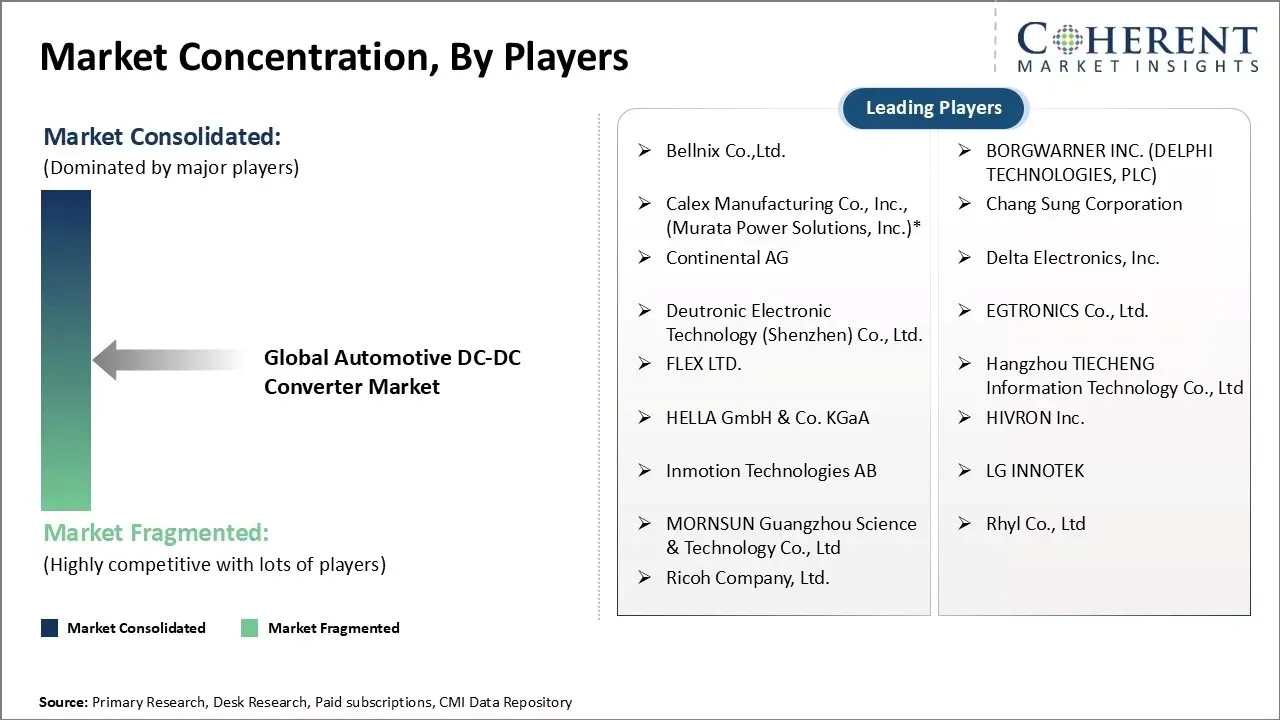
| Companies covered: | Bellnix Co., Ltd., BORGWARNER INC. (DELPHI TECHNOLOGIES, PLC), Calex Manufacturing Co., Inc., (Murata Power Solutions, Inc.), Chang Sung Corporation, Continental AG, Delta Electronics, Inc., Deutronic Electronic Technology (Shenzhen) Co., Ltd., EGTRONICS Co., Ltd., FLEX LTD., Hangzhou TIECHENG Information Technology Co., Ltd, HELLA GmbH & Co. KGaA, HIVRON Inc., Inmotion Technologies AB, LG INNOTEK, MORNSUN Guangzhou Science & Technology Co., Ltd, Rhyl Co., Ltd, and Ricoh Company, Ltd. | ||
| Growth Drivers: |
| ||
| Restraints & Challenges: |
| ||
Automotive DC-DC Converter Market Drivers
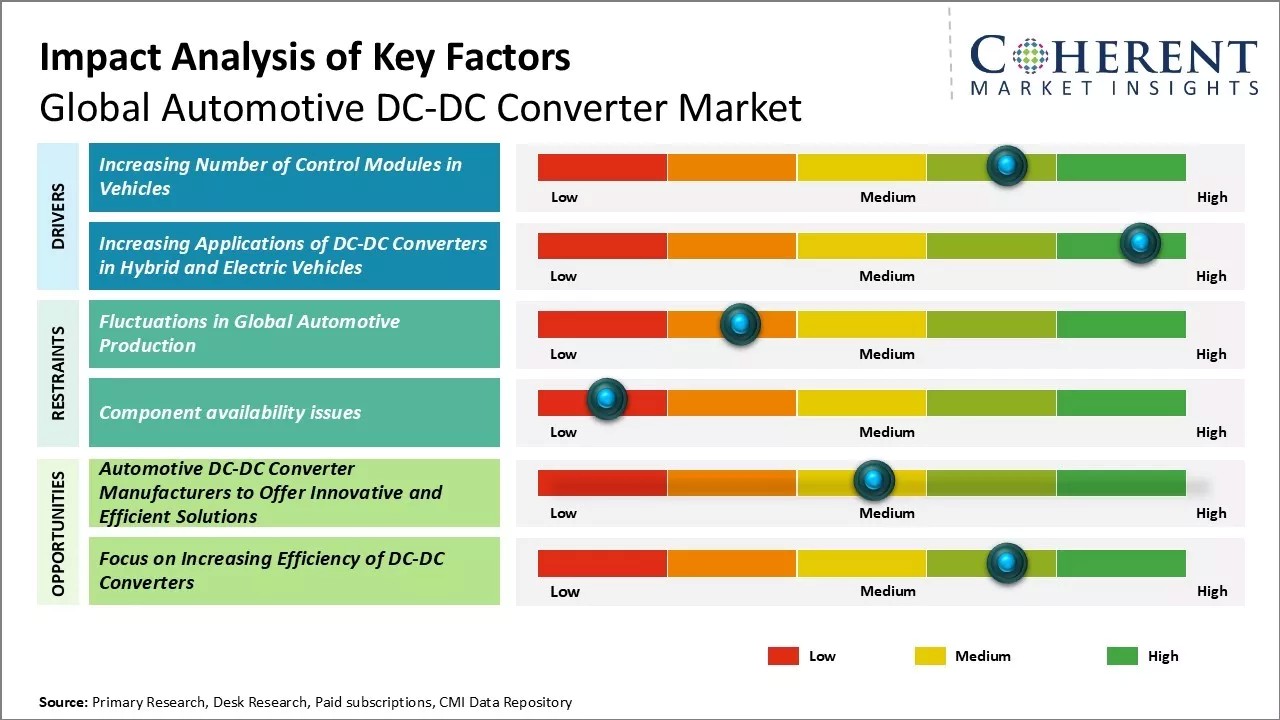
Increasing Number of Control Modules in Vehicles
Modern vehicles are becoming increasingly complex. As a result, they are incorporating a growing number of Electronic Control Units (ECUs) to manage critical functions such as engine and transmission control, advanced driver-assistance systems (ADAS), safety, infotainment, and connectivity. The rising electrification and digitization of vehicles have made them heavily reliant on these electronic modules to ensure precise and automated operation of various systems.
This growing number of ECUs has significantly increased the demand for efficient power management solutions. DC-DC converters play a crucial role in providing stable and appropriate voltage levels to different electronic modules, ensuring reliable operation across all vehicle systems. As the integration of electronic components continues to expand, the need for high-performance DC-DC converters is expected to drive market growth.
Automotive DC-DC Converter Market Opportunity
Introduction of Innovative and Efficient Solutions
The global automotive DC-DC converter market presents numerous opportunities for manufacturers. This is due to rapid electrification of vehicles and rising complexity in automobile electronics architecture.
Automotive DC-DC converter manufacturers can capitalize on this trend by developing innovative and highly efficient solutions. They can focus on developing multi-output DC-DC converters with high power density and load response to meet the evolving power requirements of different automotive systems and components.
Automotive DC-DC Converter Market Challenges
High Costs and Fluctuations in Global Automotive Production
The global automotive DC-DC converter market outlook appears promising, owing to rising demand for electric and hybrid vehicles. However, fluctuations in the global automotive production and high costs might slow down market growth to some extent during the forecast period.
Automotive DC-DC converters require advanced materials, high-power semiconductors, and compact designs to meet efficiency and safety standards. These factors make the converters expensive to develop and produce.
Many automakers, especially in cost-sensitive vehicle segments, may delay adoption or use simpler alternatives. This can slow down automotive DC-DC converter market growth during the forthcoming period.
In addition, the automotive DC-DC converter industry is closely tied to global vehicle production. Any decline in vehicle manufacturing can directly reduce the overall DC-DC converter market demand.
Analyst Opinion (Expert Opinion)
- The automotive DC‑DC converter landscape is evolving far beyond simple voltage step‑downs. Converters are becoming strategic enablers of vehicle electrification architecture, especially as OEMs migrate from 400 V to 800 V systems and deploy higher‑voltage auxiliary networks.
- Efficiency and integration are now non‑negotiable. Wide‑bandgap devices (SiC, GaN) enable higher switching frequencies and smaller magnetic components, and digital controls turn converters into data‑nodes. In one teardown, standardized platforms reduced converter variants and pushed power density from 4‑5 kW/L to 7‑8 kW/L.
- The margin game is tightening. While demand is expanding rapidly (many sources point to 20‑30%+ annual growth), OEMs are increasingly insisting on cost, size, thermal, and software performance targets. Suppliers that remain “converter‑box providers” risk commoditisation. Those that deliver multi‑rail, bidirectional, thermal‑managed, software‑enabled converters will command higher value.
- Commercial vehicles and 48 V architectures represent under‑played opportunities. While passenger BEVs get the headlines, commercial EVs require larger auxiliary loads (hydraulics, lifts, thermal pumps), the data show commercial vehicles growing at ~20%+ CAGR through 2030.
Speak to the analyst
Want personalized insights?
Take the findings above to one of our principal consultants, or have the report rebuilt around the segments, geographies and competitors you actually track.
Market Segmentation
- By DC-DC Converter Type Insights (Revenue, USD, 2021 - 2033)
- Non-Isolated (Buck, Boost, etc.)
- Isolated
- By End User Insights (Revenue, USD, 2021 - 2033)
- Hybrid EV (PHEV & HEV)
- EV/BEV
- Fuel Cell Vehicle (FCV)
- By System Insights (Revenue, USD, 2021 - 2033)
- 12 V system
- 24 V System
- 48 V System & Above
- By Vehicle Type Insights (Revenue, USD, 2021 - 2033)
- Passenger Cars
- Commercial Vehicles
- Regional Insights (Revenue, USD, 2021 - 2033)
- North America
- U.S.
- Canada
- Latin America
- Brazil
- Argentina
- Mexico
- Rest of Latin America
- Europe
- Germany
- U.K.
- Spain
- France
- Italy
- Russia
- Rest of Europe
- Asia Pacific
- China
- India
- Japan
- Australia
- South Korea
- ASEAN
- Rest of Asia Pacific
- Middle East
- GCC Countries
- Israel
- Rest of Middle East
- Africa
- South Africa
- North Africa
- Central Africa
- Key Players Insights
- Bellnix Co., Ltd.
- BORGWARNER INC. (DELPHI TECHNOLOGIES, PLC)
- Calex Manufacturing Co., Inc., (Murata Power Solutions, Inc.)
- Chang Sung Corporation
- Continental AG
- Delta Electronics, Inc.
- Deutronic Electronic Technology (Shenzhen) Co., Ltd.
- EGTRONICS Co., Ltd.
- FLEX LTD.
- Hangzhou TIECHENG Information Technology Co., Ltd
- HELLA GmbH & Co. KGaA
- HIVRON Inc.
- Inmotion Technologies AB
- LG INNOTEK
- MORNSUN Guangzhou Science & Technology Co., Ltd
- Rhyl Co., Ltd
- Ricoh Company, Ltd.
Sources
Primary Research interviews
- Interviews with automotive OEM power‑electronics engineers (e.g., lead design of voltage‑conversion modules)
- Supplementary interviews with automotive Tier‑1 suppliers of DC‑DC converter modules
- Discussions with component‑suppliers of GaN/SiC devices used in automotive DC‑DC converters
Databases
- Global technical standards databases (e.g., IEC, ISO) for voltage‑conversion modules in vehicles
- Patent databases (e.g., USPTO, EPO) covering DC‑DC converter topologies in EV/HEV applications
- Vehicle registration / EV fleet databases (national government or transport authorities) to derive installed base of electrified vehicles
Magazines
- Electronics For You — e.g., article “Latest DC‑DC Converters for Automotive & Industrial Application” covering new launches and trends.
- EDN — e.g., “Designing an automotive micro DC/DC converter (300‑W output)” article.
- Power Electronics News (or equivalent) – for product announcements and industry features on automotive power‑electronics
Journals
- Kotb R., “Power Electronics Converters for Electric Vehicle Auxiliaries” (Energies journal, 2023) — comparative study of DC‑DC converter topologies.
- DI Lorenzo R., “DC‑DC Buck Converter for Automotive Applications” (dissertation / journal) — addressing transient voltages in automotive environments.
- Korte C., Luetje T., Goetz S., “Synchronous Multistep Predictive Spectral Control of the Switching Distortion in DC‑DC Converters” (arXiv/open‑access) — technical control scheme for automotive DC‑DC.
Newspapers
- Major business/industry newspapers covering electric vehicle‑electrification trends and automotive component supply (e.g., The Hindu Business Line, Economic Times India, Automotive News)
- Example content: interview with Nicolas Richard on automotive 12 V battery alternatives (relevant for DC‑DC converter context)
Associations
- IEEE Vehicular Technology Society (VTS) – covers vehicular electronics and power systems broadly.
- National/pan‑industry associations for automotive electronics and electrified vehicles (e.g., motor‑vehicle manufacturers associations, power electronics associations)
- Technical working‑groups for power‑electronics in automotive systems (via standards bodies)
Public Domain sources
- Handbook of Automotive Power Electronics and Motor Drives (SCU/digital library) – provides baseline technical reference.
- Roadmap document “Power Electronics, Machines and Drives” (TIFAC India) – on GaN/SiC technology for DC‑DC converters in EVs.
- Component‑supplier product pages (e.g., Infineon Technologies AG automotive DC‑DC converter portfolio) – for functional & application context.
Proprietary Elements
- CMI Data Analytics Tool
- Proprietary CMI Existing Repository of information for last 8 years
Get access to 250+ pages report
Every segment, forecast, competitor profile and data table behind the analysis above — available for instant download.
- ESOMAR Member
- ISO 9001:2015 Certified
- D-U-N-S Registered
- GDPR & CCPA Compliant
Missing comfort of reading report in your local language? Find your preferred language:
Transform your Strategy with Exclusive Trending Reports
Frequently Asked Questions
The Automotive DC-DC Converter Market is estimated to be valued at USD 14.91 Bn in 2026, and is expected to reach USD 22.27 Bn by 2033.
The global automotive DC-DC converter industry size is expected to reach USD 22.27 Bn by 2033.
The global market is poised to exhibit a CAGR of 5.9% from 2026 to 2033.
Major growth drivers include rising adoption of electric and hybrid vehicles and increasing number of control modules in vehicles.
High costs and fluctuations in global automotive production are expected to limit market growth.
Non-isolated DC-DC converters remain the popular type.
Major players include Bellnix Co.,Ltd., BORGWARNER INC. (DELPHI TECHNOLOGIES, PLC), Calex Manufacturing Co., Inc., (Murata Power Solutions, Inc.)*, Chang Sung Corporation, Continental AG , Delta Electronics, Inc., Deutronic Electronic Technology (Shenzhen) Co., Ltd., EGTRONICS Co., Ltd., FLEX LTD., Hangzhou TIECHENG Information Technology Co., Ltd, HELLA GmbH & Co. KGaA, HIVRON Inc., Inmotion Technologies AB, LG INNOTEK, MORNSUN Guangzhou Science & Technology Co., Ltd , Rhyl Co., Ltd, and Ricoh Company, Ltd.