

Advanced Driver Assistance System Market Size and Forecast – 2026 to 2033
The global advanced driver assistance system market is expected to exhibit a compound annual growth rate (CAGR) of 12.5% during the forecast period, reaching USD 99.83 Bn by 2033, up from USD 43.77 Bn in 2026.
Key Takeaways from the Advanced Driver Assistance System Market Report
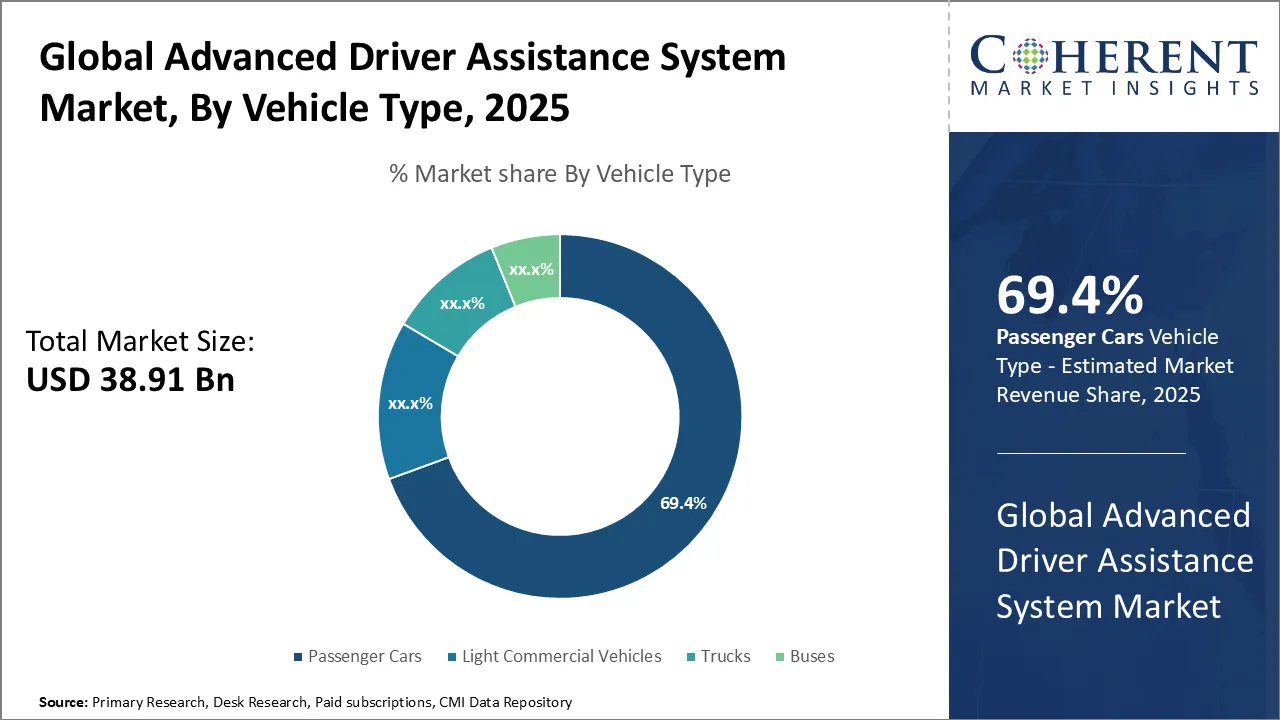
- By vehicle type, passenger vehicles segment is expected to dominate the ADAS market with a share of 85.4% in 2026.
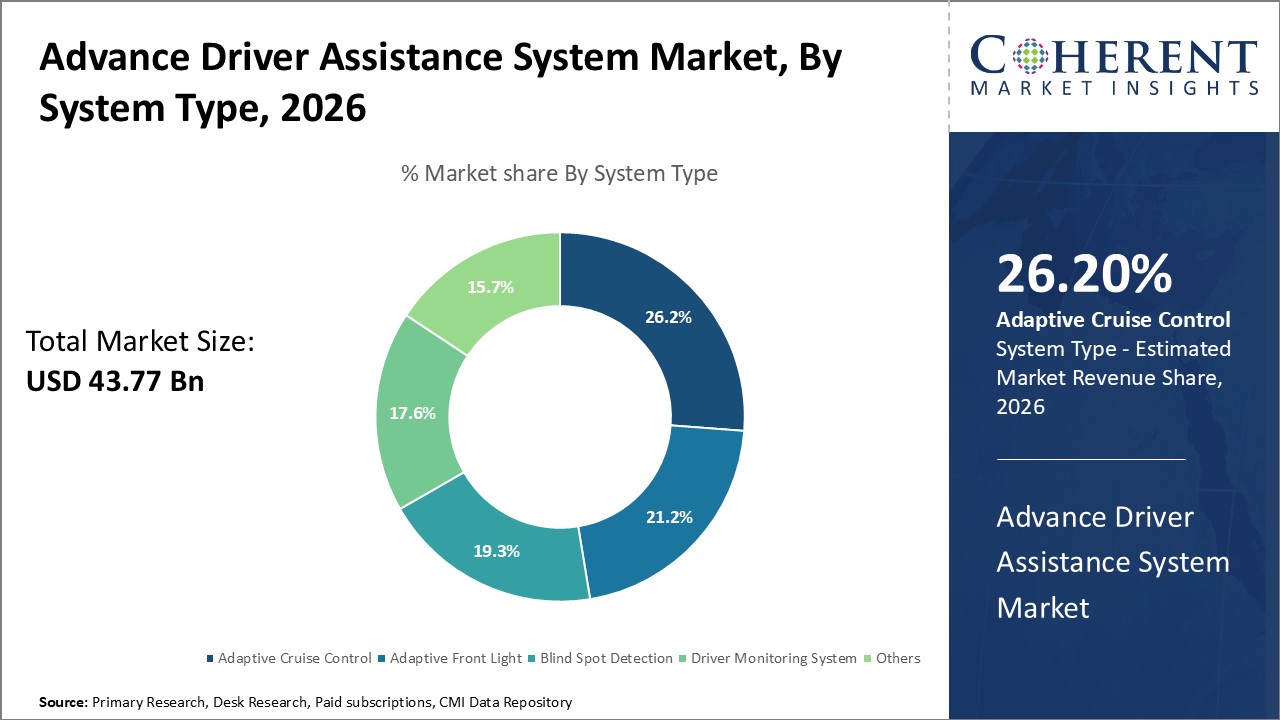
- Based on system type, adaptive cruise control (ACC) segment is slated to account for 26.2% of the global advanced driver assistance system market share in 2026.
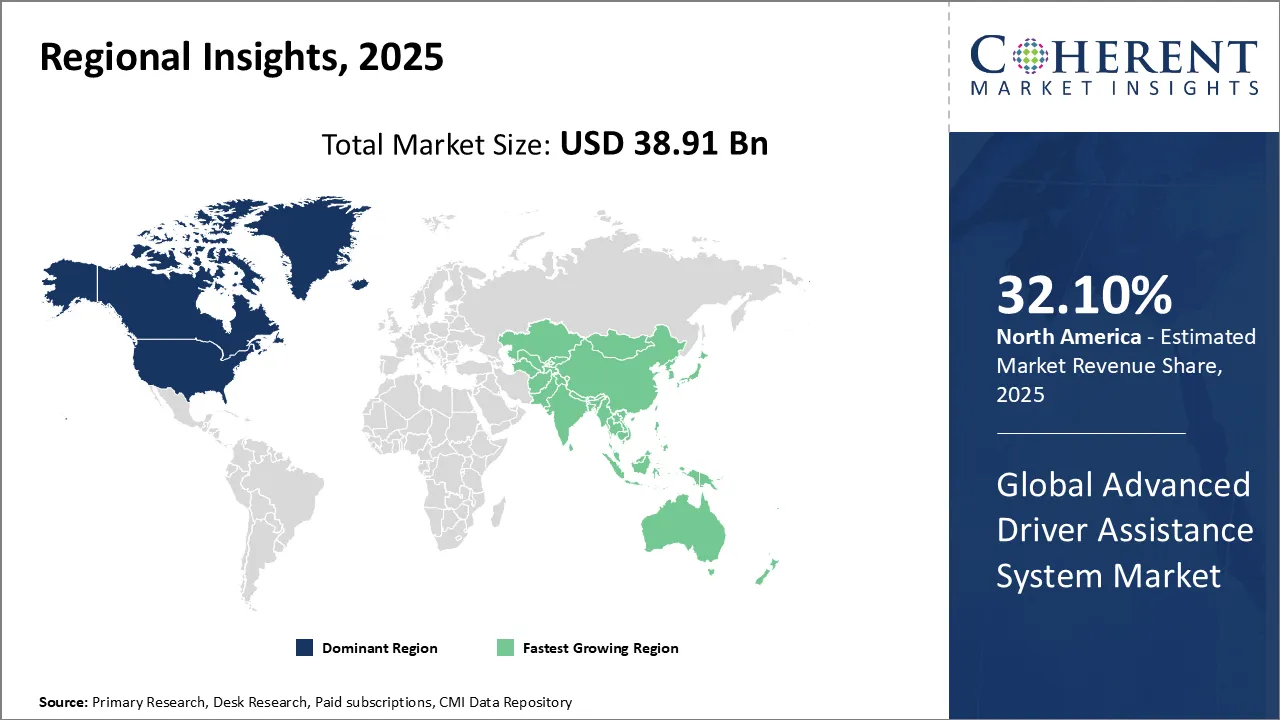
- North America is expected to retain its market dominance, accounting for a prominent share of 32.1% in 2026.
- Asia Pacific, with an estimated share of 27.8% in 2026, is poised to emerge as the fastest growing advanced driver assistance system market.
Advanced Driver Assistance System Market Overview
The global advanced driver assistance system market is expected to witness robust growth during the forecast period. This is mostly due to increasing demand for safety features in automotive vehicles and government regulations regarding vehicle safety.
Adoption of autonomous driving technology and development of semi-autonomous vehicles integrated with advanced driver assistance system (ADAS) solutions are increasing globally. This, in turn, is stimulating growth of the advanced driver assistance system market.
Increasing demand for comfort driving and focus on reducing road accidents are major trends in the advanced driver assistance system market. There is an increase in vehicle accidents globally. For instance, according to the World Health Organization (WHO), around 1.19 million people die each year from road traffic crashes worldwide.
Similarly, an estimated 20 to 50 million people suffer non‐fatal injuries from road crashes each year globally. This rise in road accidents is acting as a catalyst triggering sales of advanced driver assistance systems. However, high development cost of advanced driver assistance systems may hamper market growth over the forecast period.
Current Events and Their Impact on the Advanced Driver Assistance System Market
Current Event | Description and its Impact |
Global Regulatory Push for Vehicle Safety Standards |
|
Electric Vehicle Market Acceleration and Integration |
|
Segmental Insights
- Current Industry Events of 2026
- Market Size Estimation
- Regional Breakdown
- Competitive Landscape
- Customer Intelligence
- Segmental Analysis
- Pricing Analysis
- Key Market Drivers, Challenges & Future Trends
- Customized Insights Section
Advanced Driver Assistance System Market Insights, By Vehicle Type: Passenger Vehicles Drive Growth in ADAS Market Due to Safety and Convenience Demand
The passenger vehicles segment currently dominates ADAS market and is expected to hold a share of 85.4% in 2026. This is attributable to strong consumer demand for advanced safety and convenience features in personal vehicles.
As semi-autonomous and autonomous driving features become more common, safety-conscious consumers are choosing cars and SUVs with advanced driver assistance systems. Automakers are supporting this trend by including these technologies as standard on more models and trims. This widespread adoption is expected to fuel growth in the ADAS market during the forthcoming period.
For instance, according to the MITRE Corporation’s PARTS report, for the 2023 model year, penetration rates for key ADAS features in passenger vehicles reached as high as 94%. Many other important safety systems, like lane detection and pedestrian detection, also exceeded 92% adoption.
A major factor fueling the passenger vehicle segment is the growing consumer expectation for active and passive safety improvements. With rising vehicle ownership globally and increased road congestion in many areas, drivers appreciate technology that can help avoid accidents caused by human error or distractions.
Adaptive cruise control, automatic emergency braking, blind spot monitoring, and similar systems are increasingly recognized as valuable innovations. They offer drivers enhanced safety as well as greater confidence on the road.
Along with safety, convenience has become another strong selling point for driver assistance systems in personal vehicles. Adaptive cruise control, lane keeping assist, and parking assistance make long trips and navigation in busy areas less stressful.
Advanced Driver Assistance System Market Insights, By System Type: Adaptive Cruise Control (ACC) Leads Due to Widespread Popularity and Safety Benefits
As per CMI’s latest advanced driver assistance system market analysis, adaptive cruise control (ACC) segment is expected to dominate the market. It will likely account for the largest market share of 26.2% in 2026.
ACC is popular because it makes driving safer and more comfortable in different conditions. Unlike regular cruise control, which only keeps your car at a set speed, ACC uses sensors or radar to watch the traffic ahead and automatically adjusts your speed to keep a safe distance from the car in front.
In addition, ACC supports more complex driving scenarios than some other single-function systems. It works on highways as well as surface streets, providing assistance in both high-speed and low-speed traffic environments where incidents can occur.
ACC’s adaptive functionality means it can react appropriately to cut in vehicles or sudden braking ahead without requiring driver correction. This multi-scenario usability has broader consumer appeal than technologies limited to certain situations like parking assists.
Automakers are also incorporating ACC into more vehicle lines as a feature to attract buyers. Its strong value proposition as an active safety system that also enhances convenience has helped drive robust demand and placement in both luxury nameplates and mainstream models. As ACC adoption spreads, more drivers experience its benefits firsthand, solidifying its leading position among advanced assistance technologies.
Regional Insights
North America Dominates the Global Advanced Driver Assistance System Market
North America, with an estimated share of 32.1% in 2026, is expected to lead the advanced driver assistance system market during the forthcoming period. This is mostly due to the strong presence of key automotive manufacturers, early adoption of advanced vehicle safety technologies, and stringent government regulations.
With a developed automotive industry and the presence of major OEMs and Tier 1 suppliers, the region has seen early adoption of advanced driver assistance technologies. Stringent safety regulations by National Highway Traffic Safety Administration (NHTSA) in the U.S. have further accelerated the integration of passive and active safety systems in vehicles.
Additionally, higher consumer spending on luxury and premium vehicles equipped with advanced driver conveniences is boosting the deployment of ADAS solutions. Key players like Mobileye, Aptiv, and Magna with large R&D investments are driving innovations in the region.
Asia Pacific Becoming a Hub for Advanced Driver Assistance System Manufacturers
Asia Pacific is expected to offer lucrative growth opportunities for advanced driver assistance systems. It will likely account for 27.8% of the global advanced driver assistance system industry share in 2026.
Rapid economic development and rising per capita income have increased automobile ownership, especially in emerging countries like China and India. With growing congestion and road accidents, governments are encouraging the adoption of safety features to mitigate risks.
Similarly, local automakers are standardizing ADAS to meet evolving regulations as well as demands of tech-savvy customers. For example, Hyundai-Kia's usage-based insurance programs promote driver assistance systems. Along with a thriving component manufacturing base, these factors are expected to fuel Asia Pacific's foothold as the dominant global advanced driver assistance system market in the long term.
Advanced Driver Assistance System Market Outlook – Country-wise
United States Advanced Driver Assistance System Market Forecast
The U.S. is projected to account for a prominent share of the global advanced driver assistance system market during the forecast period. This is mostly due to high vehicle parc and growing consumer focus on luxury vehicles.
Regulatory support from NHTSA through updates to Federal Motor Vehicle Safety Standards (FMVSS) is boosting the integration of solution beyond premium segments. Companies like Ford with rich talent pools are introducing scalable platforms to deliver assisted driving experiences across model ranges.
China Advanced Driver Assistance System Market Trends
China continues to lead the Asia-Pacific advanced driver assistance system (ADAS) industry. This is mostly due to broader industrial policies such as Made in China 2026. Localization efforts by global automakers, including Tesla’s Shanghai Gigafactory, have strengthened the capabilities of domestic suppliers. Meanwhile, Baidu’s open Apollo platform for assisted driving development underscores China’s push toward digital and intelligent mobility.
Top Strategies Followed by Global Advanced Driver Assistance System Market Players
- Established Players: Leading companies focus on full-stack ADAS platforms, strategic acquisitions, and AI-enhanced perception technologies to maintain market dominance and support autonomous mobility. Major players like Bosch, Continental AG, and Mobileye invest in scalable solutions for OEMs and autonomous driving initiatives. For example, Mobileye, an Intel subsidiary, launched its EyeQ Ultra chip tailored for autonomous vehicles, combining radar, Light Detection and Ranging (LiDAR), and vision processing in a single platform. Meanwhile, Continental AG partnered with Aptiv to co-develop integrated ADAS systems and expand software-defined vehicle capabilities. Additionally, Bosch acquired Five.ai, a U.K.-based autonomous driving startup, to enhance its urban ADAS and self-driving software stack.
- Mid-level Players:Mid-sized companies are adopting strategies like regional market penetration, collaboration with Electric Vehicle (EV) manufacturers, and modular ADAS system offerings to capture emerging markets and flexible deployment. Firms such as Valeo, ZF Friedrichshafen, and Aisin Seiki focus on optimizing cost-to-performance ratios. For instance, ZF Friedrichshafen partnered with Beep Inc. to supply autonomous shuttle systems in the U.S., demonstrating modular ADAS scalability. Valeo launched its SCALA 3 LiDAR, offering long-range 3D vision to support Level 2+ and Level 3 autonomy for premium and mid-range vehicles. Aisin Seiki developed cost-effective driver-monitoring systems (DMS) tailored for APAC automakers entering the ADAS space.
- Small-scale Players: Smaller companies differentiate by focusing on niche applications, aftermarket and retrofit ADAS, and software-first innovations that target SMEs and fleet operators. These players often deliver agility through cloud-based analytics, open-source platforms, or sensor-specific tools. Nauto, for example, provides real-time AI-powered collision prediction systems for fleet vehicles, helping small logistics companies improve driver safety. Comma.ai offers an open-source retrofit ADAS kit (Comma 3X) enabling semi-autonomous capabilities for select vehicles. Phantom AI builds scalable computer vision and radar perception software that integrates with low-cost hardware for use in mid-tier vehicles and shared mobility platforms.
Automotive DC-DC Converter Industry News
- In September 2025, Valeo collaborated with Capgemini to test and validate a new ADAS system up to Level 2+. This solution is designed to improve vehicle safety as well as help reduce accidents.
- In March 2025, Leapmotor announced that it plans to introduce vehicles equipped with its advanced smart-driving technologies in Europe by 2026.
- In June 2025, Mahindra & Mahindra added Level 2 ADAS to the Scorpio‑N to improve safety and technology. This system offers features such as automatic emergency braking, adaptive cruise control, and lane-keeping assistance.
- In March 2025, Volkswagen Group collaborated with Mobileye and Valeo to improve driver assistance in future MQB vehicles. This cooperation will look to enhance safety and driving comfort in high-volume vehicles, addressing both regulatory requirements and customer expectations.
- In March 2024, Valeo opened a new plant in Daegu, Korea, for the production of advanced driver assistance systems. This facility will help the company to meet growing end user demand for ADAS in the region.
Market Report Scope
Advanced Driver Assistance System Market Report Coverage
| Report Coverage | Details | ||
|---|---|---|---|
| Base Year: | 2025 | Market Size in 2026: | USD 43.77 Bn |
| Historical Data for: | 2020 To 2024 | Forecast Period: | 2026 To 2033 |
| Forecast Period 2026 to 2033 CAGR: | 12.5% | 2033 Value Projection: | USD 99.83 Bn |
| Geographies covered: |
| ||
| Segments covered: |
| ||
| Companies covered: | Continental AG, Autoliv Inc., Magna International Inc., Mobileye N.V., Hyundai Mobis, Intel Corp, Denso Corp, Garmin Ltd, Infineon Technologies AG, Robert Bosch Engineering & Business Solutions, Valeo SA, ZF Friedrichshafen AG, Delphi Technologies, Aptiv PLC, and NVIDIA Corporation | ||
| Growth Drivers: |
| ||
| Restraints & Challenges: |
| ||
Advanced Driver Assistance System Market Drivers
Stringent Government Regulations Mandating Vehicle Safety Features
With rising concerns for road safety, governments across the globe are introducing stringent regulations for vehicle safety features. Many countries have now made several advanced driver assistance systems compulsory for new vehicles.
For instance, the European Union has mandated that all new vehicles be equipped with an Advanced Emergency Braking System (AEBS) starting in 2022. Such government interventions are aimed at reducing road accidents significantly.
Automakers are obliged to equip their vehicles with technologically advanced safety features to comply with the new norms. This growing legislative push is notably driving the adoption of advanced driver assistance systems among automakers globally. The regulatory landscape will continue to become more conducive for driver assistance technologies in the coming years to enhance road safety.
Advanced Driver Assistance System Market Opportunity
Advancements in Autonomous Vehicle Technologies
One of the big opportunities for the global advanced driver assistance system market comes from the advancements happening in autonomous vehicle technologies. While full self-driving capabilities are still being developed, various vehicle automation features require advanced driver assistance systems.
Advances in technology such as computer vision, sensor fusion, and powerful computing, first developed for self-driving cars, are now improving ADAS too. This includes better automatic emergency braking, traffic jam assistance, parking help, and highway driving features.
Leading companies are developing advanced ADAS solutions to improve vehicle safety and functionalities, as well as meet evolving customer expectations. For instance, in April 2025, Volkswagen Group in China unveiled a new AI-powered ADAS system for the next generation of intelligent electric vehicles.
As autonomous vehicle technologies mature over the next decade, more ADAS capabilities will be introduced across vehicle segments. The huge investments and breakthroughs in autonomous driving will work towards developing more affordable, standardized ADAS solutions as well. This promises to significantly expand the market size and uptake of advanced driver assistance systems globally.
Advanced Driver Assistance System Market Challenges
High Costs Associated with ADAS Technologies
One of the major challenges currently faced by the global advanced driver assistance system market is the high costs associated with these technologies. Developing and integrating advanced sensor fusion, computer vision, collision avoidance, and other ADAS features requires heavy investment in R&D.
Automakers need to invest huge sums in developing and testing these systems to ensure safety, reliability, and compliance with regulations. The components and hardware required for ADAS, like cameras, radars, ultrasonic sensors, etc., are also quite expensive for mass adoption. This makes it difficult for automakers to offer ADAS as standard even in high-end vehicles and limits their uptake.
The ongoing chip shortage has further increased costs. For wider acceptance and penetration, automakers will need to bring down the prices of ADAS technologies significantly through economies of scale and standardization. This remains a major hurdle for the short to medium term growth of the advanced driver assistance system market.
Analyst Opinion (Expert Opinion)
- The advanced driver assistance systems market is projected to witness robust growth during the forthcoming period. This is mostly due to rising safety regulations, growing consumer demand for semi-autonomous features, and technological advancements in sensor fusion, AI, and machine learning. In addition, the integration of ADAS into electric and next-gen vehicles is expected to further accelerate its adoption across developed and emerging markets.
- North America is expected to continue dominating the market owing to its strong automotive ecosystem, early adoption of ADAS technologies, and regulatory mandates promoting road safety. However, Asia Pacific is anticipated to be the fastest-growing region, fueled by rising vehicle production, increasing urbanization, and government investments in intelligent transport infrastructure.
- The shift toward L2+ and L3 automation is a key inflection point. More than 60% of new vehicles sold globally in 2024 integrated at least one ADAS feature, such as adaptive cruise control or lane-keeping assist. Tesla’s camera-only “vision-first” strategy remains controversial, yet it has reshaped how OEMs perceive cost-performance trade-offs. In contrast, European manufacturers like Mercedes-Benz and BMW continue to pursue redundancy through multi-sensor architectures combining radar, LiDAR, and vision, citing higher reliability under adverse weather conditions. This divergence underscores the fragmentation in ADAS design philosophy and it will persist until L4 autonomy sees commercial viability.
- Another often-overlooked trend is the localization of ADAS calibration and mapping data. With the EU’s proposed Data Act and China’s strict data sovereignty rules, automakers are being forced to maintain region-specific datasets for lane markings, signage recognition, and geofencing, thereby fragmenting global scalability. This presents a challenge for players like Mobileye, whose REM mapping relies on aggregated crowd-sourced data.
- Ultimately, ADAS is no longer a differentiator; it’s becoming a baseline for automotive credibility. The next competitive frontier lies in predictive intelligence, the ability of vehicles to anticipate driver intent and external hazards before they manifest. That, not mere autonomy, will define the winners of the next decade.
Speak to the analyst
Want personalized insights?
Take the findings above to one of our principal consultants, or have the report rebuilt around the segments, geographies and competitors you actually track.
Market Segmentation
- Vehicle Type Insights (Revenue, USD Bn, 2021 - 2033)
- Passenger Vehicles
- Commercial Vehicles
- System Type Insights (Revenue, USD Bn, 2021 - 2033)
- Adaptive Cruise Control (ACC)
- Lane Departure Warning (LDW)
- Automatic Emergency Braking (AEB)
- Blind Spot Detection (BSD)
- Parking Assistance
- Others
- Regional Insights (Revenue, USD Bn, 2021 - 2033)
- North America
- U.S.
- Canada
- Latin America
- Brazil
- Argentina
- Mexico
- Rest of Latin America
- Europe
- Germany
- U.K.
- Spain
- France
- Italy
- Russia
- Rest of Europe
- Asia Pacific
- China
- India
- Japan
- Australia
- South Korea
- ASEAN
- Rest of Asia Pacific
- Middle East
- GCC Countries
- Israel
- Rest of Middle East
- Africa
- South Africa
- North Africa
- Central Africa
- North America
- Key Players Insights
- Continental AG
- Autoliv Inc.
- Magna International Inc.
- Mobileye N.V.
- Hyundai Mobis
- Intel Corp
- Denso Corp
- Garmin Ltd
- Infineon Technologies AG
- Robert Bosch Engineering & Business Solutions
- Valeo SA
- ZF Friedrichshafen AG
- Delphi Technologies
- Aptiv PLC
- NVIDIA Corporation
Sources
Primary Research Interviews
- Industry experts
- OEM engineers
- Automotive safety system developers
- Tier-1 and Tier-2 component suppliers
- ADAS software developers
- Autonomous vehicle researchers
- Representatives from government regulatory bodies and automotive standardization organizations
Databases
- World Bank Data
- International Energy Agency (IEA) Mobility Database
- United Nations Economic Commission for Europe (UNECE) Transport Database
- National Highway Traffic Safety Administration (NHTSA) Database
- Euro NCAP Data
- U.S. Department of Transportation (DOT) Statistics
Magazines:
- Automotive News
- Autocar Professional
- SAE Automotive Engineering
- Motor Trend
- Car and Driver, and Automotive World
Journals
- IEEE Transactions on Intelligent Vehicles
- Journal of Intelligent Transportation Systems
- Transportation Research Part C: Emerging Technologies
- Sensors Journal (MDPI)
- Elsevier’s Journal of Safety Research
Newspapers
- The Wall Street Journal
- The Guardian
- The Economic Times (Auto Section)
- The Japan Times (Automotive)
- The New York Times (Technology Section).
Associations
- Society of Automotive Engineers (SAE International)
- International Organization of Motor Vehicle Manufacturers (OICA)
- European Automobile Manufacturers’ Association (ACEA)
- Japan Automobile Manufacturers Association (JAMA)
- Automotive Component Manufacturers Association of India (ACMA)
Public Domain Sources
- Official websites of automotive OEMs (e.g., BMW, Tesla, Toyota, Ford, and Volkswagen)
- Government transport and safety agencies
- Open-access automotive technology portals
- Patent databases (Google Patents, WIPO).
Proprietary Elements
- CMI Data Analytics Tool
- Proprietary CMI Existing Repository of information for last 8 years.
Get access to 250+ pages report
Every segment, forecast, competitor profile and data table behind the analysis above — available for instant download.
- ESOMAR Member
- ISO 9001:2015 Certified
- D-U-N-S Registered
- GDPR & CCPA Compliant
Missing comfort of reading report in your local language? Find your preferred language:
Transform your Strategy with Exclusive Trending Reports
Frequently Asked Questions
The global advance driver assistance system market is estimated to be valued at USD 43.77 Bn in 2026 and is expected to reach USD 99.83 Bn by 2033.
The CAGR of the global advance driver assistance system market is projected to be 12.5% from 2026 to 2033.
Stringent government regulations mandating vehicle safety features and rising consumer awareness and demand for vehicle safety and comfort are the major factors driving the growth of the global advance driver assistance system market.
High costs associated with ADAS technologies and complexities in system integration and potential reliability issues are the major factors hampering the growth of the global advance driver assistance system market.
In terms of vehicle type, the passenger vehicles segment is estimated to dominate the market revenue share in 2026.
Continental AG, Autoliv Inc., Magna International Inc., Mobileye N.V., Hyundai Mobis, Intel Corp, Denso Corp, Garmin Ltd, Infineon Technologies AG, Robert Bosch Engineering & Business Solutions, Valeo SA, ZF Friedrichshafen AG, Delphi Technologies, Aptiv PLC, and NVIDIA Corporation are the major players.
North America is expected to lead the global advance driver assistance system market in 2026, holding a share of 32.1%.