

Global Adaptive Cruise Control Market Size and Forecast – 2026-2033
The global adaptive cruise control market is estimated to be valued at USD 48.57 Bn in 2026 and is expected to reach USD 85.43 Bn by 2033, exhibiting a compound annual growth rate (CAGR) of 8.4% from 2026 to 2033.
Key Takeaways of the Global Adaptive Cruise Control Market
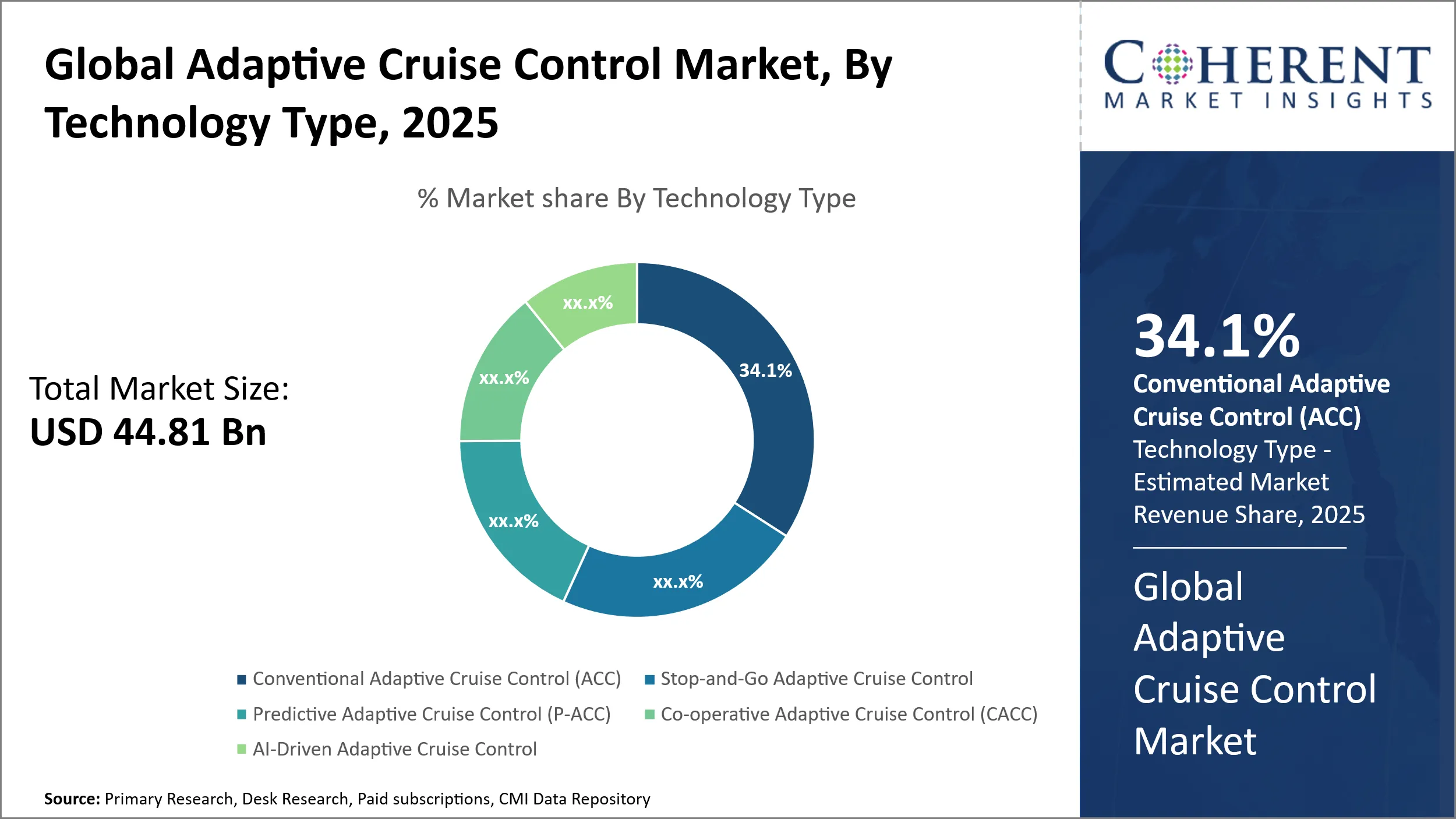
- The conventional adaptive cruise control (ACC) segment is expected to lead the market holding a share of 35.1% in 2026.
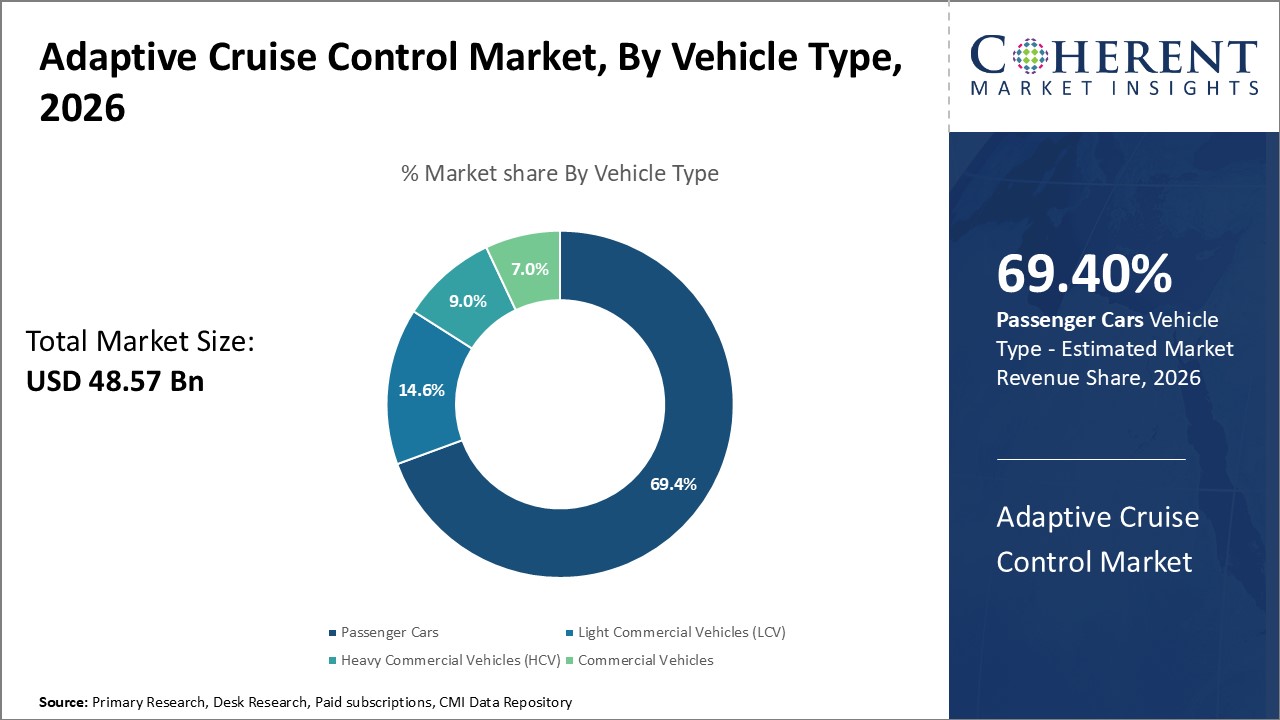
- The passenger cars segment is projected to dominate with a share of 69.4 % in 2026.
- The OEM segment leads the market holding an estimated share of 82.3 % in 2026.
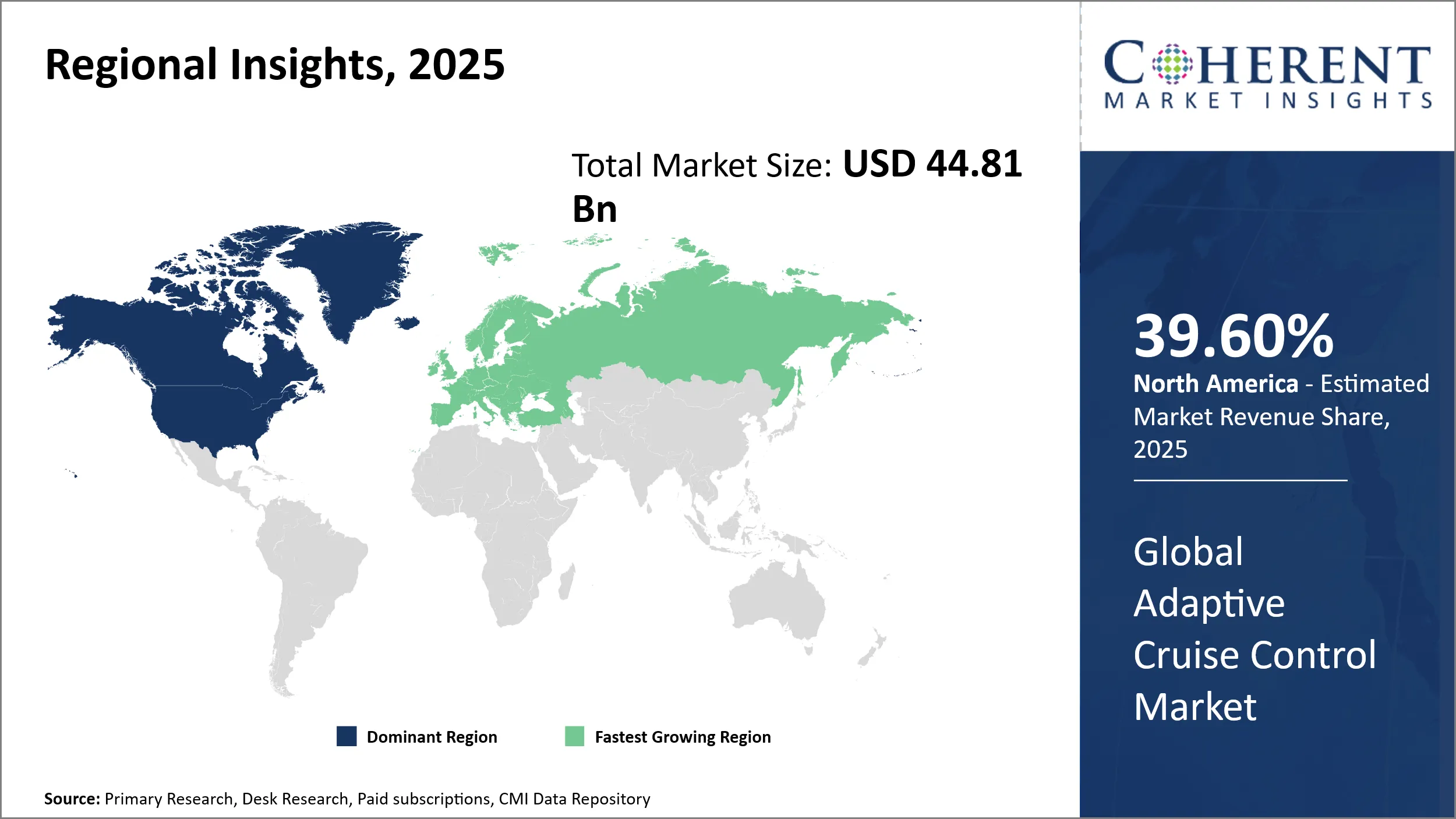
- North America, holding an expected share of 39.6 % in 2026, dominates the market.
- Europe, holding an estimated share of 27.3 % in 2026, shows the fastest growth in the market.
Market Overview
The market is seeing a lot of adoption of AI and sensor fusion technologies enhancing the accuracy and reliability of adaptive cruise control systems. Also, the push towards autonomous driving and government regulations for road safety are adding to innovation and deployment. Moreover, the rise in electric vehicle production incorporating adaptive cruise control as a standard feature is further fueling the market expansion, positioning the industry for sustained growth in the coming years.
Current Events and Its Impact
Current Events | Description and Its Impact |
UNECE vehicle cybersecurity & software-update regulations (R155 / R156) |
|
EU General Safety Regulation — mandatory ADAS requirements (GSR / new rules, effective dates through 2022–2024 rollout) |
|
China’s restrictions/retaliatory controls on exports of critical raw materials (gallium, germanium, etc.) |
|
Segmental Insights
- Current Industry Events of 2026
- Market Size Estimation
- Regional Breakdown
- Competitive Landscape
- Customer Intelligence
- Segmental Analysis
- Pricing Analysis
- Key Market Drivers, Challenges & Future Trends
- Customized Insights Section
Global Adaptive Cruise Control Market Insights, By Technology Type – Conventional Adaptive Cruise Control (ACC) Widely Adopted Because of its Reliability and Enhanced Driver Convenience
Conventional Adaptive Cruise Control (ACC) holds the largest share of 35.1% in 2026 because of its proven reliability, ease of integration, and cost efficiency. Using radar and ultrasonic sensors, conventional ACC keeps safe vehicle distance and reduces driver fatigue, making it very suitable for highway and long-distance driving. The maturity of radar technology has lowered costs, allowing OEMs to install ACC even in mid-range models. Consumer preference for intuitive, easy-to-use driver-assistance features further adds to adoption. In 2024, Toyota expanded radar-based ACC in its Corolla and Camry lineups under the “Toyota Safety Sense 3.0” suite, showing OEM confidence in conventional ACC systems.
Global Adaptive Cruise Control Market Insights, By Vehicle Type – Passenger Cars See Leading Adoption Because of Rising Demand for Safety and Comfort Features
The passenger cars segment holds 69.4% of the market share in 2026 because of consumer demand for advanced safety and convenience features. ACC improves comfort in congested and highway driving, aligning with urban mobility needs. Advancements in compact sensor design and integration allow ACC adoption even in compact and midsize vehicles. Regulatory frameworks pushing ADAS installation further make demand, as safety ratings increasingly depend on driver-assistance features. Hyundai Motor Group integrated Smart Cruise Control (SCC) as a standard feature in its 2025 Tucson and Elantra models, reflecting rising ACC adoption in mainstream passenger cars.
Global Adaptive Cruise Control Market Insights, By End User – OEM Segment Dominates through Integration and Standardization of Adaptive Cruise Control Systems
OEM account for 82.3% of the global adaptive cruise control market share in 2026, as most adaptive cruise systems are installed at the manufacturing stage for better calibration and compliance with safety mandates. OEM integration ensures system reliability, seamless connectivity with other ADAS, and improved brand differentiation. R&D investments allow OEMs to evolve ACC with predictive and AI-assisted capabilities, adding to their leadership. Volkswagen has begun equipping its ID. series EVs with Travel Assist 2.5 (an advanced ACC and lane-centering system), showing OEM-driven innovation in integrated ACC technologies.
Impact of Artificial Intelligence on the Global Adaptive Cruise Control Market
Artificial Intelligence (AI) is changing adaptive cruise control systems by enabling greater situational awareness, predictive decision-making, and smoother vehicle responses. Traditional ACC systems depend on fixed algorithms for maintaining distance and speed, while AI-driven variants continuously learn from real-time traffic patterns, driver behavior, and environmental conditions. Through machine learning, these systems can predict lane changes, adapt to varying driving styles, and optimize acceleration or braking for improved safety and comfort. AI integration also improves sensor fusion, allowing radar, camera, and LiDAR data to be processed more intelligently for accurate object recognition and reduced false alerts.
Also, AI enables continuous improvement through over-the-air (OTA) updates and data feedback loops from connected vehicles. This evolution allows automakers to refine ACC performance post-deployment, increasing system longevity and consumer trust. The use of AI also makes possible integration with other ADAS features such as lane-keeping assist and traffic jam assist, forming the foundation for higher-level driver automation. Tesla’s Autopilot and “Full Self-Driving” Beta uses AI-powered neural networks to improve adaptive cruise functionality, allowing vehicles to adjust more smoothly to dynamic traffic and road conditions. Similarly, Mercedes-Benz’s DRIVE PILOT uses AI-based sensor fusion to deliver predictive ACC performance under varying highway scenarios.
Regional Insights
North America Adaptive Cruise Control Market Analysis and Trends
North America, holding an estimated share of 39.6% in 2026, dominates the global adaptive cruise control market, stemming from a well-established automotive ecosystem combined with strong consumer demand for Advanced Driver-Assistance Systems (ADAS). The region sees strong government regulations pushing vehicle safety and incentivizing the adoption of automated technologies. The presence of leading automobile manufacturers such as General Motors, Ford, and Tesla further adds to the market growth by adding ACC to their vehicle lineups.
Also, technology giants in Silicon Valley, including Waymo and Nvidia, contribute a lot by advancing sensor technology and AI algorithms essential for ACC functionality. Well-developed infrastructure and a high standard of road safety regulations also facilitate the effective deployment and integration of ACC systems. Trade policies supporting automotive innovation and cross-border technology exchange in NAFTA/USMCA countries support market expansion.
Europe Adaptive Cruise Control Market Analysis and Trends
Europe, holding a projected share of 27.3% in 2026, shows the fastest growth in the market because of strong policy support for vehicle safety and sustainability. The region sees growth because of the European Union’s General Safety Regulation (GSR), which mandates the inclusion of Advanced Driver-Assistance Systems (ADAS) in all new vehicles from 2024 onward. This regulatory framework, added with high consumer awareness of safety and comfort features, creates a lot of adoption among European automakers and consumers alike. Premium car manufacturers such as BMW, Mercedes-Benz, Audi, and Volvo have long added ACC and related systems as standard or optional features, setting a benchmark for the market.
Also, Europe’s strong ecosystem of automotive technology suppliers, such as Bosch, Continental, and Valeo, continues to drive innovation through AI-enhanced radar, camera, and LiDAR solutions. Ongoing investments in connected and autonomous vehicle research — particularly in Germany, Sweden, and the U.K. — are pushing the transition toward predictive and cooperative ACC systems that communicate with surrounding vehicles and infrastructure. In 2024, BMW introduced its “Active Cruise Control with Stop & Go” across multiple models in Europe, featuring AI-assisted decision-making aligned with EU safety mandates.
Adaptive Cruise Control Market Outlook for Key Countries
U.S. Adaptive Cruise Control Market Analysis and Trends
The U.S. adaptive cruise control market leads because of a mature automotive industry continuously pushing innovation in the ACC segment. Automakers such as General Motors and Ford have added adaptive cruise control in many models, enhancing safety and convenience for consumers. Tesla’s Autopilot system, with ACC features, sets industry benchmarks for technological sophistication. The U.S. government’s National Highway Traffic Safety Administration (NHTSA) aggressively pushes ADAS adoption through regulatory frameworks and public safety campaigns, thus adding to market penetration. The combination of consumer demand, regulatory support, and technological innovation places the U.S. at the forefront of the adaptive cruise control market.
Germany Adaptive Cruise Control Market Analysis and Trends
Germany is a cornerstone of ACC development, led by big manufacturers such as BMW, Mercedes-Benz, and Volkswagen. These companies invest heavily in research and development to integrate next-generation adaptive cruise control systems within premium and mass-market vehicles. The German government supports technological advancements with strict emissions and safety regulations that push the adoption of ACC systems as part of broader vehicle automation trends. The presence of a well-organized supplier base specializing in sensors and control modules adds to the country’s leadership in advanced automotive technologies.
China Adaptive Cruise Control Market Analysis and Trends
China is a major growth hub for ACC, fueled by its expansive automotive production and increasing consumer interest in auto safety technologies. Leading local manufacturers like BYD, NIO, and Geely aggressively add ACC to their electric and combustion engine vehicles. The government’s push for new energy vehicles (NEVs) and safety standards directly supports ACC adoption. Also, collaboration between Chinese technology firms such as Baidu and Huawei and automotive manufacturers is pushing advancements in sensor fusion and AI, integral to ACC systems. Urbanization and infrastructure improvements further support the fast uptake of ACC technologies in China.
Japan Adaptive Cruise Control Market Analysis and Trends
Japan continues to lead as an innovation hotspot for ACC, with manufacturers such as Toyota, Honda, and Nissan playing big roles in pioneering sensor and radar technology used in adaptive cruise control. The country’s regulatory environment pushes vehicle safety and automation, making consumer trust and demand for ACC-equipped vehicles. Japan’s use of ACC with other driver assistance technologies, such as lane-keeping and collision avoidance, shows the sophistication and convergence of ADAS in the local market. Strategic partnerships with electronics firms add to development and deployment speeds across the industry.
South Korea Adaptive Cruise Control Market Analysis and Trends
South Korea adaptive cruise control market is strengthened by the active participation of automotive giants like Hyundai and Kia, which prioritize integrating advanced driver assistance systems to enhance vehicle safety and convenience. The government supports smart mobility initiatives and safety standards, pushing manufacturers to innovate in semi-autonomous vehicle technologies, including adaptive cruise control. Collaboration with technology companies, especially in radar and sensor manufacturing, adds to local innovation.
Market Players, Key Development, and Competitive Intelligence
Key Developments
- On October 29, 2025, Mobileye, a global leader in advanced driver assistance systems and autonomous driving technologies, signed a Memorandum of Understanding (MoU) with VVDN Technologies Pvt. Ltd., a leading Indian Tier 1, engineering and manufacturing services company, to localize and offer Mobileye’s ADAS technologies to India-based automakers. The collaboration is intended to leverage Mobileye’s global product and system expertise with VVDN’s local engineering, testing, and production capabilities to advance, localization, and manufacturing readiness for ADAS technologies in India.
- In May 2025, Valeo was selected by a Premium Global Automaker for a new radar system to equip its personally-owned vehicles with a hands-off, eyes-off automated driving system. The first production nomination for this radar system will enable an expanded operational design domain of automated driving and improved human-machine response for road hazards at high speeds, among other incremental features.
- In March 2025, Volkswagen Group started working with Valeo and Mobileye to upgrade the advanced driver assistance systems up to Level 2+ ("enhanced partially automated driving") in its upcoming vehicle portfolio based on the MQB platform. Launching in the next few years, this cooperation will improve safety and driving comfort in high-volume vehicles, addressing both customer expectations and regulatory requirements.
- In June 2023, Magna strengthened its active safety business with the completion of its acquisition of Veoneer Active Safety from SSW Partners. The deal, which closed today, positions Magna as one of a few suppliers equipped to tackle the increasing complexity coming from advanced software, system and integration challenges by delivering a complete set of offerings to customers.
Top Strategies Followed by Adaptive Cruise Control Market Players
- Established companies dominate the market by investing a lot in research and development (R&D) to continuously innovate and enhance their product offerings.
- Bosch’s “Predictive Cruise Control 2.0,” is a result of extensive R&D, adding radar, camera, and cloud-based traffic data to anticipate road conditions and optimize fuel efficiency — adding to its leadership in intelligent driving technologies.
- In contrast, mid-level players focus on offering cost-effective ACC solutions that strike a balance between quality and affordability, thereby targeting more price-sensitive consumers.
- In 2024, Mando launched its new mid-range radar-based ACC system for compact vehicles in South Korea, offering 30% lower production costs while maintaining Euro NCAP compliance standards.
- Small-scale players in the adaptive cruise control market make their niche by focusing on specialized features or highly innovative products.
- In 2022, Israeli startup Arbe Robotics partnered with Veoneer to commercialize 4D imaging radar for ACC and autonomous driving applications, offering better object detection and performance in complex environments.
Market Report Scope
Adaptive Cruise Control Market Report Coverage
| Report Coverage | Details | ||
|---|---|---|---|
| Base Year: | 2025 | Market Size in 2026: | USD 48.57 Bn |
| Historical Data for: | 2020 To 2024 | Forecast Period: | 2026 To 2033 |
| Forecast Period 2026 to 2033 CAGR: | 8.4% | 2033 Value Projection: | USD 85.43 Bn |
| Geographies covered: |
| ||
| Segments covered: |
| ||
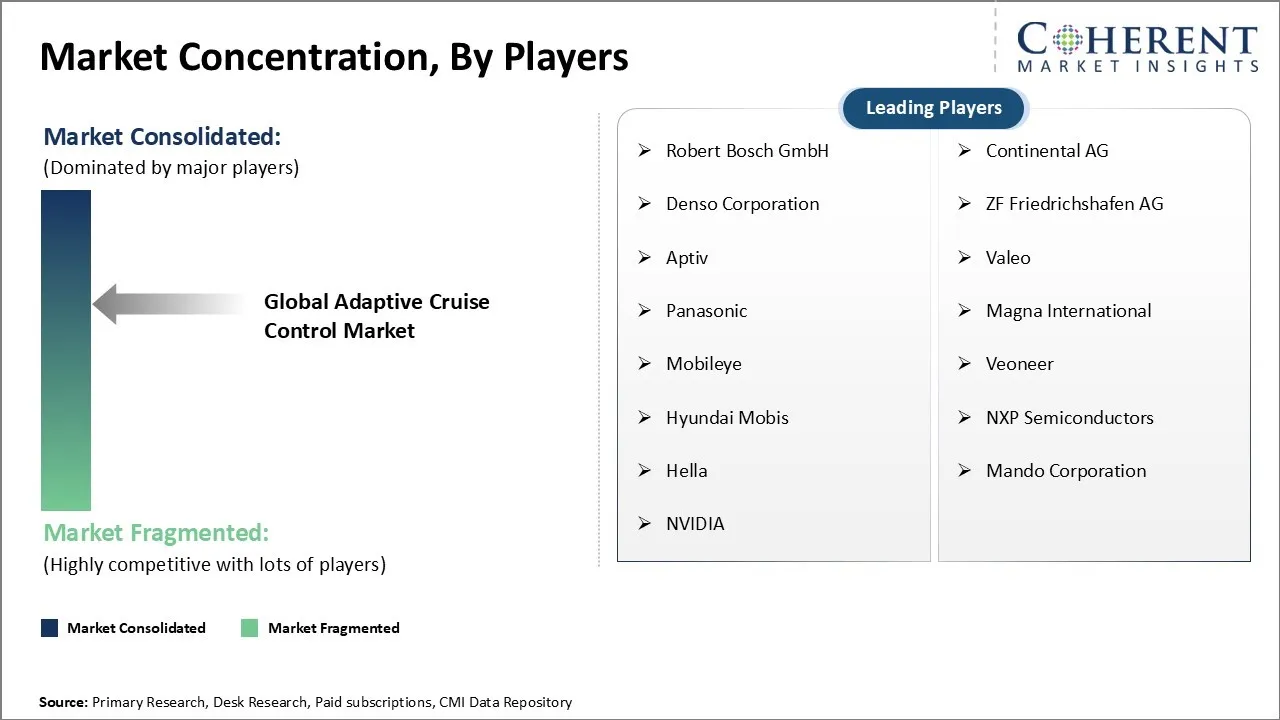
| Companies covered: | Robert Bosch GmbH, Continental AG, Denso Corporation, ZF Friedrichshafen AG, Aptiv, Valeo, Panasonic, Magna International, Mobileye, Veoneer, Hyundai Mobis, NXP Semiconductors, Hella, Mando Corporation, and NVIDIA | ||
| Growth Drivers: |
| ||
| Restraints & Challenges: |
| ||
Market Dynamics
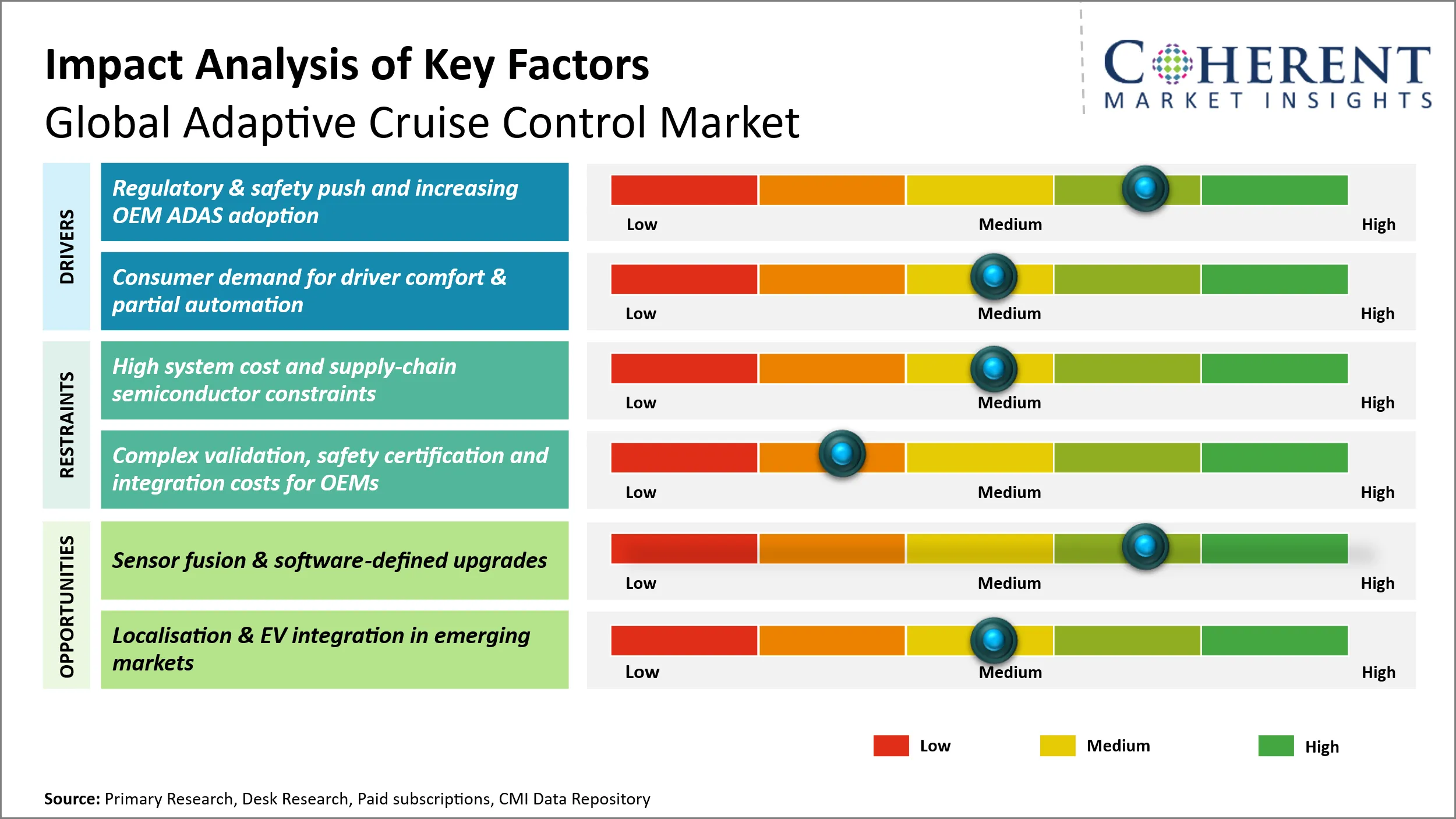
Global Adaptive Cruise Control Market Driver – Regulatory & Safety Push and Increasing OEM ADAS Adoption
The global adaptive cruise control market is being propelled by stricter safety regulations and growing OEM integration of Advanced Driver Assistance Systems (ADAS). Governments worldwide are mandating safety technologies like ACC to reduce road accidents and fatalities. In response, OEMs are adding ACC to their ADAS suites to comply with mandates and appeal to safety-conscious consumers. For instance, EU regulations under the General Safety Regulation (GSR) 2022/2026 require new vehicles to add intelligent speed assistance and adaptive cruise features, pushing automakers like Volkswagen and BMW to make ACC standard in several models. Continuous sensor and software advancements are further improving ACC reliability, making its role stronger as a core vehicle safety system.
Global Adaptive Cruise Control Market Opportunity – Sensor Fusion & Software-Defined Upgrades
Sensor fusion and software-defined upgrades present big opportunities for the adaptive cruise control market. Adding radar, lidar, and camera data improves environmental perception and system accuracy, enabling smarter, safer automation. Also, over-the-air (OTA) updates allow manufacturers to refine ACC features and meet new regulations without hardware changes. A good example is Tesla’s Autopilot and Full Self-Driving (FSD) software, which receives continuous OTA updates enhancing adaptive cruise and lane-keeping capabilities. Similarly, Volvo and Hyundai are using sensor-fusion-based ACC for smoother adaptive control. These innovations allow differentiation, cost efficiency, and long-term customer engagement in the growing ADAS ecosystem.
Analyst Opinion (Expert Opinion)
- Despite growing regulatory momentum, the high cost of ACC components—especially radar, lidar, and advanced processors—continues to limit penetration in mid-range and entry-level vehicles. OEMs face a persistent trade-off between affordability and technological sophistication, which delays widespread adoption, particularly in emerging markets where price sensitivity dominates.
- From an engineering standpoint, using ACC in different vehicle platforms is a big challenge. The system’s dependence on precise sensor alignment, complex calibration, and seamless communication across electronic control units (ECUs) often leads to performance inconsistencies.
- While safety regulations are getting stronger, a lack of harmonized global standards for ADAS functionality makes uncertainty for OEMs and suppliers. Also, consumer skepticism around system reliability—especially following incidents involving semi-autonomous failures—has affected confidence-driven adoption. Until uniform policies and stronger public trust are established, the adaptive cruise control market will struggle to reach its full potential despite technological readiness.
Speak to the analyst
Want personalized insights?
Take the findings above to one of our principal consultants, or have the report rebuilt around the segments, geographies and competitors you actually track.
Market Segmentation
- Technology Type Insights (Revenue, USD Bn, 2021 - 2033)
- Conventional Adaptive Cruise Control (ACC)
- Stop-and-Go Adaptive Cruise Control
- Predictive Adaptive Cruise Control (P-ACC)
- Co-operative Adaptive Cruise Control (CACC)
- AI-Driven Adaptive Cruise Control
- Vehicle Type Insights (Revenue, USD Bn, 2021 - 2033)
- Passenger Cars
- Light Commercial Vehicles (LCV)
- Heavy Commercial Vehicles (HCV)
- Commercial Vehicles
- End User Insights (Revenue, USD Bn, 2021 - 2033)
- OEM
- Aftermarket Retrofit Systems
- Regional Insights (Revenue, USD Bn, 2021 - 2033)
- North America
- U.S.
- Canada
- Latin America
- Brazil
- Argentina
- Mexico
- Rest of Latin America
- Europe
- Germany
- U.K.
- Spain
- France
- Italy
- Russia
- Rest of Europe
- Asia Pacific
- China
- India
- Japan
- Australia
- South Korea
- ASEAN
- Rest of Asia Pacific
- Middle East
- GCC Countries
- Israel
- Rest of Middle East
- Africa
- South Africa
- North Africa
- Central Africa
- North America
- Key Players Insights
- Robert Bosch GmbH
- Continental AG
- Denso Corporation
- ZF Friedrichshafen AG
- Aptiv
- Valeo
- Panasonic
- Magna International
- Mobileye
- Veoneer
- Hyundai Mobis
- NXP Semiconductors
- Hella
- Mando Corporation
- NVIDIA
Sources
Primary Research Interviews
Stakeholders
- Automotive OEMs and Tier-1 Suppliers
- ADAS Technology Developers and System Integrators
- Sensor and Semiconductor Manufacturers
- Automotive Software Engineers and Data Scientists specializing in ADAS and ACC algorithms
- Vehicle Safety Regulators and Transport Authorities
- Automotive Dealerships and Aftermarket Distributors
- Fleet Operators and Mobility Service Providers integrating ACC-enabled vehicles
- Research Institutes and Universities working on intelligent transport and sensor fusion systems
Databases
- European Automobile Manufacturers’ Association (ACEA)
- OICA (International Organization of Motor Vehicle Manufacturers)
- U.S. Department of Transportation (DOT)
- National Highway Traffic Safety Administration (NHTSA) Safety Database
- Automotive News Data Center
- OECD Mobility and Transport Database
Magazines
- Automotive World
- Car and Driver Tech Insights
- AutoTech Review
- Automotive Engineering International (SAE International)
- ADAS & Autonomous Vehicle Magazine
Journals
- IEEE Transactions on Intelligent Vehicles
- International Journal of Vehicle Autonomous Systems
- Transportation Research Part C: Emerging Technologies
- Sensors and Actuators Journal
- Journal of Advanced Transportation
Newspapers
- Automotive News Europe
- The Detroit News (Automotive Section)
- The Economic Times (Auto Section, India)
- The Guardian (Mobility & Future Transport Section)
- Nikkei Asia Automotive Business
Associations
- Society of Automotive Engineers (SAE)
- European Association for Automotive Research Partners (EARPA)
- Japan Automobile Manufacturers Association (JAMA)
- Automotive Component Manufacturers Association of India (ACMA)
- Intelligent Transportation Society of America (ITS America)
Public Domain Sources
- United Nations Economic Commission for Europe (UNECE) – Vehicle Regulations
- World Bank – Transport and Infrastructure Data
- EUROSTAT – Automotive Industry Statistics
- U.S. Census Bureau – Transportation Equipment Manufacturing
- ResearchGate – Open Access Automotive Safety Studies
Proprietary Elements
- CMI Data Analytics Tool, Proprietary CMI Existing Repository of information for the last 8 years
Get access to 250+ pages report
Every segment, forecast, competitor profile and data table behind the analysis above — available for instant download.
- ESOMAR Member
- ISO 9001:2015 Certified
- D-U-N-S Registered
- GDPR & CCPA Compliant
Missing comfort of reading report in your local language? Find your preferred language:
Transform your Strategy with Exclusive Trending Reports
Frequently Asked Questions
The global adaptive cruise control market is estimated to be valued at USD 48.57 billion in 2026 and is expected to reach USD 85.43 billion by 2033.
The CAGR of the global adaptive cruise control market is projected to be 8.4% from 2026 to 2033.
Regulatory & safety push and increasing OEM ADAS adoption and consumer demand for driver comfort & partial automation are the major factors driving the growth of the global adaptive cruise control market.
High system cost and supply-chain semiconductor constraints and complex validation, safety certification and integration costs for OEMs are the major factors hampering the growth of the global adaptive cruise control market.
In terms of technology type, the conventional adaptive cruise control (ACC) is estimated to dominate the market revenue share in 2026.
ACC is an advanced driver assistance system that automatically adjusts a vehicle’s speed to maintain a safe distance from vehicles ahead.
Unlike standard cruise control, ACC uses radar, lidar, or cameras to detect surrounding traffic and adapt speed accordingly.