

Automotive Heat Exchanger Market Size and Forecast — 2026-2033
The Global Automotive Heat Exchanger Market size is estimated to be valued at USD 13.28 billion in 2026 and is expected to reach USD 23.35 billion by 2033, exhibiting a compound annual growth rate (CAGR) of 8.4% from 2026 to 2033.
Overview
Automotive heat exchangers are essential components used to regulate temperature within vehicles by transferring heat between fluids or gases. Common types include radiators, oil coolers, condensers, evaporators, and charge air coolers. They are critical for engine cooling, air conditioning, and battery thermal management in electric and hybrid vehicles. Constructed from aluminum or stainless steel, modern heat exchangers are designed for high efficiency, lightweight construction, and corrosion resistance. Continuous advancements focus on compact designs, energy efficiency, and integration with vehicle thermal management systems.
Key Takeaways
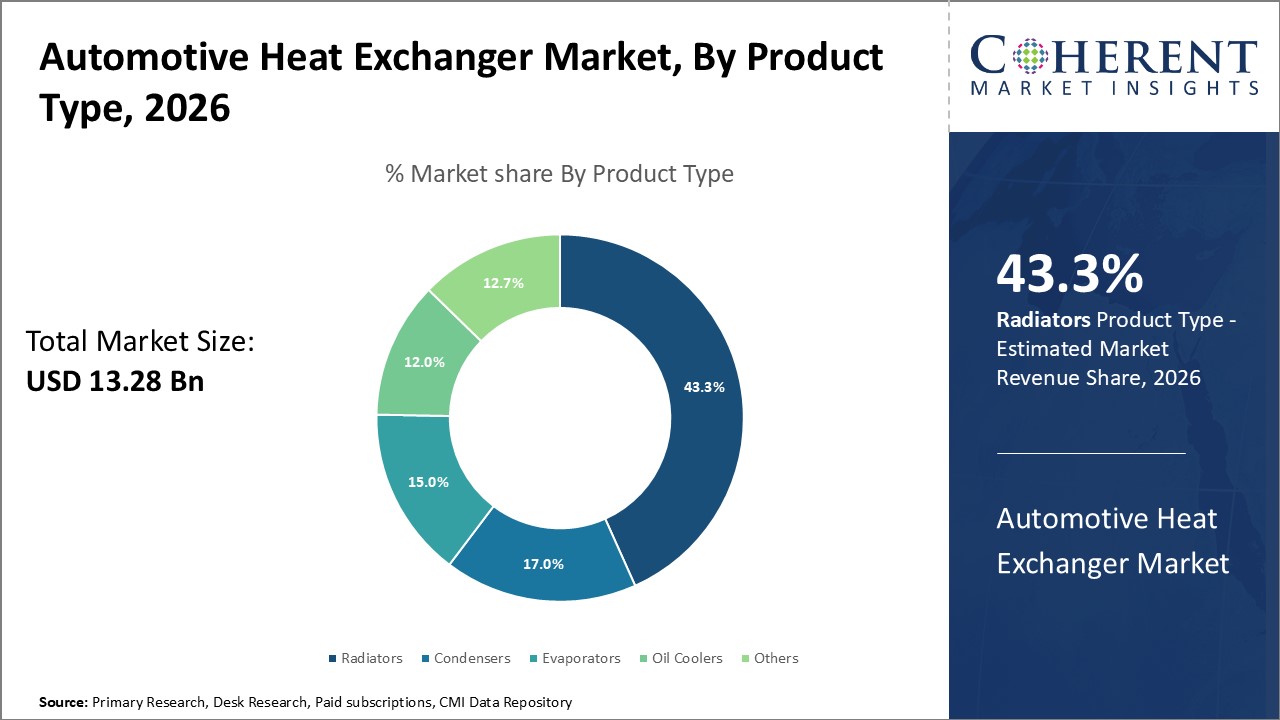
Radiators continue to dominate the product segment with a 43.3% market share, driven by their essential role in engine cooling systems and adaptability to new vehicle architectures.
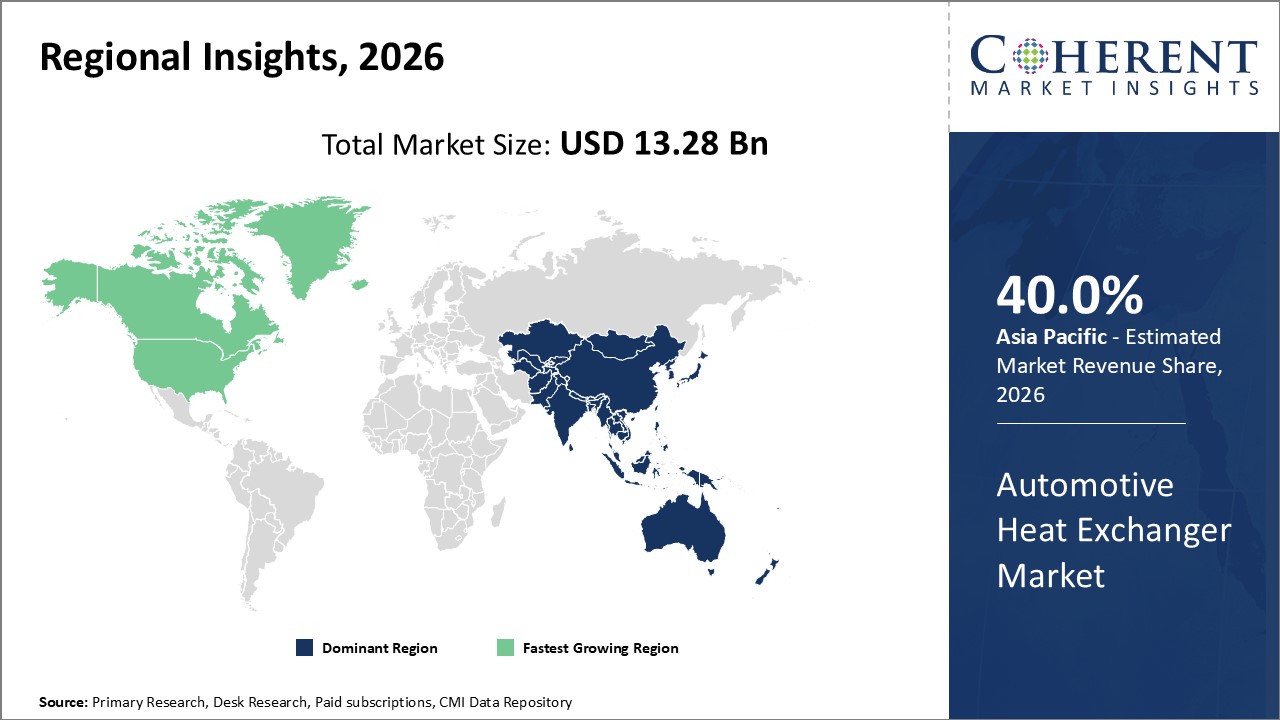
Asia Pacific remains the largest regional market influenced by high automotive production volumes and government incentives, contributing more than 40% of the market revenue.
North America, particularly the U.S., is marked by rapid technological adoption and stringent regulatory frameworks, positioning it as a hub for innovation and premium heat exchanger applications.
Automotive Heat Exchanger Market Segmentation Analysis
Automotive Heat Exchanger Market Insights, By Product Type
Radiators hold a commanding 43.3% share due to their indispensable role in thermal regulation for conventional internal combustion engines and their adaptability to various vehicle types, including hybrids. Their design advancements incorporating lightweight aluminum have contributed to improved fuel efficiency and heat dissipation. The fastest-growing subsegment is Condensers, largely propelled by the increasing integration of air conditioning systems in electric and hybrid vehicles, which utilize condensers extensively for climate control.
Automotive Heat Exchanger Market Insights, By Vehicle Type
Passenger cars remain the largest volume segment, encompassing traditional combustion engine vehicles with established heat exchanger designs. Electric Vehicles (EVs) are the fastest-growing segment, outpacing growth rates of traditional passenger cars and commercial vehicles. This surge is driven by the increasing demand for sophisticated battery cooling systems and power electronics thermal management, essential for extending battery life and ensuring safety.
Automotive Heat Exchanger Market Insights, By Material Type
Aluminum dominates the market owing to its superior thermal conductivity, corrosion resistance, and lightweight properties that align with fuel efficiency mandates. Its ubiquity is reinforced by automotive players' preference for cost-efficient yet high-performing materials. Copper, traditionally valued for thermal effectiveness, is witnessing a decline in use due to its weight and cost disadvantages.
Automotive Heat Exchanger Market Trends
Recent years have emphasized electrification, pushing the automotive heat exchanger market towards accommodating EV-specific cooling systems.
The incorporation of digital sensors and smart control mechanisms in heat exchangers has fostered tremendous efficiency gains and predictive diagnostics, as seen in several 2026 OEM implementations.
Additionally, additive manufacturing has led to lighter, more compact heat exchanger components, enabling automakers to optimize space and vehicle weight.
Automotive Heat Exchanger Market Insights, By Geography
Asia Pacific Automotive Heat Exchanger Market Analysis and Trends
In the Asia Pacific region, the dominance in the Automotive Heat Exchanger market is attributed to the high automotive production volume concentrated in China, India, and Japan. This region accounts for over 40% of the industry share due to government initiatives supporting electric vehicle adoption and stringent emission standards compelling manufacturers to upgrade thermal management systems. The presence of major automakers and suppliers contributes to the robust ecosystem, enabling continuous innovation and capacity expansion.
North America Automotive Heat Exchanger Market Analysis and Trends
Meanwhile, North America exhibits the fastest growth rate, with a CAGR surpassing 9.1%, powered primarily by the U.S. market. Proactive policies supporting clean energy vehicles, coupled with technological innovations by leading companies like Valeo and Denso, are accelerating market growth. The shift towards smart heat exchangers and the higher demand for lightweight materials are key factors driving the North American market expansion.
Automotive Heat Exchanger Market Outlook for Key Countries
USA Automotive Heat Exchanger Market Analysis and Trends
The U.S. market is characterized by the rapid adoption of advanced thermal management systems in electric and hybrid vehicles due to stringent fuel efficiency and emission regulations. Strategic investments by market players such as Hanon Systems in facility expansions and collaborative R&D have increased production capacity for cutting-edge heat exchangers. In 2025, EV sales in the U.S. exceeded 2 million units, translating directly into higher demand for technologically advanced heat exchangers. Government incentives are further propelling the expansion of the automotive heat exchanger market, especially for lightweight and high-performance systems.
China Automotive Heat Exchanger Market Analysis and Trends
China’s automotive heat exchanger market benefits from massive passenger car production alongside aggressive growth in electric vehicle manufacturing. Domestic companies, in conjunction with international suppliers, have ramped up production and innovation capabilities, focusing on cost-effective yet efficient heat exchanger solutions. In 2026, new government mandates for vehicle emissions and energy efficiency have driven manufacturers to integrate enhanced thermal management technologies, boosting market revenue and business growth significantly in the region.
Analyst Opinion
The surge in demand for electric vehicles (EVs) is reshaping the supply-side dynamics of the automotive heat exchanger market. As reported in early 2026, EV production increased by nearly 33% globally, intensifying the need for innovative heat exchanger solutions tailored for battery thermal management and power electronics cooling. This shift translates into a significant expansion in production capacity focused on high-performance heat exchangers, directly influencing market share distribution.
Pricing dynamics remain a crucial factor influencing market revenue. The increased utilization of aluminum and other lightweight materials has stabilized manufacturing costs while enhancing heat exchanger efficiency. For example, aluminum heat exchanger prices remained consistent throughout 2025 despite supply chain volatility, reinforcing the pricing trend's influence on demand-driven growth.
Demand-side indicators highlight diversified use cases beyond conventional engine cooling. Emerging applications in hybrid systems and advanced thermal management for autonomous vehicles have expanded the market scope. Recent industry surveys in 2025 indicated a 21% increase in hybrid vehicle production, which has proportionally raised the import volumes of specialized heat exchangers in key automotive regions.
Micro-indicator analysis suggests a growing trend toward modular and nano-scale heat exchanger components to meet compact vehicle designs' requirements. The automotive industry reported an uptick of 16% in the adoption of micro heat exchangers for electric drivetrains in 2026, underscoring enhanced R&D focus and market growth strategies aligning with miniaturization trends.
- Current Industry Events of 2026
- Market Size Estimation
- Regional Breakdown
- Competitive Landscape
- Customer Intelligence
- Segmental Analysis
- Pricing Analysis
- Key Market Drivers, Challenges & Future Trends
- Customized Insights Section
Market Scope
| Report Coverage | Details | ||
|---|---|---|---|
| Base Year: | 2025 | Market Size in 2026: | USD 13.28 billion |
| Historical Data for: | 2020 To 2024 | Forecast Period: | 2026 To 2033 |
| Forecast Period 2026 to 2033 CAGR: | 8.4% | 2033 Value Projection: | USD 23.35 billion |
| Geographies covered: |
| ||
| Segments covered: |
| ||
| Companies covered: | Denso Corporation, Hanon Systems, Modine Manufacturing Company, MAHLE GmbH, Marelli Holding Corporation, Kando Automotive, Calsonic Kansei Corporation, Seton Heat Exchangers, Halla Climate Control Corp., Thermotech Inc., ElringKlinger AG, S&T Dynamics. | ||
| Growth Drivers: |
| ||
Automotive Heat Exchanger Market Growth Factors
The surge in electric and hybrid vehicle adoption continues to be the primary market driver, as these vehicles require more complex thermal management systems to maintain battery performance and longevity. Recent data from 2026 reflects a 30% growth in electric vehicle sales, substantially impacting automotive heat exchanger demand. Lenient emission regulations in developing countries are compelling manufacturers to innovate heat exchanger designs to comply with cleaner and more efficient automotive systems. Additionally, increasing automotive production in Asia Pacific, particularly in countries like China and India, plays a critical role in market expansion, with production volume growth rates exceeding 7% annually. Apart from this, the trend toward lightweight materials like aluminum boosts thermal efficiency while aiding fuel economy, driving extensive adoption of such materials in heat exchanger manufacturing.
Automotive Heat Exchanger Market Development
In March 2026, Japan's Marelli Holdings Co., Ltd. partnered with Hilite Automotive Systems (Changshu) Co., Ltd. at its facility in Wuxi, China, to develop integrated thermal management modules for new energy vehicles (NEVs). This strategic cooperation will focus on creating innovative solutions for NEV thermal management, including advancements in electronic expansion valves and other heat exchanger technologies.
In March 2026, Dexin Radiator won the “Global Cooling Solution of the Year” at the International Auto Components Expo for its advanced heavy-duty radiator technology. The product features a dual-loop design to maintain optimal engine temperatures in extreme environments (e.g., mining, construction), and reportedly improves fuel efficiency and lowers maintenance costs.
Key Players
Leading players in the market include:
Hanon Systems
Modine Manufacturing Company
MAHLE GmbH
Marelli Holding Corporation
Kando Automotive
Calsonic Kansei Corporation
Seton Heat Exchangers
Halla Climate Control Corp.
Thermotech Inc.
ElringKlinger AG
S&T Dynamics
Several market players have embraced competitive strategies such as strategic partnerships and mergers to enhance product portfolios. For instance, Hanon Systems’ collaboration with electric vehicle manufacturers led to a 26% increase in revenue from their thermal management segment in 2025. Additionally, Valeo’s investment in R&D for next-generation lightweight aluminum heat exchangers secured several supplier agreements with major OEMs, significantly strengthening its market positioning in 2026.
Automotive Heat Exchanger Market Future Outlook
The market is poised for sustained growth driven by vehicle electrification, stricter emission norms, and increasing demand for comfort-oriented HVAC systems. Next-generation heat exchangers will focus on compactness, thermal efficiency, and recyclability. Innovations such as phase-change materials and micro-channel designs will enhance performance while reducing energy consumption. Electric vehicle manufacturers will remain a key growth segment, requiring advanced cooling solutions for batteries and inverters. Global OEM–supplier collaborations and investments in lightweight, sustainable materials will define the next phase of evolution.
Automotive Heat Exchanger Market Historical Analysis
The automotive heat exchanger market developed in parallel with the automotive industry, serving critical functions in engine cooling and air conditioning systems. Traditional designs relied on copper and brass, but aluminum-based exchangers gained dominance due to their lighter weight and improved heat transfer efficiency. As emission regulations tightened, automakers invested in high-performance thermal management technologies to enhance fuel efficiency. The rise of hybrid and electric vehicles introduced new demand for specialized battery and power electronics cooling systems, reshaping product design and material requirements.
Sources
Primary Research interviews:
Automotive Engineers
Component Manufacturers
OEM Procurement Heads
Thermal System Designers
Databases:
OICA Vehicle Production Database
Society of Automotive Engineers (SAE) Mobility Reports
Magazines:
Automotive World
AutoTech Review
Vehicle Dynamics International
Motor Trend (Industry)
Journals:
International Journal of Automotive Technology
Applied Thermal Engineering
SAE International Journal of Materials and Manufacturing
Heat Transfer Engineering
Newspapers:
The Economic Times (Auto)
The Hindu BusinessLine (Industry)
Automotive News
Reuters (Mobility)
Associations:
Society of Automotive Engineers (SAE)
International Energy Agency (Transport Division)
European Automobile Manufacturers Association (ACEA)
Japan Automobile Manufacturers Association (JAMA)
Get access to 250+ pages report
Every segment, forecast, competitor profile and data table behind the analysis above — available for instant download.
- ESOMAR Member
- ISO 9001:2015 Certified
- D-U-N-S Registered
- GDPR & CCPA Compliant
Missing comfort of reading report in your local language? Find your preferred language:
Transform your Strategy with Exclusive Trending Reports
Frequently Asked Questions
The market is led by several key companies, including Denso Corporation, Hanon Systems, Modine Manufacturing Company, MAHLE GmbH, Marelli Holding Corporation, Kando Automotive, Calsonic Kansei Corporation, Seton Heat Exchangers, Halla Climate Control Corp., Thermotech Inc., ElringKlinger AG, S&T Dynamics, which have solidified their positions through innovation, strategic partnerships, and production capacity expansions.
The market is projected to reach USD 23.35 billion by 2033, growing at a CAGR of 8.4%, driven primarily by increasing EV adoption and evolving thermal management needs in the automotive sector.
Electric vehicles and hybrid vehicles present the most substantial growth opportunities due to their complex cooling requirements and regulatory pressures promoting cleaner transport solutions.
The market will witness advanced material adoption, integration of smart heat exchangers with IoT capabilities, and customization enabled by additive manufacturing, resulting in increased efficiency and performance optimization.
The landscape is highly competitive with companies focusing on technological innovation and regional expansion. Key challenges include raw material price volatility and supply chain disruptions affecting market dynamics.
Players typically employ strategic collaborations with OEMs, invest heavily in R&D for eco-friendly and lightweight products, and expand manufacturing footprints globally to cater to regional demands swiftly.