

Reusable Launch Vehicle Market Analysis & Forecast: 2026-2033
Reusable Launch Vehicle Market is estimated to be valued at USD 5.40 Bn in 2026 and is expected to reach USD 11.98 Bn in 2033, exhibiting a compound annual growth rate (CAGR) of 12.2% from 2026 to 2033.
Key Takeaways
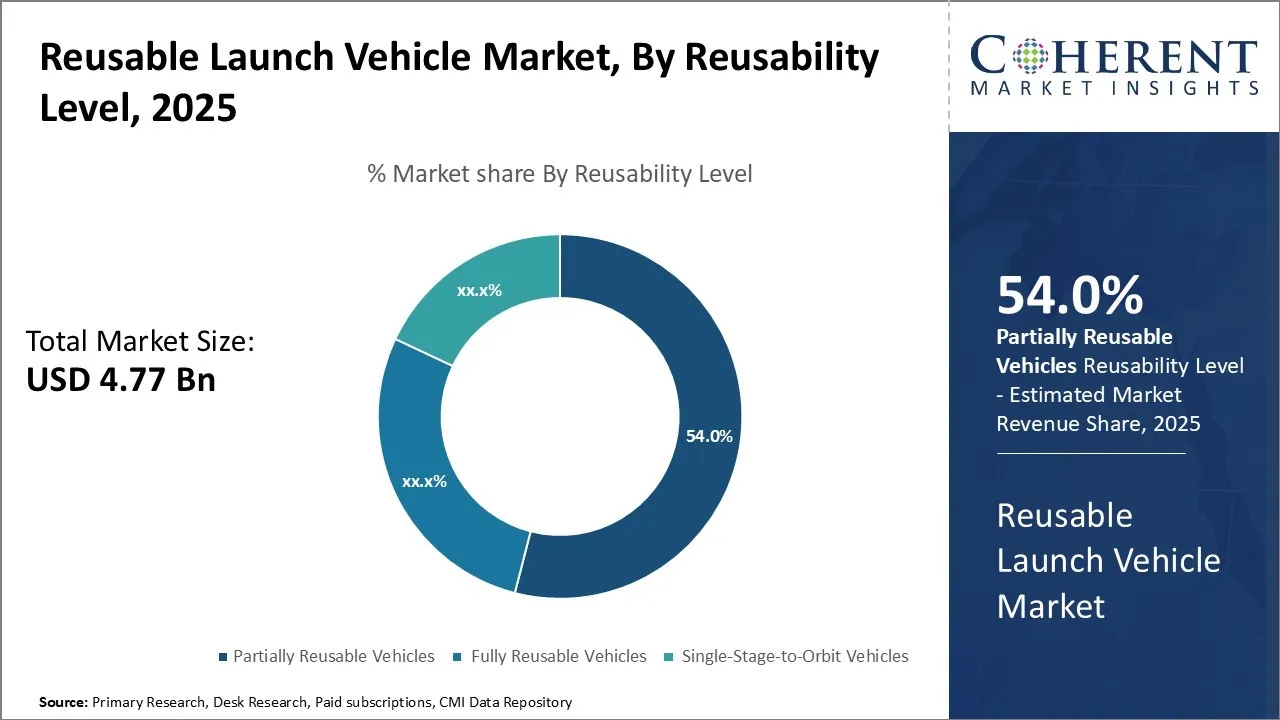
- According to Reusability Level, The Partially Reusable Category is anticipated to account for the largest share of 55.0% for the Reusable Launch Vehicle market in 2026. In comparison to expendable systems, partially reusable rockes, like SpaceX’s Falcon 9, recover and reuse essential components such as the first stage booster, greatly lowering launch costs, frequently by approx. 30-41%.
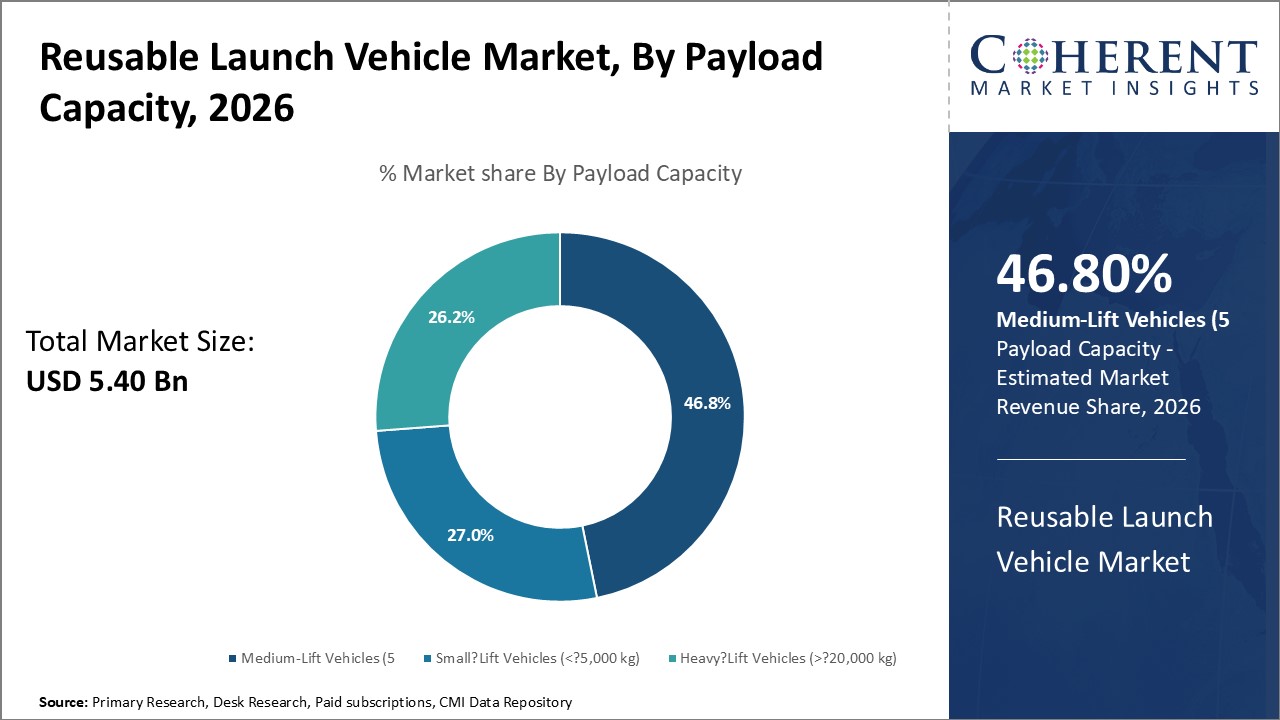
- According to Payload Capacity, The Mid-Range Segment is anticipated to hold 46.8% Reusable Launch Vehicle Market Share in 2026, due to the growing need for government missions, commercial payload launches, and satellite constellation deployments.
- According to Application, Commercial Satellite Launch Segment is expected to hold 52.4% share for reusable launch vehicle market in 2026. Frequent, economical launches are now necessary due to the growth of tiny satellite launches and the building of huge broadband constellations which encourages commercial operators to use reusable technologies.
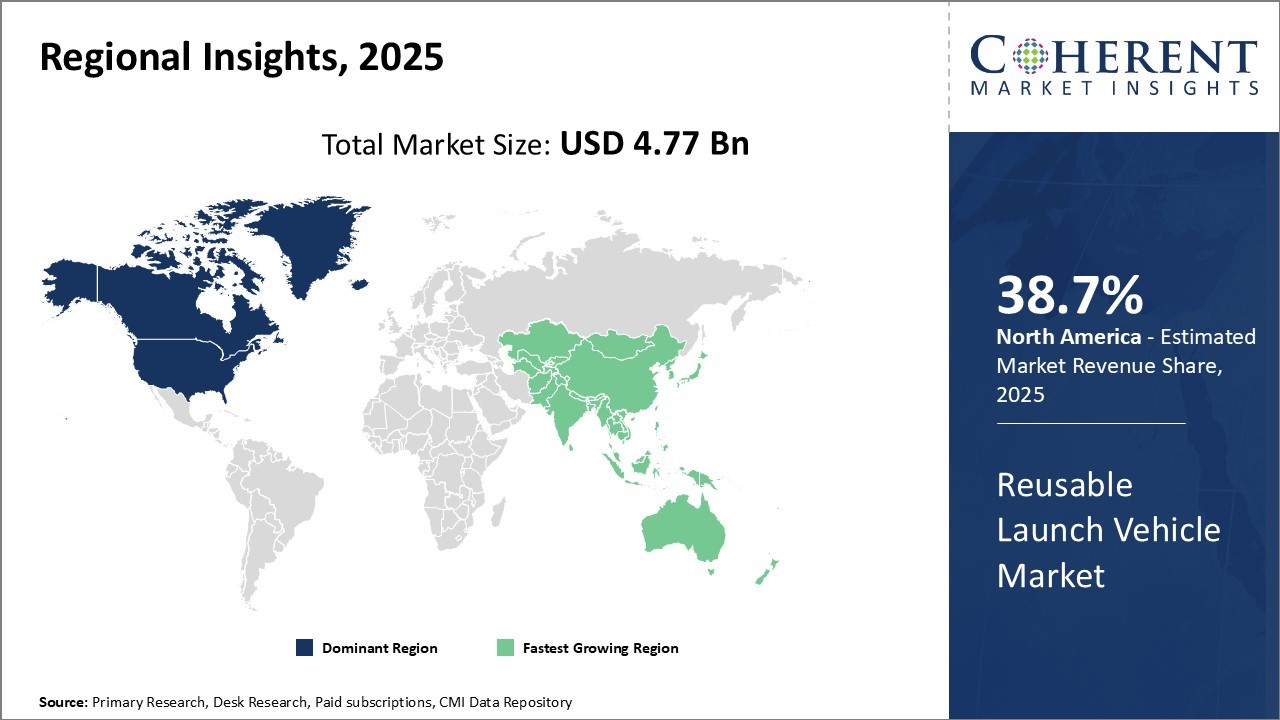
- According to region, North America holds the largest market share of 38.7% for Reusable Launch Vehicle market growth by 2026. Significant military and government investments also contribute to the region’s prosperity, with NASA leading the way with programs like the Artemis program and public private partnerships with businesses like SpaceX.
Market Overview
The Reusable Launch Vehicle Market Size is fueled by rising demand for frequent and reasonbly priced space travel, large government and private sector investments, and developments in reusable rocket technology. There has been growing demand for reduced payload cost owing to reusability of launch vehicles. Key players are actively investing in reusable launch vehicle market research to make launch vehicles reusable, which can be launched and landed back on Earth for multiple missions. Moreover, rapid technological advancements such as 3D printing, carbon composite structures and improved heat shield materials are helping players to build more durable and reusable launch vehicles. Growing small satellite launches and private spaceflight activities globally can boost adoption of reusable launch vehicles.
Current Events and Its Impact on the Reusable Launch Vehicle Market
Event | Description and Impact |
Surge in Satellite Launches |
|
Space Tourism and Commercial Spaceflight Expansion |
|
Pricing Analysis
Reusable launch vehicles (RLVs) are fundamentally transforming the economics of space access by significantly reducing launch costs compared to traditional expendable rockets. For example, the introduction of SpaceX’s Falcon 9 one of the most widely used RLVs—has demonstrated launch cost reductions of up to 40–60% per mission, primarily due to the ability to recover and reuse the first stage multiple times.
Traditionally, a single-use rocket could cost upwards of $60–$90 million per launch, with the rocket hardware accounting for 70–80% of the total mission cost. With reusability, the hardware cost per launch can drop to as low as 20–30% of the total, as refurbishment and relaunch expenses are much lower than building new vehicles from scratch.
For instance, SpaceX has reported reusing Falcon 9 boosters over 10 times, with each subsequent flight costing substantially less than the initial mission. This pricing structure is now setting new industry benchmarks, encouraging other players like Blue Origin and emerging Asian companies to adopt similar models and further drive down costs.
- Current Industry Events of 2026
- Market Size Estimation
- Regional Breakdown
- Competitive Landscape
- Customer Intelligence
- Segmental Analysis
- Pricing Analysis
- Key Market Drivers, Challenges & Future Trends
- Customized Insights Section
Role of Emerging Technologies
- Emerging technologies are at the core of the RLV market’s rapid evolution and cost efficiency. Advances in 3D printing enable rapid prototyping and manufacturing of complex rocket parts, reducing production time and costs while enhancing customization and repairability.
- The use of carbon composite structures and improved heat shield materials increases vehicle durability and allows for more launches per vehicle before major refurbishment is needed.
- Autonomous landing systems and sophisticated onboard guidance technologies have made vertical landings routine, further improving safety and turnaround times.
- Additionally, generative AI is now being used to optimize vehicle design, simulate mission scenarios, and streamline testing phases, which accelerates development cycles and reduces engineering costs.
Segmental Insights
Reusable Launch Vehicle Market Insights, By Reusability Level
In terms of reusability level, partially reusable vehicles segment is estimated to contribute the highest market share of 55%, due to their ability to deliver launches at affordable prices. These vehicles employ partly reusable designs where certain components like rocket boosters are recovered and reused, thus, bringing down overall launch costs compared to expendable vehicles. The partial reusability allows launching payloads at 20-30% lower prices, thus, making these an attractive proposition for commercial customers.
By reusing high-value components and minimizing losses, partially reusable vehicles have significantly higher price efficiency than expendable launchers especially for heavier payloads. Their cost-effective nature has resulted in growing demand from satellite operators as well as government space programs for multiple missions.
Moreover, the major players in this segment including SpaceX and Blue Origin have substantiated the technical and economic viability of reuse through multiple successful missions. This has boosted customer confidence in the reliability of partially reusable vehicles. Continuous technology improvements aimed at higher reusability numbers can foster the price competitiveness of this segment.
Reusable Launch Vehicle Market Insights, By Payload Capacity
In terms of payload capacity, medium-lift vehicles (5,000 - 20,000 kg) segment is estimated to contribute the highest market share of 46.8%, due to their versatility. With a payload range covering medium satellites as well as smaller modules to space stations, this segment has widespread suitability across applications.
Medium-lift launchers offer flexibility to deploy multiple satellites of varied sizes and end uses on a single mission. These can efficiently fulfil launch needs of both government and private sectors with a single standardized vehicle.
Moreover, the 5,000-20,000 kg lifting capability makes medium-lift vehicles sufficiently powerful for human spaceflight activities without necessitating an overwhelmingly large rocket.
Such multi-role functionality has captured diverse customer demands and positioned these vehicles as a popular one-size-fits-all solution. Its broad appeal stems from handling everything from Earth observation and communication satellites to missions involving humans. Continued expansion in new space sectors including satellite constellations and space tourism can strengthen the leadership of this versatile and multi-purpose vehicles.
Reusable Launch Vehicle Market Insights, By Application
In terms of application, commercial satellite launch segment is estimated to contribute the highest market share of 52.4%, due to increasing reliance on space-based connectivity. The satellite communications industry has witnessed exponential growth due to rising internet usage and dependence on technologies like 5G. This has translated into exponential growth in small satellite launches as operators build extensive broadband constellations.
It is estimated that over 15,000 new satellites will be launched in the coming decade for various uses including imagery, IoT, and broadband access. Such immense commercial demand has made space accessible as a business opportunity and is motivating launch providers to invest in reusable technologies for frequent, lower-cost missions. Players like SpaceX have found huge commercial success through offering reused Falcon 9 boosters for satellite deployment missions. The significant cost savings from reuse is enabling satellite operators to launch bigger constellations affordably.
Moreover, companies developing new mega-constellations also prefer reusable rockets to periodically replenish their orbital fleets economically. This attractive commercial segment therefore stands to benefit greatly from continuous maturity of reusable launch technologies.
Reusable Launch Vehicle Market – Regional Insights
North America Reusable Launch Vehicle Market
North America has been the dominant region in the global reusable launch vehicle market with an estimated market share of 38.7% in 2026. The region is home to major aerospace companies like SpaceX and Blue Origin, which have been pioneering research and development in the reusable launch technologies. Both SpaceX with its Falcon 9 and Falcon Heavy rockets along with Blue Origin's New Shepard have successfully demonstrated vertical take-off and landing of their launch vehicles multiple times.
The presence of National Aeronautics and Space Administration (NASA) alongside private space agencies in the U.S. has created a robust ecosystem supporting reusable launch technologies. Companies in the region receive substantial government funding for reusable launch vehicle programs. Favorable government policies around commercial spaceflight have also encouraged private investments. Moreover, North American companies have an advantage in terms of technological expertise and availability of skilled workforce to support research activities.
Asia Pacific Reusable Launch Vehicle Market
Asia Pacific is emerging as a fastest growing market for reusable launch vehicles. Countries like China and India have set ambitious goals around building domestic space capabilities including human spaceflight programs. Both nations are actively pursuing reusable launch vehicle technologies to make their space programs more cost effective. Chinese private space companies such as LinkSpace and Galactic Energy have received government grants to develop reusable rockets.
Rising government expenditures on space programs along with availability of scientific workforce can drive the reusable launch vehicle market growth in Asia Pacific. Rising demand for commercial satellite launch services in the region can offer new opportunities. As more nations in Asia Pacific focus on building indigenous capabilities, the reusable launch vehicle market is expected to witness growth with several new programs and demonstrations planned. This makes Asia Pacific an important region to watch out for in the global reusable launch vehicle industry.
Reusable Launch Vehicle Market In Europe
Due to its strong government support and important role within ESA, France leads the European RLV sector, although other nations including Germany, the UK, and Spain are also making notable progress. In order to compete worldwide and lower launch costs, European firms like ArianeGroup and Airbus are actively developing next-generation reusable rockets, such as the Ariane Next and the Adeline idea.
Reusable Launch Vehicle Market Dominating Countries
U.S Reusable Launch Vehicle Market
A robust supply chain, an established ecosystem of launch facilities, and rising demand for satellite launches and new uses like space tourism all help the U.S. industry. In 2026, North America, led by the United States, held the greatest proportion of the worldwide RLV market, demonstrating its dominance.
India Reusable Launch Vehicle Market
The goal of India's RLV program is to boost launch frequency and lower launch costs, increasing the nation's competitiveness in the international commercial launch market. India is positioned as a major growth engine in the Asia-Pacific region, which is currently the fastest-growing RLV industry globally, thanks to the government's strong commitment to developing space technology domestically and a burgeoning scientific workforce.
Reusable Launch Vehicle Market In China
Reusable rocket technologies are being developed at a rapid speed by Chinese companies like LinkSpace and Galactic Energy, which have launched multiple successful demonstrations. Strategic space infrastructure and technology investments by the Chinese government have accelerated research and development and allowed both state-owned and private companies to launch new reusable vehicles.
Market Report Scope
Reusable Launch Vehicle Market Report Coverage
| Report Coverage | Details | ||
|---|---|---|---|
| Base Year: | 2025 | Market Size in 2026: | USD 5.40 Bn |
| Historical Data for: | 2020 To 2024 | Forecast Period: | 2026 To 2033 |
| Forecast Period 2026 to 2033 CAGR: | 12.2% | 2033 Value Projection: | USD 11.98 Bn |
| Geographies covered: |
| ||
| Segments covered: |
| ||
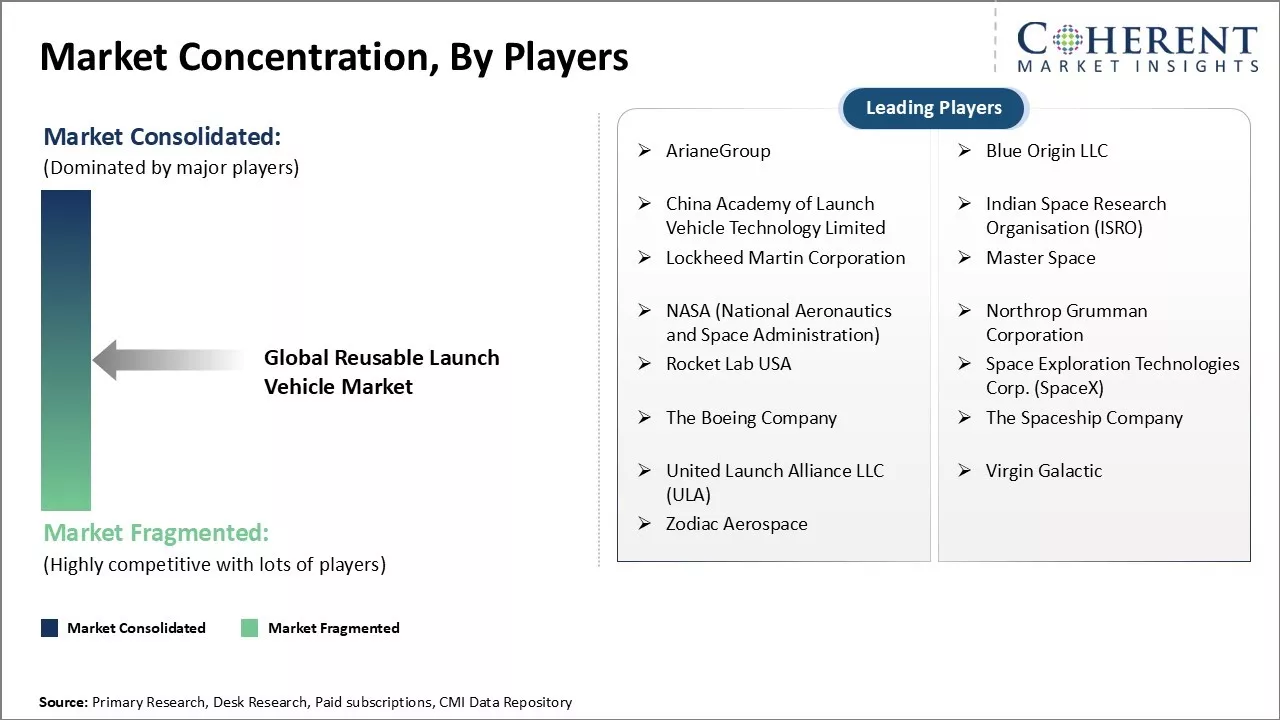
| Companies covered: | ArianeGroup, Blue Origin LLC, China Academy of Launch Vehicle Technology Limited, Indian Space Research Organisation (ISRO), Lockheed Martin Corporation, Master Space, NASA (National Aeronautics and Space Administration), Northrop Grumman Corporation, Rocket Lab USA, Space Exploration Technologies Corp. (SpaceX), The Boeing Company, The Spaceship Company, United Launch Alliance LLC (ULA), Virgin Galactic, Zodiac Aerospace | ||
| Growth Drivers: |
| ||
| Restraints & Challenges: |
| ||
Market Concentration and Competitive Landscape
Reusable Launch Vehicle Market: Growth Drivers
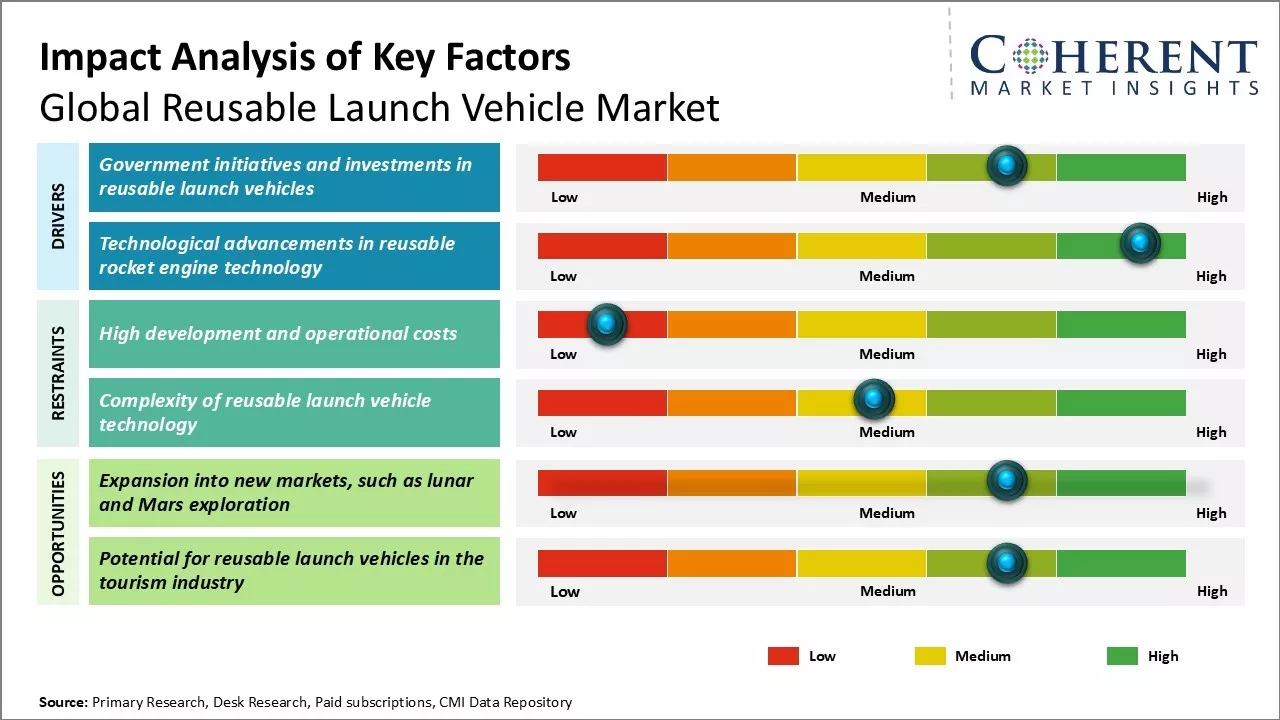
- Government initiatives and investments in reusable launch vehicles
Governments across the globe have realized the potential that reusable launch vehicles hold for the future of space exploration and commercialization. These are actively supporting research and development in this area through initiatives and funding. The National Aeronautics and Space Administration (NASA) in the U.S. has been at the forefront of this drive for reusability.
With its ambitious goals of returning humans to the Moon by 2025 under the Artemis program and later reaching Mars, NASA recognizes that expenditure on single-use rocket stages needs to reduce significantly. This was the driving force behind NASA awarding billion-dollar contracts to SpaceX for cargo and crew trips to the International Space Station using the partially reusable Falcon 9 rocket.
SpaceX has shown the commercial and technological viability of vertical rocket landing and reuse with dozens of successful Falcon 9 first stage landings. Encouraged by this progress, NASA has further committed to fund development of fully and rapidly reusable launch vehicles like SpaceX's Starship as part of public-private partnerships. Besides cargo missions, NASA also intends to use Starship for crewed lunar landings in the long run which would demonstrate reuse capabilities on longer duration deep space missions.
Other governments are also investing substantially in this area believing it to be crucial for creating a self-sustaining space economy. The European Space Agency has backed the development of reusable first stage boosters by ArianeGroup for the future Ariane 6 rocket. The Indian Space Research Organisation successfully conducted developmental flights and recovery of its unmanned reusable launch vehicle technology demonstrator named RLV-TD.
Japan is also exploring reusable technologies through projects like the HOPE-X program carried out in early 2000s. Even smaller nations and startups are entering the fray with Astroscale, a Singapore based rocket company, raising funds for its reusable last stage and Europe's PLD Space working on a mini reusable launcher. Sustained government support through projects, partnerships and procurements facilitate advancements made in reusable space transportation.
- Technological advancements in reusable rocket engine technology
While economic viability is a prime motivator, another crucial factor has been progress on the technological front related to reusable propulsion systems. Reusing rocket stages requires that engines themselves should be repeatedly relightable, durable, and cause minimum damage during landing and recovery.
Reusable Launch Vehicle Market with aerodynamics study is also gaining prominence, as understanding aerodynamic behavior is essential for safe re-entry and efficient recovery of rocket stages. Engine manufacturers have been steadily enhancing engine designs to meet these challenging requirements. SpaceX's Merlin 1D engine powering Falcon 9 has flown over 100 missions with multiple firings and landings.
Various design changes like additively manufactured combustion chambers, optimizations in propellant mixture ratios, use of lightweight materials, and advanced health monitoring systems have increased the engine's reliability. IHI, a Japan-based company, similarly developed the LE-7 engine featuring a staged combustion cycle for decreased weight and improved reusability suited for future H-3 rockets.
Developing advanced propellant types to improve engine performance on subsequent flights can also drive the market growth. This includes using non-toxic and storable propellants as opposed to cryogenic and hypergols. Companies like Rocket Lab and Relativity Space are pursuing hydrocarbon fuels owing to their ease of handling.
Relativity is also 3D printing entire smallsat launch vehicles with its proprietary additive manufacturing method to make reuse affordable. Supersonic and hypersonic retropropulsion technologies enabling precise rocket landing are also seeing leaps. SpaceX's grid fins, landing legs, landingburn of Falcon 9 and Tesla electric turbo-pumps represent numerous innovations in this regard.
Various experimental reusable engine projects have also contributed profoundly to knowledge gain in combustion instability, multi-start capabilities, extended mission durations and health monitoring of components under reuse stresses. Further continued strides are envisioning even more ambitious reusable rocket architectures. These technical evolutions have lent practicality and credence to the reusable launch
Reusable Launch Vehicle Market: Trends
Government support and public-private partnerships play a crucial role, as multi-year contracts and funding initiatives in the U.S., Europe, and Asia are accelerating R&D and commercial deployment of RLVs. Additionally, the rise of space tourism and private spaceflight is creating new revenue streams and stimulating further innovation and competition.
Reusable Launch Vehicle Market: Opportunities
- Expansion into new markets, such as lunar and Mars exploration
The expansion into new markets like lunar and Mars exploration presents significant opportunities for the global reusable launch vehicle market growth. Space agencies are actively promoting public-private partnerships to facilitate exploration of the moon and mars.
NASA’s Artemis program aims to land astronauts on the lunar south pole by 2024, paving the way for a sustained human presence on the moon by 2028. Similarly, rising private sector interest in mining lunar resources and NASA's long-term goal of sending humans to Mars in the 2030s have spurred initiatives like SpaceX's Starship program.
Reusable Launch Vehicle in fuel efficiency is becoming a critical focus, as advancements in this area directly contribute to lowering operational costs and increasing mission sustainability. Reusable heavy-lift rockets able to transport large payloads and deliver satellite constellations in low-Earth orbit will be critical enablers for these ambitious missions.
As governmental and commercial entities increasingly leverage reusable launch technologies, it could unlock new markets worth billions annually. Widespread adoption of reusable rockets can make exploration of the solar system more viable by significantly reducing launch costs.
Reusable Launch Vehicle Market: Key Developments
- December 2024, India’s space agency, the Indian Space Research Organisation (ISRO), achieved remarkable milestones, solidifying the country’s status as a powerful space-faring nation and positioning it among the top five globally. ISRO’s space programme has set ambitious goals for the next two decades, driven by the successful development of advanced, reusable rockets and next-generation launch vehicles (NGLVs).
- August 2024, India launched its first reusable hybrid rocket ‘RHUMI- 1’, developed by the Tamil Nadu-based start-up Space Zone India with Martin Group, from Thiruvidandhai in Chennai. The rocket, carrying 3 Cube Satellites and 50 PICO Satellites, was launched into a suborbital trajectory using a mobile launcher. These satellites will be collecting data for research purposes on Global warming and Climate change.
Analyst Opinion
- Global reusable launch vehicle market growth is driven by heavy investment by SpaceX and Boeing in reusable technologies like Falcon 9 and Starliner. As these companies successfully recover and reuse orbital class boosters and spacecraft, launch costs will reduce drastically, thus, making access to space more affordable for commercial and government users. This decreased cost structure can boost demand for services like satellite deployment and space tourism.
- Technologies need to demonstrate high reusability factors with quick turnaround times to convince stakeholders.
- Early reusable designs showed higher refurbishment costs as compared to costs of manufacturing new vehicles. However, as companies accumulate more experience with reuse through repeated missions, refurbishment costs are expected to decline.
- North America, especially the U.S., dominates the market due to localization of pioneers like SpaceX.
- However, China and some European nations are also aggressively working on reusable vehicle prototypes. Asian markets like India and Japan are investing in their National Space programs and have witnessed growth in interest in adopting reuse to deliver satellite payloads at lower price points. Private spaceflight companies domiciled in these regions can benefit.
Speak to the analyst
Want personalized insights?
Take the findings above to one of our principal consultants, or have the report rebuilt around the segments, geographies and competitors you actually track.
Market Segmentation
- By Reusability Level (Revenue, USD Bn, 2021 - 2033)
- Partially Reusable Vehicles
- Fully Reusable Vehicles
- Single-Stage-to-Orbit Vehicles
- By Payload Capacity (Revenue, USD Bn, 2021 - 2033)
- Medium-Lift Vehicles (5,000 20,000 kg)
- Small-Lift Vehicles (< 5,000 kg)
- Heavy-Lift Vehicles (>20,000 kg)
- By Application (Revenue, USD Bn, 2021 - 2033)
- Commercial Satellite Launch
- Government/Military Missions
- Space Tourism and Research
- By Region (Revenue, USD Bn, 2021 - 2033)
- North America
- U.S.
- Canada
- Latin America
- Brazil
- Argentina
- Mexico
- Rest of Latin America
- Europe
- Germany
- U.K.
- Spain
- France
- Italy
- Russia
- Rest of Europe
- Asia Pacific
- China
- India
- Japan
- Australia
- South Korea
- ASEAN
- Rest of Asia Pacific
- Middle East
- GCC Countries
- Israel
- Rest of Middle East
- Africa
- South Africa
- North Africa
- Central Africa
- Key Players Insights
- ArianeGroup
- Blue Origin LLC
- China Academy of Launch Vehicle Technology Limited
- Indian Space Research Organisation (ISRO)
- Lockheed Martin Corporation
- Master Space
- NASA (National Aeronautics and Space Administration)
- Northrop Grumman Corporation
- Rocket Lab USA
- Space Exploration Technologies Corp. (SpaceX)
- The Boeing Company
- The Spaceship Company
- United Launch Alliance LLC (ULA)
- Virgin Galactic
- Zodiac Aerospace
Sources
Primary Research Interviews
- NASA engineers and mission planners
- ISRO scientists and GSLV-Mk III team members
- SpaceX launch system engineers
- Blue Origin propulsion system designers
Databases
- Web of Science
- ProQuest
- ScienceDirect
- JSTOR
Magazines
- Aerospace America
- MIT Technology Review
- Scientific American
- Popular Science
Journals
- Journal of Aerospace Engineering
- Advances in Space Research
- International Journal of Aerospace Engineering
- Space Policy
Newspapers
- The New York Times (Science & Space section)
- The Washington Post (Technology section)
- The Hindu (Science and Technology)
- The Times of India (ISRO and Defense)
Associations
- JAXA (Japan Aerospace Exploration Agency)
- CNSA (China National Space Administration)
- AIAA (American Institute of Aeronautics and Astronautics)
- Space Foundation
Proprietary Elements
- CMI Data Analytics Tool, Proprietary CMI Existing Repository of information for last 8 years
*Definition: Global Reusable Launch Vehicle Market involves companies that design, develop, manufacture, and operate space launch vehicles or components that are recoverable and reusable after launch. These reusable launch vehicles are intended to lower the cost of access to space by multiple uses rather than being destroyed after a single use like conventional expendable launch systems. Major players in this market are SpaceX, Blue Origin, Boeing, Masten Space Systems, and others.
Get access to 250+ pages report
Every segment, forecast, competitor profile and data table behind the analysis above — available for instant download.
- ESOMAR Member
- ISO 9001:2015 Certified
- D-U-N-S Registered
- GDPR & CCPA Compliant
Missing comfort of reading report in your local language? Find your preferred language:
Transform your Strategy with Exclusive Trending Reports
Frequently Asked Questions
The Reusable Launch Vehicle Market size is estimated to be valued at USD 5.40 Bn in 2026, and is expected to reach USD 11.98 Bn by 2033.
The CAGR of the global Market is projected to be 12.2% from 2026 to 2033.
Government initiatives and investments in reusable launch vehicles and technological advancements in reusable rocket engine technology are the major factors driving the growth of global market.
High development and operational costs and complexity of reusable launch vehicle technology are the major factors hampering the growth of global market.
In terms of reusability level, partially reusable vehicles segment is estimated to dominate the market in 2026.
ArianeGroup, Blue Origin LLC, China Academy of Launch Vehicle Technology Limited, Indian Space Research Organisation (ISRO), Lockheed Martin Corporation, Master Space, NASA (National Aeronautics and Space Administration), Northrop Grumman Corporation, Rocket Lab USA, Space Exploration Technologies Corp. (SpaceX), The Boeing Company, The Spaceship Company, United Launch Alliance LLC (ULA), Virgin Galactic, Zodiac Aerospace are the major players.
North America is expected to lead the global reusable launch vehicle industry.