

Automotive Infotainment Market Size and Forecast – 2026 to 2033
Automotive Infotainment Market is estimated to be valued at USD 36.45 Bn in 2026 and is expected to reach USD 61.66 Bn in 2033, exhibiting a compound annual growth rate (CAGR) of 7.8% from 2026 to 2033.
Key Takeaways
- By System, Entertainment System acquired the prominent share in 2026 as rising consumer demand for in-car connectivity and entertainment.
- By Vehicle Type, Passenger Car hold the largest market share in 2026 owing to increasing production and sales of passenger cars.
- By Sales Channel, OEM dominates the overall market with an estimated share of 66% in 2026 owing to the need for differentiation and competitive advantage.
- By Region, North America acquired the prominent share of 29.3% in 2026 as high consumer adoption of advanced technologies.
Market Overview
The global automotive infotainment market have undergone significant transformations through gradual innovation, invention, and the complete reinvention of vehicle dashboards. Initially limited to music consoles, these systems have evolved into a diverse range of applications that enhance the driver and passengers' connectivity with their surroundings and the external world, while also providing entertainment during travel.
The modern auto infotainment systems encompass functionalities such as audio and video content playback and management, driving navigation, and rear-seat entertainment options like music, video, games, and social networking. By offering a plethora of features, the auto infotainment systems empower drivers to engage in various virtual activities while driving or traveling, enabling them to work or connect in a manner similar to when they are outside a vehicle.
Current Events and their Impact on the Automotive Infotainment Market
Current Events | Description and its impact |
Semiconductor Supply Chain Disruptions |
|
5G Integration and Connectivity Advancements |
|
AI-Driven Voice Assistants and Big Tech Dominance |
|
Role of Artificial Intelligence (AI) in Automotive Infotainment Market
Artificial Intelligence (AI) is revolutionizing the automotive infotainment market by enabling smarter, more personalized, and safer in-car experiences. AI-powered voice assistants allow drivers to control navigation, media, and vehicle functions using natural language, minimizing distraction and enhancing safety. Advanced algorithms personalize content by learning user preferences—suggesting music, routes, or even adjusting climate settings automatically.
In December 2024, Uno Minda launched a new touchscreen infotainment system in India, featuring integrated GPT-powered AI. The system includes a voice assistant capable of answering user queries intelligently.
- Current Industry Events of 2026
- Market Size Estimation
- Regional Breakdown
- Competitive Landscape
- Customer Intelligence
- Segmental Analysis
- Pricing Analysis
- Key Market Drivers, Challenges & Future Trends
- Customized Insights Section
End-user Feedback and Unmet Needs in the Automotive Infotainment Market
- Demand for Intuitive User Interfaces: Users frequently express frustration with complex and non-intuitive infotainment controls. They seek simplified, user-friendly interfaces that reduce distraction and allow easy access to functions like navigation, media, and vehicle settings without compromising safety during driving.
- Need for Faster System Responsiveness: Consumers want infotainment systems that respond quickly and smoothly. Lagging or slow interfaces negatively impact the overall experience, making users desire more powerful processors and optimized software to ensure instant feedback and seamless multitasking capabilities.
- Desire for Enhanced Smartphone Integration: End users increasingly expect seamless and versatile smartphone connectivity across different platforms. Many report issues with compatibility, limited app access, or interruptions, highlighting a need for improved integration with both Android and iOS ecosystems.
Segmental Insights
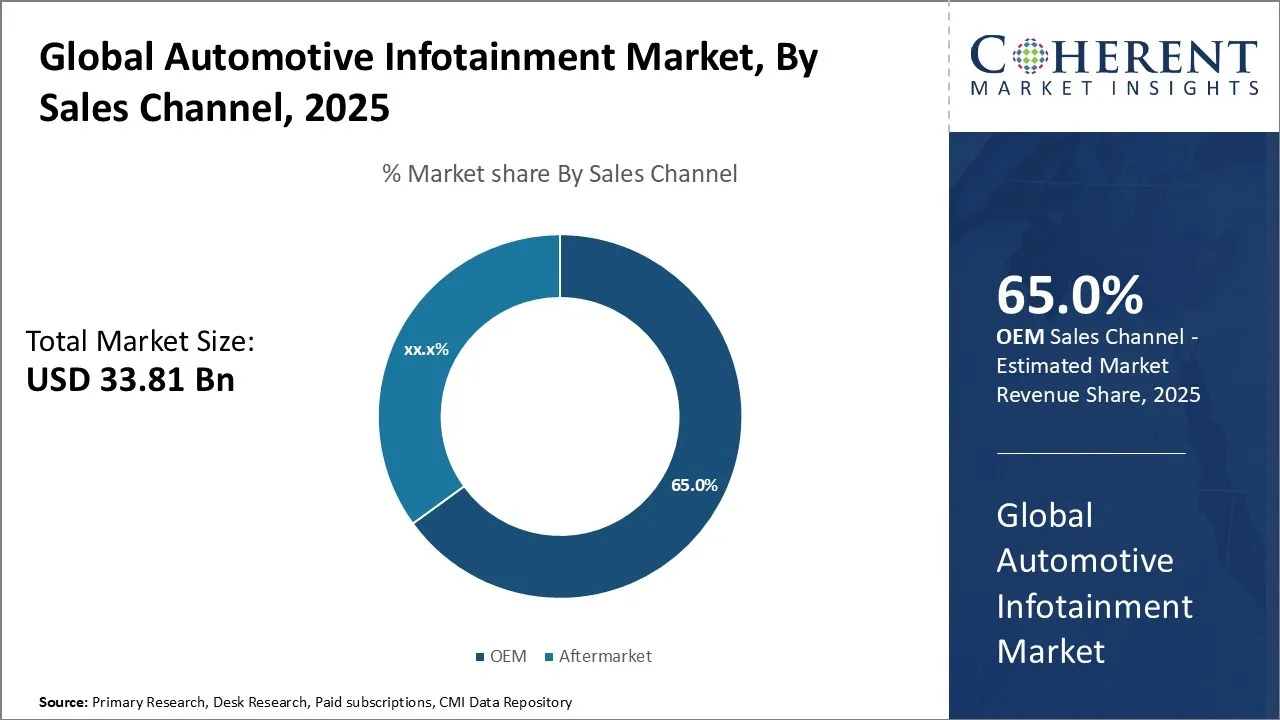
Automotive Infotainment Market Insights, By Sales Channel: OEM contribute the highest share of the market owing to its partnerships with tech companies and suppliers
OEMs actively boost the automotive infotainment market by integrating advanced systems that enhance vehicle appeal and match shifting consumer demands. They prioritize delivering features such as seamless smartphone connectivity, voice control, and real-time navigation to maintain a competitive edge. By using scalable and modular infotainment platforms, OEMs efficiently update multiple vehicle models. They also partner with technology companies to introduce innovative infotainment solutions, ensuring compliance with safety standards while elevating both the driving experience and passenger satisfaction. In January 2024, ACCESS Europe GmbH and MediaTek announced an expanded partnership to deliver an integrated in-car entertainment solution for the automotive industry. The collaboration combines MediaTek chipsets with ACCESS’s Twine4Car platform, offering OEMs a customizable app store and content hub for next-generation In-Vehicle Infotainment.
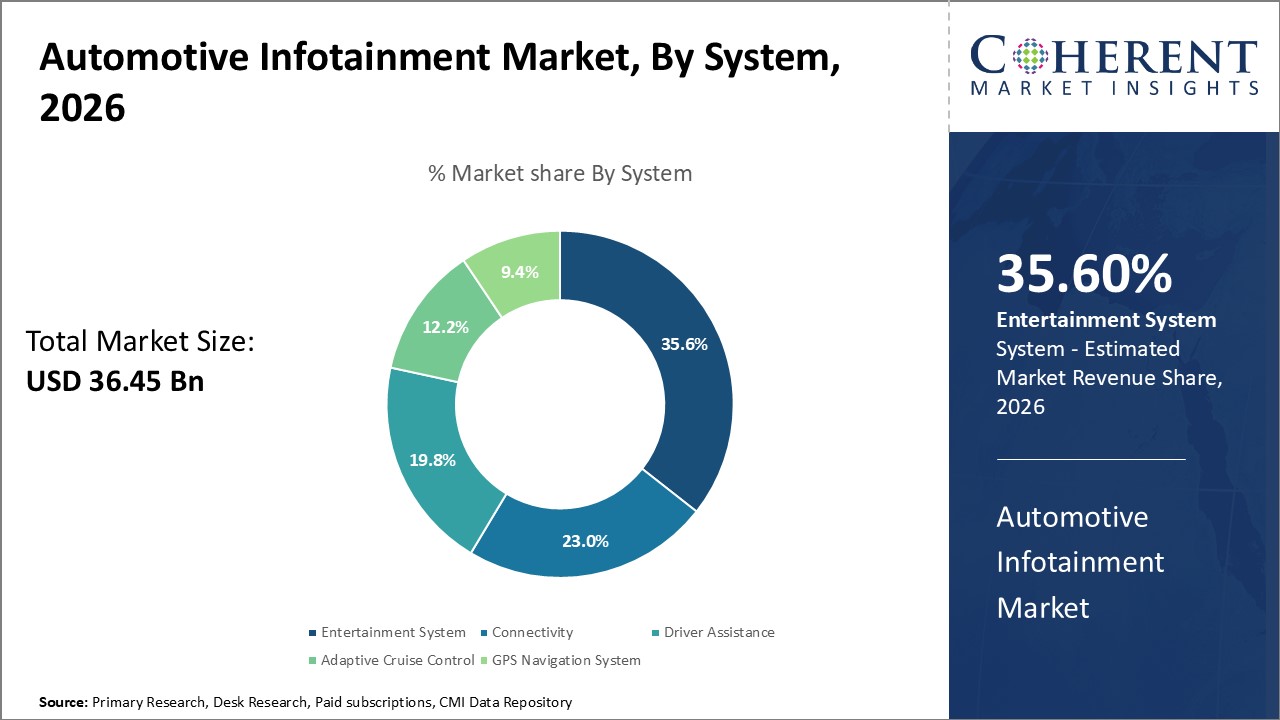
Automotive Infotainment Market Insights, By System: Entertainment System contribute the highest share of the market owing to increased consumer spending on vehicle upgrades
Consumers are increasingly driving the growth of entertainment systems in the automotive infotainment market by demanding enhanced in-car experiences, seamless smartphone integration, and real-time connectivity. They actively seek features like music streaming, video playback, and voice-controlled assistants to boost comfort and convenience. Automakers are incorporating technological advancements such as high-resolution touchscreens and AI integration, making infotainment a core component of modern vehicles. The growing use of electric and connected cars also accelerates the demand for advanced in-vehicle entertainment systems. For instance, in January 2024, ACCESS Europe GmbH, a leading developer of advanced software for the TV and automotive sectors, partnered with MediaTek to strengthen their collaboration by delivering an integrated solution for the automotive industry. Together, they are combining MediaTek’s chipsets with ACCESS’s car-focused app store and in-car entertainment platform to enhance in-vehicle digital experiences. Such innovations are accelerating the automotive infotainment market revenue.
Automotive Infotainment Market Insights, By Vehicle Type: Passenger Car contribute the highest share of the market owing to its growing urbanization and longer commutes
Consumers are driving the growth of the automotive infotainment market for passenger cars by demanding greater comfort, connectivity, and advanced technology. They now view infotainment systems as essential, actively seeking features such as navigation, multimedia access, and smartphone integration. In response, automakers are increasingly outfitting passenger vehicles with intuitive and connected systems to maintain a competitive edge. The shift toward smart interfaces and voice-activated controls is improving the in-car experience, while urban lifestyles and longer commutes continue to boost demand for engaging infotainment features.
In April 2024, HARMAN announced that Tata Motors has chosen the HARMAN Ignite Store as the in-vehicle app store for its passenger cars, enhancing access to safe and reliable mobility experiences in a new region.
Regional Insights
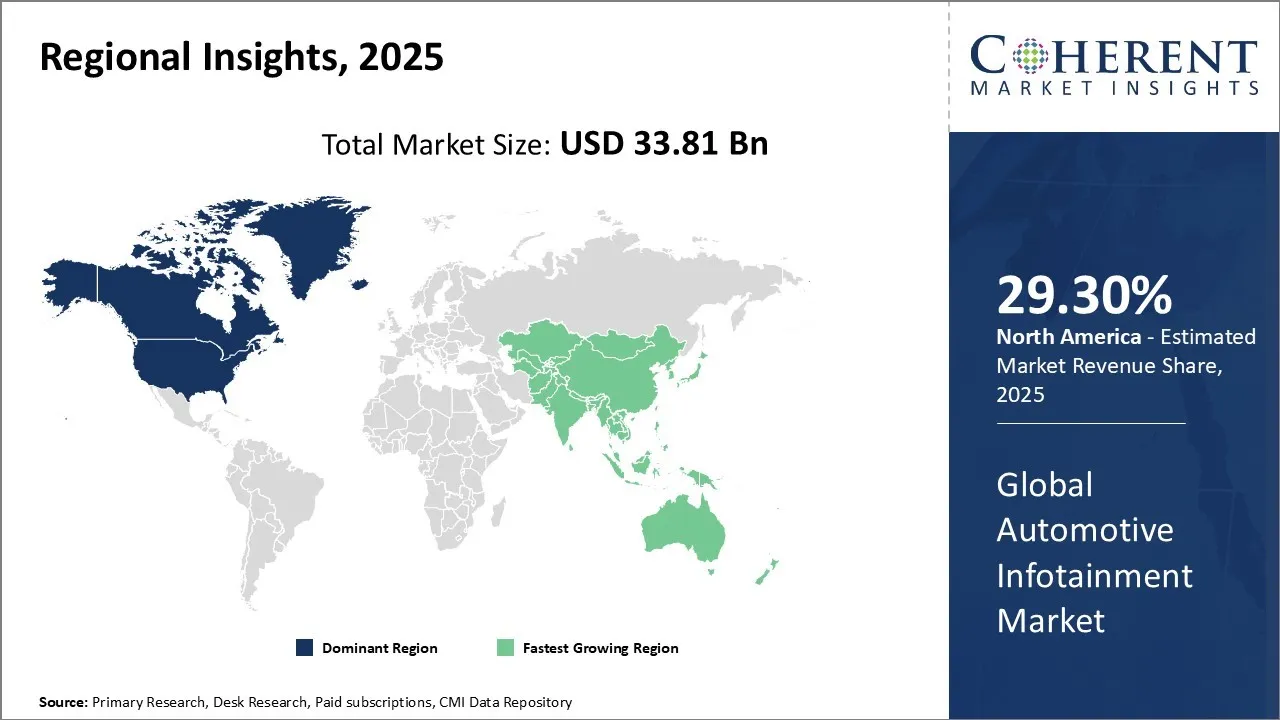
North America Automotive Infotainment Market Trends
North America acquires the largest share of 29.30%. Automakers in North America are reshaping the automotive infotainment market by actively implementing AI-powered voice assistants, gesture controls, and cloud-based personalization to improve in-car experiences. They continue to adopt Android Automotive and OTA update platforms to boost connectivity, simplify software updates, and enable third-party app integration. By introducing augmented-reality dashboards and heads-up displays, they enhance safety and navigation features. They also strengthen smartphone mirroring through CarPlay and Android Auto while addressing cybersecurity risks and refining user interfaces to improve overall user experience. For instance, in May 2026, CarPlay Ultra, the next generation of CarPlay, became available with new Aston Martin vehicle orders in the U.S. and Canada. It was also announced that it would become available for existing models equipped with the brand’s next-generation infotainment system through a software update. Such updates are proliferating the automotive infotainment market revenue.
Asia Pacific Automotive Infotainment Market Trends
Automakers across APAC actively adopt 5G, IoT, and cloud-based technologies to deliver real-time navigation, vehicle diagnostics, and music streaming. They enhance user experience by enabling seamless connectivity, over-the-air updates, and remote diagnostics. They also integrate AI-powered voice assistants, gesture controls, and predictive features to simplify driver interaction, boost safety, and personalize in-car experiences by learning user behavior. In April 2026, at the Shanghai Auto Show, Porsche CEO Oliver Blume announced the launch of a market-specific infotainment system designed for China. The customized technology, aimed at strengthening ties with Chinese drivers, is set to roll out in 2026.
India Automotive Infotainment Market Trends
Automakers in India are actively integrating AI-powered voice assistants such as Alexa Auto and Google Assistant into infotainment systems, allowing drivers to control navigation, entertainment, and vehicle settings hands-free. This enhances safety and convenience while supporting multiple languages to address India’s linguistic diversity. The widespread rollout of 4G and 5G networks is driving the adoption of connected car technologies, enabling real-time navigation, over-the-air updates, and vehicle diagnostics to improve the overall driving experience. For instance, in October 2024, TATA Technologies and the BMW Group have officially launched their joint venture, BMW TechWorks India, as an equal 50:50 partnership. Through this collaboration, both companies aim to develop advanced digital solutions for the automotive sector, focusing on software-defined vehicles (SDVs), automated driving technologies, digital infotainment, and automotive digital services, further accelerating the automotive infotainment market revenue.
Japan Automotive Infotainment Market Trends
Japanese automakers actively integrate AI-powered voice assistants into infotainment systems, allowing drivers to control navigation, media, and vehicle settings hands-free. This improves user convenience and meets Japan’s demand for advanced technology, appealing to tech-savvy consumers who want seamless in-car experiences. They also develop sophisticated human-machine interfaces by combining voice recognition, touchscreens, and gesture controls to deliver a smooth and intuitive user experience. For instance, in August 2024, Japanese car audio and entertainment system manufacturer Pioneer announced plans to expand its collaboration with Indian automakers.
Market Report Scope
Automotive Infotainment Market Report Coverage
| Report Coverage | Details | ||
|---|---|---|---|
| Base Year: | 2025 | Market Size in 2026: | USD 36.45 Bn |
| Historical Data for: | 2020 To 2024 | Forecast Period: | 2026 To 2033 |
| Forecast Period 2026 to 2033 CAGR: | 7.8% | 2033 Value Projection: | USD 61.66 Bn |
| Geographies covered: |
| ||
| Segments covered: |
| ||
| Companies covered: | Continental AG, Garmin Ltd., DENSO Corporation, Delphi Automotive LLP, Fujitsu Ten Limited, HARMAN International, Clarion, Pioneer Corporation, Panasonic Corporation, Visteon Corporation, Pacific Industrial Co., Ltd., Robert Bosch GmbH | ||
| Growth Drivers: |
| ||
| Restraints & Challenges: |
| ||
Automotive Infotainment Market Trend
- Increasing Adoption of Connected Car Technologies
Automakers are rapidly integrating connected car technologies into infotainment systems, leveraging 4G, 5G, and IoT to enable real-time data sharing, remote diagnostics, and seamless media streaming. These advancements improve navigation accuracy, vehicle health monitoring, and overall user experience. Connected systems also support over-the-air software updates, allowing manufacturers to continuously enhance features and security post-purchase, aligning with consumers’ demand for smarter, always-updated vehicles.
In March 2025, Hyundai Motor Group launched its new mobility software platform, ‘Pleos,’ at the ‘Pleos 25’ developer conference in Seoul. Designed to support autonomous and connected movement across all types of vehicles and devices, Pleos integrates transportation with infrastructure to enable smarter, more efficient mobility for users, businesses, and cities. The platform powers key functions like autonomous driving, real-time data analysis, vehicle connectivity, and optimized route planning—enhancing user experience and urban mobility efficiency. Such innovations are accelerating the automotive infotainment market share.
Automotive Infotainment Market Opportunity
- Expansion of Electric and Autonomous Vehicles
The rise of electric and autonomous vehicle presents significant opportunities for infotainment systems as cars transition into smart, connected hubs. These vehicles require sophisticated infotainment platforms that support advanced navigation, real-time data exchange, and entertainment options to engage passengers. Automakers can innovate by integrating AI, AR, and personalized content, transforming infotainment into a central feature that enhances comfort, safety, and the overall travel experience in the evolving automotive landscape.
Automotive Infotainment Market News
- In April 2025, Valeo introduced two new remanufactured products: Europe’s first remanufactured LED headlamp and a remanufactured infotainment display screen.
- In March 2025, At its ‘Pleos 25’ developer conference in Seoul, Hyundai unveiled its new infotainment and operating system, ‘Pleos.’ The system features a large tablet-style screen, similar to those found in Teslas. Based on the prototype, Hyundai appears to be including physical buttons and knobs instead of opting for a fully touch-based interface.
- In September 2024, Tata Motors introduced the updated version of its popular SUV, the Tata Punch, featuring a revised lineup and enhanced features. Although the exterior design stays the same, Tata has added several key upgrades, including a larger 10.25-inch infotainment touchscreen, wireless Android Auto and Apple CarPlay, a wireless phone charger, rear AC vents, and a front armrest.
Analyst Opinion (Expert Opinion)
- The automotive infotainment market is at a pivotal inflection point driven by an accelerated convergence of AI, connectivity, and evolving consumer expectations. From my analysis, the most transformative factor isn’t merely the hardware upgrade but the software ecosystem’s maturity — particularly the ability to deliver seamless, personalized experiences that rival mobile devices. For instance, Tesla’s over-the-air (OTA) updates and customizable UI exemplify how infotainment can evolve from a secondary feature to a core vehicle differentiator. Tesla's continuous software refinement, delivering features like Netflix streaming and game integration, is setting a new bar for competitors.
- Moreover, AI-driven voice assistants are essential for user engagement and safety. In Japan, automakers integrating AI assistants like Toyota’s “Yui” have reported a 30% increase in user interaction with infotainment features, proving that voice tech adoption directly impacts customer satisfaction and brand loyalty.
Speak to the analyst
Want personalized insights?
Take the findings above to one of our principal consultants, or have the report rebuilt around the segments, geographies and competitors you actually track.
Market Segmentation
- Global Automotive Infotainment Market, By System Type (Revenue, USD Bn, 2021 - 2033)
- Entertainment System
- Audio System
- Video System
- Connectivity
- Hands Free Call
- USB Bluetooth
- Wi-Fi Router
- Driver Assistance
- Traffic Message Channel (TMC)
- Adaptive Cruise Control (ACC)
- GPS Navigation System (GPS)
- Entertainment System
- Global Automotive Infotainment Market, By Vehicle Type (Revenue, USD Bn, 2021 - 2033)
- Passenger Car
- Compact & Mid-size
- Premium
- Luxury
- Light Commercial Vehicle
- High Commercial Vehicle
- Buses
- Trailers
- Trucks
- Passenger Car
- Global Automotive Infotainment Market, By Sales Channel (Revenue, USD Bn, 2021 - 2033)
- OEM
- Aftermarket
- Global Automotive Infotainment Market, By Region (Revenue, USD Bn, 2021 - 2033)
- North America
- U.S.
- Canada
- Europe
- Germany
- Italy
- U.K.
- France
- Russia
- Rest of Europe
- Asia Pacific
- China
- India
- Japan
- Australia
- South Korea
- ASEAN
- Rest of Asia Pacific
- Latin America
- Brazil
- Mexico
- Argentina
- Rest of Latin America
- Middle East & Africa
- GCC Countries
- South Africa
- Rest of Middle East and Africa
- North America
- Key Players Insights
- Continental AG
- Garmin Ltd.
- DENSO Corporation
- Delphi Automotive LLP
- Fujitsu Ten Limited
- HARMAN International
- Clarion
- Pioneer Corporation
- Panasonic Corporation
- Visteon Corporation
- Pacific Industrial Co., Ltd.
- Robert Bosch GmbH
Sources
Primary Research Interviews
- In-depth interviews with product managers from Tier 1 suppliers (e.g., Harman, Panasonic Automotive)
- Discussions with R&D engineers from leading OEMs (e.g., Hyundai, Toyota, Ford)
- Conversations with software developers working on embedded infotainment systems
- Feedback from automotive infotainment UX designers and HMI specialists
- Interviews with connected vehicle cybersecurity professionals
- Testimonies from dealership tech support staff and infotainment service technicians
Databases
- International Organization of Motor Vehicle Manufacturers (OICA) vehicle production database
- United Nations Economic Commission for Europe (UNECE) vehicle regulation database
- SAE International Technical Papers & Mobility Databases
- Open Automotive Alliance (OAA) data repository
- Statista (automotive tech sub-sections)
- U.S. National Highway Traffic Safety Administration (NHTSA) datasets
- Ministry of Land, Infrastructure, Transport and Tourism (Japan) automotive system registrations
- Automotive Grade Linux (AGL) codebase usage statistics
Magazines
- Automotive News
- Car and Driver
- WardsAuto
- EE Times Automotive
- Motor Trend
- TechCrunch (Mobility section)
- Autocar India
Journals
- IEEE Transactions on Intelligent Transportation Systems
- Journal of Automotive Engineering
- SAE International Journal of Connected and Automated Vehicles
- International Journal of Vehicle Design
- Transportation Research Part C Emerging Technologies
- Human Factors in Automotive UI Design Journal
Newspapers
- The Wall Street Journal – Auto Tech Section
- The Economic Times – Auto
- The New York Times – Technology Section
- The Japan Times – Mobility & Innovation
- The Guardian – Automotive Innovation Reports
Associations
- Society of Automotive Engineers (SAE)
- Automotive Electronics Council (AEC)
- 5G Automotive Association (5GAA)
- International Telecommunication Union (ITU)
- National Automotive Board (India)
- European Automobile Manufacturers’ Association (ACEA)
- Automotive Information Sharing and Analysis Center (Auto-ISAC)
Public Domain Sources
- World Bank Transport Sector Publications
- European Commission Mobility and Transport Reports
- U.S. Department of Transportation Reports
- Government whitepapers on intelligent transportation systems (e.g., UK Department for Transport)
- GitHub repositories from open-source infotainment platforms (e.g., AGL, Android Automotive)
- Publicly available OEM press releases and annual tech briefings
Proprietary Elements
- CMI Data Analytics Tool, and Proprietary CMI Existing Repository of information for last 8 years
Get access to 250+ pages report
Every segment, forecast, competitor profile and data table behind the analysis above — available for instant download.
- ESOMAR Member
- ISO 9001:2015 Certified
- D-U-N-S Registered
- GDPR & CCPA Compliant
Missing comfort of reading report in your local language? Find your preferred language:
Transform your Strategy with Exclusive Trending Reports
Frequently Asked Questions
The Automotive Infotainment Market is estimated to be valued at USD 36.45 Bn in 2026, and is expected to reach USD 61.66 Bn by 2033.
The CAGR of the Automotive Infotainment Market is projected to be 7.8% from 2026 to 2033.
Major factor driving the growth of Market during the forecast period is Integration of Smart Features.
Major factors hampering the growth of the Market during the forecast period is High Costs associated with the Automotive Infotainment market.
North America is expected to generate the highest revenue in the Market during the forecast period.