

Digital Manufacturing Market Size and Forecast — 2026 - 2033
The Global Digital Manufacturing Market size is estimated to be valued at USD 112.5 billion in 2026 and is expected to reach USD 238.7 billion by 2033, exhibiting a compound annual growth rate (CAGR) of 11.5% from 2026 to 2033.
Overview
The Digital Manufacturing Market encompasses a wide range of products designed to optimize production processes through advanced technologies. Key offerings include smart manufacturing software, industrial automation systems, 3D printing and additive manufacturing solutions, robotics, and Industrial Internet of Things (IIoT) platforms. These products enable real-time monitoring, predictive maintenance, and enhanced operational efficiency across various sectors, including automotive, aerospace, electronics, and healthcare. Digital twin technologies and simulation tools allow manufacturers to model and optimize production workflows, while cloud-based manufacturing solutions support remote monitoring and data-driven decision-making. Overall, digital manufacturing products integrate automation, connectivity, and analytics to improve productivity, reduce costs, and enhance product quality.
Key Takeaways
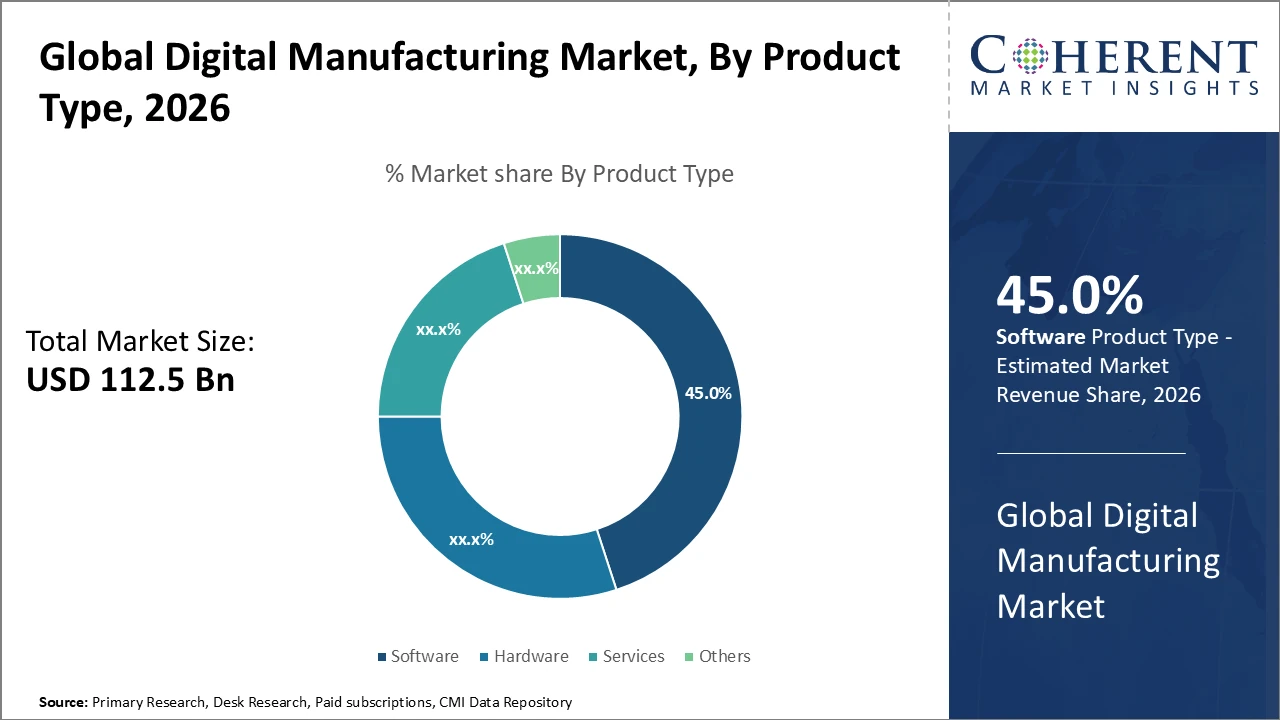
In the software product segment, cloud-based and AI-powered manufacturing solutions drive market growth, accounting for approximately 45% of total market share.
Hardware solutions are evolving to incorporate IoT sensors, enabling real-time monitoring, predictive maintenance, and enhanced operational efficiency.
Services such as consulting, system integration, and training are expanding to support enterprises in their digital transformation initiatives.
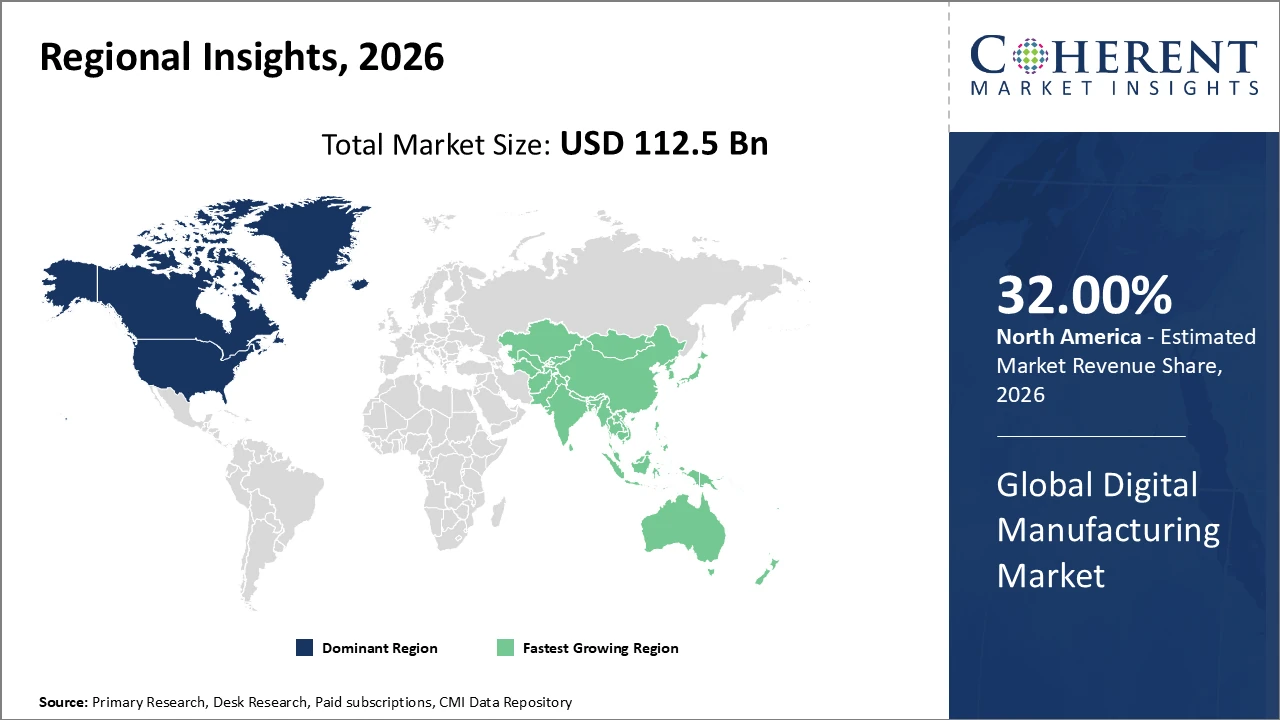
North America dominates the digital manufacturing market with over 32% revenue share, benefiting from robust infrastructure and well-established Industry 4.0 ecosystems.
Asia Pacific shows the fastest growth rate, driven by rapid industrialization and supportive government policies in China and India that enhance manufacturing competitiveness.
Segmental Analysis
Digital Manufacturing Market Insights, By Product Type
Software dominates the digital manufacturing market with a 45% share, driven by widespread adoption of cloud-based applications and AI integration that provide manufacturers with real-time insights and enhanced operational control. The fastest-growing subsegment is Services, fueled by increasing digital transformation initiatives that demand consulting, system integration, and post-deployment support to optimize manufacturing infrastructure. Hardware continues to play a critical role, including IoT sensors, robotics, and automation equipment that underpin smart manufacturing processes. The Others category covers peripherals and legacy systems catering to specialized or niche requirements. Together, these segments reflect the evolving ecosystem of digital manufacturing solutions.
Digital Manufacturing Market Insights, By Technology
Industrial IoT holds the largest share in the digital manufacturing market, enabling interconnected machinery and real-time data communication across production lines, which enhances efficiency and operational visibility. Artificial Intelligence is the fastest-growing technology subsegment, increasingly applied for predictive analytics, quality control, and process automation. Additive Manufacturing is gaining steady adoption for rapid prototyping, customization, and flexible production workflows. Robotics remains essential for automating assembly lines, reducing labor costs, and improving precision. The Others category includes emerging technologies such as augmented reality and virtual reality, which support maintenance, training, and process visualization. Collectively, these technologies are transforming modern manufacturing ecosystems.
Digital Manufacturing Market Insights, By End-User Industry
The Automotive segment dominates the digital manufacturing market, fueled by strong demand for smart factories that support mass customization, operational efficiency, and quality control. The fastest-growing subsegment is Healthcare, driven by the increasing adoption of digital manufacturing to produce personalized medical devices, prosthetics, and surgical instruments with high precision. Aerospace & Defense relies on advanced digital solutions for complex, safety-critical components, while Consumer Electronics leverages digital manufacturing to accelerate innovation cycles and reduce time-to-market. The Others category includes industrial machinery, energy, and other sectors integrating digital technologies to enhance productivity and streamline production processes. Collectively, these industries are shaping market growth.
Digital Manufacturing Market Trends
AI-driven predictive analytics is a major trend, helping manufacturers optimize supply chains and improve operational efficiency.
In 2025, more than 50% of leading manufacturers adopted AI, achieving over a 10% reduction in operational wastage.
Decentralized manufacturing through cloud platforms is gaining traction, allowing remote monitoring, control, and collaboration across facilities.
Cloud-based digital manufacturing enables smaller and emerging economy manufacturers to compete without large upfront infrastructure investments.
The integration of AI and cloud technologies supports real-time decision-making, predictive maintenance, and process optimization.
These trends collectively drive efficiency, cost reduction, and global competitiveness in the digital manufacturing market.
Digital Manufacturing Market Insights, By Geography
North America Digital Manufacturing Market Analysis and Trends
North America dominates the digital manufacturing market, driven by widespread Industry 4.0 adoption, mature innovation ecosystems, and government initiatives promoting smart manufacturing technologies. The region accounts for approximately 32% of global market share, supported by robust industrial infrastructure and high technology investment. Leading companies such as Siemens and Honeywell play a pivotal role, continuously investing in R&D, automation solutions, and advanced manufacturing platforms to enhance operational efficiency and innovation. Adoption of IoT, AI, and cloud-based manufacturing solutions across automotive, aerospace, and electronics sectors further strengthens the region’s leadership. These factors collectively position North America as a key hub for digital manufacturing growth.
Asia Pacific Digital Manufacturing Market Analysis and Trends
Asia Pacific is experiencing the fastest growth in the digital manufacturing market, with an anticipated CAGR exceeding 13%, driven by rapid industrialization, substantial government investment in digital infrastructure, and expanding manufacturing capabilities in countries like China and India. The region benefits from a growing base of multinational corporations and innovative local digital players, fostering technology adoption and enhancing the overall market ecosystem. Investments in smart factories, automation, and cloud-based manufacturing platforms are accelerating operational efficiency and productivity. These developments are creating significant business expansion opportunities, increasing revenue streams, and positioning Asia Pacific as a key high-growth region in the global digital manufacturing landscape.
Digital Manufacturing Market Outlook for Key Countries
USA Digital Manufacturing Market Analysis and Trends
The USA is a key hub for digital manufacturing innovation, representing the largest share of North America’s market revenue. Leading corporations extensively integrate AI, Industrial IoT, and automation technologies to optimize manufacturing workflows across sectors such as aerospace, automotive, and consumer electronics. In 2025, over 65% of U.S. manufacturing facilities adopted digital solutions, significantly contributing to national industry size and revenue growth. Strong technology ecosystems, skilled talent pools, and government-backed initiatives supporting Industry 4.0 further drive innovation. These factors collectively enable sustained investment in advanced manufacturing, enhance operational efficiency, and maintain the USA’s leadership in the global digital manufacturing market.
Germany Digital Manufacturing Market Analysis and Trends
Germany exemplifies Industry 4.0 in Europe, with its digital manufacturing market strengthened by well-established automotive, machinery, and industrial sectors. Leading companies such as Bosch and Siemens AG have adopted digital manufacturing technologies to improve production flexibility, efficiency, and precision, contributing to a 20% market size increase in 2026. Government initiatives like “Industrie 4.0” provide robust support through funding, infrastructure development, and innovation incentives, accelerating technology deployment and market adoption. Combined with advanced industrial expertise and a strong R&D ecosystem, Germany remains a central driver of digital manufacturing growth in Europe, influencing trends, standards, and competitive dynamics across the region.
Analyst Opinion
Digital manufacturing market growth is driven by rising investments in smart factories globally; in 2025, over 60% of automotive manufacturers in Europe integrated IoT-enabled manufacturing units, increasing regional market revenue by 14% year-over-year, supported by government incentives for digital transformation.
Diversification across end-use industries such as aerospace and healthcare has expanded digital manufacturing adoption; in 2024, North American aerospace sectors reported a 20% rise in digital tool deployment for prototyping, emphasizing precision and customization, thereby increasing vertical market share.
Pricing strategies are shifting toward subscription-based SaaS models, with over 35% of industrial clients adopting these by mid-2026, lowering entry barriers and broadening market access.
Micro-indicators show SMEs in Asia Pacific contributed approximately 25% of total market revenue in 2025, indicating digital manufacturing adoption is extending beyond large enterprises, influencing overall industry size and forecasts.
- Current Industry Events of 2026
- Market Size Estimation
- Regional Breakdown
- Competitive Landscape
- Customer Intelligence
- Segmental Analysis
- Pricing Analysis
- Key Market Drivers, Challenges & Future Trends
- Customized Insights Section
Market Scope
| Report Coverage | Details | ||
|---|---|---|---|
| Base Year: | 2025 | Market Size in 2026: | USD 112.5 billion |
| Historical Data for: | 2020 To 2024 | Forecast Period: | 2026 To 2033 |
| Forecast Period 2026 to 2033 CAGR: | 11.5% | 2033 Value Projection: | USD 238.7 billion |
| Geographies covered: |
| ||
| Segments covered: |
| ||
| Companies covered: | Siemens AG, ABB Ltd., PTC Inc., SAP SE, Cisco Systems, Inc., FANUC Corporation, Hexagon AB, Hitachi Ltd., Autodesk, Inc., Rockwell Automation, Inc. | ||
| Growth Drivers: |
| ||
Digital Manufacturing Market Growth Factors
The rapid adoption of Industry 4.0 initiatives across global manufacturing hubs is a key driver of digital manufacturing market growth. In 2025, governments in countries like China and Germany provided over USD 3 billion in incentives and grants to promote digital manufacturing adoption and infrastructure development. Rising demand for personalized products is further driving technology acceptance, as digital solutions enable flexible, large-scale customization. The integration of AI and machine learning in production management enhances predictive maintenance and operational efficiency, evidenced by a 22% reduction in downtime reported by electronics manufacturers in Taiwan in 2024. Additionally, growing digital investments in automotive and aerospace sectors, focusing on smart factories, accelerated market share growth, supported by a 15% increase in digital tool deployments in North America in 2026.
Digital Manufacturing Market Development
In February 2026, Protolabs launched ProDesk, an online platform for product development and procurement teams that provides real-time AI-powered quoting, design-for-manufacturability analysis, collaboration tools, and support for both prototyping and production.
Key Players
Leading Companies of the Market
Siemens AG
ABB Ltd.
FANUC Corporation
PTC Inc.
SAP SE
Cisco Systems, Inc.
Autodesk, Inc.
Hexagon AB
Hitachi, Ltd
Rockwell Automation, Inc.
Leading digital manufacturing companies have pursued aggressive growth strategies through strategic partnerships, acquisitions, and technology innovation. In 2025, Siemens AG expanded its software portfolio via targeted acquisitions, resulting in a 17% revenue increase in its digital manufacturing segment. Similarly, Honeywell leveraged joint ventures in emerging Asia Pacific markets to achieve substantial market penetration, strengthening its global footprint and fostering ecosystem development. These initiatives reflect a strategic focus on expanding capabilities, entering high-growth regions, and integrating advanced technologies, positioning these companies to capture greater market share and drive long-term growth in the rapidly evolving digital manufacturing landscape.
Digital Manufacturing Market Future Outlook
The digital manufacturing market is expected to experience robust growth, driven by continued adoption of Industry 4.0 technologies, AI, and Industrial IoT across diverse manufacturing sectors. Increasing demand for flexible, personalized production and smart factory solutions will accelerate digital transformation initiatives globally. Cloud-based platforms, digital twins, and predictive analytics will further enhance operational efficiency, reduce downtime, and optimize supply chains. Emerging markets in Asia Pacific and Latin America offer high-growth potential due to industrial expansion and government support. Sustainability trends and energy-efficient manufacturing practices will also shape future investments, positioning digital manufacturing as a cornerstone of competitive, technology-driven industrial ecosystems worldwide.
Digital Manufacturing Market Historical Analysis
The digital manufacturing market has experienced steady growth over the past decade, driven by the gradual adoption of Industry 4.0 technologies, automation, and IoT integration. Between 2015 and 2025, software solutions such as cloud-based manufacturing applications and AI-powered analytics led the market, while hardware including robotics and IoT-enabled machinery supported operational efficiency. Early adoption was concentrated in North America and Europe due to mature industrial infrastructure, skilled workforce, and supportive government policies. Over time, Asia Pacific emerged as a rapidly growing region, with investments in smart factories, industrial automation, and digital tool deployment expanding market reach and shaping global manufacturing trends.
Sources
Primary Research Interviews:
Manufacturing plant managers and operations directors
Industrial automation and robotics specialists
Digital manufacturing solution providers and software developers
Supply chain and production consultants
Magazines:
Manufacturing Global – Digital Manufacturing & Industry 4.0 Updates
IndustryWeek – Automation, Robotics, and Smart Factory Trends
Robotics Business Review – Industrial Robotics & Manufacturing Technology
Control Engineering – Manufacturing Systems & Automation Solutions
Journals:
Journal of Manufacturing Systems – Digital Manufacturing Research
Journal of Industrial Information Integration – Industry 4.0 & Digital Tools
Procedia Manufacturing – Applications of Digital Manufacturing Technologies
Newspapers:
The Wall Street Journal – Industrial Automation & Manufacturing Technology
Financial Times – Industry 4.0 and Manufacturing Market Trends
Reuters – Industrial Automation and Digital Manufacturing
Bloomberg – Smart Factories and Manufacturing Technology
Nikkei Asia – Industrial Technology & Manufacturing Innovations
Associations:
International Society of Automation (ISA)
SME (Society of Manufacturing Engineers)
Industrial Internet Consortium (IIC)
World Manufacturing Forum (WMF)
Get access to 250+ pages report
Every segment, forecast, competitor profile and data table behind the analysis above — available for instant download.
- ESOMAR Member
- ISO 9001:2015 Certified
- D-U-N-S Registered
- GDPR & CCPA Compliant
Missing comfort of reading report in your local language? Find your preferred language:
Transform your Strategy with Exclusive Trending Reports
Frequently Asked Questions
Leading players include Siemens AG, PTC Inc., SAP SE, ABB Ltd., and Rockwell Automation, all of which hold significant market share and technological leadership.
The Digital Manufacturing market is expected to grow from USD 112.5 billion in 2026 to USD 238.7 billion by 2033, reflecting a CAGR of 11.5%.
The automotive industry remains the largest adopter, while aerospace and healthcare sectors are rapidly growing, supported by increasing investments in smart manufacturing solutions.
Cloud manufacturing, AI-powered digital twins, and sustainability-driven adoption are expected to transform traditional manufacturing processes and dominate market dynamics.
The market is highly competitive and innovation-driven, with challenges including high digital transformation costs and complex system integration, encouraging strategic collaborations.
Key strategies include partnerships, acquisitions, technology development, and service expansion to enhance global presence and deliver comprehensive digital manufacturing solutions.