

Analog IC Market Analysis & Forecast: 2026-2033
Analog IC market is estimated to be valued at USD 90,818.3 Mn in 2026 and is expected to reach USD 1,47,753.3 Mn in 2033, exhibiting a compound annual growth rate (CAGR) of 7.2% from 2026 to 2033.
Key Takeaways
- By Product Type, Application specific segment is projected to hold 62.7% in the global analog IC market by 2026.
- By Region, Latin America is expected to command 35.1% share in the global market by 2026.
Market Overview
The global analog IC market is growing steadily because modern electronics need better ways to manage power and process signals. Smartphones, wearables, and IoT devices are becoming more popular, which is why consumer electronics are still the most popular application area. Asia Pacific is the biggest market because it has a strong manufacturing base and more money is going into semiconductors. Technological advances in electronics for cars, factories, and healthcare are also making the market bigger. At the same time, trends toward smaller and more integrated products are changing how companies compete and how new ideas come about in different parts of the world.
Current Events and its Impact on the Analog IC Market
Current Event | Description and its impact |
Semiconductor Supply Chain Stabilization |
|
Rising Adoption of Electric Vehicles (EVs) |
|
Role of Emerging Technologies: Shaping the Future of the Analog IC Market
New technologies are changing the analog IC market in a big way by pushing for new ideas in design, manufacturing, and application performance. Adding AI and machine learning to chip design is speeding up the process of making analog ICs that can handle complex tasks like power management, signal conversion, and sensor interfacing. Advanced simulation and modeling tools are making circuit design more accurate, lowering the cost of making prototypes, and speeding up the time it takes to get to market.
Also, next-generation semiconductor equipment manufacturing technologies like FinFET, SOI (Silicon-On-Insulator), and GaN (Gallium Nitride) processes are making power efficiency, thermal management, and miniaturization much better. These improvements are very important for making high-performance analog ICs work in places like electric vehicles, 5G networks, and automated factories.
- Current Industry Events of 2026
- Market Size Estimation
- Regional Breakdown
- Competitive Landscape
- Customer Intelligence
- Segmental Analysis
- Pricing Analysis
- Key Market Drivers, Challenges & Future Trends
- Customized Insights Section
Analog IC Market Trends
- Increasing demand for advanced consumer electronics fuels growth in the global analog IC market
In recent times, there has been a significant demand for consumer electronics such as Blu-ray players, tablets, smartphones, and LCD TVs. Additionally, the market has also seen a rise in the popularity of advanced products like ultra 4K HD TVs, wearable fitness trackers, smart watches, smart smoke and CO2 detectors, thermostats, IP/Wi-Fi cameras, smart switches, smart locks, dimmers, and more.
These products are projected to experience substantial growth in the coming period. Furthermore, many of these devices incorporate sensors that interact with the physical world, requiring analog processing for analog to digital conversion. By combining these functions with digital technology, a cost-effective, low-power, and reliable solution is achieved.
- Growing automotive safety system adoption drives growth in the global analog IC market
The increased utilization of electronics in areas such as fuel efficiency, safety, emission reduction, navigation, and entertainment systems has led to the integration of semiconductor devices in automotive systems, resulting in a heightened demand for analog ICs. Moreover, the presence of partial or fully autonomous systems in leading vehicles has contributed to an increased overall IC content per automobile.
As next-generation advanced driver assistance systems (ADAS) aim to expand their sensing range, enhance detection accuracy, and implement efficient algorithms for prompt responses in various driving conditions, the computational load also increases significantly. Consequently, the rising demand for autonomous and intelligent vehicles is expected to drive the need for advanced sensors in the foreseeable future. This, in turn, is anticipated to bolster the global analog IC market.
Segmental Insights
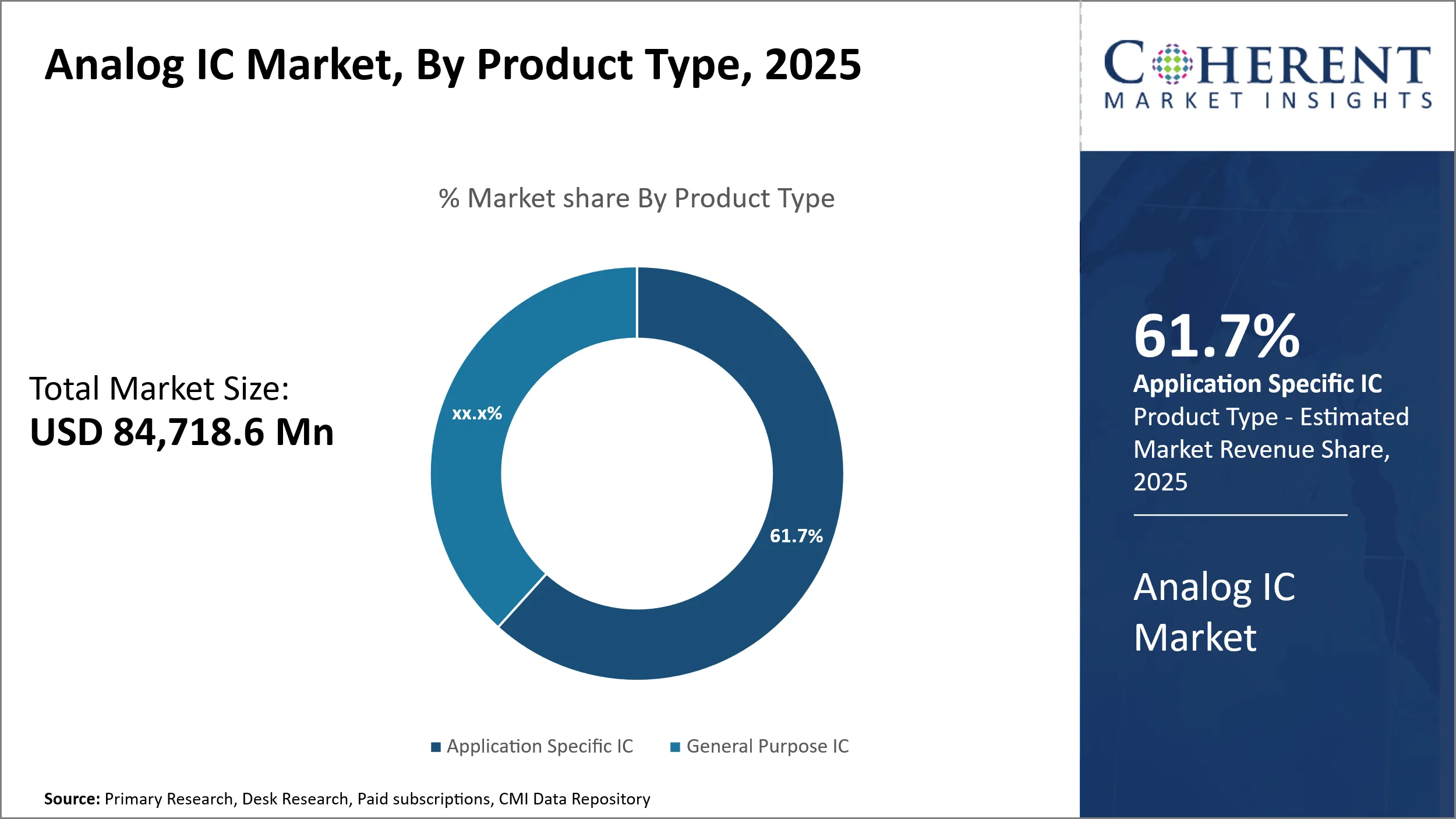
Analog IC Market Insights, By Application
The consumer electronics segment is projected to hold the largest share in the global analog IC market by 2026. This dominance is fuelled by the rapid proliferation of smartphone, tablets, wearables, and other connected devices requiring efficient power management, signal processing, and audio functionalities. Analog ICs are critical for enhancing device performance, extending battery life, and enabling real-world data conversion.
For instance, in November 2024, Renesas Electronics Corporation announced new AnalogPAK™ ICs, including lower power and automotive-qualified devices along with the industry’s first programmable 14-bit SAR ADC (Successive-Approximation Register Analog-Digital Converter).
Regional Insights
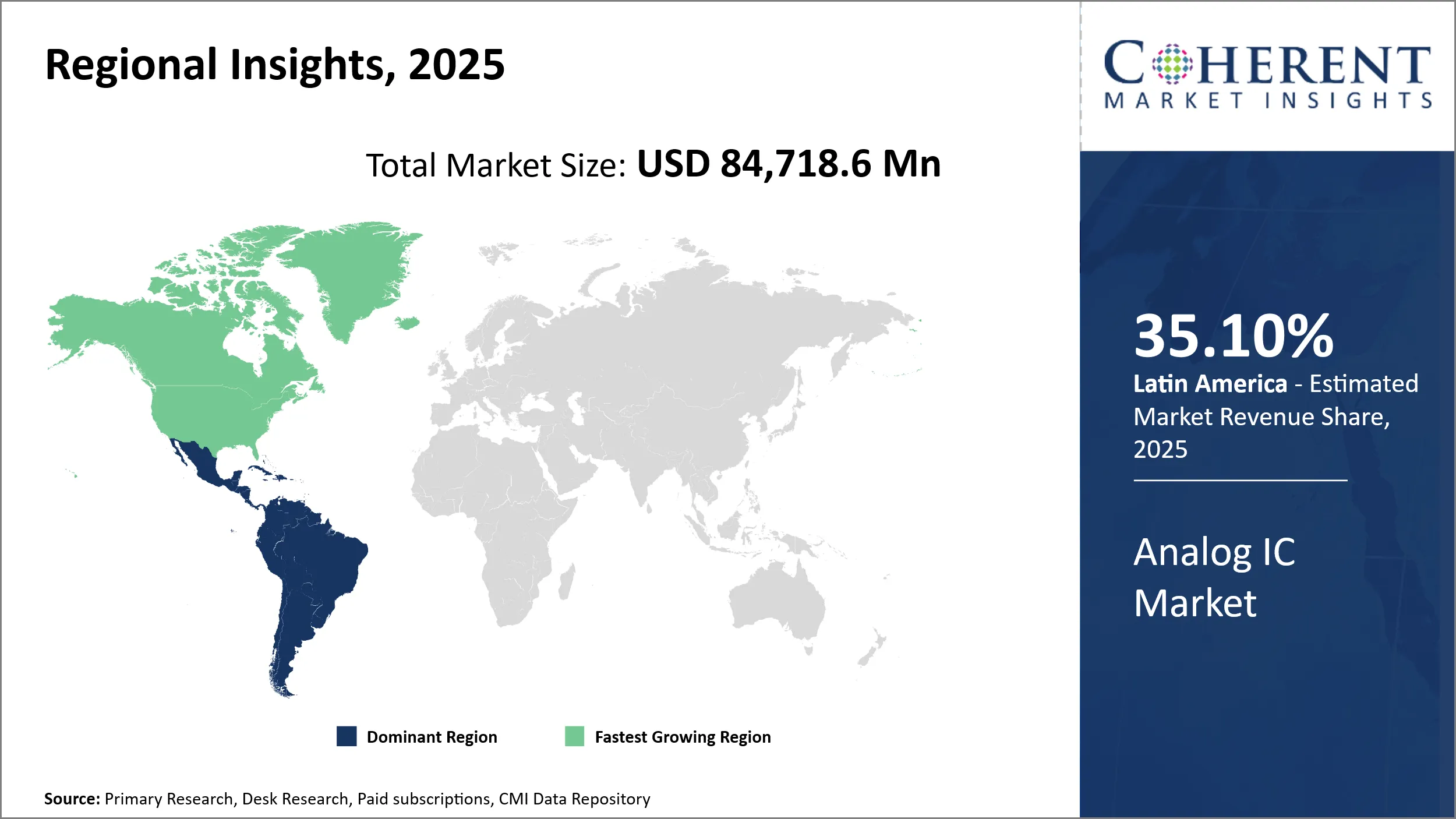
Latin America Analog IC Market Trends and Analysis
Latin America is projected to hold dominating position in the global market with 35.1% shares during the forecast period. Growth is attributed to increasing investments in infrastructure development, favorable government policies, rapid urbanization, and rising demand across key industries such as energy, construction, and agriculture.
North America Analog IC Market Trends and Analysis
North America is expected to maintain its leadership in the global analog IC market, commanding an estimated 29.0% share by 2026. This dominance is driven by the region’s strong presence of leading semiconductor companies, high demand for consumer electronics, advancements in automotive technologies, and increasing adoption of industrial automation solutions.
Analog IC Market - Dominating Countries
The U.S. Analog IC Market Trends
The U.S. analog IC market is experiencing steady growth with 20.1% shares, driven by the increasing demand for advanced consumer electronics, automotive innovations, and industrial automation. As a global hub for leading semiconductor manufacturers and R&D centers, the U.S. remains at the forefront of technological advancements in analog integrated circuits. Key trends include the integration of analog ICs in electric vehicles (EVs), 5G infrastructure, IoT devices, and medical equipment, reflecting the country's push toward digitalization and energy efficiency.
For instance, in September 2026, Agile Analog announced a significant agreement with a major US tier 1 repeat customer, to deliver its agileSecure suite of anti-tamper IP on a 4nm process node, including its new electromagnetic sensor.
China Analog IC Market Trends
The China analog IC market is witnessing rapid growth, fueled by the country's expanding electronics manufacturing base, rising demand for smartphones, and increased focus on automotive and industrial applications. As China accelerates its efforts toward self-sufficiency in semiconductor production, domestic companies are investing heavily in R&D and fabrication capabilities.
For instance, in September 2026, China's Ministry of Commerce announced that it has initiated an anti-dumping investigation into imports of certain analog IC chips originating from the United States.
Market Report Scope
Analog IC Market Report Coverage
| Report Coverage | Details | ||
|---|---|---|---|
| Base Year: | 2025 | Market Size in 2026: | USD 90,818.3 Mn |
| Historical Data for: | 2020 To 2024 | Forecast Period: | 2026 To 2033 |
| Forecast Period 2026 to 2033 CAGR: | 7.2% | 2033 Value Projection: | USD 1,47,753.3 Mn |
| Geographies covered: |
| ||
| Segments covered: |
| ||
| Companies covered: | Texas Instruments Incorporated, Renesas Corporation, Infineon Technologies AG, Qualcomm Technologies, Inc., NXP Semiconductors, Semiconductor Component Industries, LLC, STMicroelectronics, Skyworks Solutions, Inc., Analog Devices, Inc., and Maxim Integrated | ||
| Growth Drivers: |
| ||
| Restraints & Challenges: |
| ||
Analyst Viewpoint – Analog IC Market
- The global analog IC market is experiencing strong growth, fueled by expanding demand across consumer electronics, automotive, and industrial applications. Analysts emphasize the pivotal role of analog ICs in ensuring power efficiency, signal integrity, and real-time responsiveness in modern devices.
- The consumer electronics segment remains the largest application area, supported by the proliferation of smartphones, wearables, and smart home systems. Analysts also note that the increasing integration of analog and digital components on single chips is driving innovation and system-level efficiency.
- Emerging technologies are playing a crucial role in transforming the analog IC landscape. Industry analysts highlight the adoption of advanced semiconductor materials such as GaN and SiC, as well as AI-enabled design automation, as key developments enabling higher performance and miniaturization.
- Latin America is the dominant region in the analog IC market, owing to its robust electronics manufacturing ecosystem and increasing domestic demand.
Analog IC Market: Key Development
- In March 2025, Celera announced it is sampling the first ever analog IC completely designed by an autonomous software platform.
- In November 2024, Renesas Electronics Corporation announced new AnalogPAK™ ICs, including lower power and automotive-qualified devices along with the industry’s first programmable 14-bit SAR ADC (Successive-Approximation Register Analog-Digital Converter).
Market Segmentation
- Global Analog IC Market, By Product Type (Revenue, USD Mn, 2021 - 2033)
- Application Specific IC
- General Purpose IC
- Global Analog IC Market, By Application (Revenue, USD Mn, 2021 - 2033)
- Communication
- Consumer Electronics
- Automotive
- Industrial
- Medical and Healthcare
- Others
- Global Analog IC Market, By Region (Revenue, USD Mn, 2021 - 2033)
- North America
- U.S.
- Canada
- Latin America
- Brazil
- Argentina
- Mexico
- Rest of Latin America
- Europe
- Germany
- U.K.
- Spain
- France
- Italy
- Russia
- Rest of Europe
- Asia Pacific
- China
- India
- Japan
- Australia
- South Korea
- ASEAN
- Rest of Asia Pacific
- Middle East
- GCC Countries
- Israel
- Rest of Middle East
- Africa
- South Africa
- North Africa
- Central Africa
- Company Profiles
- Texas Instruments Incorporated
- Renesas Corporation
- Infineon Technologies AG
- Qualcomm Technologies
- NXP Semiconductors
- ON Semiconductor
- ST Microelectronics
- Skyworks Solutions
- Analog Devices
- Maxim Integrated Products
Sources
The Stakeholders Consulted
- Semiconductor manufacturing plant managers and process engineers
- Analog IC designers and integrated circuit developers
- Electronics component manufacturers and suppliers
- Industry experts in consumer electronics, automotive, and industrial automation
- Technical consultants specializing in power management and signal processing
- Regulatory authorities overseeing semiconductor standards and environmental compliance
- Research institutions and universities focused on semiconductor technology and analog circuit innovation
- End-users in sectors such as consumer electronics, automotive, telecommunications, healthcare, and industrial machinery
Databases Accessed
- Semiconductor Industry Association (SIA)
- International Data Corporation (IDC)
- World Semiconductor Trade Statistics (WSTS)
- U.S. International Trade Commission (USITC)
Magazines & Trade Publications
- Semiconductor Engineering
- EE Times
- Electronic Design
- Power Electronics News
- Compound Semiconductor Magazine
- Electronics Weekly
Scientific and Industry Journals
- IEEE Transactions on Circuits and Systems
- Journal of Semiconductor Technology and Science
- Analog Integrated Circuits and Signal Processing
- Microelectronics Journal
- Solid-State Electronics
Newspapers & Media Outlets
- The Wall Street Journal – Technology & Semiconductor Industry
- Bloomberg Technology – Semiconductor and Electronics Markets
- Reuters – Global Technology and Manufacturing News
- The Economic Times – Electronics and Semiconductor Sector
- Financial Times – Technology and Innovation Coverage
Associations and Regulatory Bodies
- Semiconductor Industry Association (SIA)
- International Electrotechnical Commission (IEC)
- Institute of Electrical and Electronics Engineers (IEEE)
- Federal Communications Commission (FCC)
- Ministry of Electronics and Information Technology (MeitY), India
Public Domain Sources
- U.S. Energy Information Administration (EIA) – Electronics Industry Energy Use
- European Commission – Electronics and Semiconductor Industry Reports
- World Bank – Technology Sector Development Reports
- International Telecommunication Union (ITU) – Standards and Market Data
Proprietary Research Elements
- In-house data analytics and market modeling tools
- Proprietary repository of semiconductor market trends and analog IC data (spanning past 10 years)
- Expert interviews and transcripts with industry leaders, engineers, and market analysts focusing on analog IC innovation, application, and supply chain dynamics
Get access to 250+ pages report
Every segment, forecast, competitor profile and data table behind the analysis above — available for instant download.
- ESOMAR Member
- ISO 9001:2015 Certified
- D-U-N-S Registered
- GDPR & CCPA Compliant
Missing comfort of reading report in your local language? Find your preferred language:
Transform your Strategy with Exclusive Trending Reports
Frequently Asked Questions
The Analog Ic Market size is estimated to be valued at USD 90,818.3 Mn in 2026, and is expected to reach USD 1,47,753.3 Mn by 2033.
Global market is estimated to reach USD 1,47,753.3 Mn by 2033
Some of the key players in the market are Key players operating in the global analog IC market are Texas Instruments Incorporated, Renesas Corporation, Infineon Technologies AG, Qualcomm Technologies, Inc., NXP Semiconductors, Semiconductor Components Industries, LLC., STMicroelectronics, Skyworks Solutions, Inc., Analog Devices Inc., Maxim Integrated.
Among product, the application specific IC segment held the largest market share among the in 2026.
The CAGR of the Analog Ic industry is projected to be 7.2% from 2026 to 2033.