

Flexible Battery Market Analysis & Forecast: 2026-2033
Flexible Battery Market is estimated to be valued at USD 287.3 Mn in 2026 and is expected to reach USD 1084.6 Mn in 2033, exhibiting a compound annual growth rate (CAGR) of 20.9% from 2026 to 2033.
Key Takeaways
- By Type, the thin film batteries segment is projected to lead the global flexible battery market with a commanding 56.4% share in 2026. Their dominance is attributed to their ultra-thin profile, lightweight design, and adaptability to curved or irregular surfaces.
- Asia Pacific is anticipated to lead the global flexible battery market, accounting for 31.7% of the total share in 2026. This regional leadership is fuelled by rapid technological advancements, expanding consumer electronics manufacturing, and strong investments.
Market Overview
The global Flexible Battery Market is witnessing robust growth, fuelled by rising demand for compact, lightweight, and bendable power sources across consumer electronics, medical devices, and wearable technologies. Thin film batteries dominate due to their high flexibility, safety, and suitability for next-generation devices. Asia Pacific leads the market, supported by strong manufacturing capabilities and rapid tech adoption. Manufacturers are increasingly investing in R&D to develop safer, longer-lasting batteries, aligning with evolving performance standards and the growing shift toward flexible energy solutions.
Current Events and its Impact on the Flexible Battery Market
Current Event | Description and its impact |
Technology Commercialization and Product Launches |
|
Strategic Investments and Collaborations |
|
Material Innovation and Academic-Industry Collaborations |
|
Pricing Analysis: Flexible Battery Market
The pricing dynamics in the flexible battery market are primarily influenced by battery type, production scale, material costs, and application-specific performance requirements. Thin film batteries, which dominate the market, generally range from $3 to $10 per unit depending on size, capacity, and customization, while printed and solid-state flexible batteries tend to be higher priced due to complex manufacturing processes and limited production volume.
Currently, high R&D investments and low economies of scale keep flexible battery prices relatively elevated compared to traditional batteries. However, as large manufacturers scale up production and adopt advanced printing and lamination techniques, unit costs are expected to decline steadily. Additionally, growing demand from consumer electronics, healthcare, and IoT sectors is encouraging bulk orders, which help improve cost-efficiency.
Government support for clean energy technologies and ongoing innovations in materials like printable zinc and polymer-based cells are projected to further moderate prices over the forecast period.
- Current Industry Events of 2026
- Market Size Estimation
- Regional Breakdown
- Competitive Landscape
- Customer Intelligence
- Segmental Analysis
- Pricing Analysis
- Key Market Drivers, Challenges & Future Trends
- Customized Insights Section
Emergence of New Technology: Flexible Battery Market
The flexible battery market is experiencing rapid technological advancements, primarily driven by the need for ultra-thin, lightweight, and bendable energy storage solutions for modern devices. One of the most significant breakthroughs is the development of solid-state flexible batteries, which eliminate flammable liquid electrolytes, enhancing safety and energy density. Researchers are also pioneering hydrogel-based and graphene-infused battery materials, which improve flexibility, stretch ability, and thermal stability ideal for wearables and implantable medical devices.
Another major innovation is printable battery technology, allowing batteries to be screen-printed onto paper, plastic, or fabric, opening new avenues for integration into smart textiles, RFID tags, and e-skin sensors. Micro battery architectures are being refined to support energy harvesting systems for low-power IoT applications. Furthermore, companies are increasingly leveraging AI-driven design tools to optimize performance, lifecycle, and material usage. These advances are positioning flexible batteries as critical enablers of next-generation electronics across diverse industries.
Flexible Battery Market Trends
- Rise in demand for implantable medical devices and medical patches
Flexible batteries are featuring twisting, bending, compressing, and stretching without any effect on the output of the system. These characteristics of flexible batteries enable their widespread use in medical devices. Cosmetics patches powered by flexible batteries are employed to track and monitor as well as track the user’s heart, brain, and muscle activities. These patches diagnose and track people’s syndromes by providing and controlling the drug flow of the body.
Flexible batteries powered medical implantable devices mostly used in pacemakers, neurostimulators, and defibrillators own to their long-life span as well as the biocompatible nature of flexible batteries. The rise in demand for implantable medical devices and medical patches in medical applications will drive the demand for flexible batteries.
In May 2025, The Times of India reported that a researcher from Nagaland University, Dipankar Hazarika, received support from the Norwegian Embassy in New Delhi for his work on flexible and sustainable electronic battery solutions. His innovation aims to advance flexible power systems for wearable devices and aligns with India’s clean energy storage goals.
Opportunities in the Flexible Battery Market
- Adoption of flexible batteries in electronic devices
As the electronics industry has expanded, new technological developments have resulted in a variety of electronic device shapes and battery requirements. This has prompted the adoption of flexible batteries in electronic devices. Flexible batteries are being used more and more in the electronic sector due to their benefits including lightweight, comfort, portability, and resistance to form change even after repeated twisting or bending are the factors driving the deployment of flexible batteries.
Segmental Insights
Global Flexible Battery Market Insights, By Type
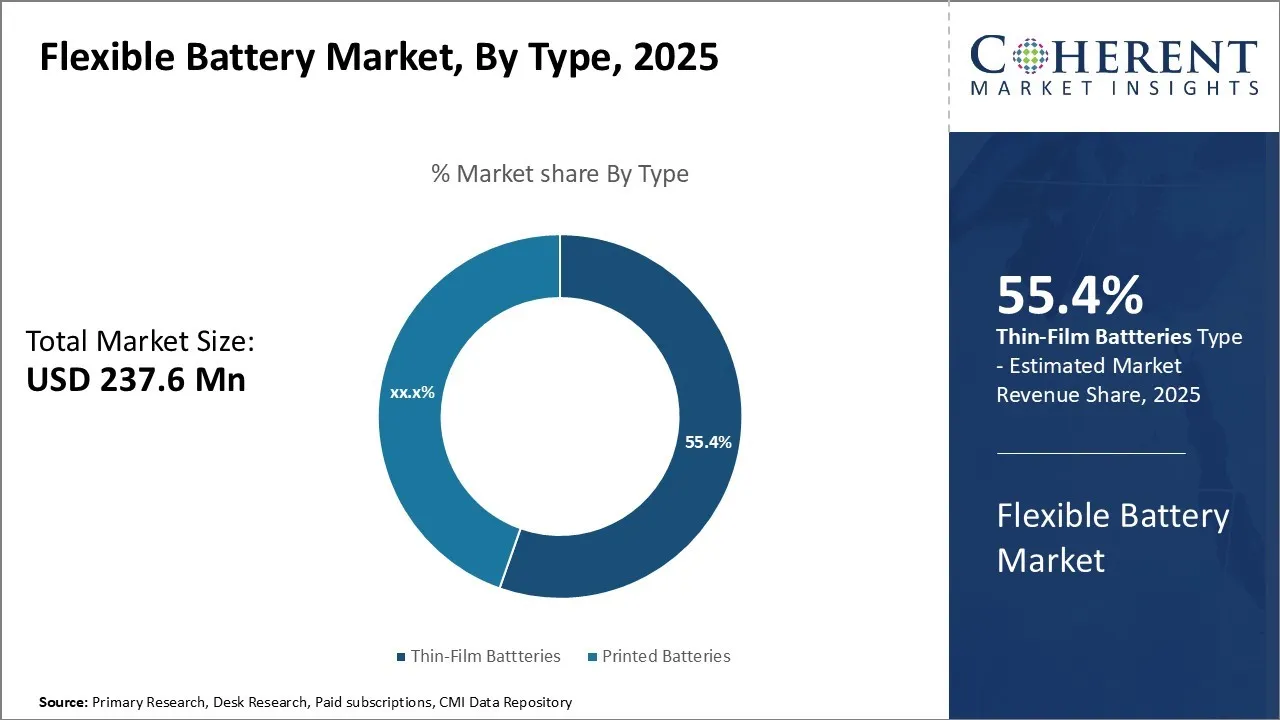
Thin film batteries are projected to lead the global flexible battery market with a commanding 56.4% share in 2026. Their dominance is attributed to their ultra-thin profile, lightweight construction, and ability to conform to curved or irregular surfaces making them ideally suited for compact, next-generation applications.
These batteries offer key advantages such as low internal resistance, improved safety, and seamless integration into space-constrained electronics. They are increasingly used in medical devices, smart cards, wearable electronics, and IoT sensors, where reliability and flexibility are critical.
As innovation in portable and bendable technologies continues to accelerate, the demand for thin film batteries is expected to rise significantly. Their proven performance, energy efficiency, and compatibility with modern design requirements position them as the battery of choice across multiple high-growth industries.
Manufacturers are actively investing in R&D and production capacity to meet this surging demand and maintain their competitive edge in the evolving energy storage landscape.
Regional Insights
Asia Pacific Flexible Battery Market Trends and Analysis
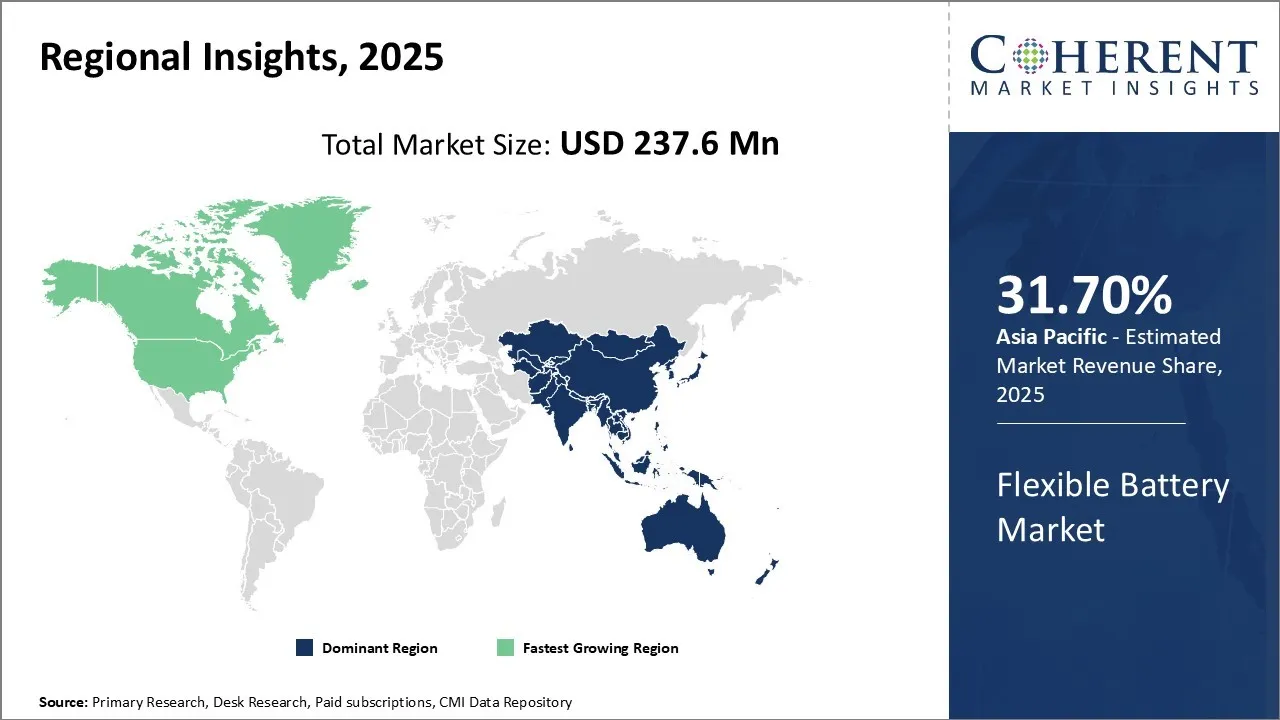
Asia Pacific is anticipated to lead the global flexible battery market, accounting for 31.70% of the total share in 2026. This regional leadership is fuelled by rapid technological advancements, expanding consumer electronics manufacturing, and robust R&D investments from countries such as China, South Korea, and Japan.
The region hosts several leading battery manufacturers and electronics giants who are at the forefront of integrating flexible batteries into cutting-edge devices like foldable smartphones, smart wearable’s, and medical patches.
Growing demand for lightweight, bendable power solutions in medical, industrial, and IoT applications is driving increased adoption of flexible batteries across the region. Government initiatives supporting clean energy storage, local production incentives, and favourable policies toward sustainable technology are further accelerating market growth.
Additionally, strong supply chain infrastructure, skilled labour availability, and a competitive manufacturing ecosystem are reinforcing Asia Pacific’s position as the primary growth engine for the global flexible battery market.
Flexible Battery Market Dominating Countries
China and South Korea
China is a leading force in the global flexible battery market, supported by its massive electronics manufacturing ecosystem, abundant raw material supply, and strong government backing for energy innovation.
Chinese companies are investing heavily in R&D and large-scale production of flexible lithium-ion and thin film batteries, particularly for wearable devices, foldable smartphones, and medical electronics. With robust export channels and a thriving domestic tech market, China continues to set the pace in both innovation and volume-driven market expansion.
South Korea complements China's leadership with its advanced technological infrastructure and strong presence of global battery giants like LG Energy Solution and Samsung SDI. The country is at the forefront of developing next-generation battery chemistries and form factors, including flexible and solid-state designs.
South Korea’s commitment to clean energy solutions, smart medical devices, and flexible displays makes it a key player in driving innovation, commercialization, and global competitiveness in the flexible battery segment.
Market Report Scope
Flexible Battery Market Report Coverage
| Report Coverage | Details | ||
|---|---|---|---|
| Base Year: | 2025 | Market Size in 2026: | USD 287.3 Mn |
| Historical Data for: | 2020 To 2024 | Forecast Period: | 2026 To 2033 |
| Forecast Period 2026 to 2033 CAGR: | 20.9% | 2033 Value Projection: | USD 1084.6 Mn |
| Geographies covered: |
| ||
| Segments covered: |
| ||
| Companies covered: | STMicroelectronics, LG Chem, SAMSUNG SDI CO., LTD., Panasonic Corporation, ROCKET Poland Sp. z o.o., Enfucell, Imprint Energy, Energy Diagnostics., Jenax Inc., and Molex | ||
| Growth Drivers: |
| ||
| Restraints & Challenges: |
| ||
Analyst Viewpoint – Flexible Battery Market
- Anglobal flexible battery market, driven by the surge in demand for compact, lightweight, and bendable power solutions across wearable electronics, medical devices, and IoT applications. The market is poised for significant growth as product miniaturization trends and next-gen electronics continue to gain traction.
- Experts highlight thin film batteries as the dominant technology due to their ultra-slim profile, safety, and adaptability to curved surfaces. Emerging innovations such as solid-state flexible batteries, hydrogel-based chemistries, and printable battery formats are expanding application possibilities while addressing safety and lifecycle concerns.
- Asia Pacific continues to lead the market, supported by advanced manufacturing capabilities in China, South Korea, and Japan, along with strong government incentives for clean energy and electronics R&D. Meanwhile, North America and Europe are investing heavily in medical-grade and industrial flexible battery solutions.
- Looking ahead, analysts believe continuous innovation, strategic collaborations, and cost reductions through scalable production will be key to unlocking long-term, cross-industry market growth.
Flexible Battery Market: Key Development
- In April 2024, TotalEnergies announced the launch of its flexible battery project in Belgium. This new project will help in mange grid congestion problems.
- In November 2020, NIO announced the launch of its 100 kWh Battery with Flexible Battery Upgrades plans.
Market Segmentation
- Global Flexible Battery Market, By Type (Revenue, USD Mn, 2021 - 2033)
- Thin-film Batteries
- Printed Batteries
- Global Flexible Battery Market, By Voltage (Revenue, USD Mn, 2021 - 2033)
- Below 1.5V
- Between 1.5V and 3V
- Above 3V
- Global Flexible Battery Market, By Capacity (Revenue, USD Mn, 2021 - 2033)
- Below 10 mAh
- Between 10 mAh and 100 mAh
- Above 100 mAh
- Global Flexible Battery Market, By Chargeability (Revenue, USD Mn, 2021 - 2033)
- Primary Batteries
- Secondary Batteries
- Global Flexible Battery Market, By Application (Revenue, USD Mn, 2021 - 2033)
- Consumer Electronics
- Smart Packaging
- Smart Cards
- Medical Devices
- IoT Devices
- Others
- Global Flexible Battery Market, By Region (Revenue, USD Mn, 2021 - 2033)
- North America
- U.S.
- Canada
- Latin America
- Brazil
- Argentina
- Mexico
- Rest of Latin America
- Europe
- Germany
- U.K.
- Spain
- France
- Italy
- Russia
- Rest of Europe
- Asia Pacific
- China
- India
- Japan
- Australia
- South Korea
- ASEAN
- Rest of Asia Pacific
- Middle East
- GCC Countries
- Israel
- Rest of Middle East
- Africa
- South Africa
- North Africa
- Central Africa
- North America
- Company Profiles
- STMicroelectronics
- LG Chem
- SAMSUNG SDI CO,LTD.
- Panasonic Corporation
- ROCKET Poland Sp. z o.o.
- Enfucell
- Imprint Energy
- Energy Diagnostics.
- Jenax Inc.
- Molex
Sources
The Stakeholders Consulted
- Manufacturers and suppliers of flexible and printed batteries
- R&D engineers in energy storage and electronics manufacturing
- Procurement managers in wearable tech, medical device, and consumer electronics firms
- Regulatory experts on battery materials and recycling compliance
- Industry consultants and analysts specializing in thin-film and solid-state battery innovation
- Government representatives from energy storage and electronics policy bodies
- End-users across industries such as healthcare, consumer electronics, automotive, and IoT solutions
Databases Opened
- U.S. Department of Energy (DOE) – Energy Storage Systems Database
- International Energy Agency (IEA) – Battery Technology and Storage Trends
- Ministry of Electronics and Information Technology (India) – Electronics and Battery Initiatives
- World Bank Open Data – Energy Access and Technology Innovation Metrics
Magazines & Trade Publications
- Battery Technology Magazine
- Printed Electronics Now
- Energy Storage News
- Electronics Weekly – Power Management Section
- TechCrunch – Hardware & Battery Innovation Reports
Scientific and Industry Journals
- Journal of Power Sources
- Nano Energy
- Advanced Energy Materials
- Flexible and Printed Electronics
- Energy & Environmental Science
Newspapers & Media Outlets
- Bloomberg – Clean Tech & Energy Storage
- Reuters – Global Electronics and Battery Supply Chain Updates
- The Wall Street Journal – Tech & Energy Markets
- The Economic Times – Electronics Manufacturing and Start-up Trends
- Business Standard – R&D and Energy Storage Developments
Associations and Regulatory Bodies
- International Energy Agency (IEA)
- U.S. Environmental Protection Agency (EPA) – Battery Recycling & Toxic Substance Guidelines
- International Electrotechnical Commission (IEC) – Battery Safety and Testing Standards
- Bureau of Indian Standards (BIS) – Battery Certification
- National Renewable Energy Laboratory (NREL) – Storage Systems Research
Public Domain Sources
- U.S. Energy Information Administration (EIA) – Battery Market Reports
- European Commission – Battery Directive and Technology Roadmaps
- World Bank – Sustainable Energy and Innovation Reports
- International Renewable Energy Agency (IRENA) – Innovation Outlook for Energy Storage
Proprietary Research Elements
- CMI Data Analytics Tool
- Proprietary CMI Repository of Market Data (covering past 8 years)
- CMI Expert Interviews and Transcripts (focused on energy storage, battery design, and flexible battery use cases in wearables, electronics, and IoT)
Get access to 250+ pages report
Every segment, forecast, competitor profile and data table behind the analysis above — available for instant download.
- ESOMAR Member
- ISO 9001:2015 Certified
- D-U-N-S Registered
- GDPR & CCPA Compliant
Missing comfort of reading report in your local language? Find your preferred language:
Transform your Strategy with Exclusive Trending Reports
Frequently Asked Questions
The Flexible Battery Market size is estimated to be valued at USD 287.3 Mn in 2026, and is expected to reach USD 1084.6 Mn by 2033.
The CAGR of the global Market is projected to be 20.9% from 2026 to 2033.
Rapid adoption of healthcare wearable devices and IoT devices fuelling the growth of the market.
Consumer electronics segment is the leading application segment in the market.
High cost associated with the flexible batteries is the major factors restraining the growth of the market.
STMicroelectronics, LG Chem, SAMSUNG SDI CO., LTD., Panasonic Corporation, ROCKET Poland Sp. z o.o., Enfucell, Imprint Energy, Energy Diagnostics., Jenax Inc., and Molex.
A flexible battery in today's market refers to an energy storage device—either primary or rechargeable—constructed from bendable, conformal materials (like thin-film polymers, printed conductive inks, or carbon based substrates) that maintain full functionality when twisted, folded, or ben.